FUNCTION OF
ORGANIZING
 It is the process of:
 determining
 grouping
 arranging of various activities
necessary for the achievement of
objectives
 It is the process of:
 defining and
 grouping the activities of the enterprise
and
 establishing authority relationship among
them.
 Helps management to be effective.
 Helps the organization (company) to grow
and expand.
 Helps in maximum use of resources.
 Helps in development in the lower level of
management.
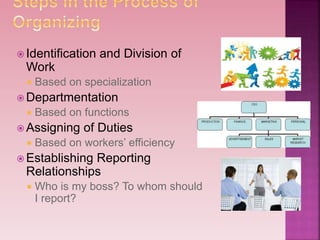
 Identification and Division of
Work
 Based on specialization
 Departmentation
 Based on functions
 Assigning of Duties
 Based on workers’ efficiency
 Establishing Reporting
Relationships
 Who is my boss? To whom should
I report?
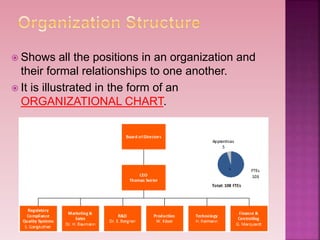
 Shows all the positions in an organization and
their formal relationships to one another.
 It is illustrated in the form of an
ORGANIZATIONAL CHART.
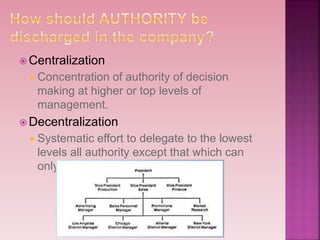
 Centralization
 Concentration of authority of decision
making at higher or top levels of
management.
 Decentralization
 Systematic effort to delegate to the lowest
levels all authority except that which can
only be exercised at central points.
 Also called as “Span of Control”.
 It is the span of supervision which depicts
(shows) the number of employees that can be
handled and controlled effectively by a single
manager.
 Types of Span of Control:
 Wide Span of Control – a manager can supervise
and control effectively a large group of persons at
one time.
 Narrow Span of Control – the work and authority is
divided amongst many subordinates and a
manager does not supervise and control a very
big group of people under him.
 Authority
 Right to perform or command.
 Responsibility
 Obligation to perform assigned
activities
 Related to ACCOUNTABILITY.
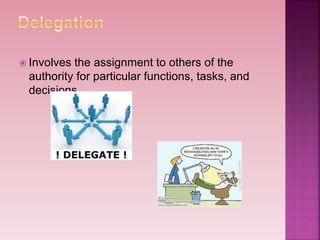
 Involves the assignment to others of the
authority for particular functions, tasks, and
decisions.
 Employees at all levels in the organization are
given the power to do their job.
 Closely linked to MOTIVATION and CUSTOMER
SERVICE
 Giving authority to make decisions to front-line
staff.
 Encouraging employee feedback.
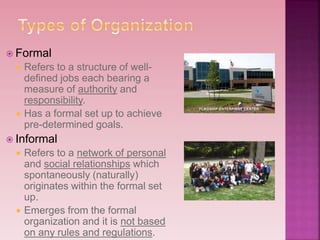
 Formal
 Refers to a structure of well-
defined jobs each bearing a
measure of authority and
responsibility.
 Has a formal set up to achieve
pre-determined goals.
 Informal
 Refers to a network of personal
and social relationships which
spontaneously (naturally)
originates within the formal set
up.
 Emerges from the formal
organization and it is not based
on any rules and regulations.

Unit 3.pom

  • 1.
  • 2.
     It isthe process of:  determining  grouping  arranging of various activities necessary for the achievement of objectives
  • 3.
     It isthe process of:  defining and  grouping the activities of the enterprise and  establishing authority relationship among them.
  • 4.
     Helps managementto be effective.  Helps the organization (company) to grow and expand.  Helps in maximum use of resources.  Helps in development in the lower level of management.
  • 5.
     Identification andDivision of Work  Based on specialization  Departmentation  Based on functions  Assigning of Duties  Based on workers’ efficiency  Establishing Reporting Relationships  Who is my boss? To whom should I report?
  • 6.
     Shows allthe positions in an organization and their formal relationships to one another.  It is illustrated in the form of an ORGANIZATIONAL CHART.
  • 7.
     Centralization  Concentrationof authority of decision making at higher or top levels of management.  Decentralization  Systematic effort to delegate to the lowest levels all authority except that which can only be exercised at central points.
  • 8.
     Also calledas “Span of Control”.  It is the span of supervision which depicts (shows) the number of employees that can be handled and controlled effectively by a single manager.  Types of Span of Control:  Wide Span of Control – a manager can supervise and control effectively a large group of persons at one time.  Narrow Span of Control – the work and authority is divided amongst many subordinates and a manager does not supervise and control a very big group of people under him.
  • 9.
     Authority  Rightto perform or command.  Responsibility  Obligation to perform assigned activities  Related to ACCOUNTABILITY.
  • 10.
     Involves theassignment to others of the authority for particular functions, tasks, and decisions.
  • 11.
     Employees atall levels in the organization are given the power to do their job.  Closely linked to MOTIVATION and CUSTOMER SERVICE  Giving authority to make decisions to front-line staff.  Encouraging employee feedback.
  • 12.
     Formal  Refersto a structure of well- defined jobs each bearing a measure of authority and responsibility.  Has a formal set up to achieve pre-determined goals.  Informal  Refers to a network of personal and social relationships which spontaneously (naturally) originates within the formal set up.  Emerges from the formal organization and it is not based on any rules and regulations.