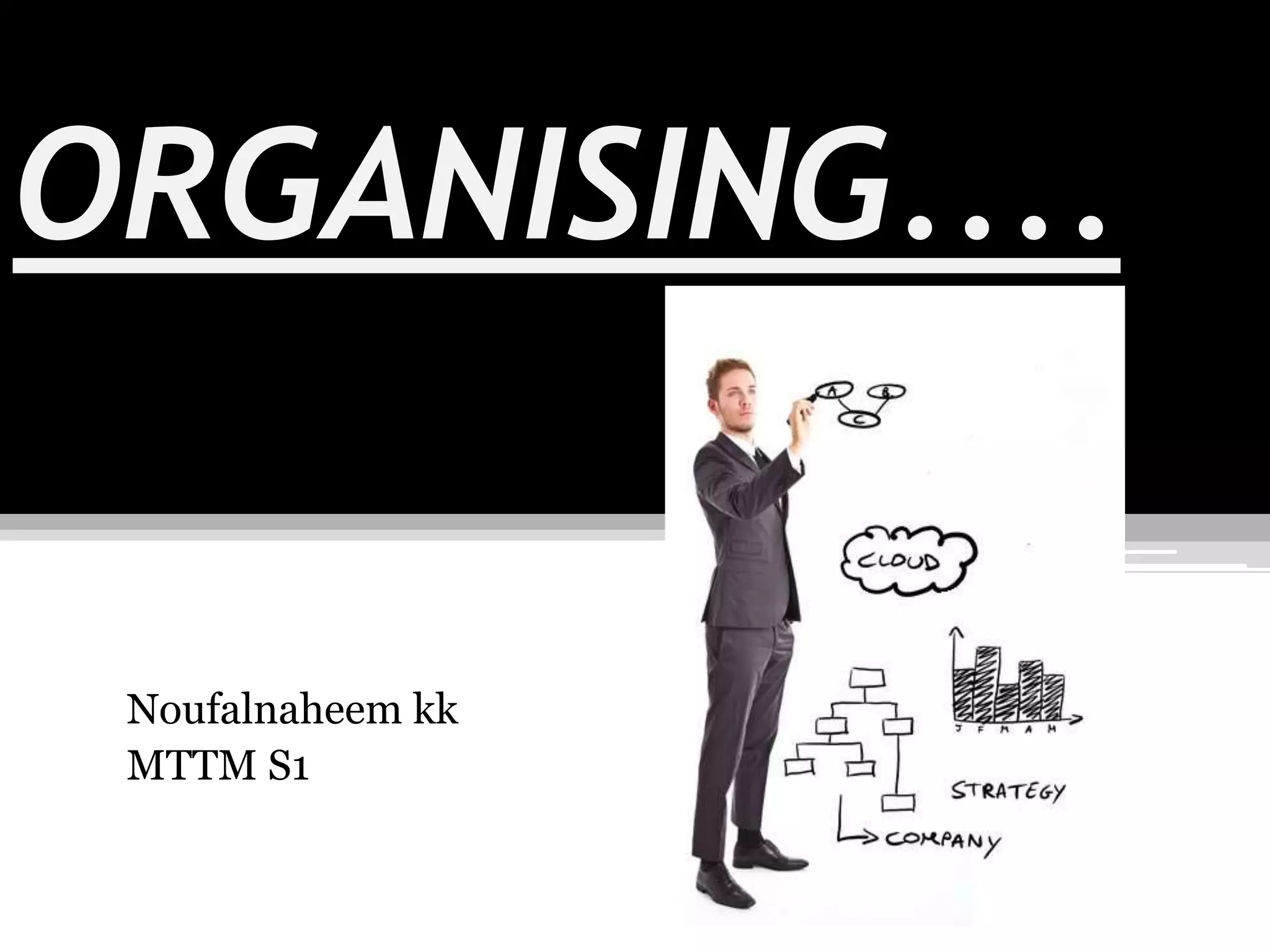
ORGANISING....
Noufalnaheem kk
MTTM S1
Organising.............
The term ‘organising’ derived from the word
‘organism’
It related to human body........
Organising.............
• Is a structure of duties and responsibilities .....
• Definition......
‘organisation is the process of identifying and
grouping work to be performed ,defining and
delegating responsibility and authority and
establishing relationships for the purpose of
enabling people to work most effectively
together in accomplishing objectives’.
Louis Allen.
• Characteristics........
Division of work.
co-ordination .
common objectives.
well defined authority and responsibility.
Organising.............
• Nature ..............
Is a art or science?
As art concerned wit the application of knowledge
and skill, organising is an art as one has to use
his skill and knowledge to achieve objectives,
Science has three basic features .....
systematic body of knowledge
principles
cause and effect relation.
Organising.............
• Organising viewed as science it built by
management thinkers, philosophers over a
period of years.
• It has certain principles and rules developed
after continued observation.
• Cause and effect relation .
Organising.............
• Steps in organising ……
• 1-Division of work.
• All business activities are divided and subdivided
in various categories.
• 2-Classification of activities.
• All similar activities are grouped together.
• 3-Appointing suitable persons.
•
• 4-Delegation of authority.
Organising.............
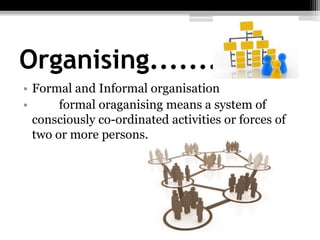
• Formal and Informal organisation
• formal oraganising means a system of
consciously co-ordinated activities or forces of
two or more persons.
Organising.............
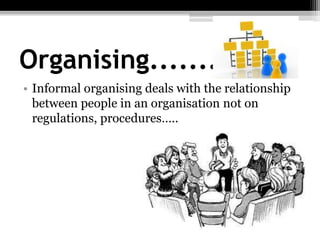
• Informal organising deals with the relationship
between people in an organisation not on
regulations, procedures…..
Organising.............
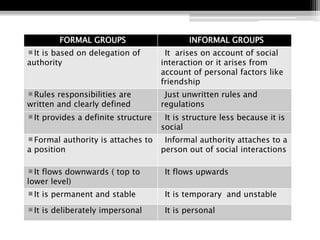
• Difference between formal and informal
organising…….
FORMAL GROUPS INFORMAL GROUPS
It is based on delegation of
authority
It arises on account of social
interaction or it arises from
account of personal factors like
friendship
Rules responsibilities are
written and clearly defined
Just unwritten rules and
regulations
It provides a definite structure It is structure less because it is
social
Formal authority is attaches to
a position
Informal authority attaches to a
person out of social interactions
It flows downwards ( top to
lower level)
It flows upwards
It is permanent and stable It is temporary and unstable
It is deliberately impersonal It is personal
Organising.............
•Organising structure........
• is the established pattern of
relationship among component or
parts of organisation.
•It provides a framework of
employees in an organisation.
Organising.............
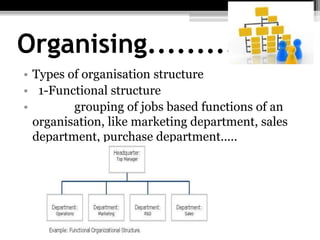
• Types of organisation structure
• 1-Functional structure
• grouping of jobs based functions of an
organisation, like marketing department, sales
department, purchase department.....
Organising.............
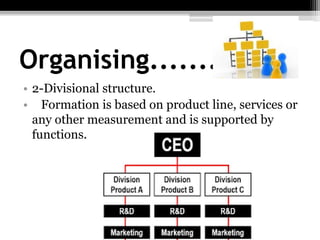
• 2-Divisional structure.
• Formation is based on product line, services or
any other measurement and is supported by
functions.
Organising.............
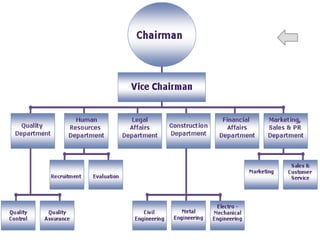
• Organising chart….
• is a diagrammatical presentation of relationship
in an organisation .
• Definition
• A diagrammatical form which shows important
aspects of an organisation,including major functions
and their respective relationship the channel of
supervision and the relative authority of each
employer who in charge of each respective function.
• Divided in to two
• 1-master chart
• 2-supplementary chart
Organising.............
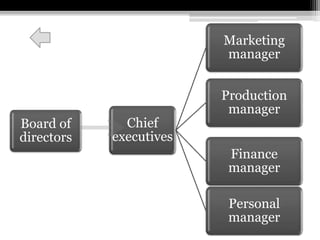
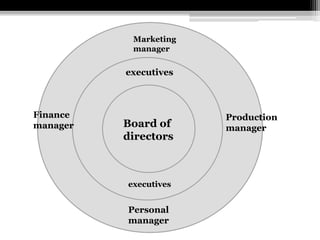
• Types of organising chart
• 1- Vertical
• 2-Horizontal
• 3-Circular
Board of
directors
Chief
executives
Marketing
manager
Production
manager
Finance
manager
Personal
manager
Board of
directors
executives
executives
Marketing
manager
Finance
manager
Production
manager
Personal
manager
Organising.............
• Types of organising……….
• 1-line organisation
• known as chain of command ,the authority
flows from top to bottom every body responsible for
is superior.
• Merits of line organisation
• 1-simplicity
• 2-identification of authority and responsibility
• 3-co-ordination
• 4-easy communication
Organising.............
• line organisation-Merits
• 5-quick decisions
• 6-unity of command
• De-merits
• 1-Excess of work
• 2-lack of specialisation
• 3-improper communication
• 4-favouritism.
•
Organising.............
• 2-Functional or staff organisation.
• here the task of management divided
according to work involved.
• Merits of functional organising
• 1-specialisation
• 2-supervision
• 3-flexiility
• 4-relie to top executives
• 5-scope of growth
Organising.............
• De-merits
• 1-conflict in authority
• 2-lack of co-ordination
• 3-difficult in fix responsibility
• 4-delay taking decisions
• 5-poor discipline
• 6-expensive
Organising.............
• 3-line and staff organisation
• A line manager is vested with execute authority
,responsible for taking decisions and implementation.
• The staff officers attached with managers to advise
them in their for specialisation.
• Merits
• 1-specialisation
• 2-better dicipline
• 3-balanced decisions
• 4-development of employee
• 5-less burden
Organising.............
• De-merits
• 1-conflict between line and staff personnels
• 2- lack of responsibility.
• 3-lack of co-ordination
• 4-expensive
Organising.............
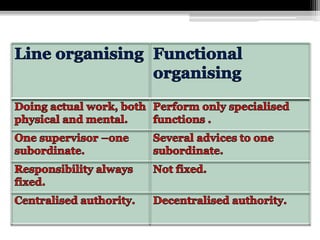
• Different between line and staff organsiation.
Organising

Organising