MANAGEMENT PRINCIPLES AND
ORGANIZATIONAL BEHAVIOUR
UNIT – II
ORGANIZING AND STAFFING
MBA – I | VCEW
SYLLABUS
UNIT – II - ORGANIZING AND STAFFING
Nature and purpose of organizing - Organization structure - Line and staff
authority- Departmentation- Span of control - Centralization and
decentralization - Delegation of authority – Staffing - Selection and
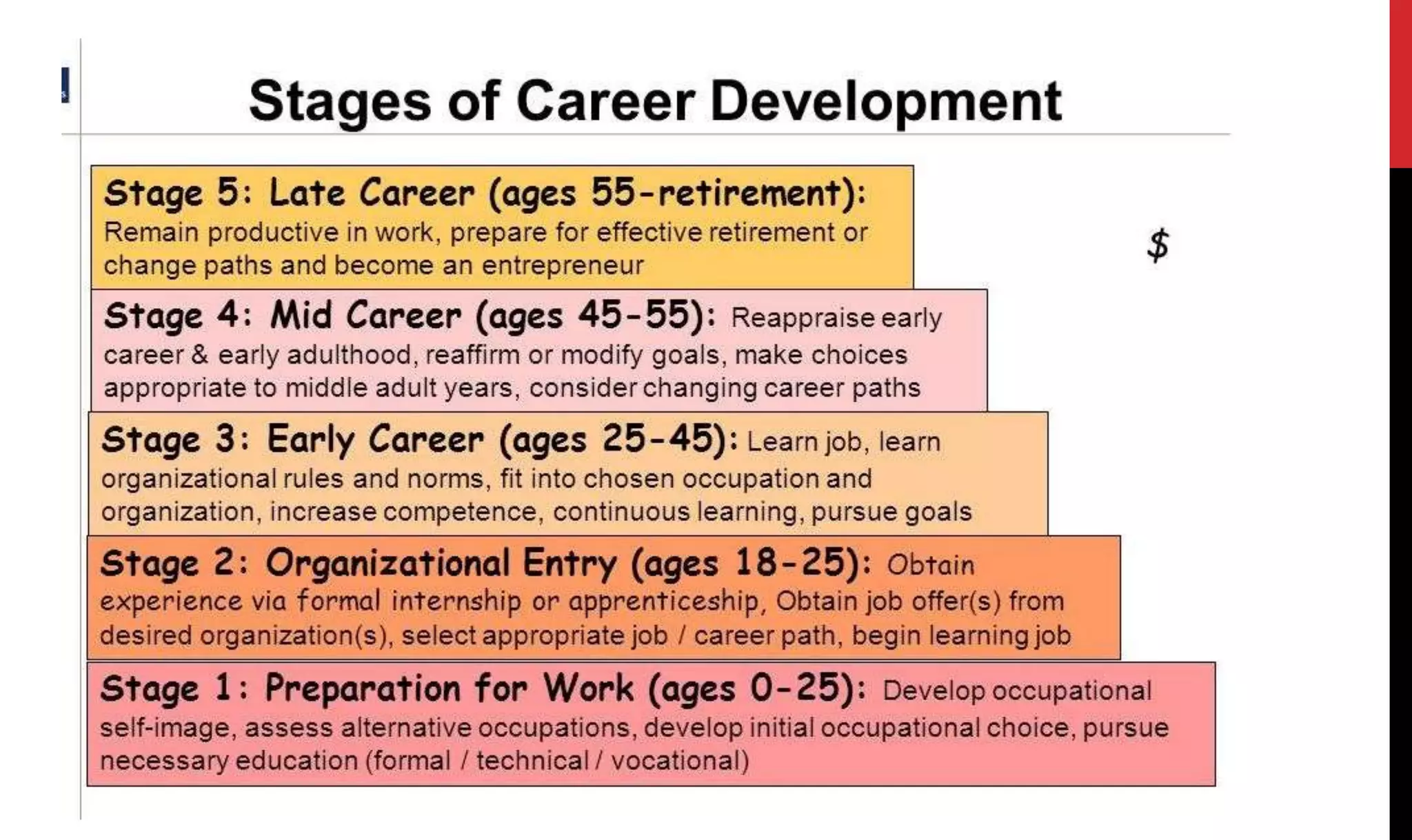
Recruitment - Career development - Career stages- Training -
Performance appraisal.
WHAT IS MEANT BY ORGANIZING?
Organising means identifying and grouping different activities in the
organization and bringing together the physical and financial and human
resources to establish the most productive relations for the achievement
of organizational goals.
Organizing is the function of management which follows planning. It is a
function in which the synchronization and combination of human, physical
and financial resources takes place. All the three resources are important
to get results. Therefore, organizational function helps in achievement of
results which in fact is important for the functioning of a concern.
DEFINE ORGANIZING
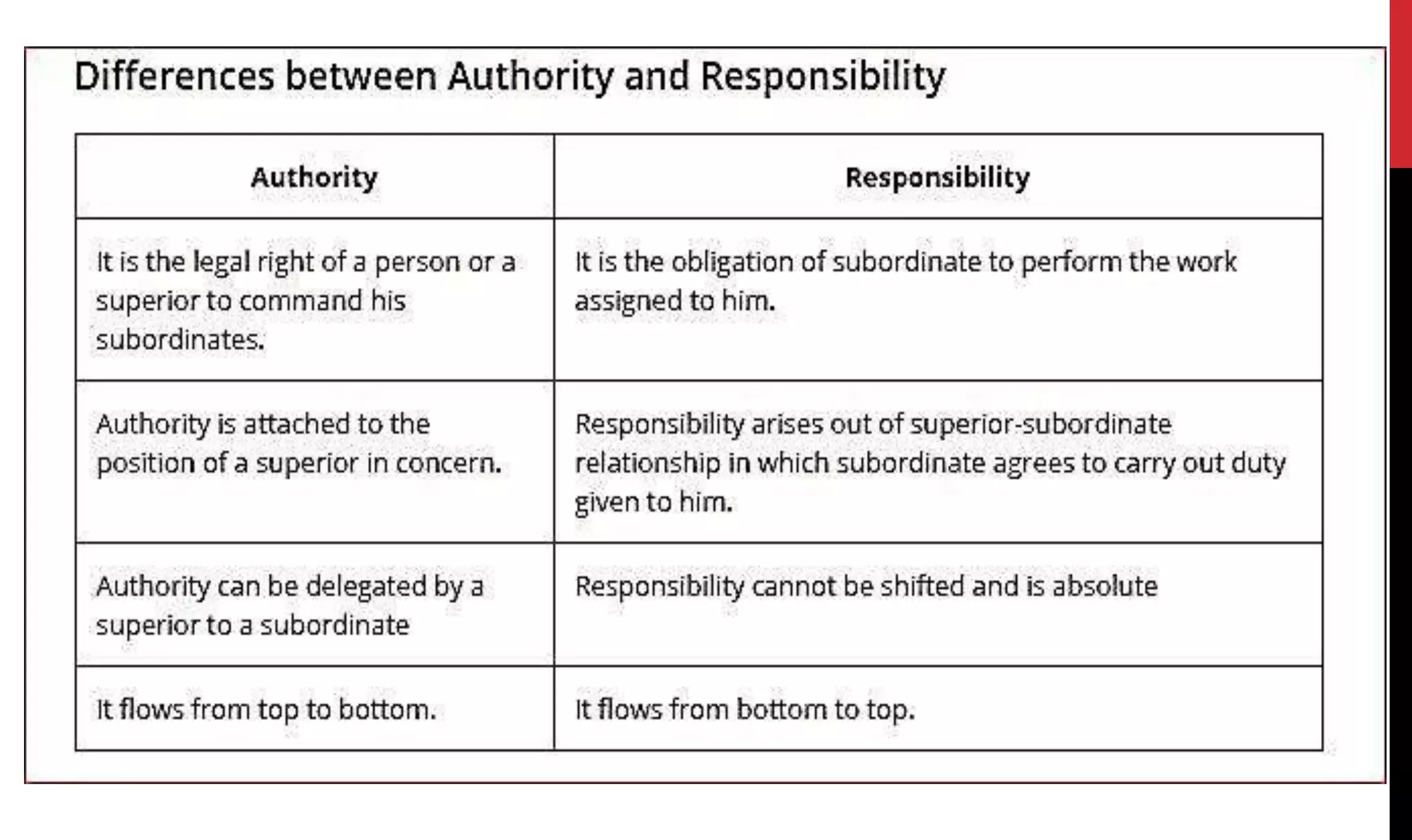
According to Chester Barnard, “Organizing is a function by which the
concern is able to define the role positions, the jobs related and the
coordination between authority and responsibility. Hence, a manager
always has to organize in order to get results”.
According to Urwick, “Organizing is a process of dividing up of activities
which are necessary to any purpose and arranging them in group which
are assigned to individuals”.
NATURE OF ORGANIZING
• Identification of activities
• Grouping of Activities
• Accumulation of resources
• Defining hierarchy of positions
• Assigning of jobs
• Establishing authority and responsibility relationship
• Evaluation of performance
PURPOSE FOR ORGANIZING
• Divide work to be done into specific jobs and Departments
• Assign Tasks and responsibilities associated with individual
• Coordinates diverse organizational tasks.
• Clusters job into units.
• Establish relationship among individuals, group and departments.
• Allocates and deploys organizational resources
ORGANIZATION STRUCTURE
WHAT IS AN ORGANIZATIONAL STRUCTURE?
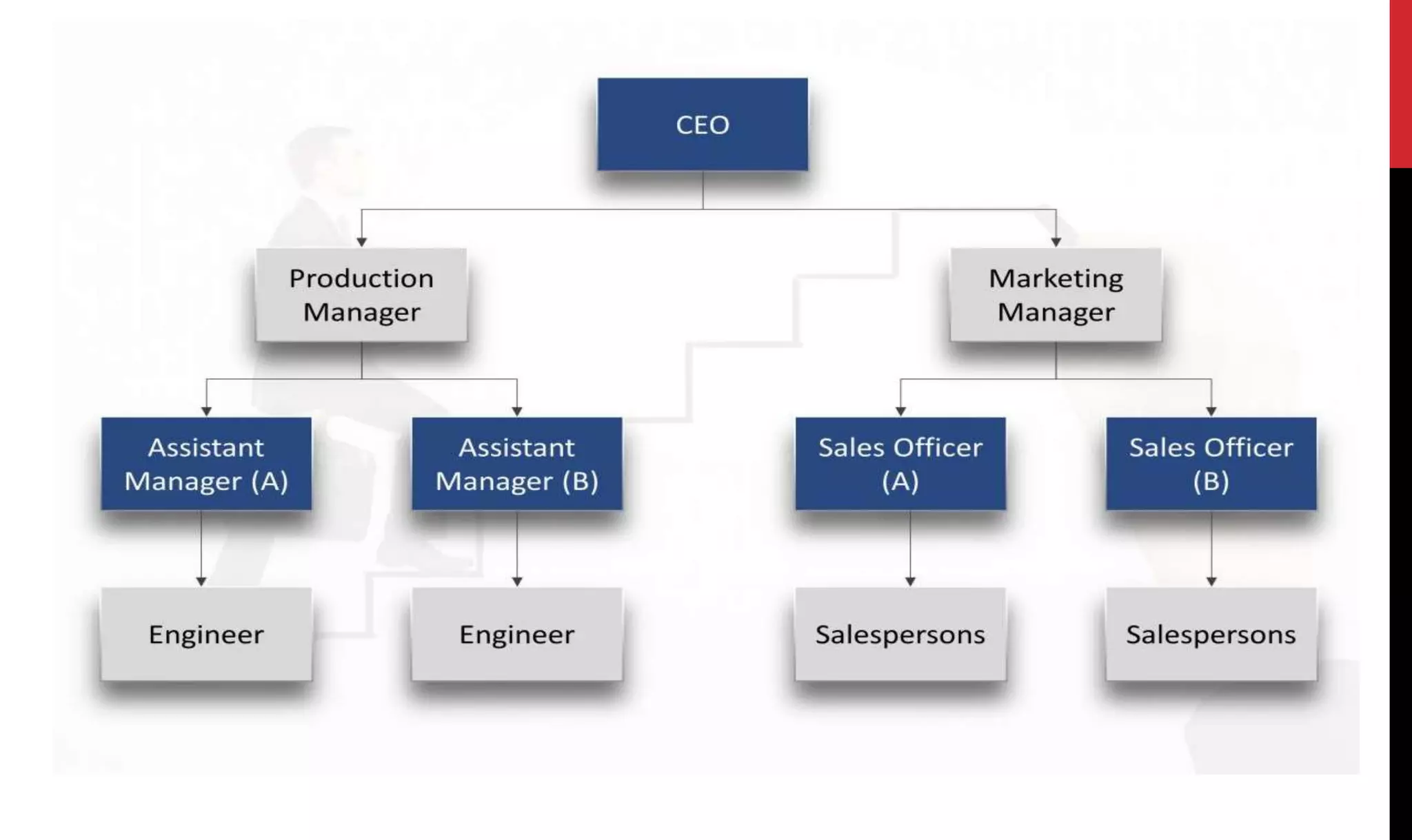
An organizational structure is a system that outlines how certain
activities are directed in order to achieve the goals of an organization.
These activities can include rules, roles, and responsibilities.
The organizational structure also determines how information flows
between levels within the company. For example, in a centralized
structure, decisions flow from the top down, while in a decentralized
structure, decision-making power is distributed among various levels of
the organization.
PRINCIPLES OF ORGANIZATION STRUCTURE
• Line and Staff Relationships
• Departmentalization
• Span of Control
• De-centralization and Centralization
LINE AND STAFF AUTHORITY
What is Line and Staff Authority?
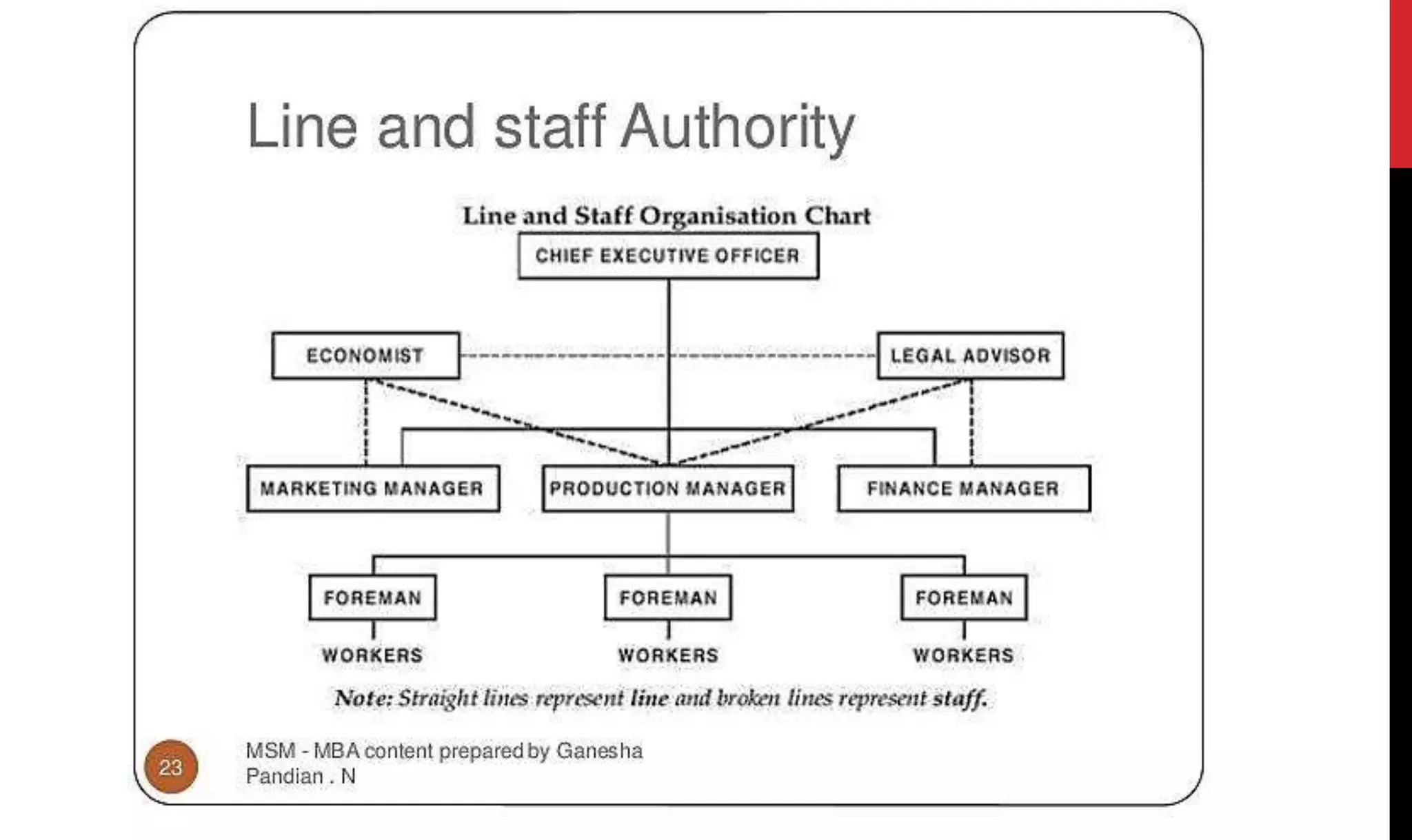
In an organization, the line authority flows from top to bottom and the
staff authority is exercised by the specialists over the line managers who
advise them on important matters. These specialists stand ready with
their specialty to serve line mangers as and when their services are
called for, to collect information and to give help which will enable the
line officials to carry out their activities better.
Line and staff authority consists of 3 categories they are:
• Empowerment
• Line or staff concepts
• Functional authority
EMPOWERMENT
• Means that employee, managers, or teams at all levels – given with the
power to make decisions without prior permission
• Power, Responsibility and Empowerment were related to one another
• Empowerment – also called as worker’s participation and employee
engagement
LINE OR STAFF CONCEPTS
• Scalar principle – there is a flow of the chain from the top level
supervisors to the low rank employees
• This principle stresses on more clearer the line, more effective the
organization
• Staff relationship is advisory in organization structure.
FUNCTIONAL AUTHORITY
It is the right delegated to an individual or to a department to control
specified processes, practices, policies or other matters – exclusively
undertaken by other department
DEPATMENTATION
DEPARTMENTATION
What is meant by Departmentation?
Departmentation is the process of grouping of work activities into
departments, divisions, and other homogenous units.
Departmentation takes place in various patterns like
departmentation by functions, products, customers, geographic
location, process, and its combinations.
KEY FACTORS OF DEPARTMENTATION
 It should facilitate control.
 It should ensure proper coordination.
 It should take into consideration the benefits of specialization.
 It should not result in excess cost.
 It should give due consideration to Human Aspects.
TYPES OF DEPARTMENTATION
 Functional departmentation
 Product departmentation
 Customer departmentation
 Geographic departmentation
 Process departmentation
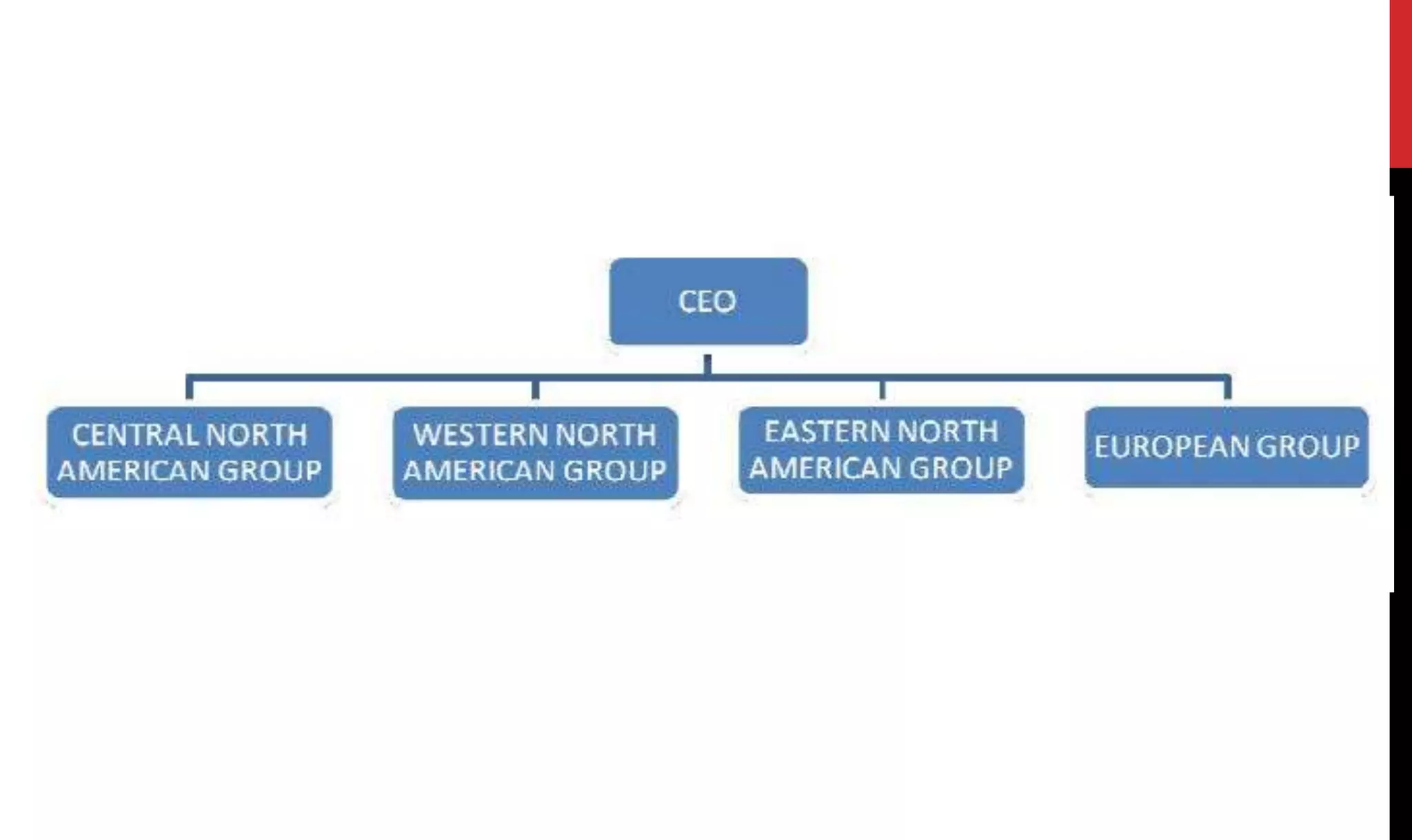
SPAN OF CONTROL
SPAN OF CONTROL
What is Span of Control?
The concept of "span of control," also known as management ratio,
refers to the number of subordinates controlled directly by a superior. It
is a particularly important concept for small business owners to
understand because small businesses often get into trouble when the
founder ends up with too wide a span of control.
TYPES OF SPAN OF CONTROL
• Narrow span
• Wide span
NARROW SPAN
According to the narrow span, the manager supervises the employees at
one time. It is difficult to get effective co-ordination and also due to this
kind of span of control, number of managers are increased and hence
overall costing of the company is mutually get increased.
WIDE SPAN
According to the wide span the manager supervises and control effectively
a large group of persons at one time. It is easy to get effective co-
ordination and better communication. Due to wide span the number of
required manager are low and the overall cost of the company is also low.
FACTORS AFFECTING SPAN OF CONTROL
 Managerial abilities
 Competence of subordinates
 Nature of work
 Delegation of authority
 Economic consideration
CENTRALIZATION AND DECENTRALIZATION
CENTRALIZATION
The authority to make important decisions is retained by top level
managers.
DECENTRALIZATION
The authority to make important decisions is delegated to managers at
all level in the hierarchy.
ARGUMENTS FOR CENTRALIZATION
• Centralization can facilitate coordination.
• Centralization can help ensure that decisions are consistent with
organizational objectives.
• Centralization can avoid duplication of activities by various subunits
within the organization.
• By concentrating power and authority in one individual or a
management team, centralization can give top-level managers the
means to bring about needed major organizational changes.
ARGUMENTS FOR DECENTRALIZATION
 Top management can become overburdened when decision-making
authority is centralized.
 Motivational research favours decentralization.
 Decentralization permits greater flexibility more rapid response to
environmental changes.
 Decentralization can result in better decisions.
 Decentralization can increase control.
LIMITATIONS OF CENTRALIZATION
• Development of low level managers are hampered Opportunity given
to exercise initiative and judgment is negligible.
• It is a costly affair and delays decision making .
• It creates problems of effective communication.
• No scope of specialization as a person may have to look into many
things.
LIMITATIONS OF DECENTRALIZATION
 It creates problems in coordination between different units of the
organization.
 May result in higher administrative expenses as qualified managers a
needed for different divisions.
 Due to different policies and procedures of each unit in a
decentralized organization inconsistencies may arise in
organizational activities.
DELEGATION OF AUTHORITY
What is Delegation of Authority?
Delegation is the process which enables a person to assign a work to
others and delegate them with adequate authority to do it. It is the most
important methods of training for the sub-ordinates and building
morals. This helps to concentrate on planning, organizing and
controlling.
DEFINE DELEGATION OF AUTHORITY
According to L.A Allen, “ Delegation is an Administrative
process of getting things to be done by others by giving
them responsibility.
PRINCIPLES OF DELEGATION OF AUTHORITY
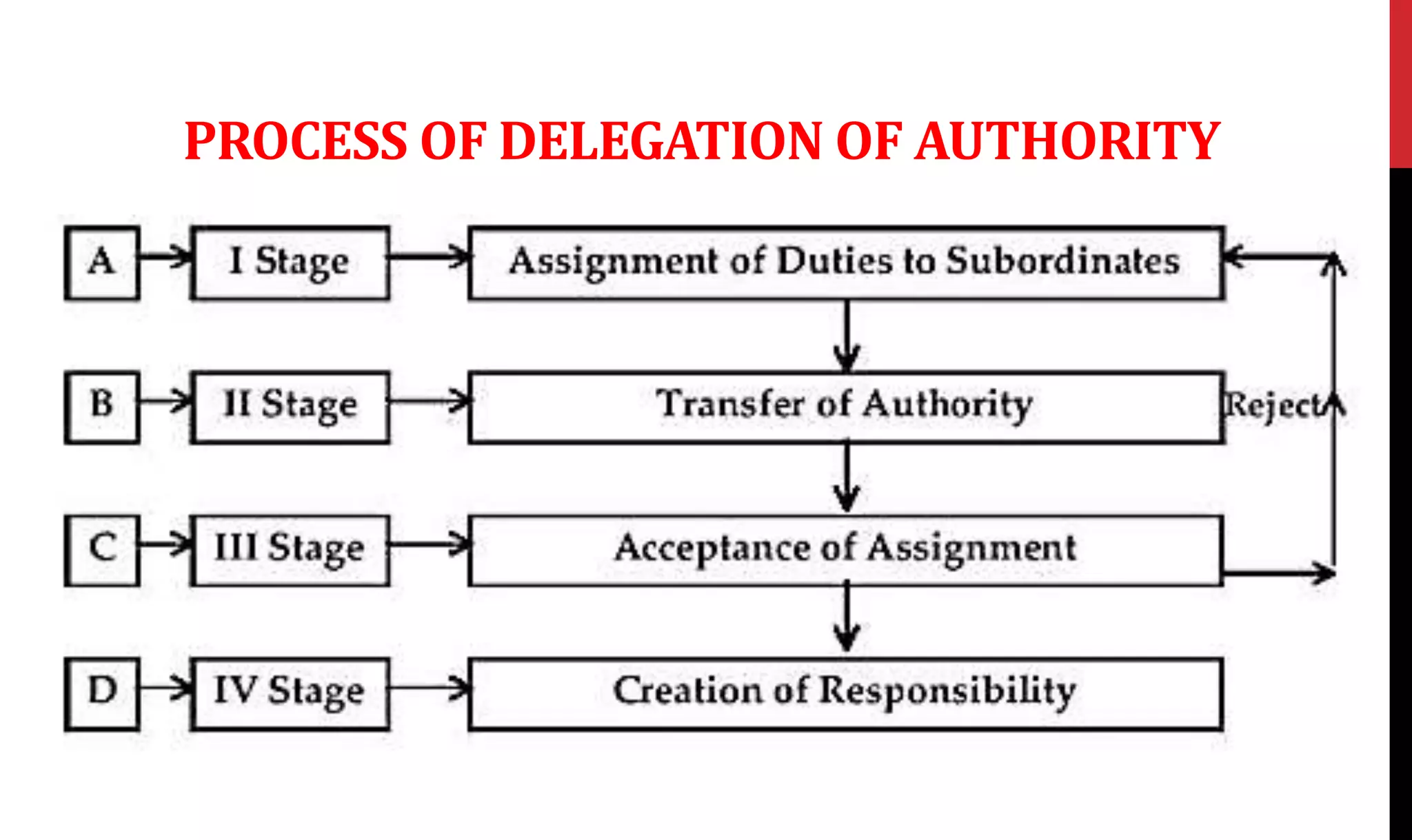
PROCESS OF DELEGATION OF AUTHORITY
STAFFING
STAFFING
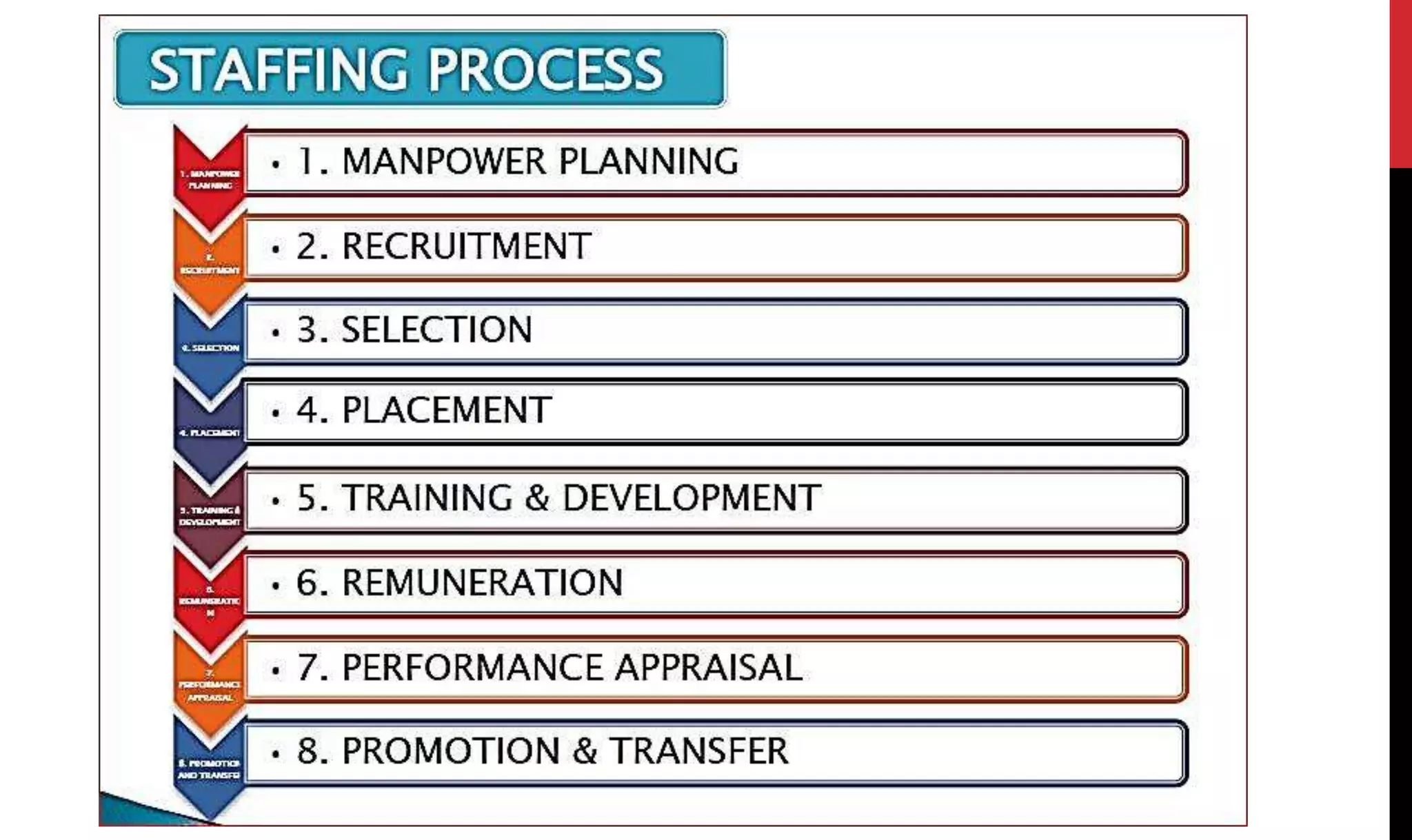
What is staffing?
Staffing is a process through which capable employees are recruited,
selected, properly trained, effectively developed, rightfully rewarded and
their joint efforts are harmoniously. Is a managerial function that takes
people with necessary skills into the organization and develops them
into precious organizational resource.
NATURE OF STAFFING
 It is a significant function of management
 It is an important part of management process
 It is continuous activity function of management
 It is concerned with human resources of an organization
 It is separate from physical factors, because it is complicated and
sensitive function
 It deals with the maximum utilization of human resources like
direction, coordination and control.
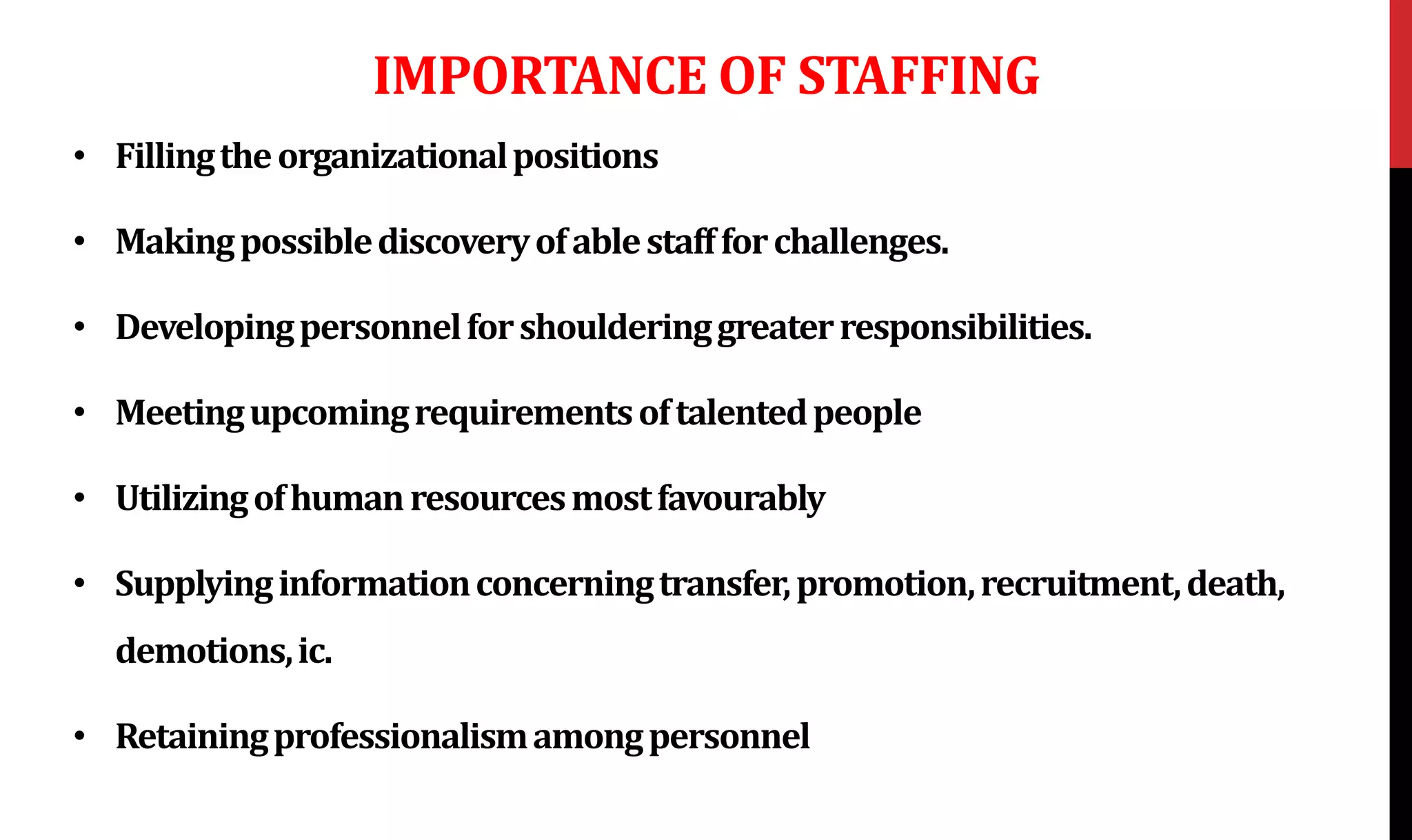
IMPORTANCE OF STAFFING
• Fillingtheorganizationalpositions
• Makingpossiblediscoveryofablestaffforchallenges.
• Developingpersonnelforshoulderinggreaterresponsibilities.
• Meetingupcomingrequirementsoftalentedpeople
• Utilizingofhumanresourcesmostfavourably
• Supplyinginformationconcerningtransfer,promotion,recruitment,death,
demotions,ic.
• Retainingprofessionalismamongpersonnel
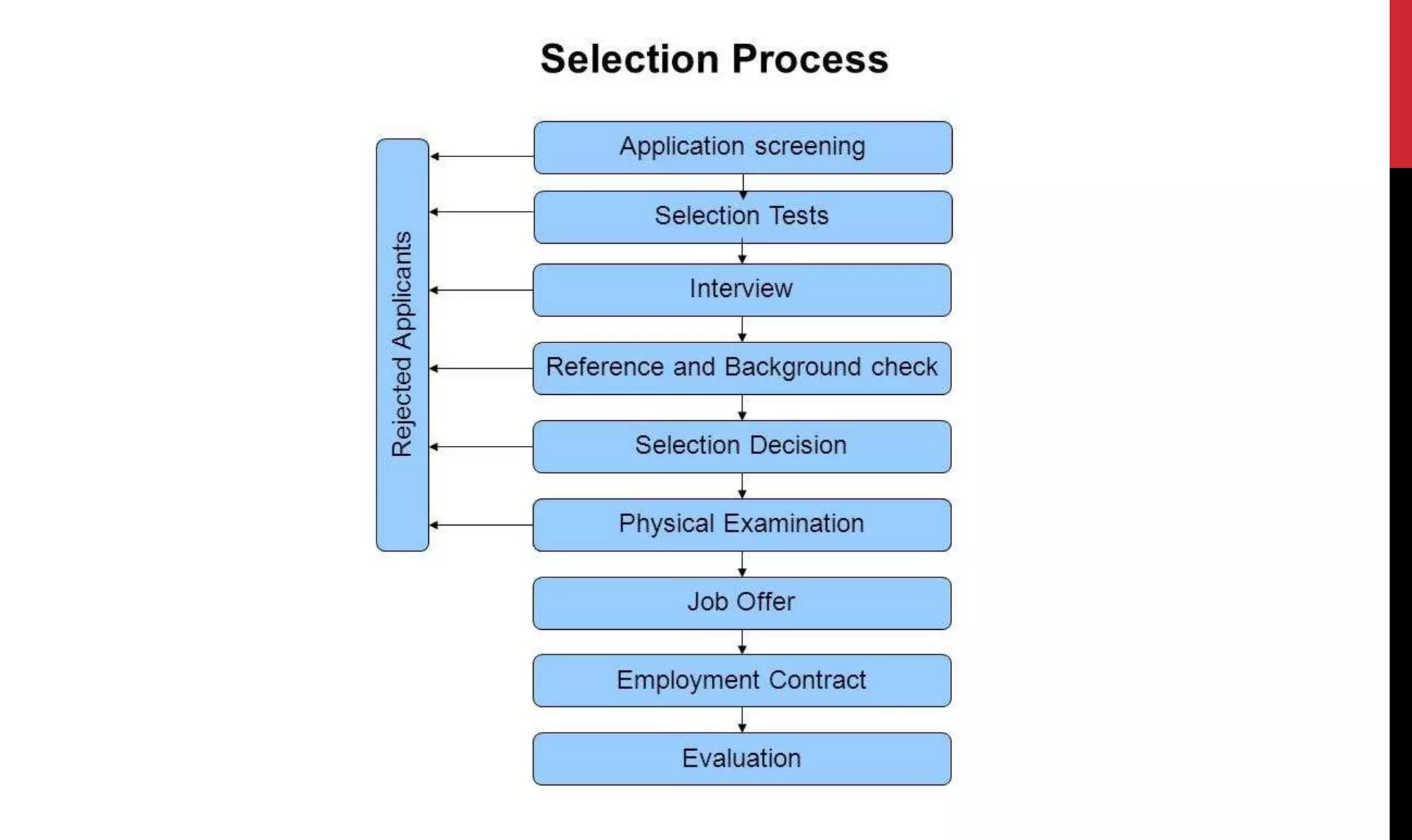
SELECTION AND RECRUITMENT
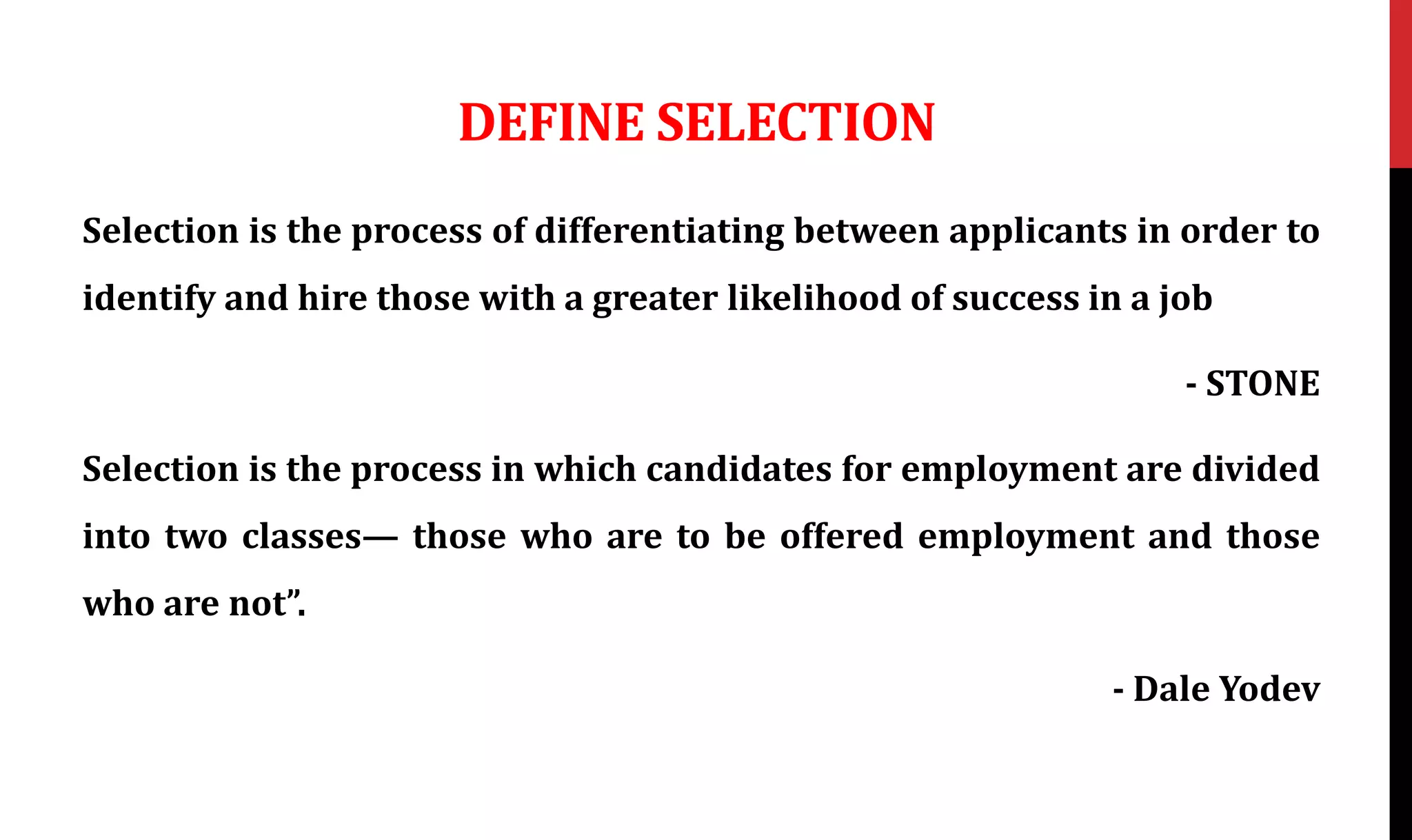
DEFINE SELECTION
Selection is the process of differentiating between applicants in order to
identify and hire those with a greater likelihood of success in a job
- STONE
Selection is the process in which candidates for employment are divided
into two classes— those who are to be offered employment and those
who are not”.
- Dale Yodev
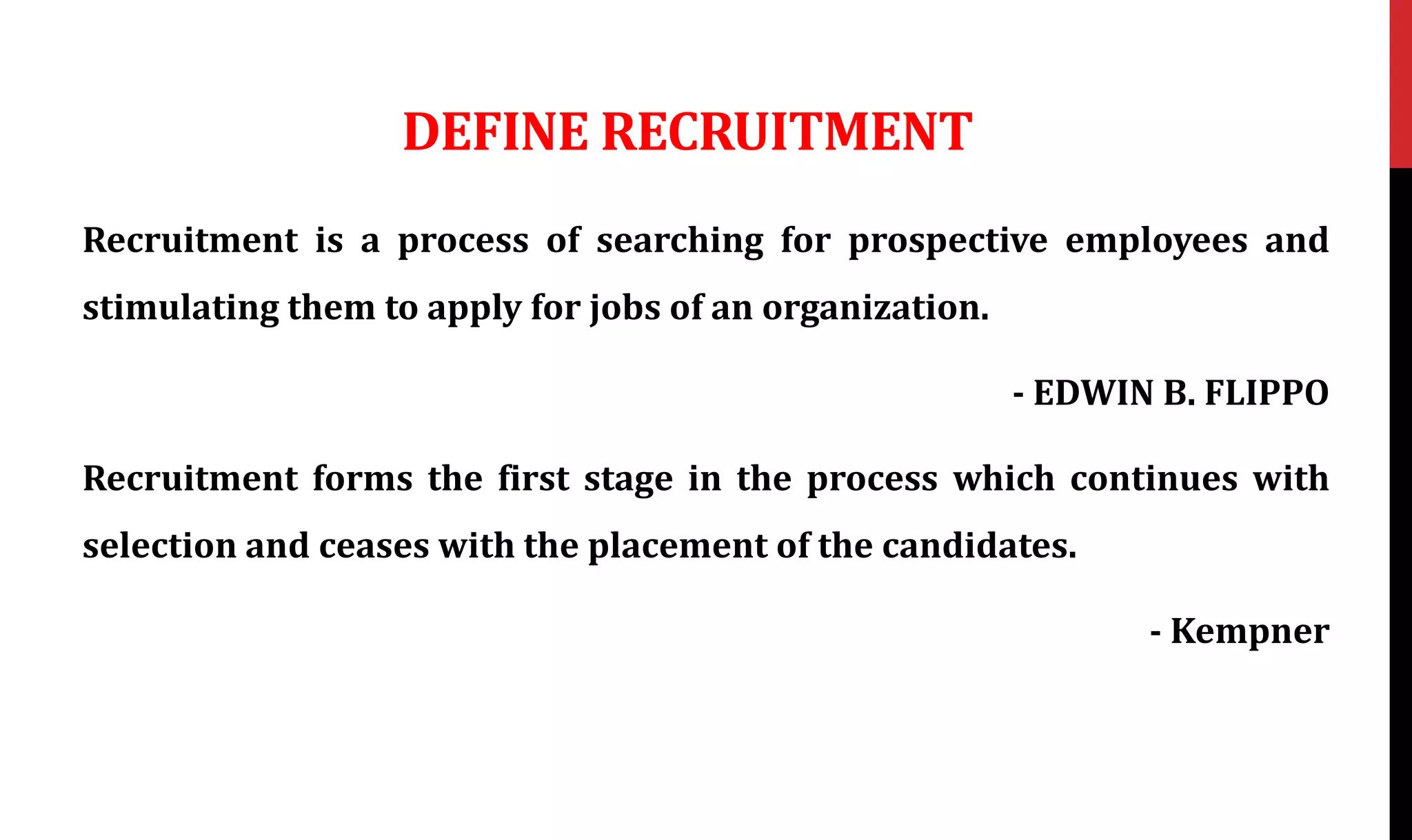
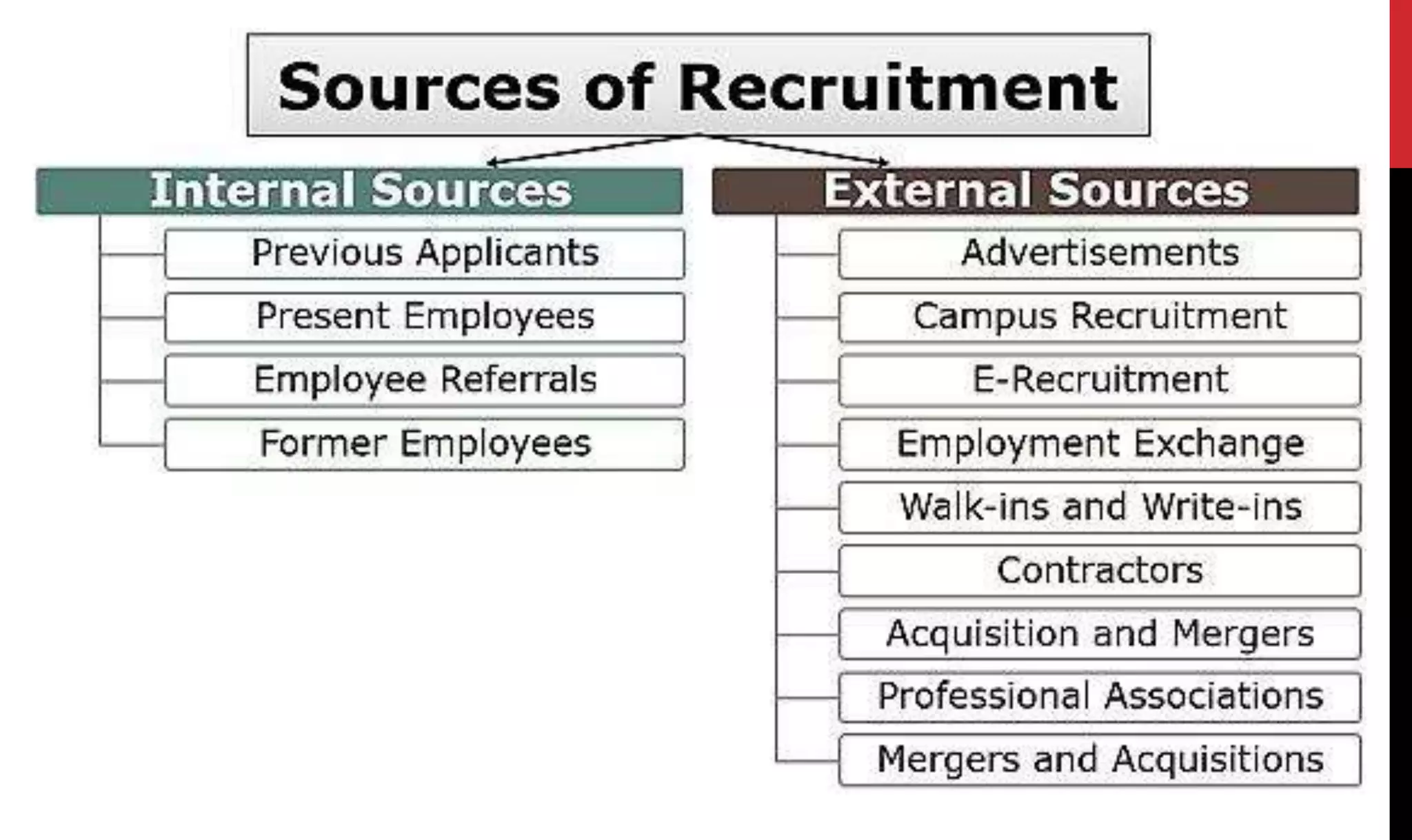
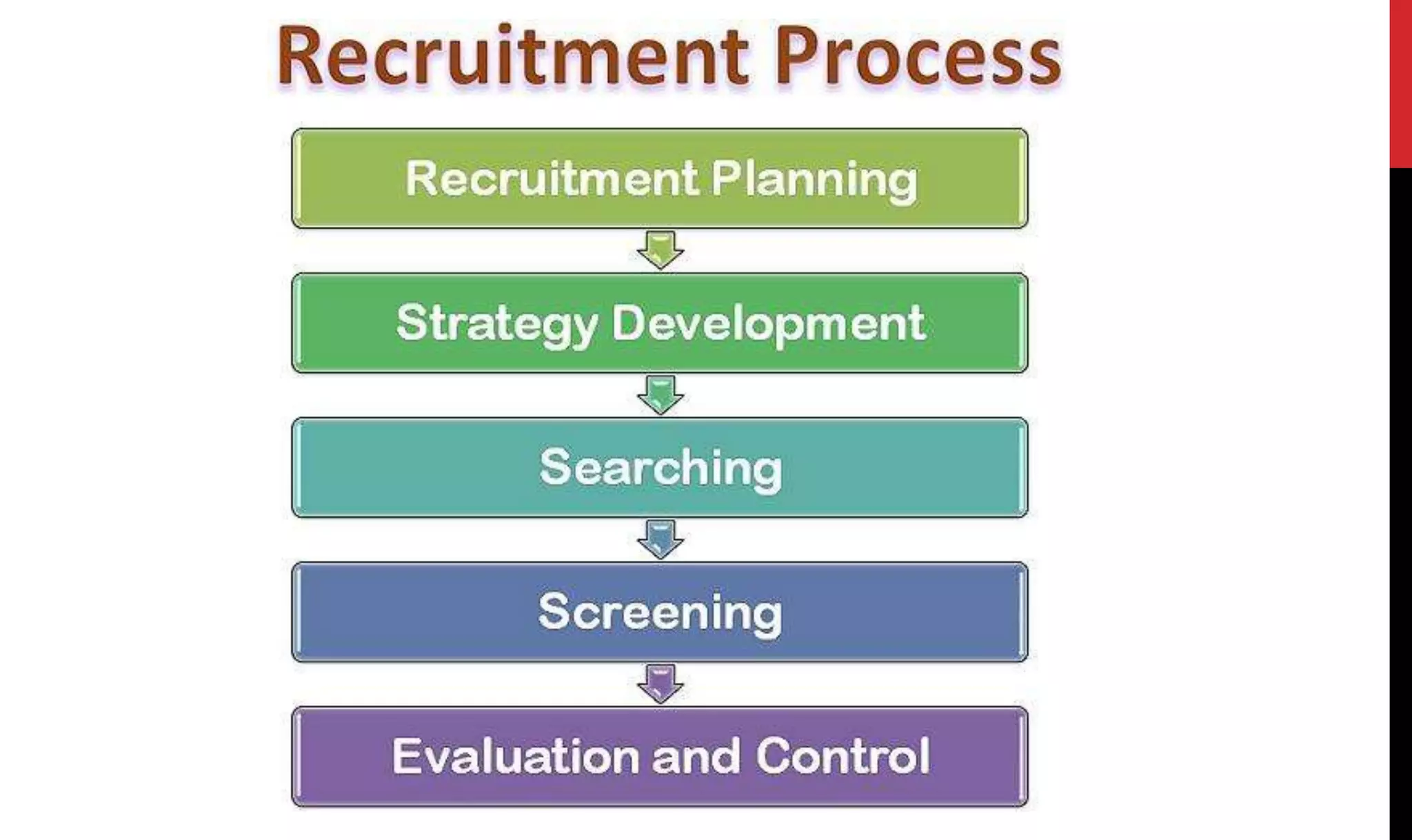
DEFINE RECRUITMENT
Recruitment is a process of searching for prospective employees and
stimulating them to apply for jobs of an organization.
- EDWIN B. FLIPPO
Recruitment forms the first stage in the process which continues with
selection and ceases with the placement of the candidates.
- Kempner
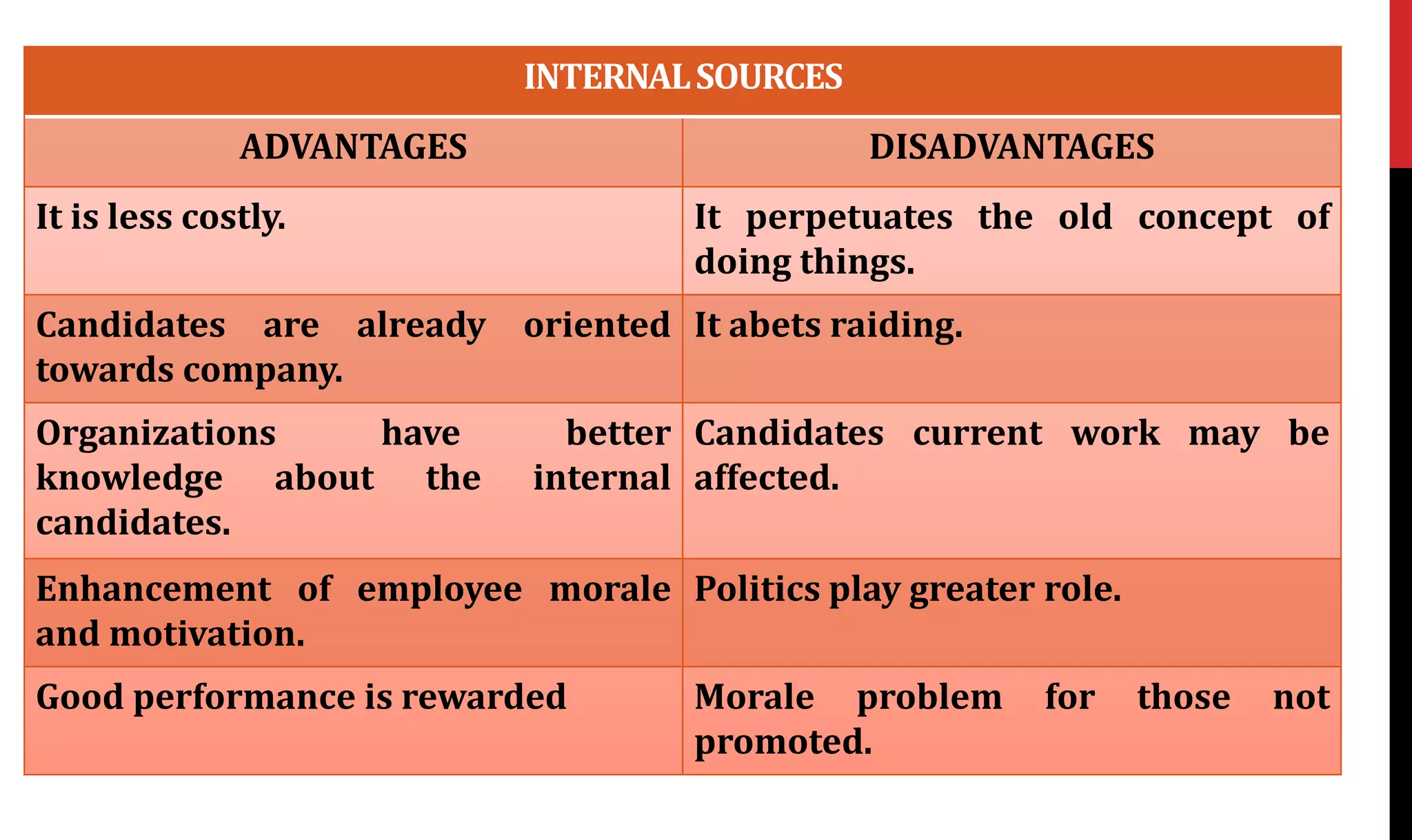
INTERNALSOURCES
ADVANTAGES DISADVANTAGES
It is less costly. It perpetuates the old concept of
doing things.
Candidates are already oriented
towards company.
It abets raiding.
Organizations have better
knowledge about the internal
candidates.
Candidates current work may be
affected.
Enhancement of employee morale
and motivation.
Politics play greater role.
Good performance is rewarded Morale problem for those not
promoted.
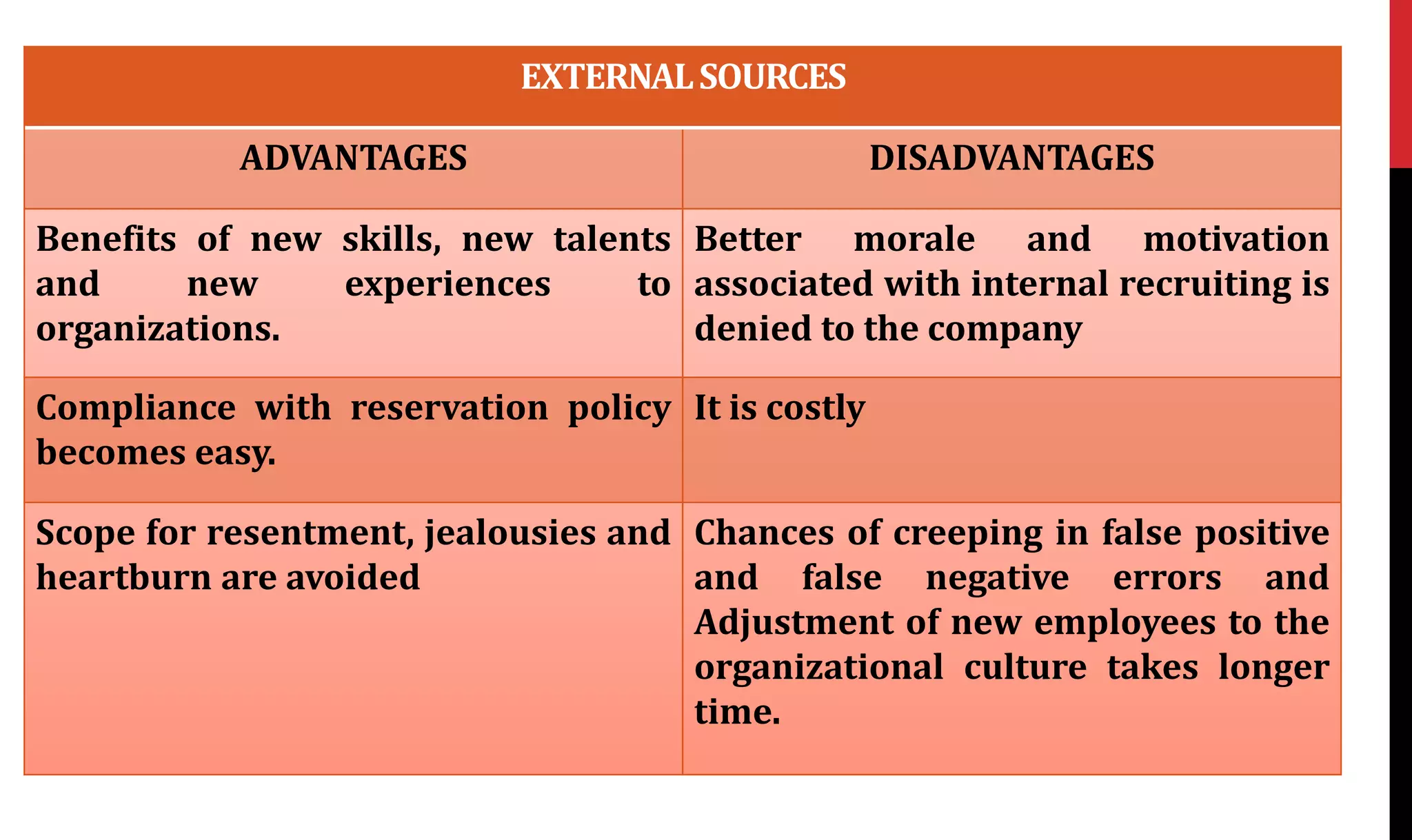
EXTERNALSOURCES
ADVANTAGES DISADVANTAGES
Benefits of new skills, new talents
and new experiences to
organizations.
Better morale and motivation
associated with internal recruiting is
denied to the company
Compliance with reservation policy
becomes easy.
It is costly
Scope for resentment, jealousies and
heartburn are avoided
Chances of creeping in false positive
and false negative errors and
Adjustment of new employees to the
organizational culture takes longer
time.
CAREER DEVELOPMENT
CAREER DEVELOPMENT
DEFINE CAREER DEVELOPMENT
Career development is a process of planning the series of possible jobs
one may hold in an organization over time and development strategies
designed to provide necessary job skills the opportunities arise".
- Middlemist, Hill and Greer
CHARACTERISTICS OF CAREER DEVELOPMENT
• It is an on-going process
• It develops and shares transferability of skills and competencies
• It aligns individual goals with organizational goals for increased
satisfaction of employees
• It helps individual to develops skills and competencies required to
fulfil present and future leadership roles within an organization
• It strengthen professional work culture in the organization.
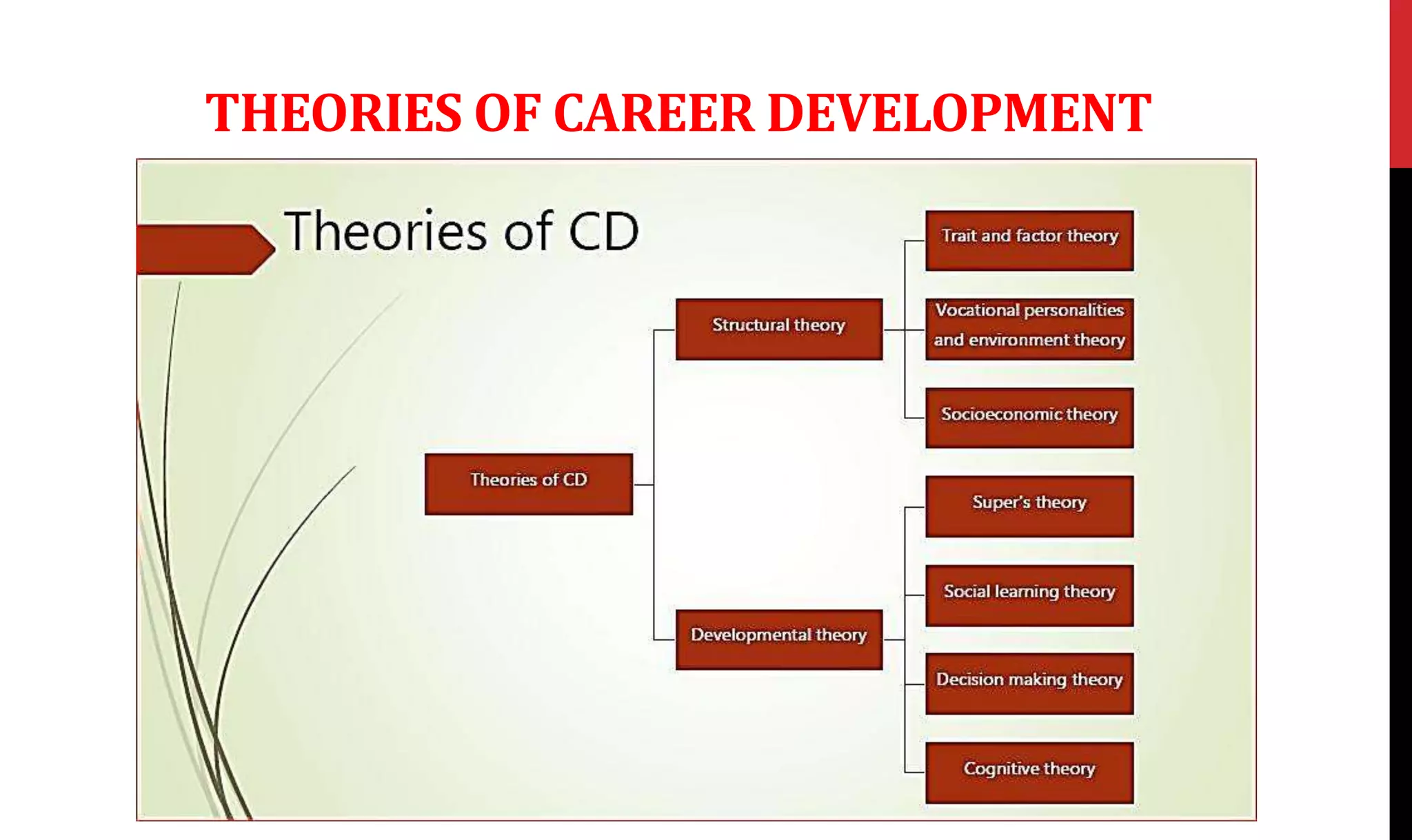
THEORIES OF CAREER DEVELOPMENT
TRAINING
TRAINING
WHAT IS MEANT BY TRAINING?
Training is a process of learning a sequence of programmed behaviour.
It is the application of knowledge and gives people an awareness about
the rules and procedures to guide their behaviour. It helps in bringing
about positive change in the knowledge, skills and attitudes of
employees.
NATURE OF TRAINING
 It is the process of acquiring specific skills which enhances job
performance.
 It is a process of teaching, informing or educating people.
 It provides required qualification to individuals in order to perform
their job in a better way.
 It provides qualification to employees so that they can perform in
positions of greater difficulty and responsibility.
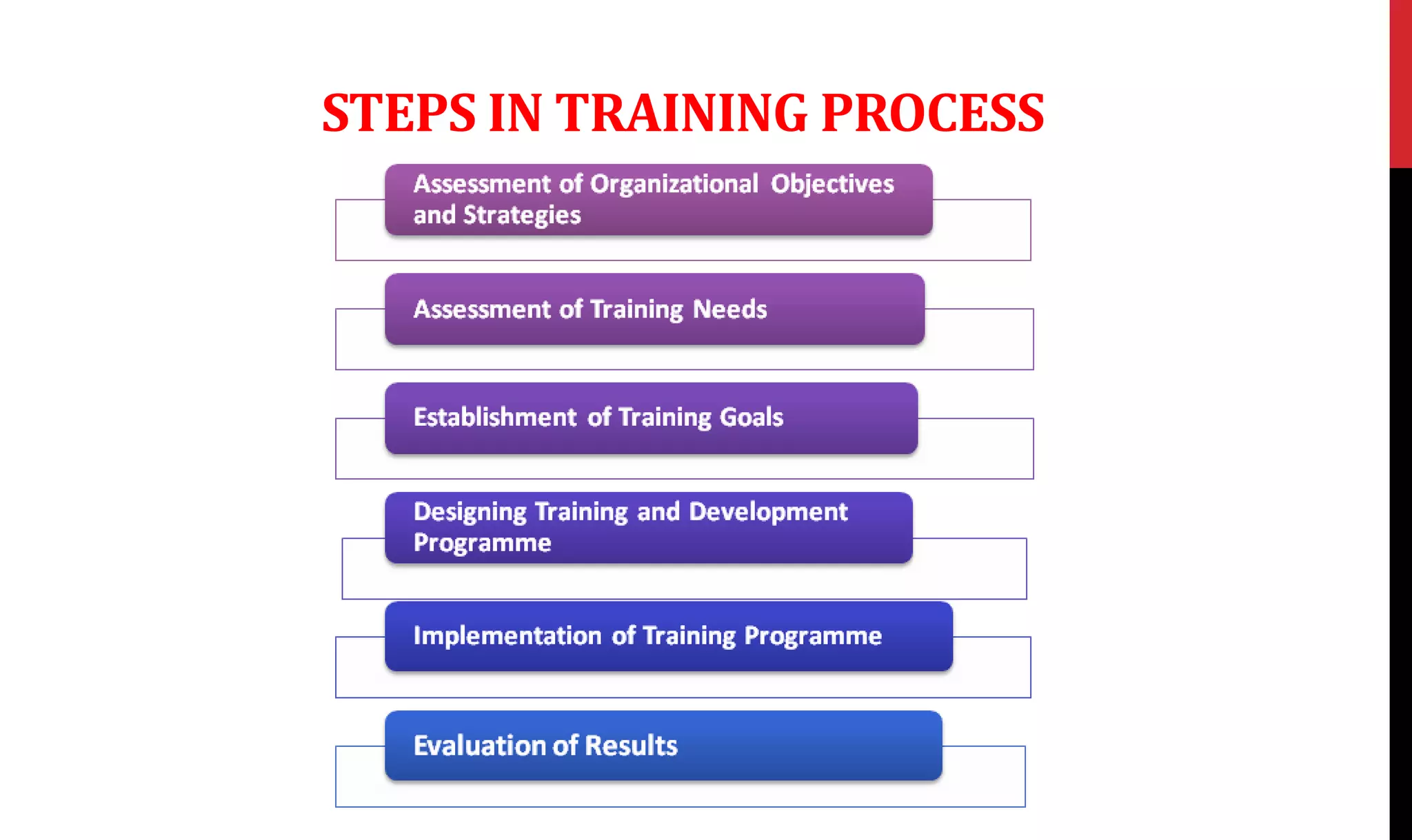
STEPS IN TRAINING PROCESS
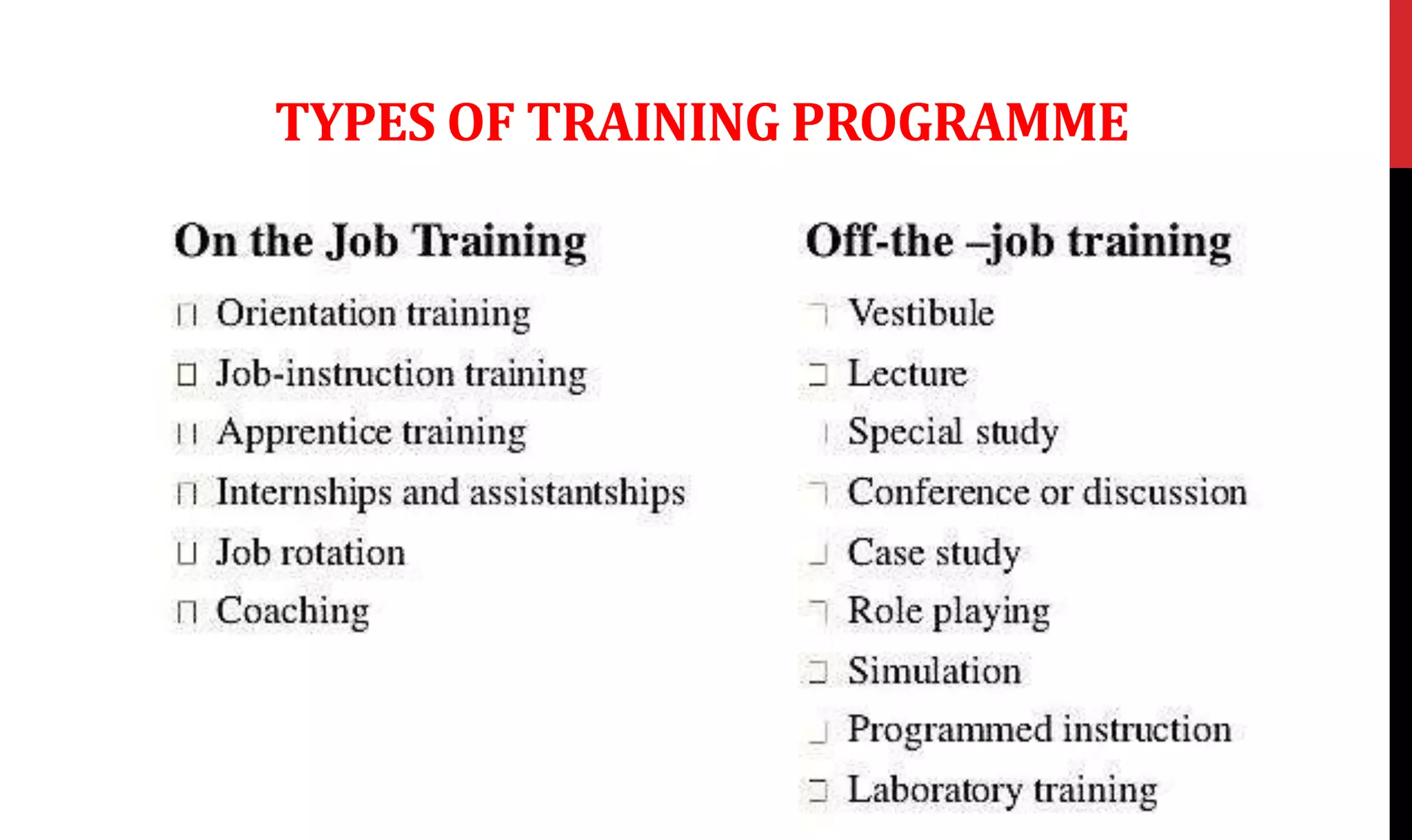
TYPES OF TRAINING PROGRAMME
PERFORMANCE APPRAISAL
What is Performance Appraisal?
Performance appraisal relates to a systematic process that involves
employees in improving organizational effectiveness to achieve the
overall mission and goals.
COMPONENTS OF PERFORMANCE APPRAISAL
 Planning work and setting expectations
 Continually monitoring performance
 Developing the capacity to perform
 Periodical rating performance
 Rewarding good performance.
TYPES OF PERFORMANCE APPRAISAL
 Management by Objective (MBO)
 360 Degree performance appraisal
 Performance Ranking Method
 Peer Review Appraisal
THANK YOU

MOB Unit - II - Google Meet.pptx

  • 1.
    MANAGEMENT PRINCIPLES AND ORGANIZATIONALBEHAVIOUR UNIT – II ORGANIZING AND STAFFING MBA – I | VCEW
  • 2.
    SYLLABUS UNIT – II- ORGANIZING AND STAFFING Nature and purpose of organizing - Organization structure - Line and staff authority- Departmentation- Span of control - Centralization and decentralization - Delegation of authority – Staffing - Selection and Recruitment - Career development - Career stages- Training - Performance appraisal.
  • 3.
    WHAT IS MEANTBY ORGANIZING? Organising means identifying and grouping different activities in the organization and bringing together the physical and financial and human resources to establish the most productive relations for the achievement of organizational goals. Organizing is the function of management which follows planning. It is a function in which the synchronization and combination of human, physical and financial resources takes place. All the three resources are important to get results. Therefore, organizational function helps in achievement of results which in fact is important for the functioning of a concern.
  • 4.
    DEFINE ORGANIZING According toChester Barnard, “Organizing is a function by which the concern is able to define the role positions, the jobs related and the coordination between authority and responsibility. Hence, a manager always has to organize in order to get results”. According to Urwick, “Organizing is a process of dividing up of activities which are necessary to any purpose and arranging them in group which are assigned to individuals”.
  • 5.
  • 6.
    NATURE OF ORGANIZING •Identification of activities • Grouping of Activities • Accumulation of resources • Defining hierarchy of positions • Assigning of jobs • Establishing authority and responsibility relationship • Evaluation of performance
  • 7.
  • 8.
    PURPOSE FOR ORGANIZING •Divide work to be done into specific jobs and Departments • Assign Tasks and responsibilities associated with individual • Coordinates diverse organizational tasks. • Clusters job into units. • Establish relationship among individuals, group and departments. • Allocates and deploys organizational resources
  • 9.
  • 10.
    WHAT IS ANORGANIZATIONAL STRUCTURE? An organizational structure is a system that outlines how certain activities are directed in order to achieve the goals of an organization. These activities can include rules, roles, and responsibilities. The organizational structure also determines how information flows between levels within the company. For example, in a centralized structure, decisions flow from the top down, while in a decentralized structure, decision-making power is distributed among various levels of the organization.
  • 11.
    PRINCIPLES OF ORGANIZATIONSTRUCTURE • Line and Staff Relationships • Departmentalization • Span of Control • De-centralization and Centralization
  • 13.
    LINE AND STAFFAUTHORITY What is Line and Staff Authority? In an organization, the line authority flows from top to bottom and the staff authority is exercised by the specialists over the line managers who advise them on important matters. These specialists stand ready with their specialty to serve line mangers as and when their services are called for, to collect information and to give help which will enable the line officials to carry out their activities better.
  • 15.
    Line and staffauthority consists of 3 categories they are: • Empowerment • Line or staff concepts • Functional authority
  • 16.
    EMPOWERMENT • Means thatemployee, managers, or teams at all levels – given with the power to make decisions without prior permission • Power, Responsibility and Empowerment were related to one another • Empowerment – also called as worker’s participation and employee engagement
  • 17.
    LINE OR STAFFCONCEPTS • Scalar principle – there is a flow of the chain from the top level supervisors to the low rank employees • This principle stresses on more clearer the line, more effective the organization • Staff relationship is advisory in organization structure.
  • 18.
    FUNCTIONAL AUTHORITY It isthe right delegated to an individual or to a department to control specified processes, practices, policies or other matters – exclusively undertaken by other department
  • 19.
  • 20.
    DEPARTMENTATION What is meantby Departmentation? Departmentation is the process of grouping of work activities into departments, divisions, and other homogenous units. Departmentation takes place in various patterns like departmentation by functions, products, customers, geographic location, process, and its combinations.
  • 21.
    KEY FACTORS OFDEPARTMENTATION  It should facilitate control.  It should ensure proper coordination.  It should take into consideration the benefits of specialization.  It should not result in excess cost.  It should give due consideration to Human Aspects.
  • 22.
    TYPES OF DEPARTMENTATION Functional departmentation  Product departmentation  Customer departmentation  Geographic departmentation  Process departmentation
  • 24.
  • 25.
    SPAN OF CONTROL Whatis Span of Control? The concept of "span of control," also known as management ratio, refers to the number of subordinates controlled directly by a superior. It is a particularly important concept for small business owners to understand because small businesses often get into trouble when the founder ends up with too wide a span of control.
  • 26.
    TYPES OF SPANOF CONTROL • Narrow span • Wide span
  • 27.
    NARROW SPAN According tothe narrow span, the manager supervises the employees at one time. It is difficult to get effective co-ordination and also due to this kind of span of control, number of managers are increased and hence overall costing of the company is mutually get increased. WIDE SPAN According to the wide span the manager supervises and control effectively a large group of persons at one time. It is easy to get effective co- ordination and better communication. Due to wide span the number of required manager are low and the overall cost of the company is also low.
  • 28.
    FACTORS AFFECTING SPANOF CONTROL  Managerial abilities  Competence of subordinates  Nature of work  Delegation of authority  Economic consideration
  • 29.
  • 30.
    CENTRALIZATION AND DECENTRALIZATION CENTRALIZATION Theauthority to make important decisions is retained by top level managers. DECENTRALIZATION The authority to make important decisions is delegated to managers at all level in the hierarchy.
  • 31.
    ARGUMENTS FOR CENTRALIZATION •Centralization can facilitate coordination. • Centralization can help ensure that decisions are consistent with organizational objectives. • Centralization can avoid duplication of activities by various subunits within the organization. • By concentrating power and authority in one individual or a management team, centralization can give top-level managers the means to bring about needed major organizational changes.
  • 32.
    ARGUMENTS FOR DECENTRALIZATION Top management can become overburdened when decision-making authority is centralized.  Motivational research favours decentralization.  Decentralization permits greater flexibility more rapid response to environmental changes.  Decentralization can result in better decisions.  Decentralization can increase control.
  • 33.
    LIMITATIONS OF CENTRALIZATION •Development of low level managers are hampered Opportunity given to exercise initiative and judgment is negligible. • It is a costly affair and delays decision making . • It creates problems of effective communication. • No scope of specialization as a person may have to look into many things.
  • 34.
    LIMITATIONS OF DECENTRALIZATION It creates problems in coordination between different units of the organization.  May result in higher administrative expenses as qualified managers a needed for different divisions.  Due to different policies and procedures of each unit in a decentralized organization inconsistencies may arise in organizational activities.
  • 35.
  • 36.
    DELEGATION OF AUTHORITY Whatis Delegation of Authority? Delegation is the process which enables a person to assign a work to others and delegate them with adequate authority to do it. It is the most important methods of training for the sub-ordinates and building morals. This helps to concentrate on planning, organizing and controlling.
  • 37.
    DEFINE DELEGATION OFAUTHORITY According to L.A Allen, “ Delegation is an Administrative process of getting things to be done by others by giving them responsibility.
  • 38.
  • 40.
  • 41.
  • 42.
    STAFFING What is staffing? Staffingis a process through which capable employees are recruited, selected, properly trained, effectively developed, rightfully rewarded and their joint efforts are harmoniously. Is a managerial function that takes people with necessary skills into the organization and develops them into precious organizational resource.
  • 43.
    NATURE OF STAFFING It is a significant function of management  It is an important part of management process  It is continuous activity function of management  It is concerned with human resources of an organization  It is separate from physical factors, because it is complicated and sensitive function  It deals with the maximum utilization of human resources like direction, coordination and control.
  • 44.
    IMPORTANCE OF STAFFING •Fillingtheorganizationalpositions • Makingpossiblediscoveryofablestaffforchallenges. • Developingpersonnelforshoulderinggreaterresponsibilities. • Meetingupcomingrequirementsoftalentedpeople • Utilizingofhumanresourcesmostfavourably • Supplyinginformationconcerningtransfer,promotion,recruitment,death, demotions,ic. • Retainingprofessionalismamongpersonnel
  • 46.
  • 47.
    DEFINE SELECTION Selection isthe process of differentiating between applicants in order to identify and hire those with a greater likelihood of success in a job - STONE Selection is the process in which candidates for employment are divided into two classes— those who are to be offered employment and those who are not”. - Dale Yodev
  • 48.
    DEFINE RECRUITMENT Recruitment isa process of searching for prospective employees and stimulating them to apply for jobs of an organization. - EDWIN B. FLIPPO Recruitment forms the first stage in the process which continues with selection and ceases with the placement of the candidates. - Kempner
  • 50.
    INTERNALSOURCES ADVANTAGES DISADVANTAGES It isless costly. It perpetuates the old concept of doing things. Candidates are already oriented towards company. It abets raiding. Organizations have better knowledge about the internal candidates. Candidates current work may be affected. Enhancement of employee morale and motivation. Politics play greater role. Good performance is rewarded Morale problem for those not promoted.
  • 51.
    EXTERNALSOURCES ADVANTAGES DISADVANTAGES Benefits ofnew skills, new talents and new experiences to organizations. Better morale and motivation associated with internal recruiting is denied to the company Compliance with reservation policy becomes easy. It is costly Scope for resentment, jealousies and heartburn are avoided Chances of creeping in false positive and false negative errors and Adjustment of new employees to the organizational culture takes longer time.
  • 54.
  • 55.
    CAREER DEVELOPMENT DEFINE CAREERDEVELOPMENT Career development is a process of planning the series of possible jobs one may hold in an organization over time and development strategies designed to provide necessary job skills the opportunities arise". - Middlemist, Hill and Greer
  • 56.
    CHARACTERISTICS OF CAREERDEVELOPMENT • It is an on-going process • It develops and shares transferability of skills and competencies • It aligns individual goals with organizational goals for increased satisfaction of employees • It helps individual to develops skills and competencies required to fulfil present and future leadership roles within an organization • It strengthen professional work culture in the organization.
  • 57.
    THEORIES OF CAREERDEVELOPMENT
  • 59.
  • 60.
    TRAINING WHAT IS MEANTBY TRAINING? Training is a process of learning a sequence of programmed behaviour. It is the application of knowledge and gives people an awareness about the rules and procedures to guide their behaviour. It helps in bringing about positive change in the knowledge, skills and attitudes of employees.
  • 61.
    NATURE OF TRAINING It is the process of acquiring specific skills which enhances job performance.  It is a process of teaching, informing or educating people.  It provides required qualification to individuals in order to perform their job in a better way.  It provides qualification to employees so that they can perform in positions of greater difficulty and responsibility.
  • 62.
  • 63.
  • 64.
  • 65.
    PERFORMANCE APPRAISAL What isPerformance Appraisal? Performance appraisal relates to a systematic process that involves employees in improving organizational effectiveness to achieve the overall mission and goals.
  • 66.
    COMPONENTS OF PERFORMANCEAPPRAISAL  Planning work and setting expectations  Continually monitoring performance  Developing the capacity to perform  Periodical rating performance  Rewarding good performance.
  • 67.
    TYPES OF PERFORMANCEAPPRAISAL  Management by Objective (MBO)  360 Degree performance appraisal  Performance Ranking Method  Peer Review Appraisal
  • 68.