18-Feb-15Prepared by- Binu Samuel M com(Finance), Mcom(marketing), B.Ed 1
INTRODUCTION TO
MANAGEMENT
18-Feb-15
Prepared by- Binu Samuel M com(Finance), Mcom(marketing), B.Ed
2
18-Feb-15Prepared by- Binu Samuel M com(Finance), Mcom(marketing), B.Ed 3
Different Meaning
Management is an art of getting
things done
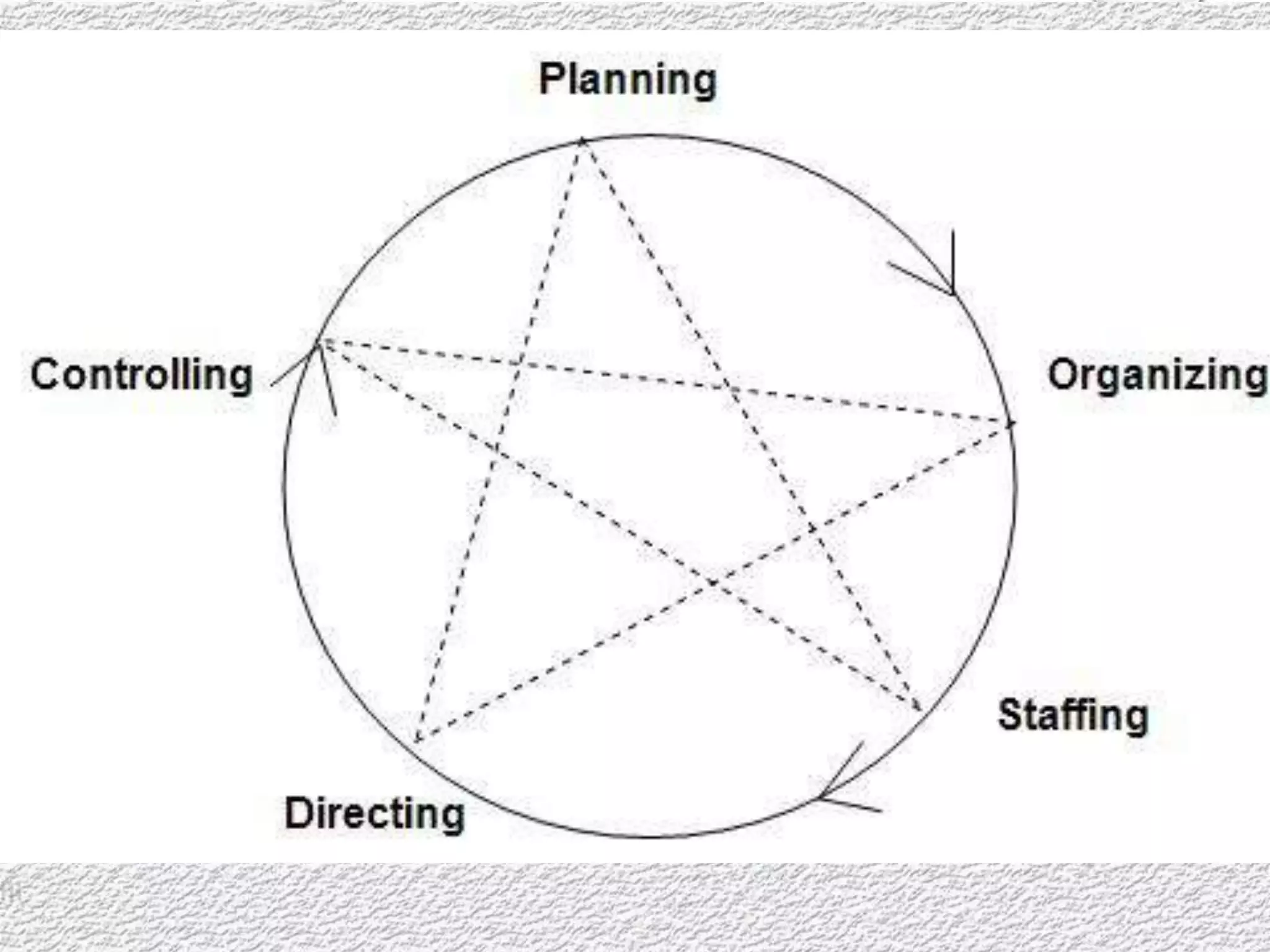
Management is a process of
planning, organizing, staffing,
directing and controlling
Management is a distinct activity
of any organization
Management is a discipline
which represents a body of
knowledge.
Management denotes a group of
18-Feb-15Prepared by- Binu Samuel M com(Finance), Mcom(marketing), B.Ed 4
Definition
‘Management is a distinct
process consisting of
planning, organizing,
actuating and controlling
performed to determine
and accomplish the
objectives by the use of
people and resources’
- George .R. Terry
18-Feb-15Prepared by- Binu Samuel M com(Finance), Mcom(marketing), B.Ed 5
Management is
principally the task of
planning,
coordinating,
motivating and
controlling the efforts
of others towards a
specific objective
18-Feb-15Prepared by- Binu Samuel M com(Finance), Mcom(marketing), B.Ed 6
Features of management
1.Management is getting
things done
2.Management is an activity
3.Management is purposeful
4.Management is a process
5.Management is a profession
6.management involves
decision making
7.Management is a science
and Art
18-Feb-15Prepared by- Binu Samuel M com(Finance), Mcom(marketing), B.Ed 7
Levels of
management
Levels of management
refers to the
arrangement of
managerial positions in
an organization
1.Top management
2.Middle management
BO
18-Feb-15Prepared by- Binu Samuel M com(Finance), Mcom(marketing), B.Ed 8
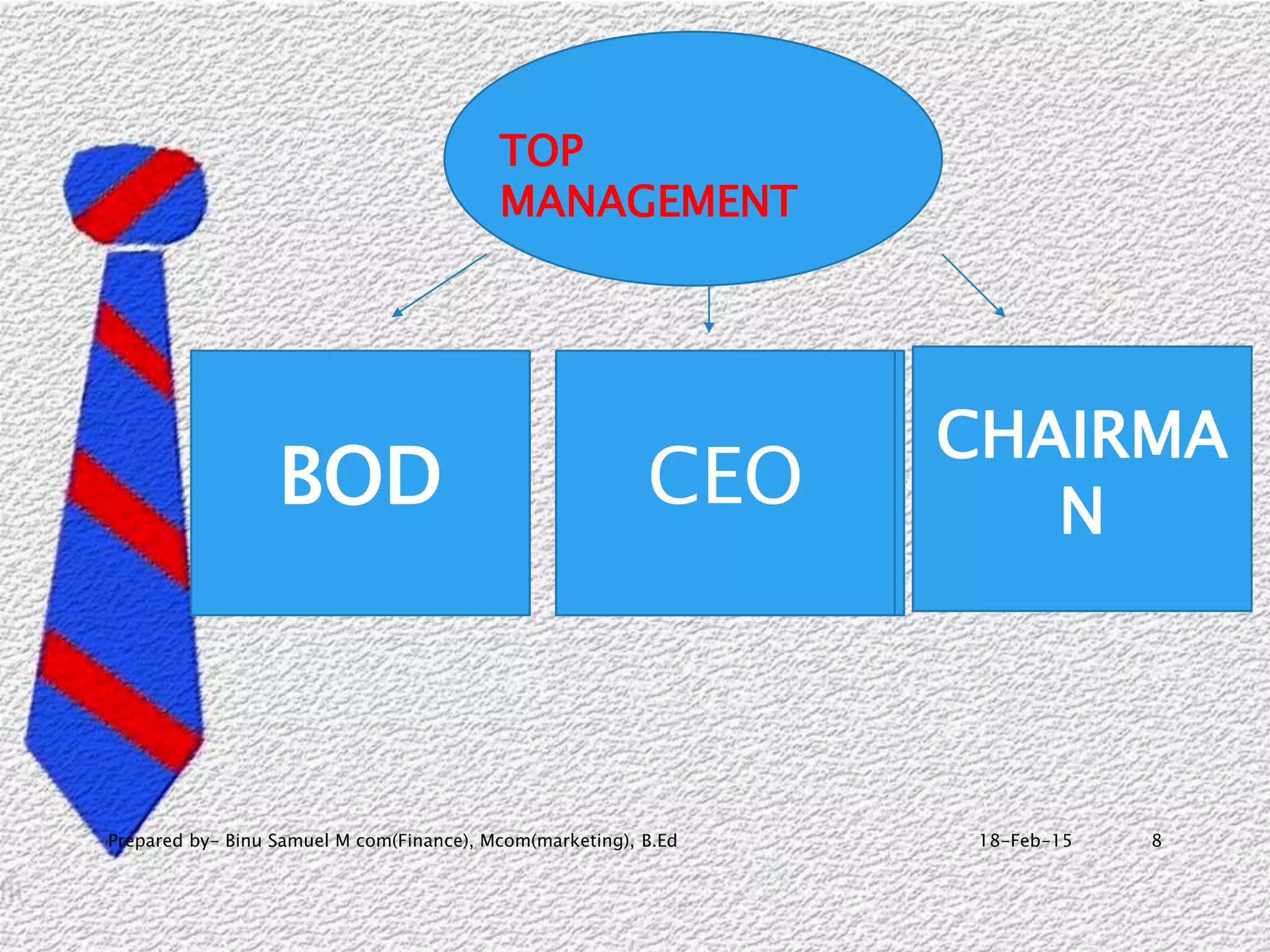
BOD
CHAIRMA
NCEO
TOP
MANAGEMENT
18-Feb-15Prepared by- Binu Samuel M com(Finance), Mcom(marketing), B.Ed 9
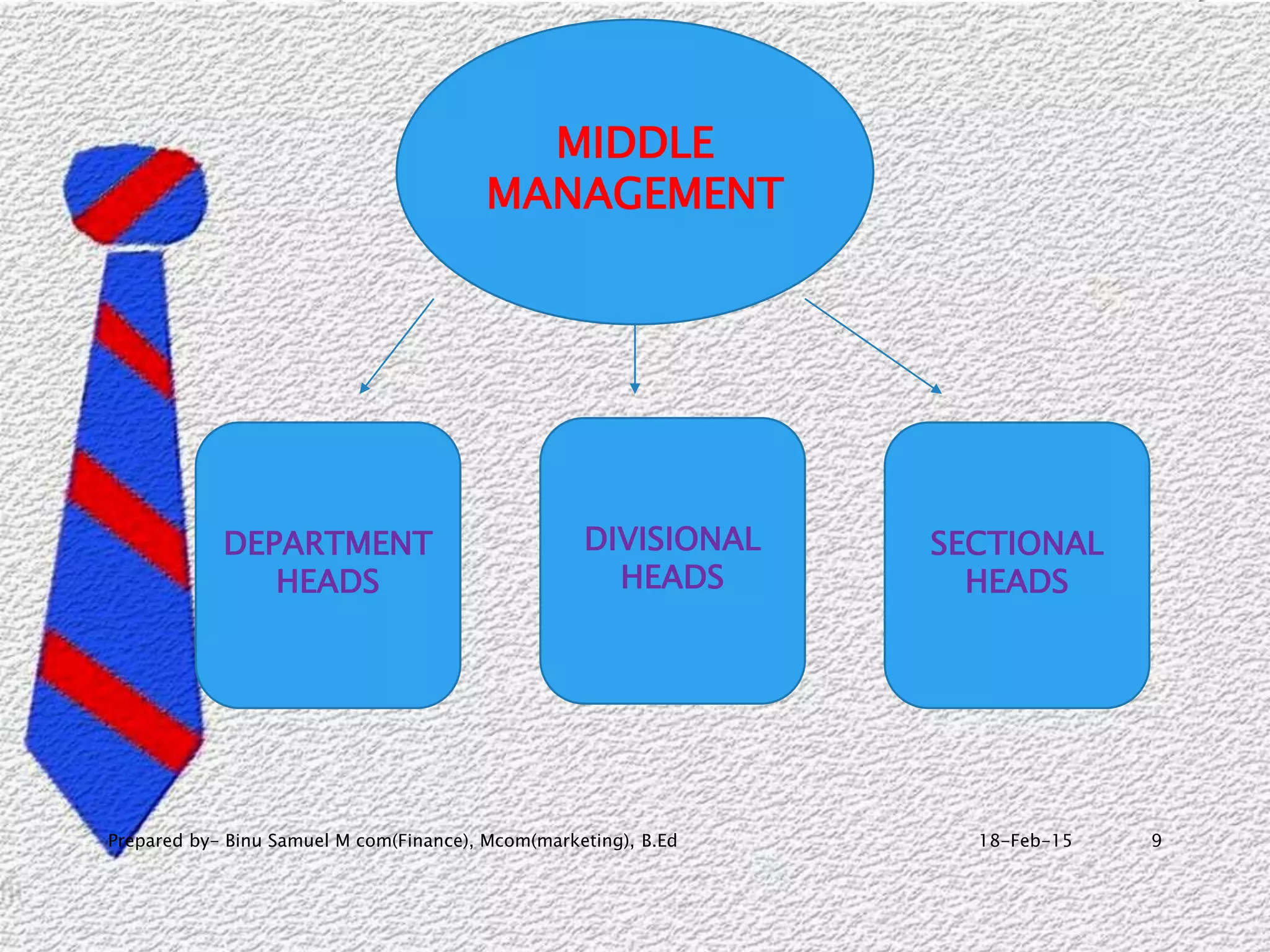
MIDDLE
MANAGEMENT
DEPARTMENT
HEADS
DIVISIONAL
HEADS
SECTIONAL
HEADS
18-Feb-15Prepared by- Binu Samuel M com(Finance), Mcom(marketing), B.Ed 10
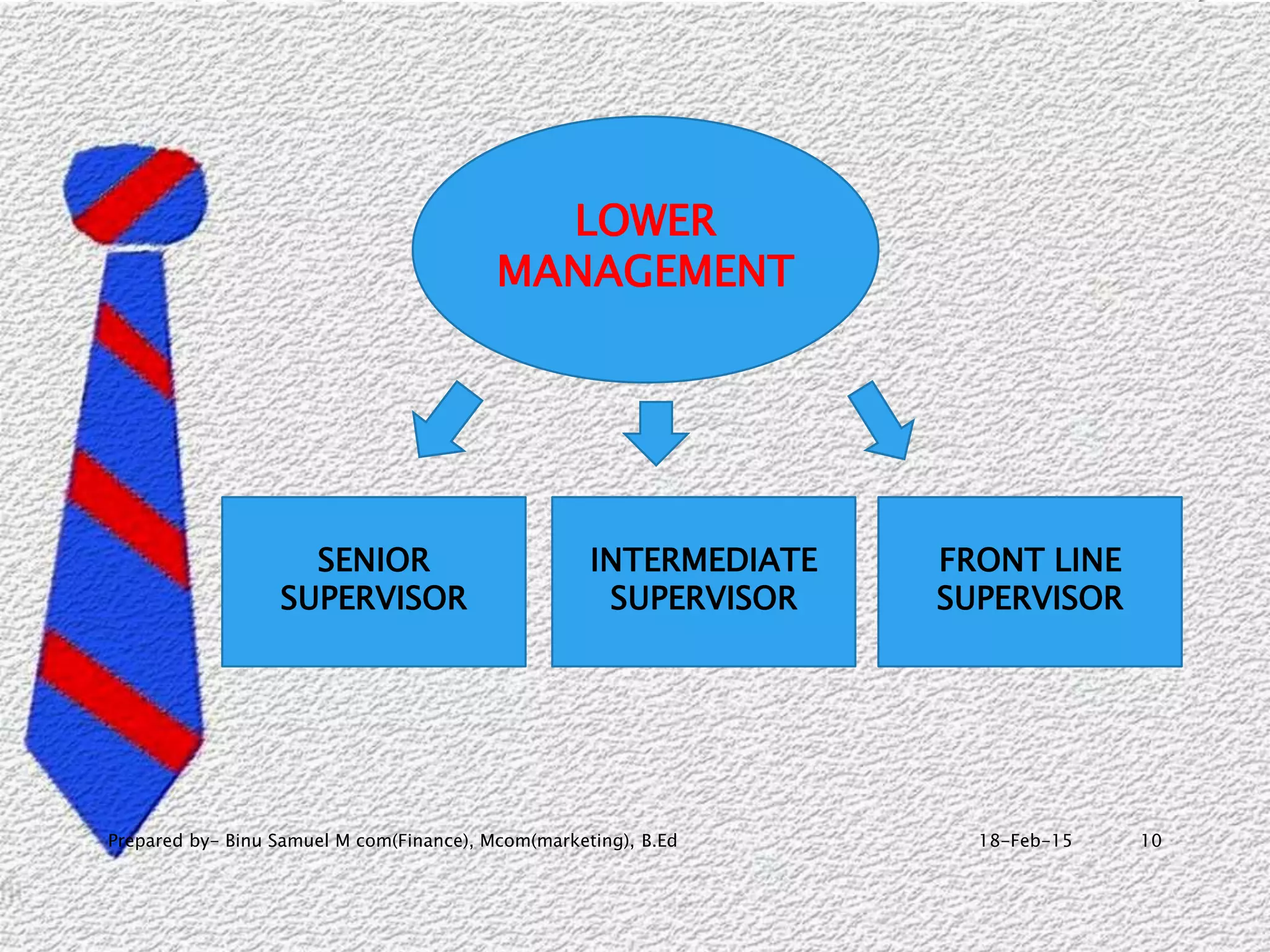
LOWER
MANAGEMENT
SENIOR
SUPERVISOR
INTERMEDIATE
SUPERVISOR
FRONT LINE
SUPERVISOR
18-Feb-15Prepared by- Binu Samuel M com(Finance), Mcom(marketing), B.Ed 11
FUNCTIONS OF
MANAGEMENT
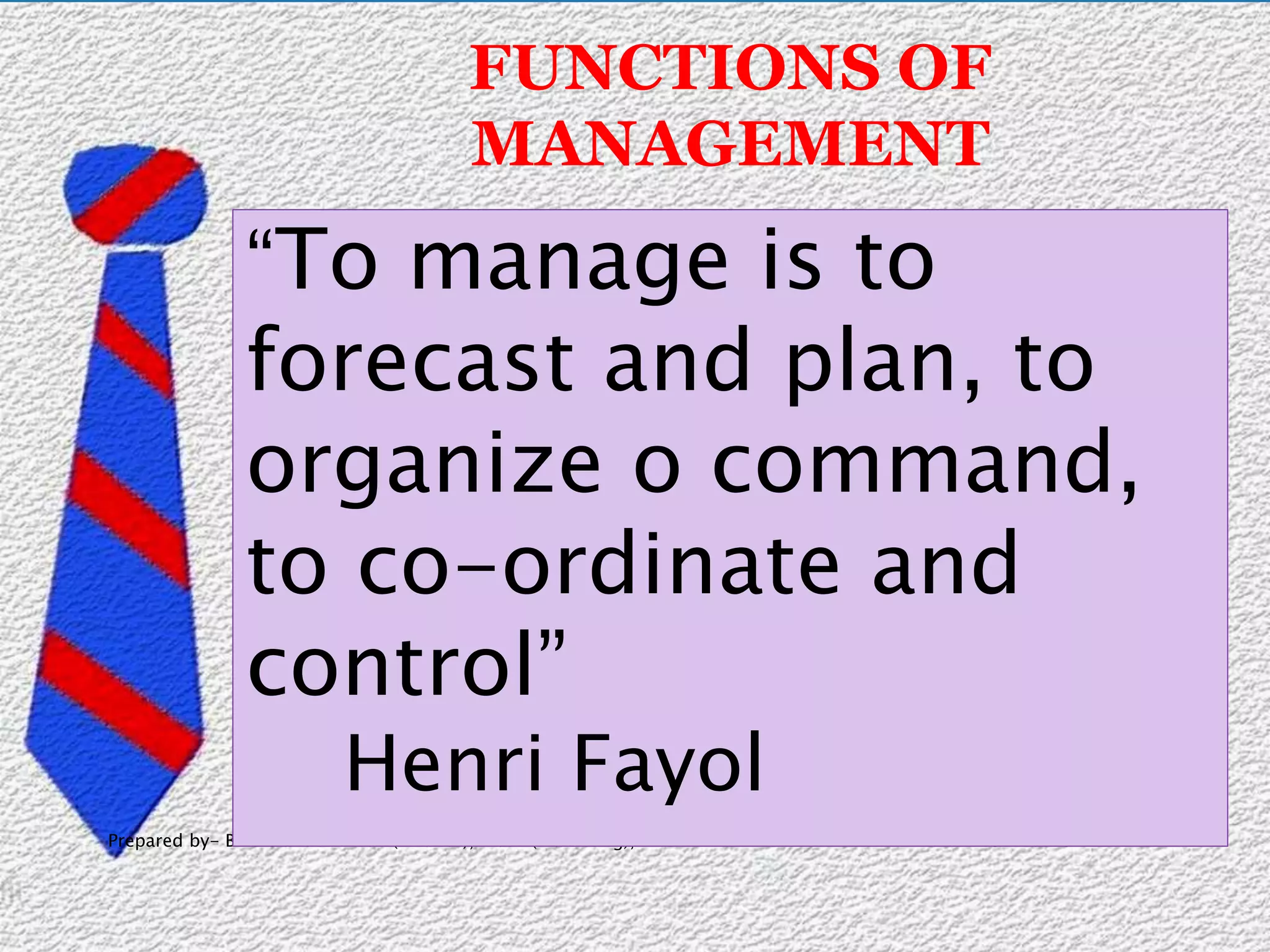
“To manage is to
forecast and plan, to
organize o command,
to co-ordinate and
control”
Henri Fayol
18-Feb-15Prepared by- Binu Samuel M com(Finance), Mcom(marketing), B.Ed 12
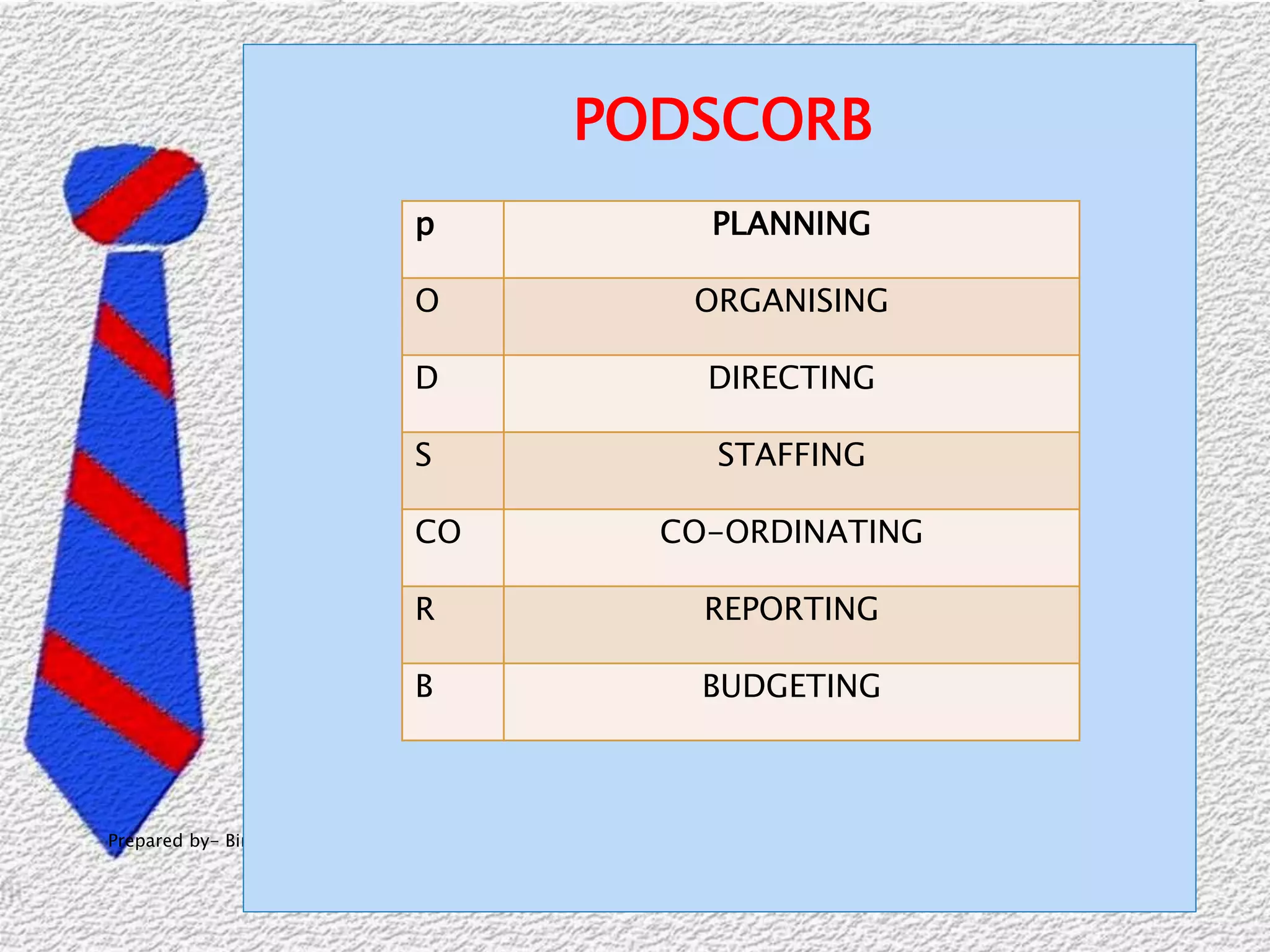
p PLANNING
O ORGANISING
D DIRECTING
S STAFFING
CO CO-ORDINATING
R REPORTING
B BUDGETING
PODSCORB
18-Feb-15Prepared by- Binu Samuel M com(Finance), Mcom(marketing), B.Ed 13
18-Feb-15Prepared by- Binu Samuel M com(Finance), Mcom(marketing), B.Ed 14
Organization structure
 A formal pattern of interactions and
coordination designed by
management to link the tasks of
individuals and group in achieving
organisational goals
 A formal framework by which jobs
tasks are divided, grouped and
coordinated.
 When managers develop or change an
organisation’s structure thy engage in
18-Feb-15Prepared by- Binu Samuel M com(Finance), Mcom(marketing), B.Ed 15
• How job tasks are formally
divided, grouped and
coordinated.
(Robbins, 1996).
• The established pattern of
relationships between the
component parts of an
organisation, outlining both
communication, control and
authority patterns.
(Wilson and Rosenfeld, 1990).
18-Feb-15Prepared by- Binu Samuel M com(Finance), Mcom(marketing), B.Ed 16
Why Do Businesses Need to be Organised?
• Small businesses (particularly sole traders)
have an informal organisational structure
• As a business gets bigger then it starts to form
some kind of organisation
• An organisation structure is required as soon as
there are several people working in the
business
• The structure determines:
– Who is responsible for what job and
– Who is responsible to whom.
18-Feb-15Prepared by- Binu Samuel M com(Finance), Mcom(marketing), B.Ed 17
Definition of terms
• Responsibility – Area of work for a person or
group is accountable for. E.g. discipline of staff or
sales of product.
• Duties – Work or job requirements arising from
responsibilities. E.g. Writing a warning letter for late
coming or to meet clients or customers to persuade
then to buy products or services.
• Authority – the right to make decisions and take
action. E.g. secretary is given the authority to sign
orders up to RM500.
– Failure to coordinate between departments result in
duplication of work, stress, communication breakdown
and therefore frustrated staff
18-Feb-15Prepared by- Binu Samuel M com(Finance), Mcom(marketing), B.Ed 18
• Responsibility is defined as “a
particular burden of obligation upon
a person who is
responsible.” Responsible is defined
as “answerable or accountable, as
for something within one’s power or
control.” Therefore, a leader is
responsible and has
responsibility for the operation for
which she has been given
authority.
18-Feb-15Prepared by- Binu Samuel M com(Finance), Mcom(marketing), B.Ed 19
• Authority is defined as “a power
or right, delegated or given.” In
this sense, the person or
company that hires a leader
vests him with the authority to
manage or direct a particular
operation. It is expected that this
individual will exercise the full
scope of his authority to properly,
profitably, and professionally
manage the operation.
ORGANIZATIONAL CHART
18-Feb-15Prepared by- Binu Samuel M com(Finance), Mcom(marketing), B.Ed 20
18-Feb-15Prepared by- Binu Samuel M com(Finance), Mcom(marketing), B.Ed 21
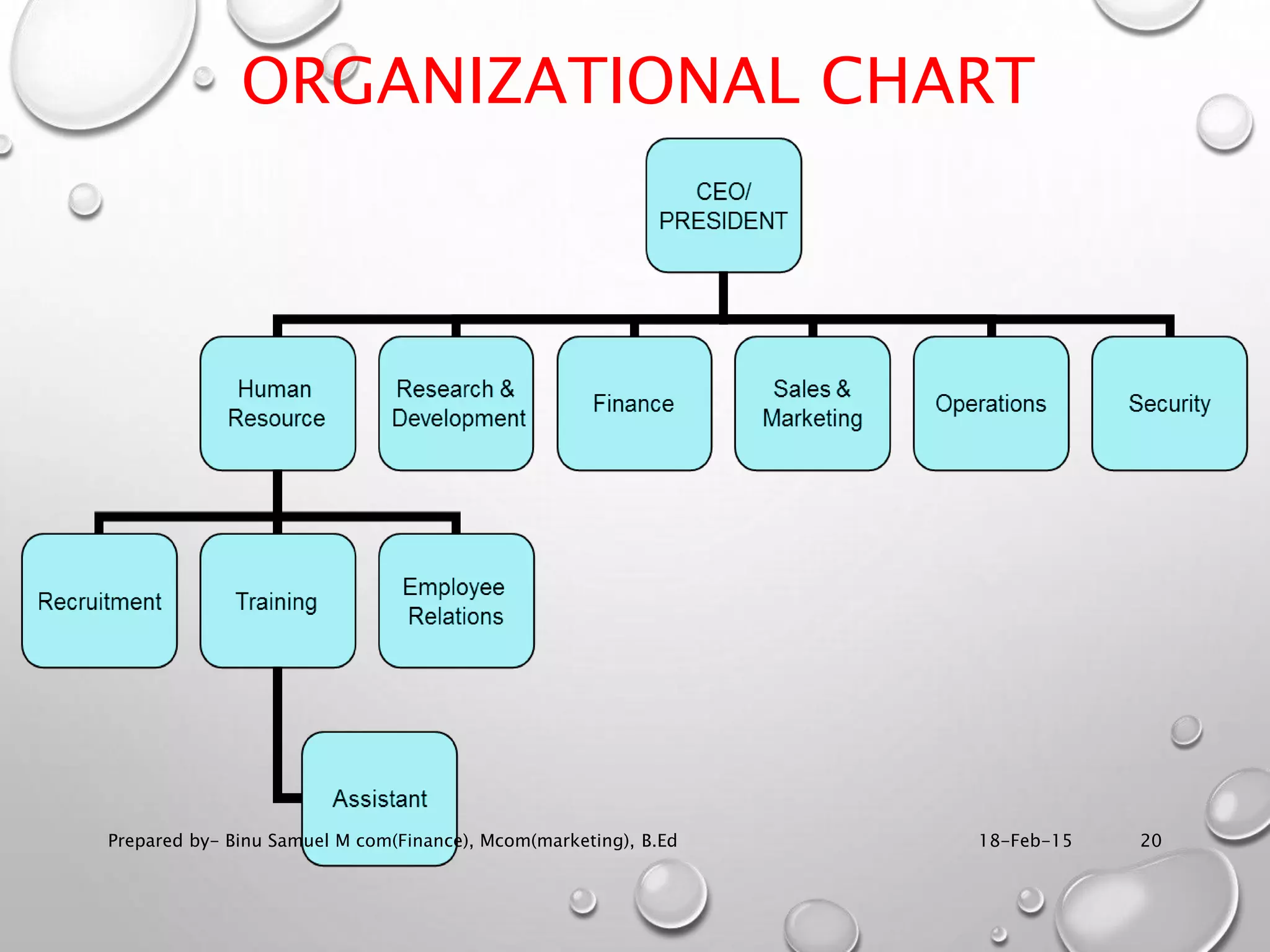
• A chart Shows;
– The business divided into areas where
employees have responsibilities.
– States relationships between staffs e.g.
Supervisor, subordinate, peer.
– Shows the number of people working in the
organisation.
– Historical record – organisation changes makes
the chart become out of date.
– As information to new employees and special
group.
– Main lines of communication.
18-Feb-15Prepared by- Binu Samuel M com(Finance), Mcom(marketing), B.Ed 22
Span of Control
The number of subordinates a supervisor
has reporting to him/her.
It is recommended that a supervisor has
about 5/6 subordinates for effective
management.
2 types of span of Control;
◦ Narrow
◦ Wide
Narrow
◦ Closer and more contact with subordinate
◦ Tight control and tight supervision
◦ More time for other duties – planning,
decision making
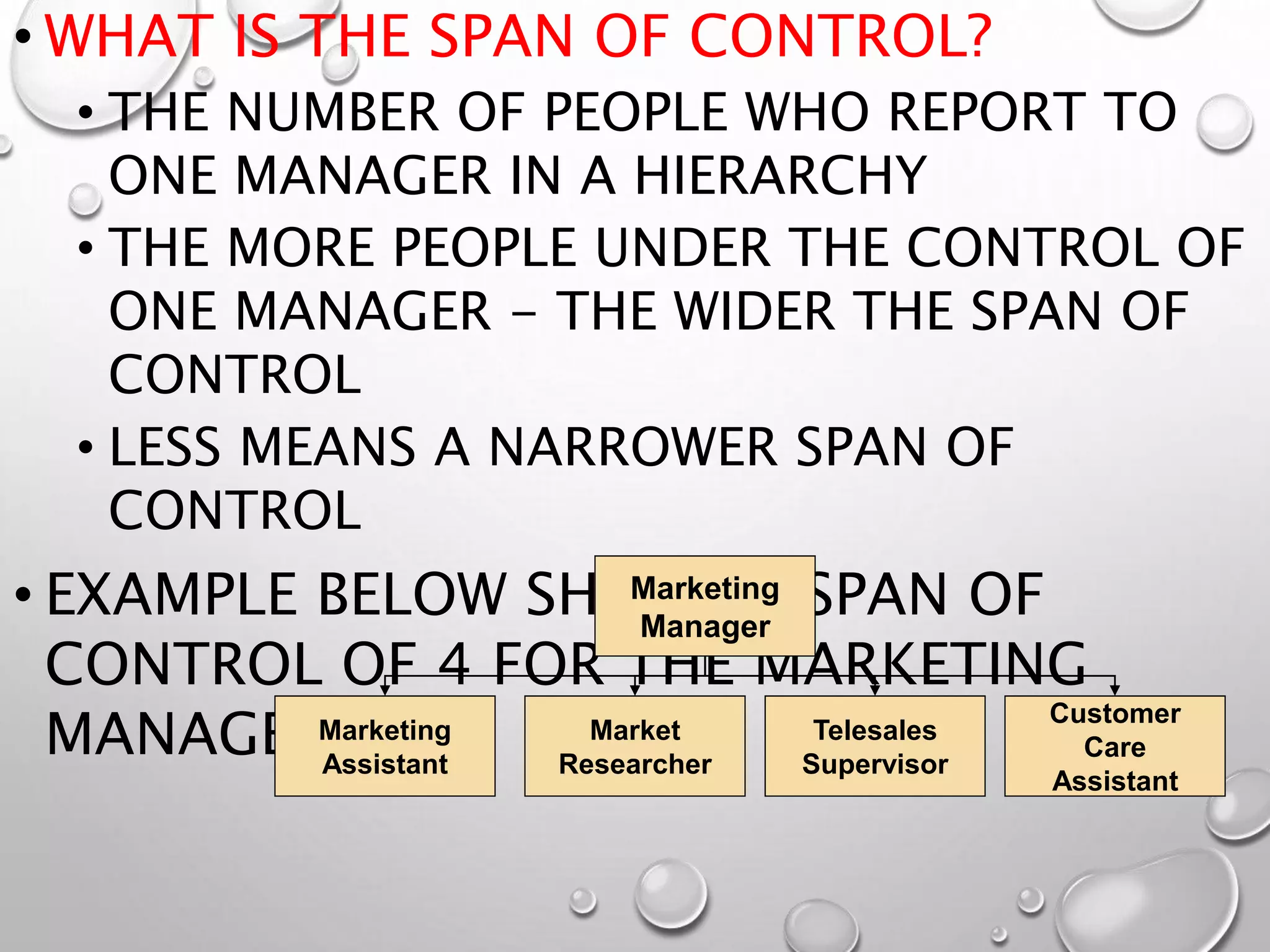
• WHAT IS THE SPAN OF CONTROL?
• THE NUMBER OF PEOPLE WHO REPORT TO
ONE MANAGER IN A HIERARCHY
• THE MORE PEOPLE UNDER THE CONTROL OF
ONE MANAGER - THE WIDER THE SPAN OF
CONTROL
• LESS MEANS A NARROWER SPAN OF
CONTROL
• EXAMPLE BELOW SHOWS A SPAN OF
CONTROL OF 4 FOR THE MARKETING
MANAGER
Marketing
Manager
Marketing
Assistant
Market
Researcher
Telesales
Supervisor
Customer
Care
Assistant
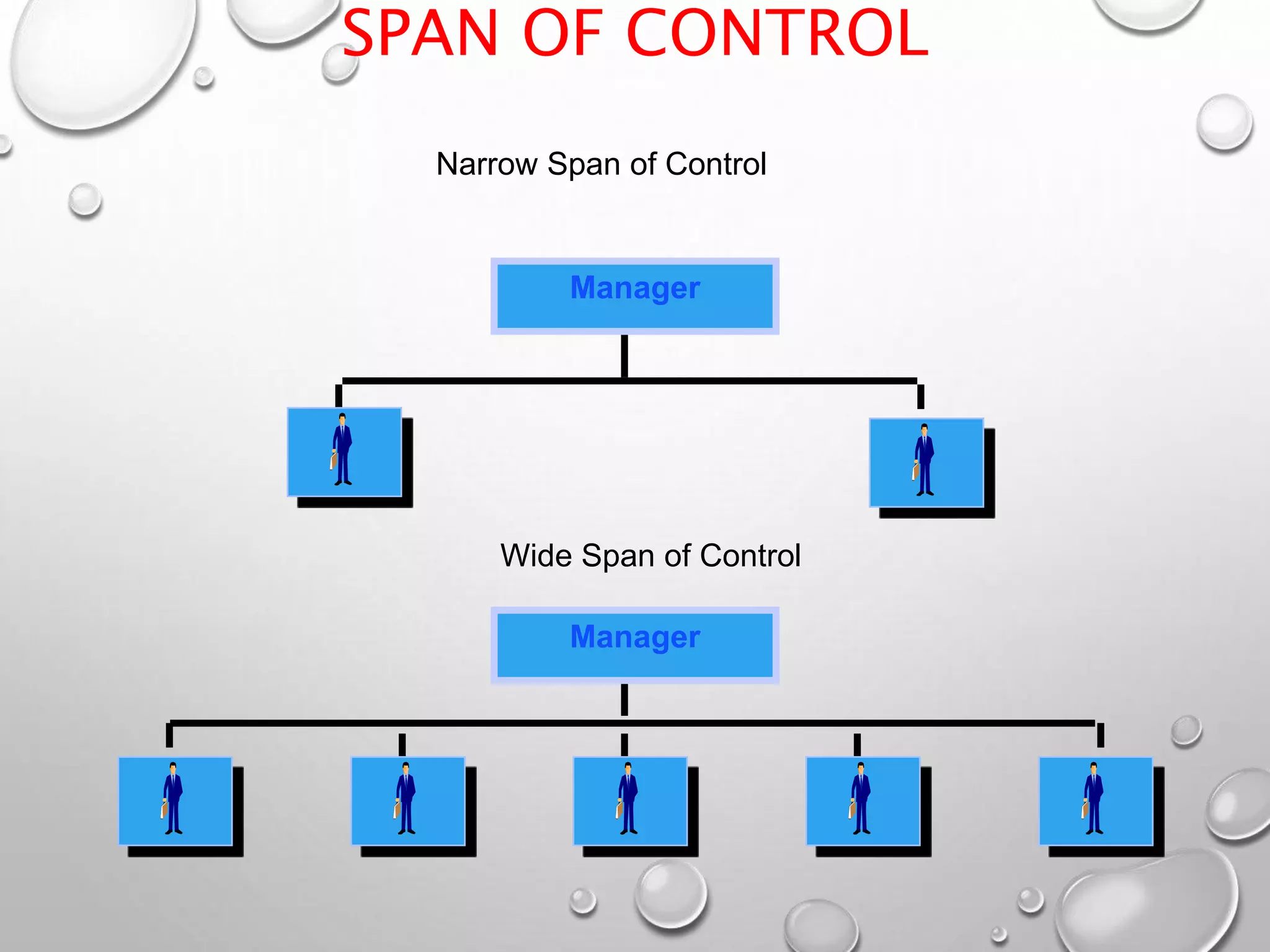
SPAN OF CONTROL
Narrow Span of Control
Manager
Wide Span of Control
Manager
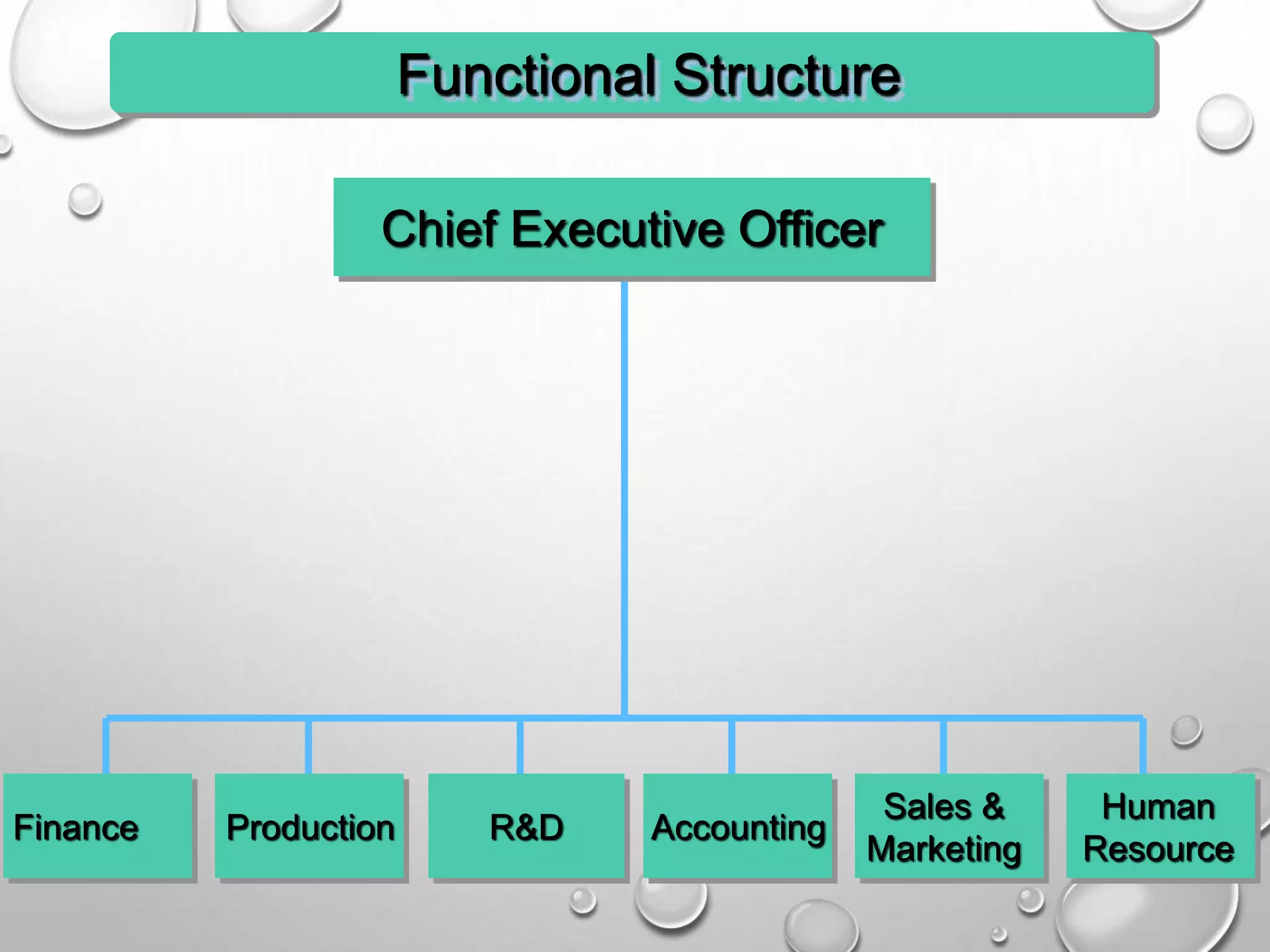
ProductionFinance R&D Accounting
Sales &
Marketing
Human
Resource
Chief Executive Officer
Functional Structure
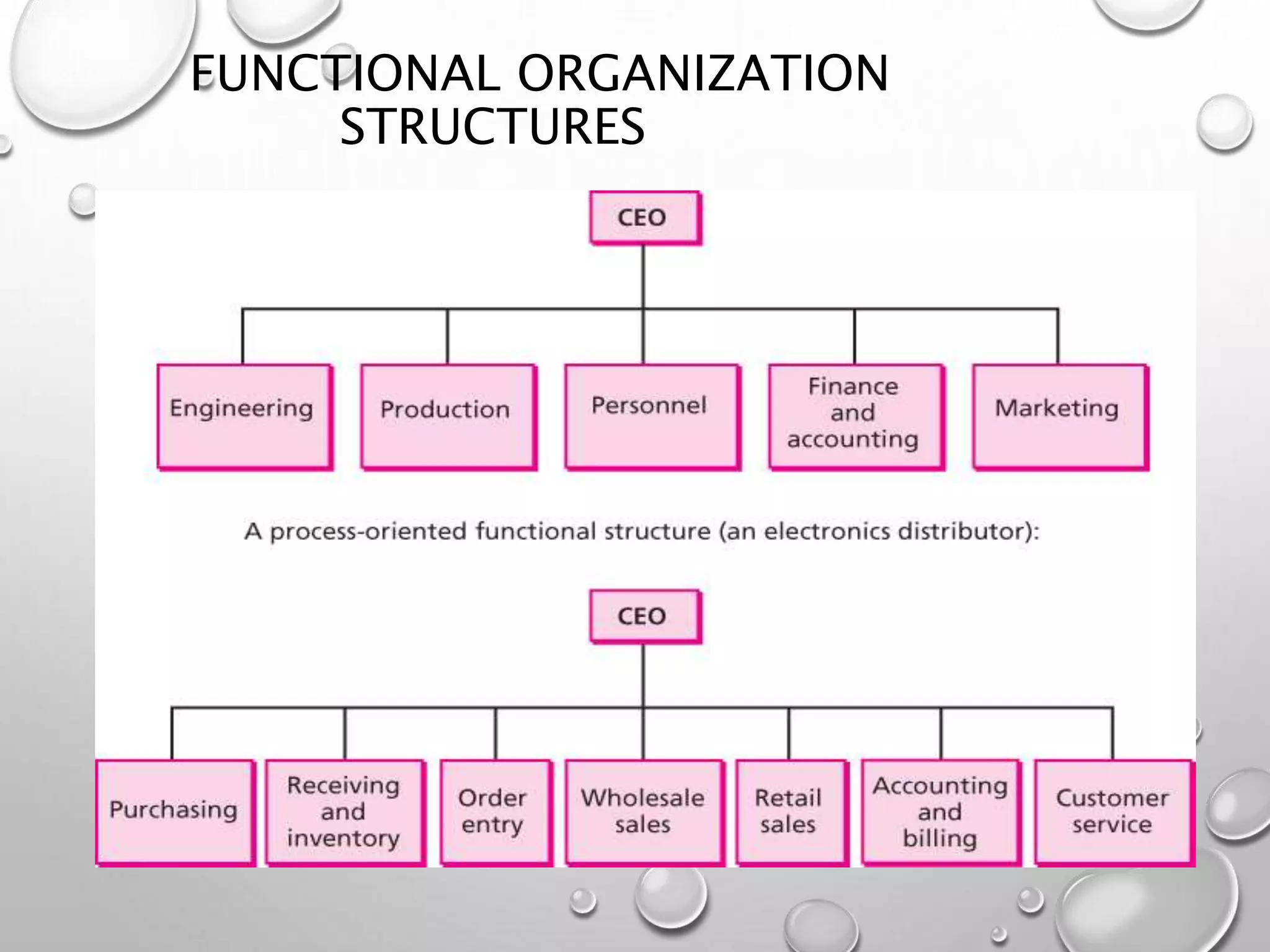
FUNCTIONAL ORGANIZATION
STRUCTURES
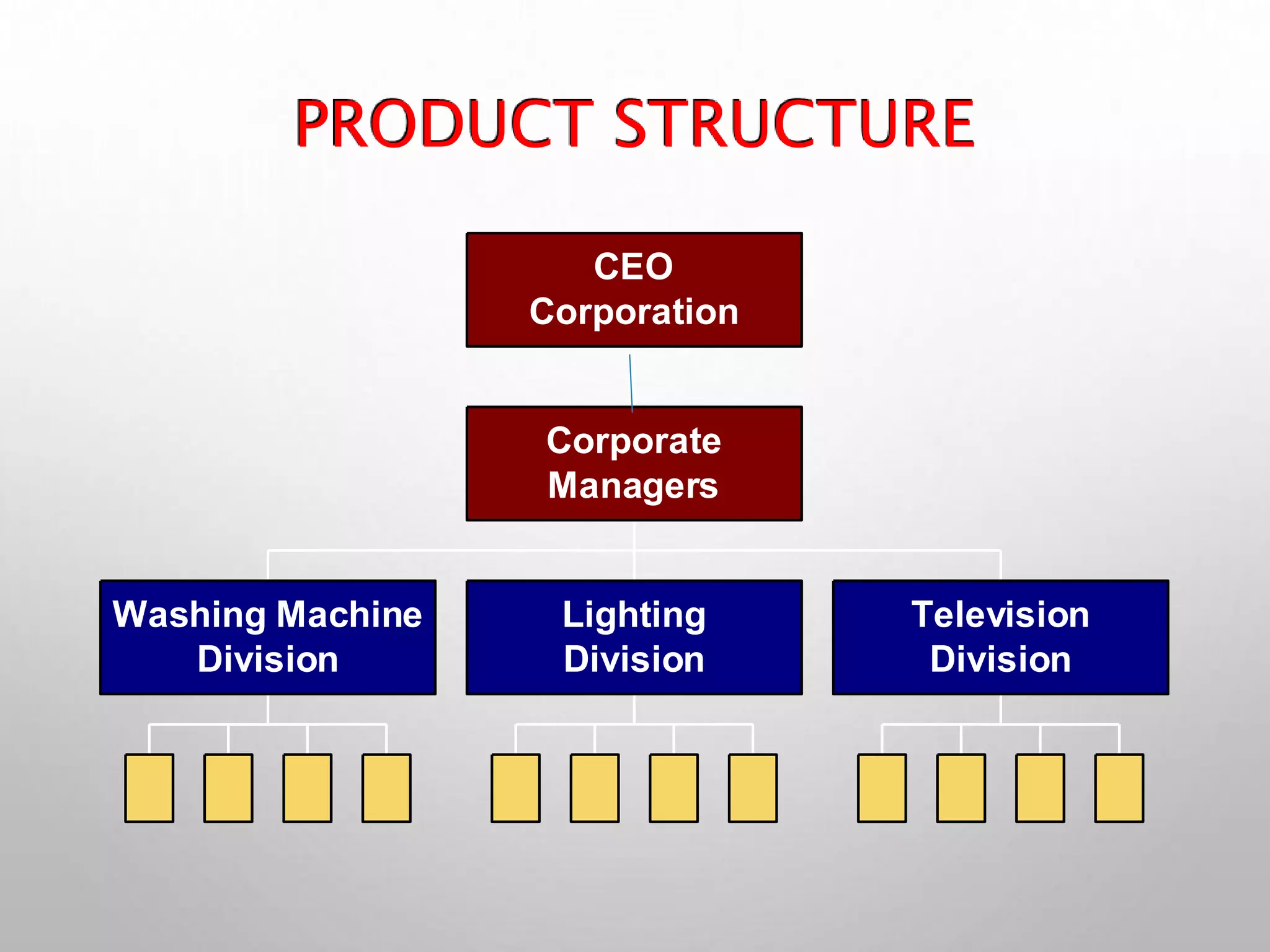
PRODUCT STRUCTURE
Washing Machine
Division
Lighting
Division
Television
Division
Corporate
Managers
CEO
Corporation
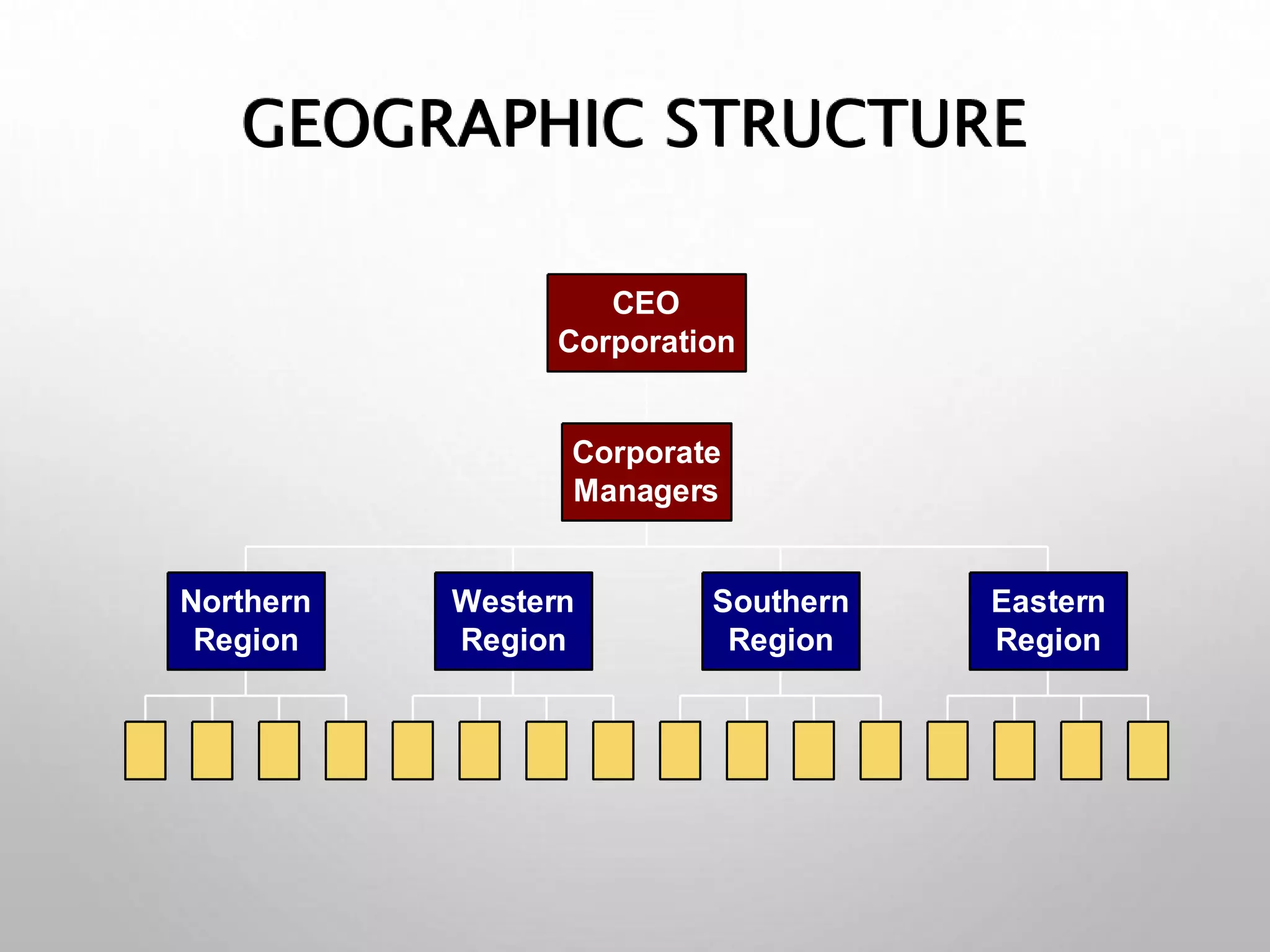
GEOGRAPHIC STRUCTURE
Northern
Region
Western
Region
Southern
Region
Eastern
Region
Corporate
Managers
CEO
Corporation
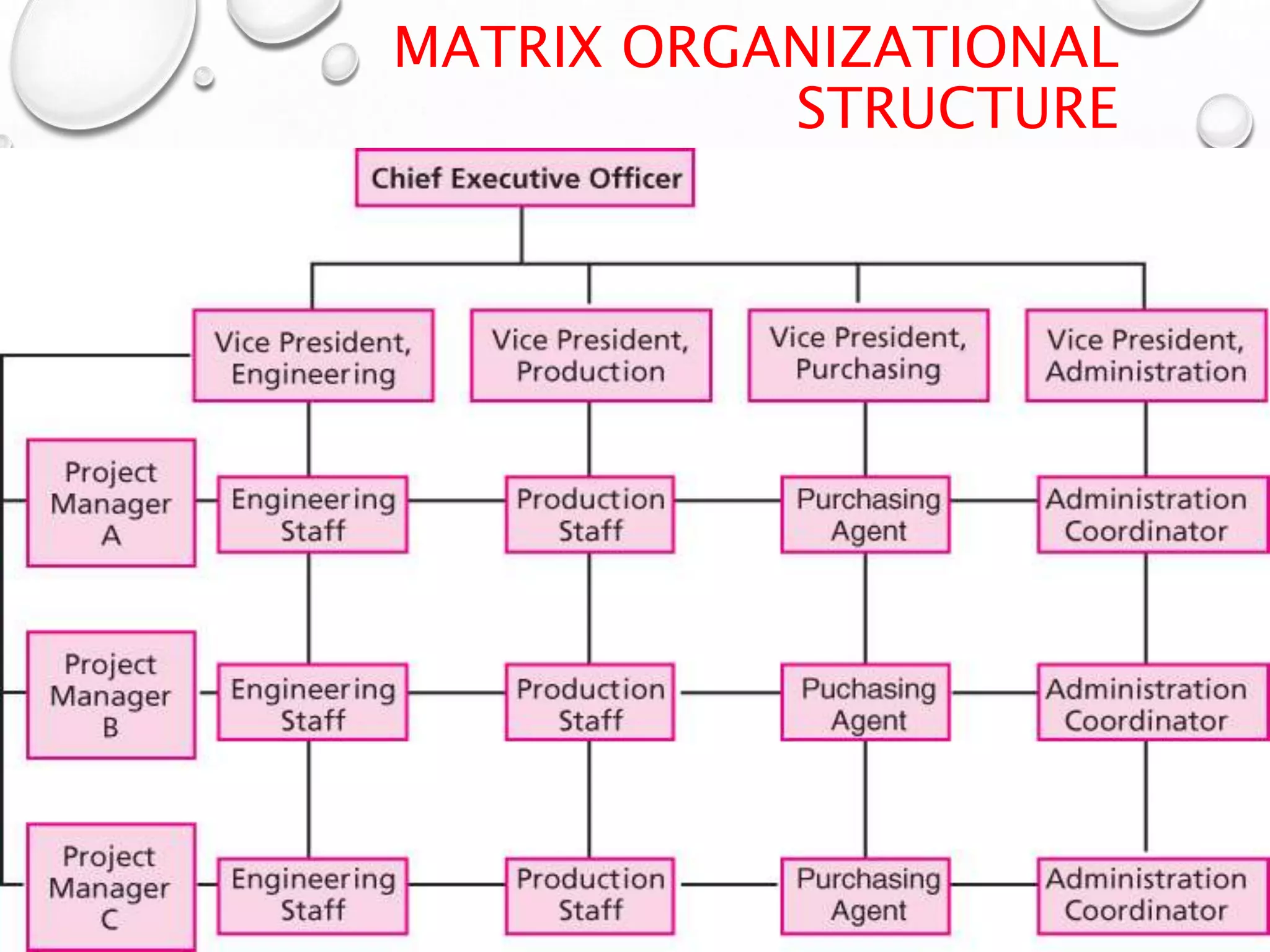
MATRIX ORGANIZATIONAL
STRUCTURE
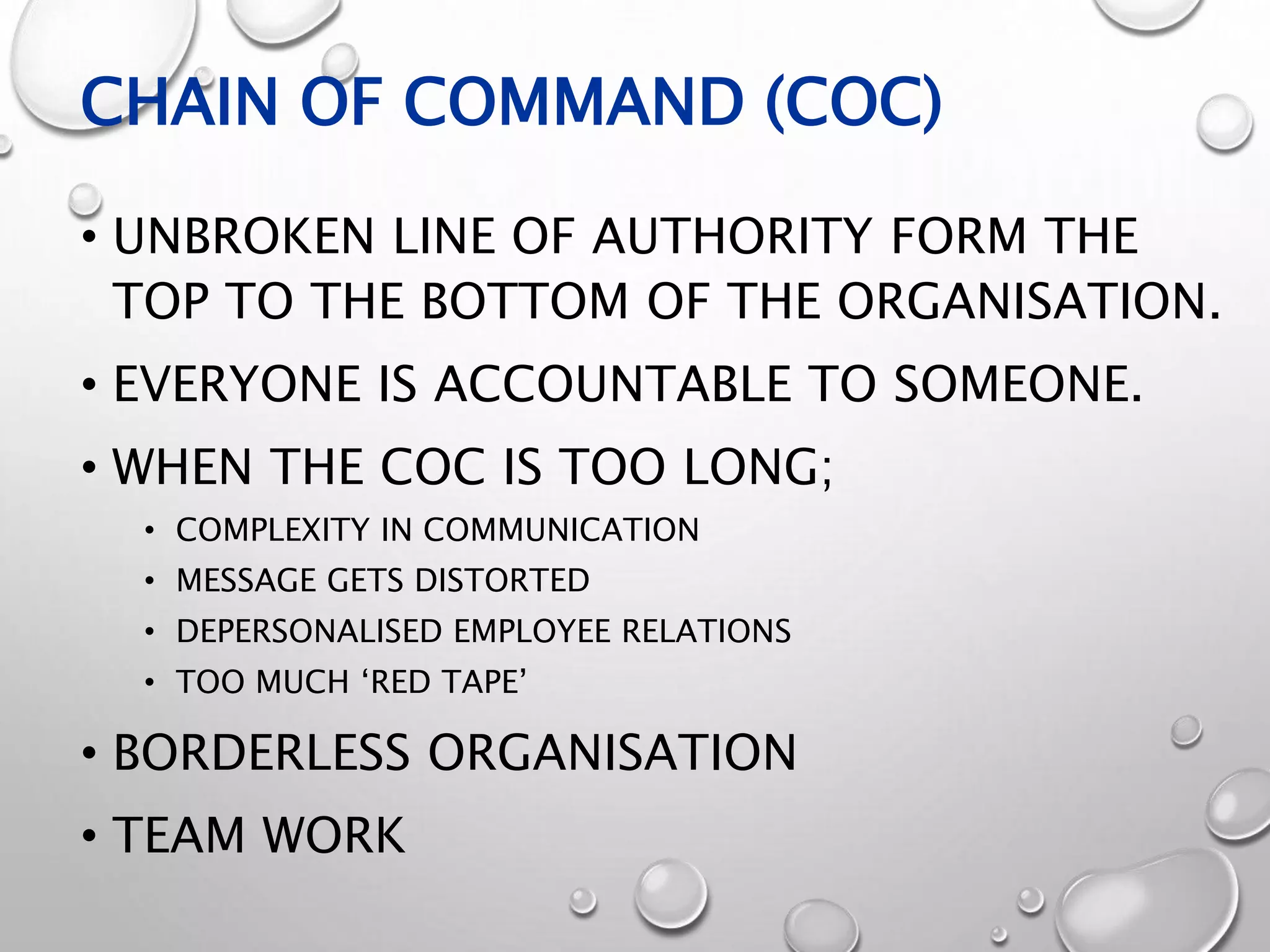
CHAIN OF COMMAND (COC)
• UNBROKEN LINE OF AUTHORITY FORM THE
TOP TO THE BOTTOM OF THE ORGANISATION.
• EVERYONE IS ACCOUNTABLE TO SOMEONE.
• WHEN THE COC IS TOO LONG;
• COMPLEXITY IN COMMUNICATION
• MESSAGE GETS DISTORTED
• DEPERSONALISED EMPLOYEE RELATIONS
• TOO MUCH ‘RED TAPE’
• BORDERLESS ORGANISATION
• TEAM WORK
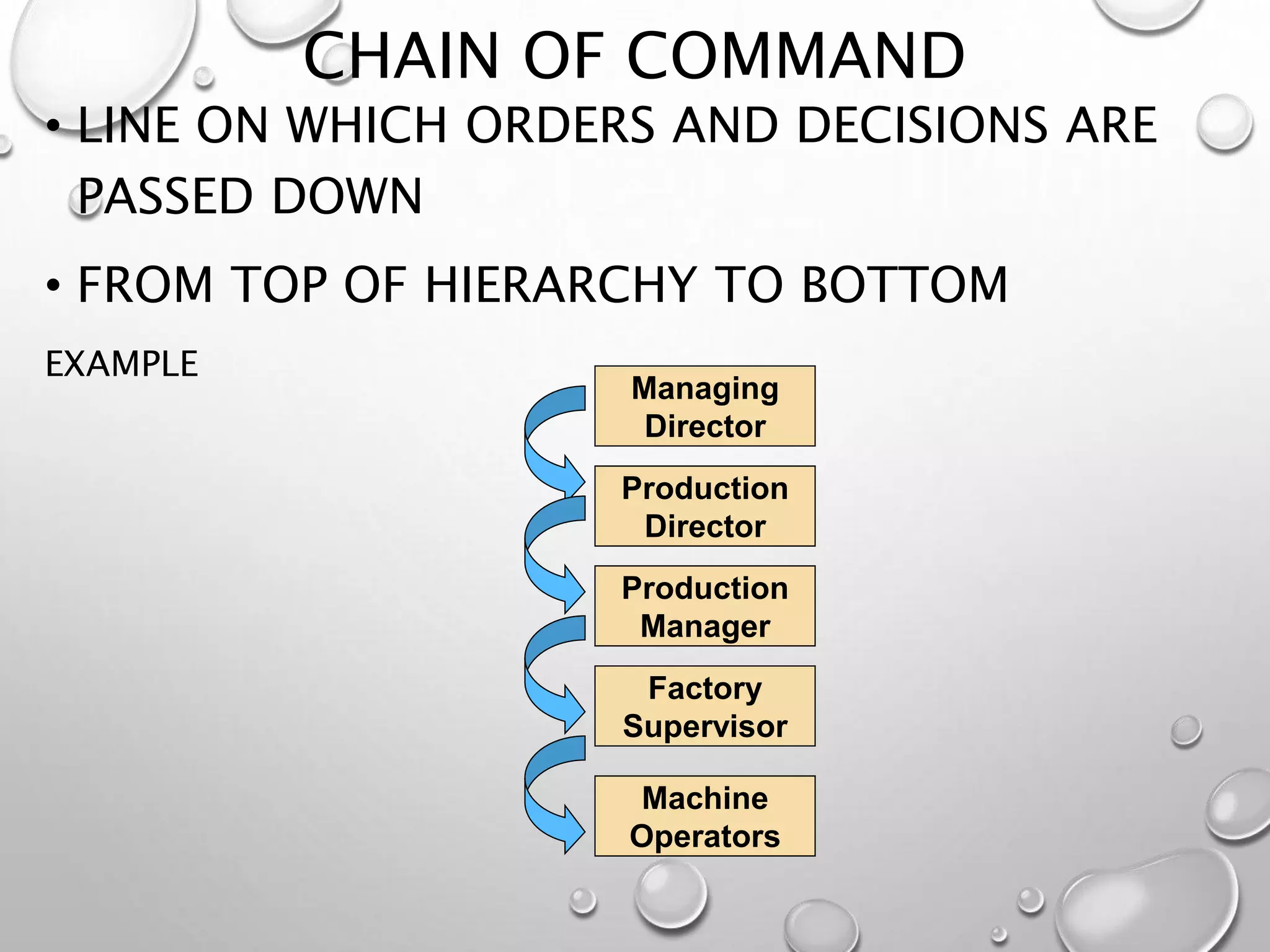
CHAIN OF COMMAND
• LINE ON WHICH ORDERS AND DECISIONS ARE
PASSED DOWN
• FROM TOP OF HIERARCHY TO BOTTOM
EXAMPLE
Managing
Director
Production
Director
Production
Manager
Factory
Supervisor
Machine
Operators
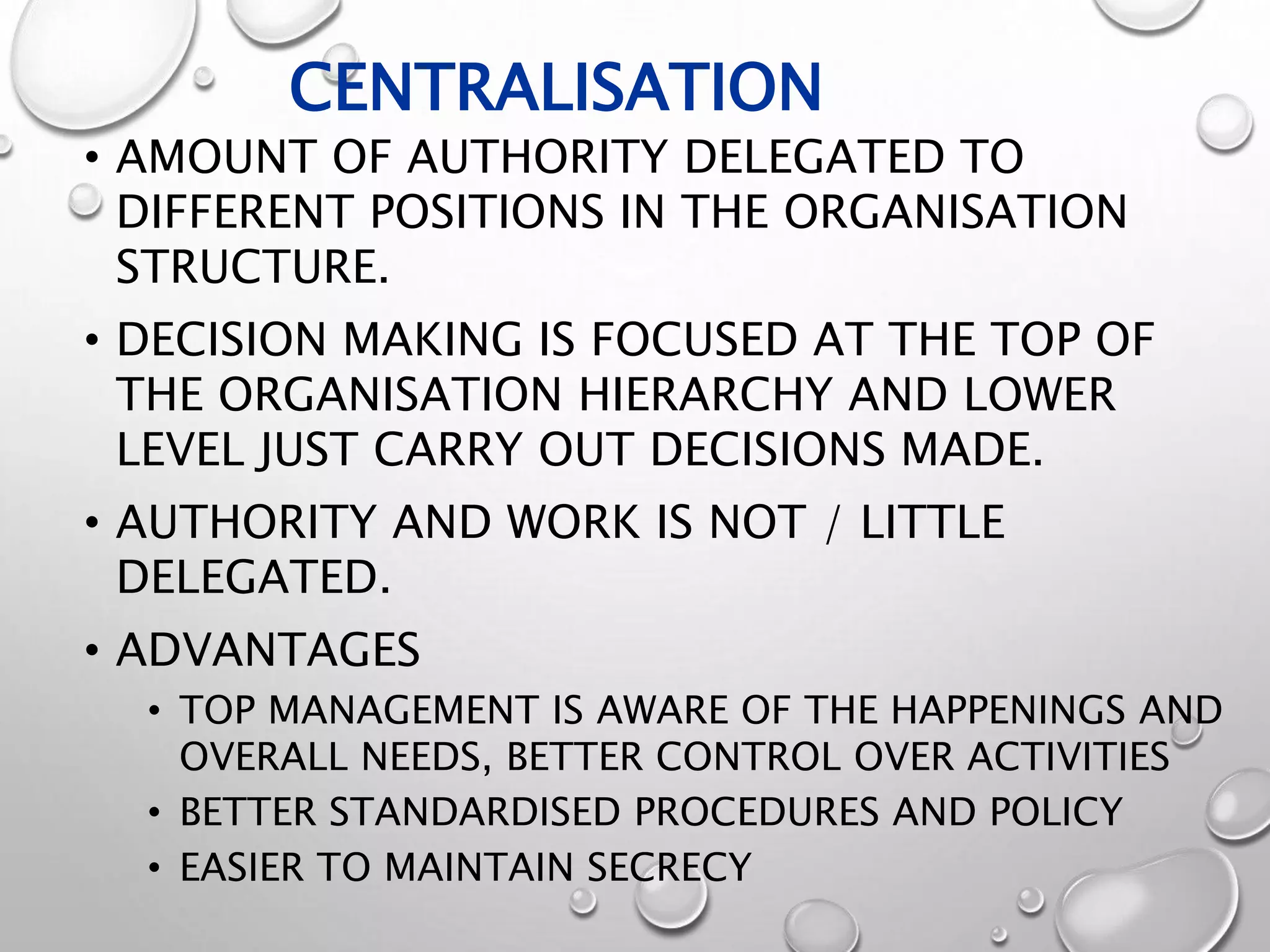
CENTRALISATION
• AMOUNT OF AUTHORITY DELEGATED TO
DIFFERENT POSITIONS IN THE ORGANISATION
STRUCTURE.
• DECISION MAKING IS FOCUSED AT THE TOP OF
THE ORGANISATION HIERARCHY AND LOWER
LEVEL JUST CARRY OUT DECISIONS MADE.
• AUTHORITY AND WORK IS NOT / LITTLE
DELEGATED.
• ADVANTAGES
• TOP MANAGEMENT IS AWARE OF THE HAPPENINGS AND
OVERALL NEEDS, BETTER CONTROL OVER ACTIVITIES
• BETTER STANDARDISED PROCEDURES AND POLICY
• EASIER TO MAINTAIN SECRECY
DECENTRALISATION
• DECISION ARE MADE AT ALL MANAGEMENT
LEVELS.
• LOWER LEVEL MANAGEMENT PROVIDE INPUT IN
DECISION MAKING.
• AUTHORITY AND WORK IS DELEGATED
• ADVANTAGES
• REDUCES WORK LOAD FOR TOP MANAGEMENT
• FASTER DECISIONS
• BETTER DECISIONS
• EMPLOYEES LEARN TO MAKE DECISIONS
• IMPROVES STAFF MORALE
• ORGANISATION BECOMES FLEXIBLE
CENTRALISED ORGANISATIONS
• WHAT ARE THEY?
• ORGANISATIONS WHERE IMPORTANT DECISIONS ARE TAKEN AT
THE CENTRE AND THEN PASSED OUT TO THE VARIOUS
DEPARTMENTS / LOCATIONS
• ADVANTAGES
• TIGHT CONTROL OF DECISIONS
• DECISIONS MADE BY SENIOR MANAGEMENT
• HELPS DECISIONS TO BE CONSISTENT ACROSS THE BUSINESS
• AVOIDS REPETITION OF FUNCTIONS (E.G. ONLY ONE PURCHASING
DEPARTMENT)
• DISADVANTAGES
• LACK OF MOTIVATION FOR MANAGERS
• CENTRAL MANAGEMENT MAY BE “OUT OF TOUCH”
• MAY BE SLOW TO MAKE DECISIONS THAT NEED TO TAKEN
QUICKLY
DE-CENTRALISED ORGANISATIONS
• WHAT ARE THEY?
• ORGANISATIONS WHERE IMPORTANT DECISIONS ARE
DELEGATED TO MANAGERS IN OTHER DEPARTMENTS /
LOCATIONS
• ADVANTAGES
• INCREASED MOTIVATION OF MANAGERS
• ENCOURAGES LOCAL INITIATIVES
• DECISIONS BASED ON MORE UP-TO-DATE
INFORMATION
• DECISIONS MADE QUICKER
• DISADVANTAGES
• MANAGERS MAY LACK EXPERIENCE
• LOCAL DECISIONS MAY BE INCONSISTENT WITH THE
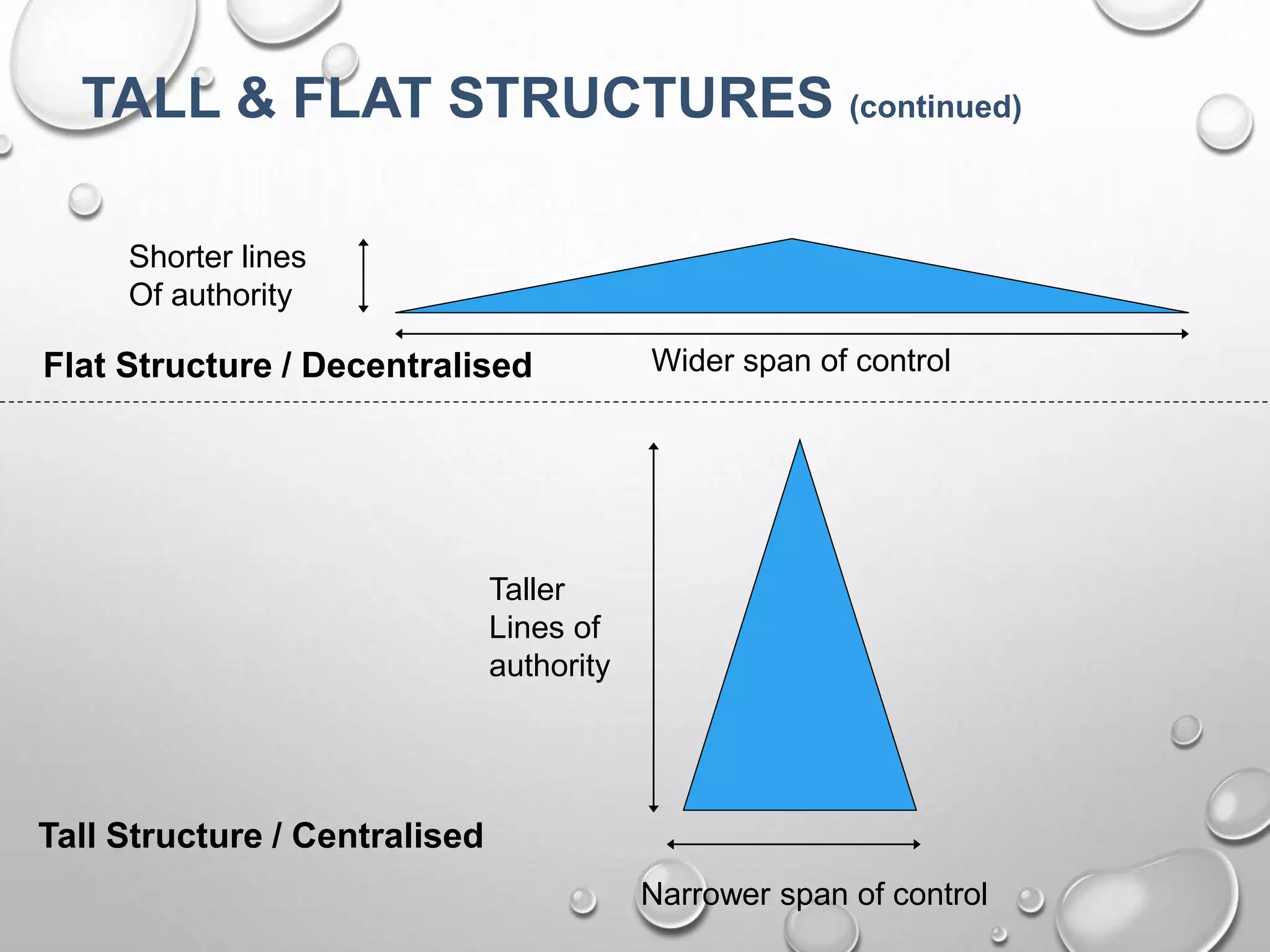
TALL & FLAT STRUCTURES (continued)
Flat Structure / Decentralised Wider span of control
Shorter lines
Of authority
Tall Structure / Centralised
Narrower span of control
Taller
Lines of
authority
18-Feb-15Prepared by- Binu Samuel M com(Finance), Mcom(marketing), B.Ed 37
Authority
it is the right to give orders.
It is institutional and
originates because of
structural relationships. It
exists in the context of
organizational relationship.
It is a downward flowing
concept.
18-Feb-15Prepared by- Binu Samuel M com(Finance), Mcom(marketing), B.Ed 38
Responsibility
Responsibility means obligation to
perform a task. It refers to the mental
and physical activities which should be
performed to carry out a task
It develops from the superior sub
ordinate relationship and can not
delegated or transferred
Responsibility is the obligation of a
subordinate to perform the assigned
and implied duties-
Koontz and O’ Donnel
18-Feb-15Prepared by- Binu Samuel M com(Finance), Mcom(marketing), B.Ed 39
Accountability
Accountability is the obligation
to perform responsibility and
exercise authority in terms of
performance standards
established by the superior.
When a subordinate is assigned
some duties to be performed, he
will be accountable to his
superior for doing or not doing
18-Feb-15Prepared by- Binu Samuel M com(Finance), Mcom(marketing), B.Ed 40
18-Feb-15Prepared by- Binu Samuel M com(Finance), Mcom(marketing), B.Ed 41

introduction to management

  • 1.
    18-Feb-15Prepared by- BinuSamuel M com(Finance), Mcom(marketing), B.Ed 1
  • 2.
    INTRODUCTION TO MANAGEMENT 18-Feb-15 Prepared by-Binu Samuel M com(Finance), Mcom(marketing), B.Ed 2
  • 3.
    18-Feb-15Prepared by- BinuSamuel M com(Finance), Mcom(marketing), B.Ed 3 Different Meaning Management is an art of getting things done Management is a process of planning, organizing, staffing, directing and controlling Management is a distinct activity of any organization Management is a discipline which represents a body of knowledge. Management denotes a group of
  • 4.
    18-Feb-15Prepared by- BinuSamuel M com(Finance), Mcom(marketing), B.Ed 4 Definition ‘Management is a distinct process consisting of planning, organizing, actuating and controlling performed to determine and accomplish the objectives by the use of people and resources’ - George .R. Terry
  • 5.
    18-Feb-15Prepared by- BinuSamuel M com(Finance), Mcom(marketing), B.Ed 5 Management is principally the task of planning, coordinating, motivating and controlling the efforts of others towards a specific objective
  • 6.
    18-Feb-15Prepared by- BinuSamuel M com(Finance), Mcom(marketing), B.Ed 6 Features of management 1.Management is getting things done 2.Management is an activity 3.Management is purposeful 4.Management is a process 5.Management is a profession 6.management involves decision making 7.Management is a science and Art
  • 7.
    18-Feb-15Prepared by- BinuSamuel M com(Finance), Mcom(marketing), B.Ed 7 Levels of management Levels of management refers to the arrangement of managerial positions in an organization 1.Top management 2.Middle management
  • 8.
    BO 18-Feb-15Prepared by- BinuSamuel M com(Finance), Mcom(marketing), B.Ed 8 BOD CHAIRMA NCEO TOP MANAGEMENT
  • 9.
    18-Feb-15Prepared by- BinuSamuel M com(Finance), Mcom(marketing), B.Ed 9 MIDDLE MANAGEMENT DEPARTMENT HEADS DIVISIONAL HEADS SECTIONAL HEADS
  • 10.
    18-Feb-15Prepared by- BinuSamuel M com(Finance), Mcom(marketing), B.Ed 10 LOWER MANAGEMENT SENIOR SUPERVISOR INTERMEDIATE SUPERVISOR FRONT LINE SUPERVISOR
  • 11.
    18-Feb-15Prepared by- BinuSamuel M com(Finance), Mcom(marketing), B.Ed 11 FUNCTIONS OF MANAGEMENT “To manage is to forecast and plan, to organize o command, to co-ordinate and control” Henri Fayol
  • 12.
    18-Feb-15Prepared by- BinuSamuel M com(Finance), Mcom(marketing), B.Ed 12 p PLANNING O ORGANISING D DIRECTING S STAFFING CO CO-ORDINATING R REPORTING B BUDGETING PODSCORB
  • 13.
    18-Feb-15Prepared by- BinuSamuel M com(Finance), Mcom(marketing), B.Ed 13
  • 14.
    18-Feb-15Prepared by- BinuSamuel M com(Finance), Mcom(marketing), B.Ed 14 Organization structure  A formal pattern of interactions and coordination designed by management to link the tasks of individuals and group in achieving organisational goals  A formal framework by which jobs tasks are divided, grouped and coordinated.  When managers develop or change an organisation’s structure thy engage in
  • 15.
    18-Feb-15Prepared by- BinuSamuel M com(Finance), Mcom(marketing), B.Ed 15 • How job tasks are formally divided, grouped and coordinated. (Robbins, 1996). • The established pattern of relationships between the component parts of an organisation, outlining both communication, control and authority patterns. (Wilson and Rosenfeld, 1990).
  • 16.
    18-Feb-15Prepared by- BinuSamuel M com(Finance), Mcom(marketing), B.Ed 16 Why Do Businesses Need to be Organised? • Small businesses (particularly sole traders) have an informal organisational structure • As a business gets bigger then it starts to form some kind of organisation • An organisation structure is required as soon as there are several people working in the business • The structure determines: – Who is responsible for what job and – Who is responsible to whom.
  • 17.
    18-Feb-15Prepared by- BinuSamuel M com(Finance), Mcom(marketing), B.Ed 17 Definition of terms • Responsibility – Area of work for a person or group is accountable for. E.g. discipline of staff or sales of product. • Duties – Work or job requirements arising from responsibilities. E.g. Writing a warning letter for late coming or to meet clients or customers to persuade then to buy products or services. • Authority – the right to make decisions and take action. E.g. secretary is given the authority to sign orders up to RM500. – Failure to coordinate between departments result in duplication of work, stress, communication breakdown and therefore frustrated staff
  • 18.
    18-Feb-15Prepared by- BinuSamuel M com(Finance), Mcom(marketing), B.Ed 18 • Responsibility is defined as “a particular burden of obligation upon a person who is responsible.” Responsible is defined as “answerable or accountable, as for something within one’s power or control.” Therefore, a leader is responsible and has responsibility for the operation for which she has been given authority.
  • 19.
    18-Feb-15Prepared by- BinuSamuel M com(Finance), Mcom(marketing), B.Ed 19 • Authority is defined as “a power or right, delegated or given.” In this sense, the person or company that hires a leader vests him with the authority to manage or direct a particular operation. It is expected that this individual will exercise the full scope of his authority to properly, profitably, and professionally manage the operation.
  • 20.
    ORGANIZATIONAL CHART 18-Feb-15Prepared by-Binu Samuel M com(Finance), Mcom(marketing), B.Ed 20
  • 21.
    18-Feb-15Prepared by- BinuSamuel M com(Finance), Mcom(marketing), B.Ed 21 • A chart Shows; – The business divided into areas where employees have responsibilities. – States relationships between staffs e.g. Supervisor, subordinate, peer. – Shows the number of people working in the organisation. – Historical record – organisation changes makes the chart become out of date. – As information to new employees and special group. – Main lines of communication.
  • 22.
    18-Feb-15Prepared by- BinuSamuel M com(Finance), Mcom(marketing), B.Ed 22 Span of Control The number of subordinates a supervisor has reporting to him/her. It is recommended that a supervisor has about 5/6 subordinates for effective management. 2 types of span of Control; ◦ Narrow ◦ Wide Narrow ◦ Closer and more contact with subordinate ◦ Tight control and tight supervision ◦ More time for other duties – planning, decision making
  • 23.
    • WHAT ISTHE SPAN OF CONTROL? • THE NUMBER OF PEOPLE WHO REPORT TO ONE MANAGER IN A HIERARCHY • THE MORE PEOPLE UNDER THE CONTROL OF ONE MANAGER - THE WIDER THE SPAN OF CONTROL • LESS MEANS A NARROWER SPAN OF CONTROL • EXAMPLE BELOW SHOWS A SPAN OF CONTROL OF 4 FOR THE MARKETING MANAGER Marketing Manager Marketing Assistant Market Researcher Telesales Supervisor Customer Care Assistant
  • 24.
    SPAN OF CONTROL NarrowSpan of Control Manager Wide Span of Control Manager
  • 25.
    ProductionFinance R&D Accounting Sales& Marketing Human Resource Chief Executive Officer Functional Structure
  • 26.
  • 27.
  • 28.
  • 29.
  • 30.
    CHAIN OF COMMAND(COC) • UNBROKEN LINE OF AUTHORITY FORM THE TOP TO THE BOTTOM OF THE ORGANISATION. • EVERYONE IS ACCOUNTABLE TO SOMEONE. • WHEN THE COC IS TOO LONG; • COMPLEXITY IN COMMUNICATION • MESSAGE GETS DISTORTED • DEPERSONALISED EMPLOYEE RELATIONS • TOO MUCH ‘RED TAPE’ • BORDERLESS ORGANISATION • TEAM WORK
  • 31.
    CHAIN OF COMMAND •LINE ON WHICH ORDERS AND DECISIONS ARE PASSED DOWN • FROM TOP OF HIERARCHY TO BOTTOM EXAMPLE Managing Director Production Director Production Manager Factory Supervisor Machine Operators
  • 32.
    CENTRALISATION • AMOUNT OFAUTHORITY DELEGATED TO DIFFERENT POSITIONS IN THE ORGANISATION STRUCTURE. • DECISION MAKING IS FOCUSED AT THE TOP OF THE ORGANISATION HIERARCHY AND LOWER LEVEL JUST CARRY OUT DECISIONS MADE. • AUTHORITY AND WORK IS NOT / LITTLE DELEGATED. • ADVANTAGES • TOP MANAGEMENT IS AWARE OF THE HAPPENINGS AND OVERALL NEEDS, BETTER CONTROL OVER ACTIVITIES • BETTER STANDARDISED PROCEDURES AND POLICY • EASIER TO MAINTAIN SECRECY
  • 33.
    DECENTRALISATION • DECISION AREMADE AT ALL MANAGEMENT LEVELS. • LOWER LEVEL MANAGEMENT PROVIDE INPUT IN DECISION MAKING. • AUTHORITY AND WORK IS DELEGATED • ADVANTAGES • REDUCES WORK LOAD FOR TOP MANAGEMENT • FASTER DECISIONS • BETTER DECISIONS • EMPLOYEES LEARN TO MAKE DECISIONS • IMPROVES STAFF MORALE • ORGANISATION BECOMES FLEXIBLE
  • 34.
    CENTRALISED ORGANISATIONS • WHATARE THEY? • ORGANISATIONS WHERE IMPORTANT DECISIONS ARE TAKEN AT THE CENTRE AND THEN PASSED OUT TO THE VARIOUS DEPARTMENTS / LOCATIONS • ADVANTAGES • TIGHT CONTROL OF DECISIONS • DECISIONS MADE BY SENIOR MANAGEMENT • HELPS DECISIONS TO BE CONSISTENT ACROSS THE BUSINESS • AVOIDS REPETITION OF FUNCTIONS (E.G. ONLY ONE PURCHASING DEPARTMENT) • DISADVANTAGES • LACK OF MOTIVATION FOR MANAGERS • CENTRAL MANAGEMENT MAY BE “OUT OF TOUCH” • MAY BE SLOW TO MAKE DECISIONS THAT NEED TO TAKEN QUICKLY
  • 35.
    DE-CENTRALISED ORGANISATIONS • WHATARE THEY? • ORGANISATIONS WHERE IMPORTANT DECISIONS ARE DELEGATED TO MANAGERS IN OTHER DEPARTMENTS / LOCATIONS • ADVANTAGES • INCREASED MOTIVATION OF MANAGERS • ENCOURAGES LOCAL INITIATIVES • DECISIONS BASED ON MORE UP-TO-DATE INFORMATION • DECISIONS MADE QUICKER • DISADVANTAGES • MANAGERS MAY LACK EXPERIENCE • LOCAL DECISIONS MAY BE INCONSISTENT WITH THE
  • 36.
    TALL & FLATSTRUCTURES (continued) Flat Structure / Decentralised Wider span of control Shorter lines Of authority Tall Structure / Centralised Narrower span of control Taller Lines of authority
  • 37.
    18-Feb-15Prepared by- BinuSamuel M com(Finance), Mcom(marketing), B.Ed 37 Authority it is the right to give orders. It is institutional and originates because of structural relationships. It exists in the context of organizational relationship. It is a downward flowing concept.
  • 38.
    18-Feb-15Prepared by- BinuSamuel M com(Finance), Mcom(marketing), B.Ed 38 Responsibility Responsibility means obligation to perform a task. It refers to the mental and physical activities which should be performed to carry out a task It develops from the superior sub ordinate relationship and can not delegated or transferred Responsibility is the obligation of a subordinate to perform the assigned and implied duties- Koontz and O’ Donnel
  • 39.
    18-Feb-15Prepared by- BinuSamuel M com(Finance), Mcom(marketing), B.Ed 39 Accountability Accountability is the obligation to perform responsibility and exercise authority in terms of performance standards established by the superior. When a subordinate is assigned some duties to be performed, he will be accountable to his superior for doing or not doing
  • 40.
    18-Feb-15Prepared by- BinuSamuel M com(Finance), Mcom(marketing), B.Ed 40
  • 41.
    18-Feb-15Prepared by- BinuSamuel M com(Finance), Mcom(marketing), B.Ed 41