Unit– III Functions of Management:
Part-I
Definition of Planning
Planning is the fundamental management function, which
involves deciding beforehand, what is to be done, when is it to
be done, how it is to be done and who is going to do it. It is
an intellectual process which lays down an organisation’s
objectives and develops various courses of action, by which the
organisation can achieve those objectives. Planning is nothing
but thinking before the action takes place. It helps us to take
a peep into the future and decide in advance the way to deal
with the situations, which we are going to encounter in future. It
involves logical thinking and rational decision making.
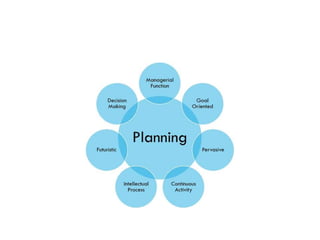
• Managerial function: Planning is a first and foremost
managerial function provides the base for other functions of
the management, i.e. organising, staffing, directing and
controlling, as they are performed within the periphery of the
plans made.
• Goal oriented: It focuses on defining the goals of the
organisation, identifying alternative courses of action and
deciding the appropriate action plan, which is to be
undertaken for reaching the goals.
• Pervasive: It is pervasive in the sense that it is present in all
the segments and is required at all the levels of the
organisation. Although the scope of planning varies at
different levels and departments.
• Continuous Process: Plans are made for a specific term, say
for a month, quarter, year and so on. Once that period is over,
new plans are drawn, considering the organisation’s present
and future requirements and conditions. Therefore, it is an
ongoing process, as the plans are framed, executed and
followed by another plan.
• Intellectual Process: It is a mental exercise at it involves the
application of mind, to think, forecast, imagine intelligently
and innovate etc.
• Futuristic: In the process of planning we take a sneak peek of
the future. It encompasses looking into the future, to analyse
and predict it so that the organisation can face future
challenges effectively.
Importance of Planning
• It helps managers to improve future performance, by
establishing objectives and selecting a course of action, for
the benefit of the organisation.
• It minimises risk and uncertainty, by looking ahead into the
future.
• It facilitates the coordination of activities. Thus, reduces
overlapping among activities and eliminates unproductive
work.
• It states in advance, what should be done in future, so it
provides direction for action.
• It uncovers and identifies future opportunities and threats.
• It sets out standards for controlling. It
compares actual performance with the
standard performance and efforts are made to
correct the same.
Types of Planning
These are of 3 types-
• Operational
• Strategical
• Tactical
Strategic Plans-Strategic plans are designed with the entire
organization in mind and begin with an organization's mission.
Top-level managers, such as CEOs or presidents, will design and
execute strategic plans to paint a picture of the desired future
and long-term goals of the organization. Essentially, strategic
plans look ahead to where the organization wants to be in three,
five, even ten years. Strategic plans, provided by top-level
managers, serve as the framework for lower-level planning.
• Tactical plans support strategic plans by translating them into
specific plans relevant to a distinct area of the organization.
Tactical plans are concerned with the responsibility and
functionality of lower-level departments to fulfill their parts of
the strategic plan.
• Operational Plans- sit at the bottom of the totem pole; they
are the plans that are made by frontline, or low-level,
managers. All operational plans are focused on the specific
procedures and processes that occur within the lowest levels
of the organization. Managers must plan the routine tasks of
the department using a high level of detail.
Process of Planning
Step # 1. Perception of opportunities:Perception of opportunities is
not strictly a part of the planning process. But this awareness of
opportunities in the external environment as well as within the
organisation is the real starting point for planning. It is important to
take a preliminary look at possible future opportunities and see them
clearly and completely.
Step # 2. Establishing Objectives:This is the second step in the
planning process. The major organisational and unit objectives are set
in this stage. This is to be done for the long term as well as for the
short range. Objective specify the expected results and indicate the
end points of what is to be done, where the primary emphasis is to be
placed and what is to be accomplished by the various types of plans.
Step # 3. Planning Premises:After determination of
organisational objectives, the next step is establishing planning
premises that is the conditions under which planning activities
will be undertaken. Planning premises are planning assumptions
the expected environmental and internal conditions.
Step # 4. Identification of Alternatives:The fourth step in
planning is to identify the alternatives. Various alternatives can
be identified based on the organisational objectives and
planning premises. The concept of various alternatives suggests
that a particular objective can be achieved through various
actions.
Step # 5. Evaluation of Alternatives:The various alternative
course of action should be analysed in the light of premises and
goals. There are various techniques available to evaluate
alternatives. The evaluation is to be done in the light of various
factors. Example, cash inflow and outflow, risks, limited
resources, expected pay back etc., the alternatives should give us
the best chance of meeting our goals at the lowest cost and
highest profit.
Step # 6. Choice of Alternative Plans:This is the real point of
decision-making. An analysis and evaluation of alternative
courses will disclose that two or more advisable and beneficial
plans are selected.
Step # 7. Formulation of Supporting Plan:After formulating the
basic plan, various plan are derived so as to support the main
plan. In an organisation there can be various derivative plans like
planning for buying equipment, buying raw materials, recruiting
and training personal, developing new product etc. These
derivative plans are formulated out of the basic or main plan and
almost invariably required to support the basic plan.
Step # 8. Establishing Sequence of Activities:After formulating
basic and derivative plans, the sequence of activities is
determined so those plans are put into action. After decisions
are made and plans are set, budgets for various periods and
divisions can be prepared to give plans more concrete meaning
for implementation.
Barriers to Effective
Planning
Lack of Leadership-Being a leader is about more than a
title following your name. It requires developing a
strategy and then expressing the vision in a clear way,
so the entire team understands the goal. When a vision
is clearly laid out, business leaders must inspire team
members to join the program for the new vision and
implement new strategies.Even when leaders do all this
well, they still need to be constant motivators, project
managers and evaluators of the strategy's
implementation. Without motivation, new strategies
fall behind as workers return to their habitual ways of
doing things.
Excessive Distractions Prevent Effective Planning-Too many
distractions present a significant barrier to effective planning. It
could be that a leader is trying to implement too many things at
once, and the team is confused about the priorities. Another
way that a distraction prevents effective planning
implementation occurs when a leader attempts to roll out a new
program during a peak business season.
• Your team can't focus on new strategies and processes if they
are working overtime taking care of clients. As the leader,
understand that timing the implementation of new strategy
carefully is as important as the strategy itself.
Lack of Systems-Having the right systems in place to
support a new strategy is important for success.
Systems could include hardware or software systems or
could be something as simple as the fulfillment process
chain of events. Leaders need to look at the resources
in place before implementing a new strategy. For
example, a new customer-retention management
program might help the team become more efficient
from the sale through the delivery of goods.
• Limited Manpower to Complete Tasks-Some strategies
require a bigger labor force. Without it, seeing a new strategy
implemented effectively has potential problems. For example,
a new lead-generation plan could do a great job of flooding
your sales team with leads. However, if the sales team doesn't
have the capacity to follow up with all the leads, the strategy
wastes money and burns prospects.
• Inadequate Resources and Funding-You may have a great
plan but don't have the resources to execute it properly. A
lack of resources can impact marketing, talent acquisition and
new distribution programs. Bootstrapping new changes can
strain the team as it implements something that isn't ready to
go. When you don't have the funding, segment the strategy
and roll it out in phases that meet budget limitations.
Forecasting
• Business forecasting is a method to predict the future, where
the future is narrowly defined by economic conditions. It
combines information gathered from past circumstances with
an accurate picture of the present economy to predict future
conditions for a business.
• It refers to techniques such as taking a prospective view of
how the economy is likely to turn out in the short-term. Its
use is critical for businesses whenever the future is uncertain.
The more they can focus on the probable outcome, the more
success the organization has as it moves forward.
Need of Business Forecasting
• Promotion of new business:-Forecasting is of utmost importance in
setting up a new business. It is not an easy task to start a new
business as it is full of uncertainties and risks. With the help of
forecasting the promoter can find out whether he can succeed in
the new business; whether he can face the existing competition;
what is the possibility of creating demand for the proposed product
etc.
• Estimation of financial requirements:The importance of forecasting
can’t be ignored in estimating the financial requirements of a
concern. Efficient utilisation of capital is a delicate issue before the
management. No business can survive without adequate capital.
But adequacy of either fixed or working capital depends entirely on
sound financial forecasting.
• Smooth and continuous working of a concern:Forecasting of
earnings’ ensures smooth and continuous working of an
enterprise, particularly to newly established ones. By
forecasting, these concerns can estimate their expected
profits or losses. The object of a forecast is to reduce in black
and white the details of working of a concern.
• Correctness of management decisions:Forecasting plays an
important role in various fields of the concern. n business,
whether the enterprise is large or small, changes in conditions
occur; shifts in personnel take place, unforeseen
contingencies arise. Moreover, just to get the wheels started
and to keep them turning, decisions must be made.”
• Success in business:The accurate forecasting of sales helps to
procure necessary raw materials on the basis of which many
business activities are undertaken. The accurate sales
forecasting becomes the basis for several other budgets. In
the absence of accurate sales forecasting, it is difficult to
decide as to how much production should be done.
• Plan Formulation:The importance of correct forecasting is
apparent from the Key role it plays in planning. It should not
go unaccounted that forecasting is an essential element in
planning since planning premises include some forecasts.
There are forecast data of a factual nature having enormous
implication on sound premises.
• Co-Operation and co-ordination: Forecasting is not one man’s
job. It needs proper co-ordination of all departmental heads
in a company. Thus, by bringing participation of all concerned
in the process of forecasting, team spirit and coordination is
automatically encouraged. According to Henry Fayol, “The act
of forecasting is of great benefit to all who take part in the
process, and is the best means of ensuring adaptability to
changing circumstances. The collaboration of all concerned
leads to a united front, an understanding of the reasons for
decisions and a broadened outlook.”
Techniques of Business Forecasting
• Bottom-up Method
• Top-down Method
• Historical Method
• Deductive Method
• Joint Opinion Method
• Scientific Business Forecasting
Techniques of Business Forecasting
• Bottom-up Method:Under this method
various departments of an enterprise collect
their own information/data and prepare their
own forecasts. On the basis of these forecasts,
the forecast for the firm as a whole is then
undertaken. Thus, the responsibility of
successful forecasting lies directly with various
departments and people in the organisation.
• Top-down Method:This method is just reverse
of the direct or bottom-up method. In this
method the forecast for the industry/business
as a whole is ascertained first and then the
particular forecasts for the various activities of
the business are established. The process of
forecasting is, thus, indirect and the
responsibility for success in forecasting mainly
lies with the top levels of management.
• Historical Method:This method refers to the
projection of trends on the basis of past
events. The historical sequence of events is
analysed as a basis for understanding the
present situation and forecasting the future
trends. The past recurring trends are
associated with the corresponding cause and
effect phenomenon in the future.
• Deductive Method:Under this method future trends are
based on observation and investigation. In addition to the
critical analysis of the past events to draw future inferences,
the subjective evaluation and conclusions for deducing
discretion, experience and intuition of the forecaster.
• This method can be regarded as more dynamic in character as
it takes into consideration not only the historical sequence of
events but also the latest developments. However, the main
drawback of this method is that it relies more on individual
judgement and initiative appraisal than on actual record.
• Joint Opinion Method:As the name suggests,
this method utilises the collective opinion,
judgement and experience of various experts.
A committee for business forecasting is
formulated to take the joint view of various
members. An attempt is made to evolve
consensus for predicting future events on the
basis of their views.
• Scientific Business Forecasting: Under this method,
forecasting is done on scientific lines by making use of various
statistical tools, such as, business index or barometer,
extrapolation or mathematical projections, regression and
econometric models. Past statistical data modified in the light
of changed present conditions provides the basic raw material
for drawing more accurate conclusions for the future.
Decision making- Types
• Programmed and Non-Programmed Decisions
• Major and Minor Decisions
• Routine and Strategic Decisions
• Organizational and Personal Decisions
• Individual and Group Decisions
• Policy and Operative Decisions
• Long-Term Departmental and Non-Economic
Decisions
Decision making- Types
• Type # 1. Programmed and Non-Programmed Decisions: Programmed
decisions are those made in accordance with some habit, rule or
procedure. Every organisation has written or unwritten policies that
simplify decision making in recurring situations by limiting or excluding
alternatives.For example, we would not usually have to worry about what
to pay to a newly hired employee; organizations generally have an
established salary scale for all positions. Routine procedures exist for
dealing with routine problems.
• Non-programmed decisions are those that deal with unusual or
exceptional problems. If a problem has not come up often enough to be
covered by a policy or is so important that it deserves special treatment, it
must be handled by a non-programmed decision.
• Type # 2. Major and Minor Decisions- A
decision related to the purchase of a CNC
machine costing several lakhs is a major
decision and purchase of a few reams of
typing paper is a minor (matter or) decision.
• Type # 3. Routine and Strategic Decisions:
• Routine decisions are of repetitive nature, do not require
much analysis and evaluation, are in the context of day-to-day
operations of the enterprise and can be made quickly at
middle management level. An example is, sending samples of
a food product to the Government investigation centre.
• Strategic decisions relate to policy matter, are taken at higher
levels of management after careful analysis and evaluation of
various alternatives, involve large expenditure of funds and a
slight mistake in decision making is injurious to the enterprise.
Examples of strategic decisions are- capital expenditure
decisions, decisions related to pricing, expansion and change
in product line etc.
• Type # 4. Organizational and Personal Decisions:A manager
makes organizational decisions in the capacity of a company
officer. Such decisions reflect the basic policy of the company.
They can be delegated to others. Personal decisions relate the
manager as an individual and not as a member of an
organization. Such decisions cannot be delegated.
• Type # 5. Individual and Group Decisions: Individual decisions
are taken by a single individual in context of routine decisions
where guidelines are already provided. Group decisions are
taken by a committee constituted for this specific purpose.
Such decisions are very important for the organisation.
• Type # 6. Policy and Operative Decisions:Policy
decisions are very important, they are taken by top
management, they have a long-term impact and
mostly relate to basic policies. Operative decisions
relate to day-to-day operations of the enterprise and
are taken at lower or middle management level.
Whether to give bonus to employees is a policy
decision but calculating bonus for each employee is
an operative decision.
• Type # 7. Long-Term Departmental and Non-
Economic Decisions: In case of long term
decisions, the time period covered is long and
the risk involved is more. Departmental
decisions relate to a particular department
only and are taken by departmental head.
Non-economic decisions relate to factors such
as technical values, moral behavior etc.
Process of rational decision making
Rational decision making leverages objective data, logic, and analysis instead
of subjectivity and intuition to help solve a problem or achieve a goal. It’s a
step-by-step model that helps you identify a problem, pick a solution
between multiple alternatives, and find an answer.
Rational Decision Making Model: 7 Easy Steps with an Example
1) Verify and define your problem.
2) Research and brainstorm possible solutions for your problem
3) Set standards of success and failure for your potential solutions
4) Flesh out the potential results of each solution
5) Choose the best solution and test it
6) Track and analyze the results of your test.
7) If the test solves your problem, implement the solution. If not, test a
new one.
• Verify and define your problem-To pinpoint your specific
problem, collect as much data from your area of need and
analyze it to find any alarming patterns or trends.
• Research and brainstorm possible solutions for your
problem- Expanding your pool of potential solutions boosts
your chances of solving your problem. To find as many
potential solutions as possible, you should gather plenty of
information about your problem from your own knowledge
and the internet. You can also brainstorm with others to
uncover more possible solutions.
• Set standards of success and failure for your potential solutions-
Setting a threshold to measure your solutions' success and failure
lets you determine which ones can actually solve your problem.
Your standard of success shouldn’t be too high, though. You’d never
be able to find a solution. But if your standards are realistic,
quantifiable, and focused, you’ll be able to find one.
• Flesh out the potential results of each solution- Next, you should
determine each of your solutions’ consequences. To do so, create a
strength and weaknesses table for each alternative and compare
them to each other. You should also prioritize your solutions in a list
from best chance to solve the problem to worst chance.
• Choose the best solution and test it- Based on
the evaluation of your potential solutions,
choose the best one and test it. You can start
monitoring your preliminary results during
this stage too.
• Track and analyze the results of your test-
Track and analyze your results to see if your
solution actually solved your problem.
• If the test solves your problem, implement
the solution. If not, test a new one- If your
potential solution passed your test and solved
your problem, then it’s the most rational
decision you can make. You should implement
it to completely solve your current problem or
any other related problems in the future. If
the solution didn’t solve your problem, then
test another potential solution that you came
up with.
Organizing
• Organising is a “process of defining the
essential relationships among people, tasks
and activities in such a way that all the
organisation’s resources are integrated and
coordinated to accomplish its objectives
efficiently and effectively”. — Pearce and
Robinson
Process of Organizing
• Determination of Objectives
• Division of Activities
• Grouping of Activities
• Define Authority and Responsibility
• Co-Ordination of Activities
• Reviewing and Re-organising
Types of organizations
• Flat Organization-A flat organization is unlike any other
corporate structure. It’s exactly as its name suggests. While
individuals may keep an expertise, hierarchy and job titles are
not stressed among general employees, senior managers, and
executives. In a purely flat organization, everyone is equal.
• Flat organizations are also described as self-managed. The
idea behind this organizational structure is to reduce
bureaucracy so as to empower employees to make decisions,
become creative problem solvers, and take responsibility for
their actions. Since there are minimal or no levels of middle
management, a company that adopts this structure well can
end up being more productive by speeding up the decision-
making processes.
• Functional Organization-Also referred to as a bureaucratic
structure, a functional organization is one that divides a firm’s
operations based on specialties. Ideally, there’s an individual in
charge of a particular function. It’s like any typical business
that consists of a sales department, human relations, and
marketing department. It means that every employee receives
tasks and is accountable to a particular specialist.
• A functional organization confers several benefits. For one,
there’s a total specialization of work meaning that every
employee gets professional guidance from a specialist.
Secondly, work is performed more efficiently since each
manager is responsible for a single function. The only
drawback to adopting a functional organization is the fact that
there’s delay in decision-making. All the functional managers
• Divisional Organization-A divisional organization
structures its activities around a market, product, or
specific group of consumers. For instance, a firm can
operate in the United States or Europe or sell
products focused on a specific group of customers.
Gap Inc. is the perfect case in point. It runs three
different retailers – Banana Republic, Gap and Old
Navy. Although each one operates as a separate
entity that caters to different consumer segments,
they are all under the company Gap Inc. brand.
Delegation Vs Decentralization
• Delegation means the passing of authority by one person who
is at a superior position to someone else who is subordinate
to him. It is the downward assign.
• Decentralization refers to the dispersal of powers by the top
level management to the other level management. It is the
systematic transfer of powers and responsibility, throughout
the corporate ladder. It elucidates how the power to take
decisions is distributed in the organizational hierarchy.ment of
authority, whereby the manager allocates work among
subordinates.
Staffing
• Staffing is the process of hiring eligible candidates in
the organization or company for specific positions. In
management, the meaning of staffing is an operation
of recruiting the employees by evaluating their skills,
knowledge and then offering them specific job roles
accordingly. Staffing can be defined as one of the
most important functions of management. It involves
the process of filling the vacant position of the right
personnel at the right job, at right time. Hence,
everything will occur in the right manner.
Functions of Staffing
• The first and foremost function of staffing is to obtain
qualified personnel for different jobs position in the
organization.
• In staffing, the right person is recruited for the right jobs,
therefore it leads to maximum productivity and higher
performance.
• It helps in promoting the optimum utilization of human
resource through various aspects.
• Job satisfaction and morale of the workers increases through
the recruitment of the right person.
• Staffing helps to ensure better utilization of human resources.
• It ensures the continuity and growth of the organization,
through development managers.
Importance of Staffing
• Efficient Performance of Other Functions-For the efficient
performance of other functions of management, staffing is its
key. Since, if an organization does not have the competent
personnel, then it cannot perform the functions of
management like planning, organizing and control functions
properly.
• Effective Use of Technology and Other Resources- It is the
human factor that is instrumental in the effective utilization of
the latest technology, capital, material, etc. the management
can ensure the right kinds of personnel by performing the
staffing function.
• Optimum Utilization of Human Resources- huge amount is
spent on recruitment, selection, training, and development of
employees. To get the optimum output, the staffing function
should be performed in an efficient manner.
• Development of Human Capital- Another function of staffing
is concerned with human capital requirements. Since the
management is required to determine in advance the
manpower requirements. Therefore, it has also to train and
develop the existing personnel for career advancement. This
will meet the requirements of the company in the future.
• The Motivation of Human Resources-In an organization, the
behaviour of individuals is influenced by various factors which
are involved such as education level, needs, socio-cultural
factors, etc. Therefore, the human aspects of the organization
have become very important and so that the workers can also
be motivated by financial and non-financial incentives in
order to perform their functions properly in achieving the
objectives.
Directing
• Directing is said to be a process in which the managers
instruct, guide and oversee the performance of the workers to
achieve predetermined goals. According to Human,
“Directing consists of process or technique by which
instruction can be issued and operations can be carried out as
originally planned” Therefore, Directing is the function of
guiding, inspiring, overseeing and instructing people towards
accomplishment of organizational goals.
• Direction has following elements:-
• Supervision
• Motivation
• Leadership
• Communication
(i) Supervision- implies overseeing the work of subordinates by
their superiors. It is the act of watching & directing work &
workers.
(ii) Motivation- means inspiring, stimulating or encouraging the
sub-ordinates with zeal to work. Positive, negative, monetary,
non-monetary incentives may be used for this purpose.
(iii) Leadership- may be defined as a process by which manager
guides and influences the work of subordinates in desired
direction.
(iv) Communications- is the process of passing information,
experience, opinion etc from one person to another. It is a bridge
of understanding.
Direction has got following
characteristics:
• Pervasive Function - Directing is required at all levels of
organization. Every manager provides guidance and
inspiration to his subordinates.
2. Continuous Activity - Direction is a continuous activity as it
continuous throughout the life of organization.
3. Human Factor - Directing function is related to
subordinates and therefore it is related to human factor. Since
human factor is complex and behaviour is unpredictable,
direction function becomes important.
.
4. Creative Activity - Direction function helps in converting plans
into performance. Without this function, people become inactive
and physical resources are meaningless.
5. Executive Function - Direction function is carried out by all
managers and executives at all levels throughout the working of
an enterprise, a subordinate receives instructions from his
superior only.
6. Delegate Function - Direction is supposed to be a function
dealing with human beings. Human behaviour is unpredictable
by nature and conditioning the people’s behaviour towards the
goals of the enterprise is what the executive does in this
function. Therefore, it is termed as having delicacy in it to tackle
human behaviour.
Principles of Directing
• Harmony of objectives. Individuals join the organization to
satisfy their physiological and psychological needs. They are
expected to work for the achievement of organizational
objectives. They will perform their tasks better if they feel
that it will satisfy their personal goals. Therefore, mar
agreement should reconcile the personal goals of employees
with the organizational goals.
2. Maximum individual contribution. Organizational
objectives are achieved at the optimum level when every
individual in the organization makes maximum contribution
towards them. Managers should, therefore, try to elicit
maximum possible contribution from each subordinate.
3. Unity of command. A subordinate should get orders and instruction from
one superior only. If he is made accountable to two bosses simultaneously,
there will be confusion, conflict, disorder and indiscipline in the organization.
Therefore, every subordinate should be asked to report to only one manager.
4. Appropriate techniques. The manager should use correct direction
techniques to ensure efficiently of direction. The technique used should be
suitable to the superior, the subordinates and the situation.
5. Direct supervision. Direction becomes more effective when there is a
direct personal contact between the superior and his subordinates. Such
contact improves the morale and commitment of the employees. Therefore,
whenever possible direct supervision should be used.
• Managerial communication. A good system of
communication between the superior and his
subordinates helps to improve mutual
understanding. Upwards communication helps
a manager to understand the subordinates to
express their feeling.

Unit 3 pom

  • 1.
    Unit– III Functionsof Management: Part-I
  • 2.
    Definition of Planning Planningis the fundamental management function, which involves deciding beforehand, what is to be done, when is it to be done, how it is to be done and who is going to do it. It is an intellectual process which lays down an organisation’s objectives and develops various courses of action, by which the organisation can achieve those objectives. Planning is nothing but thinking before the action takes place. It helps us to take a peep into the future and decide in advance the way to deal with the situations, which we are going to encounter in future. It involves logical thinking and rational decision making.
  • 4.
    • Managerial function:Planning is a first and foremost managerial function provides the base for other functions of the management, i.e. organising, staffing, directing and controlling, as they are performed within the periphery of the plans made. • Goal oriented: It focuses on defining the goals of the organisation, identifying alternative courses of action and deciding the appropriate action plan, which is to be undertaken for reaching the goals. • Pervasive: It is pervasive in the sense that it is present in all the segments and is required at all the levels of the organisation. Although the scope of planning varies at different levels and departments.
  • 5.
    • Continuous Process:Plans are made for a specific term, say for a month, quarter, year and so on. Once that period is over, new plans are drawn, considering the organisation’s present and future requirements and conditions. Therefore, it is an ongoing process, as the plans are framed, executed and followed by another plan. • Intellectual Process: It is a mental exercise at it involves the application of mind, to think, forecast, imagine intelligently and innovate etc. • Futuristic: In the process of planning we take a sneak peek of the future. It encompasses looking into the future, to analyse and predict it so that the organisation can face future challenges effectively.
  • 6.
    Importance of Planning •It helps managers to improve future performance, by establishing objectives and selecting a course of action, for the benefit of the organisation. • It minimises risk and uncertainty, by looking ahead into the future. • It facilitates the coordination of activities. Thus, reduces overlapping among activities and eliminates unproductive work. • It states in advance, what should be done in future, so it provides direction for action. • It uncovers and identifies future opportunities and threats.
  • 7.
    • It setsout standards for controlling. It compares actual performance with the standard performance and efforts are made to correct the same.
  • 8.
    Types of Planning Theseare of 3 types- • Operational • Strategical • Tactical Strategic Plans-Strategic plans are designed with the entire organization in mind and begin with an organization's mission. Top-level managers, such as CEOs or presidents, will design and execute strategic plans to paint a picture of the desired future and long-term goals of the organization. Essentially, strategic plans look ahead to where the organization wants to be in three, five, even ten years. Strategic plans, provided by top-level managers, serve as the framework for lower-level planning.
  • 9.
    • Tactical planssupport strategic plans by translating them into specific plans relevant to a distinct area of the organization. Tactical plans are concerned with the responsibility and functionality of lower-level departments to fulfill their parts of the strategic plan. • Operational Plans- sit at the bottom of the totem pole; they are the plans that are made by frontline, or low-level, managers. All operational plans are focused on the specific procedures and processes that occur within the lowest levels of the organization. Managers must plan the routine tasks of the department using a high level of detail.
  • 10.
  • 11.
    Step # 1.Perception of opportunities:Perception of opportunities is not strictly a part of the planning process. But this awareness of opportunities in the external environment as well as within the organisation is the real starting point for planning. It is important to take a preliminary look at possible future opportunities and see them clearly and completely. Step # 2. Establishing Objectives:This is the second step in the planning process. The major organisational and unit objectives are set in this stage. This is to be done for the long term as well as for the short range. Objective specify the expected results and indicate the end points of what is to be done, where the primary emphasis is to be placed and what is to be accomplished by the various types of plans.
  • 12.
    Step # 3.Planning Premises:After determination of organisational objectives, the next step is establishing planning premises that is the conditions under which planning activities will be undertaken. Planning premises are planning assumptions the expected environmental and internal conditions. Step # 4. Identification of Alternatives:The fourth step in planning is to identify the alternatives. Various alternatives can be identified based on the organisational objectives and planning premises. The concept of various alternatives suggests that a particular objective can be achieved through various actions.
  • 13.
    Step # 5.Evaluation of Alternatives:The various alternative course of action should be analysed in the light of premises and goals. There are various techniques available to evaluate alternatives. The evaluation is to be done in the light of various factors. Example, cash inflow and outflow, risks, limited resources, expected pay back etc., the alternatives should give us the best chance of meeting our goals at the lowest cost and highest profit. Step # 6. Choice of Alternative Plans:This is the real point of decision-making. An analysis and evaluation of alternative courses will disclose that two or more advisable and beneficial plans are selected.
  • 14.
    Step # 7.Formulation of Supporting Plan:After formulating the basic plan, various plan are derived so as to support the main plan. In an organisation there can be various derivative plans like planning for buying equipment, buying raw materials, recruiting and training personal, developing new product etc. These derivative plans are formulated out of the basic or main plan and almost invariably required to support the basic plan. Step # 8. Establishing Sequence of Activities:After formulating basic and derivative plans, the sequence of activities is determined so those plans are put into action. After decisions are made and plans are set, budgets for various periods and divisions can be prepared to give plans more concrete meaning for implementation.
  • 15.
    Barriers to Effective Planning Lackof Leadership-Being a leader is about more than a title following your name. It requires developing a strategy and then expressing the vision in a clear way, so the entire team understands the goal. When a vision is clearly laid out, business leaders must inspire team members to join the program for the new vision and implement new strategies.Even when leaders do all this well, they still need to be constant motivators, project managers and evaluators of the strategy's implementation. Without motivation, new strategies fall behind as workers return to their habitual ways of doing things.
  • 16.
    Excessive Distractions PreventEffective Planning-Too many distractions present a significant barrier to effective planning. It could be that a leader is trying to implement too many things at once, and the team is confused about the priorities. Another way that a distraction prevents effective planning implementation occurs when a leader attempts to roll out a new program during a peak business season. • Your team can't focus on new strategies and processes if they are working overtime taking care of clients. As the leader, understand that timing the implementation of new strategy carefully is as important as the strategy itself.
  • 17.
    Lack of Systems-Havingthe right systems in place to support a new strategy is important for success. Systems could include hardware or software systems or could be something as simple as the fulfillment process chain of events. Leaders need to look at the resources in place before implementing a new strategy. For example, a new customer-retention management program might help the team become more efficient from the sale through the delivery of goods.
  • 18.
    • Limited Manpowerto Complete Tasks-Some strategies require a bigger labor force. Without it, seeing a new strategy implemented effectively has potential problems. For example, a new lead-generation plan could do a great job of flooding your sales team with leads. However, if the sales team doesn't have the capacity to follow up with all the leads, the strategy wastes money and burns prospects. • Inadequate Resources and Funding-You may have a great plan but don't have the resources to execute it properly. A lack of resources can impact marketing, talent acquisition and new distribution programs. Bootstrapping new changes can strain the team as it implements something that isn't ready to go. When you don't have the funding, segment the strategy and roll it out in phases that meet budget limitations.
  • 19.
    Forecasting • Business forecastingis a method to predict the future, where the future is narrowly defined by economic conditions. It combines information gathered from past circumstances with an accurate picture of the present economy to predict future conditions for a business. • It refers to techniques such as taking a prospective view of how the economy is likely to turn out in the short-term. Its use is critical for businesses whenever the future is uncertain. The more they can focus on the probable outcome, the more success the organization has as it moves forward.
  • 20.
    Need of BusinessForecasting • Promotion of new business:-Forecasting is of utmost importance in setting up a new business. It is not an easy task to start a new business as it is full of uncertainties and risks. With the help of forecasting the promoter can find out whether he can succeed in the new business; whether he can face the existing competition; what is the possibility of creating demand for the proposed product etc. • Estimation of financial requirements:The importance of forecasting can’t be ignored in estimating the financial requirements of a concern. Efficient utilisation of capital is a delicate issue before the management. No business can survive without adequate capital. But adequacy of either fixed or working capital depends entirely on sound financial forecasting.
  • 21.
    • Smooth andcontinuous working of a concern:Forecasting of earnings’ ensures smooth and continuous working of an enterprise, particularly to newly established ones. By forecasting, these concerns can estimate their expected profits or losses. The object of a forecast is to reduce in black and white the details of working of a concern. • Correctness of management decisions:Forecasting plays an important role in various fields of the concern. n business, whether the enterprise is large or small, changes in conditions occur; shifts in personnel take place, unforeseen contingencies arise. Moreover, just to get the wheels started and to keep them turning, decisions must be made.”
  • 22.
    • Success inbusiness:The accurate forecasting of sales helps to procure necessary raw materials on the basis of which many business activities are undertaken. The accurate sales forecasting becomes the basis for several other budgets. In the absence of accurate sales forecasting, it is difficult to decide as to how much production should be done. • Plan Formulation:The importance of correct forecasting is apparent from the Key role it plays in planning. It should not go unaccounted that forecasting is an essential element in planning since planning premises include some forecasts. There are forecast data of a factual nature having enormous implication on sound premises.
  • 23.
    • Co-Operation andco-ordination: Forecasting is not one man’s job. It needs proper co-ordination of all departmental heads in a company. Thus, by bringing participation of all concerned in the process of forecasting, team spirit and coordination is automatically encouraged. According to Henry Fayol, “The act of forecasting is of great benefit to all who take part in the process, and is the best means of ensuring adaptability to changing circumstances. The collaboration of all concerned leads to a united front, an understanding of the reasons for decisions and a broadened outlook.”
  • 24.
    Techniques of BusinessForecasting • Bottom-up Method • Top-down Method • Historical Method • Deductive Method • Joint Opinion Method • Scientific Business Forecasting
  • 25.
    Techniques of BusinessForecasting • Bottom-up Method:Under this method various departments of an enterprise collect their own information/data and prepare their own forecasts. On the basis of these forecasts, the forecast for the firm as a whole is then undertaken. Thus, the responsibility of successful forecasting lies directly with various departments and people in the organisation.
  • 26.
    • Top-down Method:Thismethod is just reverse of the direct or bottom-up method. In this method the forecast for the industry/business as a whole is ascertained first and then the particular forecasts for the various activities of the business are established. The process of forecasting is, thus, indirect and the responsibility for success in forecasting mainly lies with the top levels of management.
  • 27.
    • Historical Method:Thismethod refers to the projection of trends on the basis of past events. The historical sequence of events is analysed as a basis for understanding the present situation and forecasting the future trends. The past recurring trends are associated with the corresponding cause and effect phenomenon in the future.
  • 28.
    • Deductive Method:Underthis method future trends are based on observation and investigation. In addition to the critical analysis of the past events to draw future inferences, the subjective evaluation and conclusions for deducing discretion, experience and intuition of the forecaster. • This method can be regarded as more dynamic in character as it takes into consideration not only the historical sequence of events but also the latest developments. However, the main drawback of this method is that it relies more on individual judgement and initiative appraisal than on actual record.
  • 29.
    • Joint OpinionMethod:As the name suggests, this method utilises the collective opinion, judgement and experience of various experts. A committee for business forecasting is formulated to take the joint view of various members. An attempt is made to evolve consensus for predicting future events on the basis of their views.
  • 30.
    • Scientific BusinessForecasting: Under this method, forecasting is done on scientific lines by making use of various statistical tools, such as, business index or barometer, extrapolation or mathematical projections, regression and econometric models. Past statistical data modified in the light of changed present conditions provides the basic raw material for drawing more accurate conclusions for the future.
  • 31.
    Decision making- Types •Programmed and Non-Programmed Decisions • Major and Minor Decisions • Routine and Strategic Decisions • Organizational and Personal Decisions • Individual and Group Decisions • Policy and Operative Decisions • Long-Term Departmental and Non-Economic Decisions
  • 32.
    Decision making- Types •Type # 1. Programmed and Non-Programmed Decisions: Programmed decisions are those made in accordance with some habit, rule or procedure. Every organisation has written or unwritten policies that simplify decision making in recurring situations by limiting or excluding alternatives.For example, we would not usually have to worry about what to pay to a newly hired employee; organizations generally have an established salary scale for all positions. Routine procedures exist for dealing with routine problems. • Non-programmed decisions are those that deal with unusual or exceptional problems. If a problem has not come up often enough to be covered by a policy or is so important that it deserves special treatment, it must be handled by a non-programmed decision.
  • 33.
    • Type #2. Major and Minor Decisions- A decision related to the purchase of a CNC machine costing several lakhs is a major decision and purchase of a few reams of typing paper is a minor (matter or) decision.
  • 34.
    • Type #3. Routine and Strategic Decisions: • Routine decisions are of repetitive nature, do not require much analysis and evaluation, are in the context of day-to-day operations of the enterprise and can be made quickly at middle management level. An example is, sending samples of a food product to the Government investigation centre. • Strategic decisions relate to policy matter, are taken at higher levels of management after careful analysis and evaluation of various alternatives, involve large expenditure of funds and a slight mistake in decision making is injurious to the enterprise. Examples of strategic decisions are- capital expenditure decisions, decisions related to pricing, expansion and change in product line etc.
  • 35.
    • Type #4. Organizational and Personal Decisions:A manager makes organizational decisions in the capacity of a company officer. Such decisions reflect the basic policy of the company. They can be delegated to others. Personal decisions relate the manager as an individual and not as a member of an organization. Such decisions cannot be delegated. • Type # 5. Individual and Group Decisions: Individual decisions are taken by a single individual in context of routine decisions where guidelines are already provided. Group decisions are taken by a committee constituted for this specific purpose. Such decisions are very important for the organisation.
  • 36.
    • Type #6. Policy and Operative Decisions:Policy decisions are very important, they are taken by top management, they have a long-term impact and mostly relate to basic policies. Operative decisions relate to day-to-day operations of the enterprise and are taken at lower or middle management level. Whether to give bonus to employees is a policy decision but calculating bonus for each employee is an operative decision.
  • 37.
    • Type #7. Long-Term Departmental and Non- Economic Decisions: In case of long term decisions, the time period covered is long and the risk involved is more. Departmental decisions relate to a particular department only and are taken by departmental head. Non-economic decisions relate to factors such as technical values, moral behavior etc.
  • 38.
    Process of rationaldecision making Rational decision making leverages objective data, logic, and analysis instead of subjectivity and intuition to help solve a problem or achieve a goal. It’s a step-by-step model that helps you identify a problem, pick a solution between multiple alternatives, and find an answer. Rational Decision Making Model: 7 Easy Steps with an Example 1) Verify and define your problem. 2) Research and brainstorm possible solutions for your problem 3) Set standards of success and failure for your potential solutions 4) Flesh out the potential results of each solution 5) Choose the best solution and test it 6) Track and analyze the results of your test. 7) If the test solves your problem, implement the solution. If not, test a new one.
  • 39.
    • Verify anddefine your problem-To pinpoint your specific problem, collect as much data from your area of need and analyze it to find any alarming patterns or trends. • Research and brainstorm possible solutions for your problem- Expanding your pool of potential solutions boosts your chances of solving your problem. To find as many potential solutions as possible, you should gather plenty of information about your problem from your own knowledge and the internet. You can also brainstorm with others to uncover more possible solutions.
  • 40.
    • Set standardsof success and failure for your potential solutions- Setting a threshold to measure your solutions' success and failure lets you determine which ones can actually solve your problem. Your standard of success shouldn’t be too high, though. You’d never be able to find a solution. But if your standards are realistic, quantifiable, and focused, you’ll be able to find one. • Flesh out the potential results of each solution- Next, you should determine each of your solutions’ consequences. To do so, create a strength and weaknesses table for each alternative and compare them to each other. You should also prioritize your solutions in a list from best chance to solve the problem to worst chance.
  • 41.
    • Choose thebest solution and test it- Based on the evaluation of your potential solutions, choose the best one and test it. You can start monitoring your preliminary results during this stage too. • Track and analyze the results of your test- Track and analyze your results to see if your solution actually solved your problem.
  • 42.
    • If thetest solves your problem, implement the solution. If not, test a new one- If your potential solution passed your test and solved your problem, then it’s the most rational decision you can make. You should implement it to completely solve your current problem or any other related problems in the future. If the solution didn’t solve your problem, then test another potential solution that you came up with.
  • 43.
    Organizing • Organising isa “process of defining the essential relationships among people, tasks and activities in such a way that all the organisation’s resources are integrated and coordinated to accomplish its objectives efficiently and effectively”. — Pearce and Robinson
  • 44.
    Process of Organizing •Determination of Objectives • Division of Activities • Grouping of Activities • Define Authority and Responsibility • Co-Ordination of Activities • Reviewing and Re-organising
  • 45.
    Types of organizations •Flat Organization-A flat organization is unlike any other corporate structure. It’s exactly as its name suggests. While individuals may keep an expertise, hierarchy and job titles are not stressed among general employees, senior managers, and executives. In a purely flat organization, everyone is equal. • Flat organizations are also described as self-managed. The idea behind this organizational structure is to reduce bureaucracy so as to empower employees to make decisions, become creative problem solvers, and take responsibility for their actions. Since there are minimal or no levels of middle management, a company that adopts this structure well can end up being more productive by speeding up the decision- making processes.
  • 46.
    • Functional Organization-Alsoreferred to as a bureaucratic structure, a functional organization is one that divides a firm’s operations based on specialties. Ideally, there’s an individual in charge of a particular function. It’s like any typical business that consists of a sales department, human relations, and marketing department. It means that every employee receives tasks and is accountable to a particular specialist. • A functional organization confers several benefits. For one, there’s a total specialization of work meaning that every employee gets professional guidance from a specialist. Secondly, work is performed more efficiently since each manager is responsible for a single function. The only drawback to adopting a functional organization is the fact that there’s delay in decision-making. All the functional managers
  • 47.
    • Divisional Organization-Adivisional organization structures its activities around a market, product, or specific group of consumers. For instance, a firm can operate in the United States or Europe or sell products focused on a specific group of customers. Gap Inc. is the perfect case in point. It runs three different retailers – Banana Republic, Gap and Old Navy. Although each one operates as a separate entity that caters to different consumer segments, they are all under the company Gap Inc. brand.
  • 48.
    Delegation Vs Decentralization •Delegation means the passing of authority by one person who is at a superior position to someone else who is subordinate to him. It is the downward assign. • Decentralization refers to the dispersal of powers by the top level management to the other level management. It is the systematic transfer of powers and responsibility, throughout the corporate ladder. It elucidates how the power to take decisions is distributed in the organizational hierarchy.ment of authority, whereby the manager allocates work among subordinates.
  • 49.
    Staffing • Staffing isthe process of hiring eligible candidates in the organization or company for specific positions. In management, the meaning of staffing is an operation of recruiting the employees by evaluating their skills, knowledge and then offering them specific job roles accordingly. Staffing can be defined as one of the most important functions of management. It involves the process of filling the vacant position of the right personnel at the right job, at right time. Hence, everything will occur in the right manner.
  • 50.
    Functions of Staffing •The first and foremost function of staffing is to obtain qualified personnel for different jobs position in the organization. • In staffing, the right person is recruited for the right jobs, therefore it leads to maximum productivity and higher performance. • It helps in promoting the optimum utilization of human resource through various aspects. • Job satisfaction and morale of the workers increases through the recruitment of the right person. • Staffing helps to ensure better utilization of human resources. • It ensures the continuity and growth of the organization, through development managers.
  • 51.
    Importance of Staffing •Efficient Performance of Other Functions-For the efficient performance of other functions of management, staffing is its key. Since, if an organization does not have the competent personnel, then it cannot perform the functions of management like planning, organizing and control functions properly. • Effective Use of Technology and Other Resources- It is the human factor that is instrumental in the effective utilization of the latest technology, capital, material, etc. the management can ensure the right kinds of personnel by performing the staffing function.
  • 52.
    • Optimum Utilizationof Human Resources- huge amount is spent on recruitment, selection, training, and development of employees. To get the optimum output, the staffing function should be performed in an efficient manner. • Development of Human Capital- Another function of staffing is concerned with human capital requirements. Since the management is required to determine in advance the manpower requirements. Therefore, it has also to train and develop the existing personnel for career advancement. This will meet the requirements of the company in the future.
  • 53.
    • The Motivationof Human Resources-In an organization, the behaviour of individuals is influenced by various factors which are involved such as education level, needs, socio-cultural factors, etc. Therefore, the human aspects of the organization have become very important and so that the workers can also be motivated by financial and non-financial incentives in order to perform their functions properly in achieving the objectives.
  • 54.
    Directing • Directing issaid to be a process in which the managers instruct, guide and oversee the performance of the workers to achieve predetermined goals. According to Human, “Directing consists of process or technique by which instruction can be issued and operations can be carried out as originally planned” Therefore, Directing is the function of guiding, inspiring, overseeing and instructing people towards accomplishment of organizational goals.
  • 55.
    • Direction hasfollowing elements:- • Supervision • Motivation • Leadership • Communication
  • 56.
    (i) Supervision- impliesoverseeing the work of subordinates by their superiors. It is the act of watching & directing work & workers. (ii) Motivation- means inspiring, stimulating or encouraging the sub-ordinates with zeal to work. Positive, negative, monetary, non-monetary incentives may be used for this purpose. (iii) Leadership- may be defined as a process by which manager guides and influences the work of subordinates in desired direction. (iv) Communications- is the process of passing information, experience, opinion etc from one person to another. It is a bridge of understanding.
  • 57.
    Direction has gotfollowing characteristics: • Pervasive Function - Directing is required at all levels of organization. Every manager provides guidance and inspiration to his subordinates. 2. Continuous Activity - Direction is a continuous activity as it continuous throughout the life of organization. 3. Human Factor - Directing function is related to subordinates and therefore it is related to human factor. Since human factor is complex and behaviour is unpredictable, direction function becomes important. .
  • 58.
    4. Creative Activity- Direction function helps in converting plans into performance. Without this function, people become inactive and physical resources are meaningless. 5. Executive Function - Direction function is carried out by all managers and executives at all levels throughout the working of an enterprise, a subordinate receives instructions from his superior only. 6. Delegate Function - Direction is supposed to be a function dealing with human beings. Human behaviour is unpredictable by nature and conditioning the people’s behaviour towards the goals of the enterprise is what the executive does in this function. Therefore, it is termed as having delicacy in it to tackle human behaviour.
  • 59.
    Principles of Directing •Harmony of objectives. Individuals join the organization to satisfy their physiological and psychological needs. They are expected to work for the achievement of organizational objectives. They will perform their tasks better if they feel that it will satisfy their personal goals. Therefore, mar agreement should reconcile the personal goals of employees with the organizational goals. 2. Maximum individual contribution. Organizational objectives are achieved at the optimum level when every individual in the organization makes maximum contribution towards them. Managers should, therefore, try to elicit maximum possible contribution from each subordinate.
  • 60.
    3. Unity ofcommand. A subordinate should get orders and instruction from one superior only. If he is made accountable to two bosses simultaneously, there will be confusion, conflict, disorder and indiscipline in the organization. Therefore, every subordinate should be asked to report to only one manager. 4. Appropriate techniques. The manager should use correct direction techniques to ensure efficiently of direction. The technique used should be suitable to the superior, the subordinates and the situation. 5. Direct supervision. Direction becomes more effective when there is a direct personal contact between the superior and his subordinates. Such contact improves the morale and commitment of the employees. Therefore, whenever possible direct supervision should be used.
  • 61.
    • Managerial communication.A good system of communication between the superior and his subordinates helps to improve mutual understanding. Upwards communication helps a manager to understand the subordinates to express their feeling.