ORGAN
IZING
What is Organizing?Organizing refers to the process
of defining and grouping the
activities of an enterprise and
establishing authority
relationship among them. It
includes the process of
determining what activities are to
be conducted, how the activities
are to be grouped, how
responsibility and authority are to
be delegated and who report to
whom.
FEATURES OF ORGANIZINGDivision of work: Division of work is the
basis of an organisation. There can be no
organisation without division of work. Under
division of work, the entire work of business
is divided into many departments. The work
of every department is further subdivided into
subworks.
Coordination: Under organisation different
persons are assigned different works but the
aim of all these persons happens to be the
same- the attainment of the objectives of the
enterprise. Organisation ensures that the
work of all the persons depends on each
other’s work even though it happens to be
different. Hence, it helps in establishing
Plurality of persons: Organisation is a
group of many persons who assemble
to fulfill a common purpose.
Common objectives: There are
various parts of an organisation with
different functions to perform but all
move in the direction of achieving a
general objective.
Organization is a machine of management:
Organization is considered to be a machine of
management. It is that machine in which no
part can afford to be non-functional. In other
words, if the division of work is not done
properly, or posts and not created correctly
the whole system of management collapse.
Importance of organizing
•Clarity in working relationship: Organising
clarifies the working relations among
employees. It specifies who is to report to
whom. Therefore communication becomes
effective. It also helps in fixing responsibility.
•Adaptation to change: An organisation
operates in a dynamic environment. An ever
changing environment poses both challenges
and opportunities to the business. Organising
helps the enterprise to adjust itself as per the
changing circumstances by suitably modifying
the organizational structure.
•Effective administration: Organisation
provides a clear description of jobs and related
duties. This helps to avoid confusion and
duplication. Clarity in working relationship
enables proper execution of work. Management
of an enterprise thereby becomes easy and this
Benefits of specialization: Organising leads to
systematic allocation of jobs amongst the workers in
accordance with their skills and competence. A person
performs a specific job on a regular basis, which allows
him to gain experience and expertise in that area. Thus it
reduces the work load, enhances productivity and leads
to specialization.
Optimum utilization of resources: Under the process of
organising the entire work is divided into various small
activities. There is a different employee performing every
different job. By doing so, there is no possibility of any
activity being left out or any possibility of unnecessary
duplicating any job. Consequently, there is optimum
utilization of all the available resources in the enterprise.Development of personnel: Organisation stimulates
creativity amongst the managers. Effective delegation
allows the managers to reduce their work load by assigning
routine jobs to their subordinates. It gives them time to
explore areas for growth and the opportunity to innovate
thereby strengthening the company’s competitive position.
Delegation also develops in the subordinate the ability to
deal effectively with challenges.•Expansion and growth: Properly designed
organisation structure creates favourable conditions
for expansion and diversification of enterprise.
Organising allows a business enterprise to add more
job positions, departments and product lines. It helps
in expansion and grow of business.
Identification and division of work:
The first step in the process of
organizing is identifying and dividing the
total work to be done in accordance with
the predetermined plans. The work is
divided into tasks in a systematic way
so that each person gets distinct and
separate task. It helps to avoid
unnecessary duplication, overlapping
and wastage of efforts.Departmentalization: After
identification and division of work, the
next step is to group related and similar
jobs under one department. Such
grouping is known as departmentation
or departmentalization. The grouping
may be done on the basis of (a)
business functions like production,
marketing etc. (b) products like textile,
Steps in the process of organizing
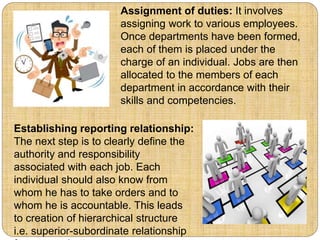
Assignment of duties: It involves
assigning work to various employees.
Once departments have been formed,
each of them is placed under the
charge of an individual. Jobs are then
allocated to the members of each
department in accordance with their
skills and competencies.
Establishing reporting relationship:
The next step is to clearly define the
authority and responsibility
associated with each job. Each
individual should also know from
whom he has to take orders and to
whom he is accountable. This leads
to creation of hierarchical structure
i.e. superior-subordinate relationship
9
Organizational structure
The organisation structure can be defined as the framework
within which managerial and operating tasks are performed. It
specifies the relationship between people, work and resources.
It is required:
•When an organisation grows in size or complexity
•When an organisation is new, the structure is required after
planning but before staffing.
Types of organisation structure
The organisation structure can be classified
under two categories :
•Functional structure
•Divisional structure.
(1)Functional Strutcture:
Functional organisational structure refers to that
organisational structure where-
•Jobs of similar nature are grouped under major
functions.
•Each major function of business is organised as a
separate department.
•All departments report to a coordinating head.
For example, in a manufacturing concern division of
work into key functions will include production,
purchase, marketing, accounts and personnel.
. DIS ADVANTAGES:
•A functional structure places less
emphasis on overall enterprise objectives
than the objectives pursued by a functional
head.
•It may lead to problems in coordination as
information has to be exchanged across
functionally differentiated departments.
•A conflict of interest arises when interests
of two or more departments are not
compatible.
•It may lead to inflexibility as people with
same skills and knowledge base may
ADVANTAGES:
•It leads to occupational
specialisation since emphasis is
placed on specific functions.
•It promotes control and
coordination within a department
because of similarity in the tasks
being performed.
•It increases managerial and
operational efficiency
•It lowers cost as it reduces
duplication of effort.
•It makes training of employees
Divisional structure
Divisional organisational structure refers to that
organisational structure where the activities of large
diversified organisations are grouped into a number of
divisions on the basis of different products
manufactured or geographical areas. For example, a
large company may have divisions like cosmetics,
clothing etc.
In a divisional structure-
•Each division has a divisional manager responsible for
performance and who has authority over the unit.
•Within each division, the functional structure tends to
be adopted.
•Each division works as a profit centre where divisional
head is responsible for the profit or loss of his division.DIS ADVANTGES:
Major disadvantages are:
•Duplication of efforts among its division
and hence costly.
•Each department focuses on their own
product without thinking of the
organisation.
•Not suitable for small and medium
sized companies.
•Conflicts among different divisions with
ADVANTAGES:
•Activities related with one product can be
easily integrated and coordinated.
•Decision making is faster and effective.
•Performance of individual products can be
assessed easily.
•Easy to fix responsibility for performance.
•Facilitates expansion and growth as new
divisions can be added by merely adding
another divisional head and staff for the
Formal and Informal Organizations
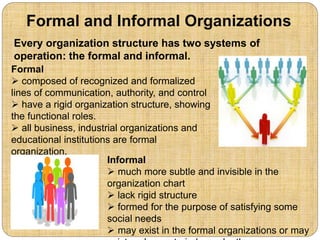
Formal
 composed of recognized and formalized
lines of communication, authority, and control
 have a rigid organization structure, showing
the functional roles.
 all business, industrial organizations and
educational institutions are formal
organization.
Informal
 much more subtle and invisible in the
organization chart
 lack rigid structure
 formed for the purpose of satisfying some
social needs
 may exist in the formal organizations or may
Every organization structure has two systems of
operation: the formal and informal.
The Art of Delegation
 Delegation is considered an art
and a science. It is an art because it
is a skill that the manager performs
effectively if he practices it.
 Delegation should first and
foremost be tackled before the
establishment of goals and
objectives and a clear definition of
responsibility and authority has
been made.
To be effective, the manager
must motivate the subordinates to
work on the delegated
responsibility and authority.
Positive motivation instead of
negative, should be given.
 Positive motivation maybe
The Elements of Delegation
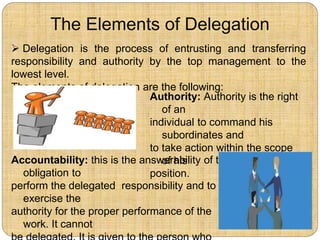
 Delegation is the process of entrusting and transferring
responsibility and authority by the top management to the
lowest level.
The elements of delegation are the following:
Accountability: this is the answerability of the
obligation to
perform the delegated responsibility and to
exercise the
authority for the proper performance of the
work. It cannot
Authority: Authority is the right
of an
individual to command his
subordinates and
to take action within the scope
of his
position.
Decentralized OrganizationsDECENTRALISATION
Decentralisation of authority refers to the systematic delegation or
dispersal of authority to take decisions from top management to the
lower level managers. Managers at lower levels are given
operational authority for decision-making and action.
In a decentralised organisation, authority is retained at top
management level only for taking major decisions on products,
products lines, capital investment etc. and the rest of authority will
be transferred to lower levels in the organisation. Thus executives
at the lower levels are empowered to take decisions as regards the
problems they face. They need not go to the higher levels for taking
decisions.
Delegation of authority is an essential aspect of
managing and organizing. An organization cannot
be functional without delegation of authority.
Managers manage by guiding and coordinating the
activities of their subordinates. This presupposes
delegation of tasks and authority. Managers have
no alternative but to delegate.
Decentralization need not necessarily be an
essential feature of organizing and managing. Many
organizations are operating with little or no
decentralization of authority. It is matter of choice
and preference of the top management.
DELEGATION OF AUTHORITY ESSENTIAL
BUT NOT DECENTRALISATION
In short, an organization cannot function without delegation
of authority but they can function without decentralization
THANK
YOU

organizing 12th 4th chapter

  • 1.
  • 2.
    What is Organizing?Organizingrefers to the process of defining and grouping the activities of an enterprise and establishing authority relationship among them. It includes the process of determining what activities are to be conducted, how the activities are to be grouped, how responsibility and authority are to be delegated and who report to whom.
  • 3.
    FEATURES OF ORGANIZINGDivisionof work: Division of work is the basis of an organisation. There can be no organisation without division of work. Under division of work, the entire work of business is divided into many departments. The work of every department is further subdivided into subworks. Coordination: Under organisation different persons are assigned different works but the aim of all these persons happens to be the same- the attainment of the objectives of the enterprise. Organisation ensures that the work of all the persons depends on each other’s work even though it happens to be different. Hence, it helps in establishing
  • 4.
    Plurality of persons:Organisation is a group of many persons who assemble to fulfill a common purpose. Common objectives: There are various parts of an organisation with different functions to perform but all move in the direction of achieving a general objective. Organization is a machine of management: Organization is considered to be a machine of management. It is that machine in which no part can afford to be non-functional. In other words, if the division of work is not done properly, or posts and not created correctly the whole system of management collapse.
  • 5.
    Importance of organizing •Clarityin working relationship: Organising clarifies the working relations among employees. It specifies who is to report to whom. Therefore communication becomes effective. It also helps in fixing responsibility. •Adaptation to change: An organisation operates in a dynamic environment. An ever changing environment poses both challenges and opportunities to the business. Organising helps the enterprise to adjust itself as per the changing circumstances by suitably modifying the organizational structure. •Effective administration: Organisation provides a clear description of jobs and related duties. This helps to avoid confusion and duplication. Clarity in working relationship enables proper execution of work. Management of an enterprise thereby becomes easy and this
  • 6.
    Benefits of specialization:Organising leads to systematic allocation of jobs amongst the workers in accordance with their skills and competence. A person performs a specific job on a regular basis, which allows him to gain experience and expertise in that area. Thus it reduces the work load, enhances productivity and leads to specialization. Optimum utilization of resources: Under the process of organising the entire work is divided into various small activities. There is a different employee performing every different job. By doing so, there is no possibility of any activity being left out or any possibility of unnecessary duplicating any job. Consequently, there is optimum utilization of all the available resources in the enterprise.Development of personnel: Organisation stimulates creativity amongst the managers. Effective delegation allows the managers to reduce their work load by assigning routine jobs to their subordinates. It gives them time to explore areas for growth and the opportunity to innovate thereby strengthening the company’s competitive position. Delegation also develops in the subordinate the ability to deal effectively with challenges.•Expansion and growth: Properly designed organisation structure creates favourable conditions for expansion and diversification of enterprise. Organising allows a business enterprise to add more job positions, departments and product lines. It helps in expansion and grow of business.
  • 7.
    Identification and divisionof work: The first step in the process of organizing is identifying and dividing the total work to be done in accordance with the predetermined plans. The work is divided into tasks in a systematic way so that each person gets distinct and separate task. It helps to avoid unnecessary duplication, overlapping and wastage of efforts.Departmentalization: After identification and division of work, the next step is to group related and similar jobs under one department. Such grouping is known as departmentation or departmentalization. The grouping may be done on the basis of (a) business functions like production, marketing etc. (b) products like textile, Steps in the process of organizing
  • 8.
    Assignment of duties:It involves assigning work to various employees. Once departments have been formed, each of them is placed under the charge of an individual. Jobs are then allocated to the members of each department in accordance with their skills and competencies. Establishing reporting relationship: The next step is to clearly define the authority and responsibility associated with each job. Each individual should also know from whom he has to take orders and to whom he is accountable. This leads to creation of hierarchical structure i.e. superior-subordinate relationship
  • 9.
    9 Organizational structure The organisationstructure can be defined as the framework within which managerial and operating tasks are performed. It specifies the relationship between people, work and resources. It is required: •When an organisation grows in size or complexity •When an organisation is new, the structure is required after planning but before staffing. Types of organisation structure The organisation structure can be classified under two categories : •Functional structure •Divisional structure.
  • 10.
    (1)Functional Strutcture: Functional organisationalstructure refers to that organisational structure where- •Jobs of similar nature are grouped under major functions. •Each major function of business is organised as a separate department. •All departments report to a coordinating head. For example, in a manufacturing concern division of work into key functions will include production, purchase, marketing, accounts and personnel. . DIS ADVANTAGES: •A functional structure places less emphasis on overall enterprise objectives than the objectives pursued by a functional head. •It may lead to problems in coordination as information has to be exchanged across functionally differentiated departments. •A conflict of interest arises when interests of two or more departments are not compatible. •It may lead to inflexibility as people with same skills and knowledge base may ADVANTAGES: •It leads to occupational specialisation since emphasis is placed on specific functions. •It promotes control and coordination within a department because of similarity in the tasks being performed. •It increases managerial and operational efficiency •It lowers cost as it reduces duplication of effort. •It makes training of employees
  • 11.
    Divisional structure Divisional organisationalstructure refers to that organisational structure where the activities of large diversified organisations are grouped into a number of divisions on the basis of different products manufactured or geographical areas. For example, a large company may have divisions like cosmetics, clothing etc. In a divisional structure- •Each division has a divisional manager responsible for performance and who has authority over the unit. •Within each division, the functional structure tends to be adopted. •Each division works as a profit centre where divisional head is responsible for the profit or loss of his division.DIS ADVANTGES: Major disadvantages are: •Duplication of efforts among its division and hence costly. •Each department focuses on their own product without thinking of the organisation. •Not suitable for small and medium sized companies. •Conflicts among different divisions with ADVANTAGES: •Activities related with one product can be easily integrated and coordinated. •Decision making is faster and effective. •Performance of individual products can be assessed easily. •Easy to fix responsibility for performance. •Facilitates expansion and growth as new divisions can be added by merely adding another divisional head and staff for the
  • 12.
    Formal and InformalOrganizations Formal  composed of recognized and formalized lines of communication, authority, and control  have a rigid organization structure, showing the functional roles.  all business, industrial organizations and educational institutions are formal organization. Informal  much more subtle and invisible in the organization chart  lack rigid structure  formed for the purpose of satisfying some social needs  may exist in the formal organizations or may Every organization structure has two systems of operation: the formal and informal.
  • 13.
    The Art ofDelegation  Delegation is considered an art and a science. It is an art because it is a skill that the manager performs effectively if he practices it.  Delegation should first and foremost be tackled before the establishment of goals and objectives and a clear definition of responsibility and authority has been made. To be effective, the manager must motivate the subordinates to work on the delegated responsibility and authority. Positive motivation instead of negative, should be given.  Positive motivation maybe
  • 14.
    The Elements ofDelegation  Delegation is the process of entrusting and transferring responsibility and authority by the top management to the lowest level. The elements of delegation are the following: Accountability: this is the answerability of the obligation to perform the delegated responsibility and to exercise the authority for the proper performance of the work. It cannot Authority: Authority is the right of an individual to command his subordinates and to take action within the scope of his position.
  • 15.
    Decentralized OrganizationsDECENTRALISATION Decentralisation ofauthority refers to the systematic delegation or dispersal of authority to take decisions from top management to the lower level managers. Managers at lower levels are given operational authority for decision-making and action. In a decentralised organisation, authority is retained at top management level only for taking major decisions on products, products lines, capital investment etc. and the rest of authority will be transferred to lower levels in the organisation. Thus executives at the lower levels are empowered to take decisions as regards the problems they face. They need not go to the higher levels for taking decisions.
  • 16.
    Delegation of authorityis an essential aspect of managing and organizing. An organization cannot be functional without delegation of authority. Managers manage by guiding and coordinating the activities of their subordinates. This presupposes delegation of tasks and authority. Managers have no alternative but to delegate. Decentralization need not necessarily be an essential feature of organizing and managing. Many organizations are operating with little or no decentralization of authority. It is matter of choice and preference of the top management. DELEGATION OF AUTHORITY ESSENTIAL BUT NOT DECENTRALISATION In short, an organization cannot function without delegation of authority but they can function without decentralization
  • 17.