ORGANIZING
ORGANIZING
A. MEANING OF ORGANIZING
• Organizing is defined as arranging and structuring work to accomplish
organizational goals.
Purposes of Organizing
Purposes
• Divides work to be done into specific jobs and departments.
• Assigns tasks and responsibilities associated with individual jobs.
• Coordinates diverse organizational tasks.
• Clusters jobs into units.
• Establishes relationships among individuals, groups, and
departments. Establishes formal lines of authority.
• Allocates and deploys organizational resources.
Elements of Organizational Design
• Organizing: management function that involves arranging and
structuring work to accomplish the organization’s goals
• Organizational structure: the formal arrangement of jobs
within an organization
• Organizational chart: the visual representation of an
organization’s structure
• Organizational design: creating or changing an organization’s
structure
ORGANIZATION STRUCTURE
A. MEANING:
Organizational structure is the formal arrangement of jobs within an organization.
This structure, which can be shown visually in an organizational chart, also serves many
purposes such as :
1. Divides work to be done into specific jobs and departments.
2. Assigns tasks and responsibilities associated with individual jobs.
3. Coordinates diverse organizational tasks.
4. Clusters jobs into units.
5. Establishes relationship among individuals, groups, and departments.
6. Establishes formal lines of authority.
7. Allocates and deploys organizational resources.
Organizational Structure
Key Elements:
• Work specialization
• Departmentalization
• Chain of command
• Span of control
• Centralization and decentralization
• Formalization
An organizational structure defines how job tasks are
formally divided, grouped and coordinated.
CONTI…
When managers create or change the structures, they are engaged in
organizational design, a process that involves decisions about six key
elements
i. Work specialization (specialize in doing part of work activities rather than
entire activity in order to increase output & quality.)
ii. Departmentalization (how jobs are grouped together)
iii. Chain of command (line of authority)
iv. Span of control ( How many employees can a manager efficiently and
effectively handle?)
v. Centralization and Decentralization
vi. Formalization (how standardized an org. jobs are and the extend to
which employees behaviour is guided by rules and procedures)
DEPARTMENTALIZATION
A. MEANING:
One aspect of organizing is the establishment of departments. The
word department designates a distinct area, division, or branch of an
organization over which a manager has authority for the performance
of specified activities.
After deciding what job tasks will be done by whom, common work
activities need to be grouped back together so the work can be done in
a co-ordinated and integrated way. How jobs are grouped together is
called departmentalization.
CONTI…
B. TYPES OF DEPARTMENTATION
i. Functional Departmentalization
ii. Geographical Departmentalization
iii. Product Departmentalization
iv. Customer Departmentalization
CONTI…
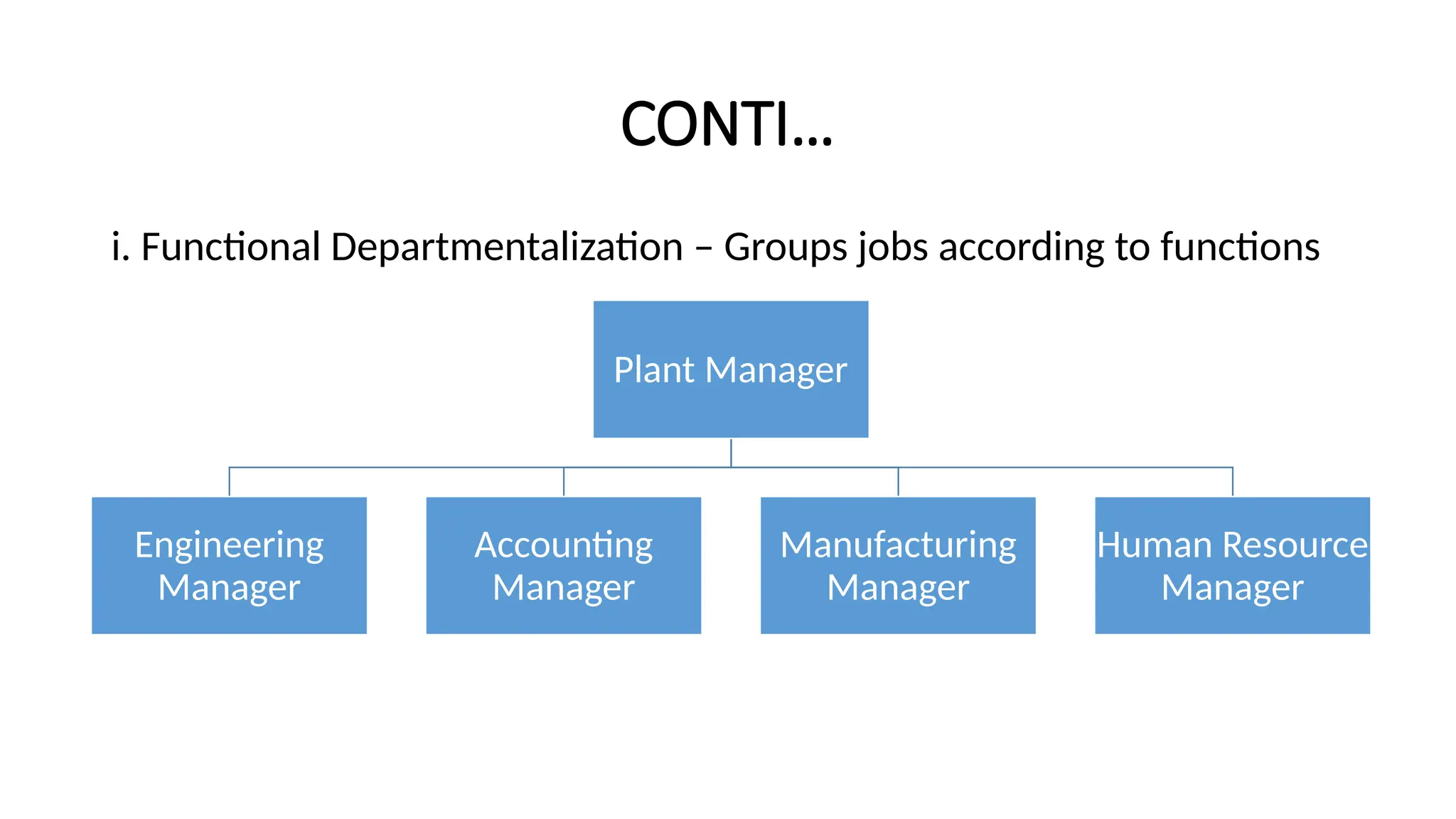
i. Functional Departmentalization – Groups jobs according to functions
Plant Manager
Engineering
Manager
Accounting
Manager
Manufacturing
Manager
Human Resource
Manager
CONTI…
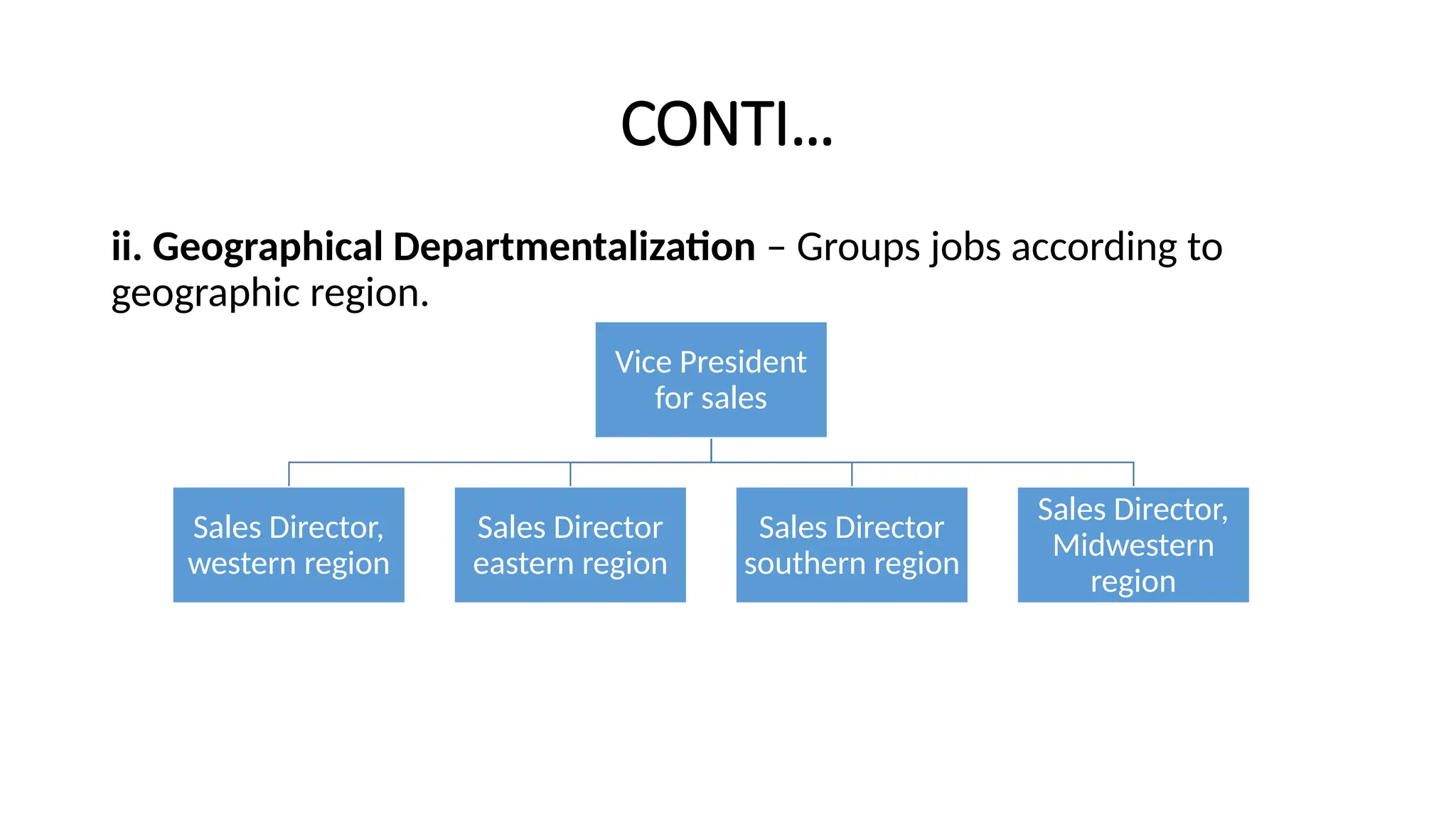
ii. Geographical Departmentalization – Groups jobs according to
geographic region.
Vice President
for sales
Sales Director,
western region
Sales Director
eastern region
Sales Director
southern region
Sales Director,
Midwestern
region
CONTI…
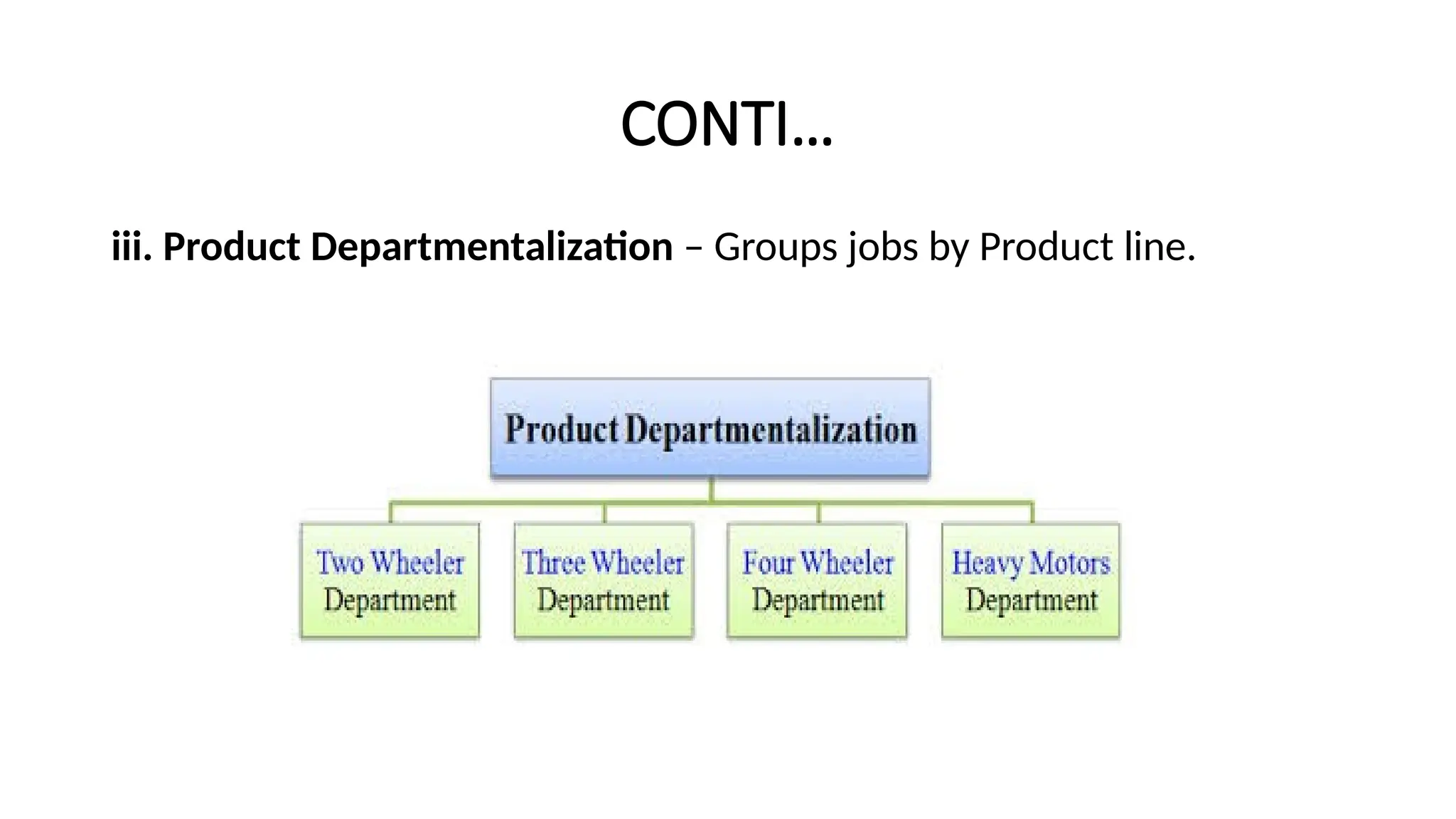
iii. Product Departmentalization – Groups jobs by Product line.
CONTI…
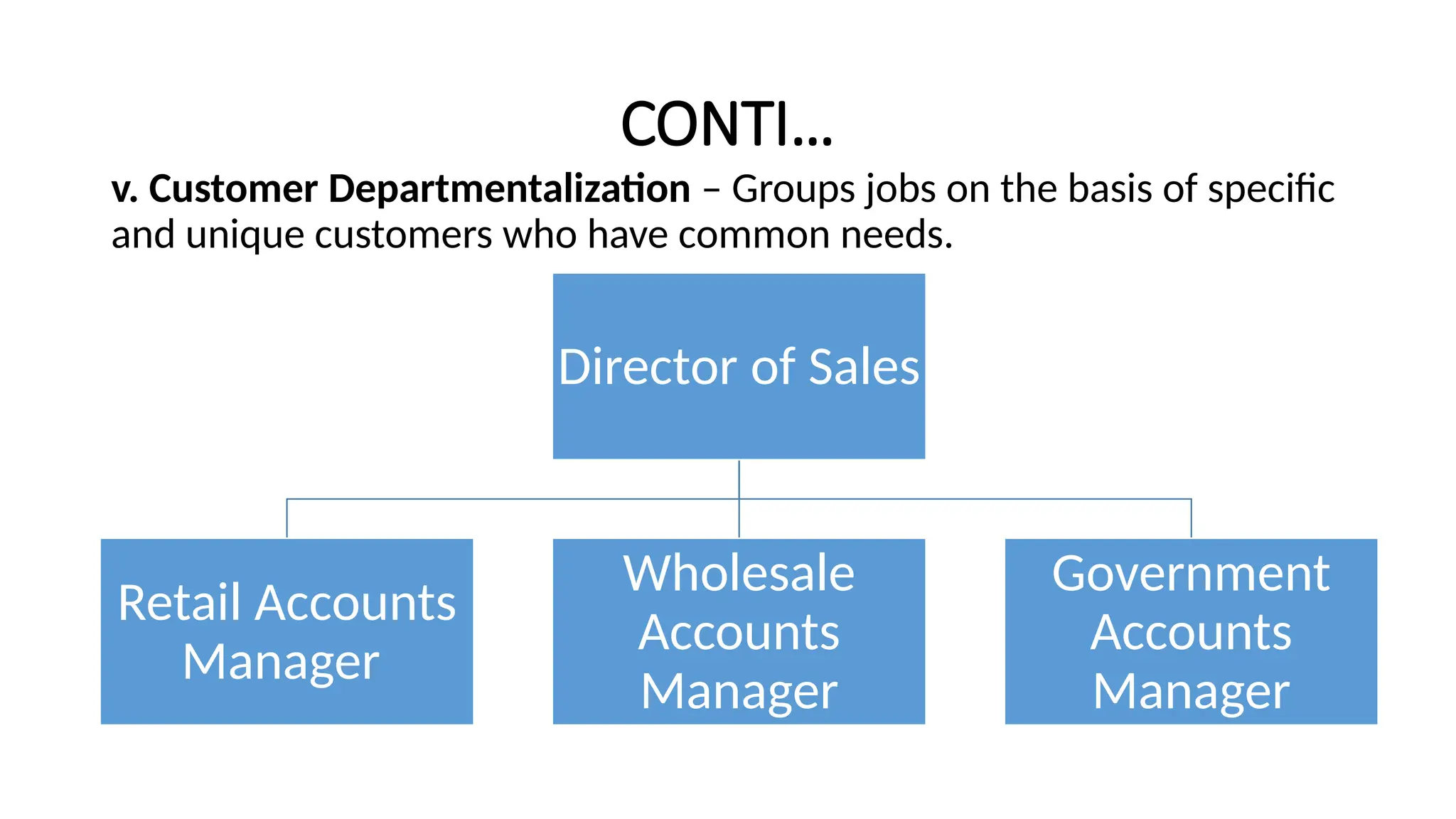
v. Customer Departmentalization – Groups jobs on the basis of specific
and unique customers who have common needs.
Director of Sales
Retail Accounts
Manager
Wholesale
Accounts
Manager
Government
Accounts
Manager
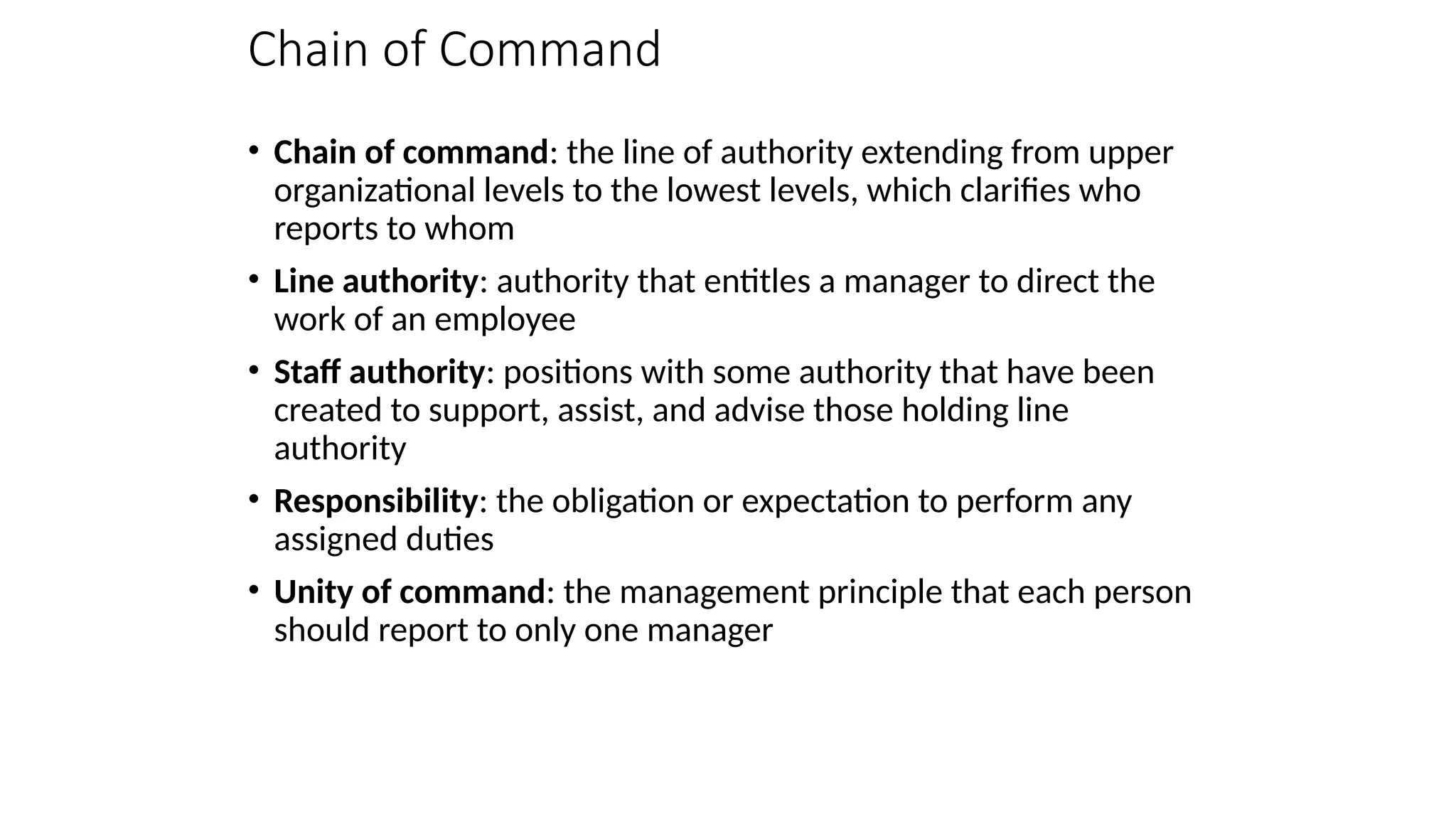
Chain of Command
• Chain of command: the line of authority extending from upper
organizational levels to the lowest levels, which clarifies who
reports to whom
• Line authority: authority that entitles a manager to direct the
work of an employee
• Staff authority: positions with some authority that have been
created to support, assist, and advise those holding line
authority
• Responsibility: the obligation or expectation to perform any
assigned duties
• Unity of command: the management principle that each person
should report to only one manager
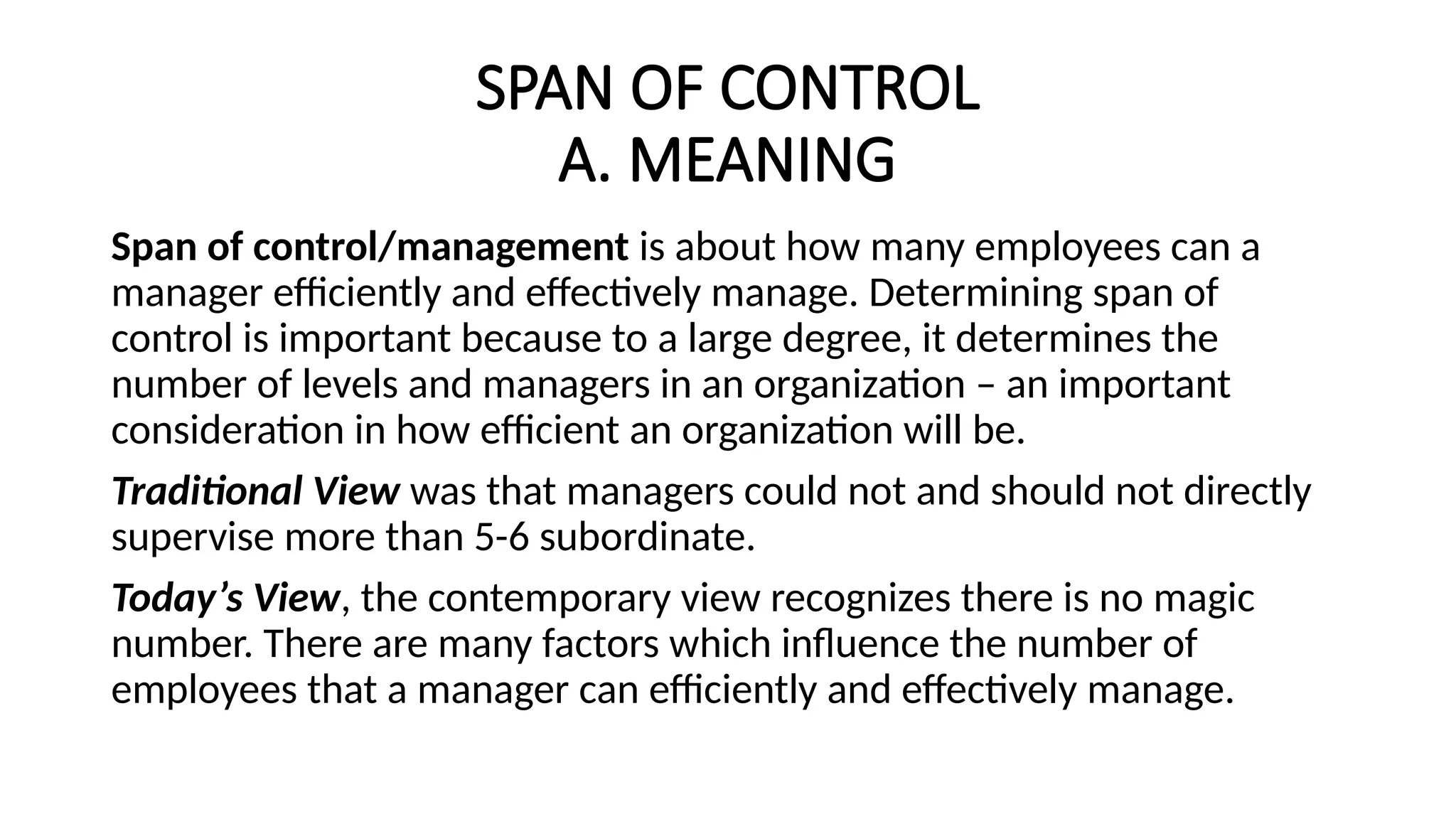
SPAN OF CONTROL
A. MEANING
Span of control/management is about how many employees can a
manager efficiently and effectively manage. Determining span of
control is important because to a large degree, it determines the
number of levels and managers in an organization – an important
consideration in how efficient an organization will be.
Traditional View was that managers could not and should not directly
supervise more than 5-6 subordinate.
Today’s View, the contemporary view recognizes there is no magic
number. There are many factors which influence the number of
employees that a manager can efficiently and effectively manage.
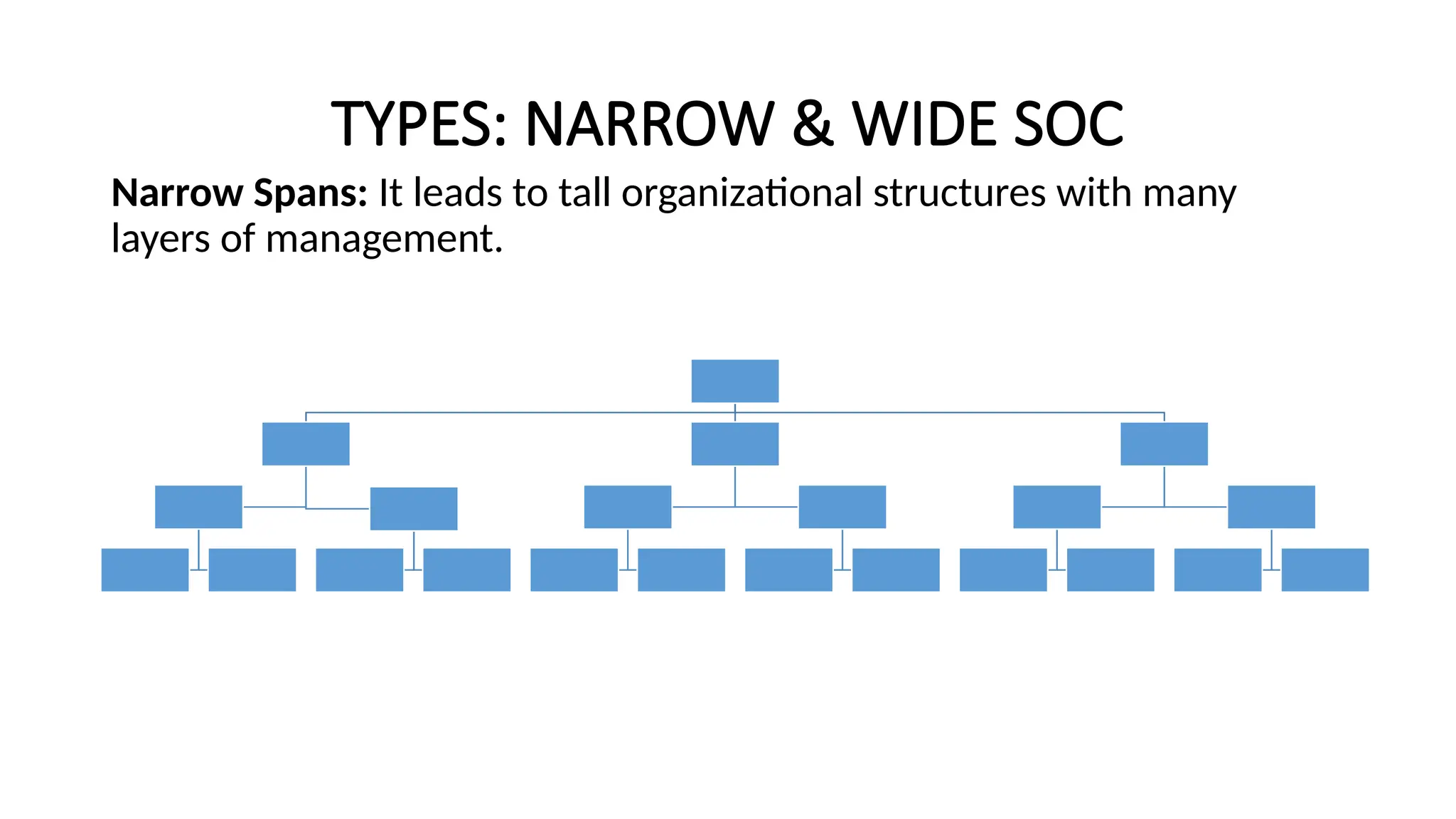
TYPES: NARROW & WIDE SOC
Narrow Spans: It leads to tall organizational structures with many
layers of management.
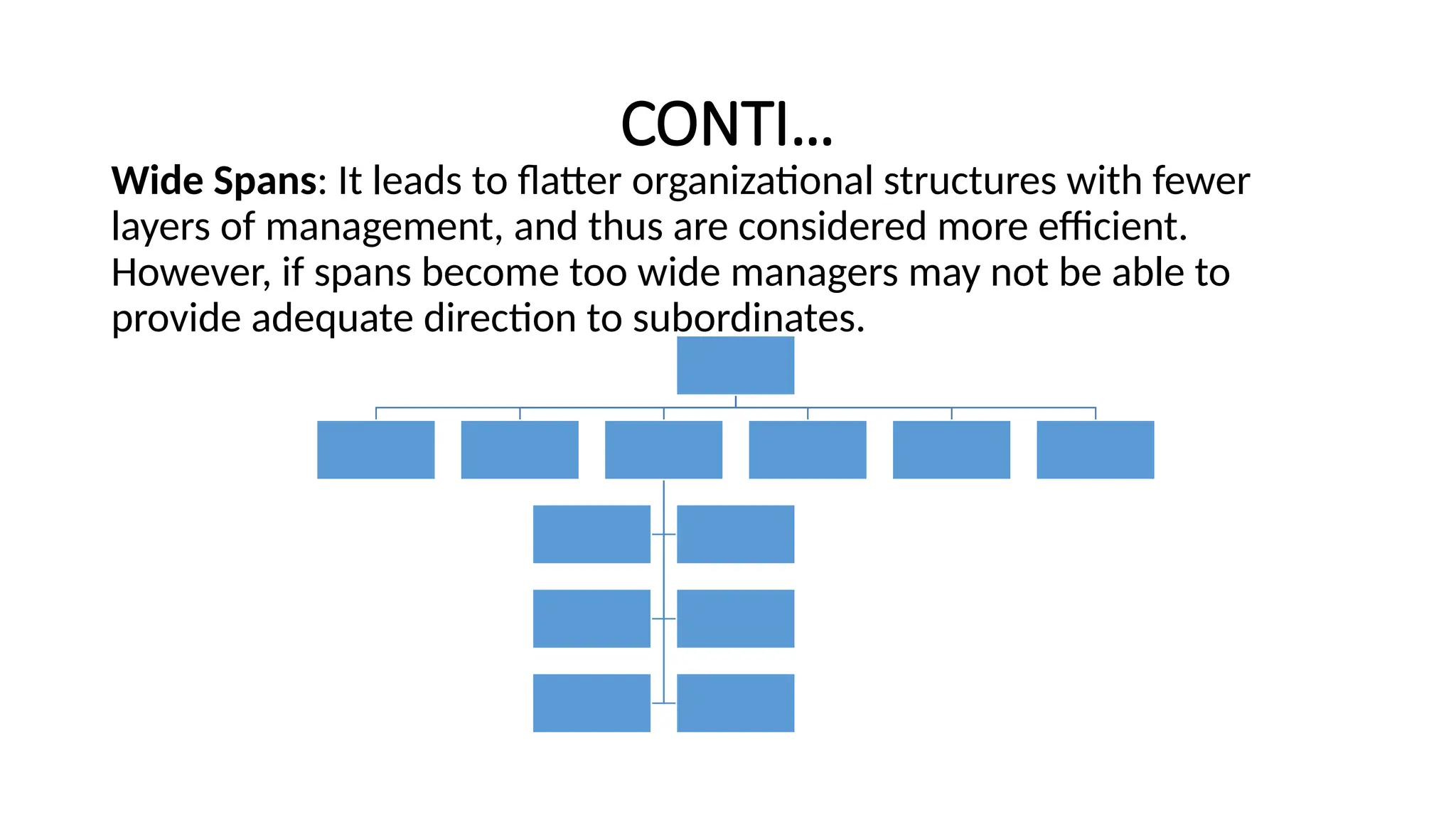
CONTI…
Wide Spans: It leads to flatter organizational structures with fewer
layers of management, and thus are considered more efficient.
However, if spans become too wide managers may not be able to
provide adequate direction to subordinates.
ADVANTAGES & DISADVANATGES OF
NARROW & WIDE SOC
Advantage of Narrow Spans
• Close supervision
• Close control
• Fast communication between subordinates and superiors
Disadvantages of Narrow Spans
• Supervisors tend to get too involved in subordinates’ work
• Many levels of management
• Excessive distance between lowest level and top level
CONTI…
Advantages of Wide Spans
• Speed up decision making (Clear policies must be made)
• Empower employees. (Subordinates must be carefully selected)
• Reduced Cost
• Increased Flexibility
Disadvantages of Wide Spans
• Tendency to overload superiors to become decision bottlenecks
• Danger of superior’s loss of control
• Requires exceptional quality of managers
FACTORS DETERMINING THE SOC
The number of subordinates a manager can effectively manage
depends on the impact of the following factors
1. Characteristics of Work been done
2. Physical proximity of subordinates
3. Skills and abilities of managers and employees
4. Degree to which standardized procedures are in place
CONTI…
1. Characteristics of work been done
• If all the subordinates are doing the same job at the same time, then it
is easy for a manager or superior to manage all employees at the same
time.
• For example, it is easy for a supervisor to manage 50 call executives at
the same time because they are doing similar work at the same time.
On the other hand, a professor can take two or a maximum of four
students pursuing a doctorate.
• The reason being is that all students work on different research topics,
and the professor can’t manage all of his students at the same time.
CONTI…
2. Physical proximity of subordinates
• If the branches of business are located at far geographic locations, then it
becomes difficult for a manager to manage all the executives working at
all the branches. Therefore, areas will be divided into clusters, and
different managers are hired to manage each cluster.
• In this way, each manager can effectively manage all employees working
in small areas. For example, if a company has its branches all over the
world, then all branches can be divided country wise and country
managers can be hired to manage all people working in that area.
CONTI…
3. Skills and abilities of managers and employees
• An experienced manager with a good understanding of the work and having good
relationships with employees can manage a higher number of employees. Whereas,
an inexperienced manager with limited skills can handle a few employees.
• A manager, no matter how much experienced he is, can handle only a few
inexperienced or new employees at one time.
• Since employees are required to be trained to do their work efficiently, the manager is
expected to spend a lot of time with each employee. As a result, it becomes difficult
for a manager to manage many subordinates at one time.
• On the other hand, a manager can manage fully-trained and experienced employees
at the same time because he is not required to teach every small task to them.
CONTI…
4. Degree to which standardized procedures are in place
• If the organization has already has its policies and procedures in place
with well trained employees and experience managers, it will become
easy to manage more subordinates as the standard procedures are
only required to follow.
DELEGATION OF AUTHORITY
A. MEANING
Authority is delegated when a superior gives a subordinate discretion to make
decisions.
Delegation of authority simply means assigning tasks or responsibilities to
the subordinates and giving them the right to perform those tasks
autonomously.
Process of Delegation
1. Determining the results expected from a position
2. Assigning tasks to the position
3. Delegating authority for accomplishing these tasks
4. Holding the person in that position responsible for the accomplishment of the tasks
ADVANTAGES & BARRIERS OF DELEGATION OF
AUTHORITY
ADVANTAGES OF DELEGATION OF AUTHORITY
1. Minimize work load of managers
2. Motivation and Morale
3. Training and Development (Facilitates growth and expansions)
4. Quicker and better decisions
5. Basis of organizing
CONTI…
BARRIERS OF DELEGATIONS OF AUTHORITY
On Manager’s Side:
1. Fear of Loss of Power (Willingness to let go)
2. The “I can do it better myself” Fallacy
3. Lack of Confidence in Subordinates (Willingness to allow mistakes by
subordinates)
4. Fear of being exposed
5. Difficulty in briefing
6. Inability to establish and exercise proper controls.
CONTI…
BARRIERS OF DELEGATIONS OF AUTHORITY
On Subordinates' Side:
1. Fear of criticism (so they refuse)
2. They feel there is lack of mental, physical ability, adequate info and resources.
3. They believe authority is inconsistent with the purposes of organization.
4. No positive personal gain (only extra responsibility)
5. Outside certain limits (area of acceptance)
GUIDELINES FOR EFFECTIVE DELEGATION
1. Define task clearly: Before delegating authority, make the nature
and the scope of the task clear. Avoid overstepping the
subordinate’s “area of acceptance”
2. Set authority boundaries: Make the subordinate clearly understand
the limits of his/her authority and deadlines. Assign authority
proportionate to the task.
3. Establish a clear reporting line
4. Balance authority and responsibility
CONTI…
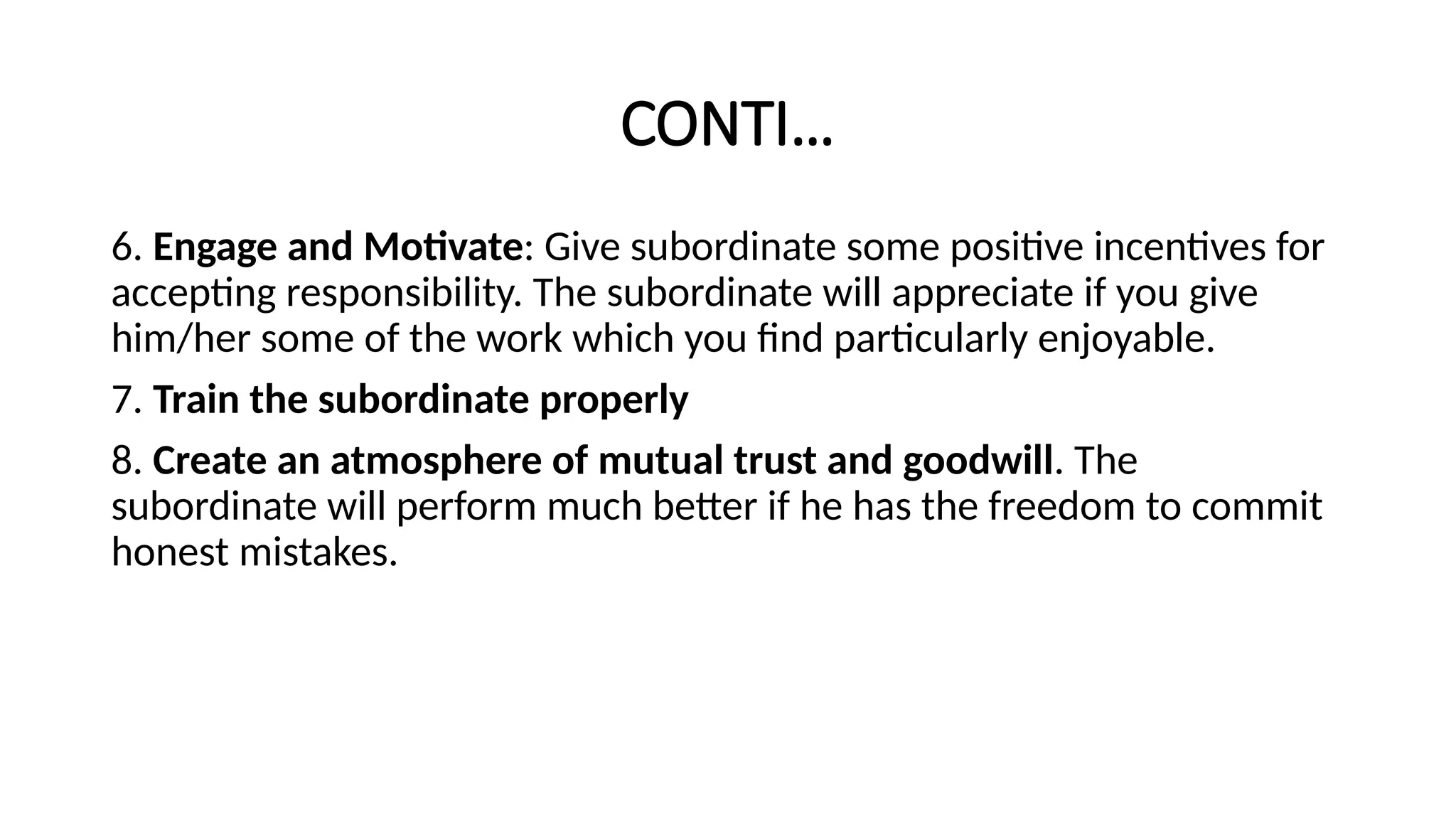
6. Engage and Motivate: Give subordinate some positive incentives for
accepting responsibility. The subordinate will appreciate if you give
him/her some of the work which you find particularly enjoyable.
7. Train the subordinate properly
8. Create an atmosphere of mutual trust and goodwill. The
subordinate will perform much better if he has the freedom to commit
honest mistakes.
CENTRALIZATION VS. DECENTRALIZATION
A. MEANING
Centralization is the degree to which decision making takes place at
upper levels of the organization. If top managers make key decisions
with little input from below, then the organization is more centralized.
Decentralization – the more that lower level employees provide input
or actually make decisions, the decentralization is there.
Keeping in mind that centralization-decentralization is relative, not
absolute – i.e. an organization is never completely centralized or
decentralized.
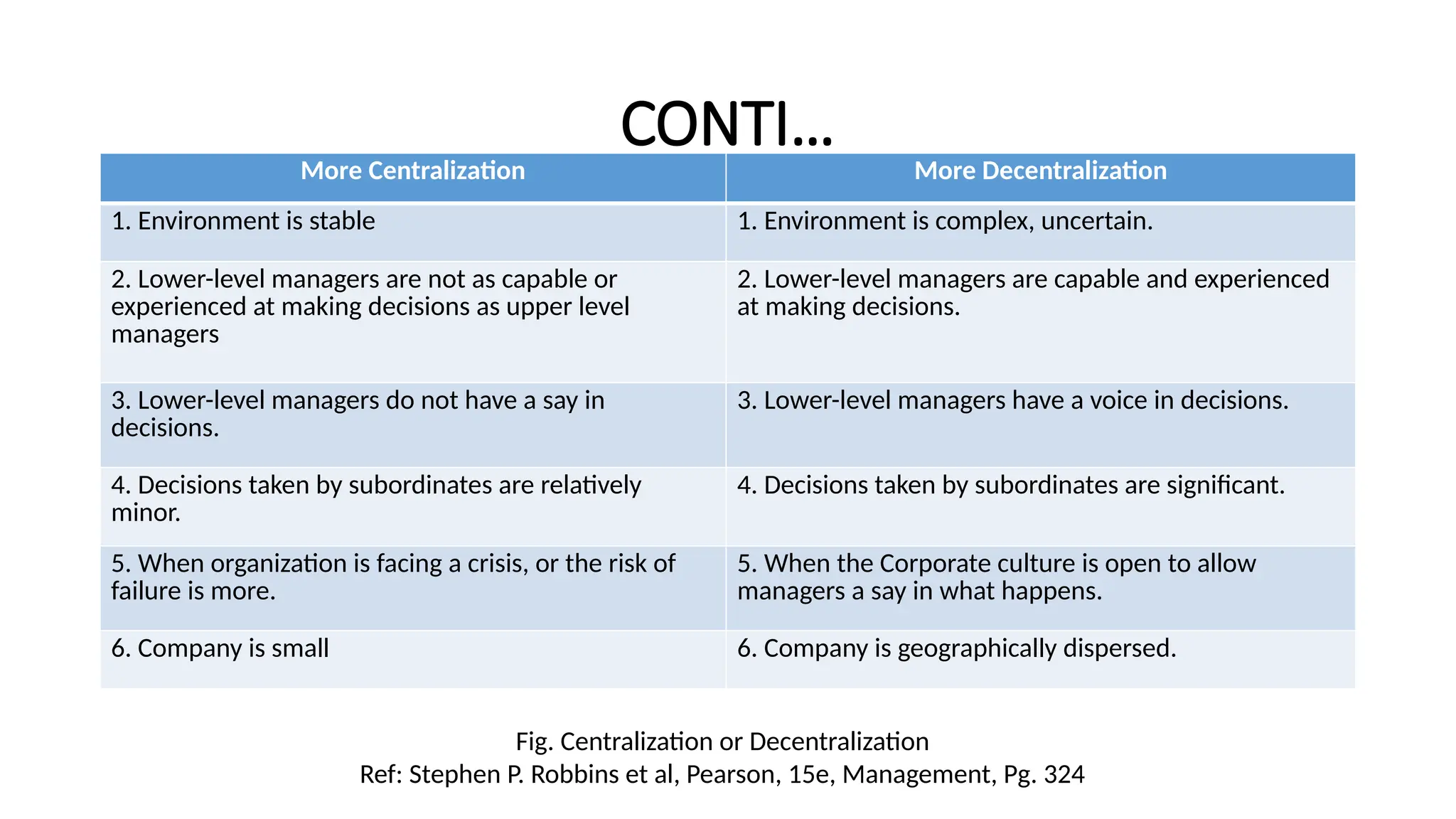
Below table shows the factors that affect an organization’s use of
centralization or decentralization.
CONTI…
More Centralization More Decentralization
1. Environment is stable 1. Environment is complex, uncertain.
2. Lower-level managers are not as capable or
experienced at making decisions as upper level
managers
2. Lower-level managers are capable and experienced
at making decisions.
3. Lower-level managers do not have a say in
decisions.
3. Lower-level managers have a voice in decisions.
4. Decisions taken by subordinates are relatively
minor.
4. Decisions taken by subordinates are significant.
5. When organization is facing a crisis, or the risk of
failure is more.
5. When the Corporate culture is open to allow
managers a say in what happens.
6. Company is small 6. Company is geographically dispersed.
Fig. Centralization or Decentralization
Ref: Stephen P. Robbins et al, Pearson, 15e, Management, Pg. 324
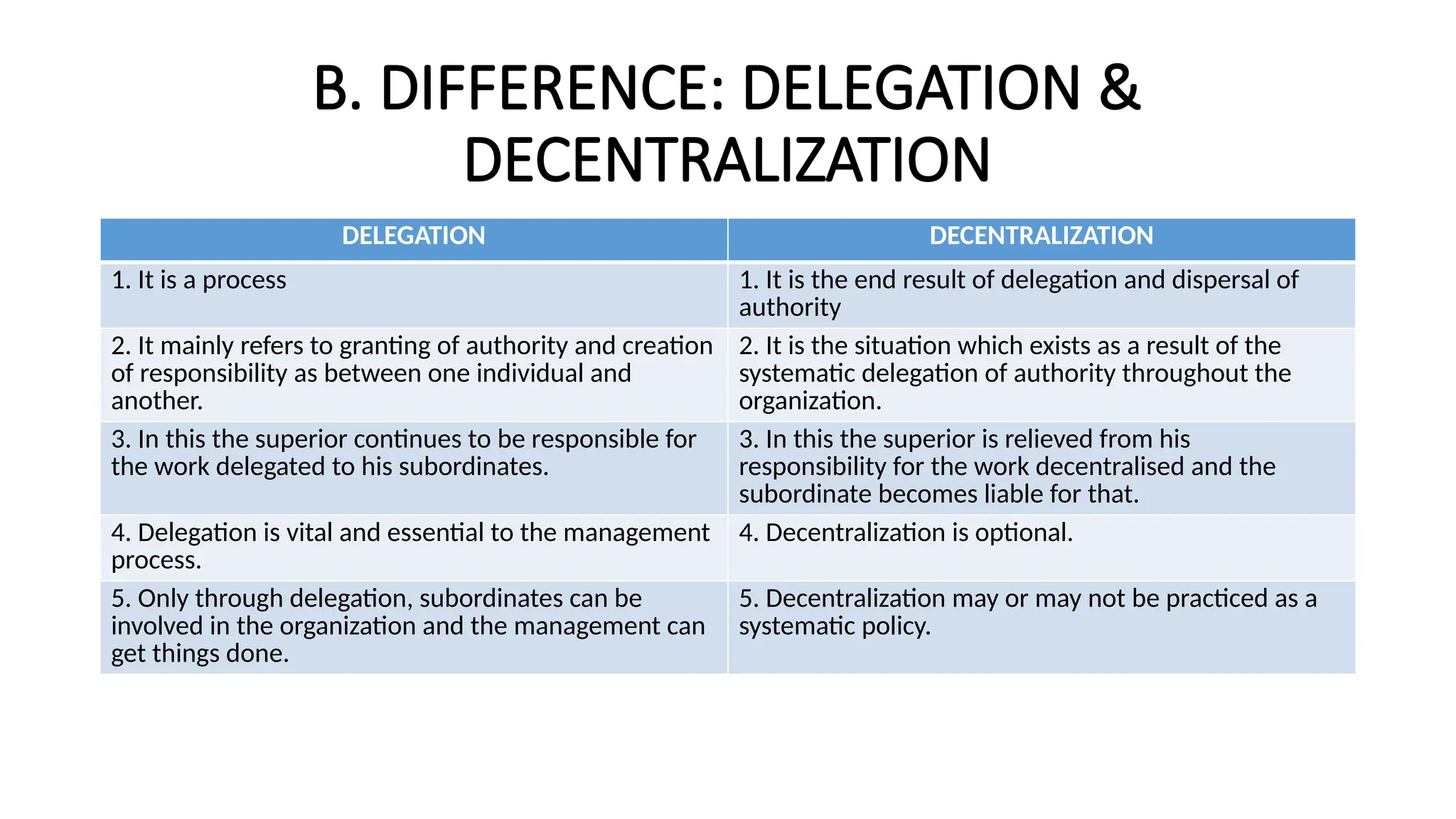
B. DIFFERENCE: DELEGATION &
DECENTRALIZATION
DELEGATION DECENTRALIZATION
1. It is a process 1. It is the end result of delegation and dispersal of
authority
2. It mainly refers to granting of authority and creation
of responsibility as between one individual and
another.
2. It is the situation which exists as a result of the
systematic delegation of authority throughout the
organization.
3. In this the superior continues to be responsible for
the work delegated to his subordinates.
3. In this the superior is relieved from his
responsibility for the work decentralised and the
subordinate becomes liable for that.
4. Delegation is vital and essential to the management
process.
4. Decentralization is optional.
5. Only through delegation, subordinates can be
involved in the organization and the management can
get things done.
5. Decentralization may or may not be practiced as a
systematic policy.
C. ADVANTAGES & DISADVANTAGES OF CENTRALIZATION & DECENTRALIZATION
Advantages of Centralization
1.Clear Chain of Command: A streamlined and well-defined hierarchy ensures efficient decision-
making. Everyone in the organization knows who to report to and who to approach whenever
they have questions. This clarity ensures prompt responses to concerns from employees. A clear
chain of command is beneficial when the organization needs to execute decisions quickly and in
a unified manner.
2.Focused Vision: Centralized management aids in communicating and delivering the
organization’s vision, and the clear lines of authority enable consistent message delivery. There
are clear lines of communication and senior executives can communicate the organization’s
vision to employees and guide them towards achievement of that vision.
3.Reduced Costs: A centralized organization follows standard procedures and methods that lead
to reduced office and administrative costs. The organization does not need to incur extra costs
to hire specialists for other parts of the organization since critical decisions are made at the
head office and then communicated outwards. The clear chain of command reduces duplication
of responsibilities that may result in additional costs to the organization.
4.Quick Implementation: A centralized structure allows for faster decision making from the top
since decisions are made by a small group of people and then communicated to the lower-level
managers.
5.Improved Quality of Work:The standardized procedures and better supervision in a centralized
organization result in improved quality of work. Supervisors in each department ensure that the
work outputs are uniform and of high quality.
C. ADVANTAGES & DISADVANTAGES OF CENTRALIZATION & DECENTRALIZATION
Disadvantages of Centralization
1.Bureaucratic Leadership: As decision making is restricted to individuals at
the headquarters level, employees are unable to contribute to the decision-
making process of the organization. This lack involvement in shaping
decisions results in a loss of creativity, reduced performance, and motivation.
2.Remote Control: The organization’s executives are under significant
pressure to formulate decisions for the organization and they lack control
over the implementation process leading to inefficiencies. The failure of
senior managers to decentralize the decision-making process contributes
significantly to their workload.
3.Delays in Work: Centralized communication may lead to productivity losses
as employees rely on information flowing to them from the top to guide
project implementation.
4.Lack of Employee Loyalty: Employee loyalty can decline in a centralized
structure as their limited autonomy stifles creativity and loyalty due to the
rigidity of the work.
CONTI…
Advantages of Decentralization
• Relief to top executives: Decentralization allows middle to lower authorities
to participate in the decision-making processes. It helps to reduce the
pressure of higher authorities. Higher authorities can easily focus on more
important works rather than on minor decision-making processes.
• Satisfaction of human needs: Decentralization serves as an important tool
to satisfy the employees’ need for power and independence.
• Quick decision making: From the middle to the lower level, employees are
allowed to make minor decisions. Based on the situation, they can take
ownership of the required action and implementation.
• Motivation of subordinates: Decentralization motivates their employees as
there are chances to show their skills without the interference of top
management. This allows improving the quality of work.
CONTI…
Disadvantages of Decentralization
• Expensive: In a decentralized organization, many employees are required to
be hired according to their work experiences and knowledge. This criterion
increases the cost of the company, as more money is spent to hire the most
eligible people for the job profile.
• Lack of uniformity: In decentralization, there is no uniformity because every
manager has their ways to make people work.
• Lack of Coordination
• More Conflicts
• Decentralization is not effective for building small firms.
CONTI…
B. TYPES OF ORGANIZATIONAL STRUCTURE
1. Traditional Organizational Structure
a. Functional Structure
b. Divisional Structure
2. Contemporary Organizational Structure
a. Matrix Structure
c. Virtual Structure
CONTI…
Traditional Organizational Structure
1.a. Functional Structure
It is an organizational design that groups similar or related occupational
specialities together.
One can think of this structure as functional departmentalization applied to
an entire organization.
Each group of specialists can therefore operate independently with
management acting as the point of cross-communication between
functional areas.
This arrangement allows for increased specialization.
CONTI…
Advantages of Functional Structure:
• Cost-saving advantages from specialization.
• Employees are grouped with others who have similar task.
Disadvantages of Functional Structure:
• Pursuit of functional goals can cause managers to lose sight of what’s
best for the overall organization.
• Functional specialists become insulated and have little understanding
of what other units are doing.
CONTI…
Traditional Organizational Structure
1.b. Divisional Structure
It is an organizational structure made up of separate business units or divisions.
In this structure, each division has limited autonomy, with a division manager
who has authority over his/her unit and is responsible for performance.
In divisional structures, however, the parent corporation typically acts as an
external overseer to coordinate and control the various divisions, and it often
support services such as financial and legal services.
Wal-Mart, for example, has two divisions: Retail (Wal-Mart Stores, International,
Sam’s Clubs, and others) and Support (Distribution Centres).
CONTI…
Advantages of Divisional Structure
• Focuses on results.
• Division managers are responsible for what happens to their products
and services.
Disadvantages of Divisional Structure
• Duplication of activities and resources increase costs.
• Duplication of activities and resources reduce efficiency.
CONTI…
Contemporary Organizational Structure
2.a. Matrix
Matrix Structure, specialists from different functional departments work
on projects that are led by a project manager.
It creates dual chain of command, in which employee have two
managers – their Functional area manager and their Project manager –
who share authority.
Each manager has his roles and responsibilities and to work effectively,
both managers have to communicate regularly, coordinate work
demands on employees and resolve conflicts together.
CONTI…
Advantages of Matrix Structure
• Fluid and flexible design that can respond to environmental changes.
• Faster decision making.
Disadvantages of Matrix Structure
• Complexity of assigning people to projects.
• Task and personality conflicts.
CONTI…
Contemporary Organizational Structure
2.b. The Virtual Organization
Virtual Organization (a.k.a. network/modular organization) consists of
small core of full-time employees and outsources its major business
functions.
Example: Sweden’s Ericsson contracts its manufacturing and even
some of its R&D to more cost-effective contractors in New Delhi,
Singapore, California and other global locations.
CONTI…
Advantages of the Virtual Structure:
• Highly flexible and responsive.
• Utilizes talent wherever its found.
Disadvantages of the Virtual Structure:
• Lack of control. (roles, goals, and responsibilities are unclear)
• Setting the stage for increased political behavior.

function of management - organising presentation

  • 1.
  • 2.
    ORGANIZING A. MEANING OFORGANIZING • Organizing is defined as arranging and structuring work to accomplish organizational goals.
  • 3.
    Purposes of Organizing Purposes •Divides work to be done into specific jobs and departments. • Assigns tasks and responsibilities associated with individual jobs. • Coordinates diverse organizational tasks. • Clusters jobs into units. • Establishes relationships among individuals, groups, and departments. Establishes formal lines of authority. • Allocates and deploys organizational resources.
  • 4.
    Elements of OrganizationalDesign • Organizing: management function that involves arranging and structuring work to accomplish the organization’s goals • Organizational structure: the formal arrangement of jobs within an organization • Organizational chart: the visual representation of an organization’s structure • Organizational design: creating or changing an organization’s structure
  • 5.
    ORGANIZATION STRUCTURE A. MEANING: Organizationalstructure is the formal arrangement of jobs within an organization. This structure, which can be shown visually in an organizational chart, also serves many purposes such as : 1. Divides work to be done into specific jobs and departments. 2. Assigns tasks and responsibilities associated with individual jobs. 3. Coordinates diverse organizational tasks. 4. Clusters jobs into units. 5. Establishes relationship among individuals, groups, and departments. 6. Establishes formal lines of authority. 7. Allocates and deploys organizational resources.
  • 6.
    Organizational Structure Key Elements: •Work specialization • Departmentalization • Chain of command • Span of control • Centralization and decentralization • Formalization An organizational structure defines how job tasks are formally divided, grouped and coordinated.
  • 7.
    CONTI… When managers createor change the structures, they are engaged in organizational design, a process that involves decisions about six key elements i. Work specialization (specialize in doing part of work activities rather than entire activity in order to increase output & quality.) ii. Departmentalization (how jobs are grouped together) iii. Chain of command (line of authority) iv. Span of control ( How many employees can a manager efficiently and effectively handle?) v. Centralization and Decentralization vi. Formalization (how standardized an org. jobs are and the extend to which employees behaviour is guided by rules and procedures)
  • 8.
    DEPARTMENTALIZATION A. MEANING: One aspectof organizing is the establishment of departments. The word department designates a distinct area, division, or branch of an organization over which a manager has authority for the performance of specified activities. After deciding what job tasks will be done by whom, common work activities need to be grouped back together so the work can be done in a co-ordinated and integrated way. How jobs are grouped together is called departmentalization.
  • 9.
    CONTI… B. TYPES OFDEPARTMENTATION i. Functional Departmentalization ii. Geographical Departmentalization iii. Product Departmentalization iv. Customer Departmentalization
  • 10.
    CONTI… i. Functional Departmentalization– Groups jobs according to functions Plant Manager Engineering Manager Accounting Manager Manufacturing Manager Human Resource Manager
  • 11.
    CONTI… ii. Geographical Departmentalization– Groups jobs according to geographic region. Vice President for sales Sales Director, western region Sales Director eastern region Sales Director southern region Sales Director, Midwestern region
  • 12.
    CONTI… iii. Product Departmentalization– Groups jobs by Product line.
  • 13.
    CONTI… v. Customer Departmentalization– Groups jobs on the basis of specific and unique customers who have common needs. Director of Sales Retail Accounts Manager Wholesale Accounts Manager Government Accounts Manager
  • 14.
    Chain of Command •Chain of command: the line of authority extending from upper organizational levels to the lowest levels, which clarifies who reports to whom • Line authority: authority that entitles a manager to direct the work of an employee • Staff authority: positions with some authority that have been created to support, assist, and advise those holding line authority • Responsibility: the obligation or expectation to perform any assigned duties • Unity of command: the management principle that each person should report to only one manager
  • 15.
    SPAN OF CONTROL A.MEANING Span of control/management is about how many employees can a manager efficiently and effectively manage. Determining span of control is important because to a large degree, it determines the number of levels and managers in an organization – an important consideration in how efficient an organization will be. Traditional View was that managers could not and should not directly supervise more than 5-6 subordinate. Today’s View, the contemporary view recognizes there is no magic number. There are many factors which influence the number of employees that a manager can efficiently and effectively manage.
  • 16.
    TYPES: NARROW &WIDE SOC Narrow Spans: It leads to tall organizational structures with many layers of management.
  • 17.
    CONTI… Wide Spans: Itleads to flatter organizational structures with fewer layers of management, and thus are considered more efficient. However, if spans become too wide managers may not be able to provide adequate direction to subordinates.
  • 18.
    ADVANTAGES & DISADVANATGESOF NARROW & WIDE SOC Advantage of Narrow Spans • Close supervision • Close control • Fast communication between subordinates and superiors Disadvantages of Narrow Spans • Supervisors tend to get too involved in subordinates’ work • Many levels of management • Excessive distance between lowest level and top level
  • 19.
    CONTI… Advantages of WideSpans • Speed up decision making (Clear policies must be made) • Empower employees. (Subordinates must be carefully selected) • Reduced Cost • Increased Flexibility Disadvantages of Wide Spans • Tendency to overload superiors to become decision bottlenecks • Danger of superior’s loss of control • Requires exceptional quality of managers
  • 20.
    FACTORS DETERMINING THESOC The number of subordinates a manager can effectively manage depends on the impact of the following factors 1. Characteristics of Work been done 2. Physical proximity of subordinates 3. Skills and abilities of managers and employees 4. Degree to which standardized procedures are in place
  • 21.
    CONTI… 1. Characteristics ofwork been done • If all the subordinates are doing the same job at the same time, then it is easy for a manager or superior to manage all employees at the same time. • For example, it is easy for a supervisor to manage 50 call executives at the same time because they are doing similar work at the same time. On the other hand, a professor can take two or a maximum of four students pursuing a doctorate. • The reason being is that all students work on different research topics, and the professor can’t manage all of his students at the same time.
  • 22.
    CONTI… 2. Physical proximityof subordinates • If the branches of business are located at far geographic locations, then it becomes difficult for a manager to manage all the executives working at all the branches. Therefore, areas will be divided into clusters, and different managers are hired to manage each cluster. • In this way, each manager can effectively manage all employees working in small areas. For example, if a company has its branches all over the world, then all branches can be divided country wise and country managers can be hired to manage all people working in that area.
  • 23.
    CONTI… 3. Skills andabilities of managers and employees • An experienced manager with a good understanding of the work and having good relationships with employees can manage a higher number of employees. Whereas, an inexperienced manager with limited skills can handle a few employees. • A manager, no matter how much experienced he is, can handle only a few inexperienced or new employees at one time. • Since employees are required to be trained to do their work efficiently, the manager is expected to spend a lot of time with each employee. As a result, it becomes difficult for a manager to manage many subordinates at one time. • On the other hand, a manager can manage fully-trained and experienced employees at the same time because he is not required to teach every small task to them.
  • 24.
    CONTI… 4. Degree towhich standardized procedures are in place • If the organization has already has its policies and procedures in place with well trained employees and experience managers, it will become easy to manage more subordinates as the standard procedures are only required to follow.
  • 25.
    DELEGATION OF AUTHORITY A.MEANING Authority is delegated when a superior gives a subordinate discretion to make decisions. Delegation of authority simply means assigning tasks or responsibilities to the subordinates and giving them the right to perform those tasks autonomously. Process of Delegation 1. Determining the results expected from a position 2. Assigning tasks to the position 3. Delegating authority for accomplishing these tasks 4. Holding the person in that position responsible for the accomplishment of the tasks
  • 26.
    ADVANTAGES & BARRIERSOF DELEGATION OF AUTHORITY ADVANTAGES OF DELEGATION OF AUTHORITY 1. Minimize work load of managers 2. Motivation and Morale 3. Training and Development (Facilitates growth and expansions) 4. Quicker and better decisions 5. Basis of organizing
  • 27.
    CONTI… BARRIERS OF DELEGATIONSOF AUTHORITY On Manager’s Side: 1. Fear of Loss of Power (Willingness to let go) 2. The “I can do it better myself” Fallacy 3. Lack of Confidence in Subordinates (Willingness to allow mistakes by subordinates) 4. Fear of being exposed 5. Difficulty in briefing 6. Inability to establish and exercise proper controls.
  • 28.
    CONTI… BARRIERS OF DELEGATIONSOF AUTHORITY On Subordinates' Side: 1. Fear of criticism (so they refuse) 2. They feel there is lack of mental, physical ability, adequate info and resources. 3. They believe authority is inconsistent with the purposes of organization. 4. No positive personal gain (only extra responsibility) 5. Outside certain limits (area of acceptance)
  • 29.
    GUIDELINES FOR EFFECTIVEDELEGATION 1. Define task clearly: Before delegating authority, make the nature and the scope of the task clear. Avoid overstepping the subordinate’s “area of acceptance” 2. Set authority boundaries: Make the subordinate clearly understand the limits of his/her authority and deadlines. Assign authority proportionate to the task. 3. Establish a clear reporting line 4. Balance authority and responsibility
  • 30.
    CONTI… 6. Engage andMotivate: Give subordinate some positive incentives for accepting responsibility. The subordinate will appreciate if you give him/her some of the work which you find particularly enjoyable. 7. Train the subordinate properly 8. Create an atmosphere of mutual trust and goodwill. The subordinate will perform much better if he has the freedom to commit honest mistakes.
  • 31.
    CENTRALIZATION VS. DECENTRALIZATION A.MEANING Centralization is the degree to which decision making takes place at upper levels of the organization. If top managers make key decisions with little input from below, then the organization is more centralized. Decentralization – the more that lower level employees provide input or actually make decisions, the decentralization is there. Keeping in mind that centralization-decentralization is relative, not absolute – i.e. an organization is never completely centralized or decentralized. Below table shows the factors that affect an organization’s use of centralization or decentralization.
  • 32.
    CONTI… More Centralization MoreDecentralization 1. Environment is stable 1. Environment is complex, uncertain. 2. Lower-level managers are not as capable or experienced at making decisions as upper level managers 2. Lower-level managers are capable and experienced at making decisions. 3. Lower-level managers do not have a say in decisions. 3. Lower-level managers have a voice in decisions. 4. Decisions taken by subordinates are relatively minor. 4. Decisions taken by subordinates are significant. 5. When organization is facing a crisis, or the risk of failure is more. 5. When the Corporate culture is open to allow managers a say in what happens. 6. Company is small 6. Company is geographically dispersed. Fig. Centralization or Decentralization Ref: Stephen P. Robbins et al, Pearson, 15e, Management, Pg. 324
  • 33.
    B. DIFFERENCE: DELEGATION& DECENTRALIZATION DELEGATION DECENTRALIZATION 1. It is a process 1. It is the end result of delegation and dispersal of authority 2. It mainly refers to granting of authority and creation of responsibility as between one individual and another. 2. It is the situation which exists as a result of the systematic delegation of authority throughout the organization. 3. In this the superior continues to be responsible for the work delegated to his subordinates. 3. In this the superior is relieved from his responsibility for the work decentralised and the subordinate becomes liable for that. 4. Delegation is vital and essential to the management process. 4. Decentralization is optional. 5. Only through delegation, subordinates can be involved in the organization and the management can get things done. 5. Decentralization may or may not be practiced as a systematic policy.
  • 34.
    C. ADVANTAGES &DISADVANTAGES OF CENTRALIZATION & DECENTRALIZATION Advantages of Centralization 1.Clear Chain of Command: A streamlined and well-defined hierarchy ensures efficient decision- making. Everyone in the organization knows who to report to and who to approach whenever they have questions. This clarity ensures prompt responses to concerns from employees. A clear chain of command is beneficial when the organization needs to execute decisions quickly and in a unified manner. 2.Focused Vision: Centralized management aids in communicating and delivering the organization’s vision, and the clear lines of authority enable consistent message delivery. There are clear lines of communication and senior executives can communicate the organization’s vision to employees and guide them towards achievement of that vision. 3.Reduced Costs: A centralized organization follows standard procedures and methods that lead to reduced office and administrative costs. The organization does not need to incur extra costs to hire specialists for other parts of the organization since critical decisions are made at the head office and then communicated outwards. The clear chain of command reduces duplication of responsibilities that may result in additional costs to the organization. 4.Quick Implementation: A centralized structure allows for faster decision making from the top since decisions are made by a small group of people and then communicated to the lower-level managers. 5.Improved Quality of Work:The standardized procedures and better supervision in a centralized organization result in improved quality of work. Supervisors in each department ensure that the work outputs are uniform and of high quality.
  • 35.
    C. ADVANTAGES &DISADVANTAGES OF CENTRALIZATION & DECENTRALIZATION Disadvantages of Centralization 1.Bureaucratic Leadership: As decision making is restricted to individuals at the headquarters level, employees are unable to contribute to the decision- making process of the organization. This lack involvement in shaping decisions results in a loss of creativity, reduced performance, and motivation. 2.Remote Control: The organization’s executives are under significant pressure to formulate decisions for the organization and they lack control over the implementation process leading to inefficiencies. The failure of senior managers to decentralize the decision-making process contributes significantly to their workload. 3.Delays in Work: Centralized communication may lead to productivity losses as employees rely on information flowing to them from the top to guide project implementation. 4.Lack of Employee Loyalty: Employee loyalty can decline in a centralized structure as their limited autonomy stifles creativity and loyalty due to the rigidity of the work.
  • 36.
    CONTI… Advantages of Decentralization •Relief to top executives: Decentralization allows middle to lower authorities to participate in the decision-making processes. It helps to reduce the pressure of higher authorities. Higher authorities can easily focus on more important works rather than on minor decision-making processes. • Satisfaction of human needs: Decentralization serves as an important tool to satisfy the employees’ need for power and independence. • Quick decision making: From the middle to the lower level, employees are allowed to make minor decisions. Based on the situation, they can take ownership of the required action and implementation. • Motivation of subordinates: Decentralization motivates their employees as there are chances to show their skills without the interference of top management. This allows improving the quality of work.
  • 37.
    CONTI… Disadvantages of Decentralization •Expensive: In a decentralized organization, many employees are required to be hired according to their work experiences and knowledge. This criterion increases the cost of the company, as more money is spent to hire the most eligible people for the job profile. • Lack of uniformity: In decentralization, there is no uniformity because every manager has their ways to make people work. • Lack of Coordination • More Conflicts • Decentralization is not effective for building small firms.
  • 38.
    CONTI… B. TYPES OFORGANIZATIONAL STRUCTURE 1. Traditional Organizational Structure a. Functional Structure b. Divisional Structure 2. Contemporary Organizational Structure a. Matrix Structure c. Virtual Structure
  • 39.
    CONTI… Traditional Organizational Structure 1.a.Functional Structure It is an organizational design that groups similar or related occupational specialities together. One can think of this structure as functional departmentalization applied to an entire organization. Each group of specialists can therefore operate independently with management acting as the point of cross-communication between functional areas. This arrangement allows for increased specialization.
  • 40.
    CONTI… Advantages of FunctionalStructure: • Cost-saving advantages from specialization. • Employees are grouped with others who have similar task. Disadvantages of Functional Structure: • Pursuit of functional goals can cause managers to lose sight of what’s best for the overall organization. • Functional specialists become insulated and have little understanding of what other units are doing.
  • 41.
    CONTI… Traditional Organizational Structure 1.b.Divisional Structure It is an organizational structure made up of separate business units or divisions. In this structure, each division has limited autonomy, with a division manager who has authority over his/her unit and is responsible for performance. In divisional structures, however, the parent corporation typically acts as an external overseer to coordinate and control the various divisions, and it often support services such as financial and legal services. Wal-Mart, for example, has two divisions: Retail (Wal-Mart Stores, International, Sam’s Clubs, and others) and Support (Distribution Centres).
  • 42.
    CONTI… Advantages of DivisionalStructure • Focuses on results. • Division managers are responsible for what happens to their products and services. Disadvantages of Divisional Structure • Duplication of activities and resources increase costs. • Duplication of activities and resources reduce efficiency.
  • 43.
    CONTI… Contemporary Organizational Structure 2.a.Matrix Matrix Structure, specialists from different functional departments work on projects that are led by a project manager. It creates dual chain of command, in which employee have two managers – their Functional area manager and their Project manager – who share authority. Each manager has his roles and responsibilities and to work effectively, both managers have to communicate regularly, coordinate work demands on employees and resolve conflicts together.
  • 44.
    CONTI… Advantages of MatrixStructure • Fluid and flexible design that can respond to environmental changes. • Faster decision making. Disadvantages of Matrix Structure • Complexity of assigning people to projects. • Task and personality conflicts.
  • 45.
    CONTI… Contemporary Organizational Structure 2.b.The Virtual Organization Virtual Organization (a.k.a. network/modular organization) consists of small core of full-time employees and outsources its major business functions. Example: Sweden’s Ericsson contracts its manufacturing and even some of its R&D to more cost-effective contractors in New Delhi, Singapore, California and other global locations.
  • 46.
    CONTI… Advantages of theVirtual Structure: • Highly flexible and responsive. • Utilizes talent wherever its found. Disadvantages of the Virtual Structure: • Lack of control. (roles, goals, and responsibilities are unclear) • Setting the stage for increased political behavior.

Editor's Notes

  • #2 For an organizational role to exist and be meaningful to people, it must incorporate the following: Verifiable objectives, which is indicated as a major part of planning. A clear idea of the major duties or activities involved. An understood area of discretion or authority so that the person filling the role knows what he or she can do to accomplish goals. In order, to make a role work out effectively, provision should be made for supplying needed information and other tools necessary for performance in that role.
  • #4 Organizing is arranging and structuring work to accomplish organizational goals. It’s an important process during which managers design an organization’s structure. Organizational structure is the formal arrangement of jobs within an organization. Structure can be shown visually in an organizational chart (see Exhibit 11-1). When managers create or change the structure, they’re engaged in organizational design, a process that involves decisions about six key elements: work specialization, departmentalization, chain of command, span of control, centralization and decentralization, and formalization.
  • #14 People need to know who their boss is. That’s what the chain of command is all about. The chain of command is the line of authority extending from upper organizational levels to lower levels, which clarifies who reports to whom. Managers need to consider it when organizing work because it helps employees with questions such as “Who do I report to?” or “Who do I go to if I have a problem?” To understand the chain of command, you have to understand three other important concepts: authority, responsibility, and unity of command.
  • #27 Most failures in effective delegation occurs not because managers do not understand the nature and principles of delegation but because they are unable or unwilling to apply them. Delegation is, in a way, an elementary act of managing. Yet studies almost invariably find that poor or inept delegation is one of the causes of managerial failures. Much of the reason lies in personal attitudes towards delegation. Although charting an organization and outlining managerial goals and duties will help in making delegation decisions, and knowledge of the principles of delegation will furnish a basis for it, certain personal attitudes underlie real delegation.
  • #28 Overcoming Weak Delegation i. Define assignments and delegate authority in the light of expected results. ii. Select the person in light of the job to be done. iii. Maintain open lines of communication iv. Establish proper controls v. Reward effective delegation and successful assumption of authority
  • #45 Former General Electric Chairman Jack Welch coined the term of Boundary-less structure because he wanted to eliminate vertical and horizontal boundaries within GE and breakdown external barriers between the company and its customers and suppliers. There are two types of boundaries: Internal – the horizontal boundaries imposed by work specialization and departmentalization and the vertical ones that separate employees into organizational levels and hierarchies. External – Boundaries that separates the organization from its customers, suppliers and other stakeholders.