Unit 2.2 Organizational StructureLesson 1: The Formal OrganizationPages 203-208IB Business & Management
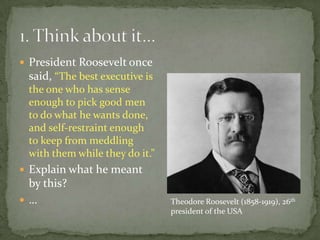
1. Think about it…President Roosevelt once said, “The best executive is the one who has sense enough to pick good men to do what he wants done, and self-restraint enough to keep from meddling with them while they do it.”Explain what he meant by this?…Theodore Roosevelt (1858-1919), 26th president of the USA
1. What are the job roles of each section in an organization?2. What is an organizational chart? 3. How are they organized?…2. Focus Questions:
We will be looking at the many ways businesses organize their human resources.We have learned in Unit 1.1 that one of the four major business functions was what?HUMAN RESOURCES!We also learned in Unit 1.2 about sole proprietorship and they various jobs they have to do because why?They are the ONLY one running the business.…3a. An overview:
So, what if the business expands and becomes larger?What will the business need then?It will need a formal and organized structure to make sure the business operates in an efficient and functional manner.This can be determined by two things:1. Accountability….what do I mean by this?Shows who is responsible for what job and their performance.2. Responsibility…what do I mean by this?Shows who is in charge of whom.3b. An overview:
In pairs:Brainstorm and create a “typical” structure for OUR Secondary (High) School.Hints:Think about who is at the top and work your way down.You have 5 mins....4. Activity: 
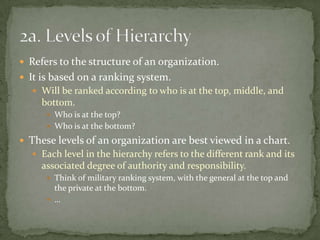
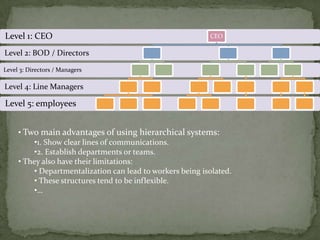
As stated before, as a business becomes larger and more complex it has to be more structured. If not, there would be total chaos and all the tasks and roles will not be fulfilled.An organizational structure is helpful in many ways:Can determine specialist areas.Determines who is the supervisor; form of accountability.Determines who has authority and their responsibilities.Explains how all areas in the business are linked.Can verify your own position in the company.Identifies the channels of communication in an organization.…5a. Formal Organization: Job Roles
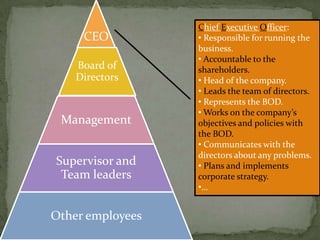
Chief Executive Officer: Responsible for running the business.
Accountable to the shareholders.
 Head of the company.
Leads the team of directors.
Represents the BOD.
Works on the company’s objectives and policies with the BOD.
Communicates with the directors about any problems.
Plans and implements corporate strategy.
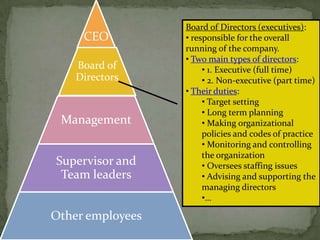
…Board of Directors (executives): responsible for the overall running of the company.
Two main types of directors:
 1. Executive (full time)
 2. Non-executive (part time)
Their duties:
 Target setting
Long term planning
Making organizational policies and codes of practice
 Monitoring and controlling the organization
Oversees staffing issues
Advising and supporting the managing directors
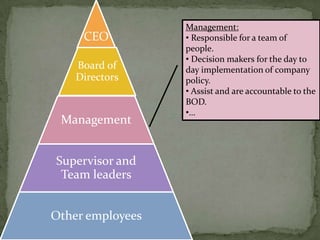
… Management:Responsible for a team of people.
Decision makers for the day to day implementation of company policy.
Assist and are accountable to the BOD.
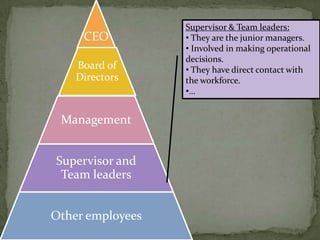
…Supervisor & Team leaders:They are the junior managers.
Involved in making operational decisions.
They have direct contact with the workforce.
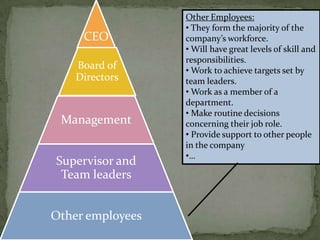
…Other Employees:They form the majority of the company’s workforce.
Will have great levels of skill and responsibilities.

Bm Unit 2.2 Organizational Structure

  • 1.
    Unit 2.2 OrganizationalStructureLesson 1: The Formal OrganizationPages 203-208IB Business & Management
  • 2.
    1. Think aboutit…President Roosevelt once said, “The best executive is the one who has sense enough to pick good men to do what he wants done, and self-restraint enough to keep from meddling with them while they do it.”Explain what he meant by this?…Theodore Roosevelt (1858-1919), 26th president of the USA
  • 3.
    1. What arethe job roles of each section in an organization?2. What is an organizational chart? 3. How are they organized?…2. Focus Questions:
  • 4.
    We will belooking at the many ways businesses organize their human resources.We have learned in Unit 1.1 that one of the four major business functions was what?HUMAN RESOURCES!We also learned in Unit 1.2 about sole proprietorship and they various jobs they have to do because why?They are the ONLY one running the business.…3a. An overview:
  • 5.
    So, what ifthe business expands and becomes larger?What will the business need then?It will need a formal and organized structure to make sure the business operates in an efficient and functional manner.This can be determined by two things:1. Accountability….what do I mean by this?Shows who is responsible for what job and their performance.2. Responsibility…what do I mean by this?Shows who is in charge of whom.3b. An overview:
  • 6.
    In pairs:Brainstorm andcreate a “typical” structure for OUR Secondary (High) School.Hints:Think about who is at the top and work your way down.You have 5 mins....4. Activity: 
  • 7.
    As stated before,as a business becomes larger and more complex it has to be more structured. If not, there would be total chaos and all the tasks and roles will not be fulfilled.An organizational structure is helpful in many ways:Can determine specialist areas.Determines who is the supervisor; form of accountability.Determines who has authority and their responsibilities.Explains how all areas in the business are linked.Can verify your own position in the company.Identifies the channels of communication in an organization.…5a. Formal Organization: Job Roles
  • 8.
    Chief Executive Officer:Responsible for running the business.
  • 9.
    Accountable to theshareholders.
  • 10.
    Head ofthe company.
  • 11.
    Leads the teamof directors.
  • 12.
  • 13.
    Works on thecompany’s objectives and policies with the BOD.
  • 14.
    Communicates with thedirectors about any problems.
  • 15.
    Plans and implementscorporate strategy.
  • 16.
    …Board of Directors(executives): responsible for the overall running of the company.
  • 17.
    Two main typesof directors:
  • 18.
    1. Executive(full time)
  • 19.
  • 20.
  • 21.
  • 22.
  • 23.
    Making organizational policiesand codes of practice
  • 24.
    Monitoring andcontrolling the organization
  • 25.
  • 26.
    Advising and supportingthe managing directors
  • 27.
  • 28.
    Decision makers forthe day to day implementation of company policy.
  • 29.
    Assist and areaccountable to the BOD.
  • 30.
    …Supervisor & Teamleaders:They are the junior managers.
  • 31.
    Involved in makingoperational decisions.
  • 32.
    They have directcontact with the workforce.
  • 33.
    …Other Employees:They formthe majority of the company’s workforce.
  • 34.
    Will have greatlevels of skill and responsibilities.