Prof.Chhaya Patel

Departmentation
Meaning of Departmentation
Departmentation is the foundation of organisation structure.
Departmentation means division of work into smaller units and their
re-grouping into bigger units (departments) on the basis of similarity
of features. Each department is headed by a person known as
departmental manager. Division of work into departments leads to
specialisation as people of one department perform activities related
to that department only. Departmentation provides scope for
organisation’s growth (along the same product lines) and expansion
(addition of new product lines).
Basis of Departmentation
There are two broad forms of organisation structure or
departmentation:
1.

Functional departmentation

2.

Divisional departmentation
Functional Departmentaion
It is grouping of activities on the basis of similarities of functions.
The nature of activities performed by different organisations is
different. Activities carried by a manufacturing concern are
production, finance, personnel and sales. For a trader, the major
activities are buying and selling. A bank performs the activities of
borrowing and lending. The major functional departments further
have derivative departments. Production department, for example,
has departments to handle purchasing, production planning and
control, manufacturing etc.
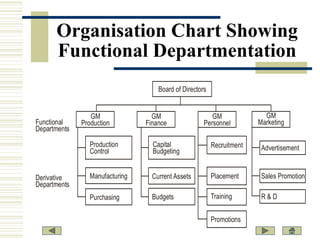
Organisation Chart Showing
Functional Departmentation
Board of Directors

Functional
Departments

GM
Production

GM
Finance

GM
Personnel

GM
Marketing

Production
Control

Derivative
Departments

Capital
Budgeting

Recruitment

Advertisement

Manufacturing

Current Assets

Placement

Sales Promotion

Purchasing

Budgets

Training

R&D

Promotions
Merits of Functional
Departmentation
1.

Simple and logical basis of creating departments

2.

Specialisaton

3.

Co-ordination

4.

Training and control

5.

Supervision

6.

Suitable for stable organisations

7.

Suitable for small organisations
Limitations of Functional
Departmentation
1.

Overall organisational goals

2.

Delayed decisions

3.

Co-ordination

4.

Holding of accountablity

5.

Unsuitable for dynamic organisations

6.

Complexity
Divisional Departmentation
Divisional structures are created on the basis of smaller divisions
where each division has its own functional activities (production,
finance, personnel and marketing). Major divisions that determine the
organisaion structure are
1.

Product departmentation

2.

Process or Equipment departmentation

3.

Cutomer departmentation

4.

Terriority or Geographic departmentation

5.

Departmentation by Time

6.

Departmentation by Size

7.

Departmentation by Task Force
Product Departmentation

This form of departmentation is suitable for companies that produce
multiple products. Product departmentation is grouping of jobs and
resources around the products or product lines that a company sells. The
focus is on the product line and all functional activities associated with
the product line. Departments are created on the basis of products and
product manager has the authority to carry out functional activities for
his department.
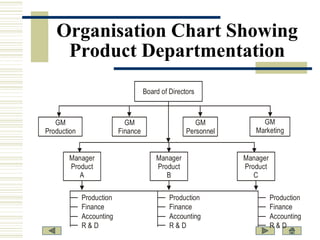
Organisation Chart Showing
Product Departmentation
Board of Directors

GM
Production

GM
Finance

Manager
Product
A
Production
Finance
Accounting
R&D

GM
Personnel

Manager
Product
B
Production
Finance
Accounting
R&D

GM
Marketing

Manager
Product
C
Production
Finance
Accounting
R&D
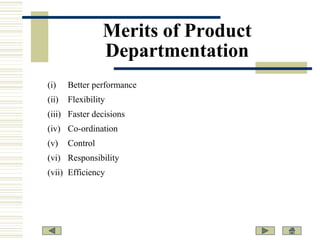
Merits of Product
Departmentation
(i)

Better performance

(ii)

Flexibility

(iii) Faster decisions
(iv) Co-ordination

(v)

Control

(vi) Responsibility
(vii) Efficiency
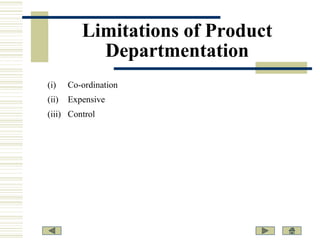
Limitations of Product
Departmentation
(i)

Co-ordination

(ii)

Expensive

(iii) Control
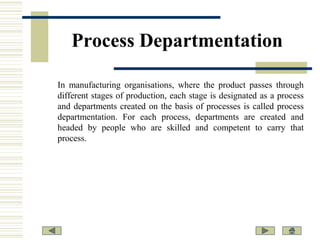
Process Departmentation
In manufacturing organisations, where the product passes through
different stages of production, each stage is designated as a process
and departments created on the basis of processes is called process
departmentation. For each process, departments are created and
headed by people who are skilled and competent to carry that
process.
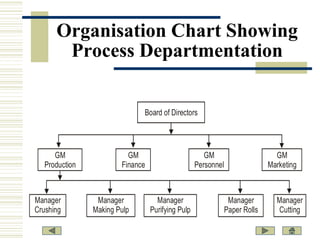
Organisation Chart Showing
Process Departmentation
Board of Directors

GM
Production

Manager
Crushing

GM
Finance

Manager
Making Pulp

GM
Personnel

Manager
Purifying Pulp

GM
Marketing

Manager
Paper Rolls

Manager
Cutting
Merits of Process
Departmentation
(i)

Specialisation

(ii)

Economic considerations

(iii) Technological consideration
(iv) Facilitates training
Limitations of Process
Departmentation

(i)

Co-ordination

(ii)

Boredom
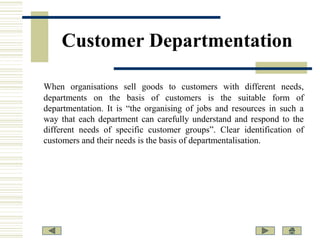
Customer Departmentation
When organisations sell goods to customers with different needs,
departments on the basis of customers is the suitable form of
departmentation. It is “the organising of jobs and resources in such a
way that each department can carefully understand and respond to the
different needs of specific customer groups”. Clear identification of
customers and their needs is the basis of departmentalisation.
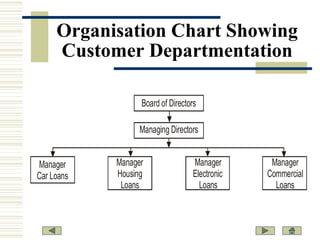
Organisation Chart Showing
Customer Departmentation
Board of Directors
Managing Directors

Manager
Car Loans

Manager
Housing
Loans

Manager
Electronic
Loans

Manager
Commercial
Loans
Merits of Customer
Departmentation
(i)

Competitive advantage

(ii)

Customer orientation

(iii) Specialisation
Limitations of Customer
Departmentation
(i)

Co-ordination

(ii) Identification of consumer groups
(iii) Change in consumer behaviour
(iv) Specialised staff
Geographic Departmentation
In territorial departmentation, organisation creates departments (i) close
to its customers because they are geographically dispersed over different
areas, or (ii) near the sources of deposits.
Each geographic unit has resources to cater to the needs of consumers of
that area. General Manager of every department looks after functional
activities of his geographical area while overall functional managers
provide supporting services to the managers of different areas.
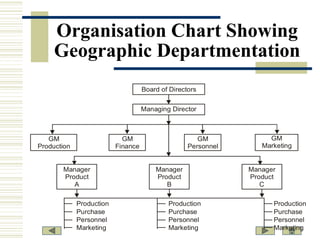
Organisation Chart Showing
Geographic Departmentation
Board of Directors
Managing Director

GM
Production

GM
Finance

Manager
Product
A
Production
Purchase
Personnel
Marketing

GM
Personnel

Manager
Product
B
Production
Purchase
Personnel
Marketing

GM
Marketing

Manager
Product
C
Production
Purchase
Personnel
Marketing
Merits of Geographic
Departmentation
(i)

Training and development

(ii)

Customer orientation

(iii) Low cost of production
(iv) Communication
Limitations of Geographic
Departmentation
(i)

Co-ordination and control

(ii)

Expensive

(iii) Managerial skills
Departmentation By Time
This method of departmentation is used in situations where work is
done round the clock because —
1.

the machine cannot be stopped before finishing the work
(manufacturing steel)

2.

the demand is high and the machine has to work overtime (during
boom conditioned)

3.

the nature of work entrusted to the organisations is such (Airlines
or Railways)

4.

the services are essential in nature (health and fire services).

5.

Workers work in shifts; morning, afternoon and night, so that work
can progress continuously.
Departmentation By Size
This method is followed in army where number of workers in the unit is
important. The company’s performance is judged by the number of
people working with it, and therefore, it adopts departmentation by size.
Departmentation By Task
Force

When organisation takes up different projects, it forms task forces,
which consist of people from different units having different skills to
carry out those projects. These groups are formed temporarily to work
till completion of the project. They are similar to project organisations.
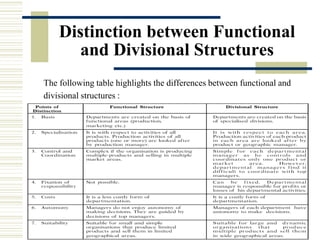
Distinction between Functional
and Divisional Structures
The following table highlights the differences between functional and
divisional structures :
Choice of Methods of
Departmentation
Though departments can be created on different basis, no method can
be described as the best. The factors that must be considered while
choosing a basis of departmentation are:
1.

The work and the process involved

2.

The extent of specialisation

3.

The capabilities of workers

4.

The technology employed

5.

The competitor’s approach

6.

The extent to which co-ordination and control is centralised or
decentralised

7.

The environment, internal and external to the organisation

8.

Optimum utilisation of resources

Departmentation

  • 1.
  • 2.
    Meaning of Departmentation Departmentationis the foundation of organisation structure. Departmentation means division of work into smaller units and their re-grouping into bigger units (departments) on the basis of similarity of features. Each department is headed by a person known as departmental manager. Division of work into departments leads to specialisation as people of one department perform activities related to that department only. Departmentation provides scope for organisation’s growth (along the same product lines) and expansion (addition of new product lines).
  • 3.
    Basis of Departmentation Thereare two broad forms of organisation structure or departmentation: 1. Functional departmentation 2. Divisional departmentation
  • 4.
    Functional Departmentaion It isgrouping of activities on the basis of similarities of functions. The nature of activities performed by different organisations is different. Activities carried by a manufacturing concern are production, finance, personnel and sales. For a trader, the major activities are buying and selling. A bank performs the activities of borrowing and lending. The major functional departments further have derivative departments. Production department, for example, has departments to handle purchasing, production planning and control, manufacturing etc.
  • 5.
    Organisation Chart Showing FunctionalDepartmentation Board of Directors Functional Departments GM Production GM Finance GM Personnel GM Marketing Production Control Derivative Departments Capital Budgeting Recruitment Advertisement Manufacturing Current Assets Placement Sales Promotion Purchasing Budgets Training R&D Promotions
  • 6.
    Merits of Functional Departmentation 1. Simpleand logical basis of creating departments 2. Specialisaton 3. Co-ordination 4. Training and control 5. Supervision 6. Suitable for stable organisations 7. Suitable for small organisations
  • 7.
    Limitations of Functional Departmentation 1. Overallorganisational goals 2. Delayed decisions 3. Co-ordination 4. Holding of accountablity 5. Unsuitable for dynamic organisations 6. Complexity
  • 8.
    Divisional Departmentation Divisional structuresare created on the basis of smaller divisions where each division has its own functional activities (production, finance, personnel and marketing). Major divisions that determine the organisaion structure are 1. Product departmentation 2. Process or Equipment departmentation 3. Cutomer departmentation 4. Terriority or Geographic departmentation 5. Departmentation by Time 6. Departmentation by Size 7. Departmentation by Task Force
  • 9.
    Product Departmentation This formof departmentation is suitable for companies that produce multiple products. Product departmentation is grouping of jobs and resources around the products or product lines that a company sells. The focus is on the product line and all functional activities associated with the product line. Departments are created on the basis of products and product manager has the authority to carry out functional activities for his department.
  • 10.
    Organisation Chart Showing ProductDepartmentation Board of Directors GM Production GM Finance Manager Product A Production Finance Accounting R&D GM Personnel Manager Product B Production Finance Accounting R&D GM Marketing Manager Product C Production Finance Accounting R&D
  • 11.
    Merits of Product Departmentation (i) Betterperformance (ii) Flexibility (iii) Faster decisions (iv) Co-ordination (v) Control (vi) Responsibility (vii) Efficiency
  • 12.
  • 13.
    Process Departmentation In manufacturingorganisations, where the product passes through different stages of production, each stage is designated as a process and departments created on the basis of processes is called process departmentation. For each process, departments are created and headed by people who are skilled and competent to carry that process.
  • 14.
    Organisation Chart Showing ProcessDepartmentation Board of Directors GM Production Manager Crushing GM Finance Manager Making Pulp GM Personnel Manager Purifying Pulp GM Marketing Manager Paper Rolls Manager Cutting
  • 15.
    Merits of Process Departmentation (i) Specialisation (ii) Economicconsiderations (iii) Technological consideration (iv) Facilitates training
  • 16.
  • 17.
    Customer Departmentation When organisationssell goods to customers with different needs, departments on the basis of customers is the suitable form of departmentation. It is “the organising of jobs and resources in such a way that each department can carefully understand and respond to the different needs of specific customer groups”. Clear identification of customers and their needs is the basis of departmentalisation.
  • 18.
    Organisation Chart Showing CustomerDepartmentation Board of Directors Managing Directors Manager Car Loans Manager Housing Loans Manager Electronic Loans Manager Commercial Loans
  • 19.
    Merits of Customer Departmentation (i) Competitiveadvantage (ii) Customer orientation (iii) Specialisation
  • 20.
    Limitations of Customer Departmentation (i) Co-ordination (ii)Identification of consumer groups (iii) Change in consumer behaviour (iv) Specialised staff
  • 21.
    Geographic Departmentation In territorialdepartmentation, organisation creates departments (i) close to its customers because they are geographically dispersed over different areas, or (ii) near the sources of deposits. Each geographic unit has resources to cater to the needs of consumers of that area. General Manager of every department looks after functional activities of his geographical area while overall functional managers provide supporting services to the managers of different areas.
  • 22.
    Organisation Chart Showing GeographicDepartmentation Board of Directors Managing Director GM Production GM Finance Manager Product A Production Purchase Personnel Marketing GM Personnel Manager Product B Production Purchase Personnel Marketing GM Marketing Manager Product C Production Purchase Personnel Marketing
  • 23.
    Merits of Geographic Departmentation (i) Trainingand development (ii) Customer orientation (iii) Low cost of production (iv) Communication
  • 24.
    Limitations of Geographic Departmentation (i) Co-ordinationand control (ii) Expensive (iii) Managerial skills
  • 25.
    Departmentation By Time Thismethod of departmentation is used in situations where work is done round the clock because — 1. the machine cannot be stopped before finishing the work (manufacturing steel) 2. the demand is high and the machine has to work overtime (during boom conditioned) 3. the nature of work entrusted to the organisations is such (Airlines or Railways) 4. the services are essential in nature (health and fire services). 5. Workers work in shifts; morning, afternoon and night, so that work can progress continuously.
  • 26.
    Departmentation By Size Thismethod is followed in army where number of workers in the unit is important. The company’s performance is judged by the number of people working with it, and therefore, it adopts departmentation by size.
  • 27.
    Departmentation By Task Force Whenorganisation takes up different projects, it forms task forces, which consist of people from different units having different skills to carry out those projects. These groups are formed temporarily to work till completion of the project. They are similar to project organisations.
  • 28.
    Distinction between Functional andDivisional Structures The following table highlights the differences between functional and divisional structures :
  • 29.
    Choice of Methodsof Departmentation Though departments can be created on different basis, no method can be described as the best. The factors that must be considered while choosing a basis of departmentation are: 1. The work and the process involved 2. The extent of specialisation 3. The capabilities of workers 4. The technology employed 5. The competitor’s approach 6. The extent to which co-ordination and control is centralised or decentralised 7. The environment, internal and external to the organisation 8. Optimum utilisation of resources