Unit 3: TRAINING AND EXECUTIVE
DEVELOPEMENT
Prepared & Presented by ,
N. Ganesha Pandian,
Assistant professor,
Madurai School of management
References: John M Ivancewich, Human resource
Management, Tata Mc Graw Hill
AcademicYear2016-2017EvenSemester
Year I Semester II
MSM-MBA 2016-2017 Even semester
CONTENTS
• Types of training methods
• Purpose- benefits- resistance
• Executive development programmes
• Common practices - Benefits
• Self development
• Knowledge management
MSM-MBA 2016-2017 Even semester
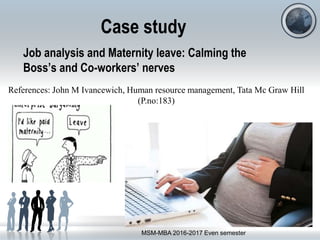
Job analysis and Maternity leave: Calming the
Boss’s and Co-workers’ nerves
MSM-MBA 2016-2017 Even semester
Case study
References: John M Ivancewich, Human resource management, Tata Mc Graw Hill
(P.no:183)
What is Training?
• Training is a process of learning a sequence of programmed
behavior.
• It is the application of knowledge & gives people an awareness of
rules & procedures to guide their behavior
• It helps in bringing about positive change in the knowledge, skills &
attitudes of employees.
MSM-MBA 2016-2017 Even semester
Why training is needed?
• Training refers to a planned effort by a company to facilitate
employees‘ learning of job related competencies.
• These competencies include knowledge, skills, or behaviors that are
critical for successful job performance.
• The goal of training is for employees to master the knowledge, skill,
and behaviors emphasized in training programs and to apply them to
their day to day activities
MSM-MBA 2016-2017 Even semester
Training Needs Assessment (TNA)
• Needs assessment is the process that is used to determine if and
what type of training is necessary
• It involves
1. Personal analysis
2. Task analysis
3. Organization analysis
MSM-MBA 2016-2017 Even semester
• Any gap between the expected and actual results
suggests a need for training.
• By observing, asking, and listening, a manager or HR
specialist is actually conducting a “Performance analysis”
MSM-MBA 2016-2017 Even semester
• There are a number specific steps to identify the training needs:
Step1: Behavioral Discrepancy
Step2: Cost – value Analysis
Step3: Is it a “can’t do” or Won’t do” situation?
Step4: Set standards
Step5: Remove obstacles
Step6: Practice
Step7 : Training
Step8: Change the job
Step9: Transfer or terminate
Step10: Create a Motivational climate
MSM-MBA 2016-2017 Even semester
Importance of Training
• Improves Morale of Employees
• Less Supervision
• Fewer Accidents
• Chances of Promotion
• Increased Productivity
MSM-MBA 2016-2017 Even semester
Training and Development Instructional methods
There are two types of Job training :
• On-the-job training takes place in a normal working
situation
• Off-the-job training takes place away from normal work
situations
MSM-MBA 2016-2017 Even semester
On- the Job training
• Probably the most widely used methods of training (formal
and informal) is on-the-job training.
• It is estimated that more than 60 percent of training occurs
on the job.
• One approach to systematic on-the-job training is the Job-
Instruction-Training (JIT) system .
MSM-MBA 2016-2017 Even semester
Some methods of On-the-job training
1. Case method – Written description of a real-decision making situation in the
organization
2. Role playing – Cross between role playing and an attitude development
program
3. In- Basket technique – To develop managerial abilities
4. Management games – Describe the operating characteristics of a company
5. Behavior modeling – Interaction management or imitating models – often by
use of films
6. Outdoor oriented programs – River rafting, mountain climbing and etc
MSM-MBA 2016-2017 Even semester
On–the–Job training for Managers
The below programs are not mutually exclusive, but run
simultaneously,
• Coaching and Counseling – relationship resembles buddy
system
• Transitory anticipatory experiences – Under study,
Management Apprenticeship
• Transfers and rotation
MSM-MBA 2016-2017 Even semester
Off- the-Job training
• Lecture-Discussion approach – use of blackboards, or visual aids
such as projectors
• Using computers – Computer assisted Instruction (CIA)
• Multimedia based training (MBT)
• Virtual reality
• Distance training or distance learning
MSM-MBA 2016-2017 Even semester
Resistance to training
• Normally people experience difficulties in learning new skills &
knowledge.
• The employees feel that management will entrust more work or new
kinds of work which would require additional skills & knowledge.
• Training programme & sessions disturbs the employees from
performing the routine duties & tasks.
• They are expected to learn more difficult activities & unlearn already
practiced skills.
• They loose their job authority & are expected to learn like students
during their training programme.
MSM-MBA 2016-2017 Even semester
Management Development / Executive development -
an overview
Executive development includes the process by
which managers and executives acquire not only
skills and competency in their present job but also
capabilities for future managerial tasks of increasing
difficulty and scope
Executive development is a planned and organized
process of learning. It is an ongoing and never ending
exercise
MSM-MBA 2016-2017 Even semester
Process of executive development
• Analysis of Development Needs
• Appraisal of the Present Managerial Talent
• Planning Individual Development Programmes
• Establishing Training and Development Programme
• Evaluating Developing Programs
MSM-MBA 2016-2017 Even semester
Executive Development Techniques
• There are three major target areas: 1. Individual 2. Group 3. Organizational
Development : Individual techniques
1. Goal setting: E.A Locke proposed that goal setting is a cognitive process
of some practical utility
2. Goal setting process
3. Research on Goal setting
4. Individual differences and goal setting
5. Criticisms of goal setting
MSM-MBA 2016-2017 Even semester
Behavior Modification
2. Behavior Modification or organizational behavior modification
B. E. Skinner’s work with animals led to use of the term Operant
conditioning
Principles of operant conditioning: Positive reinforcement and
negative reinforcement : Punishments and extinction
Behavior Modification : A Managerial perspective
Criticisms of behavior Modification
MSM-MBA 2016-2017 Even semester
Development: Team building
• Team building is a development process that helps or prepares
organization members to work more efficiently or effectively in groups
• In one organization, team building followed this pattern.
1. Team skills workshop
2. Data Collection
3. Data Confrontation
4. Action planning
5. Team building
6. Intergroup team building
MSM-MBA 2016-2017 Even semester
Development : An Organization wide technique
• TQM (Total Quality Management) – is a philosophy, a
process and a set of principles that provide an organization
with what is needed to continuously improve its
effectiveness.
• TQM involves everyone in the firm in developing and fine-
tuning processes that are customer-oriented, flexible and
improving quality
MSM-MBA 2016-2017 Even semester
Importance of executive development
• Executive development programmes are required to train and
develop professional managers
• It enables managers to face problems related to technology and
institution.
• Executives need training and education to understand and adjust to
changes in socio-economic changes.
• Executive development is required to broader the outlook of
managers.
MSM-MBA 2016-2017 Even semester
Evaluation of Executive training program
The evaluation of the process assumes importance from the following
perspectives:
1. Improving the quality of the training and development process.
2. Improving the efficiency and competency of the trainers.
3. Making improvements in the system to make it more responsive and
realistic.
4. Aligning the training activities to the organizational objectives.
5. Building the cost implications of the training into the organizational
budget.
6. Evaluating the ROI on account of training and development to justify
further investments
MSM-MBA 2016-2017 Even semester
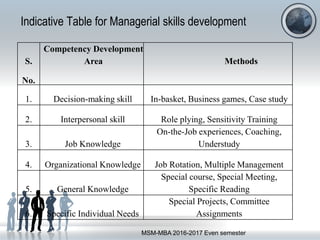
Indicative Table for Managerial skills development
S.
Competency Development
Area Methods
No.
1. Decision-making skill In-basket, Business games, Case study
2. Interpersonal skill Role plying, Sensitivity Training
3. Job Knowledge
On-the-Job experiences, Coaching,
Understudy
4. Organizational Knowledge Job Rotation, Multiple Management
5. General Knowledge
Special course, Special Meeting,
Specific Reading
6. Specific Individual Needs
Special Projects, Committee
Assignments
MSM-MBA 2016-2017 Even semester
Self development / Personal development
• It is the process of improving oneself through such activities as
enhancing employment skills, increasing consciousness and building
wealth.
• Personal development covers activities that improve awareness and
identity, develop talents and potential, build human capital and
facilitate employability, enhance the quality of life and contribute to
realization of dreams
MSM-MBA 2016-2017 Even semester
Activities of personal development
1. Improving self-awareness
2. Improving self-knowledge
3. Improving skills and/or learning new ones
4. Building or renewing self esteem
5. Developing strengths or talents
6. Improving the career
7. Improving health, lifestyle
8. Improving social skills and emotional intelligence
MSM-MBA 2016-2017 Even semester
Context of Personal development
• Psychology became linked to personal development in the early 20th
century starting with Alfred Adler (1870-1937) and Carl Jung (1975-
1961)
• Adler refused to limit psychology to analysis. He also originated the
concepts of lifestyle as a individual’s characteristics' to approach life.
Self image and work-life balance came into management
MSM-MBA 2016-2017 Even semester
• Arthur chickering defined seven vectors of personal development for
young adults during their graduate years:
1. Developing competence
2. Managing emotions
3. Achieving autonomy and interdependence
4. Establishing identity
5. Developing purpose
6. Developing integrity
MSM-MBA 2016-2017 Even semester
Personal development planning
• Personal development planning (PDP) or Individual
development plan (IDP) or Personal enterprise plan (PEP)
is the process of creating an action plan based on
awareness, values, reflection, goal setting, and planning for
personal development within the context of a career,
education, relationship or for self-improvement
MSM-MBA 2016-2017 Even semester
Typical programs in this category includes:
• Work-life balance
• Time management
• Stress management
• Health problems
• counseling
MSM-MBA 2016-2017 Even semester
Criticisms to personal development
• Scholars have targeted self-help claims as misleading and
incorrect.
• In 2005,Steve Salerno portrayed the American self-help
movement – as acronym SHAM; claiming that these
concepts are ineffective in achieving its goals and also
socially harmful
MSM-MBA 2016-2017 Even semester
Knowledge Management
• Knowledge management (KM) is the systematic
management of an organization’s knowledge assets for the
purpose of creating value and meeting tactical and strategic
requirements.
• It consist of the initiatives, processes, strategies, and
systems that sustain and enhance the storage,
assessment, sharing, refinement and creation of knowledge
MSM-MBA 2016-2017 Even semester
KM Technologies
Knowledge Management (KM) technology can be divided into the
following general categories:
• Groupware
• Workflow
• Content/Document Management
• Enterprise Portals
• eLearning
• Scheduling and planning
• Tele presence
MSM-MBA 2016-2017 Even semester
• Groupware refers to technologies that facilitate collaboration and
sharing of organizational information
• Workflow tools allow the representation of processes associated
with the creation, use, and maintenance of organizational knowledge
• Content/Document Management systems are systems designed to
automate the process of creating web content and/or documents
within an organization
• Enterprise Portals are web sites that aggregate information across
the entire organization or for groups within the organization such as
project teams.
MSM-MBA 2016-2017 Even semester
Organizational memory or learning
• Knowledge management (KM) is a powerful tool which
makes use of it for organizational learning
• It is organizational memory based on experience and data
collected over the period of time
MSM-MBA 2016-2017 Even semester

Unit 3 training and executive development

  • 1.
    Unit 3: TRAININGAND EXECUTIVE DEVELOPEMENT Prepared & Presented by , N. Ganesha Pandian, Assistant professor, Madurai School of management References: John M Ivancewich, Human resource Management, Tata Mc Graw Hill AcademicYear2016-2017EvenSemester Year I Semester II MSM-MBA 2016-2017 Even semester
  • 2.
    CONTENTS • Types oftraining methods • Purpose- benefits- resistance • Executive development programmes • Common practices - Benefits • Self development • Knowledge management MSM-MBA 2016-2017 Even semester
  • 3.
    Job analysis andMaternity leave: Calming the Boss’s and Co-workers’ nerves MSM-MBA 2016-2017 Even semester Case study References: John M Ivancewich, Human resource management, Tata Mc Graw Hill (P.no:183)
  • 4.
    What is Training? •Training is a process of learning a sequence of programmed behavior. • It is the application of knowledge & gives people an awareness of rules & procedures to guide their behavior • It helps in bringing about positive change in the knowledge, skills & attitudes of employees. MSM-MBA 2016-2017 Even semester
  • 5.
    Why training isneeded? • Training refers to a planned effort by a company to facilitate employees‘ learning of job related competencies. • These competencies include knowledge, skills, or behaviors that are critical for successful job performance. • The goal of training is for employees to master the knowledge, skill, and behaviors emphasized in training programs and to apply them to their day to day activities MSM-MBA 2016-2017 Even semester
  • 6.
    Training Needs Assessment(TNA) • Needs assessment is the process that is used to determine if and what type of training is necessary • It involves 1. Personal analysis 2. Task analysis 3. Organization analysis MSM-MBA 2016-2017 Even semester
  • 7.
    • Any gapbetween the expected and actual results suggests a need for training. • By observing, asking, and listening, a manager or HR specialist is actually conducting a “Performance analysis” MSM-MBA 2016-2017 Even semester
  • 8.
    • There area number specific steps to identify the training needs: Step1: Behavioral Discrepancy Step2: Cost – value Analysis Step3: Is it a “can’t do” or Won’t do” situation? Step4: Set standards Step5: Remove obstacles Step6: Practice Step7 : Training Step8: Change the job Step9: Transfer or terminate Step10: Create a Motivational climate MSM-MBA 2016-2017 Even semester
  • 9.
    Importance of Training •Improves Morale of Employees • Less Supervision • Fewer Accidents • Chances of Promotion • Increased Productivity MSM-MBA 2016-2017 Even semester
  • 10.
    Training and DevelopmentInstructional methods There are two types of Job training : • On-the-job training takes place in a normal working situation • Off-the-job training takes place away from normal work situations MSM-MBA 2016-2017 Even semester
  • 11.
    On- the Jobtraining • Probably the most widely used methods of training (formal and informal) is on-the-job training. • It is estimated that more than 60 percent of training occurs on the job. • One approach to systematic on-the-job training is the Job- Instruction-Training (JIT) system . MSM-MBA 2016-2017 Even semester
  • 12.
    Some methods ofOn-the-job training 1. Case method – Written description of a real-decision making situation in the organization 2. Role playing – Cross between role playing and an attitude development program 3. In- Basket technique – To develop managerial abilities 4. Management games – Describe the operating characteristics of a company 5. Behavior modeling – Interaction management or imitating models – often by use of films 6. Outdoor oriented programs – River rafting, mountain climbing and etc MSM-MBA 2016-2017 Even semester
  • 13.
    On–the–Job training forManagers The below programs are not mutually exclusive, but run simultaneously, • Coaching and Counseling – relationship resembles buddy system • Transitory anticipatory experiences – Under study, Management Apprenticeship • Transfers and rotation MSM-MBA 2016-2017 Even semester
  • 14.
    Off- the-Job training •Lecture-Discussion approach – use of blackboards, or visual aids such as projectors • Using computers – Computer assisted Instruction (CIA) • Multimedia based training (MBT) • Virtual reality • Distance training or distance learning MSM-MBA 2016-2017 Even semester
  • 15.
    Resistance to training •Normally people experience difficulties in learning new skills & knowledge. • The employees feel that management will entrust more work or new kinds of work which would require additional skills & knowledge. • Training programme & sessions disturbs the employees from performing the routine duties & tasks. • They are expected to learn more difficult activities & unlearn already practiced skills. • They loose their job authority & are expected to learn like students during their training programme. MSM-MBA 2016-2017 Even semester
  • 16.
    Management Development /Executive development - an overview Executive development includes the process by which managers and executives acquire not only skills and competency in their present job but also capabilities for future managerial tasks of increasing difficulty and scope Executive development is a planned and organized process of learning. It is an ongoing and never ending exercise MSM-MBA 2016-2017 Even semester
  • 17.
    Process of executivedevelopment • Analysis of Development Needs • Appraisal of the Present Managerial Talent • Planning Individual Development Programmes • Establishing Training and Development Programme • Evaluating Developing Programs MSM-MBA 2016-2017 Even semester
  • 18.
    Executive Development Techniques •There are three major target areas: 1. Individual 2. Group 3. Organizational Development : Individual techniques 1. Goal setting: E.A Locke proposed that goal setting is a cognitive process of some practical utility 2. Goal setting process 3. Research on Goal setting 4. Individual differences and goal setting 5. Criticisms of goal setting MSM-MBA 2016-2017 Even semester
  • 19.
    Behavior Modification 2. BehaviorModification or organizational behavior modification B. E. Skinner’s work with animals led to use of the term Operant conditioning Principles of operant conditioning: Positive reinforcement and negative reinforcement : Punishments and extinction Behavior Modification : A Managerial perspective Criticisms of behavior Modification MSM-MBA 2016-2017 Even semester
  • 20.
    Development: Team building •Team building is a development process that helps or prepares organization members to work more efficiently or effectively in groups • In one organization, team building followed this pattern. 1. Team skills workshop 2. Data Collection 3. Data Confrontation 4. Action planning 5. Team building 6. Intergroup team building MSM-MBA 2016-2017 Even semester
  • 21.
    Development : AnOrganization wide technique • TQM (Total Quality Management) – is a philosophy, a process and a set of principles that provide an organization with what is needed to continuously improve its effectiveness. • TQM involves everyone in the firm in developing and fine- tuning processes that are customer-oriented, flexible and improving quality MSM-MBA 2016-2017 Even semester
  • 22.
    Importance of executivedevelopment • Executive development programmes are required to train and develop professional managers • It enables managers to face problems related to technology and institution. • Executives need training and education to understand and adjust to changes in socio-economic changes. • Executive development is required to broader the outlook of managers. MSM-MBA 2016-2017 Even semester
  • 23.
    Evaluation of Executivetraining program The evaluation of the process assumes importance from the following perspectives: 1. Improving the quality of the training and development process. 2. Improving the efficiency and competency of the trainers. 3. Making improvements in the system to make it more responsive and realistic. 4. Aligning the training activities to the organizational objectives. 5. Building the cost implications of the training into the organizational budget. 6. Evaluating the ROI on account of training and development to justify further investments MSM-MBA 2016-2017 Even semester
  • 24.
    Indicative Table forManagerial skills development S. Competency Development Area Methods No. 1. Decision-making skill In-basket, Business games, Case study 2. Interpersonal skill Role plying, Sensitivity Training 3. Job Knowledge On-the-Job experiences, Coaching, Understudy 4. Organizational Knowledge Job Rotation, Multiple Management 5. General Knowledge Special course, Special Meeting, Specific Reading 6. Specific Individual Needs Special Projects, Committee Assignments MSM-MBA 2016-2017 Even semester
  • 25.
    Self development /Personal development • It is the process of improving oneself through such activities as enhancing employment skills, increasing consciousness and building wealth. • Personal development covers activities that improve awareness and identity, develop talents and potential, build human capital and facilitate employability, enhance the quality of life and contribute to realization of dreams MSM-MBA 2016-2017 Even semester
  • 26.
    Activities of personaldevelopment 1. Improving self-awareness 2. Improving self-knowledge 3. Improving skills and/or learning new ones 4. Building or renewing self esteem 5. Developing strengths or talents 6. Improving the career 7. Improving health, lifestyle 8. Improving social skills and emotional intelligence MSM-MBA 2016-2017 Even semester
  • 27.
    Context of Personaldevelopment • Psychology became linked to personal development in the early 20th century starting with Alfred Adler (1870-1937) and Carl Jung (1975- 1961) • Adler refused to limit psychology to analysis. He also originated the concepts of lifestyle as a individual’s characteristics' to approach life. Self image and work-life balance came into management MSM-MBA 2016-2017 Even semester
  • 28.
    • Arthur chickeringdefined seven vectors of personal development for young adults during their graduate years: 1. Developing competence 2. Managing emotions 3. Achieving autonomy and interdependence 4. Establishing identity 5. Developing purpose 6. Developing integrity MSM-MBA 2016-2017 Even semester
  • 29.
    Personal development planning •Personal development planning (PDP) or Individual development plan (IDP) or Personal enterprise plan (PEP) is the process of creating an action plan based on awareness, values, reflection, goal setting, and planning for personal development within the context of a career, education, relationship or for self-improvement MSM-MBA 2016-2017 Even semester
  • 30.
    Typical programs inthis category includes: • Work-life balance • Time management • Stress management • Health problems • counseling MSM-MBA 2016-2017 Even semester
  • 31.
    Criticisms to personaldevelopment • Scholars have targeted self-help claims as misleading and incorrect. • In 2005,Steve Salerno portrayed the American self-help movement – as acronym SHAM; claiming that these concepts are ineffective in achieving its goals and also socially harmful MSM-MBA 2016-2017 Even semester
  • 32.
    Knowledge Management • Knowledgemanagement (KM) is the systematic management of an organization’s knowledge assets for the purpose of creating value and meeting tactical and strategic requirements. • It consist of the initiatives, processes, strategies, and systems that sustain and enhance the storage, assessment, sharing, refinement and creation of knowledge MSM-MBA 2016-2017 Even semester
  • 33.
    KM Technologies Knowledge Management(KM) technology can be divided into the following general categories: • Groupware • Workflow • Content/Document Management • Enterprise Portals • eLearning • Scheduling and planning • Tele presence MSM-MBA 2016-2017 Even semester
  • 34.
    • Groupware refersto technologies that facilitate collaboration and sharing of organizational information • Workflow tools allow the representation of processes associated with the creation, use, and maintenance of organizational knowledge • Content/Document Management systems are systems designed to automate the process of creating web content and/or documents within an organization • Enterprise Portals are web sites that aggregate information across the entire organization or for groups within the organization such as project teams. MSM-MBA 2016-2017 Even semester
  • 35.
    Organizational memory orlearning • Knowledge management (KM) is a powerful tool which makes use of it for organizational learning • It is organizational memory based on experience and data collected over the period of time MSM-MBA 2016-2017 Even semester
  • 36.