COMPENSATION
PLANNING
Chapter 5
Compensation
 Compensation is what the employees receive in
exchange for their services to the organization
 It can be of three types:
 Base Pay: it is the basic compensation what the employee gets,
usually as a wage or salary
 Variable Pay: it is the compensation that is directly linked to
performance accomplishments(bonuses, incentives, stock options)
 Benefits: these are the indirect rewards given to an employee or a
group of employees as a part of organizational membership
(health insurance, vacation pay, retirement pension etc)
Objectives of Compensation Planning
 The most important objective of any pay system is
fairness or equity. The term equity has three
dimensions, namely:
 Internal Equity: ensures that the difficult jobs are paid more
 External Equity: ensures that jobs are fairly compensated in
comparison to similar jobs in the labor market
 Individual Equity: ensures equal pay for equal work i.e., each
individual’s pay is fair in comparison to the others doing the
same/similar jobs
Continuation…
 The ultimate goal of compensation administration is to
reward the desired behaviors and encourage the
employees to do well in their jobs. The other important
objectives are:
 Attract talent
 Retain talent
 Ensure equity
 New and desired behavior
 Control costs
 Comply with the legal rules
 Ease of operations
Wage and Salary
 Wage:
 a variable pay an individual receives on the basis of the time spent
in completion of the certain amount of work
 It is paid to semi-skilled or unskilled workers
 Variable in nature
 Salary:
 A fixed pay an individual receives for the work done by him on the
annual basis
 It is paid for the skilled workers
 It is fixed in nature
Wage and Salary Administration
 The term compensation administration or wage & salary
administration denotes the process of managing the company’s
compensation programme
 Employee compensation can be classified into two types:
 Base compensation: it refers to the monetary payments the employees
receive in the form of wages and salaries
 Supplementary compensation: it signifies the incentive payments
based on the actual performance of the employee or a group of employees
Objectives of Wage & Salary
Administration
 To establish the fair & equitable remuneration offering similar pay for similar
work
 To attract qualified and competent personnel
 To retain the present employees by keeping wage levels in tune with competing
units
 To control labor and administrative costs in line with the ability of the
organization to pay
 To improve the motivation & the morale of employees & improve the unit
management
 To project a good image of the company and to comply with the legal needs
relating to wages and salaries
Principles of Wage & Salary
Administration
 Wage & salary plans should be sufficiently flexible
 Must always be consistent with the overall
organizational plans and programmes
 Comparing the performance with the salary received
 Measuring the job satisfaction of the employees
 Evaluating the unsatisfied wants and unrealized goals
and aspirations of the employees
 Should be in conformity with the social and
economical objectives of the country
 Should be responsive to the changing local and
national conditions
The Elements of Wage & Salary System
 Cost estimating the worth of its members of their
salary opportunities and communicating them to
employees
 Relating salary to needs & goals
 Developing quality, quantity and time standards
related to work and goals
 Determining the effort necessary to achieve standards
 Measuring the actual performance
 Finding out the dissatisfaction arising from unfulfilled
needs and unattained goals
Factors Influencing the Compensation
Levels
 Job needs
 Ability to pay
 Cost of living
 Prevailing wage rates
 Unions
 Productivity
 State regulations
 Demand and supply of labour
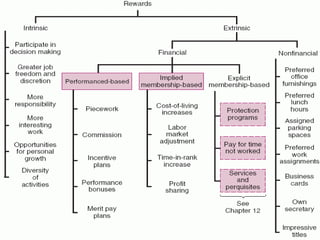
Types of Reward Plans
Intrinsic versus Extrinsic Rewards
 Intrinsic rewards (personal satisfactions) come
from the job itself, such as:
 pride in one’s work
 feelings of accomplishment
 being part of a work team
Types of Reward Plans
Financial versus Non-financial Rewards
 Financial rewards include:
 wages
 bonuses
 profit sharing
 pension plans
 paid leaves
 purchase discounts
 Non-financial rewards emphasize making life on the
job more attractive; employees vary greatly on what
types they find desirable.
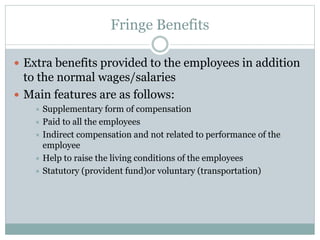
Fringe Benefits
 Extra benefits provided to the employees in addition
to the normal wages/salaries
 Main features are as follows:
 Supplementary form of compensation
 Paid to all the employees
 Indirect compensation and not related to performance of the
employee
 Help to raise the living conditions of the employees
 Statutory (provident fund)or voluntary (transportation)
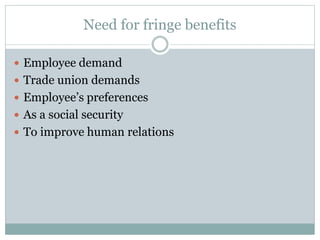
Need for fringe benefits
 Employee demand
 Trade union demands
 Employee’s preferences
 As a social security
 To improve human relations
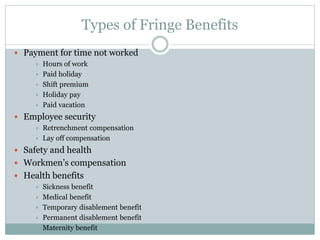
Types of Fringe Benefits
 Payment for time not worked
 Hours of work
 Paid holiday
 Shift premium
 Holiday pay
 Paid vacation
 Employee security
 Retrenchment compensation
 Lay off compensation
 Safety and health
 Workmen’s compensation
 Health benefits
 Sickness benefit
 Medical benefit
 Temporary disablement benefit
 Permanent disablement benefit
 Maternity benefit
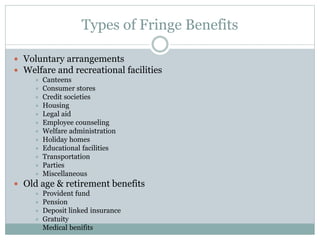
Types of Fringe Benefits
 Voluntary arrangements
 Welfare and recreational facilities
 Canteens
 Consumer stores
 Credit societies
 Housing
 Legal aid
 Employee counseling
 Welfare administration
 Holiday homes
 Educational facilities
 Transportation
 Parties
 Miscellaneous
 Old age & retirement benefits
 Provident fund
 Pension
 Deposit linked insurance
 Gratuity
 Medical benifits
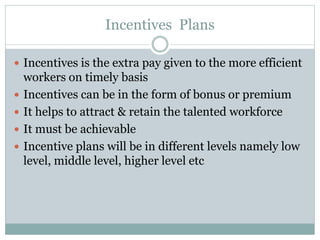
Incentives Plans
 Incentives is the extra pay given to the more efficient
workers on timely basis
 Incentives can be in the form of bonus or premium
 It helps to attract & retain the talented workforce
 It must be achievable
 Incentive plans will be in different levels namely low
level, middle level, higher level etc
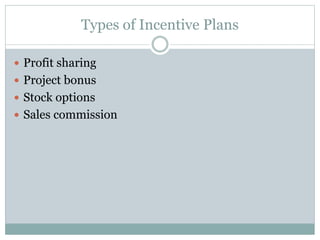
Types of Incentive Plans
 Profit sharing
 Project bonus
 Stock options
 Sales commission
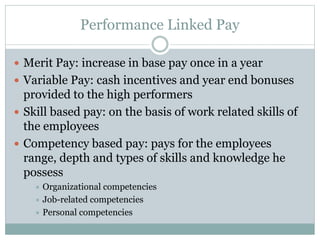
Performance Linked Pay
 Merit Pay: increase in base pay once in a year
 Variable Pay: cash incentives and year end bonuses
provided to the high performers
 Skill based pay: on the basis of work related skills of
the employees
 Competency based pay: pays for the employees
range, depth and types of skills and knowledge he
possess
 Organizational competencies
 Job-related competencies
 Personal competencies
Compensation Survey
 These are the tools used to determine the median for
the average compensation to be paid for the
employee on one or more jobs
 The compensation data collected from the several
employers is used to determine the amount of
compensation to be paid
 Surveys focus on job titles, geographic locations,
employer size and the industries
 Surveys will be conducted by employer’s
associations, survey vendors or individual employers
Compensation Surveys
 Types of Compensation Surveys are:
 Base salaries
 Increase in percentage or amounts
 Merit increases
 Salary ranges
 Starting salaries
 Incentives/Bonuses
 Allowances and benefits
 Working hours
 Educational requirements
 Geographic location
 Source of hire (External/Internal)
 Working conditions
Compensation Surveys
 How to choose a right survey
 Appropriate jobs
 Summary
 Methodology
 Tabulations
 Participating in survey
 Indentifying the response deadline
 Match jobs
• Title
• Organizational structure
• Job duties
 Determining what data is needed
 Backup your response
Pay Structure
 Pay structure or pay scale is a system that how much
is to be paid to the employee as a salary or wage
based on one or more factors such as the employee’s
level, rank or status within the employer’s
organization, the length of employee’s service to the
organization and the difficulty of the task
 Allocate the payroll budget
 Benchmark the value of each job
 Use the internal equity system to create a salary
ranges by pay grade
 Use market pricing to relate jobs to external forces
Thank you

Compensation Planning

  • 1.
  • 2.
    Compensation  Compensation iswhat the employees receive in exchange for their services to the organization  It can be of three types:  Base Pay: it is the basic compensation what the employee gets, usually as a wage or salary  Variable Pay: it is the compensation that is directly linked to performance accomplishments(bonuses, incentives, stock options)  Benefits: these are the indirect rewards given to an employee or a group of employees as a part of organizational membership (health insurance, vacation pay, retirement pension etc)
  • 3.
    Objectives of CompensationPlanning  The most important objective of any pay system is fairness or equity. The term equity has three dimensions, namely:  Internal Equity: ensures that the difficult jobs are paid more  External Equity: ensures that jobs are fairly compensated in comparison to similar jobs in the labor market  Individual Equity: ensures equal pay for equal work i.e., each individual’s pay is fair in comparison to the others doing the same/similar jobs
  • 4.
    Continuation…  The ultimategoal of compensation administration is to reward the desired behaviors and encourage the employees to do well in their jobs. The other important objectives are:  Attract talent  Retain talent  Ensure equity  New and desired behavior  Control costs  Comply with the legal rules  Ease of operations
  • 5.
    Wage and Salary Wage:  a variable pay an individual receives on the basis of the time spent in completion of the certain amount of work  It is paid to semi-skilled or unskilled workers  Variable in nature  Salary:  A fixed pay an individual receives for the work done by him on the annual basis  It is paid for the skilled workers  It is fixed in nature
  • 6.
    Wage and SalaryAdministration  The term compensation administration or wage & salary administration denotes the process of managing the company’s compensation programme  Employee compensation can be classified into two types:  Base compensation: it refers to the monetary payments the employees receive in the form of wages and salaries  Supplementary compensation: it signifies the incentive payments based on the actual performance of the employee or a group of employees
  • 7.
    Objectives of Wage& Salary Administration  To establish the fair & equitable remuneration offering similar pay for similar work  To attract qualified and competent personnel  To retain the present employees by keeping wage levels in tune with competing units  To control labor and administrative costs in line with the ability of the organization to pay  To improve the motivation & the morale of employees & improve the unit management  To project a good image of the company and to comply with the legal needs relating to wages and salaries
  • 8.
    Principles of Wage& Salary Administration  Wage & salary plans should be sufficiently flexible  Must always be consistent with the overall organizational plans and programmes  Comparing the performance with the salary received  Measuring the job satisfaction of the employees  Evaluating the unsatisfied wants and unrealized goals and aspirations of the employees  Should be in conformity with the social and economical objectives of the country  Should be responsive to the changing local and national conditions
  • 9.
    The Elements ofWage & Salary System  Cost estimating the worth of its members of their salary opportunities and communicating them to employees  Relating salary to needs & goals  Developing quality, quantity and time standards related to work and goals  Determining the effort necessary to achieve standards  Measuring the actual performance  Finding out the dissatisfaction arising from unfulfilled needs and unattained goals
  • 10.
    Factors Influencing theCompensation Levels  Job needs  Ability to pay  Cost of living  Prevailing wage rates  Unions  Productivity  State regulations  Demand and supply of labour
  • 11.
    Types of RewardPlans Intrinsic versus Extrinsic Rewards  Intrinsic rewards (personal satisfactions) come from the job itself, such as:  pride in one’s work  feelings of accomplishment  being part of a work team
  • 12.
    Types of RewardPlans Financial versus Non-financial Rewards  Financial rewards include:  wages  bonuses  profit sharing  pension plans  paid leaves  purchase discounts  Non-financial rewards emphasize making life on the job more attractive; employees vary greatly on what types they find desirable.
  • 14.
    Fringe Benefits  Extrabenefits provided to the employees in addition to the normal wages/salaries  Main features are as follows:  Supplementary form of compensation  Paid to all the employees  Indirect compensation and not related to performance of the employee  Help to raise the living conditions of the employees  Statutory (provident fund)or voluntary (transportation)
  • 15.
    Need for fringebenefits  Employee demand  Trade union demands  Employee’s preferences  As a social security  To improve human relations
  • 16.
    Types of FringeBenefits  Payment for time not worked  Hours of work  Paid holiday  Shift premium  Holiday pay  Paid vacation  Employee security  Retrenchment compensation  Lay off compensation  Safety and health  Workmen’s compensation  Health benefits  Sickness benefit  Medical benefit  Temporary disablement benefit  Permanent disablement benefit  Maternity benefit
  • 17.
    Types of FringeBenefits  Voluntary arrangements  Welfare and recreational facilities  Canteens  Consumer stores  Credit societies  Housing  Legal aid  Employee counseling  Welfare administration  Holiday homes  Educational facilities  Transportation  Parties  Miscellaneous  Old age & retirement benefits  Provident fund  Pension  Deposit linked insurance  Gratuity  Medical benifits
  • 18.
    Incentives Plans  Incentivesis the extra pay given to the more efficient workers on timely basis  Incentives can be in the form of bonus or premium  It helps to attract & retain the talented workforce  It must be achievable  Incentive plans will be in different levels namely low level, middle level, higher level etc
  • 19.
    Types of IncentivePlans  Profit sharing  Project bonus  Stock options  Sales commission
  • 20.
    Performance Linked Pay Merit Pay: increase in base pay once in a year  Variable Pay: cash incentives and year end bonuses provided to the high performers  Skill based pay: on the basis of work related skills of the employees  Competency based pay: pays for the employees range, depth and types of skills and knowledge he possess  Organizational competencies  Job-related competencies  Personal competencies
  • 21.
    Compensation Survey  Theseare the tools used to determine the median for the average compensation to be paid for the employee on one or more jobs  The compensation data collected from the several employers is used to determine the amount of compensation to be paid  Surveys focus on job titles, geographic locations, employer size and the industries  Surveys will be conducted by employer’s associations, survey vendors or individual employers
  • 22.
    Compensation Surveys  Typesof Compensation Surveys are:  Base salaries  Increase in percentage or amounts  Merit increases  Salary ranges  Starting salaries  Incentives/Bonuses  Allowances and benefits  Working hours  Educational requirements  Geographic location  Source of hire (External/Internal)  Working conditions
  • 23.
    Compensation Surveys  Howto choose a right survey  Appropriate jobs  Summary  Methodology  Tabulations  Participating in survey  Indentifying the response deadline  Match jobs • Title • Organizational structure • Job duties  Determining what data is needed  Backup your response
  • 24.
    Pay Structure  Paystructure or pay scale is a system that how much is to be paid to the employee as a salary or wage based on one or more factors such as the employee’s level, rank or status within the employer’s organization, the length of employee’s service to the organization and the difficulty of the task  Allocate the payroll budget  Benchmark the value of each job  Use the internal equity system to create a salary ranges by pay grade  Use market pricing to relate jobs to external forces
  • 25.