

MSM MBA - CF 2019
CORPORATE FINANCE
UNIT 4: FINANCING
DECISION
SUBJECT CODE: 8014
Prepared and Presented by,
N. Ganesha Pandian
Reference:
1. Financial
Management –
MY Khan and PK
Jain
2. Corporate
Finance – Richard
A Brealey,
Stewarts C
Myers, Franklin
Allen, Pitabas
Mohanty
Content – Financing decision
 Simulation and financing decision
 Cash inadequacy and cash insolvency
 Determining the probability of cash insolvency
 Financing decision in context of option pricing model
and agency costs
 Inter dependence of investment
 Financing and Dividend decisions
MSM MBA - CF 2019
What is Insolvency?
 Insolvency refers to the situation in which a firm
or individual is unable to meet financial
obligations
 An Insolvent firm may decide to file for
bankruptcy protection – a court order may
overseas the liquidation of a firm’s assets
 Insolvency – a state of financial distress
MSM MBA - CF 2019
Cash flow insolvency
 The situation occurs when the firm unable to
pay its debtors
 Cash insolvency refers to the lack of liquid
assets to fulfill debt obligations
 Only way to solve this financial distress is by
selling less liquid assets and repay on time
MSM MBA - CF 2019
Cash Inadequacy
 Cash insolvency is different from cash
inadequacy, as the proper working capital
requirement need to be met.
What is inadequate working capital?
Inadequate working capital means shortage of
working capital to meet the day to day operating
activity of business firm
MSM MBA - CF 2019
Disadvantages of inadequate
working capital
1. The growth of the business concern will be stagnated
2. It affect the goodwill of the company
3. The objectives of the organization can’t be achieved and
also average rate of return can’t be earned by the
company
4. The short term liabilities can’t be met in time
5. Fixed assets can’t be used properly due to inadequate
working capital
MSM MBA - CF 2019
Contd…
6.The market opportunities like cash discount and trade
discount can’t be availed by business
7. Business opportunities are not utilized due to non
availability of adequate working capital
8. Production capacity is not used fully. It results in low
level of production
9. It directly affects the liquidity position of the business
firm
10.The creditworthiness of the company is decreased to
some extent
MSM MBA - CF 2019
Debt capacity
 Debt capacity relates to how much debt can be
comfortable for a firm
 Debt can be increased up to the point at which
the additional cash drain would cause the
probability of cash insolvency
 Cash insolvency = risk tolerance specified by
management
MSM MBA - CF 2019
Contd…
 A similar type of analysis has been suggested
by Gordon Donaldson
 It argued – firm normally – bearable to meet its
fixed obligations
 But the extreme form of financial decisions is
termed as “Recession Condition”
 So alternative debt policy is required to affect
the cash flows during recession condition
MSM MBA - CF 2019
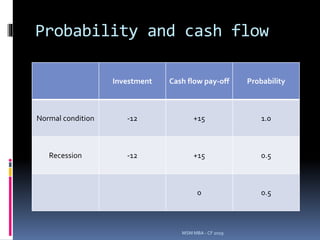
Probability and cash flow
Investment Cash flow pay-off Probability
Normal condition -12 +15 1.0
Recession -12 +15 0.5
0 0.5
MSM MBA - CF 2019
Simulation and Financing
Decision
 Simulation is a technique which is a working model of the real world
situation
 Simulation helps us to avoid the risk factors controlled by managers
 Both capital budgeting simulation and working capital simulation -
way to find appropriate and optimal finance decisions
 The quality of financing decisions would be greatly depends on the
robustness of the model
 In Simulation, possibilities of forecasting the probability errors would
help in finding the cash flow and the positive NPV (Net PresentValue)
MSM MBA - CF 2019
Option valuation
 What is option?
Option is a contract that confers to its
holder/owner the right but not the obligation to
buy/sell a specified security at a specified price
on/before a given date.
So the buyer of the option is placed in an
advantageous/favorable situation as he will excise
his option only when it is profitable
MSM MBA - CF 2019
Contd…
 The seller/writer of the option runs the risk of loss for
assuming – charges “option premium” from the buyer
of option
 Types of option : 1. American option
2. European option
1. American Option – are flexible – can be exercised at
any time upto the expiration date
2.European option – can be exercised only on the
expiration date
Two types of options : 1. call options
2. Put options
MSM MBA - CF 2019
Important terms associated with
options
1. Buyer of an option – paying the option premium
buys the rights to buy/sell securities but not the
obligation
2. Seller/writer of an option – receives the option
premium and is thereby obliged to sell/buy securities
3. Option price/ premium – is the price that option
buyer pays to the option seller
MSM MBA - CF 2019
Contd…
 Expiration date – is the date specified in the option
contract by which the buyer can exercise his right to
sell/buy the securities
- exercise date, strike date or maturity date
 Strike price – the price specified in the options contract
by which option can be exercised
 At the money option – option that would lead to zero
cash flow to the holder
 In the money option – option that would lead to zero
cash flow to the holder
MSM MBA - CF 2019
Call and Put option
MSM MBA - CF 2019
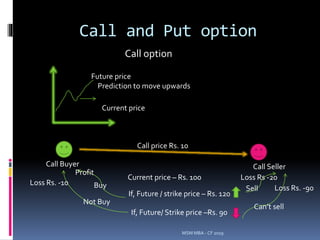
Call option
Current price
Future price
Prediction to move upwards
Call Buyer Call Seller
Call price Rs. 10
If, Future / strike price – Rs. 120
Current price – Rs. 100
If, Future/ Strike price –Rs. 90
Buy Sell
Not Buy
Can’t sell
Profit
Loss Rs. -10
Loss Rs -20
Loss Rs. -90
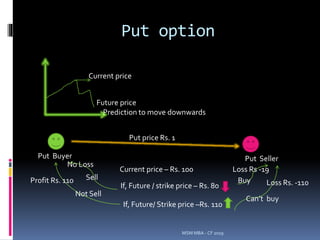
Put option
MSM MBA - CF 2019
Current price
Future price
Prediction to move downwards
Put Buyer Put Seller
Put price Rs. 1
If, Future / strike price – Rs. 80
Current price – Rs. 100
If, Future/ Strike price –Rs. 110
Sell Buy
Not Sell
Can’t buy
No Loss
Profit Rs. 110
Loss Rs -19
Loss Rs. -110
Call option
 The call option buyers expect the price of securities
to go up as it benefit them
 The reverse hold true for the call writers; they
expect to go down
 The call writers gain equivalent to the option
premium he has received at the time of selling the
call option
 The call buyers exercise the option to buy the shares
as the market go up
MSM MBA - CF 2019
Gain or loss
 Assuming no transaction costs, the purchase of
call option primarily requires the payment of
premium to option writer
 In contrast, the writer of the call option gains as
long as the price of shares on the date of
maturity is less than the sum of exercise price
and premium received
MSM MBA - CF 2019
Put option
 A put option is just the opposite of a call option
 Entitles the holder the right but not the obligation to
sell securities on or by a certain date at a fixed
exercise price
 In other words, the seller/writer of the put option has
the obligation to buy securities in case, the put
owner decides to exercise his option
 Put premium – it is the compensation received by
the put option writer from the put option buyer
MSM MBA - CF 2019
Option payoffs
 Option premium is the price the option buyer pays to the
option seller
 So the call option owner’s loss limited to the call option
premium
 But the profit he can earn is not so limited. (i.e.) limited risk
with unlimited profit
 The put option owner/investor is benefited when the share
price prevailing on the date of maturity is less than the strike
price at which he has acquired the right to sell the shares to
the put writer
MSM MBA - CF 2019
Call option boundaries
 Efficient markets – embraces all information
and arbitrage opportunities do not exist.
 The call option is bounded between the upper
bound C0<=S0 and lower bound C0>=S0-E
 Intrinsic value of a call is the excess of share
price over exercise price
 IV = E-S0
MSM MBA - CF 2019
Contd…
 The highest value of the call option(the upper
bound) can never be more than the price of the
share itself
 Practically, this value can be reached only if the
option has a very long time to expiration or is not
likely to be exercised until far into future
 Time value of a option - is the difference
between the option premium and the intrinsic
value
MSM MBA - CF 2019
Factors influencing option
valuation
To determine the worth of a call option
1. Current share price
2. Exercise price
3. Risk free rate
4. Time to Expiration/Maturity
5. Price volatility of share
MSM MBA - CF 2019
1. Current share price
 The current share price prevailing in the
market has a positive impact in the call value
MSM MBA - CF 2019
Current Market Price Value of call option
2. Exercise price
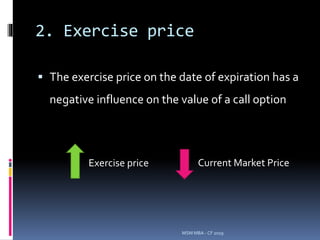
 The exercise price on the date of expiration has a
negative influence on the value of a call option
MSM MBA - CF 2019
Current Market PriceExercise price
3. Risk free rate
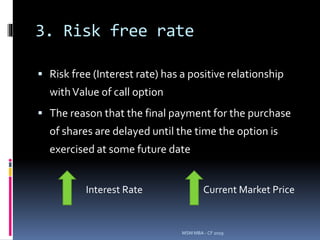
 Risk free (Interest rate) has a positive relationship
withValue of call option
 The reason that the final payment for the purchase
of shares are delayed until the time the option is
exercised at some future date
MSM MBA - CF 2019
Interest Rate Current Market Price
4. Time to Expiration
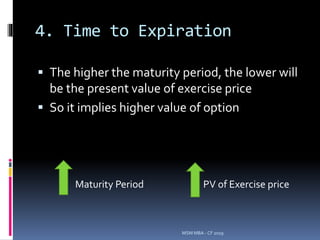
 The higher the maturity period, the lower will
be the present value of exercise price
 So it implies higher value of option
MSM MBA - CF 2019
Maturity Period PV of Exercise price
5. Price volatility of share
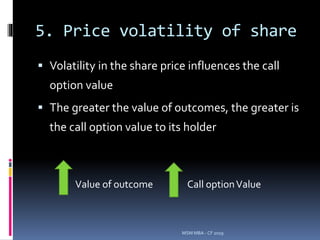
 Volatility in the share price influences the call
option value
 The greater the value of outcomes, the greater is
the call option value to its holder
MSM MBA - CF 2019
Value of outcome Call optionValue
The Black and Scholes option
pricing model
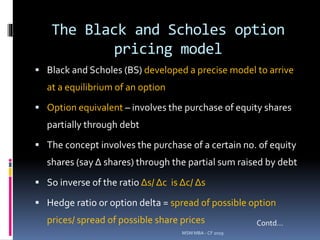
 Black and Scholes (BS) developed a precise model to arrive
at a equilibrium of an option
 Option equivalent – involves the purchase of equity shares
partially through debt
 The concept involves the purchase of a certain no. of equity
shares (say Δ shares) through the partial sum raised by debt
 So inverse of the ratio Δs/ Δc is Δc/ Δs
 Hedge ratio or option delta = spread of possible option
prices/ spread of possible share prices
MSM MBA - CF 2019
Contd…
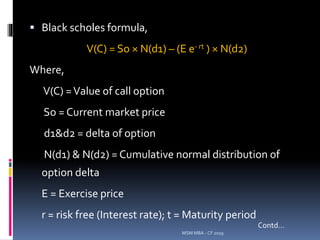
 Black scholes formula,
V(C) = So × N(d1) – (E e- rt ) × N(d2)
Where,
V(C) =Value of call option
So = Current market price
d1&d2 = delta of option
N(d1) & N(d2) = Cumulative normal distribution of
option delta
E = Exercise price
r = risk free (Interest rate); t = Maturity period
MSM MBA - CF 2019
Contd…
d1 = Ln [S0/E] + [ r+0.5(σ2 )] × t
σ √t
d2 = d1 - σ √t
Here “σ ” – Measure ofVolatility (standard
deviation)
V(p) =V(c) + [E e- rt] ] – So
MSM MBA - CF 2019
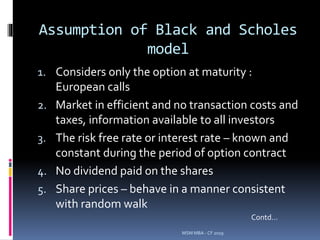
Assumption of Black and Scholes
model
1. Considers only the option at maturity :
European calls
2. Market in efficient and no transaction costs and
taxes, information available to all investors
3. The risk free rate or interest rate – known and
constant during the period of option contract
4. No dividend paid on the shares
5. Share prices – behave in a manner consistent
with random walk
MSM MBA - CF 2019
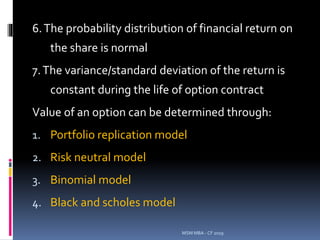
Contd…
6.The probability distribution of financial return on
the share is normal
7.The variance/standard deviation of the return is
constant during the life of option contract
Value of an option can be determined through:
1. Portfolio replication model
2. Risk neutral model
3. Binomial model
4. Black and scholes model
MSM MBA - CF 2019
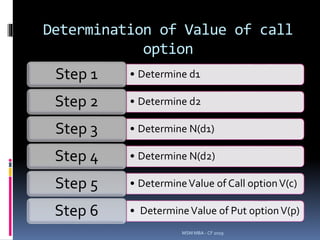
Determination of Value of call
option
MSM MBA - CF 2019
• Determine d1Step 1
• Determine d2Step 2
• Determine N(d1)Step 3
• Determine N(d2)Step 4
• DetermineValue of Call optionV(c)Step 5
• DetermineValue of Put optionV(p)Step 6
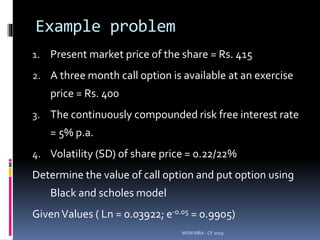
Example problem
1. Present market price of the share = Rs. 415
2. A three month call option is available at an exercise
price = Rs. 400
3. The continuously compounded risk free interest rate
= 5% p.a.
4. Volatility (SD) of share price = 0.22/22%
Determine the value of call option and put option using
Black and scholes model
GivenValues ( Ln = 0.03922; e-0.05 = 0.9905)
MSM MBA - CF 2019
Step 1: Determine d1
d1 = Ln [S0/E] + [ r+0.5(σ2 )] × t
σ √t
d2 = d1 - σ √t
= Ln [415/400] + [0.05+(0.5 * (0.22)2 )] 0.25
0.22 * √0.25
= 0.03922* 1.04 + 0.01855 /0.11
= 0.5252
= 0.53
MSM MBA - CF 2019
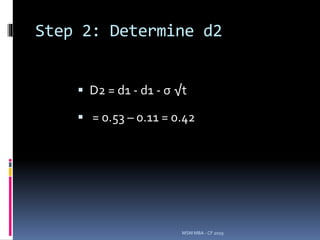
Step 2: Determine d2
 D2 = d1 - d1 - σ √t
 = 0.53 – 0.11 = 0.42
MSM MBA - CF 2019
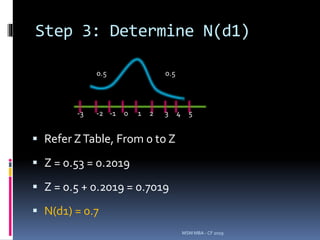
Step 3: Determine N(d1)
 Refer ZTable, From 0 to Z
 Z = 0.53 = 0.2019
 Z = 0.5 + 0.2019 = 0.7019
 N(d1) = 0.7
MSM MBA - CF 2019
-3 -2 -1 0 1 2 3 4 5
0.5 0.5
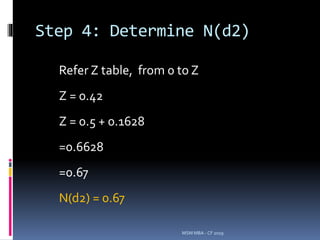
Step 4: Determine N(d2)
Refer Z table, from 0 to Z
Z = 0.42
Z = 0.5 + 0.1628
=0.6628
=0.67
N(d2) = 0.67
MSM MBA - CF 2019
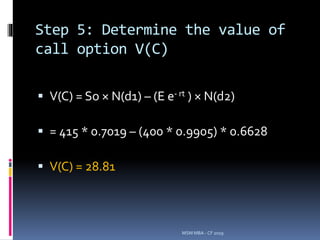
Step 5: Determine the value of
call option V(C)
 V(C) = So × N(d1) – (E e- rt ) × N(d2)
 = 415 * 0.7019 – (400 * 0.9905) * 0.6628
 V(C) = 28.81
MSM MBA - CF 2019
Step 6: Determination of Value
of call option
 Using call – put parity theory, value of put
option is,
 V(p) =V(c) + [E e- rt] ] – So
 = 28.81 + (400 * 0.9905) – 415
 V(p) = 9.83
MSM MBA - CF 2019
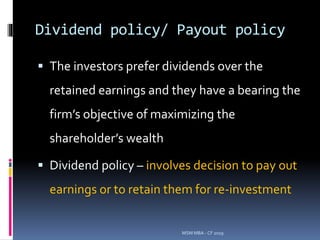
Dividend policy/ Payout policy
 The investors prefer dividends over the
retained earnings and they have a bearing the
firm’s objective of maximizing the
shareholder’s wealth
 Dividend policy – involves decision to pay out
earnings or to retain them for re-investment
MSM MBA - CF 2019
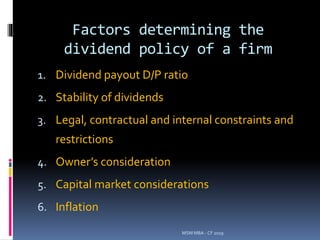
Factors determining the
dividend policy of a firm
1. Dividend payout D/P ratio
2. Stability of dividends
3. Legal, contractual and internal constraints and
restrictions
4. Owner’s consideration
5. Capital market considerations
6. Inflation
MSM MBA - CF 2019
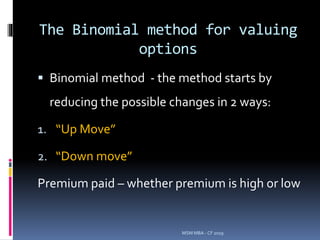
The Binomial method for valuing
options
 Binomial method - the method starts by
reducing the possible changes in 2 ways:
1. “Up Move”
2. “Down move”
Premium paid – whether premium is high or low
MSM MBA - CF 2019
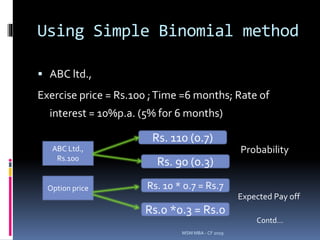
Using Simple Binomial method
 ABC ltd.,
Exercise price = Rs.100 ;Time =6 months; Rate of
interest = 10%p.a. (5% for 6 months)
MSM MBA - CF 2019
ABC Ltd.,
Rs.100
Option price
Rs. 110 (0.7)
Rs. 90 (0.3)
Rs. 10 * 0.7 = Rs.7
Rs.0 *0.3 = Rs.0
Probability
Expected Pay off
Contd…
 PV of option value = 7/1.05 = Rs.6.67
 Value of option = Cu P + Cd (1-P)
R
Where,
Cu = Call option Up
Cd = Call option down
P = Probability
R = Rate of return
Calculation of Probability
P = [R-d]/[U-d] = p(U)
MSM MBA - CF 2019
Example problem
 Exercise price = Rs.100 ;Time = 6 months; So Current
price = Rs.100 ; U=10% ; d= 10%; R=10% p.a. (6
months =0.5)
 Step 1: (Probability of up and down)
P(u) = [1.05-0.90]-[1.10-0.90] = 0.75
P(d) = 1 – P(u) = 1 – 0.75 = 0.25
 Value of option = Cu P + Cd (1-P)
R
= (10 * 0.75)+(0*0.25)/1.05 = 7.5/1.05 = Rs.7.14
MSM MBA - CF 2019
1. Dividend payout D/P ratio
 Indicates the percentage earnings distributed
to shareholders in cash, calculated dividing
the cash dividend per share by its earnings
per share
MSM MBA - CF 2019
2. Stability of Dividends
 Refers to the payment of certain minimum
amount of dividend regularly
 Stability of dividend in 3 forms
1. Constant dividend/share
2. Constant per D/P ratio
3. Constant dividend/ share+ extra
MSM MBA - CF 2019
3. Legal, contractual and internal
constraints and restrictions
 Legal stipulations do not require a dividend declaration, but they specify
the conditions under which dividends must be paid
1. Capital Impairment
2. Net profits
3. Insolvency
Important restrictions on the payment of dividend may be accepted by
company when obtaining external capital – loans, debentures, lease
contract and etc.,
Internal constraints such as liquid assets, growth prospects, financial
requirements , availability of funds, earnings stability and control
MSM MBA - CF 2019
4. Owner’s consideration
 Dividend policy – affected by the owner’s
consideration
1. Tax status of shareholders
2. Their opportunities of investment
3. The dilution of ownership
MSM MBA - CF 2019
5. Capital market consideration:
- strongly affect the dividend policy – to the
extent the firm has access to capital market
6. Inflation:
- with rising prices, funds generated from
depreciation may be inadequate to replace
obsolete equipments
- they rely upon retained earnings as a source of
funds
MSM MBA - CF 2019
MSM MBA - CF 2019

Corporate Finance unit 4 : Financing decision

  • 1.
    MSM MBA -CF 2019 CORPORATE FINANCE UNIT 4: FINANCING DECISION SUBJECT CODE: 8014 Prepared and Presented by, N. Ganesha Pandian Reference: 1. Financial Management – MY Khan and PK Jain 2. Corporate Finance – Richard A Brealey, Stewarts C Myers, Franklin Allen, Pitabas Mohanty
  • 2.
    Content – Financingdecision  Simulation and financing decision  Cash inadequacy and cash insolvency  Determining the probability of cash insolvency  Financing decision in context of option pricing model and agency costs  Inter dependence of investment  Financing and Dividend decisions MSM MBA - CF 2019
  • 3.
    What is Insolvency? Insolvency refers to the situation in which a firm or individual is unable to meet financial obligations  An Insolvent firm may decide to file for bankruptcy protection – a court order may overseas the liquidation of a firm’s assets  Insolvency – a state of financial distress MSM MBA - CF 2019
  • 4.
    Cash flow insolvency The situation occurs when the firm unable to pay its debtors  Cash insolvency refers to the lack of liquid assets to fulfill debt obligations  Only way to solve this financial distress is by selling less liquid assets and repay on time MSM MBA - CF 2019
  • 5.
    Cash Inadequacy  Cashinsolvency is different from cash inadequacy, as the proper working capital requirement need to be met. What is inadequate working capital? Inadequate working capital means shortage of working capital to meet the day to day operating activity of business firm MSM MBA - CF 2019
  • 6.
    Disadvantages of inadequate workingcapital 1. The growth of the business concern will be stagnated 2. It affect the goodwill of the company 3. The objectives of the organization can’t be achieved and also average rate of return can’t be earned by the company 4. The short term liabilities can’t be met in time 5. Fixed assets can’t be used properly due to inadequate working capital MSM MBA - CF 2019 Contd…
  • 7.
    6.The market opportunitieslike cash discount and trade discount can’t be availed by business 7. Business opportunities are not utilized due to non availability of adequate working capital 8. Production capacity is not used fully. It results in low level of production 9. It directly affects the liquidity position of the business firm 10.The creditworthiness of the company is decreased to some extent MSM MBA - CF 2019
  • 8.
    Debt capacity  Debtcapacity relates to how much debt can be comfortable for a firm  Debt can be increased up to the point at which the additional cash drain would cause the probability of cash insolvency  Cash insolvency = risk tolerance specified by management MSM MBA - CF 2019 Contd…
  • 9.
     A similartype of analysis has been suggested by Gordon Donaldson  It argued – firm normally – bearable to meet its fixed obligations  But the extreme form of financial decisions is termed as “Recession Condition”  So alternative debt policy is required to affect the cash flows during recession condition MSM MBA - CF 2019
  • 10.
    Probability and cashflow Investment Cash flow pay-off Probability Normal condition -12 +15 1.0 Recession -12 +15 0.5 0 0.5 MSM MBA - CF 2019
  • 11.
    Simulation and Financing Decision Simulation is a technique which is a working model of the real world situation  Simulation helps us to avoid the risk factors controlled by managers  Both capital budgeting simulation and working capital simulation - way to find appropriate and optimal finance decisions  The quality of financing decisions would be greatly depends on the robustness of the model  In Simulation, possibilities of forecasting the probability errors would help in finding the cash flow and the positive NPV (Net PresentValue) MSM MBA - CF 2019
  • 12.
    Option valuation  Whatis option? Option is a contract that confers to its holder/owner the right but not the obligation to buy/sell a specified security at a specified price on/before a given date. So the buyer of the option is placed in an advantageous/favorable situation as he will excise his option only when it is profitable MSM MBA - CF 2019 Contd…
  • 13.
     The seller/writerof the option runs the risk of loss for assuming – charges “option premium” from the buyer of option  Types of option : 1. American option 2. European option 1. American Option – are flexible – can be exercised at any time upto the expiration date 2.European option – can be exercised only on the expiration date Two types of options : 1. call options 2. Put options MSM MBA - CF 2019
  • 14.
    Important terms associatedwith options 1. Buyer of an option – paying the option premium buys the rights to buy/sell securities but not the obligation 2. Seller/writer of an option – receives the option premium and is thereby obliged to sell/buy securities 3. Option price/ premium – is the price that option buyer pays to the option seller MSM MBA - CF 2019 Contd…
  • 15.
     Expiration date– is the date specified in the option contract by which the buyer can exercise his right to sell/buy the securities - exercise date, strike date or maturity date  Strike price – the price specified in the options contract by which option can be exercised  At the money option – option that would lead to zero cash flow to the holder  In the money option – option that would lead to zero cash flow to the holder MSM MBA - CF 2019
  • 16.
    Call and Putoption MSM MBA - CF 2019 Call option Current price Future price Prediction to move upwards Call Buyer Call Seller Call price Rs. 10 If, Future / strike price – Rs. 120 Current price – Rs. 100 If, Future/ Strike price –Rs. 90 Buy Sell Not Buy Can’t sell Profit Loss Rs. -10 Loss Rs -20 Loss Rs. -90
  • 17.
    Put option MSM MBA- CF 2019 Current price Future price Prediction to move downwards Put Buyer Put Seller Put price Rs. 1 If, Future / strike price – Rs. 80 Current price – Rs. 100 If, Future/ Strike price –Rs. 110 Sell Buy Not Sell Can’t buy No Loss Profit Rs. 110 Loss Rs -19 Loss Rs. -110
  • 18.
    Call option  Thecall option buyers expect the price of securities to go up as it benefit them  The reverse hold true for the call writers; they expect to go down  The call writers gain equivalent to the option premium he has received at the time of selling the call option  The call buyers exercise the option to buy the shares as the market go up MSM MBA - CF 2019
  • 19.
    Gain or loss Assuming no transaction costs, the purchase of call option primarily requires the payment of premium to option writer  In contrast, the writer of the call option gains as long as the price of shares on the date of maturity is less than the sum of exercise price and premium received MSM MBA - CF 2019
  • 20.
    Put option  Aput option is just the opposite of a call option  Entitles the holder the right but not the obligation to sell securities on or by a certain date at a fixed exercise price  In other words, the seller/writer of the put option has the obligation to buy securities in case, the put owner decides to exercise his option  Put premium – it is the compensation received by the put option writer from the put option buyer MSM MBA - CF 2019
  • 21.
    Option payoffs  Optionpremium is the price the option buyer pays to the option seller  So the call option owner’s loss limited to the call option premium  But the profit he can earn is not so limited. (i.e.) limited risk with unlimited profit  The put option owner/investor is benefited when the share price prevailing on the date of maturity is less than the strike price at which he has acquired the right to sell the shares to the put writer MSM MBA - CF 2019
  • 22.
    Call option boundaries Efficient markets – embraces all information and arbitrage opportunities do not exist.  The call option is bounded between the upper bound C0<=S0 and lower bound C0>=S0-E  Intrinsic value of a call is the excess of share price over exercise price  IV = E-S0 MSM MBA - CF 2019 Contd…
  • 23.
     The highestvalue of the call option(the upper bound) can never be more than the price of the share itself  Practically, this value can be reached only if the option has a very long time to expiration or is not likely to be exercised until far into future  Time value of a option - is the difference between the option premium and the intrinsic value MSM MBA - CF 2019
  • 24.
    Factors influencing option valuation Todetermine the worth of a call option 1. Current share price 2. Exercise price 3. Risk free rate 4. Time to Expiration/Maturity 5. Price volatility of share MSM MBA - CF 2019
  • 25.
    1. Current shareprice  The current share price prevailing in the market has a positive impact in the call value MSM MBA - CF 2019 Current Market Price Value of call option
  • 26.
    2. Exercise price The exercise price on the date of expiration has a negative influence on the value of a call option MSM MBA - CF 2019 Current Market PriceExercise price
  • 27.
    3. Risk freerate  Risk free (Interest rate) has a positive relationship withValue of call option  The reason that the final payment for the purchase of shares are delayed until the time the option is exercised at some future date MSM MBA - CF 2019 Interest Rate Current Market Price
  • 28.
    4. Time toExpiration  The higher the maturity period, the lower will be the present value of exercise price  So it implies higher value of option MSM MBA - CF 2019 Maturity Period PV of Exercise price
  • 29.
    5. Price volatilityof share  Volatility in the share price influences the call option value  The greater the value of outcomes, the greater is the call option value to its holder MSM MBA - CF 2019 Value of outcome Call optionValue
  • 30.
    The Black andScholes option pricing model  Black and Scholes (BS) developed a precise model to arrive at a equilibrium of an option  Option equivalent – involves the purchase of equity shares partially through debt  The concept involves the purchase of a certain no. of equity shares (say Δ shares) through the partial sum raised by debt  So inverse of the ratio Δs/ Δc is Δc/ Δs  Hedge ratio or option delta = spread of possible option prices/ spread of possible share prices MSM MBA - CF 2019 Contd…
  • 31.
     Black scholesformula, V(C) = So × N(d1) – (E e- rt ) × N(d2) Where, V(C) =Value of call option So = Current market price d1&d2 = delta of option N(d1) & N(d2) = Cumulative normal distribution of option delta E = Exercise price r = risk free (Interest rate); t = Maturity period MSM MBA - CF 2019 Contd…
  • 32.
    d1 = Ln[S0/E] + [ r+0.5(σ2 )] × t σ √t d2 = d1 - σ √t Here “σ ” – Measure ofVolatility (standard deviation) V(p) =V(c) + [E e- rt] ] – So MSM MBA - CF 2019
  • 33.
    Assumption of Blackand Scholes model 1. Considers only the option at maturity : European calls 2. Market in efficient and no transaction costs and taxes, information available to all investors 3. The risk free rate or interest rate – known and constant during the period of option contract 4. No dividend paid on the shares 5. Share prices – behave in a manner consistent with random walk MSM MBA - CF 2019 Contd…
  • 34.
    6.The probability distributionof financial return on the share is normal 7.The variance/standard deviation of the return is constant during the life of option contract Value of an option can be determined through: 1. Portfolio replication model 2. Risk neutral model 3. Binomial model 4. Black and scholes model MSM MBA - CF 2019
  • 35.
    Determination of Valueof call option MSM MBA - CF 2019 • Determine d1Step 1 • Determine d2Step 2 • Determine N(d1)Step 3 • Determine N(d2)Step 4 • DetermineValue of Call optionV(c)Step 5 • DetermineValue of Put optionV(p)Step 6
  • 36.
    Example problem 1. Presentmarket price of the share = Rs. 415 2. A three month call option is available at an exercise price = Rs. 400 3. The continuously compounded risk free interest rate = 5% p.a. 4. Volatility (SD) of share price = 0.22/22% Determine the value of call option and put option using Black and scholes model GivenValues ( Ln = 0.03922; e-0.05 = 0.9905) MSM MBA - CF 2019
  • 37.
    Step 1: Determined1 d1 = Ln [S0/E] + [ r+0.5(σ2 )] × t σ √t d2 = d1 - σ √t = Ln [415/400] + [0.05+(0.5 * (0.22)2 )] 0.25 0.22 * √0.25 = 0.03922* 1.04 + 0.01855 /0.11 = 0.5252 = 0.53 MSM MBA - CF 2019
  • 38.
    Step 2: Determined2  D2 = d1 - d1 - σ √t  = 0.53 – 0.11 = 0.42 MSM MBA - CF 2019
  • 39.
    Step 3: DetermineN(d1)  Refer ZTable, From 0 to Z  Z = 0.53 = 0.2019  Z = 0.5 + 0.2019 = 0.7019  N(d1) = 0.7 MSM MBA - CF 2019 -3 -2 -1 0 1 2 3 4 5 0.5 0.5
  • 40.
    Step 4: DetermineN(d2) Refer Z table, from 0 to Z Z = 0.42 Z = 0.5 + 0.1628 =0.6628 =0.67 N(d2) = 0.67 MSM MBA - CF 2019
  • 41.
    Step 5: Determinethe value of call option V(C)  V(C) = So × N(d1) – (E e- rt ) × N(d2)  = 415 * 0.7019 – (400 * 0.9905) * 0.6628  V(C) = 28.81 MSM MBA - CF 2019
  • 42.
    Step 6: Determinationof Value of call option  Using call – put parity theory, value of put option is,  V(p) =V(c) + [E e- rt] ] – So  = 28.81 + (400 * 0.9905) – 415  V(p) = 9.83 MSM MBA - CF 2019
  • 43.
    Dividend policy/ Payoutpolicy  The investors prefer dividends over the retained earnings and they have a bearing the firm’s objective of maximizing the shareholder’s wealth  Dividend policy – involves decision to pay out earnings or to retain them for re-investment MSM MBA - CF 2019
  • 44.
    Factors determining the dividendpolicy of a firm 1. Dividend payout D/P ratio 2. Stability of dividends 3. Legal, contractual and internal constraints and restrictions 4. Owner’s consideration 5. Capital market considerations 6. Inflation MSM MBA - CF 2019
  • 45.
    The Binomial methodfor valuing options  Binomial method - the method starts by reducing the possible changes in 2 ways: 1. “Up Move” 2. “Down move” Premium paid – whether premium is high or low MSM MBA - CF 2019
  • 46.
    Using Simple Binomialmethod  ABC ltd., Exercise price = Rs.100 ;Time =6 months; Rate of interest = 10%p.a. (5% for 6 months) MSM MBA - CF 2019 ABC Ltd., Rs.100 Option price Rs. 110 (0.7) Rs. 90 (0.3) Rs. 10 * 0.7 = Rs.7 Rs.0 *0.3 = Rs.0 Probability Expected Pay off Contd…
  • 47.
     PV ofoption value = 7/1.05 = Rs.6.67  Value of option = Cu P + Cd (1-P) R Where, Cu = Call option Up Cd = Call option down P = Probability R = Rate of return Calculation of Probability P = [R-d]/[U-d] = p(U) MSM MBA - CF 2019
  • 48.
    Example problem  Exerciseprice = Rs.100 ;Time = 6 months; So Current price = Rs.100 ; U=10% ; d= 10%; R=10% p.a. (6 months =0.5)  Step 1: (Probability of up and down) P(u) = [1.05-0.90]-[1.10-0.90] = 0.75 P(d) = 1 – P(u) = 1 – 0.75 = 0.25  Value of option = Cu P + Cd (1-P) R = (10 * 0.75)+(0*0.25)/1.05 = 7.5/1.05 = Rs.7.14 MSM MBA - CF 2019
  • 49.
    1. Dividend payoutD/P ratio  Indicates the percentage earnings distributed to shareholders in cash, calculated dividing the cash dividend per share by its earnings per share MSM MBA - CF 2019
  • 50.
    2. Stability ofDividends  Refers to the payment of certain minimum amount of dividend regularly  Stability of dividend in 3 forms 1. Constant dividend/share 2. Constant per D/P ratio 3. Constant dividend/ share+ extra MSM MBA - CF 2019
  • 51.
    3. Legal, contractualand internal constraints and restrictions  Legal stipulations do not require a dividend declaration, but they specify the conditions under which dividends must be paid 1. Capital Impairment 2. Net profits 3. Insolvency Important restrictions on the payment of dividend may be accepted by company when obtaining external capital – loans, debentures, lease contract and etc., Internal constraints such as liquid assets, growth prospects, financial requirements , availability of funds, earnings stability and control MSM MBA - CF 2019
  • 52.
    4. Owner’s consideration Dividend policy – affected by the owner’s consideration 1. Tax status of shareholders 2. Their opportunities of investment 3. The dilution of ownership MSM MBA - CF 2019
  • 53.
    5. Capital marketconsideration: - strongly affect the dividend policy – to the extent the firm has access to capital market 6. Inflation: - with rising prices, funds generated from depreciation may be inadequate to replace obsolete equipments - they rely upon retained earnings as a source of funds MSM MBA - CF 2019
  • 54.
    MSM MBA -CF 2019