Principles of
Management
Unit 2: Planning
PREPARED AND PRESENTED BY,
GANESHA PANDIAN . N
1
Content
 Nature and purpose of planning
 Planning process
 Types of plan
 Objectives
 Management by objectives (MBO)
 Types of strategies
 Policies
 Decision making
 Type of decision
 Decision making process
 Rational decision making process
 Decision making under different conditions
2
Essentials of planning
 Planning involves selecting missions and
objectives and deciding on the actions to
achieve them.
 Requires decision making – course of
action from among alternatives.
 Plans thus furnish the standards of control
3
Type of plans
 Plans can be classified as
1. Missions or purposes
2. Objectives or goals
3. Strategies
4. Policies
5. Procedures
6. Rules
7. Programs
8. Budgets
4
1. Mission
 The basic purpose or function or task of
an organization/enterprise/agency/any
part of it.
 (what they want to do)
 For an example: The purpose of business
– generally is the production and
distribution of goods and services
5
1
2
3
4
5
6
7
8
2. Objectives or goal
Objectives or goals – end
towards the activity is aimed (this
is what organization want to
accomplish)
6
1
2
3
4
5
6
7
8
3. Strategy
 The determination of the basic long
term objectives of an enterprise and
the adoption of courses of action
and allocation of resources
necessary to achieve these goals.
7
1
2
3
4
5
6
7
8
4. Policies
 General statement or undertakings that
guide or channel thinking in decision
making
 Policies define an area within which a
decision is to be made and ensure that
the decision will be consistent with and
contribute to an objective.
8
1
2
3
4
5
6
7
8
5. Procedures
Plans that establish a required
method of handling future
activities.
(e.g.) leave procedure
9
1
2
3
4
5
6
7
8
6. Rules
 They spell out specific required actions
or non actions, allowing no discretion
 Rule that allows no deviation from a
stated course of action
 Must and must not’s (set of rules)
10
1
2
3
4
5
6
7
8
7. Program
 A complex of goals, policies,
procedures, rules, tasks
assignments, steps to be taken,
resources to be employed and
other elements necessary to carry
out a given course of action
11
1
2
3
4
5
6
7
8
8. Budget
 A statement of expected results
expressed in numerical terms
 Also called “Quantified” plan.
 Expressed in financial terms.
 Budget – necessary for control
(standards established)
12
1
2
3
4
5
6
7
8
The planning done in
different stages in the
organization from the top
level management to
operational level
13
Planning process
 The purpose and nature of planning
1. Principle of contribution to objective – purpose of every plan
and supporting plan – to promote accomplishments
2. Principle of objectives – objectives are to be meaningful to
people, clear, attainable and verifiable
3. Principle of primacy of planning – planning logically precedes
all managerial functions
4. Principle of efficiency of plans – Efficiency of plans –
measured by the amount it contributes to purpose and
objectives
14
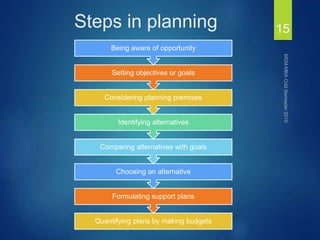
Steps in planning 15
Quantifying plans by making budgets
Formulating support plans
Choosing an alternative
Comparing alternatives with goals
Identifying alternatives
Considering planning premises
Setting objectives or goals
Being aware of opportunity
1. Being aware of opportunities
 Analysis of external environment – real
starting point for planning
 Setting realistic objectives depends on the
awareness of external environment or
opportunities.
 Planning requires a realistic diagnosis of
opportunity situation
16
1
2
3
4
5
6
7
8
2. Establishing objectives
 Objectives – specify the expected
results and indicate the end points
of what is to be done.
 Enterprise/ Company’s objective
give direction to major plans
17
1
2
3
4
5
6
7
8
3. Developing premises
 Premises – assumptions about the
environment in which plan is to be carried out.
Principle of planning premises – the more
thoroughly individuals charged with planning
understand and agree to utilize the consistent
planning premises, the more coordinated
enterprise planning will be.
18
1
2
3
4
5
6
7
8
4. Determining alternative
courses
 It is to search for and examine alternative
course of action
 Number of alternative that can be thoroughly
examined
 The planner must usually make a preliminary
analysis to find out best alternative.
19
1
2
3
4
5
6
7
8
5. Evaluating alternative
courses
 After examining the strong and weak points of
alternatives
 Evaluate the alternatives by weighing them as
compared with goals or objectives of a firm.
 One course may appear to be most profitable –
but high risk and not match firm’s or company’s
goal
20
1
2
3
4
5
6
7
8
6. Selecting a course of action
 Real point of decision making
 Alternative course of action – one or more
advisable
 Manager decide to follow several courses
rather than one but course
21
1
2
3
4
5
6
7
8
7. Formulating derivative plans
Derivative plans/supporting
plans – invariably required
to support the basic plan
22
1
2
3
4
5
6
7
8
8. Quantifying – Budgeting plans
 To quantify them by converting them into budgets
 The overall budget of a firm/an enterprise
represents the sum total of income and expenses
 Budgets become a means of adding the various
plan and set important standards against which
planning process can be measured
23
1
2
3
4
5
6
7
8
Objectives
 Objectives were defined as important
ends towards which organizational and
individual activities are directed
 The emphasis is on verifiable objectives
– means at the end of the period –
whether or not objective has been
achieved
24
Nature of objectives
 Objectives state end result and
overall objectives need to be
supported by sub-objectives
 Objectives forms a hierarchy as well
as network
25
Hierarchy of objectives
 Objectives form a hierarchy, ranging from the broad
aim to specific individual objectives
 Zenith of hierarchy – mission/purpose
 General objectives and strategies, such as
designing, producing and marketing reliable, low
cost, fuel efficient automobiles
 KRA – Key result area – These are the areas in
which performance is essential for the success of
the enterprise.
26
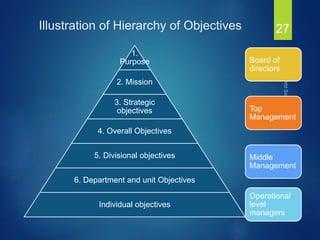
Illustration of Hierarchy of Objectives 27
1.
Purpose
2. Mission
3. Strategic
objectives
4. Overall Objectives
5. Divisional objectives
6. Department and unit Objectives
Individual objectives
Board of
directors
Top
Management
Middle
Management
Operational
level
managers
Setting Objectives and Organizational
hierarchy
 Managers at different levels in the organizational hierarchy
are concerned with different kinds of objectives
1. Board of Directors and top level managers – involved in
determining the purpose, the mission and overall objectives
of firm.
2. Middle level managers – Vice president or
marketing/production division objectives and department
objectives
3. Low level managers – setting the objectives of departments
and units as well as their sub-ordinates
28
Setting of objectives –approaches
1. Top down approach
2. Bottom up approach
29
Multiplicity of approaches
 Objectives – normally multiple
 The objectives should be verifiable
and all the objectives are realistic,
attainable and precise.
30
How to set objectives
Examples of non verifiable objectives:
1. To make a reasonable profit
2. To improve communication
3. To improve productivity of the
production department
31
Contd…
Examples of Verifiable objectives:
1. To achieve a return on investment of 12% at the
end of the current fiscal year
2. To issue a two page monthly newsletter beginning
July 1 2005, involving not more than 40 working
hours of preparation time.
3. To increase production output by 5% by December
31, 2005 without additional costs while maintaining
the current quality level
The management, people or a group of individual
can’t work without clear aim.
32
Quantitative and Qualitative
objectives
 Quantitative objectives – are verifiable objectives
can be measured in terms of numerical values
(e.g.) financial reports; profits and loss, cash flow
 Qualitative objectives – are difficult to verify
objectives - can be measured in terms of
attributes or characteristics (e.g.) quality of
products
33
Guidelines for setting objectives
 There are certain guidelines for setting the
objectives of an enterprise or firm. It is indeed a
difficult task
 It requires intelligent coaching by the superior and
extensive practice by the sub-ordinate
1. List of objectives should not be too long, yet cover
main features
2. Objectives should be verifiable and state what is to
be accomplished
34
Contd…
3. Objectives should present a challenge, indicate
priorities
4. Objectives should be consistent throughout the
organization
5. Objectives should be precise and identifiable
6. Objectives should cover on the area of resources
and authority
The above mentioned are some of the important
guidelines for establishing objectives
35
Management by Objectives (MBO)
 MBO – the concept and use is not always clear
 MBO (Management by Objectives) – is a
comprehensive managerial system that
integrates many key managerial activities in a
systematic manner and is consciously directed
toward the effective and efficient achievement of
organizational and individual objectives.
36
Contd…
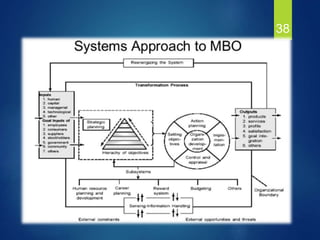
 MBO – a comprehensive goal driven, success
oriented management system. It is used for
performance appraisal, instrument for
motivating individuals and in strategic planning.
 Managerial sub-systems – Human resources
planning and development, career planning, the
reward system, budgeting and other managerial
activities integrates MBO process
37
38
Benefits of MBO
1. Improvement of management through results –
oriented planning
2. Clarification of organizational roles and structures as
well as delegation of authority (results expected of
the people occupying the roles)
3. Encouragement of commitment to personal and
organizational goals.
4. Development of effective controls that measure
results and lead to corrective action
39
Failures of MBO and
recommendations to avoid failures
Despite all its advantages, MBO system has a number
of weaknesses. It is due to applying the concepts not
properly.
1. Failure to teach the philosophy of MBO – one of
major weaknesses
2. Failure to give guidelines to the goal setters.
Managers should need to know planning premises
of company.
3. Difficulty of setting verifiable goals with the right
degree of flexibility
40
Contd…
4. The excessive concern over the economic results puts
pressure or individuals that may encourage unethical
behavior
5. The emphasis on short term goals can be done at the
expense of longer range health of the organization
6. To reduce the probability of resorting to unethical means to
achieve results, top management must agree to reasonable
objectives, clearly state behavioral expectations, and give
high priority to ethical behavior
7. Over use of quantitative goals and the attempt to use
numbers in areas where are not applicable, may cause
troubles to managers.
41
Strategies
 Strategic planning is a systematic approach for identifying and
analyzing factors external to the organization and matching
them with the firm’s capabilities
 Complex process
 Planning is done in an environment of uncertainty
 People make assumptions for forecasts about the anticipated
environment
 So the strategic planning process – identifies the critical
aspects of formulating a strategy
42
Nature and purpose of strategies
and policies
 Strategies and policies are closely related,
they are framework for plans
 Strategy – the determination of mission or
purpose and basic long term objectives of an
enterprises; adoption of course of action.
 Policies – general statements or undertakings
that guide managers’ thinking in decision
making
43
The strategic process
1. Industry analysis
2. Enterprise profile
3. Orientation, values and vision
of executives
4. Mission, Major objectives and
strategic intent
5. Present and future
environment
6. Internal environment
44
Contd…
7. Development of alternative
strategies
8. Evaluation and choice of
strategies
9. Consistency testing and
consistency planning
10. Medium and short range
planning and implementation
45
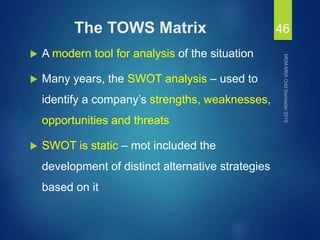
The TOWS Matrix
 A modern tool for analysis of the situation
 Many years, the SWOT analysis – used to
identify a company’s strengths, weaknesses,
opportunities and threats
 SWOT is static – mot included the
development of distinct alternative strategies
based on it
46
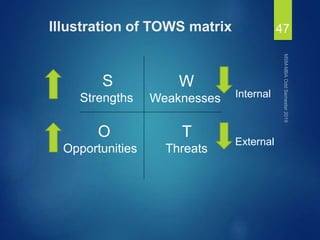
Illustration of TOWS matrix 47
S
Strengths
W
Weaknesses
O
Opportunities
T
Threats
Internal
External
 Tows matrix has been introduced for analyzing the
competitive situation of a company
 - development for four distinct set of strategic
alternatives.
 SWOT – orderly fashion strength, weakness,
opportunity and threat
 To systematize the choices, TOWS matrix – used
 TOWS model starts with Threats, then opportunity
and in the order alike
 A company undertakes strategic planning as a result
of a perceived crisis, problem or threat
48
Identify the strength, weakness, opportunity
and threat for a company
1. Sales of this year increased as compared to previous
year.
2. Employees are taking long leave and production
decline.
3. New R&D (research and development) department is
going to be established
4. Government announced incentives in tax rates
5. SEBI lowered their regulation in issue of new shares
49
Contd…
6. High court imposed ban on the import of a raw
materials used in our production
7. Retained earnings are low as dividend payout
increased to shareholders, so there is hindrances
of business growth
8. There is a high demand for our product in new
market (i.e.) outside country research report
9. Gross profit is high as compared to previous year –
profit and loss account – financial report
10. One of the powerful CEO retires from his position
at the end of tenure
50
TOWS matrix for strategy
formulation
1. The WT strategy – aims to minimize both
weaknesses and strengths – called “mini-
mini” strategy (e.g.) Retrench, liquidation
2. The WO strategy – aims to minimize the
weaknesses and maximize the opportunities
- called “mini-maxi” strategy (e.g.) Technology
up gradation, Employee training
51
Contd…
 The ST strategy – aims to maximize strength and
minimize threats – called – “Maxi mini” strategy
(e.g.) Marketing strength of company to cope up
the threats of new products introduced by
competitors.
 The SO strategy – aims to maximize both
strength and opportunities called – “Maxi – Maxi”
strategy (e.g.) the company uses its R&D
department and innovate new product –
demanded by people
52
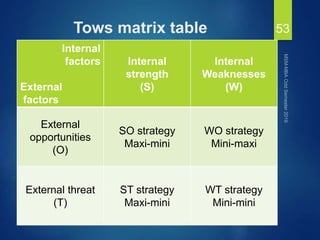
Tows matrix table
Internal
factors
External
factors
Internal
strength
(S)
Internal
Weaknesses
(W)
External
opportunities
(O)
SO strategy
Maxi-mini
WO strategy
Mini-maxi
External threat
(T)
ST strategy
Maxi-mini
WT strategy
Mini-mini
53
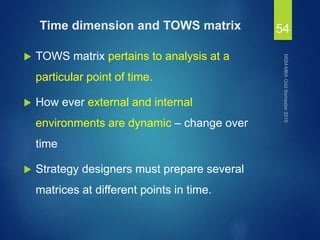
Time dimension and TOWS matrix
 TOWS matrix pertains to analysis at a
particular point of time.
 How ever external and internal
environments are dynamic – change over
time
 Strategy designers must prepare several
matrices at different points in time.
54
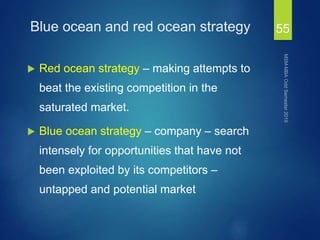
Blue ocean and red ocean strategy
 Red ocean strategy – making attempts to
beat the existing competition in the
saturated market.
 Blue ocean strategy – company – search
intensely for opportunities that have not
been exploited by its competitors –
untapped and potential market
55
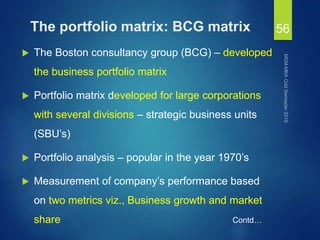
The portfolio matrix: BCG matrix
 The Boston consultancy group (BCG) – developed
the business portfolio matrix
 Portfolio matrix developed for large corporations
with several divisions – strategic business units
(SBU’s)
 Portfolio analysis – popular in the year 1970’s
 Measurement of company’s performance based
on two metrics viz., Business growth and market
share
56
Contd…
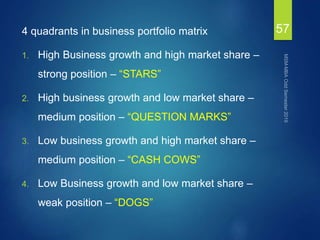
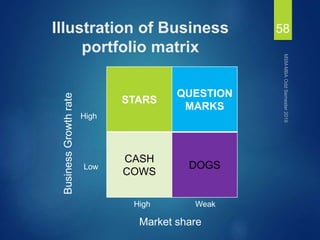
574 quadrants in business portfolio matrix
1. High Business growth and high market share –
strong position – “STARS”
2. High business growth and low market share –
medium position – “QUESTION MARKS”
3. Low business growth and high market share –
medium position – “CASH COWS”
4. Low Business growth and low market share –
weak position – “DOGS”
Illustration of Business
portfolio matrix
STARS
QUESTION
MARKS
CASH
COWS
DOGS
58
BusinessGrowthrate
High
Low
High Weak
Market share
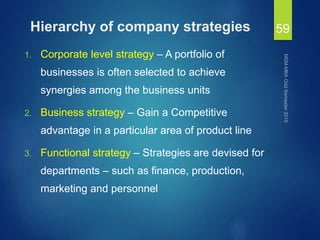
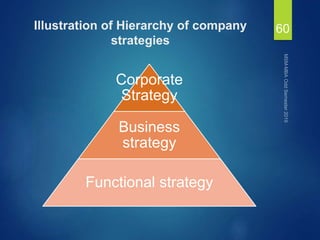
Hierarchy of company strategies
1. Corporate level strategy – A portfolio of
businesses is often selected to achieve
synergies among the business units
2. Business strategy – Gain a Competitive
advantage in a particular area of product line
3. Functional strategy – Strategies are devised for
departments – such as finance, production,
marketing and personnel
59
Illustration of Hierarchy of company
strategies
60
Corporate
Strategy
Business
strategy
Functional strategy
Porter’s industry analysis and generic
strategies
 Professor Michael porter suggests
that strategy formulation requires an
analysis of the attractiveness of an
industry and the company’s position
within that industry
61
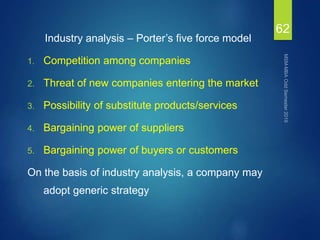
Industry analysis – Porter’s five force model
1. Competition among companies
2. Threat of new companies entering the market
3. Possibility of substitute products/services
4. Bargaining power of suppliers
5. Bargaining power of buyers or customers
On the basis of industry analysis, a company may
adopt generic strategy
62
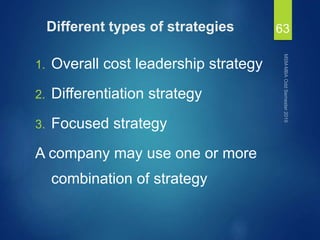
Different types of strategies
1. Overall cost leadership strategy
2. Differentiation strategy
3. Focused strategy
A company may use one or more
combination of strategy
63
Decision making
 Decision making - defined as the
selection of a course of action from
among alternatives
 Core of planning
 A decision – a commitment of
resources, direction or reputation
 It is the central job of a manager
64
Rational decision making
The process leading to decision
making
1. Premising
2. Identifying alternatives
3. Evaluating alternatives
4. Choosing alternatives – decision
making
65
Contd…
- The effective decision making must be
rational
- The manager have the information
and the ability to analyze and evaluate
alternatives in light of goals to be
achieved
- Decision making – for future course
action – future involves uncertainties
66
Limited or Bounded rationality
 A manager must settle for limited or
“bounded” rationality limitation in terms of
information and time
 Managers can’t be completely rational – but
pick the best alternative
 Managers do attempt to make the best
decisions they can within the limits of
rationality and in light of the degree and
nature of risks involved
67
Principle of limiting factor
 Limiting factor – stands in the way of
accomplishing a desire objective
 Principle of limiting factor –
recognizing and overcoming those
factors that stand critically in the way
of a goal, the best alternative course
of action can be selected
68
Quantitative and qualitative factors
Quantitative factors - factors that
can be measured in numerical
terms
Qualitative factors - factors that
are difficult to measure
numerically
69
 Marginal analysis – comparing the
additional revenue and the additional
cost arising from incremental output
 Cost-effectiveness analysis – seeks
the best ratio of benefit and cost
- least costly way of reaching an
objective with high benefits.
70
Selecting an alternative
 Managers can use three basic
approaches:
1. Experience (past)
2. Experimentation
3. Research and analysis
71
Experience
 Reliance on past – 2 sides of decision
making by experience
1. Good side – It is relied and get same
effect as before without mush effort
2. Bad side – wrong decisions and
things changes with time
72
1
2
3
Experimentation
Experimentation – often used
in scientific enquiry
The experimental technique is
likely to be the most expensive
of all techniques
73
1
2
3
Research and analysis
 Most effective techniques for selecting from
alternatives
 Solving a planning problem requires breaking
it into its component parts and studying
various quantitative and qualitative factors
 Major step in research and analysis approach
– develop a model simulating the problem
74
1
2
3
Programmed decisions
 are used for structured or routine work
(e.g.) Re-ordering of standard inventory
items
- Kind of decision
- Used for routine and repetitive work
75
Non – programmed decisions
- are used for unstructured, novel
and ill defined situations of a non –
recurring nature
(e.g.) Product design and
development – car model design
76
77
Problem Decision making
Illustration of Programmed and
un programmed decisions
Structured Un - Structured Programmed
Non- Programmed
Decision making under different
situations
1. Certainty :
In situation involving certainty, people are
reasonably sure about what will happen
when they make a decision.
The information is available and considered
to be reliable
- cause and effect relationship known
78
1
2
3
2. Uncertainty:
In situation of uncertainty, people
have only a meager database, not sure
about data reliable or not
- cause and effects relationships to be
studied
79
1
2
3
3. Risks
 In a situation with risks, factual information
may exist, but are incomplete
 Estimation of probabilities by using
mathematical models, based on judgment
and experience may be used
80
1
2
3
Creativity and Innovation
 Creativity – the ability and power to develop
new ideas
 Innovation – the use of new ideas
4 phases of creative process:
1. Unconscious planning
2. Intuition
3. Insight
4. Logical formulation
81
Brain storming
Best known technique for facilitating creativity – developed
by Alex F. Osborn - Father of Brain storming
- Emphasis on group thinking
The rule of brain storming :
1. No ideas are ever criticized
2. The more radical the ideas are the better
3. The quantity of idea production is stressed
4. The improvement of ideas by others - encouraged
82
Invention: pertains to new ideas and
process
Innovation: the application of the
ideas to products and services
83
84

Principles of Management - unit 2 planning

  • 1.
    Principles of Management Unit 2:Planning PREPARED AND PRESENTED BY, GANESHA PANDIAN . N 1
  • 2.
    Content  Nature andpurpose of planning  Planning process  Types of plan  Objectives  Management by objectives (MBO)  Types of strategies  Policies  Decision making  Type of decision  Decision making process  Rational decision making process  Decision making under different conditions 2
  • 3.
    Essentials of planning Planning involves selecting missions and objectives and deciding on the actions to achieve them.  Requires decision making – course of action from among alternatives.  Plans thus furnish the standards of control 3
  • 4.
    Type of plans Plans can be classified as 1. Missions or purposes 2. Objectives or goals 3. Strategies 4. Policies 5. Procedures 6. Rules 7. Programs 8. Budgets 4
  • 5.
    1. Mission  Thebasic purpose or function or task of an organization/enterprise/agency/any part of it.  (what they want to do)  For an example: The purpose of business – generally is the production and distribution of goods and services 5 1 2 3 4 5 6 7 8
  • 6.
    2. Objectives orgoal Objectives or goals – end towards the activity is aimed (this is what organization want to accomplish) 6 1 2 3 4 5 6 7 8
  • 7.
    3. Strategy  Thedetermination of the basic long term objectives of an enterprise and the adoption of courses of action and allocation of resources necessary to achieve these goals. 7 1 2 3 4 5 6 7 8
  • 8.
    4. Policies  Generalstatement or undertakings that guide or channel thinking in decision making  Policies define an area within which a decision is to be made and ensure that the decision will be consistent with and contribute to an objective. 8 1 2 3 4 5 6 7 8
  • 9.
    5. Procedures Plans thatestablish a required method of handling future activities. (e.g.) leave procedure 9 1 2 3 4 5 6 7 8
  • 10.
    6. Rules  Theyspell out specific required actions or non actions, allowing no discretion  Rule that allows no deviation from a stated course of action  Must and must not’s (set of rules) 10 1 2 3 4 5 6 7 8
  • 11.
    7. Program  Acomplex of goals, policies, procedures, rules, tasks assignments, steps to be taken, resources to be employed and other elements necessary to carry out a given course of action 11 1 2 3 4 5 6 7 8
  • 12.
    8. Budget  Astatement of expected results expressed in numerical terms  Also called “Quantified” plan.  Expressed in financial terms.  Budget – necessary for control (standards established) 12 1 2 3 4 5 6 7 8
  • 13.
    The planning donein different stages in the organization from the top level management to operational level 13
  • 14.
    Planning process  Thepurpose and nature of planning 1. Principle of contribution to objective – purpose of every plan and supporting plan – to promote accomplishments 2. Principle of objectives – objectives are to be meaningful to people, clear, attainable and verifiable 3. Principle of primacy of planning – planning logically precedes all managerial functions 4. Principle of efficiency of plans – Efficiency of plans – measured by the amount it contributes to purpose and objectives 14
  • 15.
    Steps in planning15 Quantifying plans by making budgets Formulating support plans Choosing an alternative Comparing alternatives with goals Identifying alternatives Considering planning premises Setting objectives or goals Being aware of opportunity
  • 16.
    1. Being awareof opportunities  Analysis of external environment – real starting point for planning  Setting realistic objectives depends on the awareness of external environment or opportunities.  Planning requires a realistic diagnosis of opportunity situation 16 1 2 3 4 5 6 7 8
  • 17.
    2. Establishing objectives Objectives – specify the expected results and indicate the end points of what is to be done.  Enterprise/ Company’s objective give direction to major plans 17 1 2 3 4 5 6 7 8
  • 18.
    3. Developing premises Premises – assumptions about the environment in which plan is to be carried out. Principle of planning premises – the more thoroughly individuals charged with planning understand and agree to utilize the consistent planning premises, the more coordinated enterprise planning will be. 18 1 2 3 4 5 6 7 8
  • 19.
    4. Determining alternative courses It is to search for and examine alternative course of action  Number of alternative that can be thoroughly examined  The planner must usually make a preliminary analysis to find out best alternative. 19 1 2 3 4 5 6 7 8
  • 20.
    5. Evaluating alternative courses After examining the strong and weak points of alternatives  Evaluate the alternatives by weighing them as compared with goals or objectives of a firm.  One course may appear to be most profitable – but high risk and not match firm’s or company’s goal 20 1 2 3 4 5 6 7 8
  • 21.
    6. Selecting acourse of action  Real point of decision making  Alternative course of action – one or more advisable  Manager decide to follow several courses rather than one but course 21 1 2 3 4 5 6 7 8
  • 22.
    7. Formulating derivativeplans Derivative plans/supporting plans – invariably required to support the basic plan 22 1 2 3 4 5 6 7 8
  • 23.
    8. Quantifying –Budgeting plans  To quantify them by converting them into budgets  The overall budget of a firm/an enterprise represents the sum total of income and expenses  Budgets become a means of adding the various plan and set important standards against which planning process can be measured 23 1 2 3 4 5 6 7 8
  • 24.
    Objectives  Objectives weredefined as important ends towards which organizational and individual activities are directed  The emphasis is on verifiable objectives – means at the end of the period – whether or not objective has been achieved 24
  • 25.
    Nature of objectives Objectives state end result and overall objectives need to be supported by sub-objectives  Objectives forms a hierarchy as well as network 25
  • 26.
    Hierarchy of objectives Objectives form a hierarchy, ranging from the broad aim to specific individual objectives  Zenith of hierarchy – mission/purpose  General objectives and strategies, such as designing, producing and marketing reliable, low cost, fuel efficient automobiles  KRA – Key result area – These are the areas in which performance is essential for the success of the enterprise. 26
  • 27.
    Illustration of Hierarchyof Objectives 27 1. Purpose 2. Mission 3. Strategic objectives 4. Overall Objectives 5. Divisional objectives 6. Department and unit Objectives Individual objectives Board of directors Top Management Middle Management Operational level managers
  • 28.
    Setting Objectives andOrganizational hierarchy  Managers at different levels in the organizational hierarchy are concerned with different kinds of objectives 1. Board of Directors and top level managers – involved in determining the purpose, the mission and overall objectives of firm. 2. Middle level managers – Vice president or marketing/production division objectives and department objectives 3. Low level managers – setting the objectives of departments and units as well as their sub-ordinates 28
  • 29.
    Setting of objectives–approaches 1. Top down approach 2. Bottom up approach 29
  • 30.
    Multiplicity of approaches Objectives – normally multiple  The objectives should be verifiable and all the objectives are realistic, attainable and precise. 30
  • 31.
    How to setobjectives Examples of non verifiable objectives: 1. To make a reasonable profit 2. To improve communication 3. To improve productivity of the production department 31 Contd…
  • 32.
    Examples of Verifiableobjectives: 1. To achieve a return on investment of 12% at the end of the current fiscal year 2. To issue a two page monthly newsletter beginning July 1 2005, involving not more than 40 working hours of preparation time. 3. To increase production output by 5% by December 31, 2005 without additional costs while maintaining the current quality level The management, people or a group of individual can’t work without clear aim. 32
  • 33.
    Quantitative and Qualitative objectives Quantitative objectives – are verifiable objectives can be measured in terms of numerical values (e.g.) financial reports; profits and loss, cash flow  Qualitative objectives – are difficult to verify objectives - can be measured in terms of attributes or characteristics (e.g.) quality of products 33
  • 34.
    Guidelines for settingobjectives  There are certain guidelines for setting the objectives of an enterprise or firm. It is indeed a difficult task  It requires intelligent coaching by the superior and extensive practice by the sub-ordinate 1. List of objectives should not be too long, yet cover main features 2. Objectives should be verifiable and state what is to be accomplished 34 Contd…
  • 35.
    3. Objectives shouldpresent a challenge, indicate priorities 4. Objectives should be consistent throughout the organization 5. Objectives should be precise and identifiable 6. Objectives should cover on the area of resources and authority The above mentioned are some of the important guidelines for establishing objectives 35
  • 36.
    Management by Objectives(MBO)  MBO – the concept and use is not always clear  MBO (Management by Objectives) – is a comprehensive managerial system that integrates many key managerial activities in a systematic manner and is consciously directed toward the effective and efficient achievement of organizational and individual objectives. 36 Contd…
  • 37.
     MBO –a comprehensive goal driven, success oriented management system. It is used for performance appraisal, instrument for motivating individuals and in strategic planning.  Managerial sub-systems – Human resources planning and development, career planning, the reward system, budgeting and other managerial activities integrates MBO process 37
  • 38.
  • 39.
    Benefits of MBO 1.Improvement of management through results – oriented planning 2. Clarification of organizational roles and structures as well as delegation of authority (results expected of the people occupying the roles) 3. Encouragement of commitment to personal and organizational goals. 4. Development of effective controls that measure results and lead to corrective action 39
  • 40.
    Failures of MBOand recommendations to avoid failures Despite all its advantages, MBO system has a number of weaknesses. It is due to applying the concepts not properly. 1. Failure to teach the philosophy of MBO – one of major weaknesses 2. Failure to give guidelines to the goal setters. Managers should need to know planning premises of company. 3. Difficulty of setting verifiable goals with the right degree of flexibility 40 Contd…
  • 41.
    4. The excessiveconcern over the economic results puts pressure or individuals that may encourage unethical behavior 5. The emphasis on short term goals can be done at the expense of longer range health of the organization 6. To reduce the probability of resorting to unethical means to achieve results, top management must agree to reasonable objectives, clearly state behavioral expectations, and give high priority to ethical behavior 7. Over use of quantitative goals and the attempt to use numbers in areas where are not applicable, may cause troubles to managers. 41
  • 42.
    Strategies  Strategic planningis a systematic approach for identifying and analyzing factors external to the organization and matching them with the firm’s capabilities  Complex process  Planning is done in an environment of uncertainty  People make assumptions for forecasts about the anticipated environment  So the strategic planning process – identifies the critical aspects of formulating a strategy 42
  • 43.
    Nature and purposeof strategies and policies  Strategies and policies are closely related, they are framework for plans  Strategy – the determination of mission or purpose and basic long term objectives of an enterprises; adoption of course of action.  Policies – general statements or undertakings that guide managers’ thinking in decision making 43
  • 44.
    The strategic process 1.Industry analysis 2. Enterprise profile 3. Orientation, values and vision of executives 4. Mission, Major objectives and strategic intent 5. Present and future environment 6. Internal environment 44 Contd…
  • 45.
    7. Development ofalternative strategies 8. Evaluation and choice of strategies 9. Consistency testing and consistency planning 10. Medium and short range planning and implementation 45
  • 46.
    The TOWS Matrix A modern tool for analysis of the situation  Many years, the SWOT analysis – used to identify a company’s strengths, weaknesses, opportunities and threats  SWOT is static – mot included the development of distinct alternative strategies based on it 46
  • 47.
    Illustration of TOWSmatrix 47 S Strengths W Weaknesses O Opportunities T Threats Internal External
  • 48.
     Tows matrixhas been introduced for analyzing the competitive situation of a company  - development for four distinct set of strategic alternatives.  SWOT – orderly fashion strength, weakness, opportunity and threat  To systematize the choices, TOWS matrix – used  TOWS model starts with Threats, then opportunity and in the order alike  A company undertakes strategic planning as a result of a perceived crisis, problem or threat 48
  • 49.
    Identify the strength,weakness, opportunity and threat for a company 1. Sales of this year increased as compared to previous year. 2. Employees are taking long leave and production decline. 3. New R&D (research and development) department is going to be established 4. Government announced incentives in tax rates 5. SEBI lowered their regulation in issue of new shares 49 Contd…
  • 50.
    6. High courtimposed ban on the import of a raw materials used in our production 7. Retained earnings are low as dividend payout increased to shareholders, so there is hindrances of business growth 8. There is a high demand for our product in new market (i.e.) outside country research report 9. Gross profit is high as compared to previous year – profit and loss account – financial report 10. One of the powerful CEO retires from his position at the end of tenure 50
  • 51.
    TOWS matrix forstrategy formulation 1. The WT strategy – aims to minimize both weaknesses and strengths – called “mini- mini” strategy (e.g.) Retrench, liquidation 2. The WO strategy – aims to minimize the weaknesses and maximize the opportunities - called “mini-maxi” strategy (e.g.) Technology up gradation, Employee training 51 Contd…
  • 52.
     The STstrategy – aims to maximize strength and minimize threats – called – “Maxi mini” strategy (e.g.) Marketing strength of company to cope up the threats of new products introduced by competitors.  The SO strategy – aims to maximize both strength and opportunities called – “Maxi – Maxi” strategy (e.g.) the company uses its R&D department and innovate new product – demanded by people 52
  • 53.
    Tows matrix table Internal factors External factors Internal strength (S) Internal Weaknesses (W) External opportunities (O) SOstrategy Maxi-mini WO strategy Mini-maxi External threat (T) ST strategy Maxi-mini WT strategy Mini-mini 53
  • 54.
    Time dimension andTOWS matrix  TOWS matrix pertains to analysis at a particular point of time.  How ever external and internal environments are dynamic – change over time  Strategy designers must prepare several matrices at different points in time. 54
  • 55.
    Blue ocean andred ocean strategy  Red ocean strategy – making attempts to beat the existing competition in the saturated market.  Blue ocean strategy – company – search intensely for opportunities that have not been exploited by its competitors – untapped and potential market 55
  • 56.
    The portfolio matrix:BCG matrix  The Boston consultancy group (BCG) – developed the business portfolio matrix  Portfolio matrix developed for large corporations with several divisions – strategic business units (SBU’s)  Portfolio analysis – popular in the year 1970’s  Measurement of company’s performance based on two metrics viz., Business growth and market share 56 Contd…
  • 57.
    574 quadrants inbusiness portfolio matrix 1. High Business growth and high market share – strong position – “STARS” 2. High business growth and low market share – medium position – “QUESTION MARKS” 3. Low business growth and high market share – medium position – “CASH COWS” 4. Low Business growth and low market share – weak position – “DOGS”
  • 58.
    Illustration of Business portfoliomatrix STARS QUESTION MARKS CASH COWS DOGS 58 BusinessGrowthrate High Low High Weak Market share
  • 59.
    Hierarchy of companystrategies 1. Corporate level strategy – A portfolio of businesses is often selected to achieve synergies among the business units 2. Business strategy – Gain a Competitive advantage in a particular area of product line 3. Functional strategy – Strategies are devised for departments – such as finance, production, marketing and personnel 59
  • 60.
    Illustration of Hierarchyof company strategies 60 Corporate Strategy Business strategy Functional strategy
  • 61.
    Porter’s industry analysisand generic strategies  Professor Michael porter suggests that strategy formulation requires an analysis of the attractiveness of an industry and the company’s position within that industry 61
  • 62.
    Industry analysis –Porter’s five force model 1. Competition among companies 2. Threat of new companies entering the market 3. Possibility of substitute products/services 4. Bargaining power of suppliers 5. Bargaining power of buyers or customers On the basis of industry analysis, a company may adopt generic strategy 62
  • 63.
    Different types ofstrategies 1. Overall cost leadership strategy 2. Differentiation strategy 3. Focused strategy A company may use one or more combination of strategy 63
  • 64.
    Decision making  Decisionmaking - defined as the selection of a course of action from among alternatives  Core of planning  A decision – a commitment of resources, direction or reputation  It is the central job of a manager 64
  • 65.
    Rational decision making Theprocess leading to decision making 1. Premising 2. Identifying alternatives 3. Evaluating alternatives 4. Choosing alternatives – decision making 65 Contd…
  • 66.
    - The effectivedecision making must be rational - The manager have the information and the ability to analyze and evaluate alternatives in light of goals to be achieved - Decision making – for future course action – future involves uncertainties 66
  • 67.
    Limited or Boundedrationality  A manager must settle for limited or “bounded” rationality limitation in terms of information and time  Managers can’t be completely rational – but pick the best alternative  Managers do attempt to make the best decisions they can within the limits of rationality and in light of the degree and nature of risks involved 67
  • 68.
    Principle of limitingfactor  Limiting factor – stands in the way of accomplishing a desire objective  Principle of limiting factor – recognizing and overcoming those factors that stand critically in the way of a goal, the best alternative course of action can be selected 68
  • 69.
    Quantitative and qualitativefactors Quantitative factors - factors that can be measured in numerical terms Qualitative factors - factors that are difficult to measure numerically 69
  • 70.
     Marginal analysis– comparing the additional revenue and the additional cost arising from incremental output  Cost-effectiveness analysis – seeks the best ratio of benefit and cost - least costly way of reaching an objective with high benefits. 70
  • 71.
    Selecting an alternative Managers can use three basic approaches: 1. Experience (past) 2. Experimentation 3. Research and analysis 71
  • 72.
    Experience  Reliance onpast – 2 sides of decision making by experience 1. Good side – It is relied and get same effect as before without mush effort 2. Bad side – wrong decisions and things changes with time 72 1 2 3
  • 73.
    Experimentation Experimentation – oftenused in scientific enquiry The experimental technique is likely to be the most expensive of all techniques 73 1 2 3
  • 74.
    Research and analysis Most effective techniques for selecting from alternatives  Solving a planning problem requires breaking it into its component parts and studying various quantitative and qualitative factors  Major step in research and analysis approach – develop a model simulating the problem 74 1 2 3
  • 75.
    Programmed decisions  areused for structured or routine work (e.g.) Re-ordering of standard inventory items - Kind of decision - Used for routine and repetitive work 75
  • 76.
    Non – programmeddecisions - are used for unstructured, novel and ill defined situations of a non – recurring nature (e.g.) Product design and development – car model design 76
  • 77.
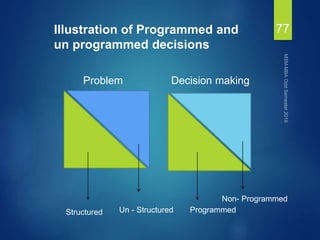
    77 Problem Decision making Illustrationof Programmed and un programmed decisions Structured Un - Structured Programmed Non- Programmed
  • 78.
    Decision making underdifferent situations 1. Certainty : In situation involving certainty, people are reasonably sure about what will happen when they make a decision. The information is available and considered to be reliable - cause and effect relationship known 78 1 2 3
  • 79.
    2. Uncertainty: In situationof uncertainty, people have only a meager database, not sure about data reliable or not - cause and effects relationships to be studied 79 1 2 3
  • 80.
    3. Risks  Ina situation with risks, factual information may exist, but are incomplete  Estimation of probabilities by using mathematical models, based on judgment and experience may be used 80 1 2 3
  • 81.
    Creativity and Innovation Creativity – the ability and power to develop new ideas  Innovation – the use of new ideas 4 phases of creative process: 1. Unconscious planning 2. Intuition 3. Insight 4. Logical formulation 81
  • 82.
    Brain storming Best knowntechnique for facilitating creativity – developed by Alex F. Osborn - Father of Brain storming - Emphasis on group thinking The rule of brain storming : 1. No ideas are ever criticized 2. The more radical the ideas are the better 3. The quantity of idea production is stressed 4. The improvement of ideas by others - encouraged 82
  • 83.
    Invention: pertains tonew ideas and process Innovation: the application of the ideas to products and services 83
  • 84.