MANAGEMENT
DEVELOPMENT METHODS
What is Development?
• WhileTraining focuses on improving an employee’s skill level, development
has a more long-term focus intended to help an employee prepare for future
jobs.
• It helps the organization to achieve its mission and goals by improving
individual and, ultimately, organizational performance.
• The major objective of development is managerial effectiveness through a
planned and a deliberate process of learning.
Difference betweenTraining and Development
• Training:
• 1.It's a short term process.
• 2.Refers to instruction in technical and mechanical problems
• 3.Targeted in most cases for non-managerial personnel
• 4.Specific job related purpose
• Development:
• 1.It is a long term educational process.
• 2.Refers to philosophical and theoretical educational concepts
• 3.Managerial personnel
• 4.General knowledge purpose
Objectives of Management Development
• Improving performance of managers
• Identifying employees with executive talent
• Motivating managers
• Updating managers
• Improving analytical skills
• Improving human relational skills
• Providing insights into economic, social and technical areas.
• http://www.youtube.com/watch?v=wjMfaAj0t6I
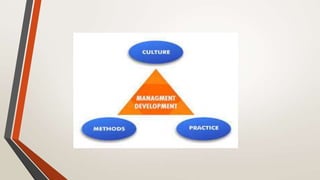
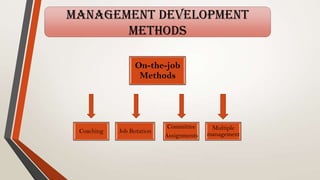
MANAGEMENT DEVELOPMENT
METHODS
On-the-job
Methods
Coaching Job Rotation
Committee
Assignments
Multiple
management
MANAGEMENT DEVELOPMENT
METHODS
Simulation
Transactional
analysis
Sensitivity
training Conferences Lectures
Off-the-job
Methods
http://www.youtube.com/watch?v=6lMFTVTnlSM
LearningOrganisations and Development
• These organisations encourage development through shared
information, culture and leadership.
• Informal learning
• Employees continuously learn and solve problems.
• Career development centres.
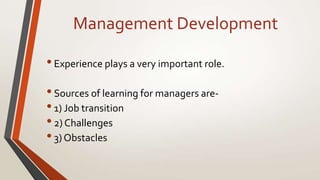
Management Development
•Experience plays a very important role.
•Sources of learning for managers are-
•1) Job transition
•2) Challenges
•3) Obstacles
Various Approaches for Development
•Supervisor Development
•Leadership Development-
•1) Modelling
•2) Coaching
•3) Management Mentoring
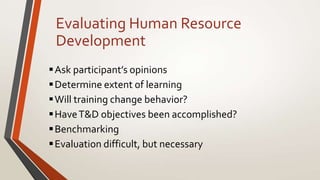
Evaluating Human Resource
Development
Ask participant’s opinions
Determine extent of learning
Will training change behavior?
HaveT&D objectives been accomplished?
Benchmarking
Evaluation difficult, but necessary
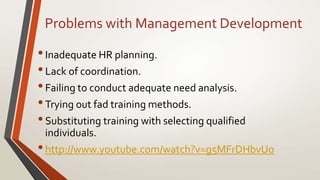
Problems with Management Development
•Inadequate HR planning.
•Lack of coordination.
•Failing to conduct adequate need analysis.
•Trying out fad training methods.
•Substituting training with selecting qualified
individuals.
•http://www.youtube.com/watch?v=g5MFrDHbvUo
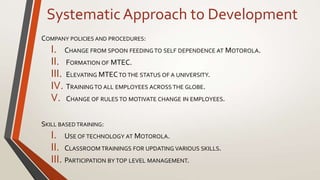
SystematicApproach to Development
COMPANY POLICIES AND PROCEDURES:
I. CHANGE FROM SPOON FEEDING TO SELF DEPENDENCE AT MOTOROLA.
II. FORMATION OF MTEC.
III. ELEVATING MTECTO THE STATUS OF A UNIVERSITY.
IV. TRAININGTO ALL EMPLOYEES ACROSS THE GLOBE.
V. CHANGE OF RULES TO MOTIVATE CHANGE IN EMPLOYEES.
SKILL BASED TRAINING:
I. USE OF TECHNOLOGY AT MOTOROLA.
II. CLASSROOM TRAININGS FOR UPDATING VARIOUS SKILLS.
III. PARTICIPATION BY TOP LEVEL MANAGEMENT.
•THANKYOU!!

Management development methods

  • 1.
  • 2.
    What is Development? •WhileTraining focuses on improving an employee’s skill level, development has a more long-term focus intended to help an employee prepare for future jobs. • It helps the organization to achieve its mission and goals by improving individual and, ultimately, organizational performance. • The major objective of development is managerial effectiveness through a planned and a deliberate process of learning.
  • 4.
    Difference betweenTraining andDevelopment • Training: • 1.It's a short term process. • 2.Refers to instruction in technical and mechanical problems • 3.Targeted in most cases for non-managerial personnel • 4.Specific job related purpose • Development: • 1.It is a long term educational process. • 2.Refers to philosophical and theoretical educational concepts • 3.Managerial personnel • 4.General knowledge purpose
  • 5.
    Objectives of ManagementDevelopment • Improving performance of managers • Identifying employees with executive talent • Motivating managers • Updating managers • Improving analytical skills • Improving human relational skills • Providing insights into economic, social and technical areas. • http://www.youtube.com/watch?v=wjMfaAj0t6I
  • 6.
    MANAGEMENT DEVELOPMENT METHODS On-the-job Methods Coaching JobRotation Committee Assignments Multiple management
  • 7.
    MANAGEMENT DEVELOPMENT METHODS Simulation Transactional analysis Sensitivity training ConferencesLectures Off-the-job Methods http://www.youtube.com/watch?v=6lMFTVTnlSM
  • 8.
    LearningOrganisations and Development •These organisations encourage development through shared information, culture and leadership. • Informal learning • Employees continuously learn and solve problems. • Career development centres.
  • 9.
    Management Development •Experience playsa very important role. •Sources of learning for managers are- •1) Job transition •2) Challenges •3) Obstacles
  • 10.
    Various Approaches forDevelopment •Supervisor Development •Leadership Development- •1) Modelling •2) Coaching •3) Management Mentoring
  • 11.
    Evaluating Human Resource Development Askparticipant’s opinions Determine extent of learning Will training change behavior? HaveT&D objectives been accomplished? Benchmarking Evaluation difficult, but necessary
  • 12.
    Problems with ManagementDevelopment •Inadequate HR planning. •Lack of coordination. •Failing to conduct adequate need analysis. •Trying out fad training methods. •Substituting training with selecting qualified individuals. •http://www.youtube.com/watch?v=g5MFrDHbvUo
  • 13.
    SystematicApproach to Development COMPANYPOLICIES AND PROCEDURES: I. CHANGE FROM SPOON FEEDING TO SELF DEPENDENCE AT MOTOROLA. II. FORMATION OF MTEC. III. ELEVATING MTECTO THE STATUS OF A UNIVERSITY. IV. TRAININGTO ALL EMPLOYEES ACROSS THE GLOBE. V. CHANGE OF RULES TO MOTIVATE CHANGE IN EMPLOYEES. SKILL BASED TRAINING: I. USE OF TECHNOLOGY AT MOTOROLA. II. CLASSROOM TRAININGS FOR UPDATING VARIOUS SKILLS. III. PARTICIPATION BY TOP LEVEL MANAGEMENT.
  • 14.