Human Resource Management vs
Personnel Management
Simaran Shaheen
Asst. Prof.
Ghanshyam Binani Academy of Management Sciences,
Mirzapur
 Personnel Management

 Personnel Management is a part of management that
deals with the recruitment, hiring, staffing, development,
and compensation of the workforce and their relation with
the organization to achieve the organizational objectives.
The primary functions of the personnel management are
divided into two categories:
 Operative Functions: The activities that are concerned
with procurement, development, compensation, job
evaluation, employee welfare, utilization, maintenance
and collective bargaining.
 Human Resource Management
 Human Resource Management is that specialized and
organized branch of management which is concerned
with the acquisition, maintenance, development,
utilization and coordination of people at work, in such a
manner that they will give their best to the enterprise. It
refers to a systematic function of planning for the human
resource needs and demands, selection, training,
compensation, and performance appraisal, to meet those
requirements.
 Human Resource Management is a continuous process
of ensuring the availability of eligible and willing workforce
i.e. putting the right man at the right job. In a nutshell, it is
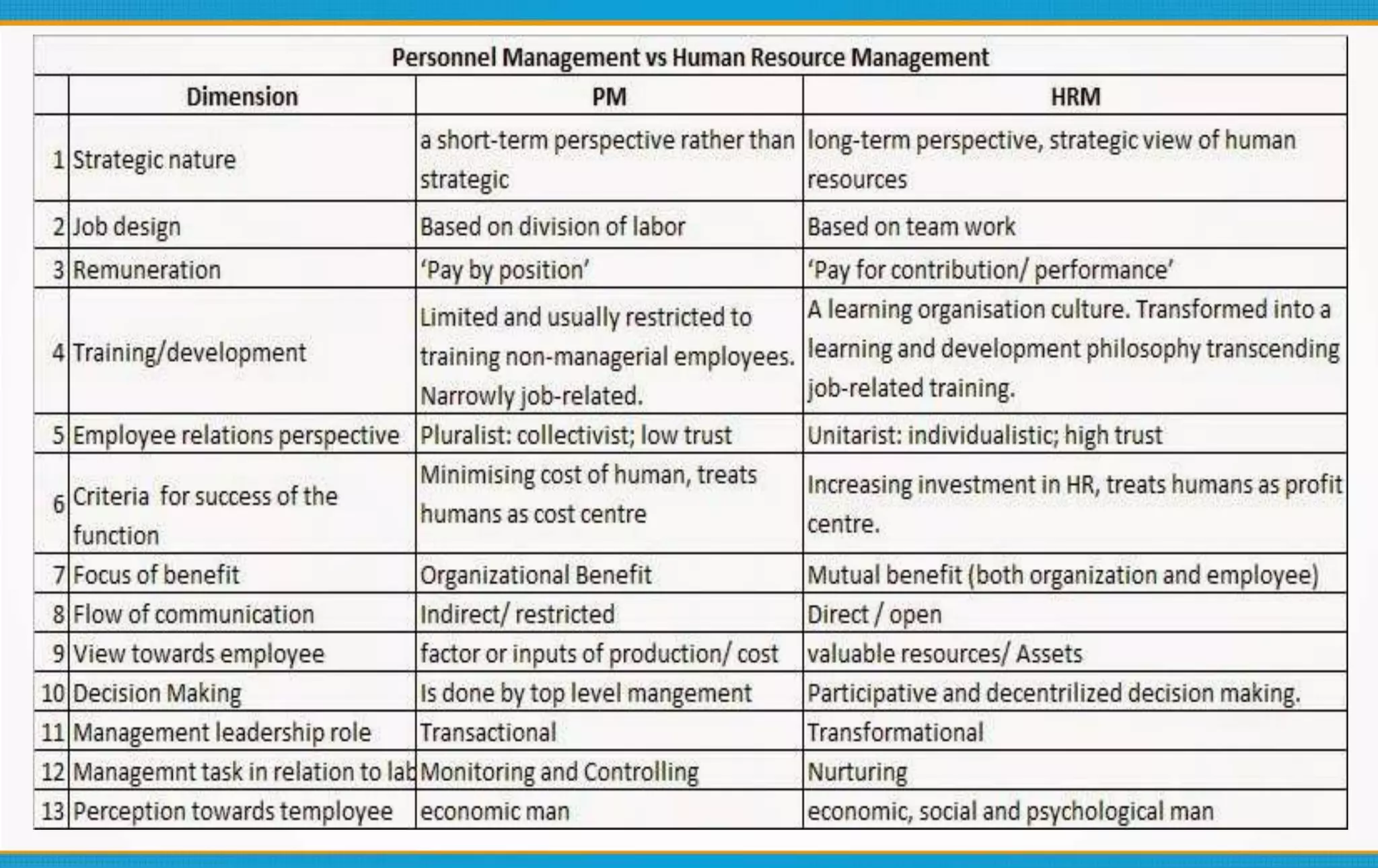
 The main difference between Personnel Management
and Human Resource Management lies in their scope
and orientation. While the scope of personnel
management is limited and has an inverted approach,
wherein workers are viewed as tool. Here the behavior of
the worker can be manipulated as per the core
competencies of the organization and are replaced when
they are worn-out.
 On the other hand, human resource management has a
wider scope and considers employees as the asset to the
organization. It promotes mutuality in terms of goals,
responsibility, reward etc. that will help in enhancing the
economic performance and high level of human resource
development.
Human Resource Management vs Personnel Management

Human Resource Management vs Personnel Management

  • 1.
    Human Resource Managementvs Personnel Management Simaran Shaheen Asst. Prof. Ghanshyam Binani Academy of Management Sciences, Mirzapur
  • 2.
     Personnel Management  Personnel Management is a part of management that deals with the recruitment, hiring, staffing, development, and compensation of the workforce and their relation with the organization to achieve the organizational objectives. The primary functions of the personnel management are divided into two categories:  Operative Functions: The activities that are concerned with procurement, development, compensation, job evaluation, employee welfare, utilization, maintenance and collective bargaining.
  • 3.
     Human ResourceManagement  Human Resource Management is that specialized and organized branch of management which is concerned with the acquisition, maintenance, development, utilization and coordination of people at work, in such a manner that they will give their best to the enterprise. It refers to a systematic function of planning for the human resource needs and demands, selection, training, compensation, and performance appraisal, to meet those requirements.  Human Resource Management is a continuous process of ensuring the availability of eligible and willing workforce i.e. putting the right man at the right job. In a nutshell, it is
  • 4.
     The maindifference between Personnel Management and Human Resource Management lies in their scope and orientation. While the scope of personnel management is limited and has an inverted approach, wherein workers are viewed as tool. Here the behavior of the worker can be manipulated as per the core competencies of the organization and are replaced when they are worn-out.  On the other hand, human resource management has a wider scope and considers employees as the asset to the organization. It promotes mutuality in terms of goals, responsibility, reward etc. that will help in enhancing the economic performance and high level of human resource development.