UNIT 3. THE HYDROSPHERE
1. HYDROSPHERE
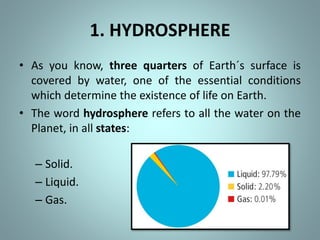
• As you know, three quarters of Earth´s surface is
covered by water, one of the essential conditions
which determine the existence of life on Earth.
• The word hydrosphere refers to all the water on the
Planet, in all states:
– Solid.
– Liquid.
– Gas.
TYPES OF WATER: STATES
SOLID STATE WATER
• Most solid state water exists as snow and ice in the
polar ice caps and glaciers.
• Liquid water freezes below 0 °C and transforms into
a solid.
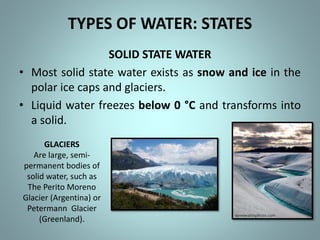
GLACIERS
Are large, semi-
permanent bodies of
solid water, such as
The Perito Moreno
Glacier (Argentina) or
Petermann Glacier
(Greenland).
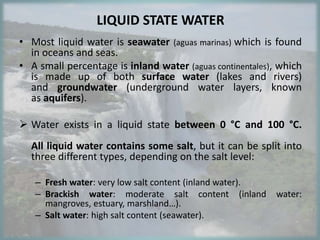
LIQUID STATE WATER
• Most liquid water is seawater (aguas marinas) which is found
in oceans and seas.
• A small percentage is inland water (aguas continentales), which
is made up of both surface water (lakes and rivers)
and groundwater (underground water layers, known
as aquifers).
 Water exists in a liquid state between 0 °C and 100 °C.
All liquid water contains some salt, but it can be split into
three different types, depending on the salt level:
– Fresh water: very low salt content (inland water).
– Brackish water: moderate salt content (inland water:
mangroves, estuary, marshland…).
– Salt water: high salt content (seawater).
GAS WATER STATE
• Water is considered a gas in the form of water vapour.
• Most water vapour exists in the Earth’s atmosphere as
evaporation from surface water. However, it can also come
from inside the Earth in areas of volcanic activity.
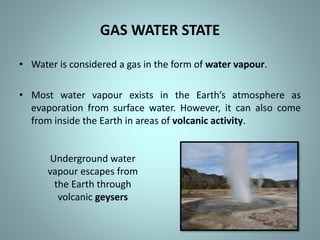
Underground water
vapour escapes from
the Earth through
volcanic geysers
WATER CYCLE
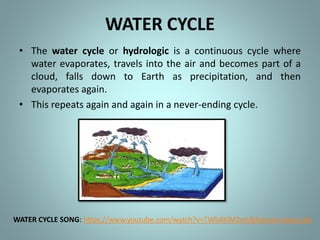
• The water cycle or hydrologic is a continuous cycle where
water evaporates, travels into the air and becomes part of a
cloud, falls down to Earth as precipitation, and then
evaporates again.
• This repeats again and again in a never-ending cycle.
WATER CYCLE SONG: https://www.youtube.com/watch?v=TWb4KlM2vts&feature=youtu.be
2. WATER IN SEAS AND OCEANS → SALT WATER.
OCEANS are large bodies of water that surround continents.
SEAS are smaller and form parts of oceans.
 COMPOSITION: sea water is a mixture of mineral salts, such as sodium
chloride (common salt) and magnesium salts.
– The salt in sea water affects density.
• Water with a higher salt content has a greater density.
• Water with a lower salt content has a lower density.
• Video: https://youtu.be/VhkijfRtMOo
– Seawater temperature depends on latitude and depth.
• Latitude: at lower latitudes (more exposed to sunlight) are warmer.
• Depth: temperatures are lower in deeper bodies of water and warmer in
shallower areas.
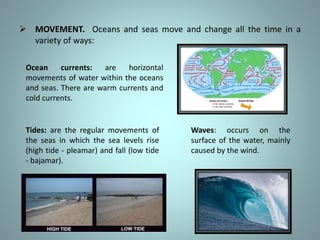
 MOVEMENT. Oceans and seas move and change all the time in a
variety of ways:
Waves: occurs on the
surface of the water, mainly
caused by the wind.
Tides: are the regular movements of
the seas in which the sea levels rise
(high tide - pleamar) and fall (low tide
- bajamar).
Ocean currents: are horizontal
movements of water within the oceans
and seas. There are warm currents and
cold currents.
3. INLAND WATER → FRESH WATER.
• Inland water includes surface water and groundwater, as well as glaciers.
1. Surface water can be found on Earth in a variety of forms:
1. Rivers: are flowing body of fresh water. The route of a river is called its course.
2. Lakes: a body of fresh or salt water of considerable size, surrounded by land.
3. Wetlands: a shallow layer of water covers the ground for only part of the year.
4. Glaciers: are large masses of slow-moving ice.
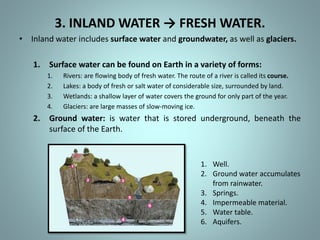
2. Ground water: is water that is stored underground, beneath the
surface of the Earth.
1. Well.
2. Ground water accumulates
from rainwater.
3. Springs.
4. Impermeable material.
5. Water table.
6. Aquifers.
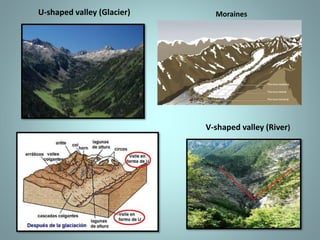
V-shaped valley (River)
U-shaped valley (Glacier) Moraines

Unit 3

  • 1.
    UNIT 3. THEHYDROSPHERE
  • 2.
    1. HYDROSPHERE • Asyou know, three quarters of Earth´s surface is covered by water, one of the essential conditions which determine the existence of life on Earth. • The word hydrosphere refers to all the water on the Planet, in all states: – Solid. – Liquid. – Gas.
  • 3.
    TYPES OF WATER:STATES SOLID STATE WATER • Most solid state water exists as snow and ice in the polar ice caps and glaciers. • Liquid water freezes below 0 °C and transforms into a solid. GLACIERS Are large, semi- permanent bodies of solid water, such as The Perito Moreno Glacier (Argentina) or Petermann Glacier (Greenland).
  • 4.
    LIQUID STATE WATER •Most liquid water is seawater (aguas marinas) which is found in oceans and seas. • A small percentage is inland water (aguas continentales), which is made up of both surface water (lakes and rivers) and groundwater (underground water layers, known as aquifers).  Water exists in a liquid state between 0 °C and 100 °C. All liquid water contains some salt, but it can be split into three different types, depending on the salt level: – Fresh water: very low salt content (inland water). – Brackish water: moderate salt content (inland water: mangroves, estuary, marshland…). – Salt water: high salt content (seawater).
  • 5.
    GAS WATER STATE •Water is considered a gas in the form of water vapour. • Most water vapour exists in the Earth’s atmosphere as evaporation from surface water. However, it can also come from inside the Earth in areas of volcanic activity. Underground water vapour escapes from the Earth through volcanic geysers
  • 6.
    WATER CYCLE • Thewater cycle or hydrologic is a continuous cycle where water evaporates, travels into the air and becomes part of a cloud, falls down to Earth as precipitation, and then evaporates again. • This repeats again and again in a never-ending cycle. WATER CYCLE SONG: https://www.youtube.com/watch?v=TWb4KlM2vts&feature=youtu.be
  • 7.
    2. WATER INSEAS AND OCEANS → SALT WATER. OCEANS are large bodies of water that surround continents. SEAS are smaller and form parts of oceans.  COMPOSITION: sea water is a mixture of mineral salts, such as sodium chloride (common salt) and magnesium salts. – The salt in sea water affects density. • Water with a higher salt content has a greater density. • Water with a lower salt content has a lower density. • Video: https://youtu.be/VhkijfRtMOo – Seawater temperature depends on latitude and depth. • Latitude: at lower latitudes (more exposed to sunlight) are warmer. • Depth: temperatures are lower in deeper bodies of water and warmer in shallower areas.
  • 8.
     MOVEMENT. Oceansand seas move and change all the time in a variety of ways: Waves: occurs on the surface of the water, mainly caused by the wind. Tides: are the regular movements of the seas in which the sea levels rise (high tide - pleamar) and fall (low tide - bajamar). Ocean currents: are horizontal movements of water within the oceans and seas. There are warm currents and cold currents.
  • 9.
    3. INLAND WATER→ FRESH WATER. • Inland water includes surface water and groundwater, as well as glaciers. 1. Surface water can be found on Earth in a variety of forms: 1. Rivers: are flowing body of fresh water. The route of a river is called its course. 2. Lakes: a body of fresh or salt water of considerable size, surrounded by land. 3. Wetlands: a shallow layer of water covers the ground for only part of the year. 4. Glaciers: are large masses of slow-moving ice. 2. Ground water: is water that is stored underground, beneath the surface of the Earth. 1. Well. 2. Ground water accumulates from rainwater. 3. Springs. 4. Impermeable material. 5. Water table. 6. Aquifers.
  • 10.
    V-shaped valley (River) U-shapedvalley (Glacier) Moraines