Water And its existence on our Earth
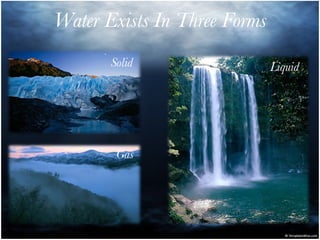
Water Exists In Three Forms Solid Liquid Gas
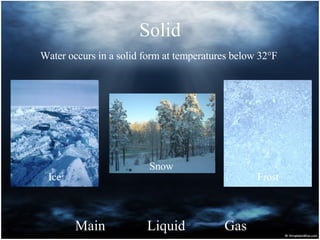
Solid Water occurs in a solid form at temperatures below 32°F  Main Liquid Gas Ice Snow Frost
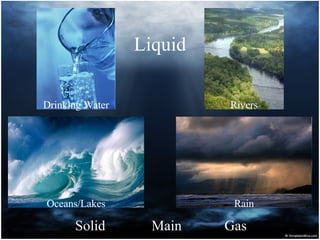
Liquid Solid Main Gas Drinking Water Rivers Rain Oceans/Lakes
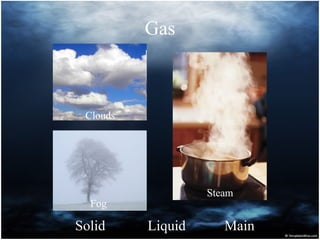
Gas Solid Liquid Main Clouds Steam Fog
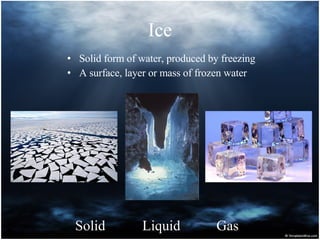
Ice Solid form of water, produced by freezing A surface, layer or mass of frozen water Solid Liquid Gas
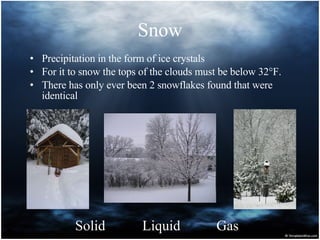
Snow Precipitation in the form of ice crystals  For it to snow the tops of the clouds must be below 32°F.  There has only ever been 2 snowflakes found that were identical Solid Liquid Gas
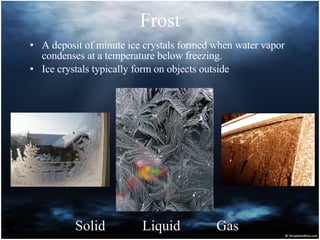
Frost A deposit of minute ice crystals formed when water vapor condenses at a temperature below freezing.  Ice crystals typically form on objects outside Solid Liquid Gas
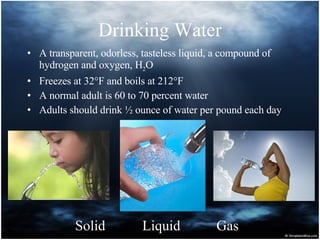
Drinking Water A transparent, odorless, tasteless liquid, a compound of hydrogen and oxygen, H 2 O Freezes at 32°F and boils at 212°F A normal adult is 60 to 70 percent water Adults should drink ½ ounce of water per pound each day Solid Liquid Gas
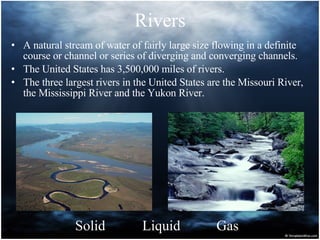
Rivers A natural stream of water of fairly large size flowing in a definite course or channel or series of diverging and converging channels. The United States has 3,500,000 miles of rivers. The three largest rivers in the United States are the Missouri River, the Mississippi River and the Yukon River.  Solid Liquid Gas
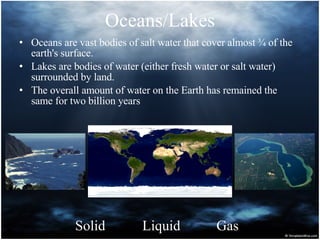
Oceans/Lakes Oceans are vast bodies of salt water that cover almost ¾ of the earth's surface. Lakes are bodies of water (either fresh water or salt water) surrounded by land. The overall amount of water on the Earth has remained the same for two billion years Solid Liquid Gas
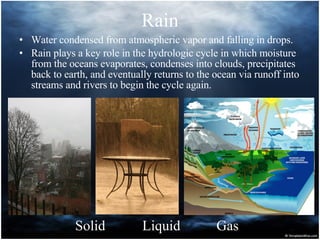
Rain Water condensed from atmospheric vapor and falling in drops.  Rain plays a key role in the hydrologic cycle in which moisture from the oceans evaporates, condenses into clouds, precipitates back to earth, and eventually returns to the ocean via runoff into streams and rivers to begin the cycle again.  Solid Liquid Gas
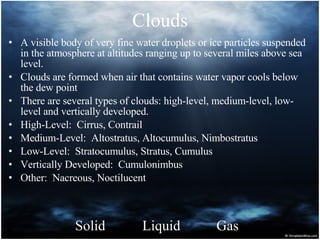
Clouds A visible body of very fine water droplets or ice particles suspended in the atmosphere at altitudes ranging up to several miles above sea level.   Clouds are formed when air that contains water vapor cools below the dew point  There are several types of clouds: high-level, medium-level, low-level and vertically developed. High-Level:  Cirrus, Contrail Medium-Level:  Altostratus, Altocumulus, Nimbostratus Low-Level:  Stratocumulus, Stratus, Cumulus Vertically Developed:  Cumulonimbus Other:  Nacreous, Noctilucent  Solid Liquid Gas
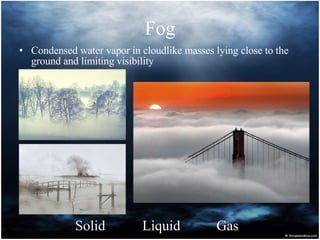
Fog Condensed water vapor in cloudlike masses lying close to the ground and limiting visibility  Solid Liquid Gas
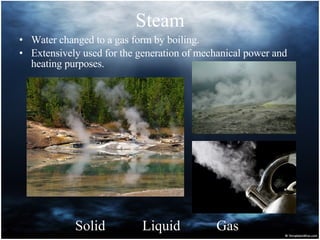
Steam Water changed to a gas form by boiling. Extensively used for the generation of mechanical power and heating purposes.  Solid Liquid Gas

Durga Interactive Water

  • 1.
    Water And itsexistence on our Earth
  • 2.
    Water Exists InThree Forms Solid Liquid Gas
  • 3.
    Solid Water occursin a solid form at temperatures below 32°F Main Liquid Gas Ice Snow Frost
  • 4.
    Liquid Solid MainGas Drinking Water Rivers Rain Oceans/Lakes
  • 5.
    Gas Solid LiquidMain Clouds Steam Fog
  • 6.
    Ice Solid formof water, produced by freezing A surface, layer or mass of frozen water Solid Liquid Gas
  • 7.
    Snow Precipitation inthe form of ice crystals For it to snow the tops of the clouds must be below 32°F. There has only ever been 2 snowflakes found that were identical Solid Liquid Gas
  • 8.
    Frost A depositof minute ice crystals formed when water vapor condenses at a temperature below freezing. Ice crystals typically form on objects outside Solid Liquid Gas
  • 9.
    Drinking Water Atransparent, odorless, tasteless liquid, a compound of hydrogen and oxygen, H 2 O Freezes at 32°F and boils at 212°F A normal adult is 60 to 70 percent water Adults should drink ½ ounce of water per pound each day Solid Liquid Gas
  • 10.
    Rivers A naturalstream of water of fairly large size flowing in a definite course or channel or series of diverging and converging channels. The United States has 3,500,000 miles of rivers. The three largest rivers in the United States are the Missouri River, the Mississippi River and the Yukon River. Solid Liquid Gas
  • 11.
    Oceans/Lakes Oceans arevast bodies of salt water that cover almost ¾ of the earth's surface. Lakes are bodies of water (either fresh water or salt water) surrounded by land. The overall amount of water on the Earth has remained the same for two billion years Solid Liquid Gas
  • 12.
    Rain Water condensedfrom atmospheric vapor and falling in drops. Rain plays a key role in the hydrologic cycle in which moisture from the oceans evaporates, condenses into clouds, precipitates back to earth, and eventually returns to the ocean via runoff into streams and rivers to begin the cycle again. Solid Liquid Gas
  • 13.
    Clouds A visiblebody of very fine water droplets or ice particles suspended in the atmosphere at altitudes ranging up to several miles above sea level. Clouds are formed when air that contains water vapor cools below the dew point There are several types of clouds: high-level, medium-level, low-level and vertically developed. High-Level: Cirrus, Contrail Medium-Level: Altostratus, Altocumulus, Nimbostratus Low-Level: Stratocumulus, Stratus, Cumulus Vertically Developed: Cumulonimbus Other: Nacreous, Noctilucent Solid Liquid Gas
  • 14.
    Fog Condensed watervapor in cloudlike masses lying close to the ground and limiting visibility Solid Liquid Gas
  • 15.
    Steam Water changedto a gas form by boiling. Extensively used for the generation of mechanical power and heating purposes. Solid Liquid Gas