Unit 2 – the 13 Original Colonieshttp://www.youtube.com/watch?v=F6SrZ-6cGVA
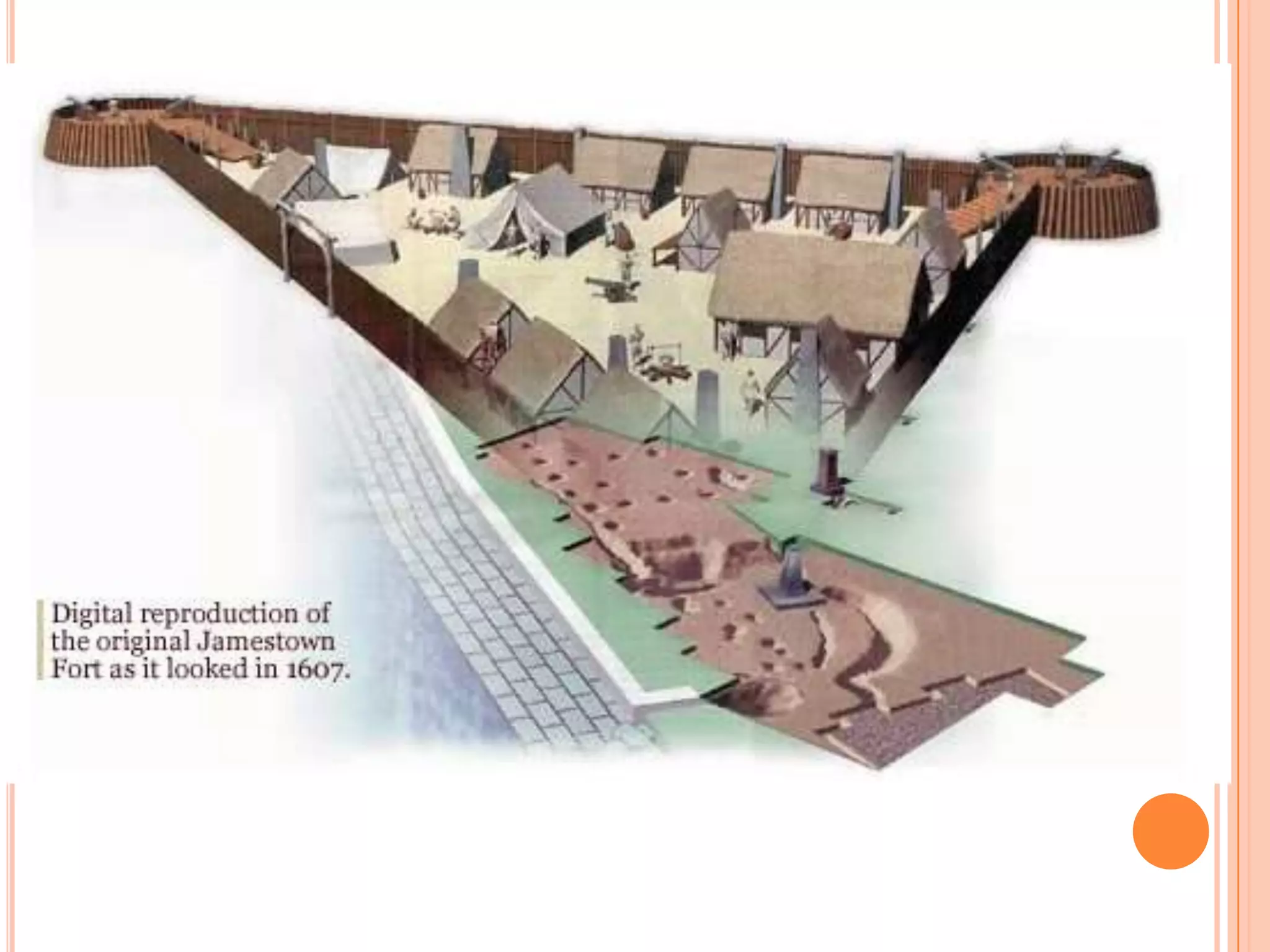
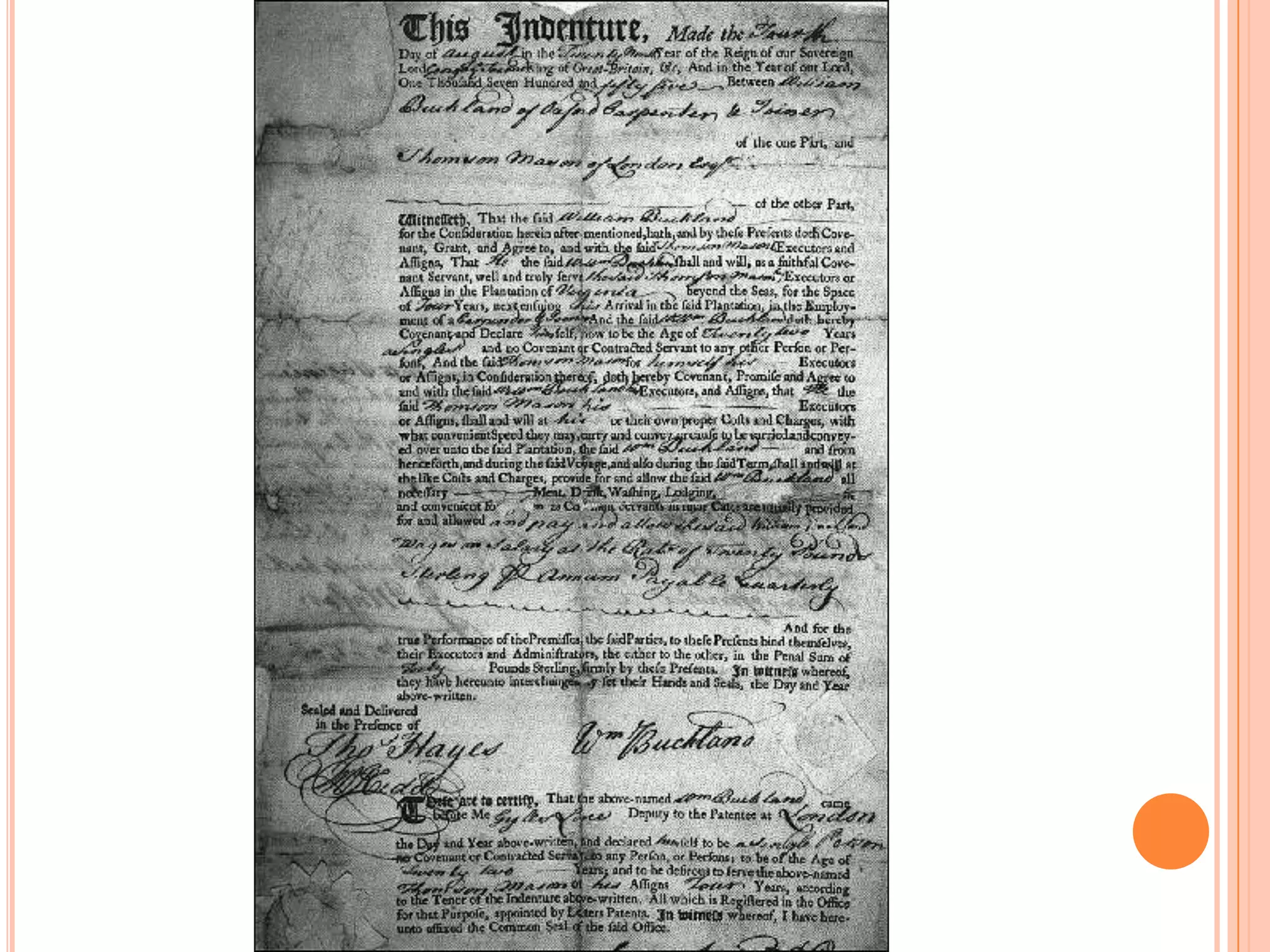
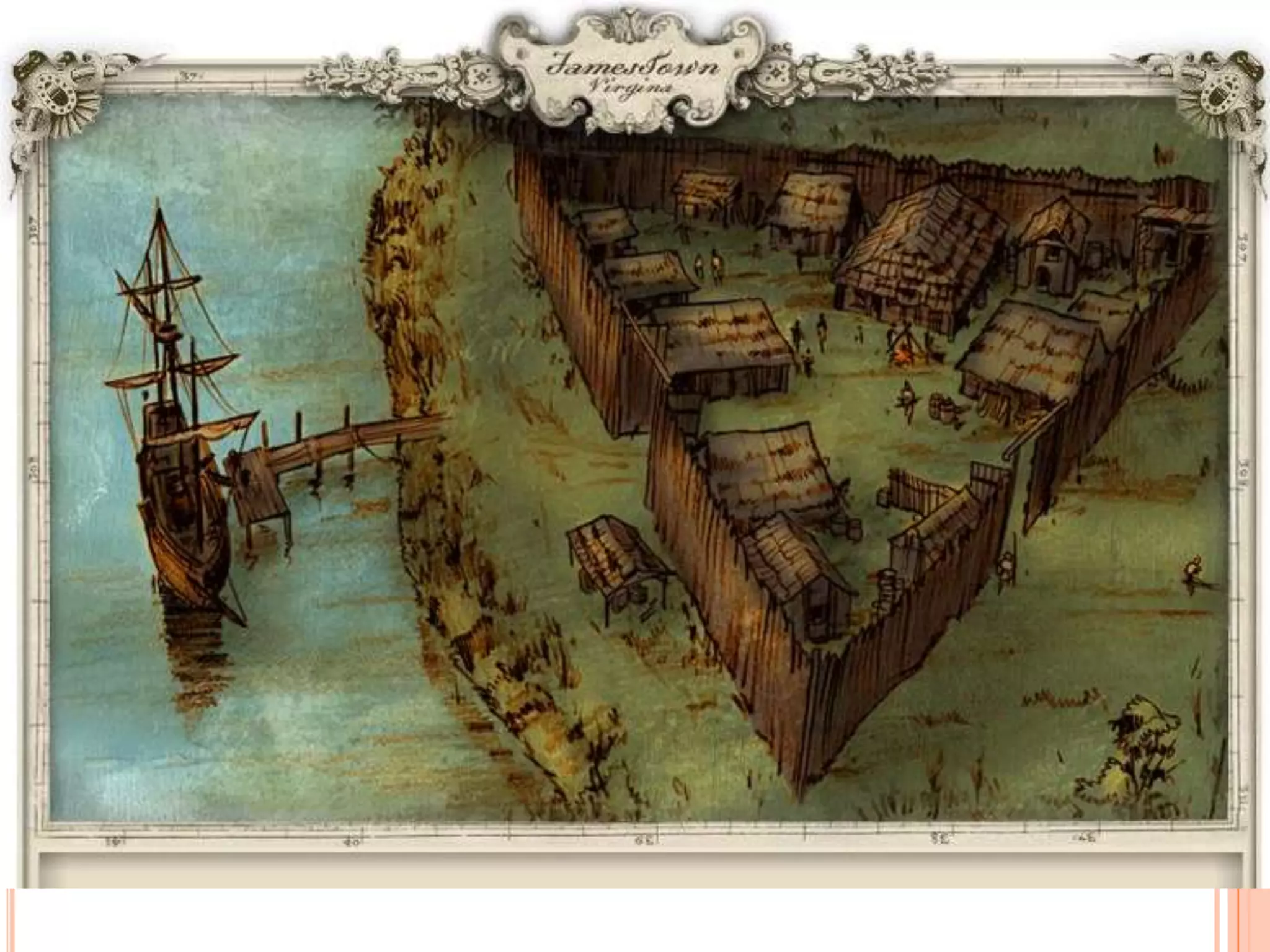
James Town – The London CompanyCompany granted a charterBrought 144 settlers, mostly gentlemen, some farmers, some indentured servantsWhat is an indentured servant?105 made it to North AmericaLeadership in Jamestown was lackingStory of John Smith, Pocahontas and John RolfeNot like the Disney movie
Jamestown was a Charter ColonyThe men going to Jamestown were given a charter.  This charter was a set of rules as to how the King of England wanted the colony to be runThe settlers were supposed to obey the charter to the best of their abilitywww.historyglobe.com/jamestown
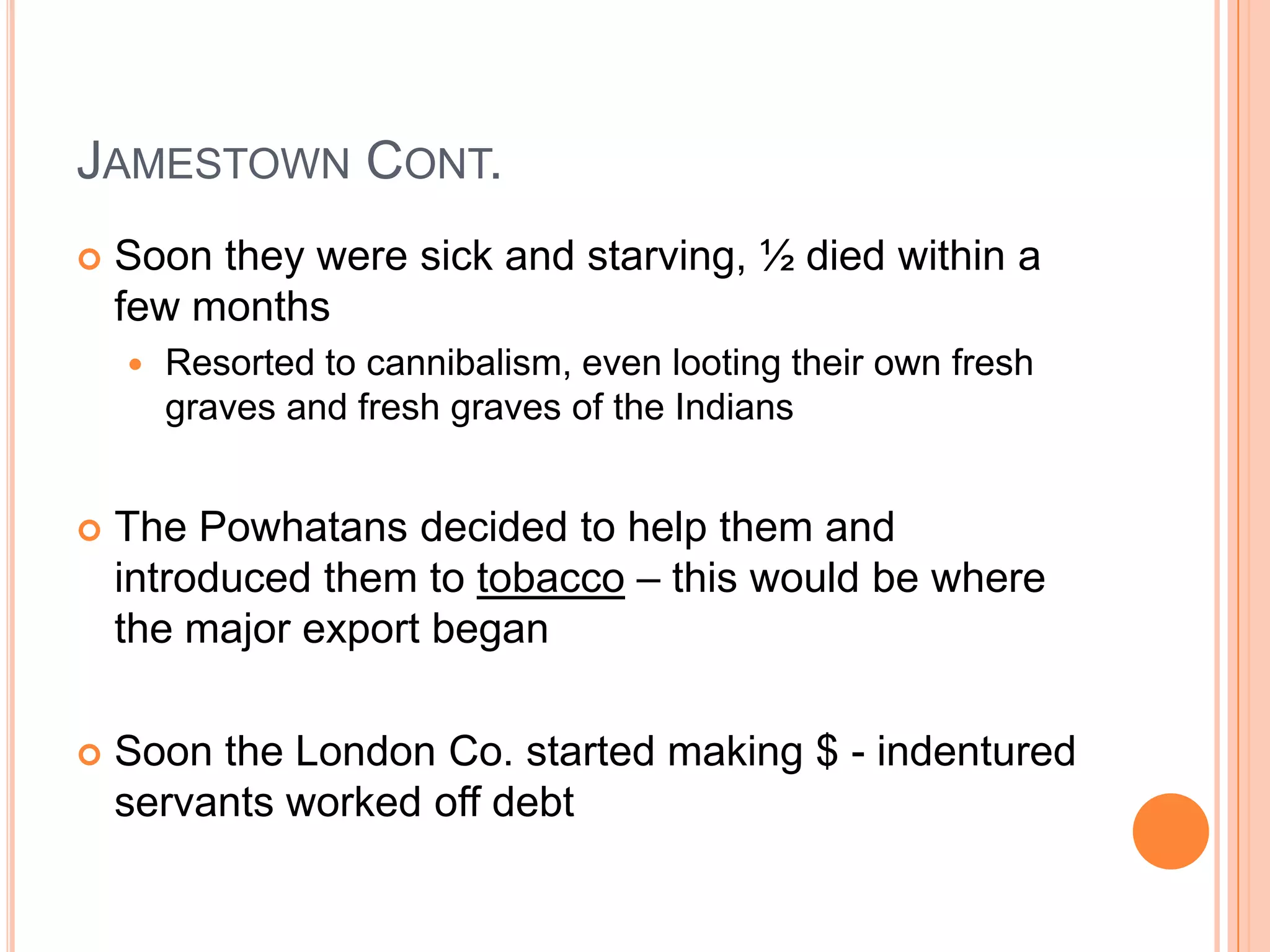
Jamestown Cont.Soon they were sick and starving, ½ died within a few monthsResorted to cannibalism, even looting their own fresh graves and fresh graves of the IndiansThe Powhatans decided to help them and introduced them to tobacco – this would be where the major export beganSoon the London Co. started making $ - indentured servants worked off debt
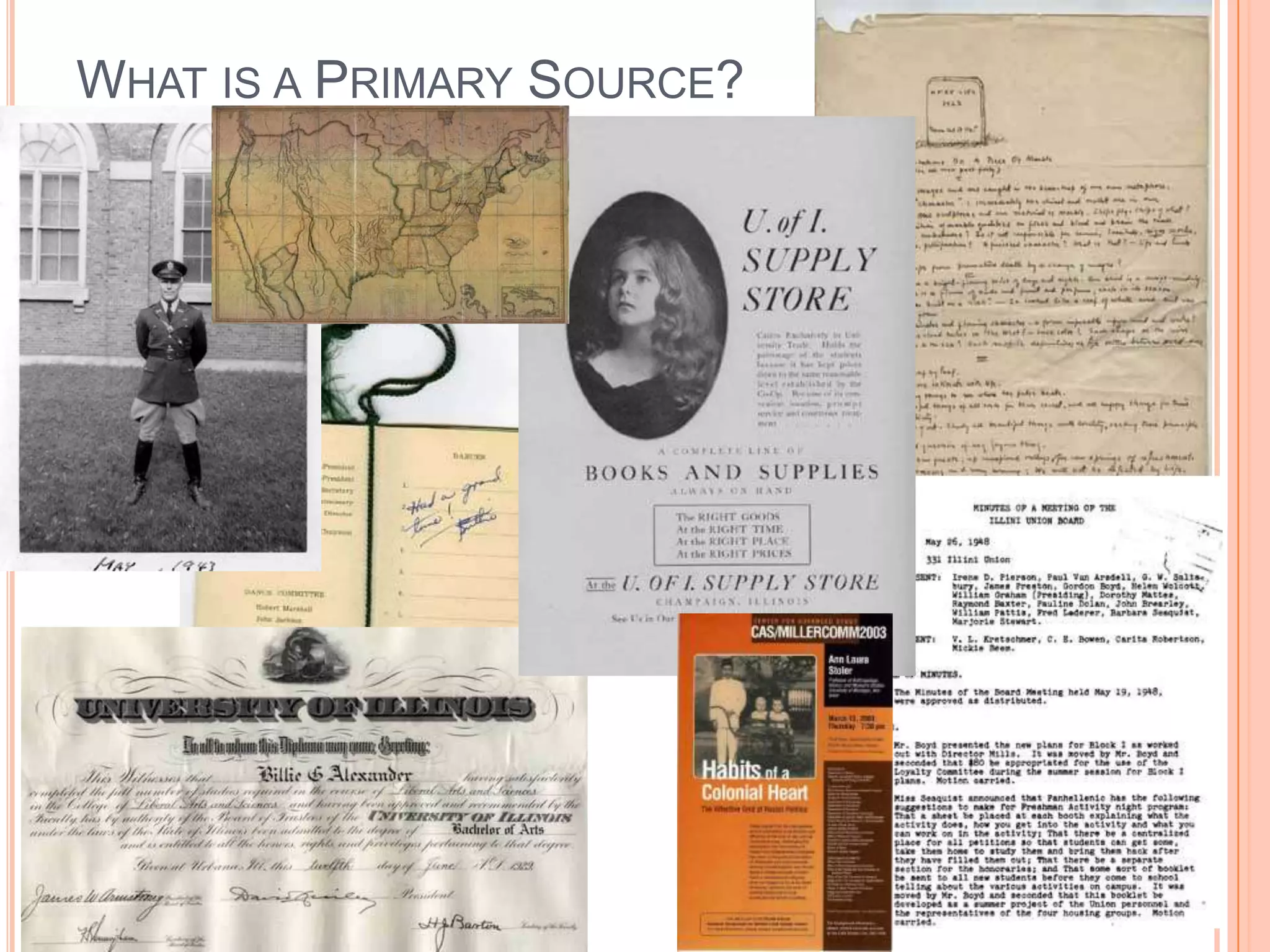
What is a Primary Source?
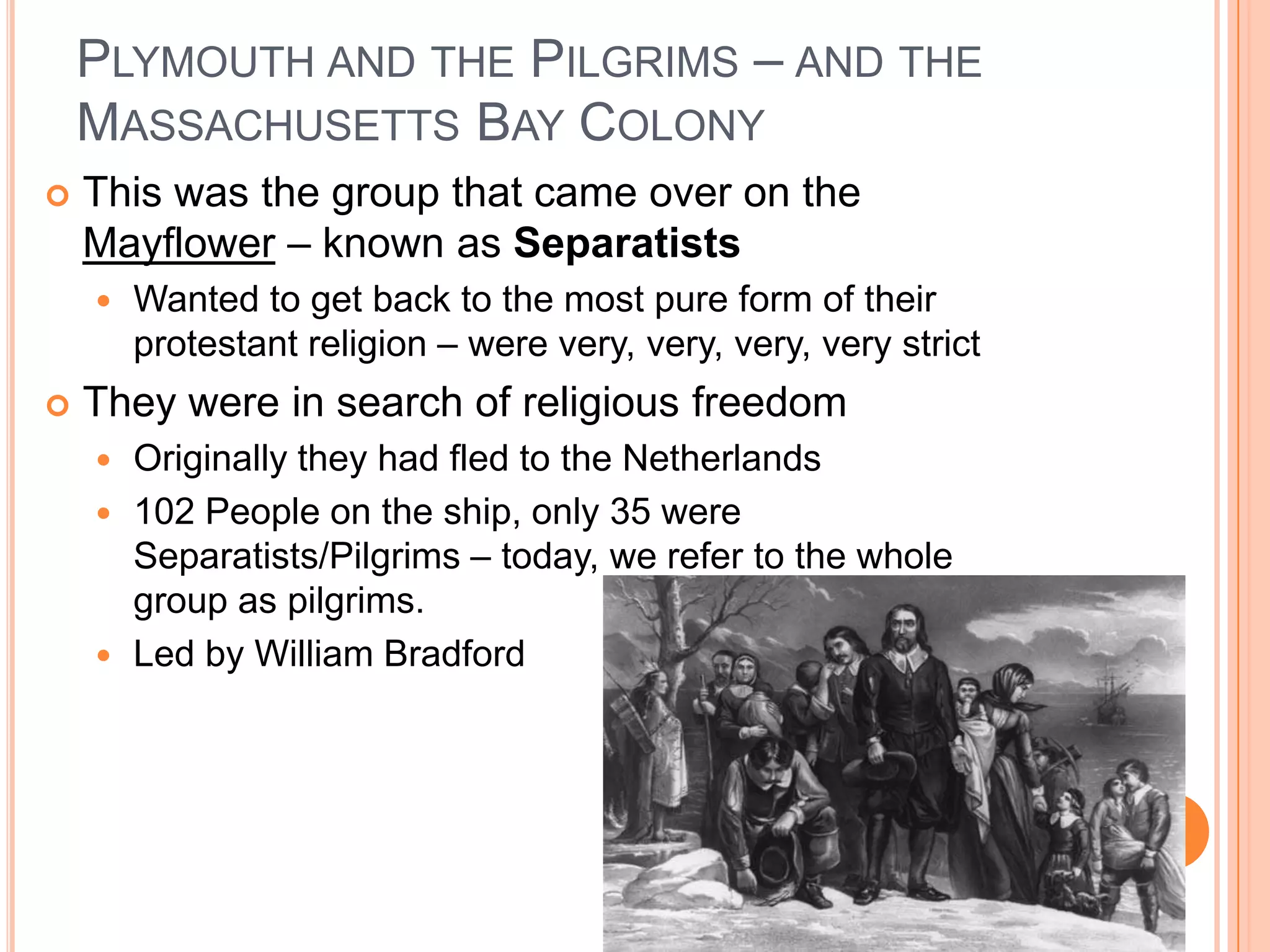
Plymouth and the Pilgrims – and the Massachusetts Bay Colony This was the group that came over on the Mayflower – known as SeparatistsWanted to get back to the most pure form of their protestant religion – were very, very, very, very strictThey were in search of religious freedomOriginally they had fled to the Netherlands102 People on the ship, only 35 were Separatists/Pilgrims – today, we refer to the whole group as pilgrims.  Led by William Bradford
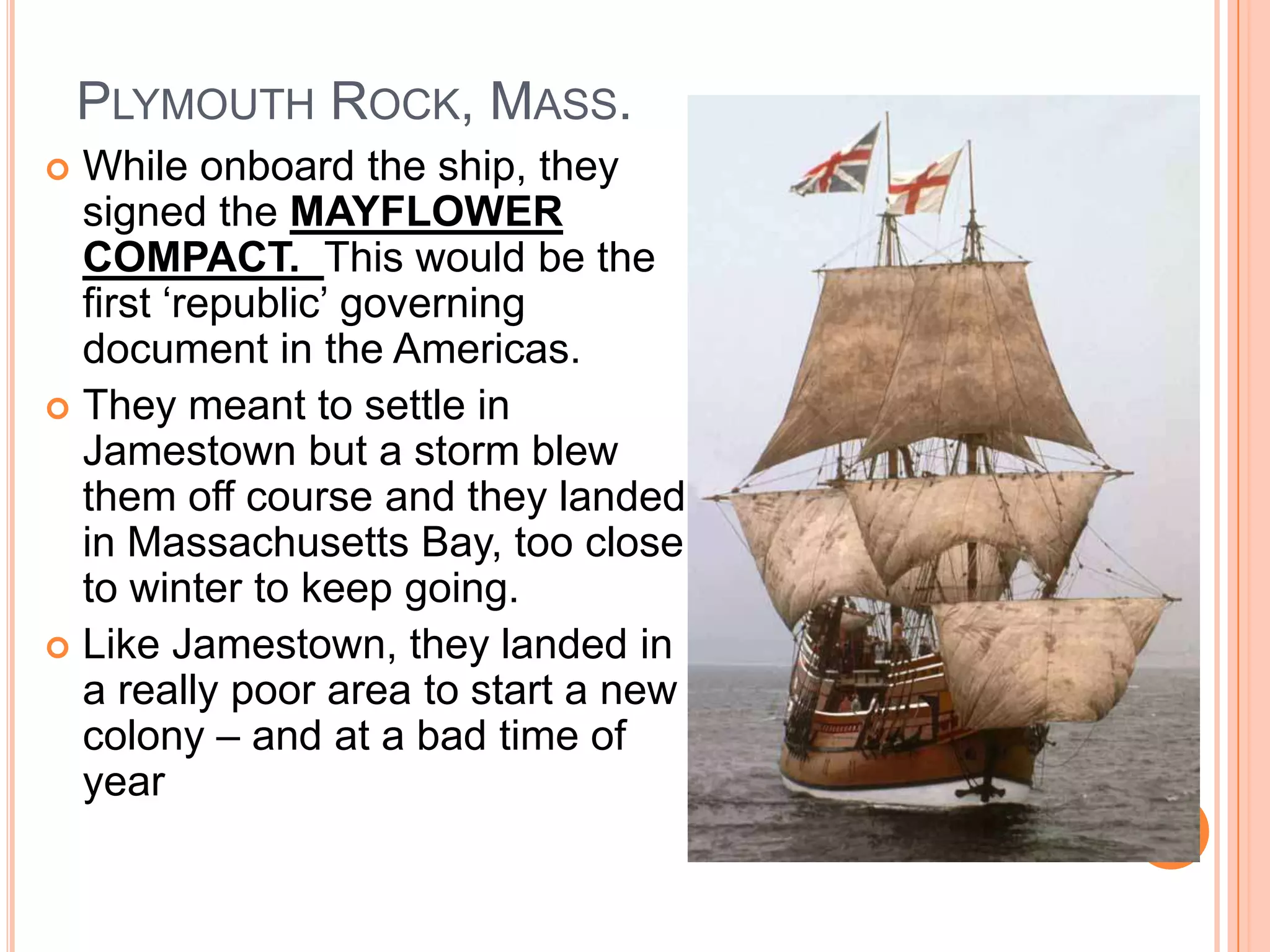
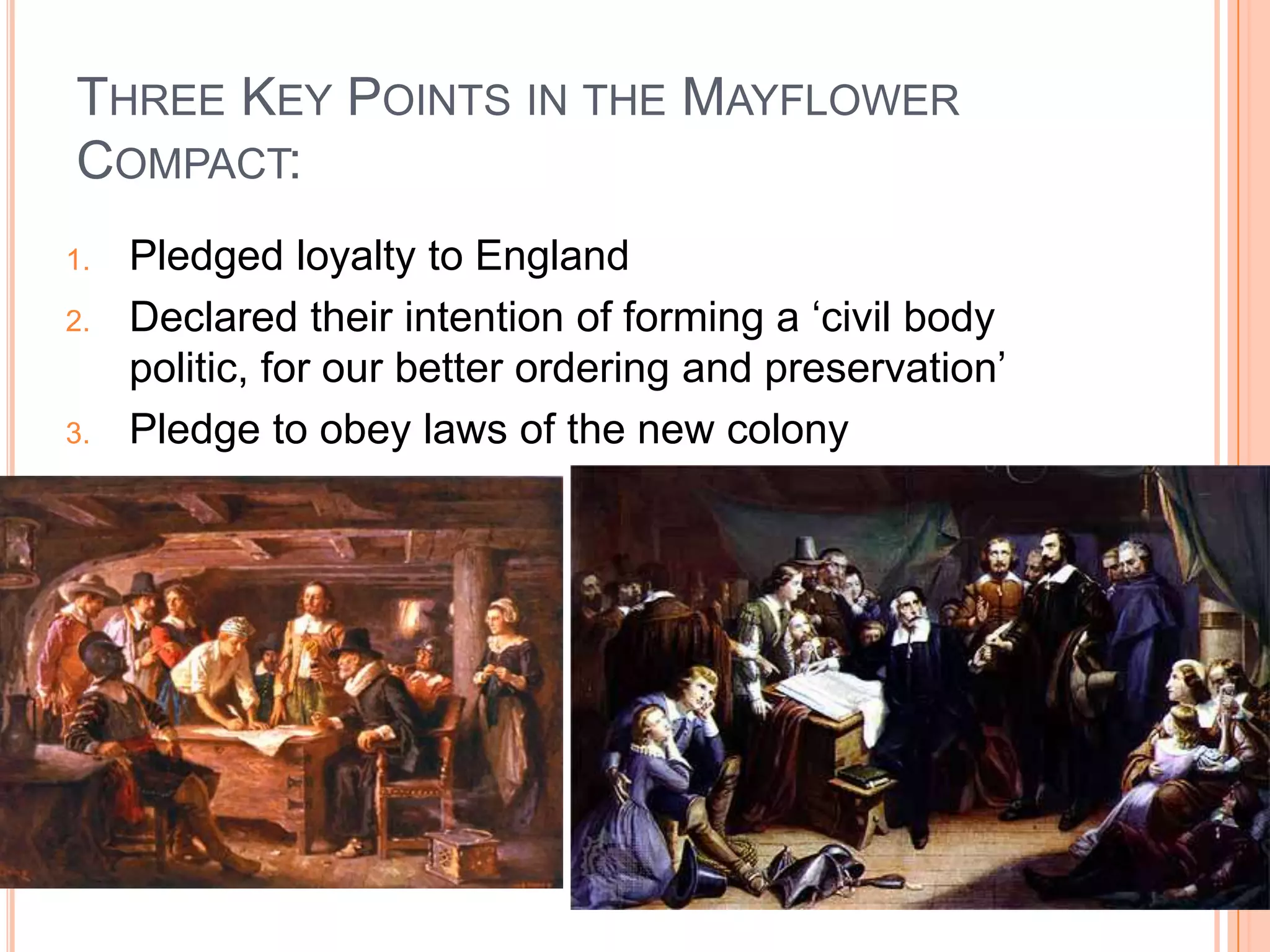
Plymouth Rock, Mass.While onboard the ship, they signed the MAYFLOWER COMPACT.  This would be the first ‘republic’ governing document in the Americas. They meant to settle in Jamestown but a storm blew them off course and they landed in Massachusetts Bay, too close to winter to keep going.Like Jamestown, they landed in a really poor area to start a new colony – and at a bad time of year
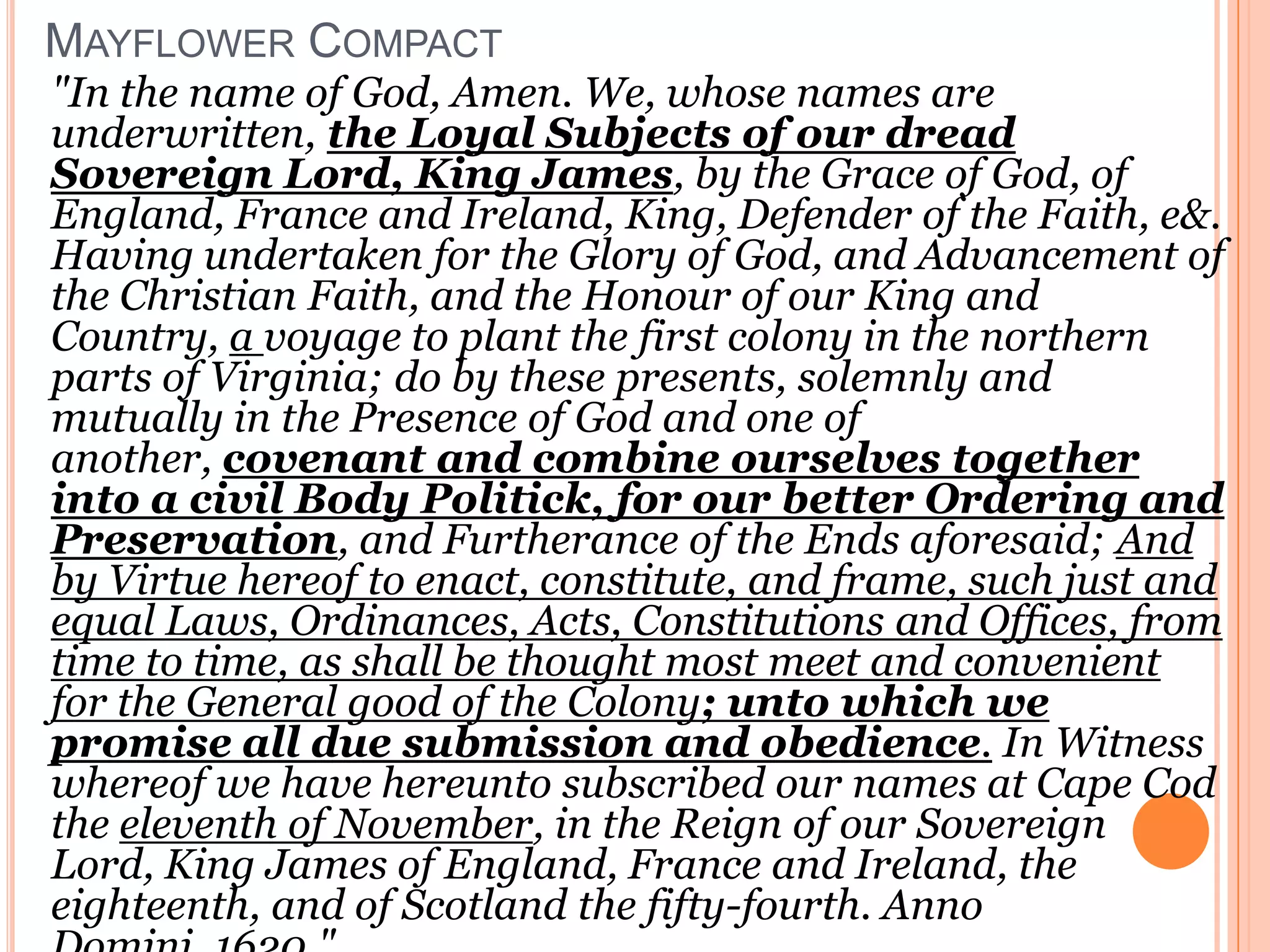
Mayflower Compact"In the name of God, Amen. We, whose names are underwritten, the Loyal Subjects of our dread Sovereign Lord, King James, by the Grace of God, of England, France and Ireland, King, Defender of the Faith, e&. Having undertaken for the Glory of God, and Advancement of the Christian Faith, and the Honour of our King and Country, a voyage to plant the first colony in the northern parts of Virginia; do by these presents, solemnly and mutually in the Presence of God and one of another, covenant and combine ourselves together into a civil Body Politick, for our better Ordering and Preservation, and Furtherance of the Ends aforesaid; And by Virtue hereof to enact, constitute, and frame, such just and equal Laws, Ordinances, Acts, Constitutions and Offices, from time to time, as shall be thought most meet and convenient for the General good of the Colony; unto which we promise all due submission and obedience. In Witness whereof we have hereunto subscribed our names at Cape Cod the eleventh of November, in the Reign of our Sovereign Lord, King James of England, France and Ireland, the eighteenth, and of Scotland the fifty-fourth. Anno Domini, 1620."
Three Key Points in the Mayflower Compact:Pledged loyalty to EnglandDeclared their intention of forming a ‘civil body politic, for our better ordering and preservation’Pledge to obey laws of the new colony
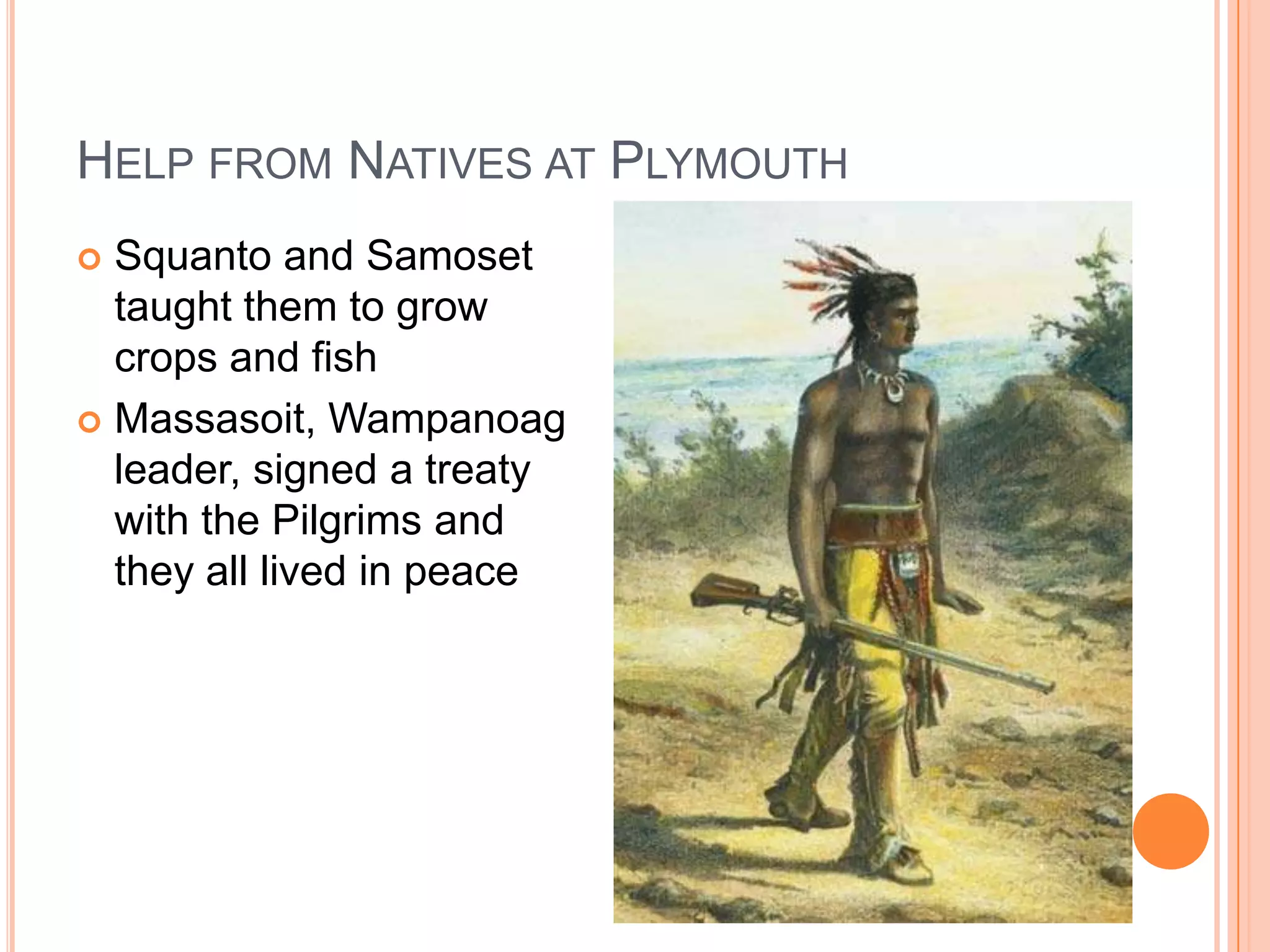
Help from Natives at PlymouthSquanto and Samoset taught them to grow crops and fishMassasoit, Wampanoag leader, signed a treaty with the Pilgrims and they all lived in peace
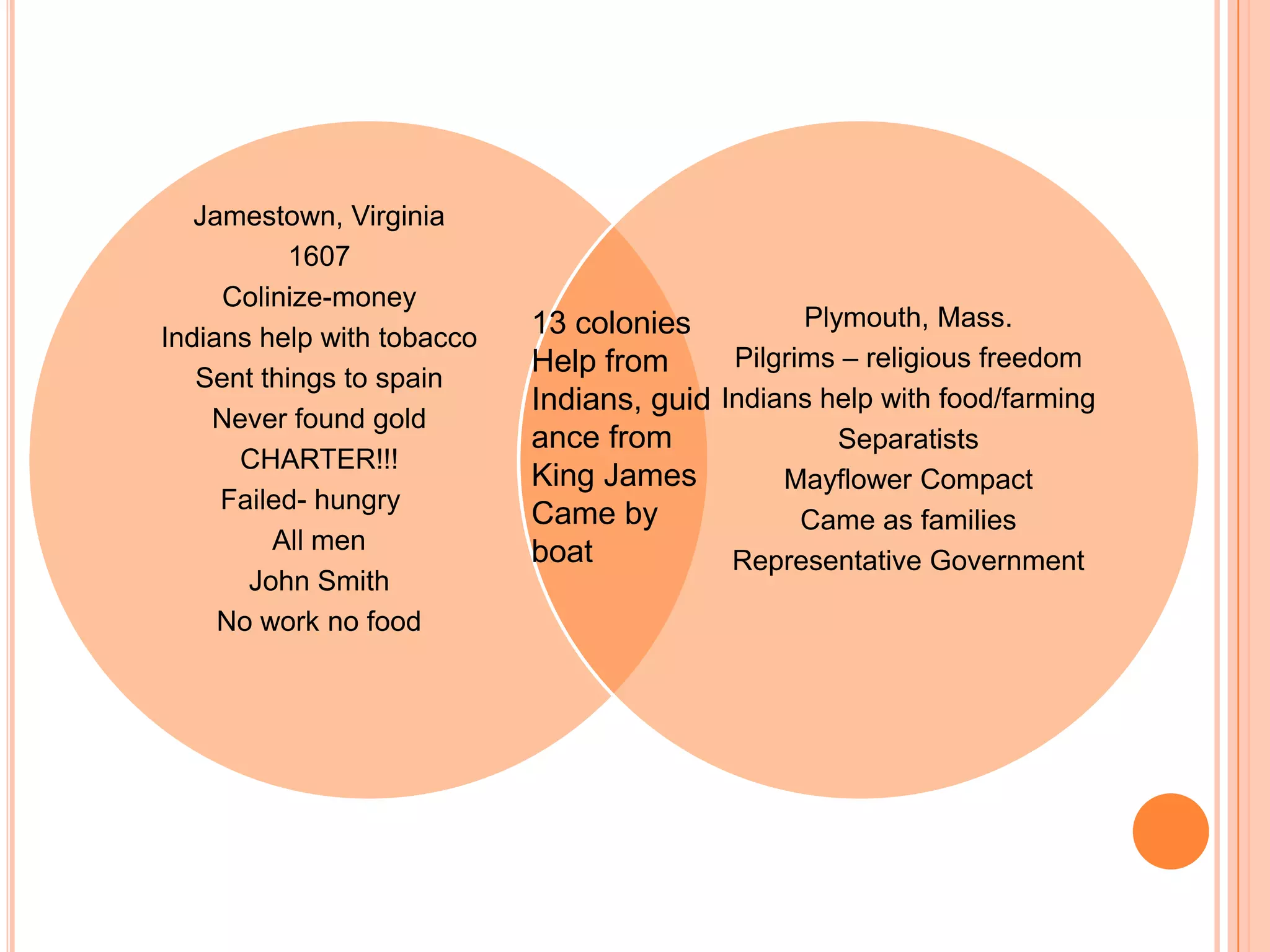
13 coloniesHelp from Indians, guidance from King JamesCame by boat
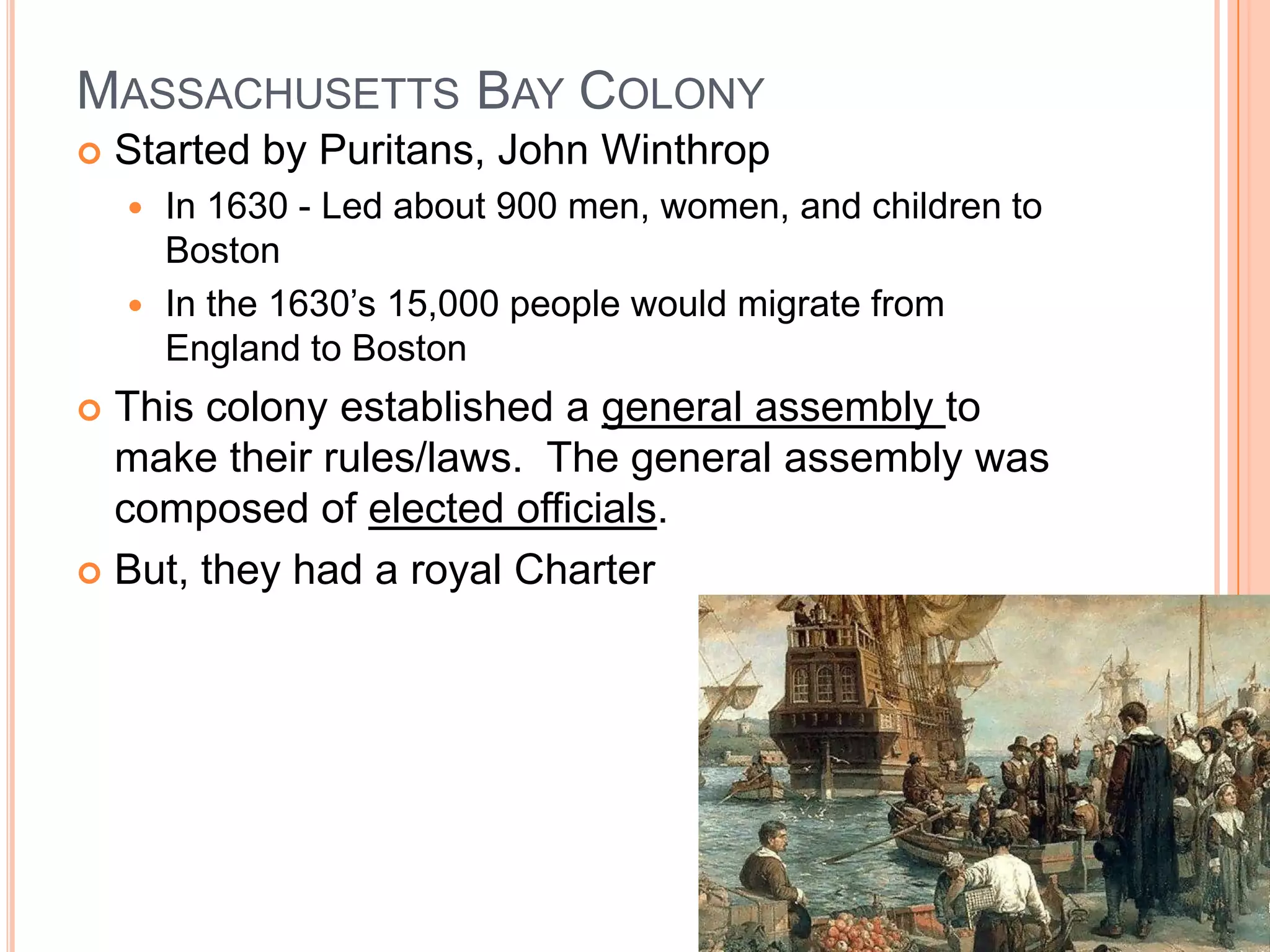
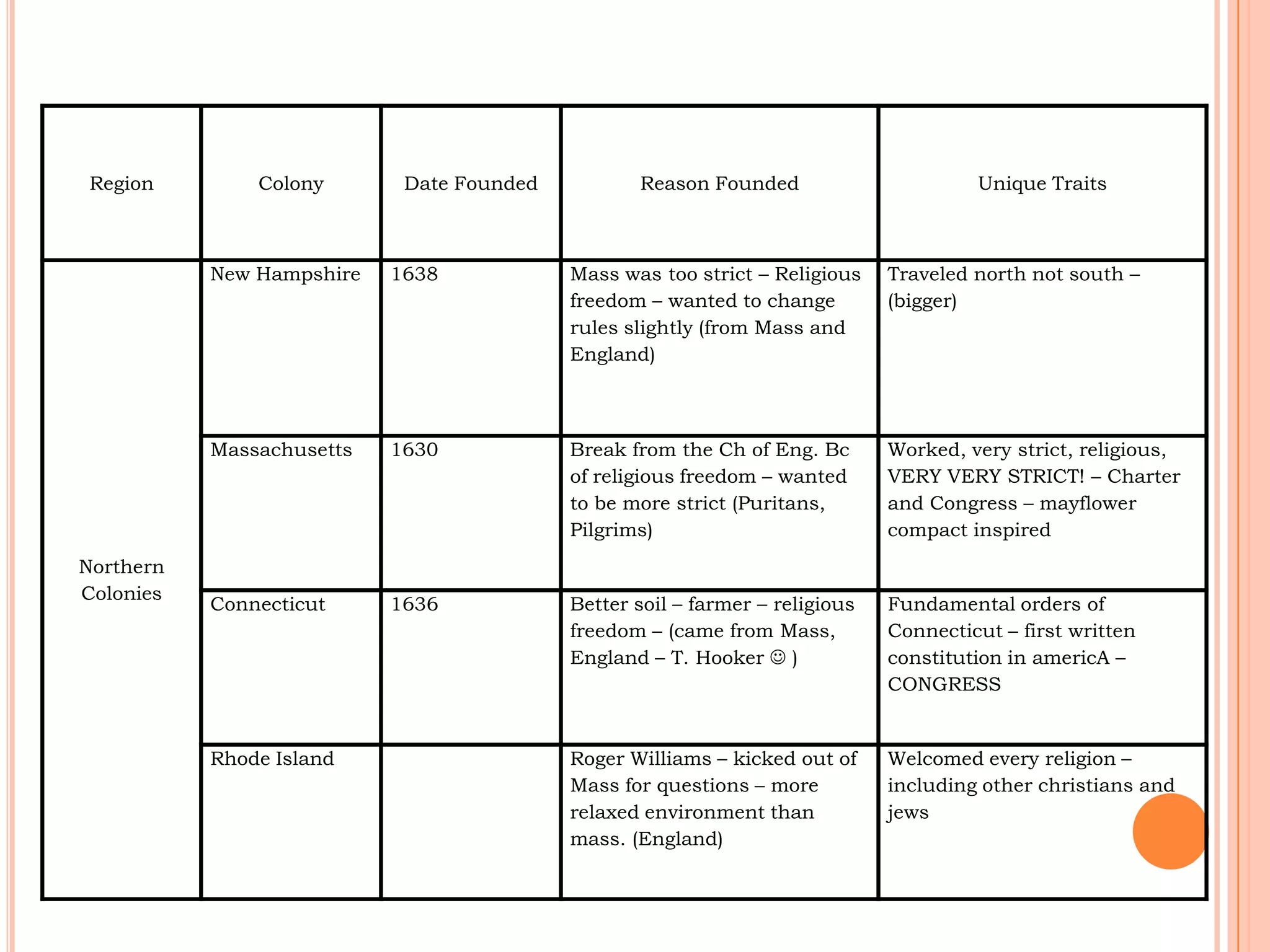
Massachusetts Bay Colony	Started by Puritans, John WinthropIn 1630 - Led about 900 men, women, and children to BostonIn the 1630’s 15,000 people would migrate from England to BostonThis colony established a general assembly to make their rules/laws.  The general assembly was composed of elected officials.But, they had a royal Charter
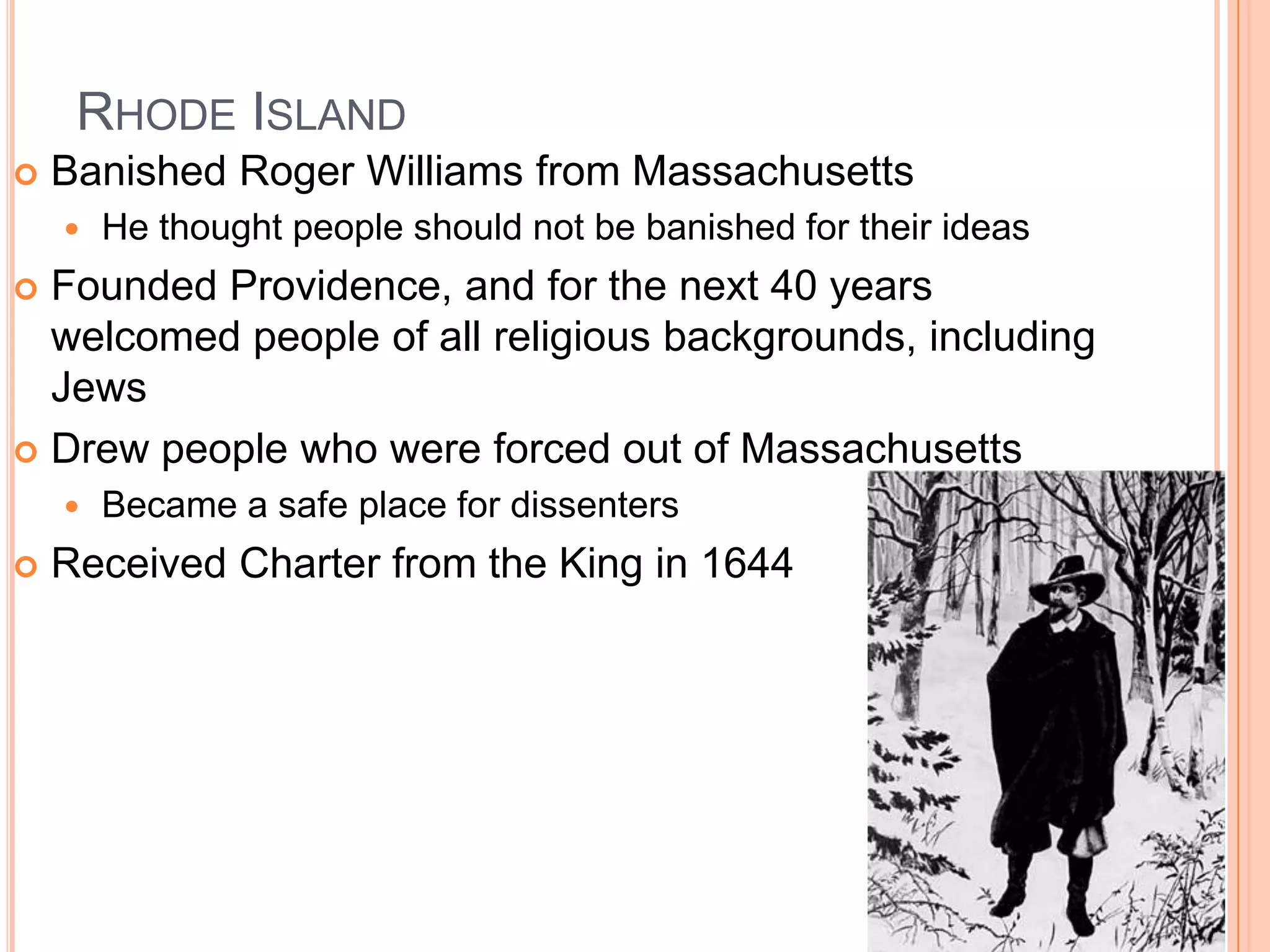
Rhode Island	Banished Roger Williams from MassachusettsHe thought people should not be banished for their ideas Founded Providence, and for the next 40 years welcomed people of all religious backgrounds, including JewsDrew people who were forced out of MassachusettsBecame a safe place for dissentersReceived Charter from the King in 1644
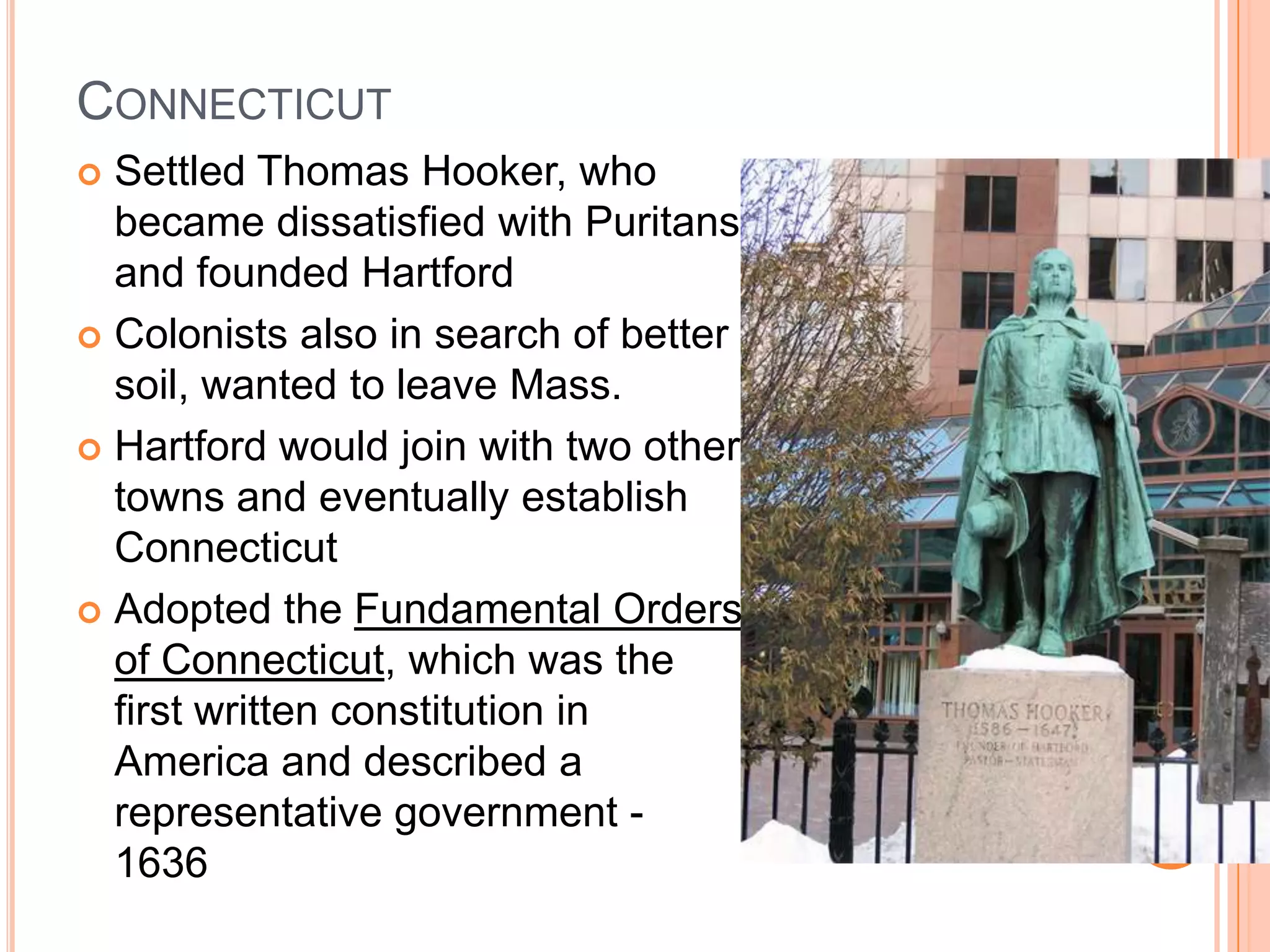
ConnecticutSettled Thomas Hooker, who became dissatisfied with Puritans and founded HartfordColonists also in search of better soil, wanted to leave Mass.Hartford would join with two other towns and eventually establish ConnecticutAdopted the Fundamental Orders of Connecticut, which was the first written constitution in America and described a representative government - 1636
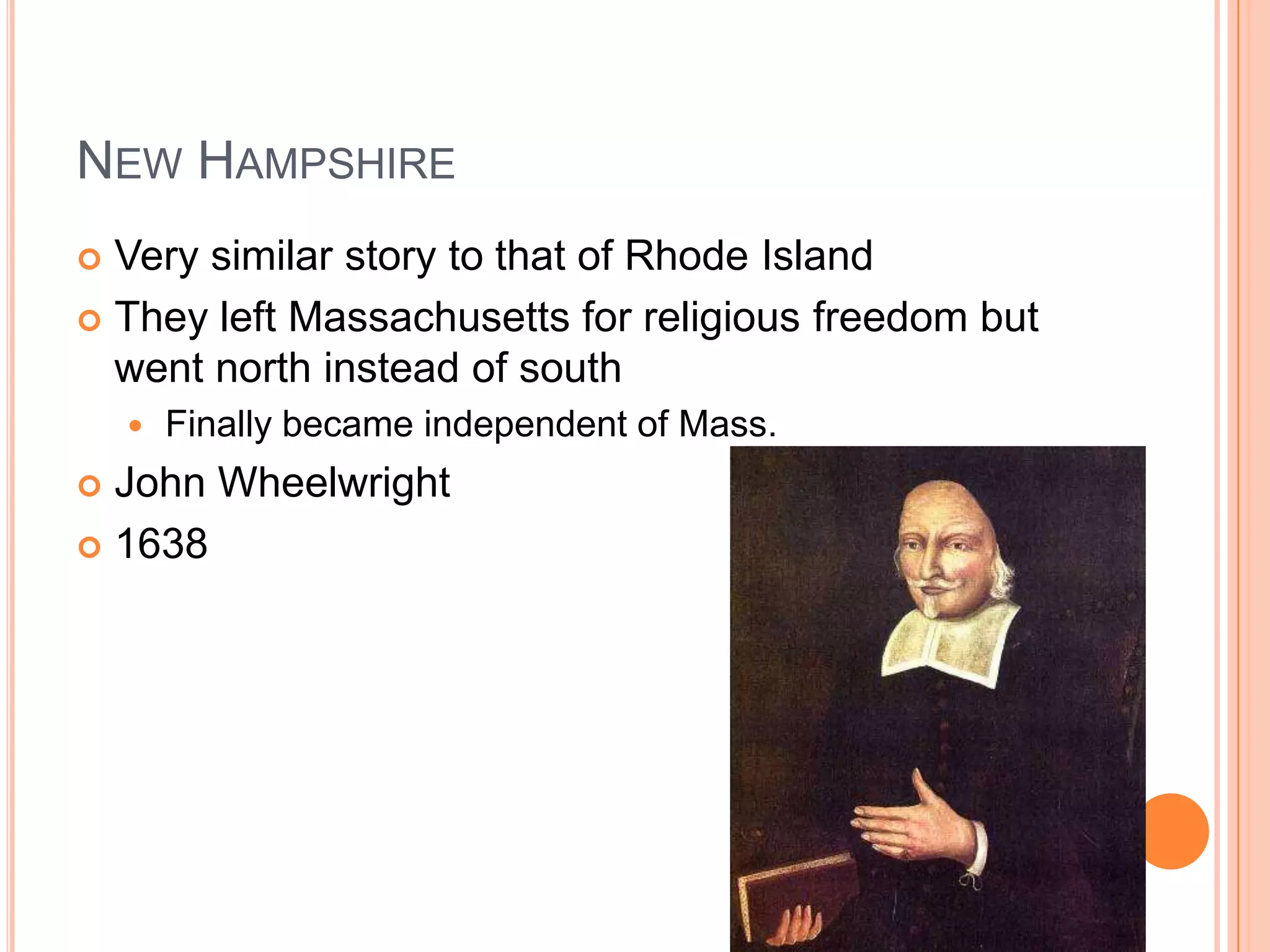
New HampshireVery similar story to that of Rhode IslandThey left Massachusetts for religious freedom but went north instead of southFinally became independent of Mass.  John Wheelwright1638
Conflicts with Natives begins in New England1675 war begins with Wampanoag The colonists would win, now free to expand as far as they wanted
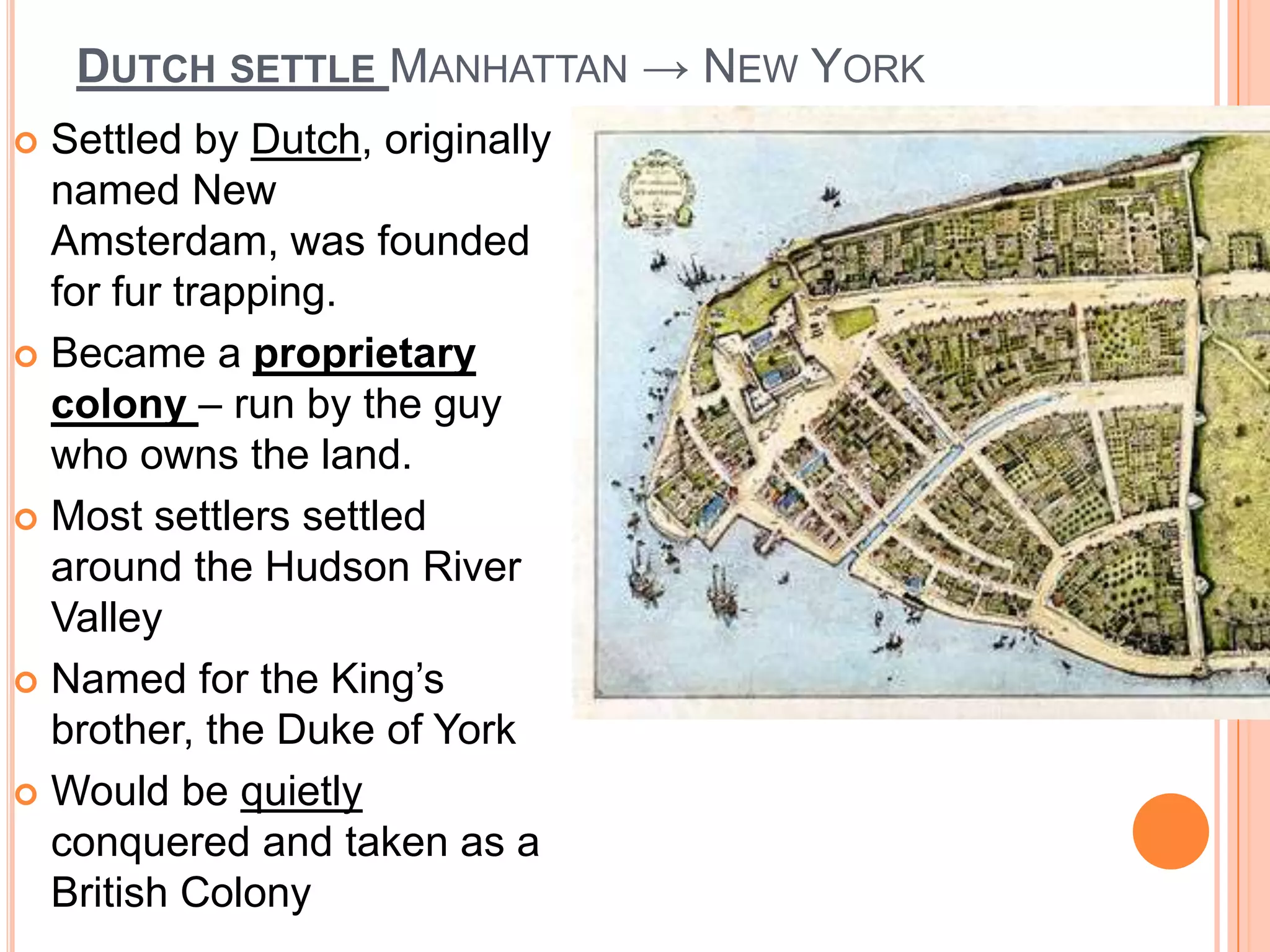
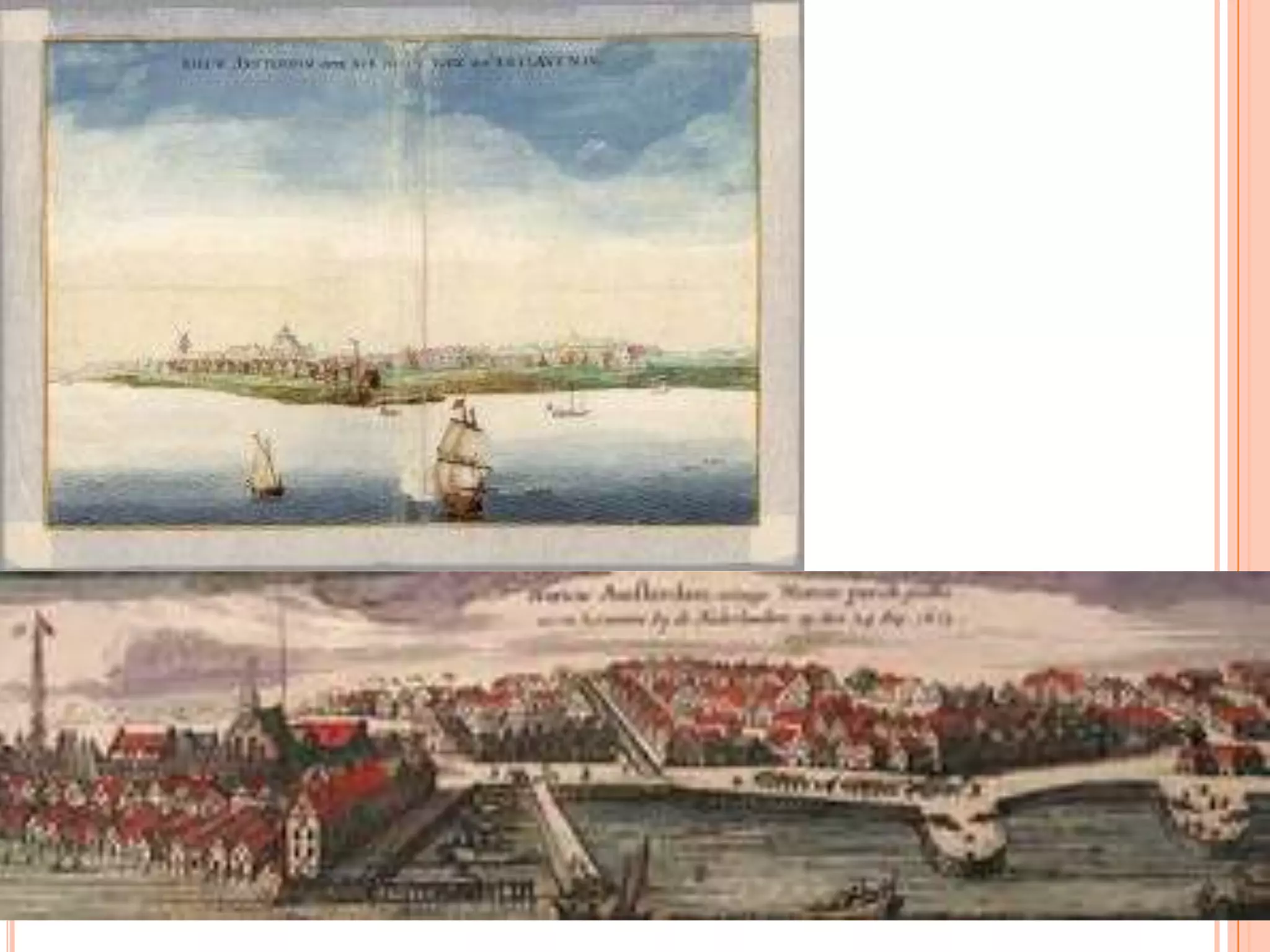
Dutch settle Manhattan -> New York	Settled by Dutch, originally named New Amsterdam, was founded for fur trapping.Became a proprietary colony – run by the guy who owns the land. Most settlers settled around the Hudson River ValleyNamed for the King’s brother, the Duke of YorkWould be quietly conquered and taken as a British Colony
New JerseyThe Duke of York gave the southern part of his colony to two other English nobles.  They named it New Jersey after the island of Jersey in the English Channel where one of the noblemen was born.Also a proprietary colony.  To get people there they gave large tracts of land, promised religious freedom, trial by jury and a representative assembly.  No natural harbors, so did not develop as a major port.
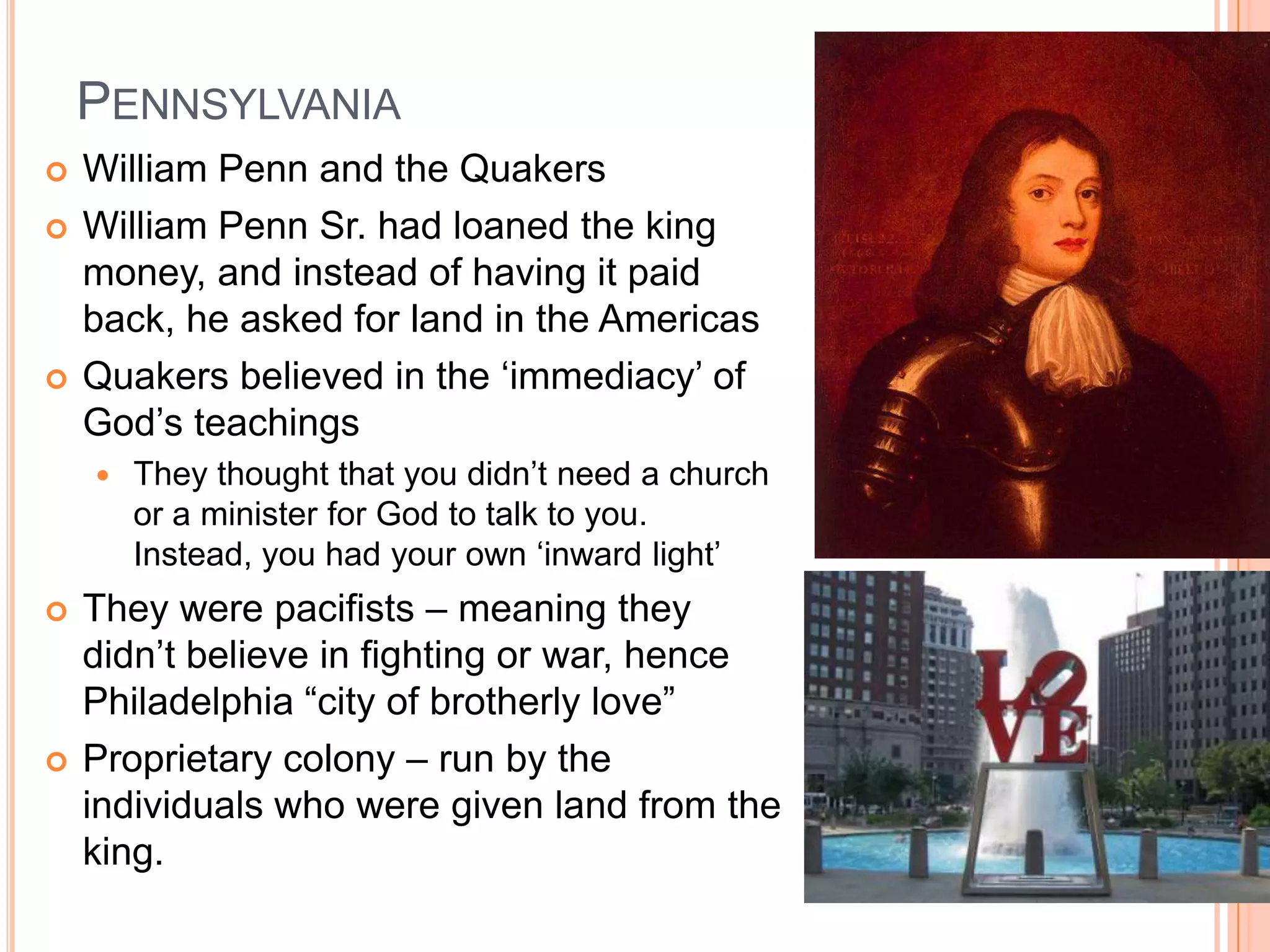
Pennsylvania	William Penn and the QuakersWilliam Penn Sr. had loaned the king money, and instead of having it paid back, he asked for land in the AmericasQuakers believed in the ‘immediacy’ of God’s teachingsThey thought that you didn’t need a church or a minister for God to talk to you.  Instead, you had your own ‘inward light’They were pacifists – meaning they didn’t believe in fighting or war, hence Philadelphia “city of brotherly love”Proprietary colony – run by the individuals who were given land from the king.
DelawareWas originally the southern tip of PennsylvaniaSettled by Swedes and DutchThe Charter of Privileges, allowed them to form their own legislature and from then on became known as their own colony.Another proprietary colony. Report to Governor of Pennsylvania
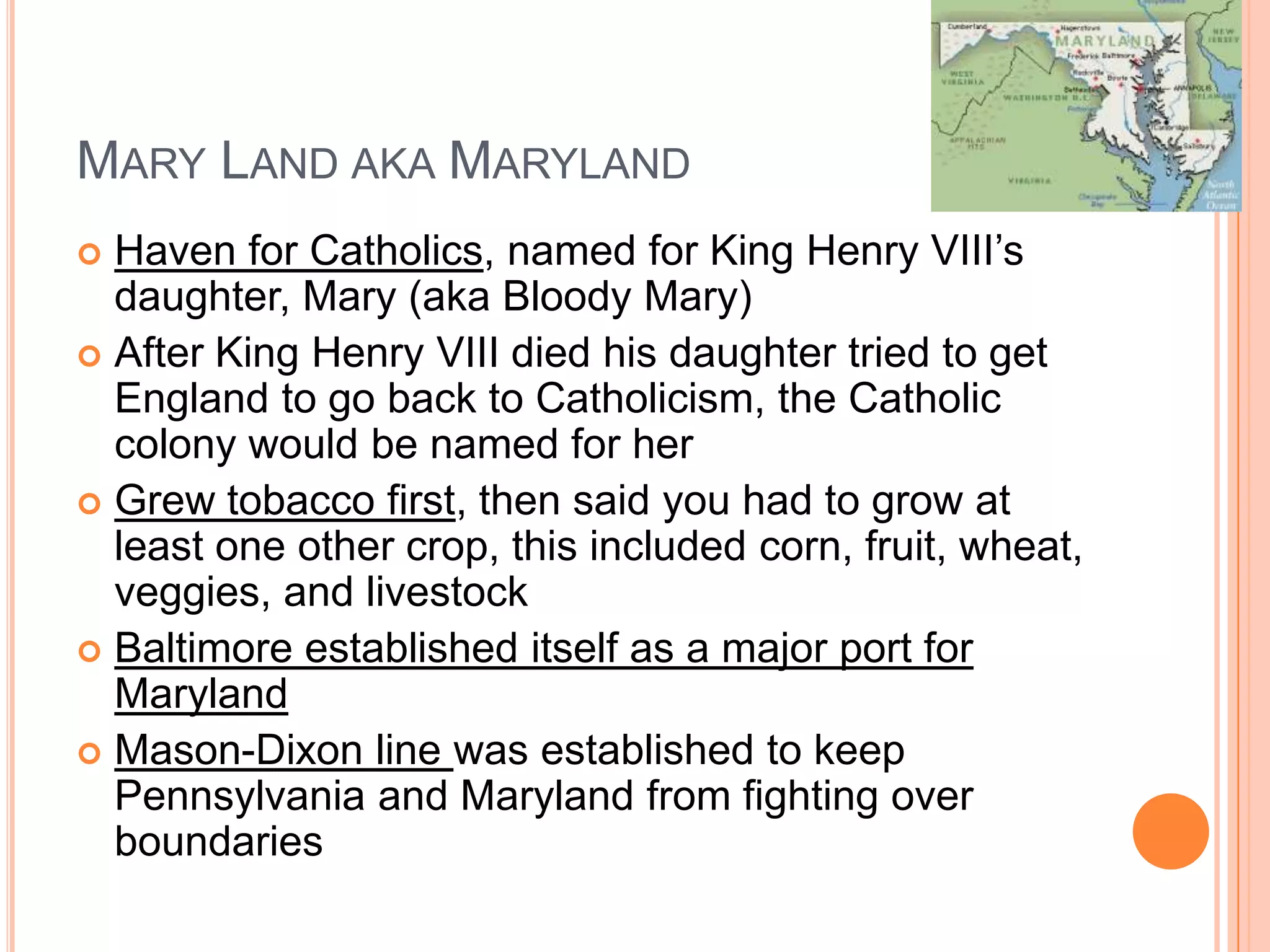
Mary Land aka MarylandHaven for Catholics, named for King Henry VIII’s daughter, Mary (aka Bloody Mary)After King Henry VIII died his daughter tried to get England to go back to Catholicism, the Catholic colony would be named for her Grew tobacco first, then said you had to grow at least one other crop, this included corn, fruit, wheat, veggies, and livestockBaltimore established itself as a major port for MarylandMason-Dixon line was established to keep Pennsylvania and Maryland from fighting over boundaries
VirginiaStarted with JamestownBacon’s Rebellion: attacked Native Americans and burnt down Jamestown – land disputewould have taken charge of Virginia, but died
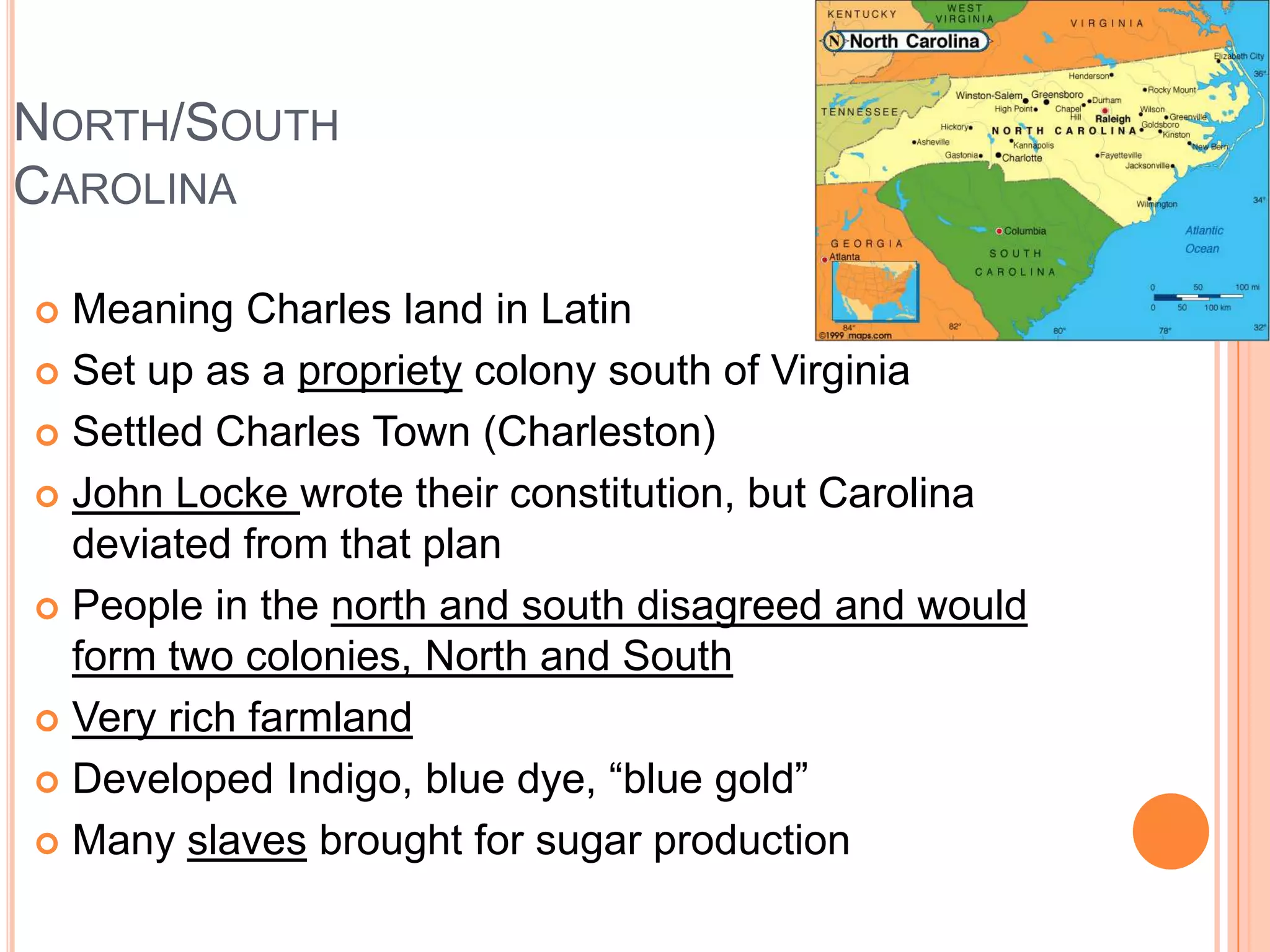
North/South CarolinaMeaning Charles land in LatinSet up as a propriety colony south of VirginiaSettled Charles Town (Charleston)John Locke wrote their constitution, but Carolina deviated from that planPeople in the north and south disagreed and would form two colonies, North and SouthVery rich farmlandDeveloped Indigo, blue dye, “blue gold”Many slaves brought for sugar production
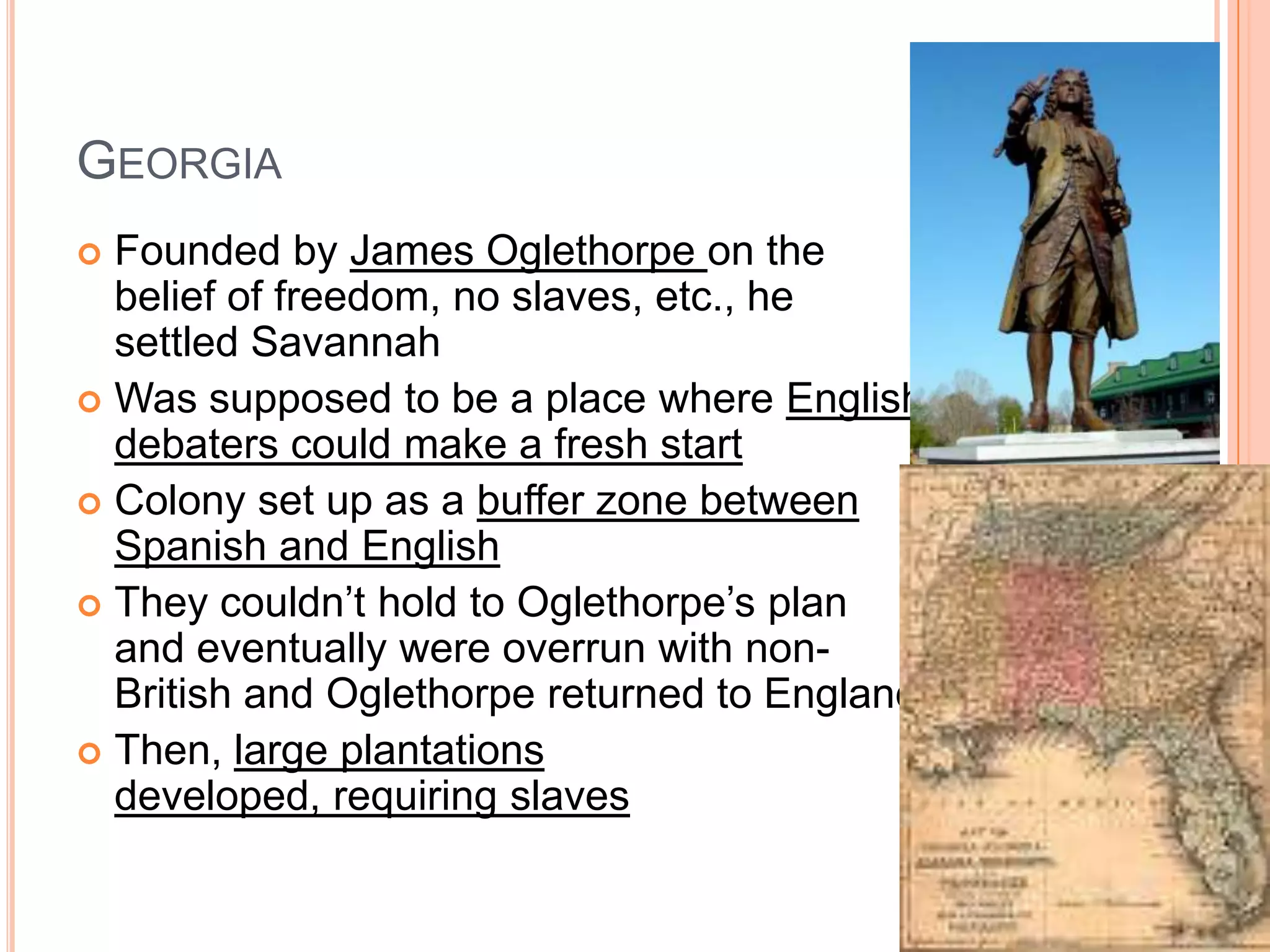
Georgia Founded by James Oglethorpe on the belief of freedom, no slaves, etc., he settled SavannahWas supposed to be a place where English debaters could make a fresh startColony set up as a buffer zone between Spanish and EnglishThey couldn’t hold to Oglethorpe’s plan and eventually were overrun with non-British and Oglethorpe returned to EnglandThen, large plantations developed, requiring slaves
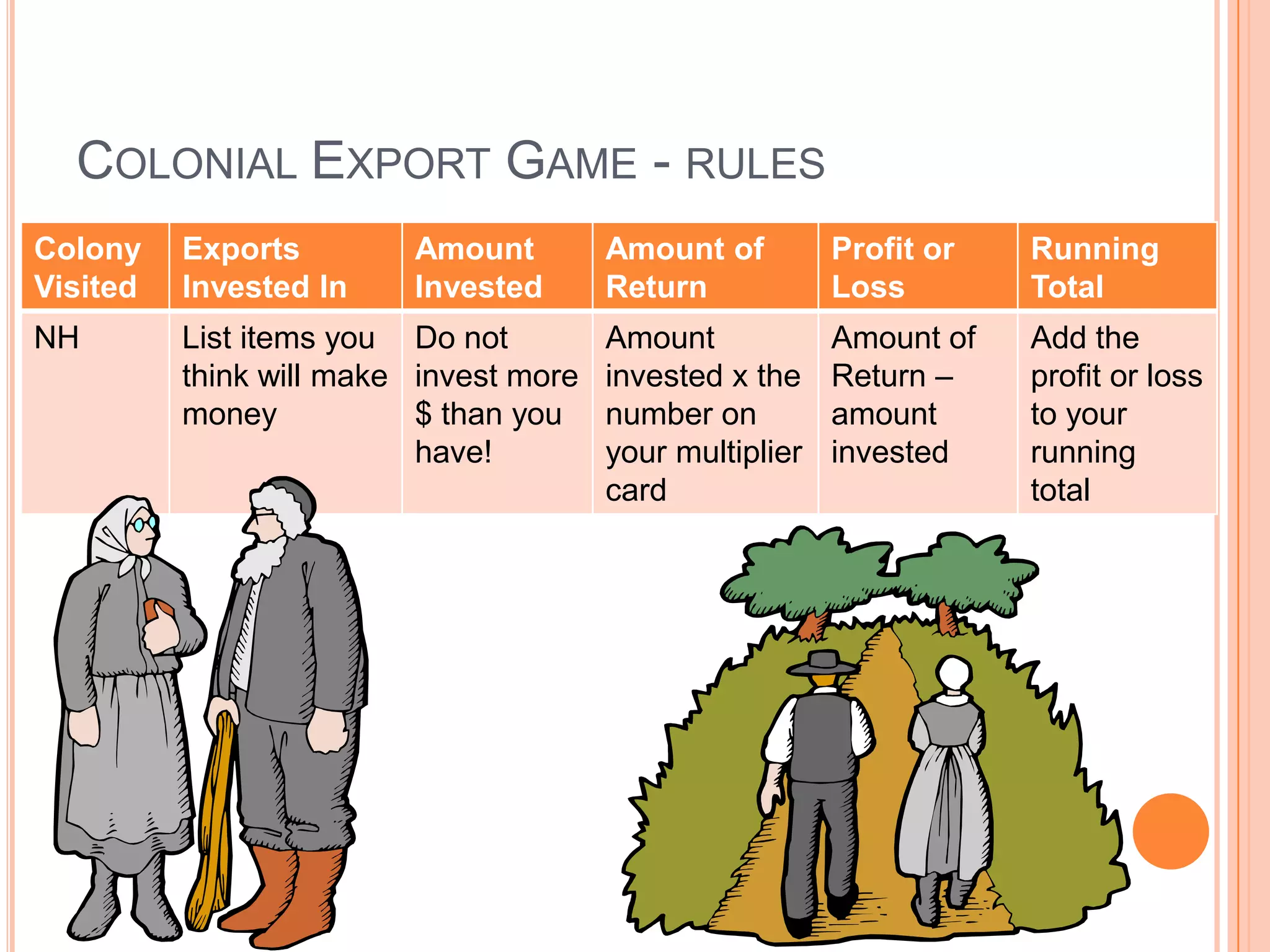
Colonial Export Game - rules
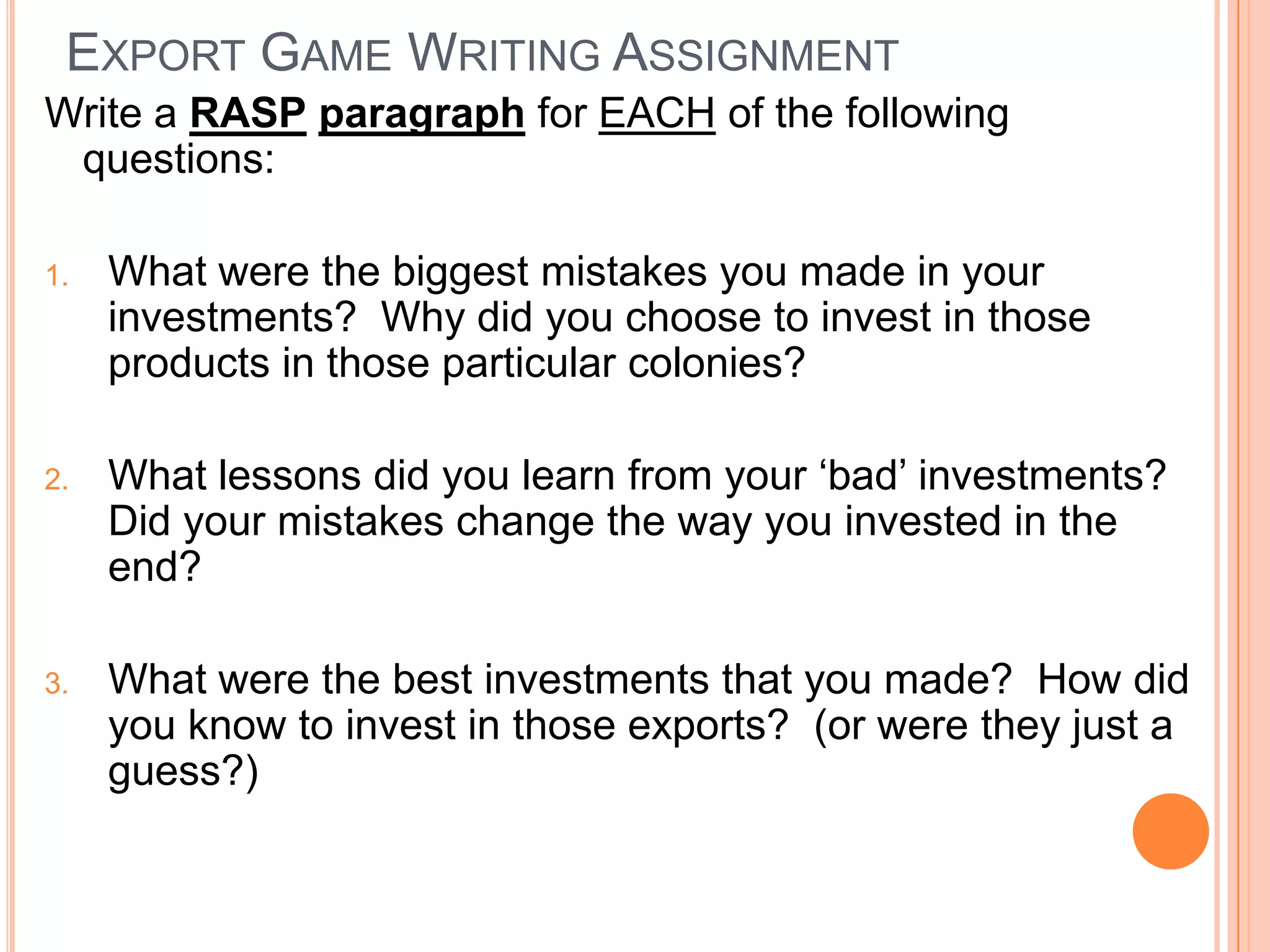
Export Game Writing AssignmentWrite a RASPparagraph for EACH of the following questions:What were the biggest mistakes you made in your investments?  Why did you choose to invest in those products in those particular colonies?What lessons did you learn from your ‘bad’ investments?  Did your mistakes change the way you invested in the end?What were the best investments that you made?  How did you know to invest in those exports?  (or were they just a guess?)
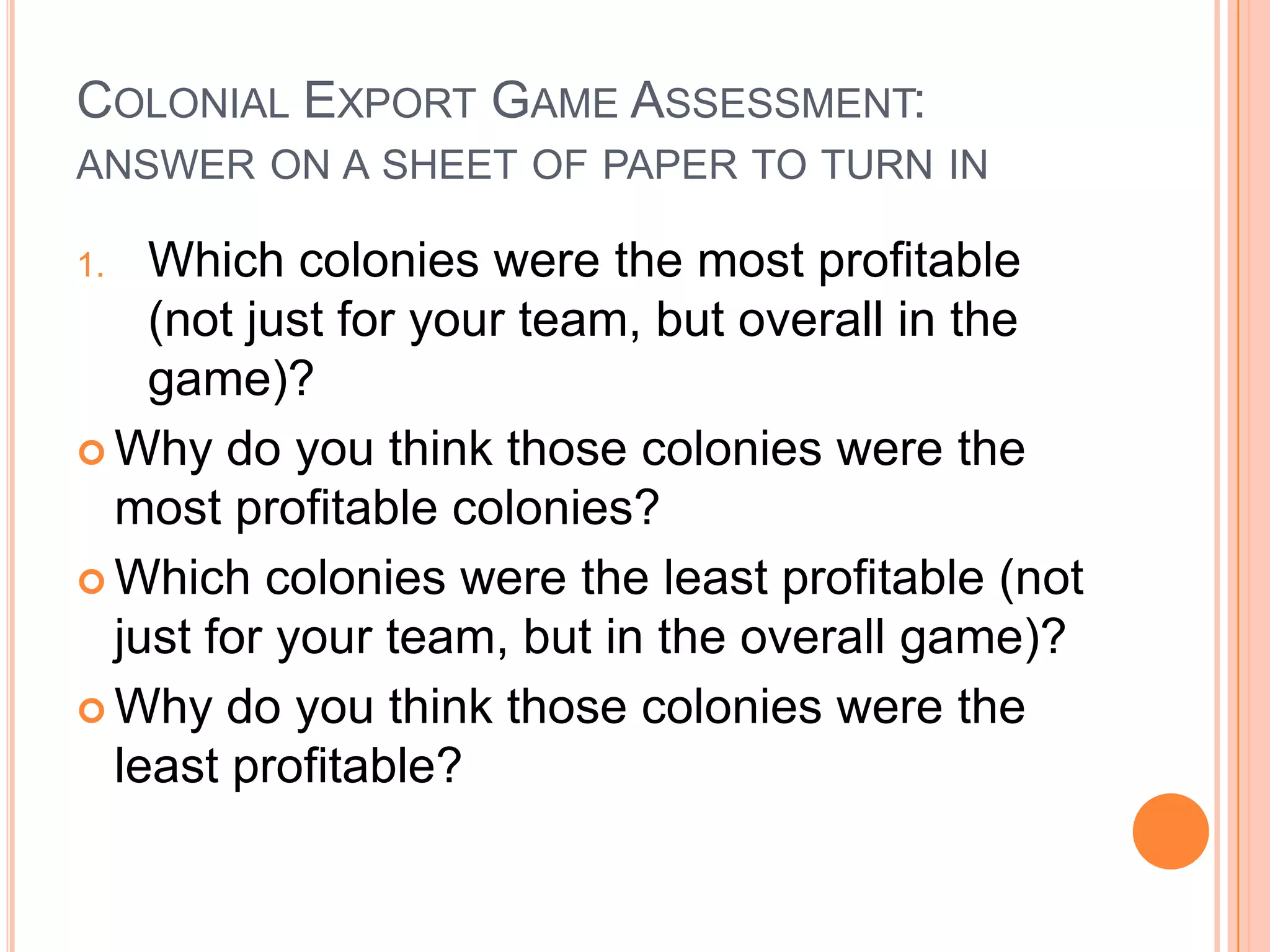
Colonial Export Game Assessment:answer on a sheet of paper to turn in Which colonies were the most profitable (not just for your team, but overall in the game)?Why do you think those colonies were the most profitable colonies?Which colonies were the least profitable (not just for your team, but in the overall game)?Why do you think those colonies were the least profitable?
IOC Votes Today:
Southern Colony Border Wars
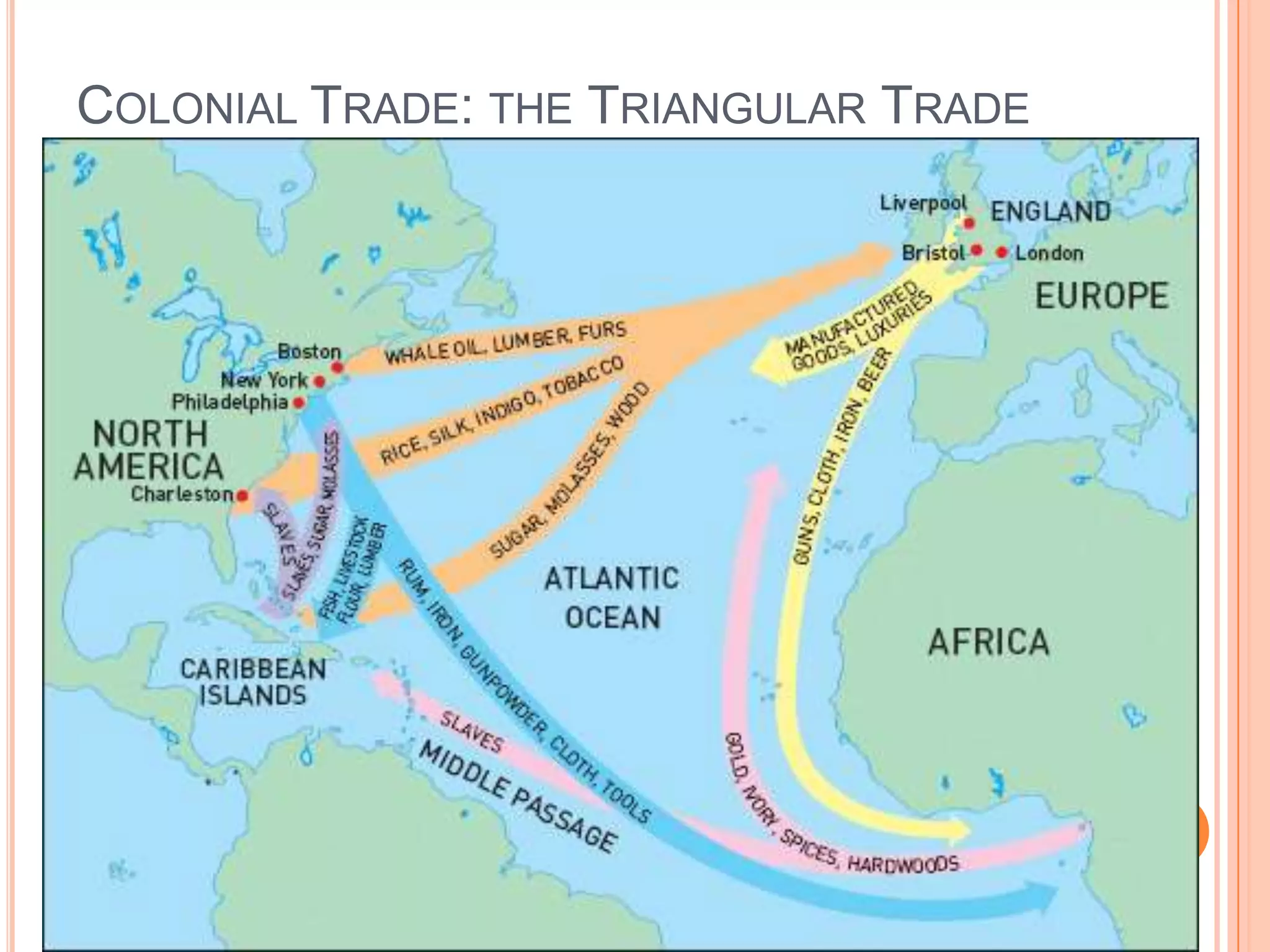
Colonial Trade: the Triangular Trade
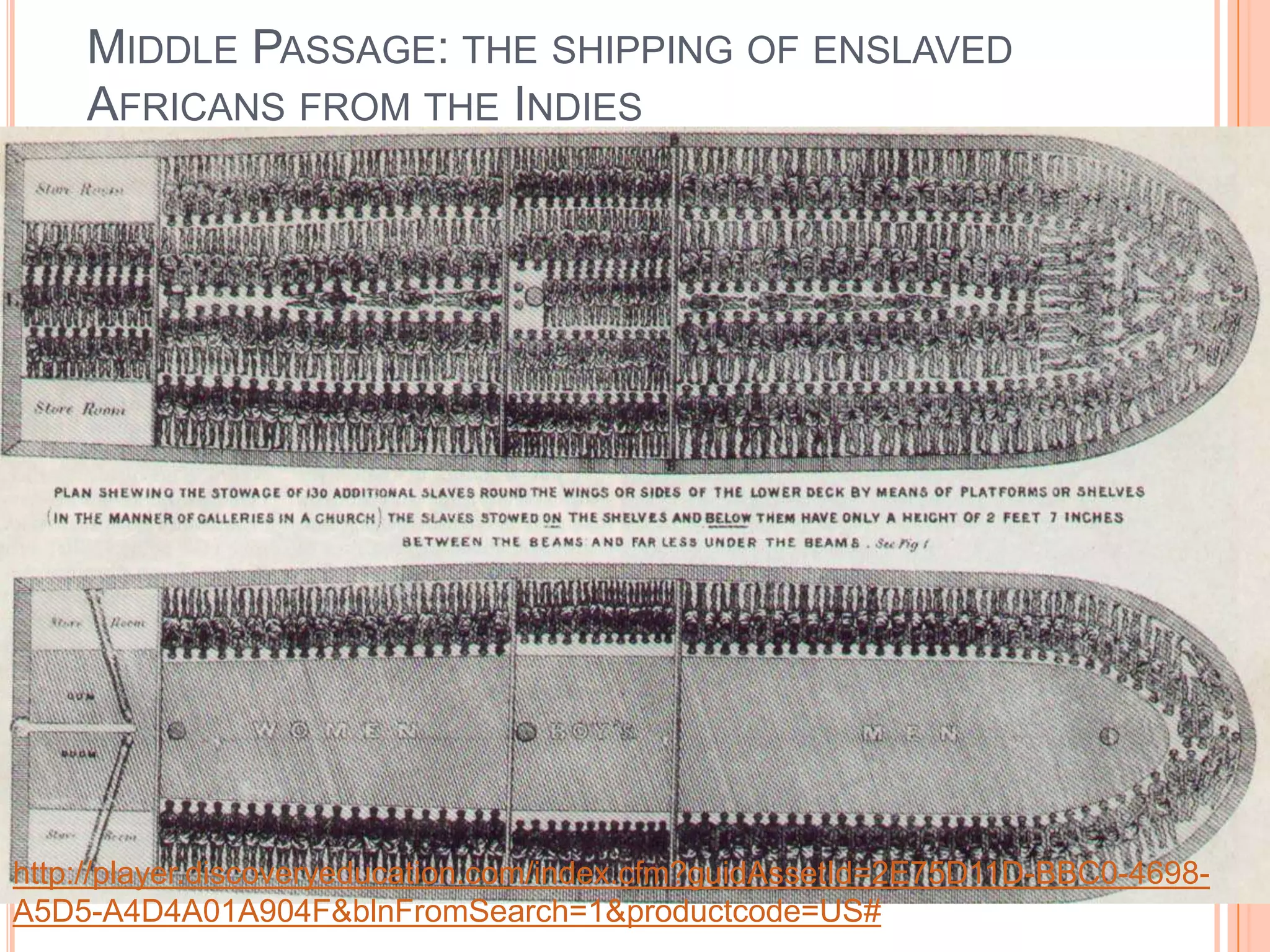
Middle Passage: the shipping of enslaved Africans from the Indieshttp://player.discoveryeducation.com/index.cfm?guidAssetId=2E75D11D-BBC0-4698-A5D5-A4D4A01A904F&blnFromSearch=1&productcode=US#
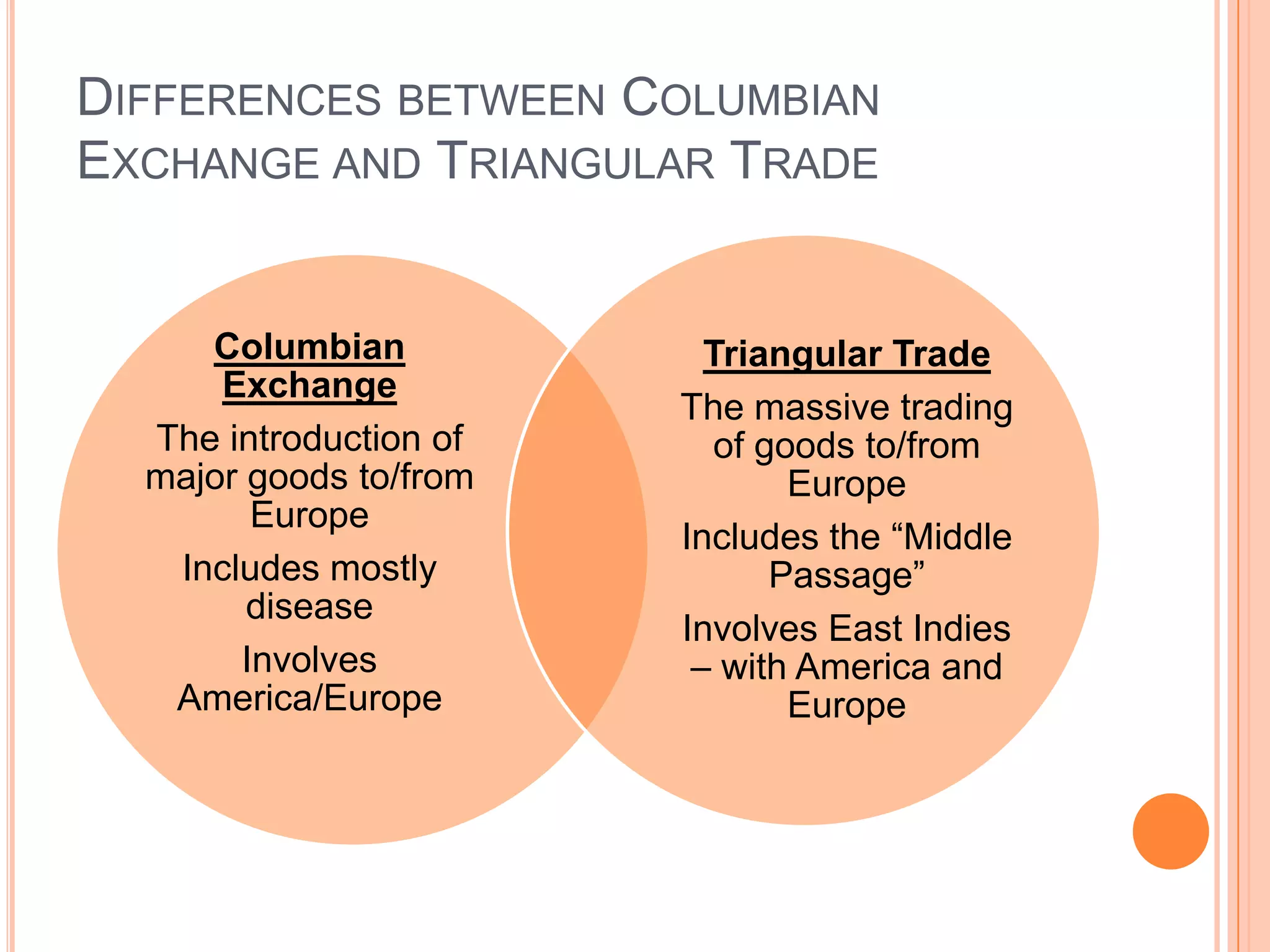
Differences between Columbian Exchange and Triangular Trade
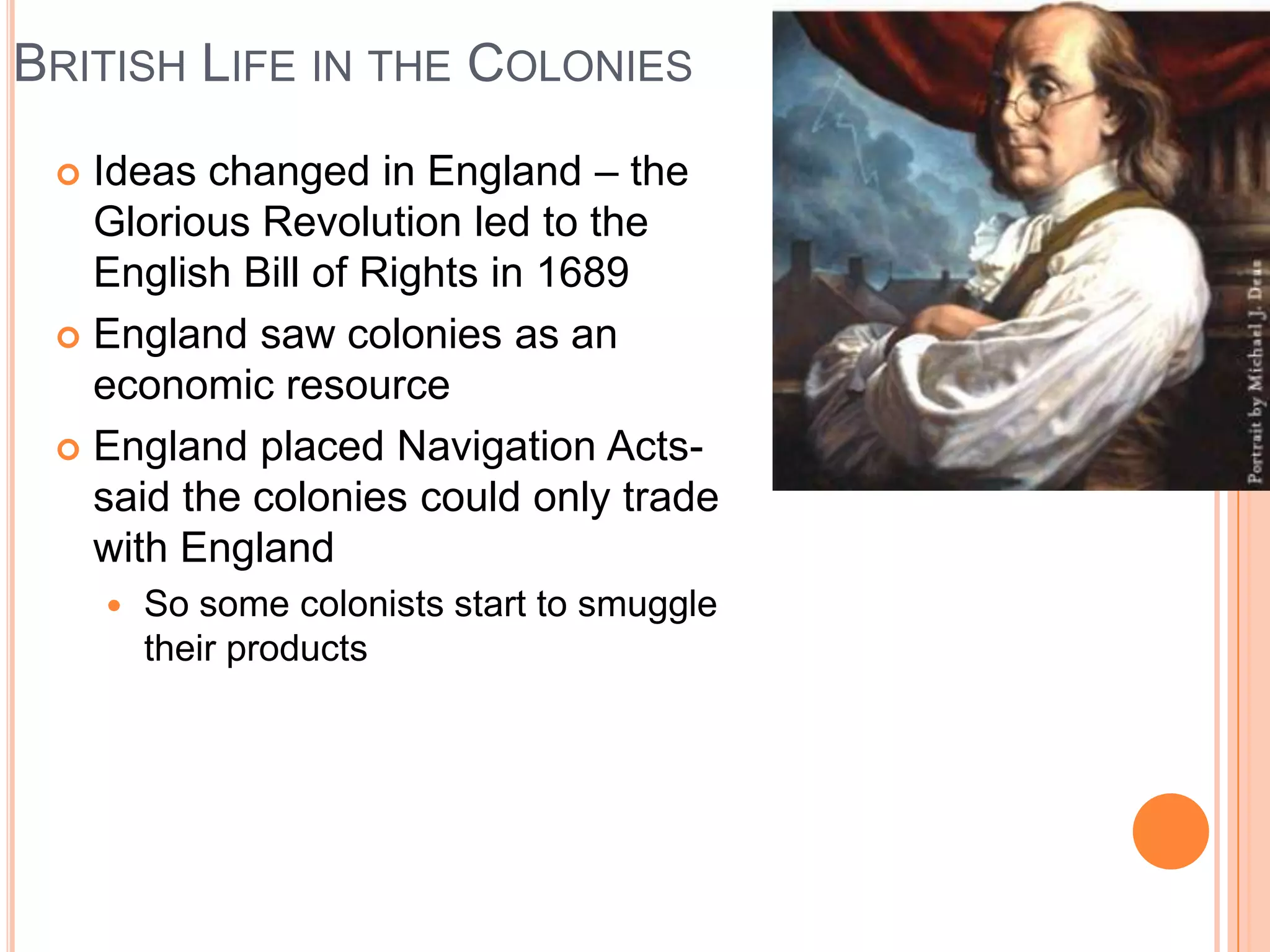
British Life in the ColoniesIdeas changed in England – the Glorious Revolution led to the English Bill of Rights in 1689England saw colonies as an economic resourceEngland placed Navigation Acts- said the colonies could only trade with EnglandSo some colonists start to smuggle their products
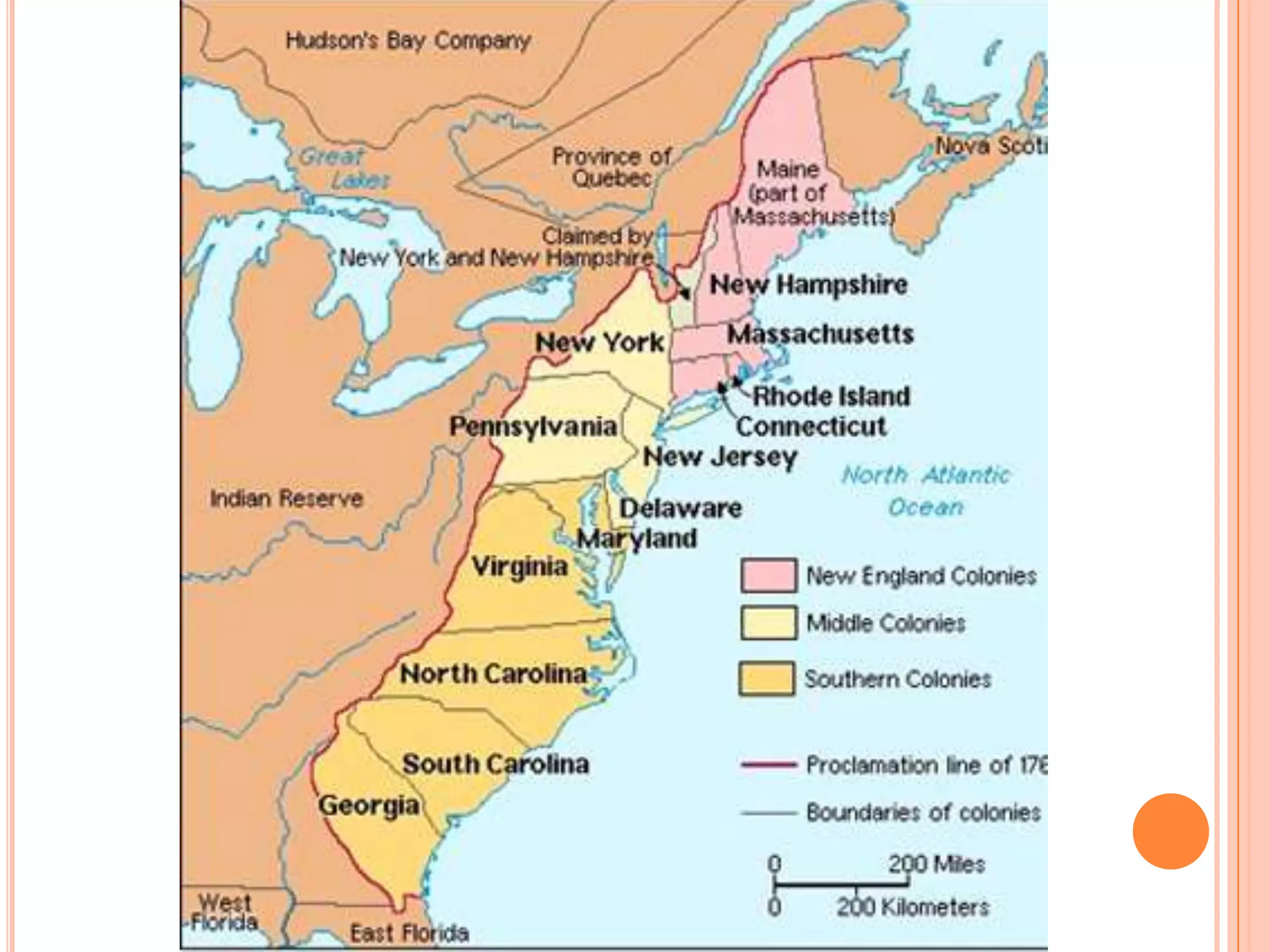
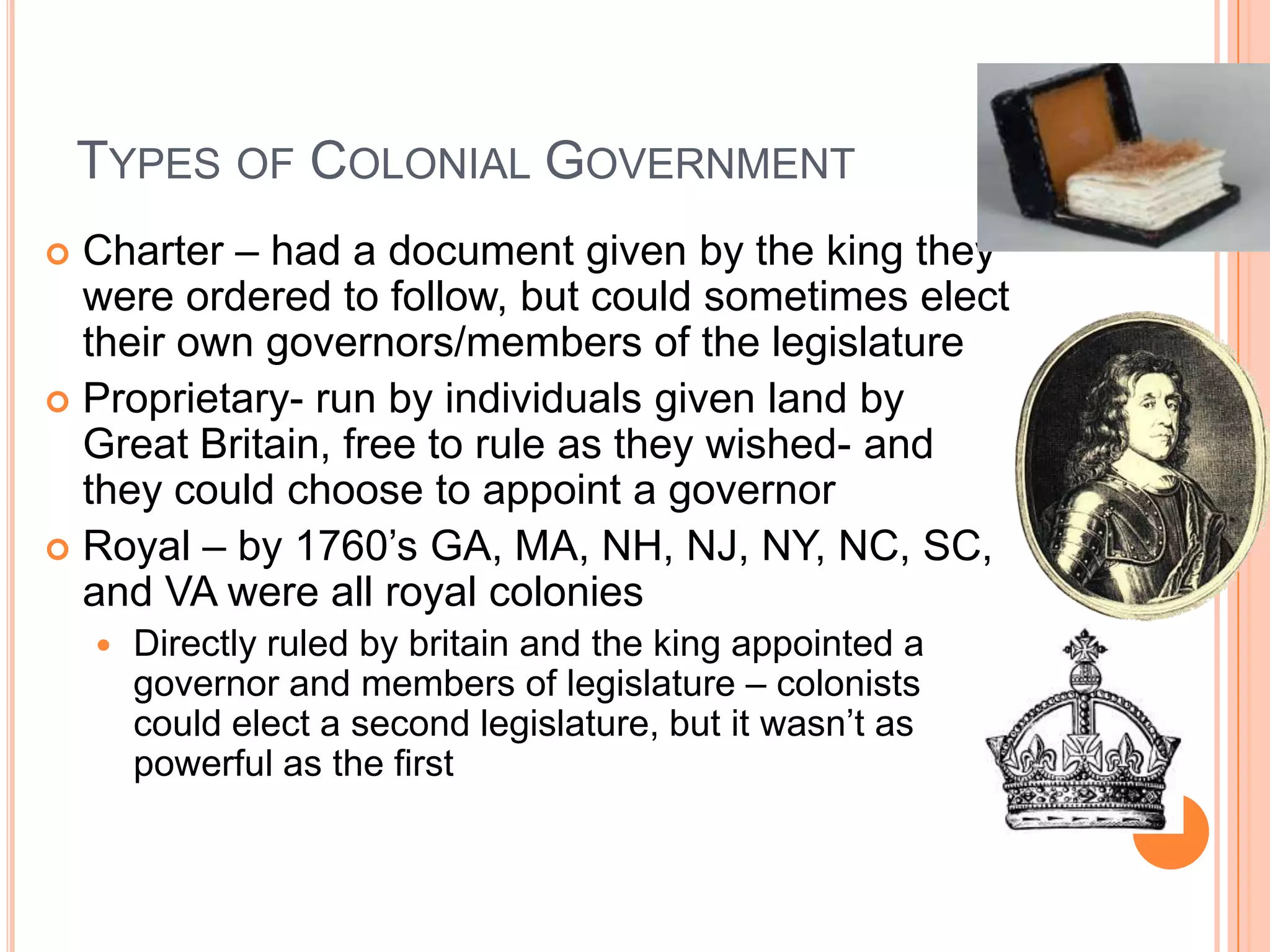
Types of Colonial Government	Charter – had a document given by the king they were ordered to follow, but could sometimes elect their own governors/members of the legislatureProprietary- run by individuals given land by Great Britain, free to rule as they wished- and they could choose to appoint a governorRoyal – by 1760’s GA, MA, NH, NJ, NY, NC, SC, and VA were all royal coloniesDirectly ruled by britain and the king appointed a governor and members of legislature – colonists could elect a second legislature, but it wasn’t as powerful as the first
Its important to understand:Up to this point, the colonists still considered themselves Englishmen first, then Virginians/New Englanders, etc.  They never would have considered themselves AmericanWhy? Because England was still defending them and buying their goods and supporting themAgainst Who you may ask?...The French!! – we have already talked about the long standing rivalry between the French and the English, here it is again…
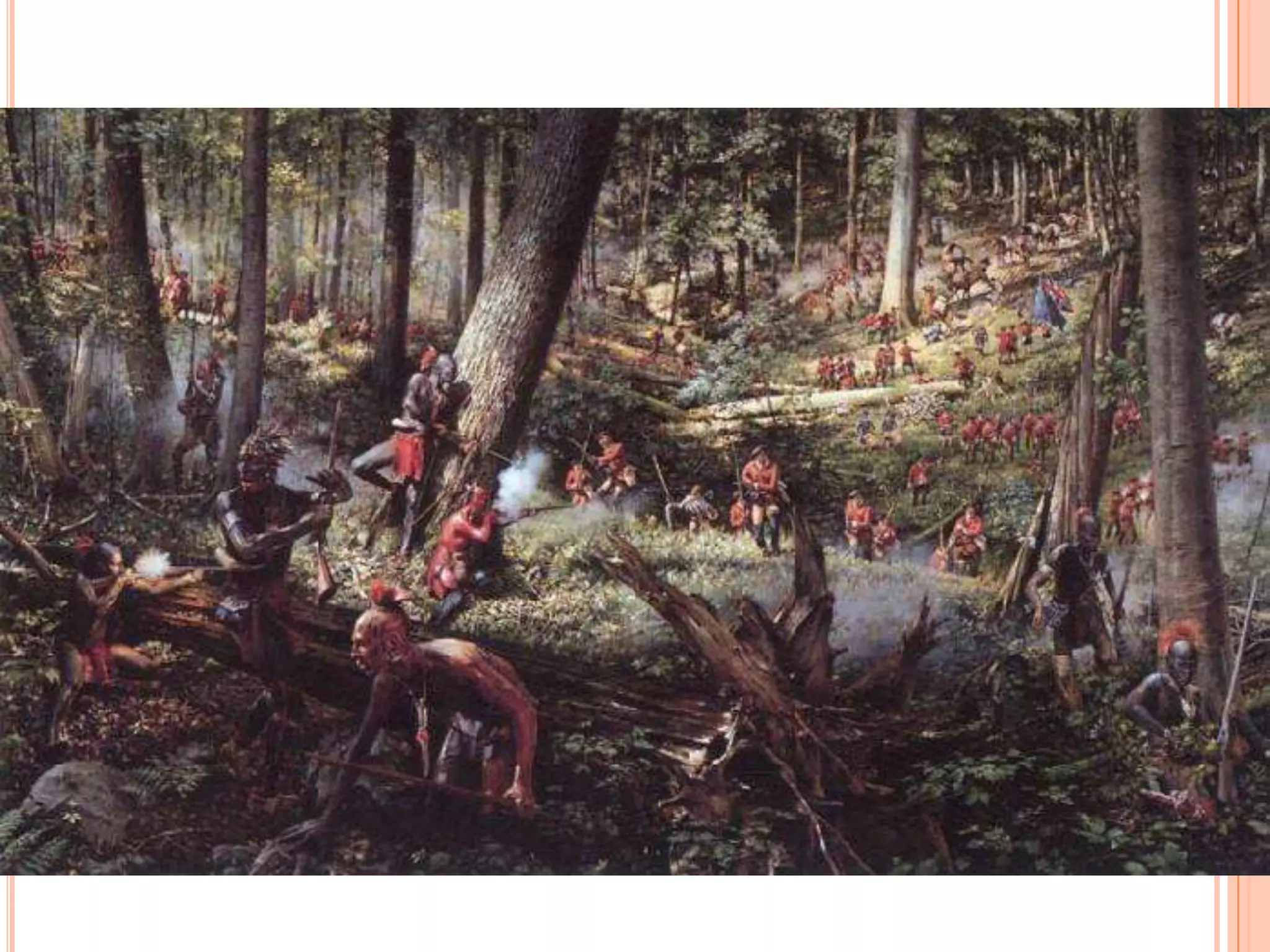
New France unites the ColoniesFrench Louisiana, named for King Louis XIII, French, who started in Canada, would travel down the Mississippi river and claim all the land they found for France, when this happened Spanish moved to the southeastFrance came to convert the Native Americans to Catholicism, but learned their languages, did not ask them to change their traditions, and grew slowly so they did not kick Indians off their landAttacks from France would unite the colonies
French and Indian War…
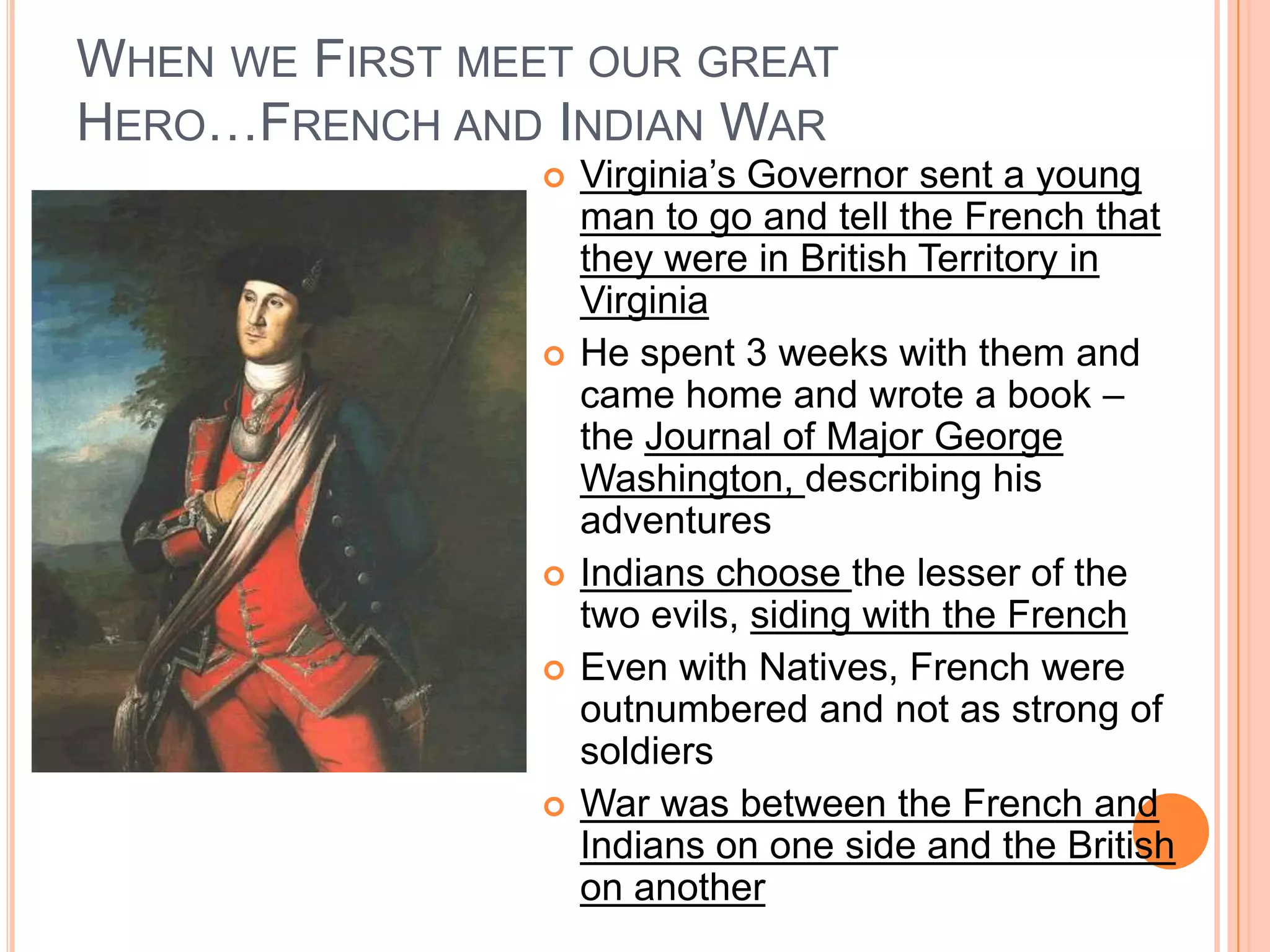
When we First meet our great Hero…French and Indian WarVirginia’s Governor sent a young man to go and tell the French that they were in British Territory in VirginiaHe spent 3 weeks with them and came home and wrote a book – the Journal of Major George Washington, describing his adventuresIndians choose the lesser of the two evils, siding with the FrenchEven with Natives, French were outnumbered and not as strong of soldiersWar was between the French and Indians on one side and the British on another
France and Britain Clash: What we already Know“America was a pawn in a larger chess game”Kenneth C. DavisThe British and the French have a long standing RivilaryLittle “wars” have been going on in the colonies between the British and the FrenchKing Williams WarQueen Anne’s WarKing George’s WarFrance and Britain Clash: New Information
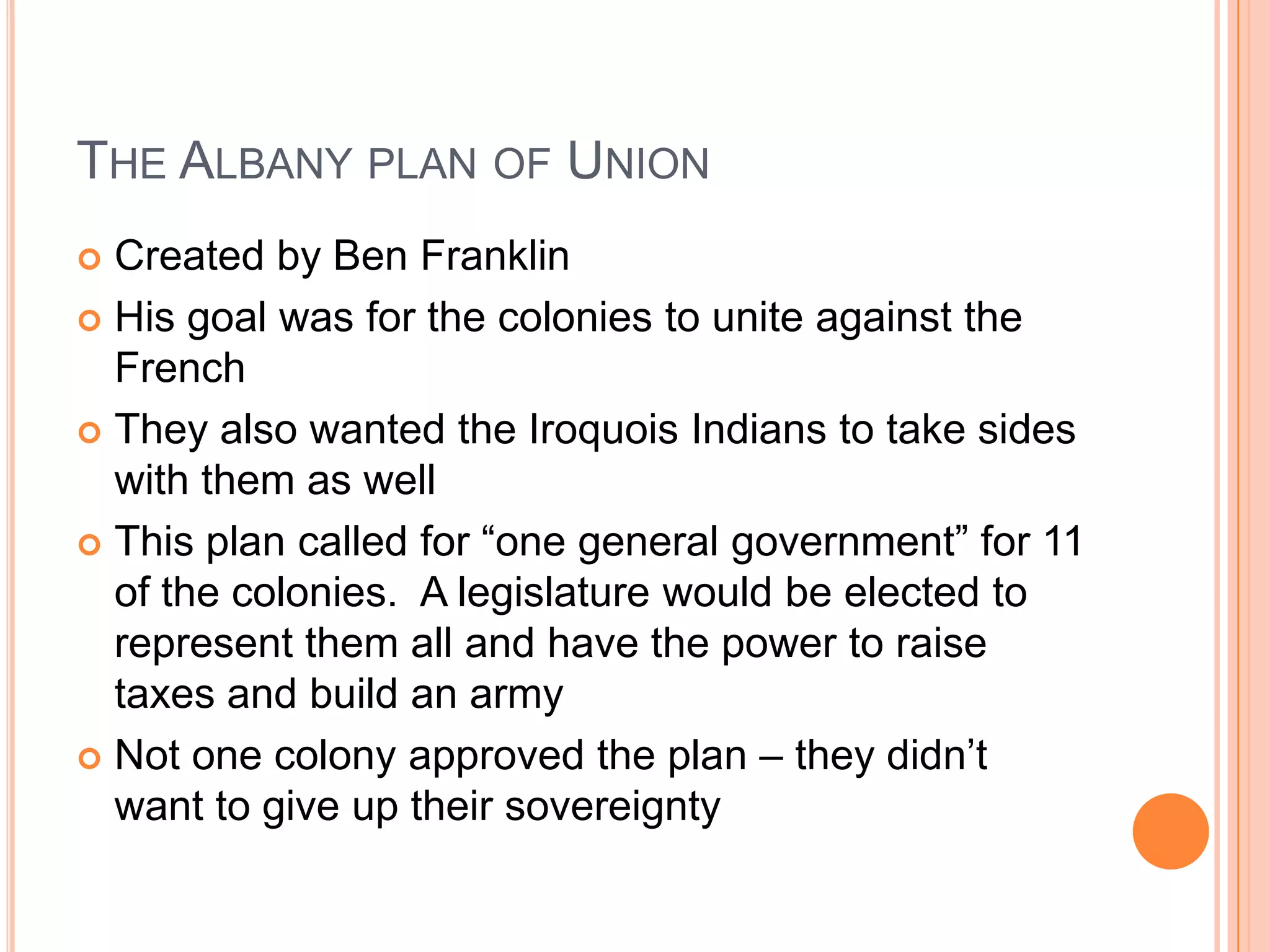
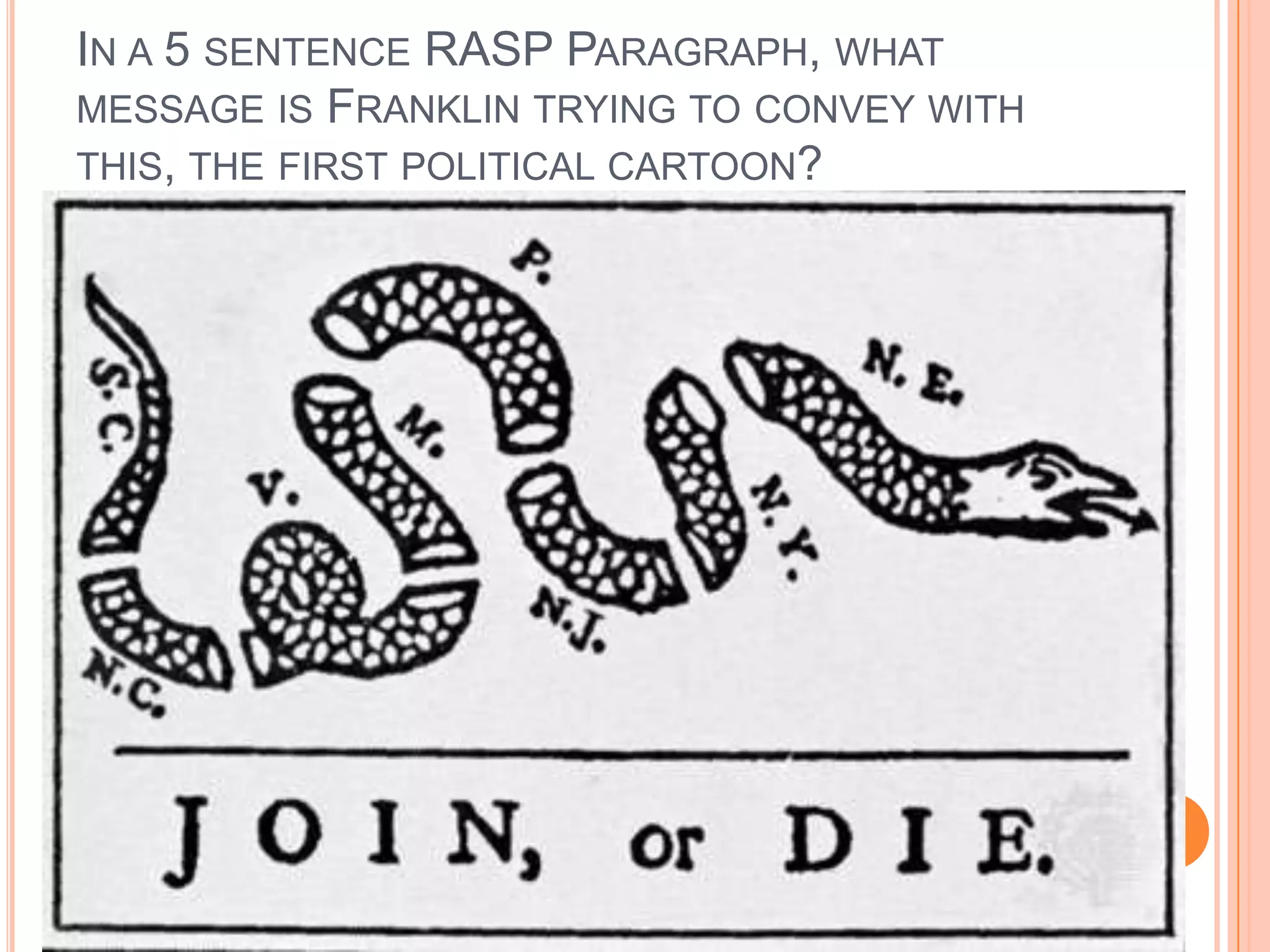
The Albany plan of UnionCreated by Ben FranklinHis goal was for the colonies to unite against the FrenchThey also wanted the Iroquois Indians to take sides with them as wellThis plan called for “one general government” for 11 of the colonies.  A legislature would be elected to represent them all and have the power to raise taxes and build an armyNot one colony approved the plan – they didn’t want to give up their sovereignty
In a 5 sentence RASP Paragraph, what message is Franklin trying to convey with this, the first political cartoon?
GB declares war on FranceThe Seven Years War is fought in Europe and in the coloniesFor the first 4 years, GB and colonies lose, but a new British general takes charge and turns things around…Eventually, New France falls in 1759 for a British Victory!
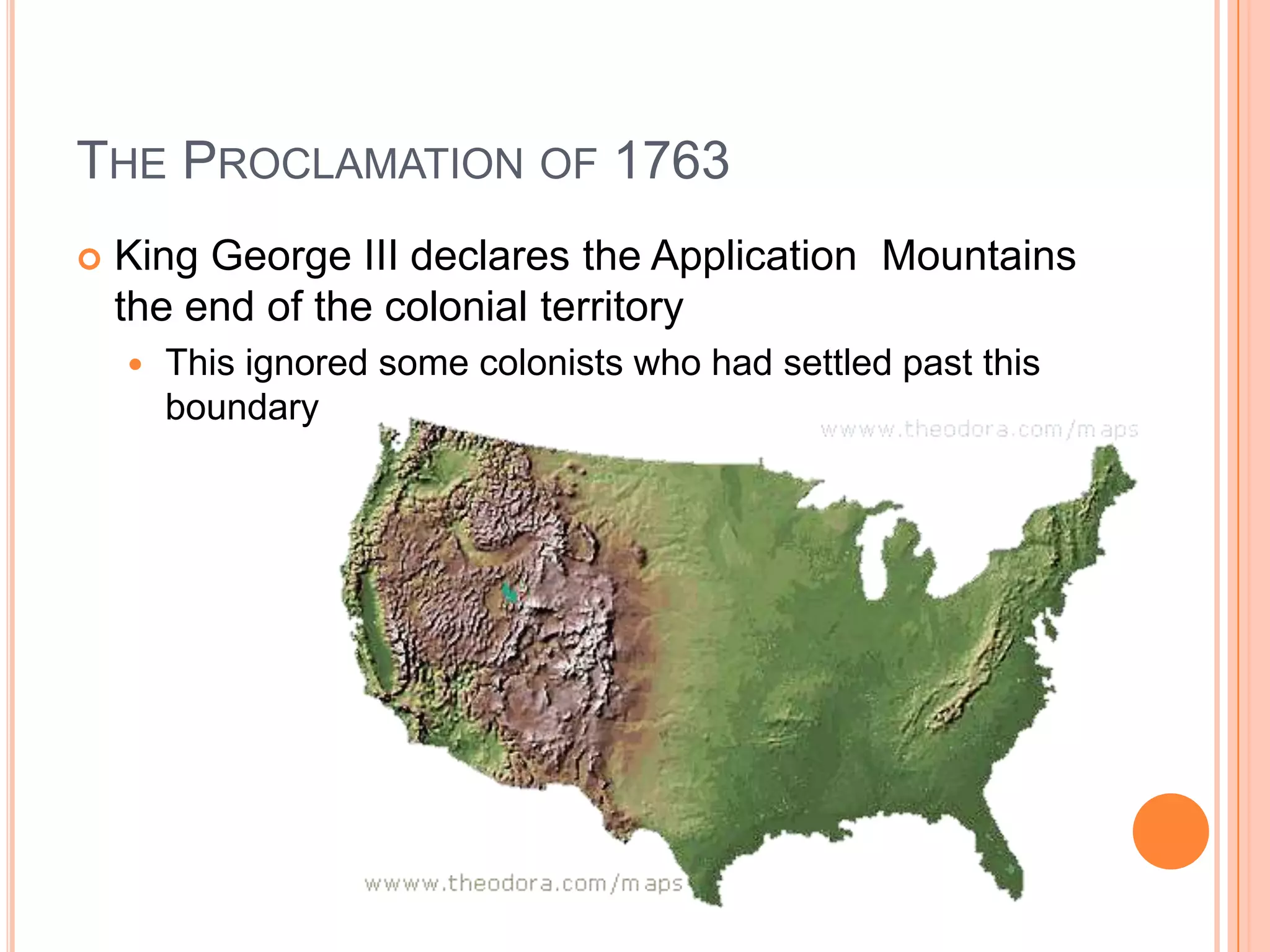
The Proclamation of 1763King George III declares the Application  Mountains the end of the colonial territoryThis ignored some colonists who had settled past this boundary
Results of the French & Indian WarGreat Britain defended the Colonies against the French and the Indians.  War ended with the Treaty of Paris. This defense was expensiveBritish also fought in 4 other wars in the coloniesKing Williams WarQueen Anne’s WarKing George’s WarFrench and Indian WarNow, the British feel that the colonies should help them make their money back…they begin to raise TAXES.Washington tried to retire after this war, he didn’t want to be a soldier any more.
Why does this matter??The British wanting to make their money back is what eventually unites the colonies to rise against King George III

Unit 2 – the 13 original colonies

  • 1.
    Unit 2 –the 13 Original Colonieshttp://www.youtube.com/watch?v=F6SrZ-6cGVA
  • 4.
    James Town –The London CompanyCompany granted a charterBrought 144 settlers, mostly gentlemen, some farmers, some indentured servantsWhat is an indentured servant?105 made it to North AmericaLeadership in Jamestown was lackingStory of John Smith, Pocahontas and John RolfeNot like the Disney movie
  • 5.
    Jamestown was aCharter ColonyThe men going to Jamestown were given a charter. This charter was a set of rules as to how the King of England wanted the colony to be runThe settlers were supposed to obey the charter to the best of their abilitywww.historyglobe.com/jamestown
  • 9.
    Jamestown Cont.Soon theywere sick and starving, ½ died within a few monthsResorted to cannibalism, even looting their own fresh graves and fresh graves of the IndiansThe Powhatans decided to help them and introduced them to tobacco – this would be where the major export beganSoon the London Co. started making $ - indentured servants worked off debt
  • 10.
    What is aPrimary Source?
  • 11.
    Plymouth and thePilgrims – and the Massachusetts Bay Colony This was the group that came over on the Mayflower – known as SeparatistsWanted to get back to the most pure form of their protestant religion – were very, very, very, very strictThey were in search of religious freedomOriginally they had fled to the Netherlands102 People on the ship, only 35 were Separatists/Pilgrims – today, we refer to the whole group as pilgrims. Led by William Bradford
  • 12.
    Plymouth Rock, Mass.Whileonboard the ship, they signed the MAYFLOWER COMPACT. This would be the first ‘republic’ governing document in the Americas. They meant to settle in Jamestown but a storm blew them off course and they landed in Massachusetts Bay, too close to winter to keep going.Like Jamestown, they landed in a really poor area to start a new colony – and at a bad time of year
  • 13.
    Mayflower Compact"In thename of God, Amen. We, whose names are underwritten, the Loyal Subjects of our dread Sovereign Lord, King James, by the Grace of God, of England, France and Ireland, King, Defender of the Faith, e&. Having undertaken for the Glory of God, and Advancement of the Christian Faith, and the Honour of our King and Country, a voyage to plant the first colony in the northern parts of Virginia; do by these presents, solemnly and mutually in the Presence of God and one of another, covenant and combine ourselves together into a civil Body Politick, for our better Ordering and Preservation, and Furtherance of the Ends aforesaid; And by Virtue hereof to enact, constitute, and frame, such just and equal Laws, Ordinances, Acts, Constitutions and Offices, from time to time, as shall be thought most meet and convenient for the General good of the Colony; unto which we promise all due submission and obedience. In Witness whereof we have hereunto subscribed our names at Cape Cod the eleventh of November, in the Reign of our Sovereign Lord, King James of England, France and Ireland, the eighteenth, and of Scotland the fifty-fourth. Anno Domini, 1620."
  • 14.
    Three Key Pointsin the Mayflower Compact:Pledged loyalty to EnglandDeclared their intention of forming a ‘civil body politic, for our better ordering and preservation’Pledge to obey laws of the new colony
  • 15.
    Help from Nativesat PlymouthSquanto and Samoset taught them to grow crops and fishMassasoit, Wampanoag leader, signed a treaty with the Pilgrims and they all lived in peace
  • 17.
    13 coloniesHelp fromIndians, guidance from King JamesCame by boat
  • 18.
    Massachusetts Bay Colony Startedby Puritans, John WinthropIn 1630 - Led about 900 men, women, and children to BostonIn the 1630’s 15,000 people would migrate from England to BostonThis colony established a general assembly to make their rules/laws. The general assembly was composed of elected officials.But, they had a royal Charter
  • 19.
    Rhode Island Banished RogerWilliams from MassachusettsHe thought people should not be banished for their ideas Founded Providence, and for the next 40 years welcomed people of all religious backgrounds, including JewsDrew people who were forced out of MassachusettsBecame a safe place for dissentersReceived Charter from the King in 1644
  • 20.
    ConnecticutSettled Thomas Hooker,who became dissatisfied with Puritans and founded HartfordColonists also in search of better soil, wanted to leave Mass.Hartford would join with two other towns and eventually establish ConnecticutAdopted the Fundamental Orders of Connecticut, which was the first written constitution in America and described a representative government - 1636
  • 21.
    New HampshireVery similarstory to that of Rhode IslandThey left Massachusetts for religious freedom but went north instead of southFinally became independent of Mass. John Wheelwright1638
  • 22.
    Conflicts with Nativesbegins in New England1675 war begins with Wampanoag The colonists would win, now free to expand as far as they wanted
  • 24.
    Dutch settle Manhattan-> New York Settled by Dutch, originally named New Amsterdam, was founded for fur trapping.Became a proprietary colony – run by the guy who owns the land. Most settlers settled around the Hudson River ValleyNamed for the King’s brother, the Duke of YorkWould be quietly conquered and taken as a British Colony
  • 25.
    New JerseyThe Dukeof York gave the southern part of his colony to two other English nobles. They named it New Jersey after the island of Jersey in the English Channel where one of the noblemen was born.Also a proprietary colony. To get people there they gave large tracts of land, promised religious freedom, trial by jury and a representative assembly. No natural harbors, so did not develop as a major port.
  • 26.
    Pennsylvania William Penn andthe QuakersWilliam Penn Sr. had loaned the king money, and instead of having it paid back, he asked for land in the AmericasQuakers believed in the ‘immediacy’ of God’s teachingsThey thought that you didn’t need a church or a minister for God to talk to you. Instead, you had your own ‘inward light’They were pacifists – meaning they didn’t believe in fighting or war, hence Philadelphia “city of brotherly love”Proprietary colony – run by the individuals who were given land from the king.
  • 27.
    DelawareWas originally thesouthern tip of PennsylvaniaSettled by Swedes and DutchThe Charter of Privileges, allowed them to form their own legislature and from then on became known as their own colony.Another proprietary colony. Report to Governor of Pennsylvania
  • 28.
    Mary Land akaMarylandHaven for Catholics, named for King Henry VIII’s daughter, Mary (aka Bloody Mary)After King Henry VIII died his daughter tried to get England to go back to Catholicism, the Catholic colony would be named for her Grew tobacco first, then said you had to grow at least one other crop, this included corn, fruit, wheat, veggies, and livestockBaltimore established itself as a major port for MarylandMason-Dixon line was established to keep Pennsylvania and Maryland from fighting over boundaries
  • 30.
    VirginiaStarted with JamestownBacon’sRebellion: attacked Native Americans and burnt down Jamestown – land disputewould have taken charge of Virginia, but died
  • 31.
    North/South CarolinaMeaning Charlesland in LatinSet up as a propriety colony south of VirginiaSettled Charles Town (Charleston)John Locke wrote their constitution, but Carolina deviated from that planPeople in the north and south disagreed and would form two colonies, North and SouthVery rich farmlandDeveloped Indigo, blue dye, “blue gold”Many slaves brought for sugar production
  • 32.
    Georgia Founded byJames Oglethorpe on the belief of freedom, no slaves, etc., he settled SavannahWas supposed to be a place where English debaters could make a fresh startColony set up as a buffer zone between Spanish and EnglishThey couldn’t hold to Oglethorpe’s plan and eventually were overrun with non-British and Oglethorpe returned to EnglandThen, large plantations developed, requiring slaves
  • 33.
  • 35.
    Export Game WritingAssignmentWrite a RASPparagraph for EACH of the following questions:What were the biggest mistakes you made in your investments? Why did you choose to invest in those products in those particular colonies?What lessons did you learn from your ‘bad’ investments? Did your mistakes change the way you invested in the end?What were the best investments that you made? How did you know to invest in those exports? (or were they just a guess?)
  • 36.
    Colonial Export GameAssessment:answer on a sheet of paper to turn in Which colonies were the most profitable (not just for your team, but overall in the game)?Why do you think those colonies were the most profitable colonies?Which colonies were the least profitable (not just for your team, but in the overall game)?Why do you think those colonies were the least profitable?
  • 37.
  • 38.
  • 39.
    Colonial Trade: theTriangular Trade
  • 40.
    Middle Passage: theshipping of enslaved Africans from the Indieshttp://player.discoveryeducation.com/index.cfm?guidAssetId=2E75D11D-BBC0-4698-A5D5-A4D4A01A904F&blnFromSearch=1&productcode=US#
  • 41.
    Differences between ColumbianExchange and Triangular Trade
  • 42.
    British Life inthe ColoniesIdeas changed in England – the Glorious Revolution led to the English Bill of Rights in 1689England saw colonies as an economic resourceEngland placed Navigation Acts- said the colonies could only trade with EnglandSo some colonists start to smuggle their products
  • 43.
    Types of ColonialGovernment Charter – had a document given by the king they were ordered to follow, but could sometimes elect their own governors/members of the legislatureProprietary- run by individuals given land by Great Britain, free to rule as they wished- and they could choose to appoint a governorRoyal – by 1760’s GA, MA, NH, NJ, NY, NC, SC, and VA were all royal coloniesDirectly ruled by britain and the king appointed a governor and members of legislature – colonists could elect a second legislature, but it wasn’t as powerful as the first
  • 44.
    Its important tounderstand:Up to this point, the colonists still considered themselves Englishmen first, then Virginians/New Englanders, etc. They never would have considered themselves AmericanWhy? Because England was still defending them and buying their goods and supporting themAgainst Who you may ask?...The French!! – we have already talked about the long standing rivalry between the French and the English, here it is again…
  • 45.
    New France unitesthe ColoniesFrench Louisiana, named for King Louis XIII, French, who started in Canada, would travel down the Mississippi river and claim all the land they found for France, when this happened Spanish moved to the southeastFrance came to convert the Native Americans to Catholicism, but learned their languages, did not ask them to change their traditions, and grew slowly so they did not kick Indians off their landAttacks from France would unite the colonies
  • 46.
  • 48.
    When we Firstmeet our great Hero…French and Indian WarVirginia’s Governor sent a young man to go and tell the French that they were in British Territory in VirginiaHe spent 3 weeks with them and came home and wrote a book – the Journal of Major George Washington, describing his adventuresIndians choose the lesser of the two evils, siding with the FrenchEven with Natives, French were outnumbered and not as strong of soldiersWar was between the French and Indians on one side and the British on another
  • 49.
    France and BritainClash: What we already Know“America was a pawn in a larger chess game”Kenneth C. DavisThe British and the French have a long standing RivilaryLittle “wars” have been going on in the colonies between the British and the FrenchKing Williams WarQueen Anne’s WarKing George’s WarFrance and Britain Clash: New Information
  • 50.
    The Albany planof UnionCreated by Ben FranklinHis goal was for the colonies to unite against the FrenchThey also wanted the Iroquois Indians to take sides with them as wellThis plan called for “one general government” for 11 of the colonies. A legislature would be elected to represent them all and have the power to raise taxes and build an armyNot one colony approved the plan – they didn’t want to give up their sovereignty
  • 51.
    In a 5sentence RASP Paragraph, what message is Franklin trying to convey with this, the first political cartoon?
  • 55.
    GB declares waron FranceThe Seven Years War is fought in Europe and in the coloniesFor the first 4 years, GB and colonies lose, but a new British general takes charge and turns things around…Eventually, New France falls in 1759 for a British Victory!
  • 56.
    The Proclamation of1763King George III declares the Application Mountains the end of the colonial territoryThis ignored some colonists who had settled past this boundary
  • 57.
    Results of theFrench & Indian WarGreat Britain defended the Colonies against the French and the Indians. War ended with the Treaty of Paris. This defense was expensiveBritish also fought in 4 other wars in the coloniesKing Williams WarQueen Anne’s WarKing George’s WarFrench and Indian WarNow, the British feel that the colonies should help them make their money back…they begin to raise TAXES.Washington tried to retire after this war, he didn’t want to be a soldier any more.
  • 58.
    Why does thismatter??The British wanting to make their money back is what eventually unites the colonies to rise against King George III