What kind of society did the
French colonists create in
their North American
colonies?
Chapter 2: France Takes an
Interest in North America
France Takes an Interest in
North America
 Colony: A territory controlled by another country.
 Empire: A network of colonies controlled by a
single country.
 Imperialism: A country extending its control
over other countries, often using economic or
military means.
 Silk Road: The route travelled by Europeans
crossing through Asia and Eastern Europe used for
trading.
Imperialism
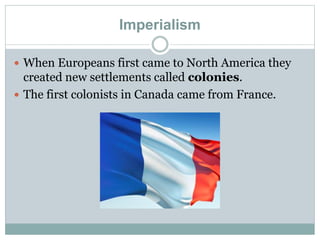
 When Europeans first came to North America they
created new settlements called colonies.
 The first colonists in Canada came from France.
Imperialism
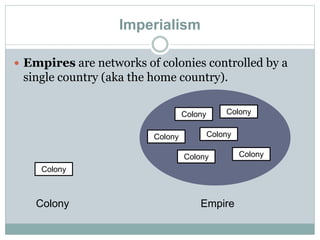
 Empires are networks of colonies controlled by a
single country (aka the home country).
Colony
Colony Colony
Colony Colony
ColonyColony
EmpireColony
Imperialism
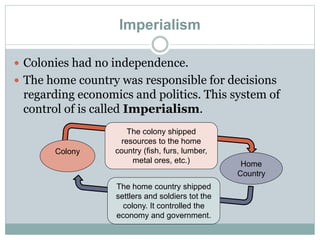
 Colonies had no independence.
 The home country was responsible for decisions
regarding economics and politics. This system of
control of is called Imperialism.
Colony
Home
Country
The colony shipped
resources to the home
country (fish, furs, lumber,
metal ores, etc.)
The home country shipped
settlers and soldiers tot the
colony. It controlled the
economy and government.
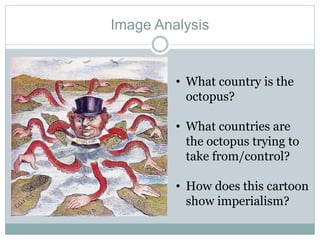
Image Analysis
• What country is the
octopus?
• What countries are
the octopus trying to
take from/control?
• How does this cartoon
show imperialism?
Imperialism
 For centuries, much of the world was ruled by
imperial powers.
 It was within this framework that Canada became a
country.
In this chapter we’re going to investigate why
France was interested in building a colony in
North America.
European Imperialism
 People began arriving in the land we now call
Canada over 10, 000 years ago.
 The first people to arrive here were....
Canada’s First Peoples
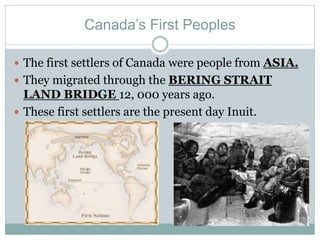
 The first settlers of Canada were people from ASIA.
 They migrated through the BERING STRAIT
LAND BRIDGE 12, 000 years ago.
 These first settlers are the present day Inuit.
European Imperialism
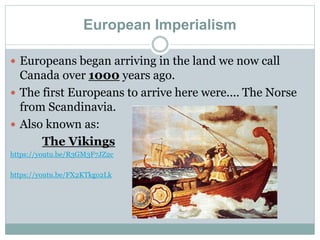
 Europeans began arriving in the land we now call
Canada over 1000 years ago.
 The first Europeans to arrive here were.... The Norse
from Scandinavia.
 Also known as:
The Vikings
https://youtu.be/R3GM3F7JZ2c
https://youtu.be/FX2KTkgo2Lk
The Vikings – The First European Explorers
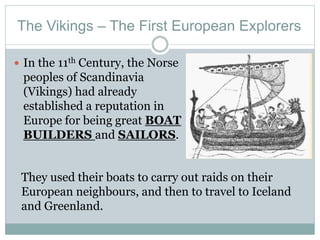
 In the 11th Century, the Norse
peoples of Scandinavia
(Vikings) had already
established a reputation in
Europe for being great BOAT
BUILDERS and SAILORS.
They used their boats to carry out raids on their
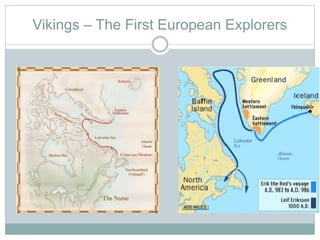
European neighbours, and then to travel to Iceland
and Greenland.
The Vikings – The First European Explorers
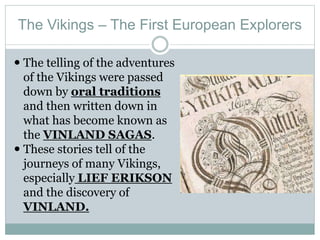
 The telling of the adventures
of the Vikings were passed
down by oral traditions
and then written down in
what has become known as
the VINLAND SAGAS.
 These stories tell of the
journeys of many Vikings,
especially LIEF ERIKSON
and the discovery of
VINLAND.
Vikings - The First European Explorers
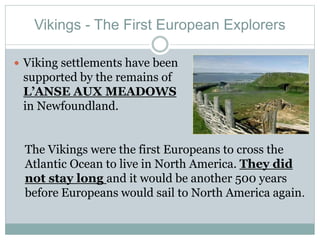
 Viking settlements have been
supported by the remains of
L’ANSE AUX MEADOWS
in Newfoundland.
The Vikings were the first Europeans to cross the
Atlantic Ocean to live in North America. They did
not stay long and it would be another 500 years
before Europeans would sail to North America again.
Vikings – The First European Explorers
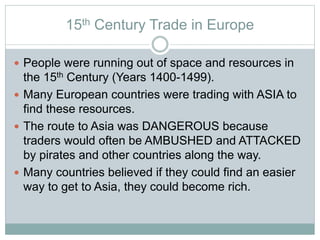
15th Century Trade in Europe
 People were running out of space and resources in
the 15th Century (Years 1400-1499).
 Many European countries were trading with ASIA to
find these resources.
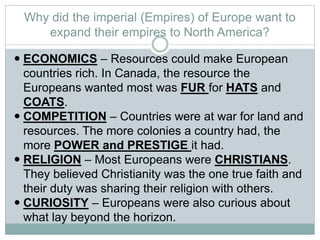
 The route to Asia was DANGEROUS because
traders would often be AMBUSHED and ATTACKED
by pirates and other countries along the way.
 Many countries believed if they could find an easier
way to get to Asia, they could become rich.
Why did the imperial (Empires) of Europe want to
expand their empires to North America?
 ECONOMICS – Resources could make European
countries rich. In Canada, the resource the
Europeans wanted most was FUR for HATS and
COATS.
 COMPETITION – Countries were at war for land and
resources. The more colonies a country had, the
more POWER and PRESTIGE it had.
 RELIGION – Most Europeans were CHRISTIANS.
They believed Christianity was the one true faith and
their duty was sharing their religion with others.
 CURIOSITY – Europeans were also curious about
what lay beyond the horizon.
What comparisons can you make?
 What is similar between this song and the Explorers
of Europe?
https://youtu.be/cPAbx5kgCJo
Looking for a New Silk Road
 For centuries, the countries of EUROPE and ASIA
traded with one another.
 France, England, Spain, Portugal and the
Netherlands looked to India, China, Japan and
Indonesia for what kinds of goods?
Looking for a New Silk Road
 For centuries, the countries of Europe and Asia
traded with one another.
 France, England, Spain, Portugal and the
Netherlands looked to India, China, Japan and
Indonesia for what kinds of goods?
 Spices
 Tea
 Silk
 Porcelain
 Gems
Looking for a New Silk Road
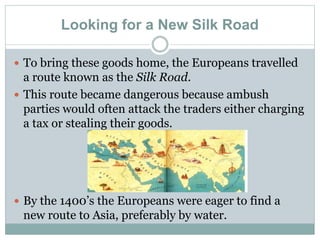
 To bring these goods home, the Europeans travelled
a route known as the Silk Road.
 This route became dangerous because ambush
parties would often attack the traders either charging
a tax or stealing their goods.
 By the 1400’s the Europeans were eager to find a
new route to Asia, preferably by water.
Looking for a New Silk Road
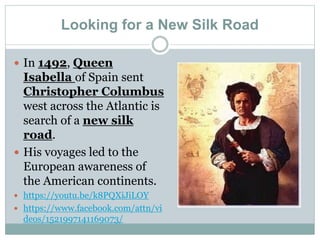
 In 1492, Queen
Isabella of Spain sent
Christopher Columbus
west across the Atlantic is
search of a new silk
road.
 His voyages led to the
European awareness of
the American continents.
 https://youtu.be/k8PQXiJiLOY
 https://www.facebook.com/attn/vi
deos/1521997141169073/
Expanding Across the Ocean
 Why did the imperial countries of Europe want to
expand their empires?
Expanding Across the Ocean
 Why did the imperial countries of Europe want to
expand their empires?
1. Economics
2. Competition
3. Religion
4. Curiosity
Expanding Across the Ocean
1. Economics
 Europeans set up colonies so they could
claim the resources for themselves.
Ex: Fur
Expanding Across the Ocean
2. Competition
 Countries of Europe were at competition
with each other.
 The more colonies (and land) that a country
controlled, the more power and prestige it
had.
Expanding Across the Ocean
3. Religion
 The Catholics (France) and the Protestants
(England) wanted to spread their version of
Christianity to other parts of the world.
Expanding Across the Ocean
4. Curiosity
 Europeans were curious about the rest of
the world.
 New technologies made travelling farther
than they ever had before possible.
Brainstorm
Looking at Canada today, how do
we know France has played an
important role in developing
Canada?
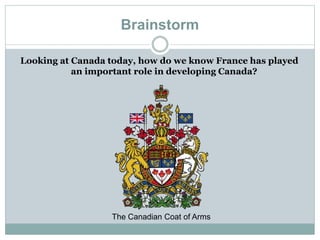
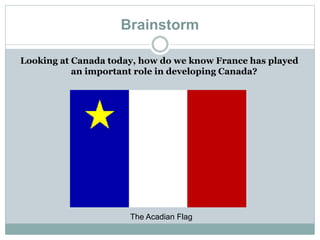
Brainstorm
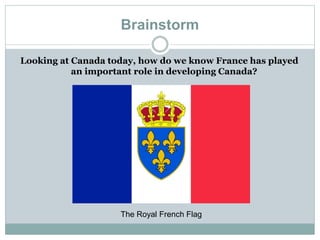
Looking at Canada today, how do we know France has played
an important role in developing Canada?
The Royal French Flag
Brainstorm
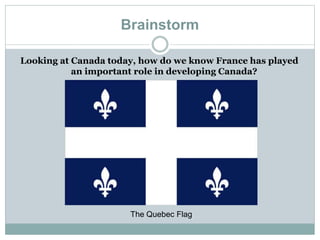
Looking at Canada today, how do we know France has played
an important role in developing Canada?
The Quebec Flag
Brainstorm
Looking at Canada today, how do we know France has played
an important role in developing Canada?
The Canadian Coat of Arms
Brainstorm
Looking at Canada today, how do we know France has played
an important role in developing Canada?
The Acadian Flag
Cartier Crosses the Atlantic
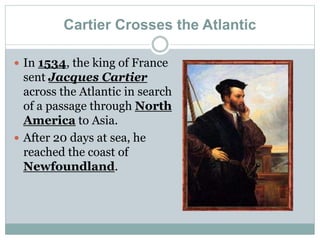
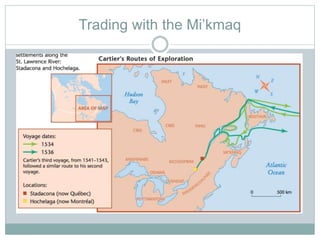
 In 1534, the king of France
sent Jacques Cartier
across the Atlantic in search
of a passage through North
America to Asia.
 After 20 days at sea, he
reached the coast of
Newfoundland.
Cartier Crosses the Atlantic
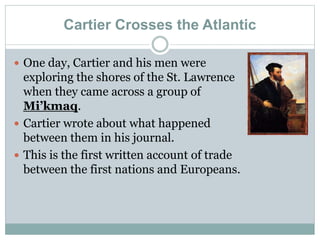
 One day, Cartier and his men were
exploring the shores of the St. Lawrence
when they came across a group of
Mi’kmaq.
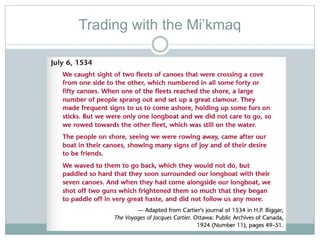
 Cartier wrote about what happened
between them in his journal.
 This is the first written account of trade
between the first nations and Europeans.
Trading with the Mi’kmaq
Questions
First Encounters (pg 52-55)
1. Based on Cartier’s journal entry on page 53, what
suggests that the Mi’kmaq had traded before? (3pts)
With whom do you think they might have traded? (1
pt)
The Challenges of Settlement
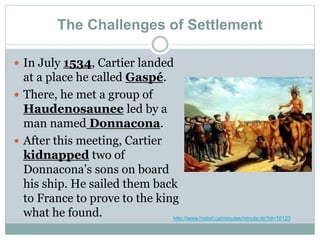
 In July 1534, Cartier landed
at a place he called Gaspé.
 There, he met a group of
Haudenosaunee led by a
man named Donnacona.
 After this meeting, Cartier
kidnapped two of
Donnacona’s sons on board
his ship. He sailed them back
to France to prove to the king
what he found. http://www.histori.ca/minutes/minute.do?id=10123
The Challenges of Settlement
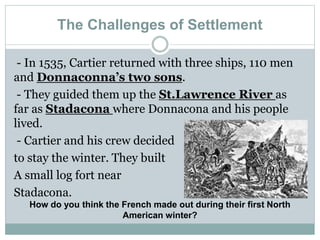
- In 1535, Cartier returned with three ships, 110 men
and Donnaconna’s two sons.
- They guided them up the St.Lawrence River as
far as Stadacona where Donnacona and his people
lived.
- Cartier and his crew decided
to stay the winter. They built
A small log fort near
Stadacona.
How do you think the French made out during their first North
American winter?
The Challenges of Settlement
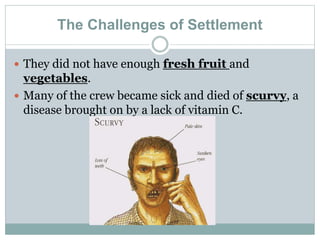
 They did not have enough fresh fruit and
vegetables.
 Many of the crew became sick and died of scurvy, a
disease brought on by a lack of vitamin C.
The Challenges of Settlement
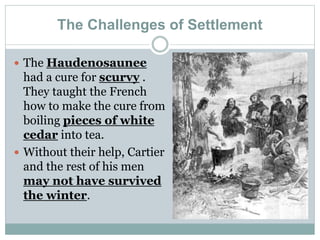
 The Haudenosaunee
had a cure for scurvy .
They taught the French
how to make the cure from
boiling pieces of white
cedar into tea.
 Without their help, Cartier
and the rest of his men
may not have survived
the winter.
Land of Riches
 The Haudenosaunee told Cartier about a land
northeast of their village where there were fruit
trees, metals and gems.
 In 1536, Cartier kidnapped Donnacona and nine
other villagers back to Europe.
Why do you think Cartier took them back to Europe?
Land of Riches
 The Haudenosaunee told Cartier about a land
northeast of their village where there were fruit
trees, metals and gems.
 In 1536, Cartier forcibly took Donnacona and nine
other villagers back to Europe.
 So they could tell the king about the riches in North
America.
 He hoped this information would convince the king
to pay for another cross-Atlantic trip.
Why do you think Cartier took them back to Europe?
Paying for their travels
 How do you think European explorers PAID
for their trips across the ocean to explore the
new world?
Paying for their travels
 How do you think European explorers PAID
for their trips across the ocean to explore the
new world?
 European explorers needed sponsors. Like athletes
today, explorers needed sponsors to pay for their
adventures and in return, sponsors received most
of the resources explorers could bring back. The
explorers would claim land for their sponsors.
My friend: Haley the Athlete
 http://www.spor
tsnet.ca/960/96
0-news/calgarys-
haley-daniels-
one-step-closer-
to-olympic-
dream/
 http://www.hale
ydaniels.ca/my-
journey/
Cartier Visits Again
 Cartier returned to North America in 1542 to set up
a colony along the St. Lawrence River.
 By this time, all but one of the Haudenosaunee
Cartier had taken to Europe died. Cartier told the
Hauenosaunee that everyone else was well and living
in Europe.
Why do you think Cartier lied about the Haudenosaunee
being alive? Do you think they believed him?
Cartier Visits Again
 Cartier returned to north America in 1542 to set up
a colony along the St. Lawrence River.
 By this time, all but one of the Haudenosaunee
Cartier had taken to Europe died. Cartier told the
Hauenosaunee that that everyone else was well and
living in Europe.
 Written accounts say they did not believe him and as
a result were hostile toward the French.
Why do you think Cartier lied about the Haudenosaunee
being alive? Do you think they believed him?
Brainstorm
Discuss with the person beside you:
How would you feel if strangers came to
your school, raised a flag and claimed
the school for themselves?
How would the newcomers describe
their actions?
How would you respond to such an event?
Cartier and Donnacona
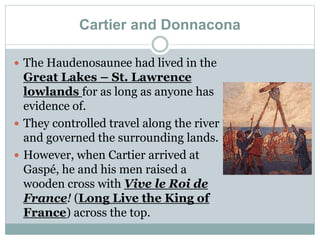
 The Haudenosaunee had lived in the
Great Lakes – St. Lawrence
lowlands for as long as anyone has
evidence of.
 They controlled travel along the river
and governed the surrounding lands.
 However, when Cartier arrived at
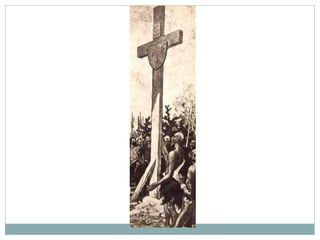
Gaspé, he and his men raised a
wooden cross with Vive le Roi de
France! (Long Live the King of
France) across the top.
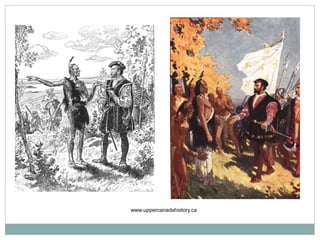
www.uppercanadahistory.ca
Role play
With a partner, role play the encounter between
Cartier and Donnacona as Cartier raised the
cross at Gaspé.
Include why you think Cartier felt justified in raising the
cross and why Donnacona felt justified in objecting.
Preparing your role play
1. Make notes: Include a) facts about the
situation/event, b) your character’s perspective, c)
how your character feels and d) how your
character acts (voice, gestures, etc).
2. Dialogue: Decide if you are going to read from a
script or make up the dialogue as you go along.
3. Respect: Remember to be respectful of cultures.
Cartier Visits Again
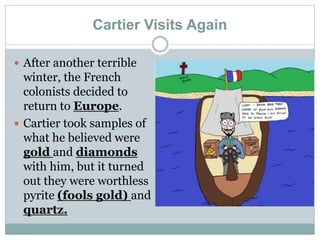
 After another terrible
winter, the French
colonists decided to
return to Europe.
 Cartier took samples of
what he believed were
gold and diamonds
with him, but it turned
out they were worthless
pyrite (fools gold) and
quartz.
Jacques Cartier’s Reputation
 Although Jacques Cartier was given the task of
beginning a colony, the colony ultimately was left
behind when Cartier thought he had found riches.
 This colony went back to France when their leader
left them.
 Jacques Cartier was remembered by the French
people as a fraud and phony.
France Expands Its Empire
 Jacques Cartier’s settlement failed but the French
did not completely forget about North America;
 Fishing fleets still returned to North America.
 Fur traders still came to trade with First Nations
trappers.
Questions
1. How did the Haudenosaunee help Cartier and his
men? (1 pt)
2. Why did Cartier take the natives back to Europe
in 1536? (2 pts)
3. How did Cartier fail as an explorer? How did he
succeed? (2 pts)
Guiding Questions
 How did the French and Mi’kmaq get along?
 How did the Haudenosaunee and French get along?
 Who were key figures in the French exploration and
settlement of North America?
 How was imperialism responsible for the settlement
of Acadia and New France?
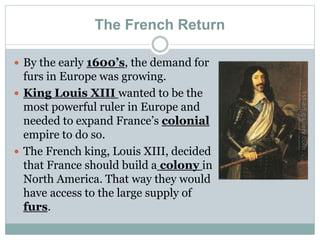
The French Return
 By the early 1600’s, the demand for
furs in Europe was growing.
 King Louis XIII wanted to be the
most powerful ruler in Europe and
needed to expand France’s colonial
empire to do so.
 The French king, Louis XIII, decided
that France should build a colony in
North America. That way they would
have access to the large supply of
furs.
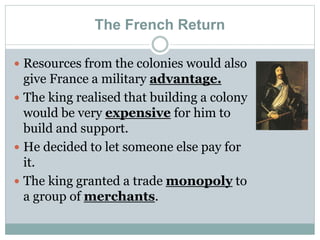
The French Return
 Resources from the colonies would also
give France a military advantage.
 The king realised that building a colony
would be very expensive for him to
build and support.
 He decided to let someone else pay for
it.
 The king granted a trade monopoly to
a group of merchants.
France Expands Its Empire
 Monopoly: When ONLY one company or group is
allowed to sell or trade a product in a certain area.
The French Return
 A trade monopoly, NOT
 This meant that only merchants within the group
holding the monopoly would be allowed to trade for
furs in the colony.
 In return, the merchants agreed to build colonies in
North America and find French citizens to live in
them.
France Expands Its Empire
 Monopoly: When only one company or group is
allowed to sell or trade a product in a certain area.
 Merchant: Someone who trades resources that are
produced or gathered by other people.
The French in Acadia
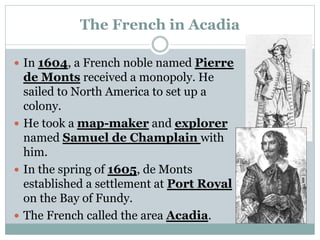
 In 1604, a French noble named Pierre
de Monts received a monopoly. He
sailed to North America to set up a
colony.
 He took a map-maker and explorer
named Samuel de Champlain with
him.
 In the spring of 1605, de Monts
established a settlement at Port Royal
on the Bay of Fundy.
 The French called the area Acadia.
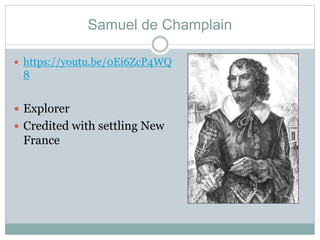
Samuel de Champlain
 https://youtu.be/0Ei6ZcP4WQ
8
 Explorer
 Credited with settling New
France
The French in Acadia
 The Mi’kmaq were already living on this land.
How do you think they reacted to the
newcomers?
A) They didn’t object because they would be able to
trade with them.
B) They were afraid of them and avoided them.
C) They wanted them off their land and started
destroying their property.
D) They wanted them off their land and started a war!
The French in Acadia
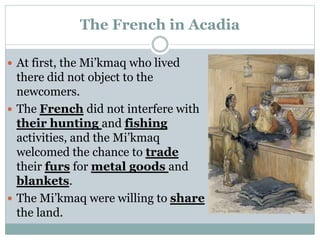
 At first, the Mi’kmaq who lived
there did not object to the
newcomers.
 The French did not interfere with
their hunting and fishing
activities, and the Mi’kmaq
welcomed the chance to trade
their furs for metal goods and
blankets.
 The Mi’kmaq were willing to share
the land.
The French in Acadia
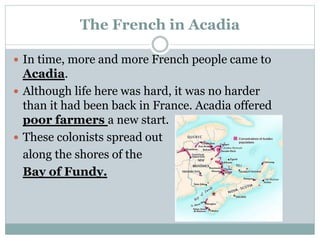
 In time, more and more French people came to
Acadia.
 Although life here was hard, it was no harder
than it had been back in France. Acadia offered
poor farmers a new start.
 These colonists spread out
along the shores of the
Bay of Fundy.
The French in Acadia
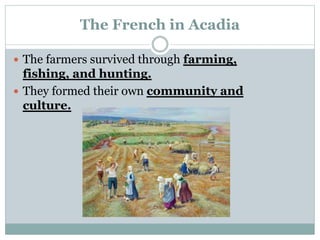
 The farmers survived through farming,
fishing, and hunting.
 They formed their own community and
culture.
The Founding of Québec
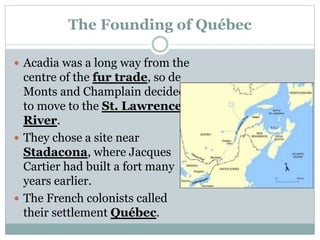
 Acadia was a long way from the
centre of the fur trade, so de
Monts and Champlain decided
to move to the St. Lawrence
River.
 They chose a site near
Stadacona, where Jacques
Cartier had built a fort many
years earlier.
 The French colonists called
their settlement Québec.
The Founding of Québec
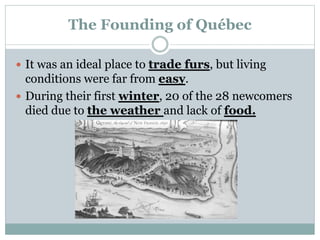
 It was an ideal place to trade furs, but living
conditions were far from easy.
 During their first winter, 20 of the 28 newcomers
died due to the weather and lack of food.
Surviving Québec Winters
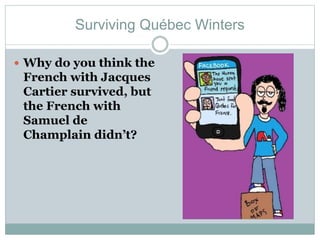
 Why do you think the
French with Jacques
Cartier survived, but
the French with
Samuel de
Champlain didn’t?
Surviving Québec Winters
 Why do you think the
French with Jacques
Cartier survived, but
the French with
Samuel de
Champlain didn’t?
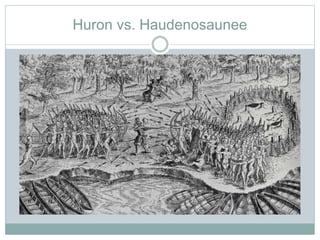
Huron vs. Haudenosaunee
Guiding Questions
 How did the French and Mi’kmaq get along?
 How did the Haudenosaunee and French get along?
 Who were key figures in the French exploration and
settlement of North America?
 How was imperialism responsible for the settlement
of Acadia and New France?
Exploring Deeper into the Continent
 Coureur de bois: A Canadian trader
(“runner of the woods”) who paddled on
long journeys into the wilderness to trade
for furs with the First Nations.
 Métis: People of mixed First Nations and
European ancestry.
Exploring Deeper into the Continent
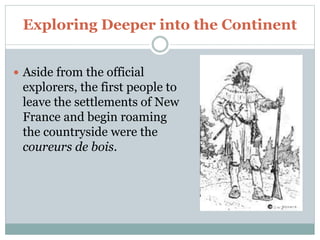
 Aside from the official
explorers, the first people to
leave the settlements of New
France and begin roaming
the countryside were the
coureurs de bois.
The Coureurs de Bois
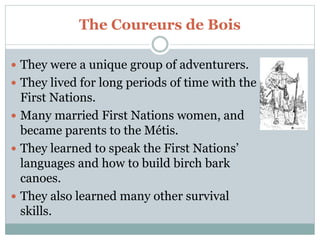
 They were a unique group of adventurers.
 They lived for long periods of time with the
First Nations.
 Many married First Nations women, and
became parents to the Métis.
 They learned to speak the First Nations’
languages and how to build birch bark
canoes.
 They also learned many other survival
skills.
The Coureurs de Bois
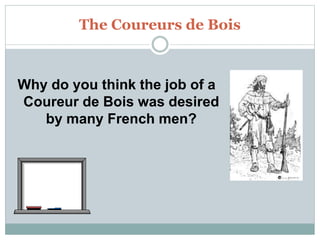
Why do you think the job of a
Coureur de Bois was desired
by many French men?
The Coureurs de Bois
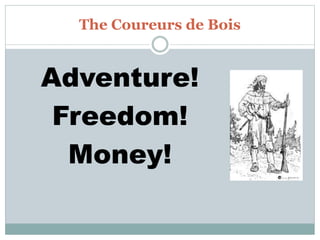
Adventure!
Freedom!
Money!
The Coureurs de Bois
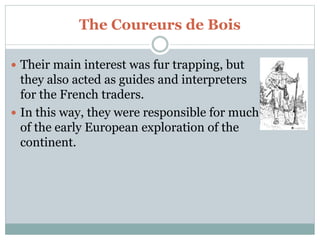
 Their main interest was fur trapping, but
they also acted as guides and interpreters
for the French traders.
 In this way, they were responsible for much
of the early European exploration of the
continent.
Étienne Brûlé
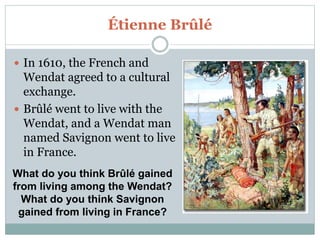
 In 1610, the French and
Wendat agreed to a cultural
exchange.
 Brûlé went to live with the
Wendat, and a Wendat man
named Savignon went to live
in France.
What do you think Brûlé gained
from living among the Wendat?
What do you think Savignon
gained from living in France?
Étienne Brûlé
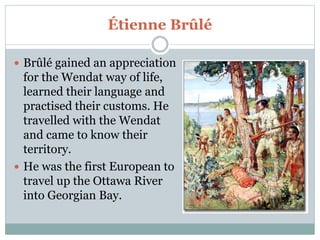
 Brûlé gained an appreciation
for the Wendat way of life,
learned their language and
practised their customs. He
travelled with the Wendat
and came to know their
territory.
 He was the first European to
travel up the Ottawa River
into Georgian Bay.
Étienne Brûlé
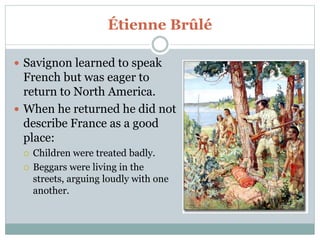
 Savignon learned to speak
French but was eager to
return to North America.
 When he returned he did not
describe France as a good
place:
 Children were treated badly.
 Beggars were living in the
streets, arguing loudly with one
another.
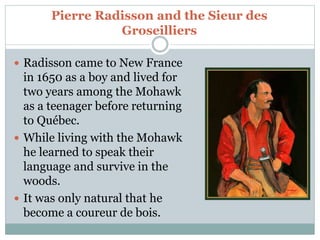
Pierre Radisson and the Sieur des
Groseilliers
 Radisson came to New France
in 1650 as a boy and lived for
two years among the Mohawk
as a teenager before returning
to Québec.
 While living with the Mohawk
he learned to speak their
language and survive in the
woods.
 It was only natural that he
become a coureur de bois.
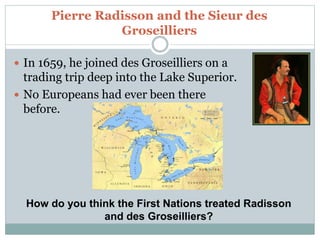
Pierre Radisson and the Sieur des
Groseilliers
 In 1659, he joined des Groseilliers on a
trading trip deep into the Lake Superior.
 No Europeans had ever been there
before.
How do you think the First Nations treated Radisson
and des Groseilliers?
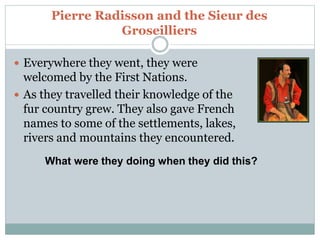
Pierre Radisson and the Sieur des
Groseilliers
 Everywhere they went, they were
welcomed by the First Nations.
 As they travelled their knowledge of the
fur country grew. They also gave French
names to some of the settlements, lakes,
rivers and mountains they encountered.
What were they doing when they did this?
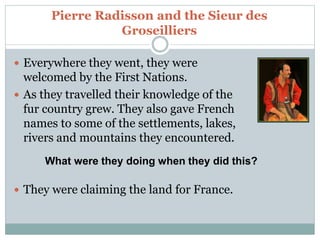
Pierre Radisson and the Sieur des
Groseilliers
 Everywhere they went, they were
welcomed by the First Nations.
 As they travelled their knowledge of the
fur country grew. They also gave French
names to some of the settlements, lakes,
rivers and mountains they encountered.
 They were claiming the land for France.
What were they doing when they did this?
Pierre Radisson and the Sieur des
Groseilliers
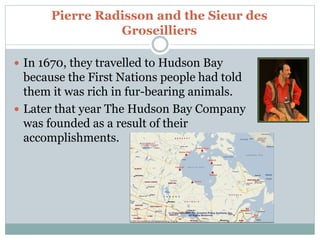
 In 1670, they travelled to Hudson Bay
because the First Nations people had told
them it was rich in fur-bearing animals.
 Later that year The Hudson Bay Company
was founded as a result of their
accomplishments.
Economy and Government in New France
 King Louis XIV: King of France also known as the
“Sun King” because he was all powerful. He was
so forceful in acquiring colonies that other
countries of Europe united against him.
 Sovereign Council: A government with three
officials: a governor, an intendant, and a bishop,
set up by King Louis XIV to govern the colony of
New France.
Definitions contd.
 Habitants: A Francophone farmer of New France.
 Jesuits: An order of missionaries who came to North
America to convert First Nations peoples to the
Catholic religion.
 Canadien(ne): A Francophone descendent of the
settlers of New France living anywhere in North
America, including the West (in use until about the
First World War).
 Seigneurial System: A system based on nobles (or
seigneurs) who rented land to farmers (or habitants).
The Royal Takeover
 As a colony, New France depended on France for its
survival.
 France provided: Colonists, supplies and military
protection
 New France supplied: Resources such as furs and
fish
 The colony of New France made France richer and
more powerful.
The Royal Takeover
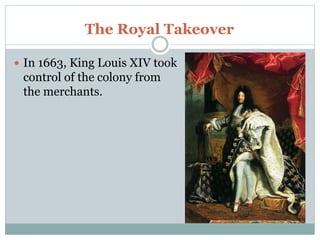
 In 1663, King Louis XIV took
control of the colony from
the merchants.
The Royal Takeover
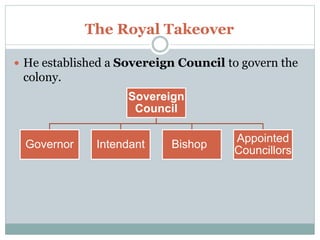
 He established a Sovereign Council to govern the
colony.
Sovereign
Council
Governor Intendant Bishop
Appointed
Councillors
The Sovereign Council
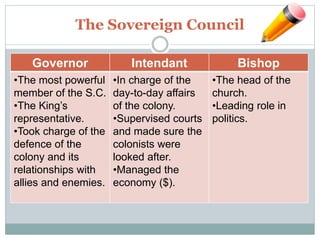
Governor Intendant Bishop
•The most powerful
member of the S.C.
•The King’s
representative.
•Took charge of the
defence of the
colony and its
relationships with
allies and enemies.
•In charge of the
day-to-day affairs
of the colony.
•Supervised courts
and made sure the
colonists were
looked after.
•Managed the
economy ($).
•The head of the
church.
•Leading role in
politics.
The Sovereign Council
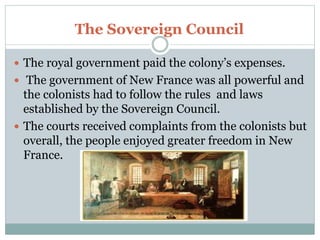
 The royal government paid the colony’s expenses.
 The government of New France was all powerful and
the colonists had to follow the rules and laws
established by the Sovereign Council.
 The courts received complaints from the colonists but
overall, the people enjoyed greater freedom in New
France.
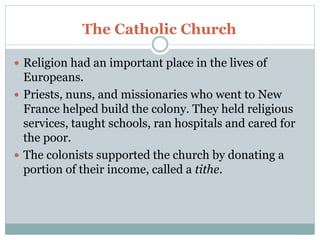
The Catholic Church
 Religion had an important place in the lives of
Europeans.
 Priests, nuns, and missionaries who went to New
France helped build the colony. They held religious
services, taught schools, ran hospitals and cared for
the poor.
 The colonists supported the church by donating a
portion of their income, called a tithe.
The Catholic Church
What was the #1 goal of the Catholic Church?
The Catholic Church
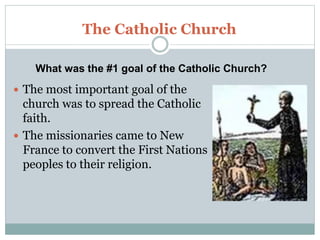
 The most important goal of the
church was to spread the Catholic
faith.
 The missionaries came to New
France to convert the First Nations
peoples to their religion.
What was the #1 goal of the Catholic Church?
The Catholic Church
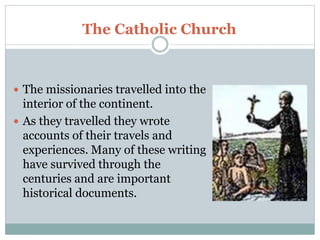
 The missionaries travelled into the
interior of the continent.
 As they travelled they wrote
accounts of their travels and
experiences. Many of these writing
have survived through the
centuries and are important
historical documents.
The Economy of New France
How did New France make money?
The Economy of New France
 The fur trade and farming.
How did New France make money?
 The social structure was based on a Seigneurial
System.
1. The king gave large tracts of land along the St.Lawrence
to the nobles aka seigneurs.
2. Each seigneur had to find colonists aka habitants to settle
the land. These habitants rented strips of land and set up
farms.
3. Seigneurs and habitants had duties which were protected
by law.
 Habitants had to give a portion of their crop and pay
other fees to the seigneur.
 The seigneur had to build a church and mill on his land.
The Economy of New France
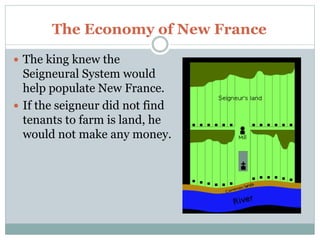
 The king knew the
Seigneural System would
help populate New France.
 If the seigneur did not find
tenants to farm is land, he
would not make any money.
The Economy of New France
Questions
 Please complete the “Royal Takeover” and “Catholic
Church” sheets in your Chapter 2 booklet.
Populating the Colony
 Fille du Roi: The women known as the “king’s
daughters” who were sent to New France to
become wives.
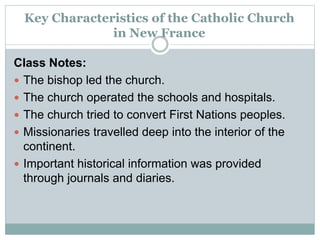
Key Characteristics of the Catholic Church
in New France
Class Notes:
 The bishop led the church.
 The church operated the schools and hospitals.
 The church tried to convert First Nations peoples.
 Missionaries travelled deep into the interior of the
continent.
 Important historical information was provided
through journals and diaries.
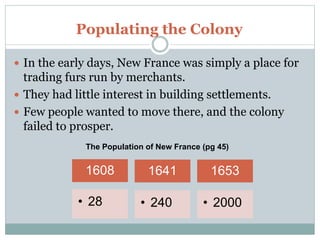
Populating the Colony
 In the early days, New France was simply a place for
trading furs run by merchants.
 They had little interest in building settlements.
 Few people wanted to move there, and the colony
failed to prosper.
1608
• 28
1641
• 240
1653
• 2000
The Population of New France (pg 45)
Brainstorm
Why was it so difficult for New France’s
population to grow?
 Nobody wanted to leave France to live there.
 Death and disease
 There were hardly any WOMEN!
What do you see as the biggest
problem?
Populating the Colony
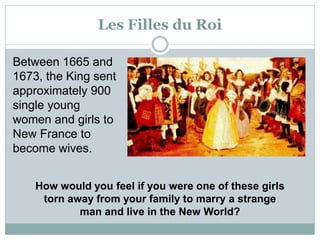
Les Filles du Roi
Between 1665 and
1673, the King sent
approximately 900
single young
women and girls to
New France to
become wives.
How would you feel if you were one of these girls
torn away from your family to marry a strange
man and live in the New World?
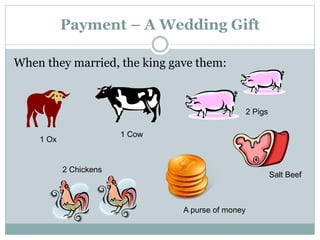
Payment – A Wedding Gift
When they married, the king gave them:
1 Cow
1 Ox
2 Chickens
2 Pigs
Salt Beef
A purse of money
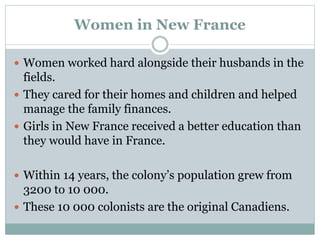
Women in New France
 Women worked hard alongside their husbands in the
fields.
 They cared for their homes and children and helped
manage the family finances.
 Girls in New France received a better education than
they would have in France.
 Within 14 years, the colony’s population grew from
3200 to 10 000.
 These 10 000 colonists are the original Canadiens.
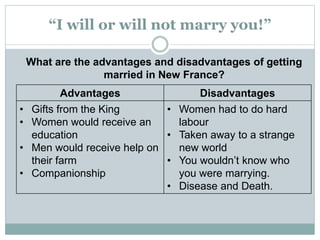
“I will or will not marry you!”
What are the advantages and disadvantages of getting
married in New France?
Advantages Disadvantages
• Gifts from the King
• Women would receive an
education
• Men would receive help on
their farm
• Companionship
• Women had to do hard
labour
• Taken away to a strange
new world
• You wouldn’t know who
you were marrying.
• Disease and Death.

Chapter 2 lecture slides

  • 1.
    What kind ofsociety did the French colonists create in their North American colonies? Chapter 2: France Takes an Interest in North America
  • 2.
    France Takes anInterest in North America  Colony: A territory controlled by another country.  Empire: A network of colonies controlled by a single country.  Imperialism: A country extending its control over other countries, often using economic or military means.  Silk Road: The route travelled by Europeans crossing through Asia and Eastern Europe used for trading.
  • 3.
    Imperialism  When Europeansfirst came to North America they created new settlements called colonies.  The first colonists in Canada came from France.
  • 4.
    Imperialism  Empires arenetworks of colonies controlled by a single country (aka the home country). Colony Colony Colony Colony Colony ColonyColony EmpireColony
  • 5.
    Imperialism  Colonies hadno independence.  The home country was responsible for decisions regarding economics and politics. This system of control of is called Imperialism. Colony Home Country The colony shipped resources to the home country (fish, furs, lumber, metal ores, etc.) The home country shipped settlers and soldiers tot the colony. It controlled the economy and government.
  • 6.
    Image Analysis • Whatcountry is the octopus? • What countries are the octopus trying to take from/control? • How does this cartoon show imperialism?
  • 7.
    Imperialism  For centuries,much of the world was ruled by imperial powers.  It was within this framework that Canada became a country. In this chapter we’re going to investigate why France was interested in building a colony in North America.
  • 8.
    European Imperialism  Peoplebegan arriving in the land we now call Canada over 10, 000 years ago.  The first people to arrive here were....
  • 9.
    Canada’s First Peoples The first settlers of Canada were people from ASIA.  They migrated through the BERING STRAIT LAND BRIDGE 12, 000 years ago.  These first settlers are the present day Inuit.
  • 10.
    European Imperialism  Europeansbegan arriving in the land we now call Canada over 1000 years ago.  The first Europeans to arrive here were.... The Norse from Scandinavia.  Also known as: The Vikings https://youtu.be/R3GM3F7JZ2c https://youtu.be/FX2KTkgo2Lk
  • 11.
    The Vikings –The First European Explorers  In the 11th Century, the Norse peoples of Scandinavia (Vikings) had already established a reputation in Europe for being great BOAT BUILDERS and SAILORS. They used their boats to carry out raids on their European neighbours, and then to travel to Iceland and Greenland.
  • 12.
    The Vikings –The First European Explorers  The telling of the adventures of the Vikings were passed down by oral traditions and then written down in what has become known as the VINLAND SAGAS.  These stories tell of the journeys of many Vikings, especially LIEF ERIKSON and the discovery of VINLAND.
  • 13.
    Vikings - TheFirst European Explorers  Viking settlements have been supported by the remains of L’ANSE AUX MEADOWS in Newfoundland. The Vikings were the first Europeans to cross the Atlantic Ocean to live in North America. They did not stay long and it would be another 500 years before Europeans would sail to North America again.
  • 14.
    Vikings – TheFirst European Explorers
  • 15.
    15th Century Tradein Europe  People were running out of space and resources in the 15th Century (Years 1400-1499).  Many European countries were trading with ASIA to find these resources.  The route to Asia was DANGEROUS because traders would often be AMBUSHED and ATTACKED by pirates and other countries along the way.  Many countries believed if they could find an easier way to get to Asia, they could become rich.
  • 16.
    Why did theimperial (Empires) of Europe want to expand their empires to North America?  ECONOMICS – Resources could make European countries rich. In Canada, the resource the Europeans wanted most was FUR for HATS and COATS.  COMPETITION – Countries were at war for land and resources. The more colonies a country had, the more POWER and PRESTIGE it had.  RELIGION – Most Europeans were CHRISTIANS. They believed Christianity was the one true faith and their duty was sharing their religion with others.  CURIOSITY – Europeans were also curious about what lay beyond the horizon.
  • 17.
    What comparisons canyou make?  What is similar between this song and the Explorers of Europe? https://youtu.be/cPAbx5kgCJo
  • 18.
    Looking for aNew Silk Road  For centuries, the countries of EUROPE and ASIA traded with one another.  France, England, Spain, Portugal and the Netherlands looked to India, China, Japan and Indonesia for what kinds of goods?
  • 19.
    Looking for aNew Silk Road  For centuries, the countries of Europe and Asia traded with one another.  France, England, Spain, Portugal and the Netherlands looked to India, China, Japan and Indonesia for what kinds of goods?  Spices  Tea  Silk  Porcelain  Gems
  • 20.
    Looking for aNew Silk Road  To bring these goods home, the Europeans travelled a route known as the Silk Road.  This route became dangerous because ambush parties would often attack the traders either charging a tax or stealing their goods.  By the 1400’s the Europeans were eager to find a new route to Asia, preferably by water.
  • 21.
    Looking for aNew Silk Road  In 1492, Queen Isabella of Spain sent Christopher Columbus west across the Atlantic is search of a new silk road.  His voyages led to the European awareness of the American continents.  https://youtu.be/k8PQXiJiLOY  https://www.facebook.com/attn/vi deos/1521997141169073/
  • 22.
    Expanding Across theOcean  Why did the imperial countries of Europe want to expand their empires?
  • 23.
    Expanding Across theOcean  Why did the imperial countries of Europe want to expand their empires? 1. Economics 2. Competition 3. Religion 4. Curiosity
  • 24.
    Expanding Across theOcean 1. Economics  Europeans set up colonies so they could claim the resources for themselves. Ex: Fur
  • 25.
    Expanding Across theOcean 2. Competition  Countries of Europe were at competition with each other.  The more colonies (and land) that a country controlled, the more power and prestige it had.
  • 26.
    Expanding Across theOcean 3. Religion  The Catholics (France) and the Protestants (England) wanted to spread their version of Christianity to other parts of the world.
  • 27.
    Expanding Across theOcean 4. Curiosity  Europeans were curious about the rest of the world.  New technologies made travelling farther than they ever had before possible.
  • 28.
    Brainstorm Looking at Canadatoday, how do we know France has played an important role in developing Canada?
  • 29.
    Brainstorm Looking at Canadatoday, how do we know France has played an important role in developing Canada? The Royal French Flag
  • 30.
    Brainstorm Looking at Canadatoday, how do we know France has played an important role in developing Canada? The Quebec Flag
  • 31.
    Brainstorm Looking at Canadatoday, how do we know France has played an important role in developing Canada? The Canadian Coat of Arms
  • 32.
    Brainstorm Looking at Canadatoday, how do we know France has played an important role in developing Canada? The Acadian Flag
  • 33.
    Cartier Crosses theAtlantic  In 1534, the king of France sent Jacques Cartier across the Atlantic in search of a passage through North America to Asia.  After 20 days at sea, he reached the coast of Newfoundland.
  • 34.
    Cartier Crosses theAtlantic  One day, Cartier and his men were exploring the shores of the St. Lawrence when they came across a group of Mi’kmaq.  Cartier wrote about what happened between them in his journal.  This is the first written account of trade between the first nations and Europeans.
  • 35.
  • 36.
  • 37.
    Questions First Encounters (pg52-55) 1. Based on Cartier’s journal entry on page 53, what suggests that the Mi’kmaq had traded before? (3pts) With whom do you think they might have traded? (1 pt)
  • 38.
    The Challenges ofSettlement  In July 1534, Cartier landed at a place he called Gaspé.  There, he met a group of Haudenosaunee led by a man named Donnacona.  After this meeting, Cartier kidnapped two of Donnacona’s sons on board his ship. He sailed them back to France to prove to the king what he found. http://www.histori.ca/minutes/minute.do?id=10123
  • 39.
    The Challenges ofSettlement - In 1535, Cartier returned with three ships, 110 men and Donnaconna’s two sons. - They guided them up the St.Lawrence River as far as Stadacona where Donnacona and his people lived. - Cartier and his crew decided to stay the winter. They built A small log fort near Stadacona. How do you think the French made out during their first North American winter?
  • 40.
    The Challenges ofSettlement  They did not have enough fresh fruit and vegetables.  Many of the crew became sick and died of scurvy, a disease brought on by a lack of vitamin C.
  • 41.
    The Challenges ofSettlement  The Haudenosaunee had a cure for scurvy . They taught the French how to make the cure from boiling pieces of white cedar into tea.  Without their help, Cartier and the rest of his men may not have survived the winter.
  • 42.
    Land of Riches The Haudenosaunee told Cartier about a land northeast of their village where there were fruit trees, metals and gems.  In 1536, Cartier kidnapped Donnacona and nine other villagers back to Europe. Why do you think Cartier took them back to Europe?
  • 43.
    Land of Riches The Haudenosaunee told Cartier about a land northeast of their village where there were fruit trees, metals and gems.  In 1536, Cartier forcibly took Donnacona and nine other villagers back to Europe.  So they could tell the king about the riches in North America.  He hoped this information would convince the king to pay for another cross-Atlantic trip. Why do you think Cartier took them back to Europe?
  • 44.
    Paying for theirtravels  How do you think European explorers PAID for their trips across the ocean to explore the new world?
  • 45.
    Paying for theirtravels  How do you think European explorers PAID for their trips across the ocean to explore the new world?  European explorers needed sponsors. Like athletes today, explorers needed sponsors to pay for their adventures and in return, sponsors received most of the resources explorers could bring back. The explorers would claim land for their sponsors.
  • 46.
    My friend: Haleythe Athlete  http://www.spor tsnet.ca/960/96 0-news/calgarys- haley-daniels- one-step-closer- to-olympic- dream/  http://www.hale ydaniels.ca/my- journey/
  • 47.
    Cartier Visits Again Cartier returned to North America in 1542 to set up a colony along the St. Lawrence River.  By this time, all but one of the Haudenosaunee Cartier had taken to Europe died. Cartier told the Hauenosaunee that everyone else was well and living in Europe. Why do you think Cartier lied about the Haudenosaunee being alive? Do you think they believed him?
  • 48.
    Cartier Visits Again Cartier returned to north America in 1542 to set up a colony along the St. Lawrence River.  By this time, all but one of the Haudenosaunee Cartier had taken to Europe died. Cartier told the Hauenosaunee that that everyone else was well and living in Europe.  Written accounts say they did not believe him and as a result were hostile toward the French. Why do you think Cartier lied about the Haudenosaunee being alive? Do you think they believed him?
  • 49.
    Brainstorm Discuss with theperson beside you: How would you feel if strangers came to your school, raised a flag and claimed the school for themselves? How would the newcomers describe their actions? How would you respond to such an event?
  • 50.
    Cartier and Donnacona The Haudenosaunee had lived in the Great Lakes – St. Lawrence lowlands for as long as anyone has evidence of.  They controlled travel along the river and governed the surrounding lands.  However, when Cartier arrived at Gaspé, he and his men raised a wooden cross with Vive le Roi de France! (Long Live the King of France) across the top.
  • 51.
  • 52.
    Role play With apartner, role play the encounter between Cartier and Donnacona as Cartier raised the cross at Gaspé. Include why you think Cartier felt justified in raising the cross and why Donnacona felt justified in objecting.
  • 53.
    Preparing your roleplay 1. Make notes: Include a) facts about the situation/event, b) your character’s perspective, c) how your character feels and d) how your character acts (voice, gestures, etc). 2. Dialogue: Decide if you are going to read from a script or make up the dialogue as you go along. 3. Respect: Remember to be respectful of cultures.
  • 55.
    Cartier Visits Again After another terrible winter, the French colonists decided to return to Europe.  Cartier took samples of what he believed were gold and diamonds with him, but it turned out they were worthless pyrite (fools gold) and quartz.
  • 56.
    Jacques Cartier’s Reputation Although Jacques Cartier was given the task of beginning a colony, the colony ultimately was left behind when Cartier thought he had found riches.  This colony went back to France when their leader left them.  Jacques Cartier was remembered by the French people as a fraud and phony.
  • 57.
    France Expands ItsEmpire  Jacques Cartier’s settlement failed but the French did not completely forget about North America;  Fishing fleets still returned to North America.  Fur traders still came to trade with First Nations trappers.
  • 58.
    Questions 1. How didthe Haudenosaunee help Cartier and his men? (1 pt) 2. Why did Cartier take the natives back to Europe in 1536? (2 pts) 3. How did Cartier fail as an explorer? How did he succeed? (2 pts)
  • 59.
    Guiding Questions  Howdid the French and Mi’kmaq get along?  How did the Haudenosaunee and French get along?  Who were key figures in the French exploration and settlement of North America?  How was imperialism responsible for the settlement of Acadia and New France?
  • 60.
    The French Return By the early 1600’s, the demand for furs in Europe was growing.  King Louis XIII wanted to be the most powerful ruler in Europe and needed to expand France’s colonial empire to do so.  The French king, Louis XIII, decided that France should build a colony in North America. That way they would have access to the large supply of furs.
  • 61.
    The French Return Resources from the colonies would also give France a military advantage.  The king realised that building a colony would be very expensive for him to build and support.  He decided to let someone else pay for it.  The king granted a trade monopoly to a group of merchants.
  • 62.
    France Expands ItsEmpire  Monopoly: When ONLY one company or group is allowed to sell or trade a product in a certain area.
  • 63.
    The French Return A trade monopoly, NOT  This meant that only merchants within the group holding the monopoly would be allowed to trade for furs in the colony.  In return, the merchants agreed to build colonies in North America and find French citizens to live in them.
  • 64.
    France Expands ItsEmpire  Monopoly: When only one company or group is allowed to sell or trade a product in a certain area.  Merchant: Someone who trades resources that are produced or gathered by other people.
  • 65.
    The French inAcadia  In 1604, a French noble named Pierre de Monts received a monopoly. He sailed to North America to set up a colony.  He took a map-maker and explorer named Samuel de Champlain with him.  In the spring of 1605, de Monts established a settlement at Port Royal on the Bay of Fundy.  The French called the area Acadia.
  • 66.
    Samuel de Champlain https://youtu.be/0Ei6ZcP4WQ 8  Explorer  Credited with settling New France
  • 67.
    The French inAcadia  The Mi’kmaq were already living on this land. How do you think they reacted to the newcomers? A) They didn’t object because they would be able to trade with them. B) They were afraid of them and avoided them. C) They wanted them off their land and started destroying their property. D) They wanted them off their land and started a war!
  • 68.
    The French inAcadia  At first, the Mi’kmaq who lived there did not object to the newcomers.  The French did not interfere with their hunting and fishing activities, and the Mi’kmaq welcomed the chance to trade their furs for metal goods and blankets.  The Mi’kmaq were willing to share the land.
  • 69.
    The French inAcadia  In time, more and more French people came to Acadia.  Although life here was hard, it was no harder than it had been back in France. Acadia offered poor farmers a new start.  These colonists spread out along the shores of the Bay of Fundy.
  • 70.
    The French inAcadia  The farmers survived through farming, fishing, and hunting.  They formed their own community and culture.
  • 71.
    The Founding ofQuébec  Acadia was a long way from the centre of the fur trade, so de Monts and Champlain decided to move to the St. Lawrence River.  They chose a site near Stadacona, where Jacques Cartier had built a fort many years earlier.  The French colonists called their settlement Québec.
  • 72.
    The Founding ofQuébec  It was an ideal place to trade furs, but living conditions were far from easy.  During their first winter, 20 of the 28 newcomers died due to the weather and lack of food.
  • 73.
    Surviving Québec Winters Why do you think the French with Jacques Cartier survived, but the French with Samuel de Champlain didn’t?
  • 74.
    Surviving Québec Winters Why do you think the French with Jacques Cartier survived, but the French with Samuel de Champlain didn’t?
  • 75.
  • 76.
    Guiding Questions  Howdid the French and Mi’kmaq get along?  How did the Haudenosaunee and French get along?  Who were key figures in the French exploration and settlement of North America?  How was imperialism responsible for the settlement of Acadia and New France?
  • 77.
    Exploring Deeper intothe Continent  Coureur de bois: A Canadian trader (“runner of the woods”) who paddled on long journeys into the wilderness to trade for furs with the First Nations.  Métis: People of mixed First Nations and European ancestry.
  • 78.
    Exploring Deeper intothe Continent  Aside from the official explorers, the first people to leave the settlements of New France and begin roaming the countryside were the coureurs de bois.
  • 79.
    The Coureurs deBois  They were a unique group of adventurers.  They lived for long periods of time with the First Nations.  Many married First Nations women, and became parents to the Métis.  They learned to speak the First Nations’ languages and how to build birch bark canoes.  They also learned many other survival skills.
  • 80.
    The Coureurs deBois Why do you think the job of a Coureur de Bois was desired by many French men?
  • 81.
    The Coureurs deBois Adventure! Freedom! Money!
  • 82.
    The Coureurs deBois  Their main interest was fur trapping, but they also acted as guides and interpreters for the French traders.  In this way, they were responsible for much of the early European exploration of the continent.
  • 83.
    Étienne Brûlé  In1610, the French and Wendat agreed to a cultural exchange.  Brûlé went to live with the Wendat, and a Wendat man named Savignon went to live in France. What do you think Brûlé gained from living among the Wendat? What do you think Savignon gained from living in France?
  • 84.
    Étienne Brûlé  Brûlégained an appreciation for the Wendat way of life, learned their language and practised their customs. He travelled with the Wendat and came to know their territory.  He was the first European to travel up the Ottawa River into Georgian Bay.
  • 85.
    Étienne Brûlé  Savignonlearned to speak French but was eager to return to North America.  When he returned he did not describe France as a good place:  Children were treated badly.  Beggars were living in the streets, arguing loudly with one another.
  • 86.
    Pierre Radisson andthe Sieur des Groseilliers  Radisson came to New France in 1650 as a boy and lived for two years among the Mohawk as a teenager before returning to Québec.  While living with the Mohawk he learned to speak their language and survive in the woods.  It was only natural that he become a coureur de bois.
  • 87.
    Pierre Radisson andthe Sieur des Groseilliers  In 1659, he joined des Groseilliers on a trading trip deep into the Lake Superior.  No Europeans had ever been there before. How do you think the First Nations treated Radisson and des Groseilliers?
  • 88.
    Pierre Radisson andthe Sieur des Groseilliers  Everywhere they went, they were welcomed by the First Nations.  As they travelled their knowledge of the fur country grew. They also gave French names to some of the settlements, lakes, rivers and mountains they encountered. What were they doing when they did this?
  • 89.
    Pierre Radisson andthe Sieur des Groseilliers  Everywhere they went, they were welcomed by the First Nations.  As they travelled their knowledge of the fur country grew. They also gave French names to some of the settlements, lakes, rivers and mountains they encountered.  They were claiming the land for France. What were they doing when they did this?
  • 90.
    Pierre Radisson andthe Sieur des Groseilliers  In 1670, they travelled to Hudson Bay because the First Nations people had told them it was rich in fur-bearing animals.  Later that year The Hudson Bay Company was founded as a result of their accomplishments.
  • 91.
    Economy and Governmentin New France  King Louis XIV: King of France also known as the “Sun King” because he was all powerful. He was so forceful in acquiring colonies that other countries of Europe united against him.  Sovereign Council: A government with three officials: a governor, an intendant, and a bishop, set up by King Louis XIV to govern the colony of New France.
  • 92.
    Definitions contd.  Habitants:A Francophone farmer of New France.  Jesuits: An order of missionaries who came to North America to convert First Nations peoples to the Catholic religion.  Canadien(ne): A Francophone descendent of the settlers of New France living anywhere in North America, including the West (in use until about the First World War).  Seigneurial System: A system based on nobles (or seigneurs) who rented land to farmers (or habitants).
  • 93.
    The Royal Takeover As a colony, New France depended on France for its survival.  France provided: Colonists, supplies and military protection  New France supplied: Resources such as furs and fish  The colony of New France made France richer and more powerful.
  • 94.
    The Royal Takeover In 1663, King Louis XIV took control of the colony from the merchants.
  • 95.
    The Royal Takeover He established a Sovereign Council to govern the colony. Sovereign Council Governor Intendant Bishop Appointed Councillors
  • 96.
    The Sovereign Council GovernorIntendant Bishop •The most powerful member of the S.C. •The King’s representative. •Took charge of the defence of the colony and its relationships with allies and enemies. •In charge of the day-to-day affairs of the colony. •Supervised courts and made sure the colonists were looked after. •Managed the economy ($). •The head of the church. •Leading role in politics.
  • 97.
    The Sovereign Council The royal government paid the colony’s expenses.  The government of New France was all powerful and the colonists had to follow the rules and laws established by the Sovereign Council.  The courts received complaints from the colonists but overall, the people enjoyed greater freedom in New France.
  • 98.
    The Catholic Church Religion had an important place in the lives of Europeans.  Priests, nuns, and missionaries who went to New France helped build the colony. They held religious services, taught schools, ran hospitals and cared for the poor.  The colonists supported the church by donating a portion of their income, called a tithe.
  • 99.
    The Catholic Church Whatwas the #1 goal of the Catholic Church?
  • 100.
    The Catholic Church The most important goal of the church was to spread the Catholic faith.  The missionaries came to New France to convert the First Nations peoples to their religion. What was the #1 goal of the Catholic Church?
  • 101.
    The Catholic Church The missionaries travelled into the interior of the continent.  As they travelled they wrote accounts of their travels and experiences. Many of these writing have survived through the centuries and are important historical documents.
  • 102.
    The Economy ofNew France How did New France make money?
  • 103.
    The Economy ofNew France  The fur trade and farming. How did New France make money?
  • 104.
     The socialstructure was based on a Seigneurial System. 1. The king gave large tracts of land along the St.Lawrence to the nobles aka seigneurs. 2. Each seigneur had to find colonists aka habitants to settle the land. These habitants rented strips of land and set up farms. 3. Seigneurs and habitants had duties which were protected by law.  Habitants had to give a portion of their crop and pay other fees to the seigneur.  The seigneur had to build a church and mill on his land. The Economy of New France
  • 105.
     The kingknew the Seigneural System would help populate New France.  If the seigneur did not find tenants to farm is land, he would not make any money. The Economy of New France
  • 106.
    Questions  Please completethe “Royal Takeover” and “Catholic Church” sheets in your Chapter 2 booklet.
  • 107.
    Populating the Colony Fille du Roi: The women known as the “king’s daughters” who were sent to New France to become wives.
  • 108.
    Key Characteristics ofthe Catholic Church in New France Class Notes:  The bishop led the church.  The church operated the schools and hospitals.  The church tried to convert First Nations peoples.  Missionaries travelled deep into the interior of the continent.  Important historical information was provided through journals and diaries.
  • 109.
    Populating the Colony In the early days, New France was simply a place for trading furs run by merchants.  They had little interest in building settlements.  Few people wanted to move there, and the colony failed to prosper. 1608 • 28 1641 • 240 1653 • 2000 The Population of New France (pg 45)
  • 110.
    Brainstorm Why was itso difficult for New France’s population to grow?
  • 111.
     Nobody wantedto leave France to live there.  Death and disease  There were hardly any WOMEN! What do you see as the biggest problem? Populating the Colony
  • 112.
    Les Filles duRoi Between 1665 and 1673, the King sent approximately 900 single young women and girls to New France to become wives. How would you feel if you were one of these girls torn away from your family to marry a strange man and live in the New World?
  • 113.
    Payment – AWedding Gift When they married, the king gave them: 1 Cow 1 Ox 2 Chickens 2 Pigs Salt Beef A purse of money
  • 114.
    Women in NewFrance  Women worked hard alongside their husbands in the fields.  They cared for their homes and children and helped manage the family finances.  Girls in New France received a better education than they would have in France.  Within 14 years, the colony’s population grew from 3200 to 10 000.  These 10 000 colonists are the original Canadiens.
  • 115.
    “I will orwill not marry you!” What are the advantages and disadvantages of getting married in New France? Advantages Disadvantages • Gifts from the King • Women would receive an education • Men would receive help on their farm • Companionship • Women had to do hard labour • Taken away to a strange new world • You wouldn’t know who you were marrying. • Disease and Death.