PROGRESSIVE
ERA
1890s-1920
A21w
9.2.13
ESSENTIAL QUESTIONS
►
►
►

Who were the Progressives?
What reforms did they seek?
How successful were
Progressive Era reforms in
the period 1890-1920?
Consider: political change, social change (industrial conditions, urban life, women, prohibition)
ORIGINS OF
PROGRESSIV
E REFORM
Progressivism
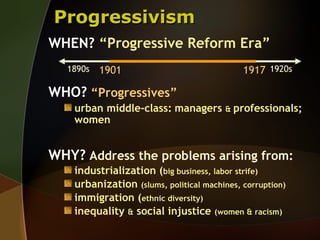
WHEN? “Progressive Reform Era”
1890s

1901

1917 1920s

WHO? “Progressives”
urban middle-class: managers
women

& professionals;

WHY? Address the problems arising from:
industrialization (big business, labor strife)
urbanization (slums, political machines, corruption)
immigration (ethnic diversity)
inequality & social injustice (women & racism)
Progressivism
WHAT are their goals?

► Democracy – government accountable to the people
► Regulation of corporations & monopolies
► Social justice – workers, poor, minorities
► Environmental

protection

HOW?

► Government (laws, regulations, programs)
► Efficiency
value experts, use of scientific study to determine the
best solution
Pragmatism

–

William James, John Dewey ( Darwinism)

(Cf. scientific management/Taylor)

HOW MUCH?????
Origins of Progressivism
►
►
►
►

“Muckrakers”
Jacob Riis – How the Other Half Lives (1890)
Ida Tarbell – “The History of the Standard Oil Co.” (1902)
Lincoln Steffens – The Shame of the Cities (1904)

Ida Tarbell

Lincoln Steffens
MUNICIPAL
& STATE
REFORMS
MUNICIPAL REFORM
► municipal

reform

► utilities - water, gas, electricity, trolleys
►

council-manager plan

Shoe line - Bowery
men with gifts
from ward boss
Tim Sullivan,
February, 1910

(Dayton, 1913)
MUNICIPAL REFORM
strong mayor system

COUNCIL
MEMBER

COUNCIL
MEMBER

COUNCIL
MEMBER

COUNCIL
MEMBER

council-manager plan
COUNCIL
MEMBER

COUNCIL
MEMBER

COUNCIL
MEMBER

MAYOR

(Dayton, 1913)

COUNCIL
MEMBER

CITY
MANAGER
CITY SERVICES

COUNCIL
MEMBER

COUNCIL
MEMBER

CITY
SERVICES
STATE POLITICAL REFORM
► secret

ballots
► direct primary
► Robert M.
LaFollette
► Seventeenth
Amendment
(1913)

► initiative
► referendum
► recall

Robert M. LaFollette,

Wisconsin Governor 1900-06
STATE POLITICAL REFORM

Voter
Participation
in Presidential
Elections,
1876-1920
STATE SOCIAL REFORMS
► professional

social workers
► settlement houses - education, culture, day
care

► child

labor laws

Enable education & advancement for working
class children
STATE SOCIAL REFORMS
► workplace

& labor reforms

eight-hour work day
improved safety & health conditions in
factories
workers compensation laws
minimum wage laws
unionization
child labor laws

Triangle Shirtwaist
Factory Fire, 1913
State Social Reform: Child Labor
Child Laborers in Indiana Glass Works,
Midnight, Indiana. 1908

Child Laborer, Newberry, S.C. 1908

“Breaker Boys” Pennsylvania, 1911

Shrimp pickers in Peerless Oyster Co.
Bay St. Louis, Miss., March 3, 1911
Settlement Houses
► Settlement

Houses
► Hull-House – Jane Addams

Jane Addams (1905)

Hull-House Complex in 1906
TEMPERANCE
► Temperance Crusade
► Women’s Christian
Temperance Union (WCTU)
► Anti-Saloon League

Frances Willard (1838-98),
leader of the WCTU

Anti-Saloon League Campaign, Dayton
TEMPERANCE & PROHIBITION
► Eighteenth

Amendment

Prohibition on the Eve of
the 18th Amendment, 1919
SOCIALISM
ALTERNATIVES
SOCIALISM
► Socialist

Party
► Eugene V. Debs

► Industrial

World

Workers of the

(IWW or “Wobblies”)

Socialists parade, May Day, 1910

Eugene V. Debs
NATIONA
L

REFORM
Roosevelt, Taft & Wilson
as Progressive presidents
ESSENTIAL QUESTION
How effective were Progressive
Era reformers and the federal
government in bringing about
reform at the national level in
the period 1900-1920?
Assassination of President McKinley , Sept 6,
1901
Theodore Roosevelt:
the “accidental President”
Republican (1901-1909)

(The New-York Historical Society)
Roosevelt’s
“Square Deal”
► 1902

Anthracite Coal
Miners Strike
► “Square Deal”

Anthracite miners at Scranton, Pennsylvania, 1900
Roosevelt the “trust-buster”
► Northern

Securities Company (1904)
► “good trusts” and “bad trusts”
► Hepburn Railroad Regulation Act (1906)

“ONE SEES HIS FINISH UNLESS GOOD GOVERNMENT RETAKES THE SHIP”
Consumer Protection
► Upton

Sinclair’s The Jungle
► Pure Food and Drug Act (1906)
► Meat Inspection Act (1906)

Chicago Meatpacking Workers, 1905

"A nauseating job, but it must be done"
Roosevelt &
Conservation
► Used

the Forest
Reserve Act of 1891
► U.S. Forest Service
(1906)

► Gifford

Pinchot
► White House
conference on
conservation -1908
► John Muir
Theodore
Roosevelt &
John Muir
at Yosemite
1906

Theodore Roosevelt and
Gifford Pinchot, 1907
CONSERVATION :
National Parks and
Forests
William
Howard Taft

President 1909-13
Republican

Postcard with Taft cartoon
Taft Birthplace today, Mt. Auburn
Taft’s Progressive Accomplishments
► trust-busting
► forest

and oil
reserves

► Sixteenth

Amendment

(Taft has) “…completely
twisted around the policies
I advocated and acted
upon.”
-Theodore Roosevelt

► BUT:

Caused split in
Republican Party
Payne-Aldrich Tariff
Pinchot-Ballinger
Controversy

(1909)
Election of 1912
► Woodrow

Wilson
► Progressive Party
(“Bull Moose party”)

► “New

Nationalism”

► significance

Woodrow Wilson

Theodore
Roosevelt
cartoon,
March 1912
1912
Presidential
Election
Wilson
► Woodrow

Wilson
► “New Freedom”
► Underwood Simmons
Tariff (1913)
► Sixteenth Amendment
(1913)

► Federal

Reserve Act (1913)
► Federal Trade
Commission Act (1914)
► Clayton Anti-Trust Act
(1914)

► Keating-Owen

Act

(1916)

Wilson at the peak of his power
Federal Reserve System
► Federal Reserve Act
WOMEN
&

SUFFRAG
E
ESSENTIAL QUESTION
To what extent did economic and
political developments as well as
the assumptions about the nature of
women affect the position of
American women during the period
1890-1925?
WOMEN
► “women’s

professions”
► “new woman”
► clubwomen
A local club for nurses was formed in New
York City in 1894. Here the club members
are pictured in their clubhouse reception
area. (Photo courtesy of the Women's History and Resource
Center, General Federation of Women's Clubs.)

The Women's Club of Madison, Wisconsin conducted classes in food,
nutrition, and sewing for recent immigrants. (Photo courtesy of the Women's
History and Resource Center, General Federation of Women's Clubs.)
Women’s Suffrage
► National

American
Woman Suffrage
Association (NAWSA)
► Carrie Chapman Catt

Ohio Woman Suffrage Headquarters,
Cleveland, 1912
Woman suffrage before 1920
Women’s Suffrage
► Alice

Paul
► National Woman’s Party
► Nineteenth Amendment
► Equal Rights
Suffragette
Banner
Amendment
1918

19th Amendment
National Woman’s Party members picketing in front of the White House, 1917

(All: Library of Congress)
RACE

RELATION
S
ESSENTIAL QUESTION
Booker T. Washington and W.E.B. Du Bois
offered different strategies for dealing
with the problems of poverty and discrimination faced by black Americans at the
end of the nineteenth and beginning of
the twentieth centuries. How appropriate
were each of these strategies (considering
the context in which each was developed)?
Black Population, 1920
African-Americans
► Booker

T. Washington
► W.E.B. Du Bois
► Niagara Movement
► “talented tenth”
► NAACP

W.E.B. Du Bois

Booker T.
Washington

Progressive Era

Editor's Notes

  • #6 wikipedia
  • #7 Wadsworth.com; http://www.spartacus.schoolnet.co.uk/Jsteffens.htm
  • #9 Shoe line--Bowery men with gift from Tim Sullivan, February, 1910 "Big Tim" Sullivan, a New York City ward boss, rewarded "repeat voters" with a new pair of shoes. Sullivan once explained, "When you've voted ‘em with their whiskers on, you take ‘em to a barber and scrape off the chin fringe. Then you vote ‘em again…Then to a barber again, off comes the sides and you vote ‘em a third time with the mustache…[Then] clean off the mustache and vote ‘em plain face. That makes every one of ‘em for four votes." (Library of Congress) Pageant 13e Reader’s Companion
  • #11 Wadsworth.com
  • #15 (1) Description: Child Laborers in Indiana Glass Works, Midnight, Indiana. 1908. Photographer, Lewis W. Hine; Credit: Nartional Archives and Records Administration; http://teachpol.tcnj.edu/amer_pol_hist/thumbnail272.html (2) Description: Child Laborer, Newberry, S.C. 1908. The overseer said apologetically, "She just happened in." She was working steadily . photographer, Lewis W. Hine;Credit: Nartional Archives and Records Administration; http://teachpol.tcnj.edu/amer_pol_hist/thumbnail273.html (3) The coal mines of Pennsylvania employed more than ten thousand boys under the age of 16. Known as "breaker boys," they sorted coal. Such work was dangerous and sometimes fatal, as attested by this 1911 headline. (Library of Congress); Pageant 13e History Companion (4) Lewis W. Hine. Shrimp pickers in Peerless Oyster Co. Bay St. Louis, Miss., March 3, 1911.;"On other side of shed still younger children were working. Out of sixty working,... I counted 15 apparently under 12 years of age. Some 3, 4, and 5 years old were picking too.... Boss said they went to work at 3 A.M. and would quit about 3 or 4 P.M." ; PBS American Photography
  • #16 Hull House today: http://cpl.lib.uic.edu/004chicago/timeline/hullhouse.html; http://www.americaslibrary.gov/aa/addams/aa_addams_subj_e.html; (1906 picture) http://tigger.uic.edu/htbin/cgiwrap/bin/urbanexp/main.cgi?file=img/show_gallery.ptt&gallery=3
  • #17 http://prohibition.osu.edu/Willard/; http://prohibition.history.ohio-state.edu/asl/OhioDry1.htm
  • #18 Henretta, America’s History 4e from http://www.bedfordstmartins.com/mapcentral
  • #20 Socialists parade, May Day, 1910 Though their objectives sometimes differed from those of middle-class Progressive reformers, socialists also became a more active force in the early twentieth century. Socialist parades on May Day, such as this one in 1910, were meant to express the solidarity of all working people. (Library of Congress)
  • #22 (2003B DBQ)
  • #23 Description: Assassination of William McKinley. Czolgosz shoots President McKinley with a concealed revolver, at Pan-American Exposition reception, Sept. 6th, 1901.Keywords: Credit: Library of Congresshttp://teachpol.tcnj.edu/amer_pol_hist/thumbnail261.html
  • #24 Wadsworth.com (portrait and on horseback); Underwood and Underwood. Theodore Roosevelt Addressing a Crowd, 1901-09. Collection of The New-York Historical Society. PBS- American Photography
  • #25 Wadsworth.com (both)
  • #26 Scanned from The Verdict 22 May 1899 by C. Gordon Moffat http://history.osu.edu/projects/uscartoons/gapecartoons/TrustsAsPirates.htm
  • #27 Wadsworth.com (stockyards, Meatpacking workers); Brinkley 11e Instructor Resource CD (The Jungle); Theodore Roosevelt cartoon "A nauseating job, but it must be done“; Upton Sinclair's novel, The Jungle, published in 1906, prompted President Theodore Roosevelt to order an investigation of Sinclair's allegations about unsanitary practices. Roosevelt then used the results of that investigation to pressure Congress into approving new federal legislation to inspect meatpacking. (Utica Saturday Globe) Pageant 13e
  • #28 Theodore Roosevelt and Gifford Pinchot, 1907; The two friends and allies in the conservation cause aboard the steamboat Mississippi on a 1907 tour with the Inland Waterways Commission. (Library of Congress)’; [Pageant 13e History Companion] Description: Theodore Roosevelt and John Muir on Glacier Point, Yosemite Valley, California, c1906;Credit: Library of Congress; http://teachpol.tcnj.edu/amer_pol_hist/thumbnail268.html
  • #29 Faragher, Out of Many, 3rd Ed.; http://wps.prenhall.com/hss_faragher_outofmany_ap/
  • #30 This postcard depicts how President Theodore Roosevelt, in command of the Republican Party, persuaded his friend William Howard Taft to run for president in 1908. Taft was not eager for that office, but Roosevelt succeeded in convincing him to seek it. With Roosevelt's strong support, Taft was elected, but he proved a disappointment to Roosevelt. (Collection of Janice L. and David J. Frent)
  • #31 http://www.cr.nps.gov/nr/twhp/wwwlps/lessons/15taft/15taft.htm The Mount Auburn house was sold by the Taft family in 1889. It went through many alterations, including use as an apartment house, before it was saved from demolition by the Taft Memorial Association in 1938, eight years after Taft's death. In 1969, the Federal Government designated the Taft house a national historic site, honoring the life and work of William Howard Taft.
  • #33 Wilson: Wadsworth.com; Description: Theodore Roosevelt as an opera singer who wins the favor of "Miss Insurgency", while Robert La Follette watches in disgust. 03/18/1912. Artist, Berryman, Clifford K.;Credit: National Archives and Records Administration; http://teachpol.tcnj.edu/amer_pol_hist/thumbnail277.html
  • #34 wadsworth
  • #35 Wadsworth.com
  • #36 Thomson Wadsworth.com
  • #38 (1997 DBQ) (1997 DBQ)
  • #39 http://www.nmwh.org/ProgressiveEra/gfwcpictures.html
  • #40 Wadsworth.com
  • #41 Thomson Wadsworth Wadsworth.com
  • #42 Description: Women suffragists picketing in front of the White house. The first picket line - College day in the picket line line, 1917;Credit: Library of Congress.http://teachpol.tcnj.edu/amer_pol_hist/thumbnail294.html; Description: The 19th amendment; Credit: Library of Congress http://teachpol.tcnj.edu/amer_pol_hist/thumbnail317.html
  • #44 (1989 DBQ edited)
  • #45 Faragher, Out of Many, 3rd Ed.; http://wps.prenhall.com/hss_faragher_outofmany_ap/
  • #46 BTW: http://history.grand-forks.k12.nd.us/ndhistory/LessonImages/Sources/Pictures/Booker%20T%20Washington.jpg; Du Bois: Wadsworth.com