Warm-up 1/16/14
1. Would you rather live in the city or the
country? Why?
2. What, to you, is a reasonable size for a
city? What’s too big? Too small? Why?
3. Who should decide how cities look,
function, and/or grow?
Standards
• · 8.H.3.1 Explain how migration and
immigration contributed to the development
of North Carolina and the United States
from colonization to contemporary times.
• · 8.H.3.2 Explain how changes brought
about by technology and other innovations
affected individuals and groups in North
Carolina and the United States.
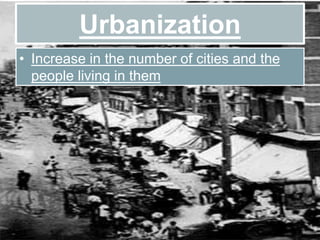
• Increase in the number of cities and the
people living in them
Urbanization
Industrialization
• Second Urban Revolution prompted by
second revolution in agriculture
• Increased urbanization
• Industrial Cities – fundamental reason for
existence was to simply assemble, fabricate
& distribute manufactured goods
• Urban Sprawl – unrestricted growth of
housing, commercial developments and
roads
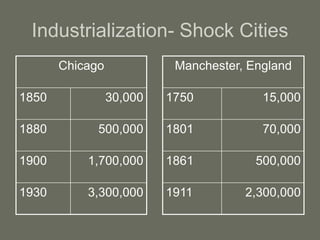
Industrialization- Shock Cities
Manchester, England
1750 15,000
1801 70,000
1861 500,000
1911 2,300,000
Chicago
1850 30,000
1880 500,000
1900 1,700,000
1930 3,300,000
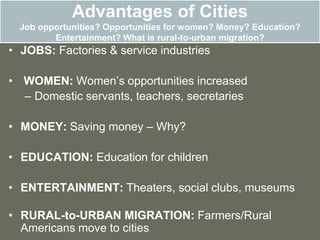
Advantages of Cities
Job opportunities? Opportunities for women? Money? Education?
Entertainment? What is rural-to-urban migration?
• JOBS: Factories & service industries
• WOMEN: Women’s opportunities increased
– Domestic servants, teachers, secretaries
• MONEY: Saving money – Why?
• EDUCATION: Education for children
• ENTERTAINMENT: Theaters, social clubs, museums
• RURAL-to-URBAN MIGRATION: Farmers/Rural
Americans move to cities
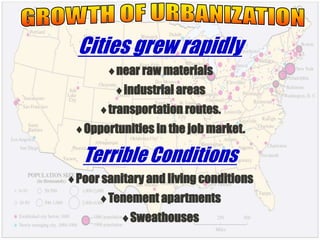
Cities grew rapidly
near raw materials
industrial areas
transportation routes.
Opportunities in the job market.
Terrible Conditions
Poor sanitary and living conditions
Tenement apartments
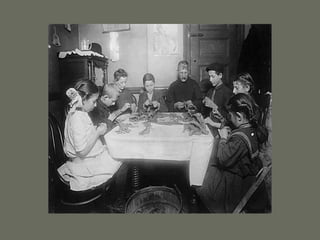
Sweathouses
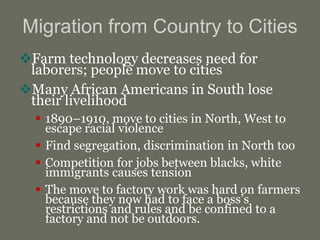
Migration from Country to Cities
Farm technology decreases need for
laborers; people move to cities
Many African Americans in South lose
their livelihood
 1890–1910, move to cities in North, West to
escape racial violence
 Find segregation, discrimination in North too
 Competition for jobs between blacks, white
immigrants causes tension
 The move to factory work was hard on farmers
because they now had to face a boss’s
restrictions and rules and be confined to a
factory and not be outdoors.
Urban Technological Improvements
Key inventions? Inventors? What problems did they solve?
• Skyscrapers (overcrowding)
• Safety Elevator (Elisha Otis)
• Electric streetcars (cleaner, quieter)
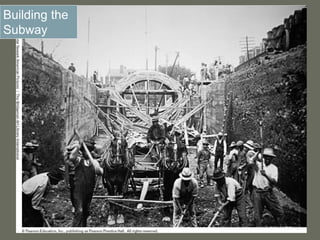
• Subways (overcrowding)
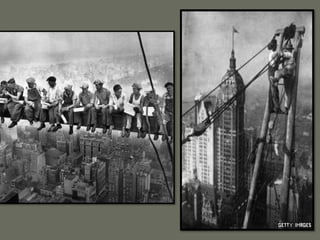
Engineers Build Skyward
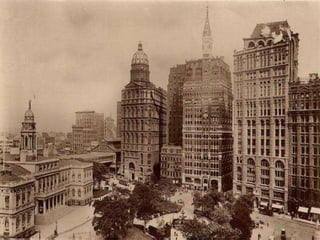
• Skyscrapers = 10 story and taller buildings
that had steel frames.
• Provided office space for cities that had no more
room left on the ground.
• Elisha Otis = Developed safety elevator that
would not fall if the lifting rope broke.
• The American Institute of Architecture-1857
– Required education and licensing to become
and architect.
– Built schools, libraries, train stations, residents
and office buildings.
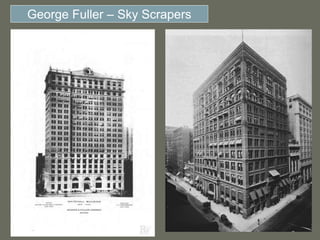
George Fuller – Sky Scrapers
Building the
Subway
Electricity and Mass Transit
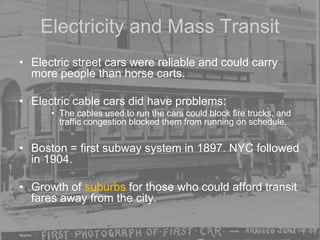
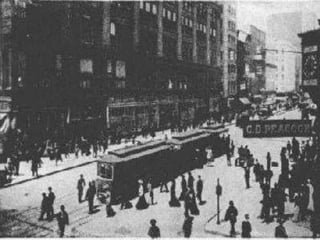
• Electric street cars were reliable and could carry
more people than horse carts.
• Electric cable cars did have problems:
• The cables used to run the cars could block fire trucks, and
traffic congestion blocked them from running on schedule.
• Boston = first subway system in 1897. NYC followed
in 1904.
• Growth of suburbs for those who could afford transit
fares away from the city.
Issues of Urban Living
Major problems? What are tenements? What were the living conditions?
• MAJOR PROBLEMS: Overcrowding, poverty, poor
sanitation
• TENEMENTS: Low-cost, multi-family housing
• LIVING CONDITIONS: Poor water quality, potential
for fire, overcrowding
• OTHER PROBLEMS: Dangerous streets, crime,
tension between urban groups (gangs)
THE EXPANDING CITY
AND ITS PROBLEMS
• Urban problems
– Housing
– Public health
– Crime
– Immorality
• Expansion of industry was main cause of urban
growth
– 1890: one person in three lived in a city
– 1910: nearly one in two
– Increasing proportion of urban population was
immigrants
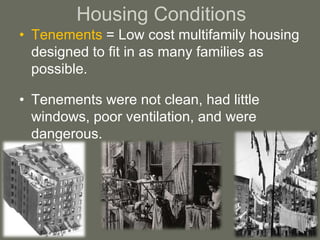
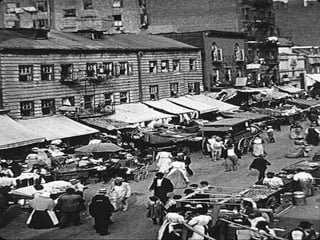
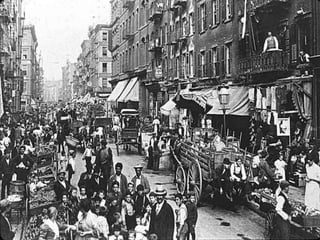
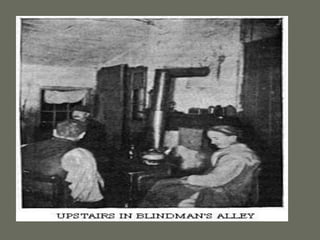
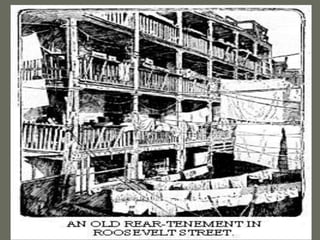
Housing Conditions
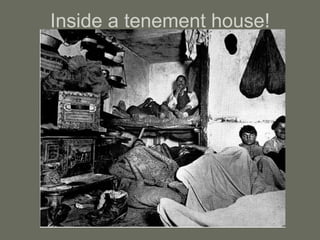
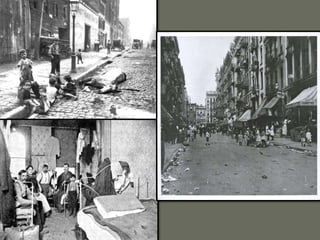
• Tenements = Low cost multifamily housing
designed to fit in as many families as
possible.
• Tenements were not clean, had little
windows, poor ventilation, and were
dangerous.
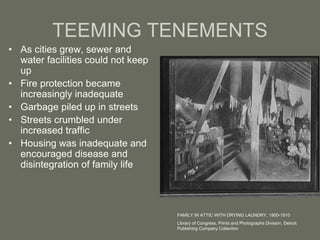
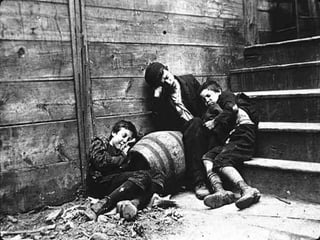
TEEMING TENEMENTS
• As cities grew, sewer and
water facilities could not keep
up
• Fire protection became
increasingly inadequate
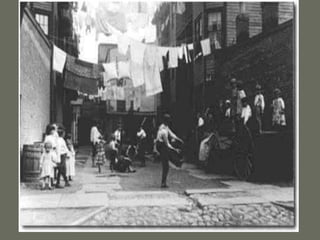
• Garbage piled up in streets
• Streets crumbled under
increased traffic
• Housing was inadequate and
encouraged disease and
disintegration of family life
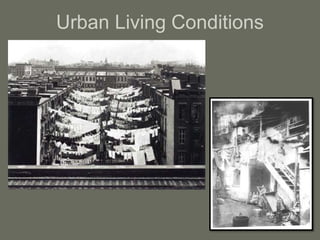
FAMILY IN ATTIC WITH DRYING LAUNDRY, 1900-1910
Library of Congress, Prints and Photographs Division, Detroit
Publishing Company Collection
Urban Living Conditions
http://www.tenement.org/education_lessonplans.html
http://www.tenement.org/immigrate/
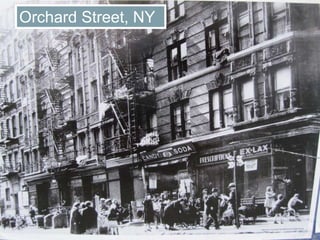
97 Orchard Street, NY
Orchard Street, NY
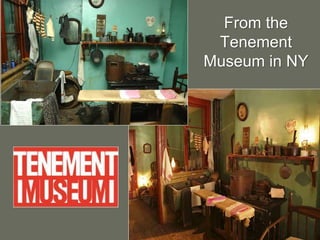
From the
Tenement
Museum in NY
Inside a tenement house!
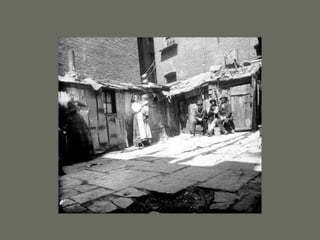
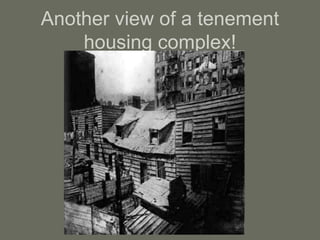
Another view of a tenement
housing complex!
Water and Sanitation
Water
 1860s cities have inadequate or no piped water,
indoor plumbing rare
 Filtration introduced 1870s, chlorination in 1908
Sanitation
 Streets: manure, open gutters, factory smoke, poor
trash collection
 Contractors hired to sweep streets, collect garbage,
clean outhouses-------often do not do job properly
 By 1900, cities develop sewer lines, create sanitation
departments
Fire and Crime
Crime
 As population grows, thieves flourish
 Early police forces too small to be effective
Fire
 Fire hazards: limited water, wood houses, candles,
kerosene heaters
 Most firefighters volunteers, not always available
 1900, most cities have full-time, professional fire
departments
 Fire sprinklers, non-flammable building materials make
cities safer
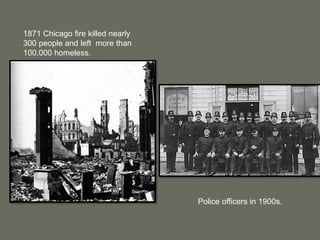
1871 Chicago fire killed nearly
300 people and left more than
100,000 homeless.
Police officers in 1900s.
The Triangle Shirtwaist Factory
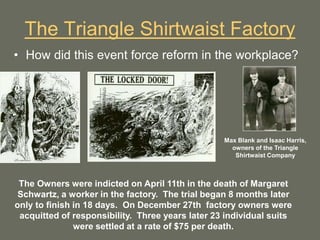
• How did this event force reform in the workplace?
Max Blank and Isaac Harris,
owners of the Triangle
Shirtwaist Company
The Owners were indicted on April 11th in the death of Margaret
Schwartz, a worker in the factory. The trial began 8 months later
only to finish in 18 days. On December 27th factory owners were
acquitted of responsibility. Three years later 23 individual suits
were settled at a rate of $75 per death.
City Planners start to control
growth
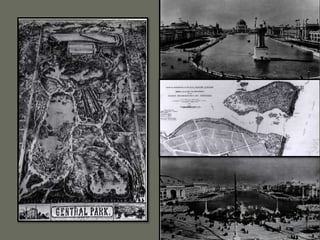
• As cities grew, architectural firms expanded to offer city planning
services to make cities more functional and beautiful.
• Cities were zoned for different uses. (residential, industrial and
financial)
• Parks, boulevards, buildings and electric street lights were a few of
the new developments.
• Frederick Law Olmstead = Designed Philadelphia’s Fairmount Park,
NYC’s Central Park, and similar parks in Detroit, Washington D.C.,
and California.
These
characteristics
and issues of
urbanization
caused…
… These
cultural trends
in America
during the
Gilded Age…
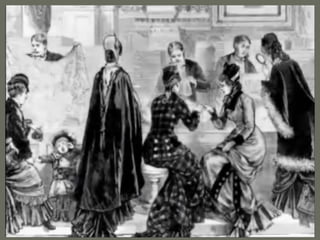
Conspicuous Consumerism
How did lifestyles change? How available did goods become?
What new amenities emerged?
• People buying more goods than ever (increase in
consumerism)
– Purchasing goods for the purpose of impressing
others
• People are able to buy more than they ever have in
the past
– People now working for wages (instead of on
farms)
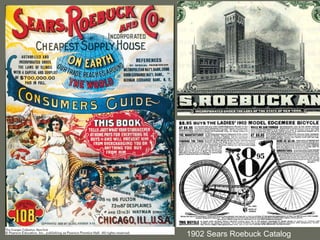
• NEW AMENITIES: Department stores, advertising,
mail-order catalogs
1902 Sears Roebuck Catalog
Mass Culture
• Mass Culture- when
household items,
food, preferences are
the same from house
to house in a given
place.
• Newspapers
• Literature
• Education
Mass Culture Boom
What is it? How was it spread? Who were some key people in it?
• WHAT?: Similar cultural patterns in a society
• SPREAD by transportation, communication, &
advertising
• WHO?: Literature criticized society – Mark
Twain & Horatio Alger
• Compulsory schools, increased literacy rate
• College for women and African Americans
Advertising
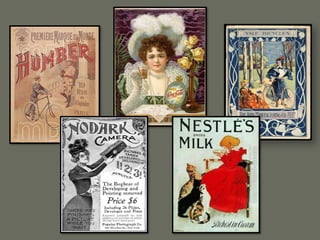
• Rowland H. Macy = opened one of the first
department stores in N.Y. in 1858 and it became the
largest in America.
• Methods used = advertising, goods organized into
departments, and high quality goods for fair prices.
• New concepts at other stores = money back
guarantee, newspaper advertisements, lower
shipping rates, distinctive logos, and long distance
shipping.
The first Macy’s in New York City
Rowland H. Macy
Newspapers
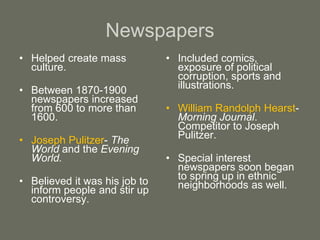
• Helped create mass
culture.
• Between 1870-1900
newspapers increased
from 600 to more than
1600.
• Joseph Pulitzer- The
World and the Evening
World.
• Believed it was his job to
inform people and stir up
controversy.
• Included comics,
exposure of political
corruption, sports and
illustrations.
• William Randolph Hearst-
Morning Journal.
Competitor to Joseph
Pulitzer.
• Special interest
newspapers soon began
to spring up in ethnic
neighborhoods as well.
Education
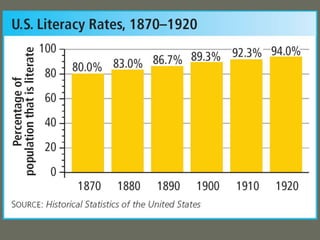
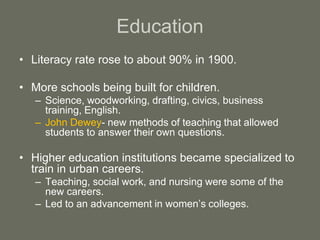
• Literacy rate rose to about 90% in 1900.
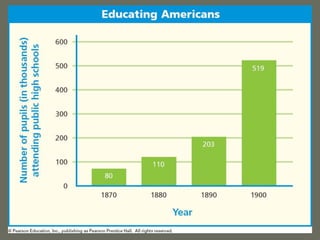
• More schools being built for children.
– Science, woodworking, drafting, civics, business
training, English.
– John Dewey- new methods of teaching that allowed
students to answer their own questions.
• Higher education institutions became specialized to
train in urban careers.
– Teaching, social work, and nursing were some of the
new careers.
– Led to an advancement in women’s colleges.
New Entertainment
What were the new types of entertainment? What event, shows, and
spectator sports emerged?
• Amusement parks, performances, events
• Theatres, shows, motion pictures
(Nickelodeons)
• Spectator sports – baseball, horse racing,
boxing, football, basketball
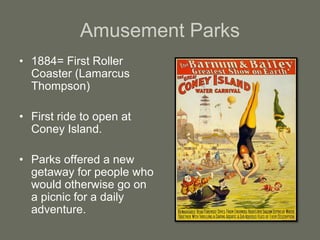
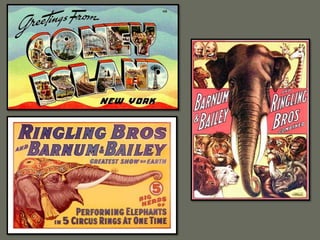
Amusement Parks
• 1884= First Roller
Coaster (Lamarcus
Thompson)
• First ride to open at
Coney Island.
• Parks offered a new
getaway for people who
would otherwise go on
a picnic for a daily
adventure.
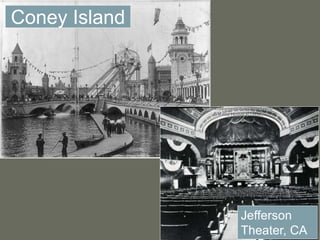
Coney Island
Jefferson
Theater, CA

9920717.pptx

  • 1.
    Warm-up 1/16/14 1. Wouldyou rather live in the city or the country? Why? 2. What, to you, is a reasonable size for a city? What’s too big? Too small? Why? 3. Who should decide how cities look, function, and/or grow?
  • 2.
    Standards • · 8.H.3.1Explain how migration and immigration contributed to the development of North Carolina and the United States from colonization to contemporary times. • · 8.H.3.2 Explain how changes brought about by technology and other innovations affected individuals and groups in North Carolina and the United States.
  • 3.
    • Increase inthe number of cities and the people living in them Urbanization
  • 4.
    Industrialization • Second UrbanRevolution prompted by second revolution in agriculture • Increased urbanization • Industrial Cities – fundamental reason for existence was to simply assemble, fabricate & distribute manufactured goods • Urban Sprawl – unrestricted growth of housing, commercial developments and roads
  • 5.
    Industrialization- Shock Cities Manchester,England 1750 15,000 1801 70,000 1861 500,000 1911 2,300,000 Chicago 1850 30,000 1880 500,000 1900 1,700,000 1930 3,300,000
  • 6.
    Advantages of Cities Jobopportunities? Opportunities for women? Money? Education? Entertainment? What is rural-to-urban migration? • JOBS: Factories & service industries • WOMEN: Women’s opportunities increased – Domestic servants, teachers, secretaries • MONEY: Saving money – Why? • EDUCATION: Education for children • ENTERTAINMENT: Theaters, social clubs, museums • RURAL-to-URBAN MIGRATION: Farmers/Rural Americans move to cities
  • 7.
    Cities grew rapidly nearraw materials industrial areas transportation routes. Opportunities in the job market. Terrible Conditions Poor sanitary and living conditions Tenement apartments Sweathouses
  • 8.
    Migration from Countryto Cities Farm technology decreases need for laborers; people move to cities Many African Americans in South lose their livelihood  1890–1910, move to cities in North, West to escape racial violence  Find segregation, discrimination in North too  Competition for jobs between blacks, white immigrants causes tension  The move to factory work was hard on farmers because they now had to face a boss’s restrictions and rules and be confined to a factory and not be outdoors.
  • 9.
    Urban Technological Improvements Keyinventions? Inventors? What problems did they solve? • Skyscrapers (overcrowding) • Safety Elevator (Elisha Otis) • Electric streetcars (cleaner, quieter) • Subways (overcrowding)
  • 10.
    Engineers Build Skyward •Skyscrapers = 10 story and taller buildings that had steel frames. • Provided office space for cities that had no more room left on the ground. • Elisha Otis = Developed safety elevator that would not fall if the lifting rope broke. • The American Institute of Architecture-1857 – Required education and licensing to become and architect. – Built schools, libraries, train stations, residents and office buildings.
  • 12.
    George Fuller –Sky Scrapers
  • 14.
  • 15.
    Electricity and MassTransit • Electric street cars were reliable and could carry more people than horse carts. • Electric cable cars did have problems: • The cables used to run the cars could block fire trucks, and traffic congestion blocked them from running on schedule. • Boston = first subway system in 1897. NYC followed in 1904. • Growth of suburbs for those who could afford transit fares away from the city.
  • 17.
    Issues of UrbanLiving Major problems? What are tenements? What were the living conditions? • MAJOR PROBLEMS: Overcrowding, poverty, poor sanitation • TENEMENTS: Low-cost, multi-family housing • LIVING CONDITIONS: Poor water quality, potential for fire, overcrowding • OTHER PROBLEMS: Dangerous streets, crime, tension between urban groups (gangs)
  • 18.
    THE EXPANDING CITY ANDITS PROBLEMS • Urban problems – Housing – Public health – Crime – Immorality • Expansion of industry was main cause of urban growth – 1890: one person in three lived in a city – 1910: nearly one in two – Increasing proportion of urban population was immigrants
  • 19.
    Housing Conditions • Tenements= Low cost multifamily housing designed to fit in as many families as possible. • Tenements were not clean, had little windows, poor ventilation, and were dangerous.
  • 20.
    TEEMING TENEMENTS • Ascities grew, sewer and water facilities could not keep up • Fire protection became increasingly inadequate • Garbage piled up in streets • Streets crumbled under increased traffic • Housing was inadequate and encouraged disease and disintegration of family life FAMILY IN ATTIC WITH DRYING LAUNDRY, 1900-1910 Library of Congress, Prints and Photographs Division, Detroit Publishing Company Collection
  • 21.
  • 22.
  • 23.
  • 26.
  • 27.
    Another view ofa tenement housing complex!
  • 32.
    Water and Sanitation Water 1860s cities have inadequate or no piped water, indoor plumbing rare  Filtration introduced 1870s, chlorination in 1908 Sanitation  Streets: manure, open gutters, factory smoke, poor trash collection  Contractors hired to sweep streets, collect garbage, clean outhouses-------often do not do job properly  By 1900, cities develop sewer lines, create sanitation departments
  • 34.
    Fire and Crime Crime As population grows, thieves flourish  Early police forces too small to be effective Fire  Fire hazards: limited water, wood houses, candles, kerosene heaters  Most firefighters volunteers, not always available  1900, most cities have full-time, professional fire departments  Fire sprinklers, non-flammable building materials make cities safer
  • 37.
    1871 Chicago firekilled nearly 300 people and left more than 100,000 homeless. Police officers in 1900s.
  • 38.
    The Triangle ShirtwaistFactory • How did this event force reform in the workplace? Max Blank and Isaac Harris, owners of the Triangle Shirtwaist Company The Owners were indicted on April 11th in the death of Margaret Schwartz, a worker in the factory. The trial began 8 months later only to finish in 18 days. On December 27th factory owners were acquitted of responsibility. Three years later 23 individual suits were settled at a rate of $75 per death.
  • 39.
    City Planners startto control growth • As cities grew, architectural firms expanded to offer city planning services to make cities more functional and beautiful. • Cities were zoned for different uses. (residential, industrial and financial) • Parks, boulevards, buildings and electric street lights were a few of the new developments. • Frederick Law Olmstead = Designed Philadelphia’s Fairmount Park, NYC’s Central Park, and similar parks in Detroit, Washington D.C., and California.
  • 41.
    These characteristics and issues of urbanization caused… …These cultural trends in America during the Gilded Age…
  • 42.
    Conspicuous Consumerism How didlifestyles change? How available did goods become? What new amenities emerged? • People buying more goods than ever (increase in consumerism) – Purchasing goods for the purpose of impressing others • People are able to buy more than they ever have in the past – People now working for wages (instead of on farms) • NEW AMENITIES: Department stores, advertising, mail-order catalogs
  • 44.
  • 45.
    Mass Culture • MassCulture- when household items, food, preferences are the same from house to house in a given place. • Newspapers • Literature • Education
  • 46.
    Mass Culture Boom Whatis it? How was it spread? Who were some key people in it? • WHAT?: Similar cultural patterns in a society • SPREAD by transportation, communication, & advertising • WHO?: Literature criticized society – Mark Twain & Horatio Alger • Compulsory schools, increased literacy rate • College for women and African Americans
  • 47.
    Advertising • Rowland H.Macy = opened one of the first department stores in N.Y. in 1858 and it became the largest in America. • Methods used = advertising, goods organized into departments, and high quality goods for fair prices. • New concepts at other stores = money back guarantee, newspaper advertisements, lower shipping rates, distinctive logos, and long distance shipping.
  • 48.
    The first Macy’sin New York City Rowland H. Macy
  • 51.
    Newspapers • Helped createmass culture. • Between 1870-1900 newspapers increased from 600 to more than 1600. • Joseph Pulitzer- The World and the Evening World. • Believed it was his job to inform people and stir up controversy. • Included comics, exposure of political corruption, sports and illustrations. • William Randolph Hearst- Morning Journal. Competitor to Joseph Pulitzer. • Special interest newspapers soon began to spring up in ethnic neighborhoods as well.
  • 52.
    Education • Literacy raterose to about 90% in 1900. • More schools being built for children. – Science, woodworking, drafting, civics, business training, English. – John Dewey- new methods of teaching that allowed students to answer their own questions. • Higher education institutions became specialized to train in urban careers. – Teaching, social work, and nursing were some of the new careers. – Led to an advancement in women’s colleges.
  • 54.
    New Entertainment What werethe new types of entertainment? What event, shows, and spectator sports emerged? • Amusement parks, performances, events • Theatres, shows, motion pictures (Nickelodeons) • Spectator sports – baseball, horse racing, boxing, football, basketball
  • 55.
    Amusement Parks • 1884=First Roller Coaster (Lamarcus Thompson) • First ride to open at Coney Island. • Parks offered a new getaway for people who would otherwise go on a picnic for a daily adventure.
  • 57.