2. Classification of matter Chemistry: Matter and materials Grade 10
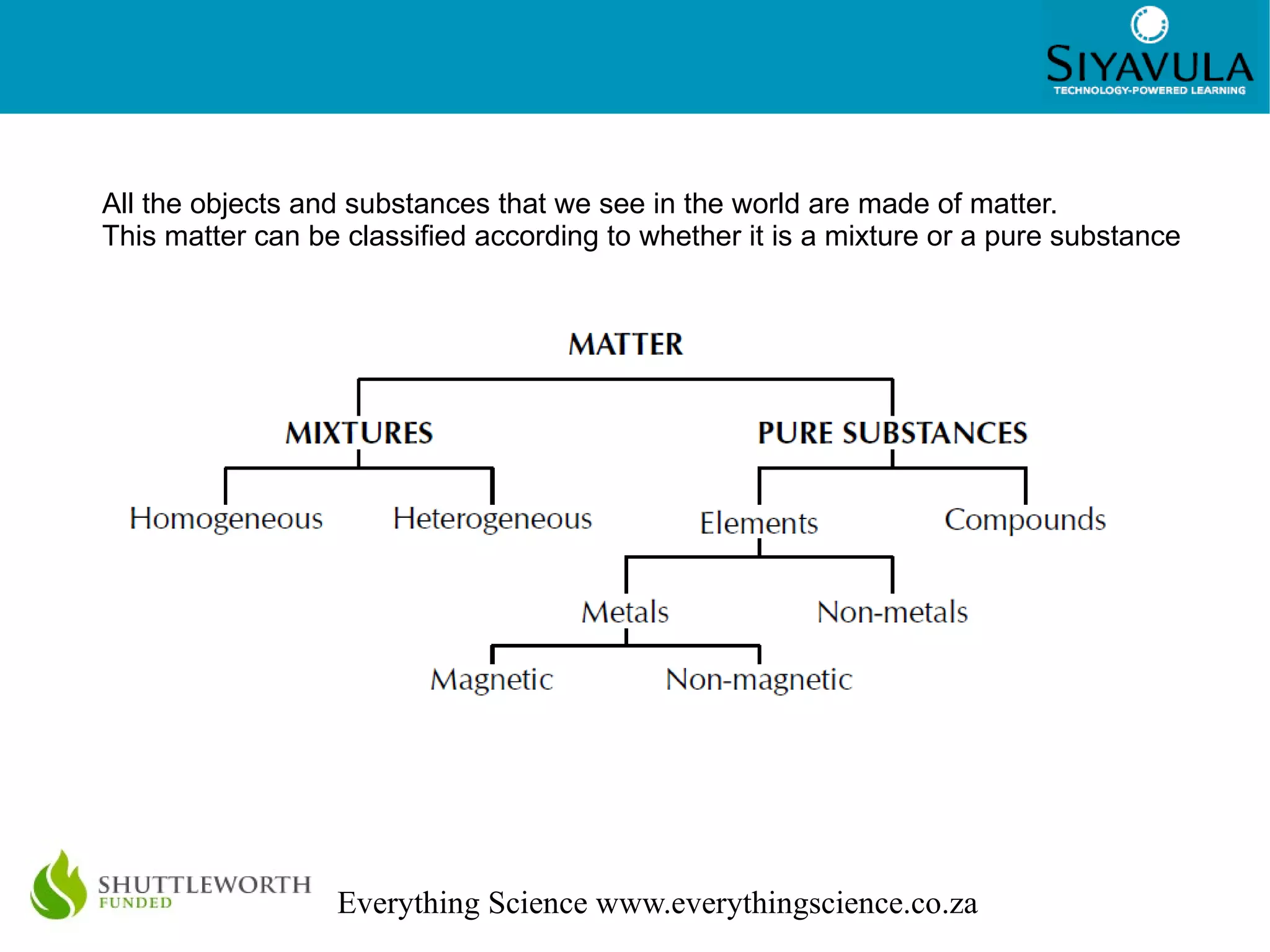
All the objects and substances that we see in the world are made of matter. This matter can be classified according to whether it is a mixture or a pure substance
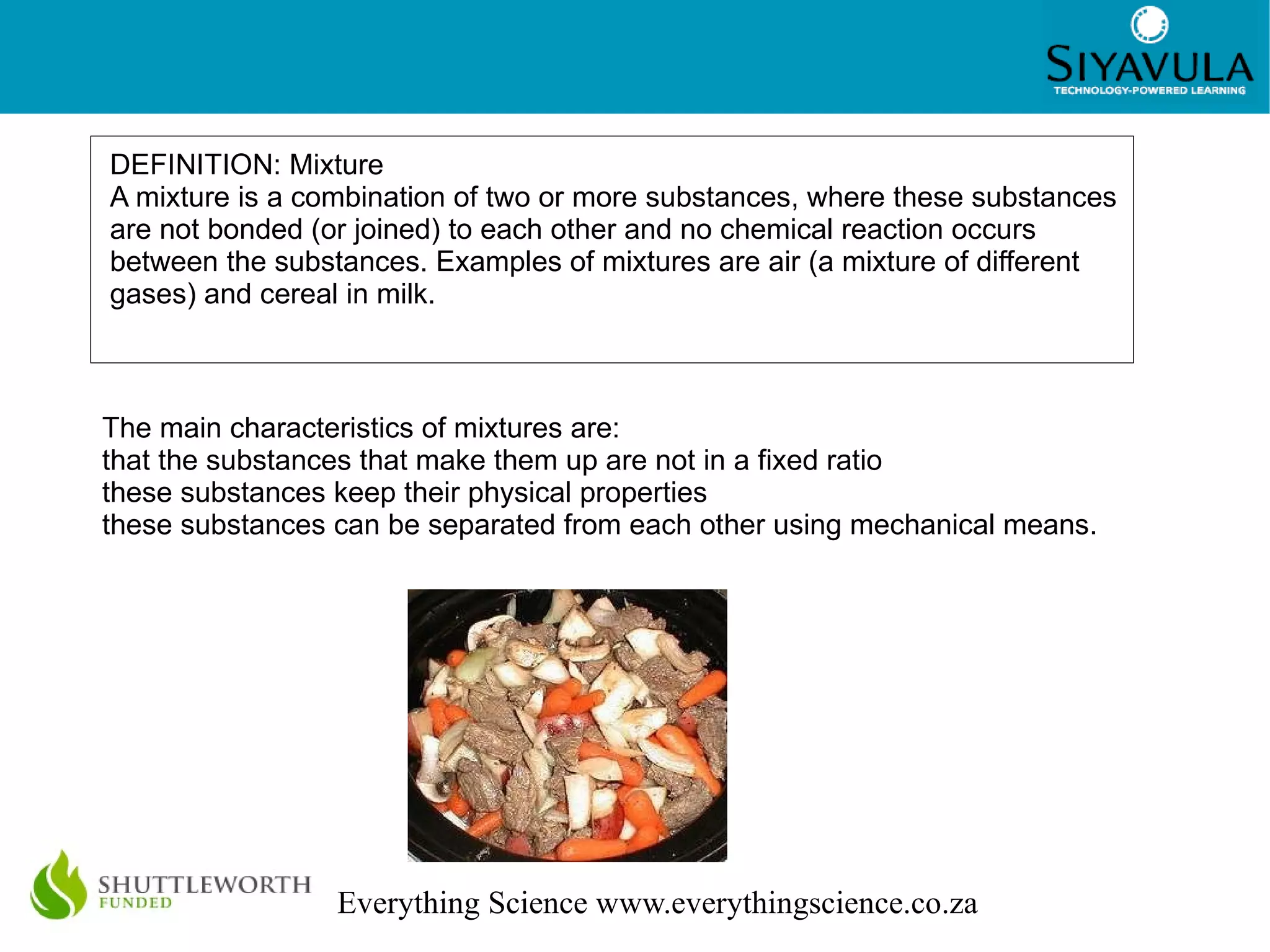
DEFINITION: Mixture A mixture is a combination of two or more substances, where these substances are not bonded (or joined) to each other and no chemical reaction occurs between the substances. Examples of mixtures are air (a mixture of different gases) and cereal in milk. The main characteristics of mixtures are: that the substances that make them up are not in a fixed ratio
these substances keep their physical properties
these substances can be separated from each other using mechanical means.
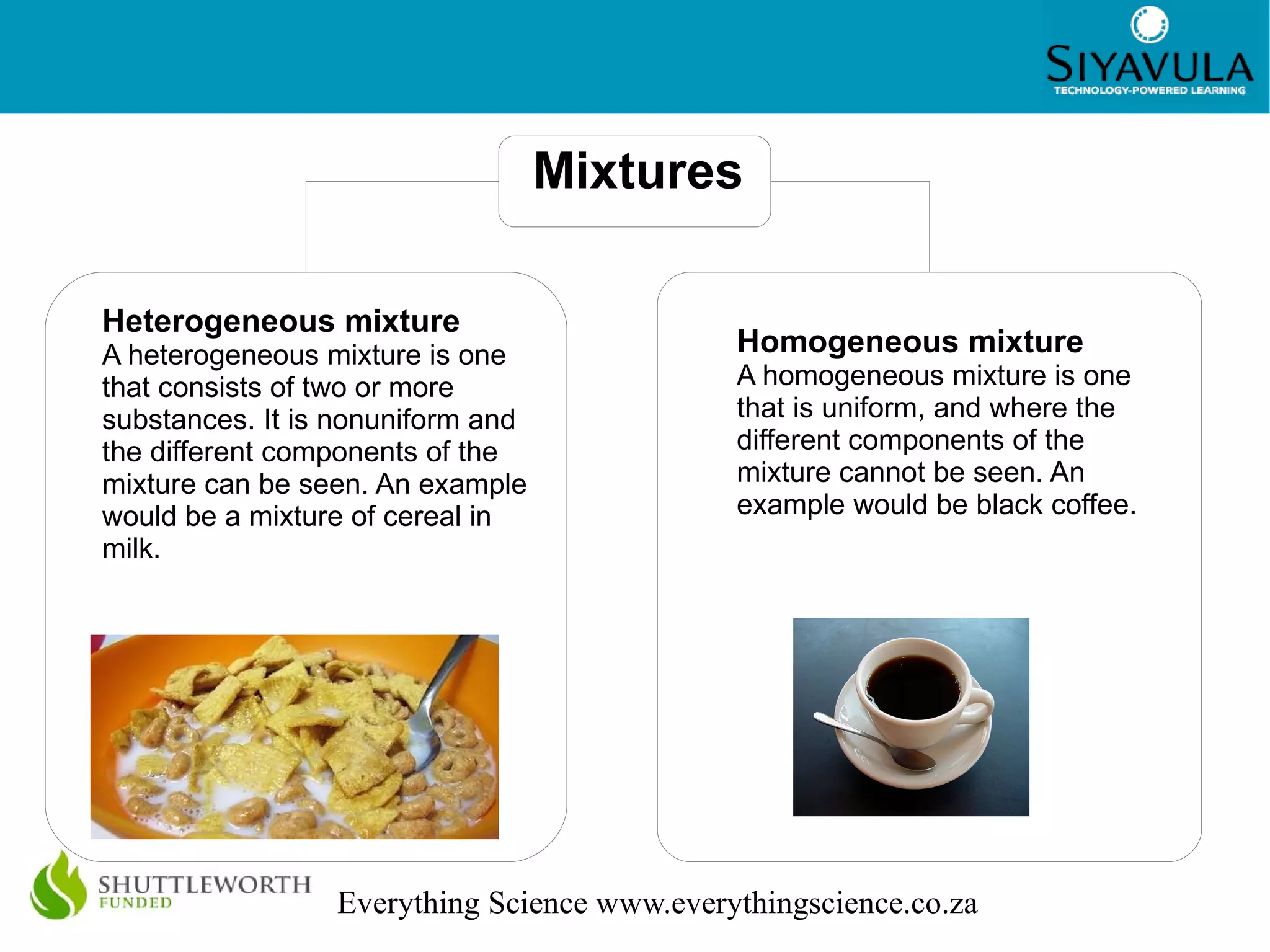
Heterogeneous mixture A heterogeneous mixture is one that consists of two or more substances. It is nonuniform and the different components of the mixture can be seen. An example would be a mixture of cereal in milk. Homogeneous mixture A homogeneous mixture is one that is uniform, and where the different components of the mixture cannot be seen. An example would be black coffee. Mixtures
DEFINITION: Pure substance Pure substances are any material that is not a mixture. Pure substances cannot be broken down into their component parts by ordinary chemical means. Examples are any element, e.g. aluminium, sulphur and any compound, e.g. iron sulphide. Pure substances have a sharply defined (one temperature) melting or boiling point.
Pure substances show only one substance at the end of the chromatography process.
Pure substances cannot be broken down into their constituent parts by ordinary chemical means.
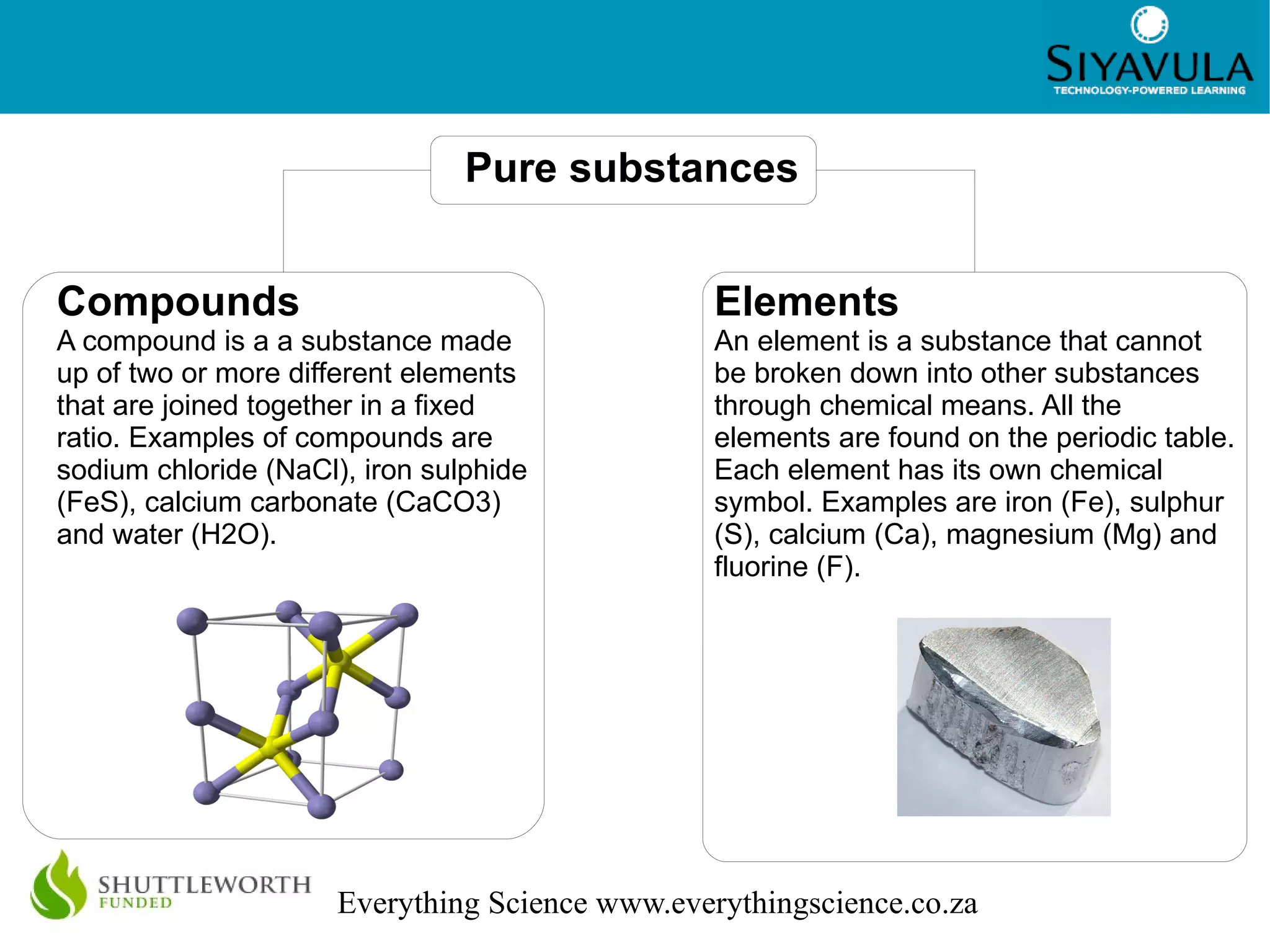
Elements An element is a substance that cannot be broken down into other substances through chemical means. All the elements are found on the periodic table. Each element has its own chemical symbol. Examples are iron (Fe), sulphur (S), calcium (Ca), magnesium (Mg) and fluorine (F). Compounds A compound is a a substance made up of two or more different elements that are joined together in a fixed ratio. Examples of compounds are sodium chloride (NaCl), iron sulphide (FeS), calcium carbonate (CaCO3) and water (H2O). Pure substances
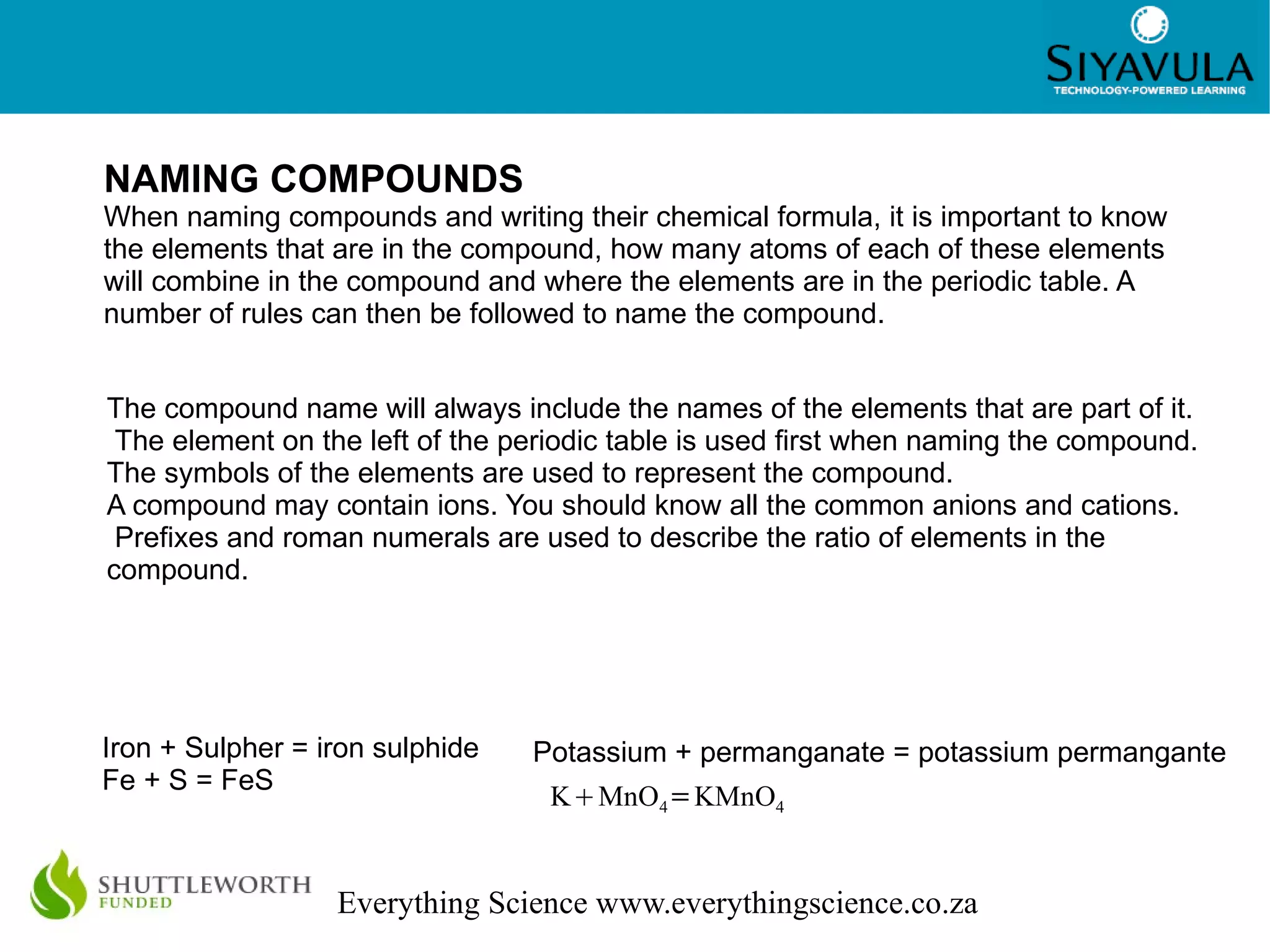
NAMING COMPOUNDS When naming compounds and writing their chemical formula, it is important to know the elements that are in the compound, how many atoms of each of these elements will combine in the compound and where the elements are in the periodic table. A number of rules can then be followed to name the compound. The compound name will always include the names of the elements that are part of it.

Classification of matter

  • 1.
    2. Classification ofmatter Chemistry: Matter and materials Grade 10
  • 2.
    All the objectsand substances that we see in the world are made of matter. This matter can be classified according to whether it is a mixture or a pure substance
  • 3.
    DEFINITION: Mixture Amixture is a combination of two or more substances, where these substances are not bonded (or joined) to each other and no chemical reaction occurs between the substances. Examples of mixtures are air (a mixture of different gases) and cereal in milk. The main characteristics of mixtures are: that the substances that make them up are not in a fixed ratio
  • 4.
    these substances keeptheir physical properties
  • 5.
    these substances canbe separated from each other using mechanical means.
  • 6.
    Heterogeneous mixture Aheterogeneous mixture is one that consists of two or more substances. It is nonuniform and the different components of the mixture can be seen. An example would be a mixture of cereal in milk. Homogeneous mixture A homogeneous mixture is one that is uniform, and where the different components of the mixture cannot be seen. An example would be black coffee. Mixtures
  • 7.
    DEFINITION: Pure substancePure substances are any material that is not a mixture. Pure substances cannot be broken down into their component parts by ordinary chemical means. Examples are any element, e.g. aluminium, sulphur and any compound, e.g. iron sulphide. Pure substances have a sharply defined (one temperature) melting or boiling point.
  • 8.
    Pure substances showonly one substance at the end of the chromatography process.
  • 9.
    Pure substances cannotbe broken down into their constituent parts by ordinary chemical means.
  • 10.
    Elements An elementis a substance that cannot be broken down into other substances through chemical means. All the elements are found on the periodic table. Each element has its own chemical symbol. Examples are iron (Fe), sulphur (S), calcium (Ca), magnesium (Mg) and fluorine (F). Compounds A compound is a a substance made up of two or more different elements that are joined together in a fixed ratio. Examples of compounds are sodium chloride (NaCl), iron sulphide (FeS), calcium carbonate (CaCO3) and water (H2O). Pure substances
  • 11.
    NAMING COMPOUNDS Whennaming compounds and writing their chemical formula, it is important to know the elements that are in the compound, how many atoms of each of these elements will combine in the compound and where the elements are in the periodic table. A number of rules can then be followed to name the compound. The compound name will always include the names of the elements that are part of it.
  • 12.
    The element onthe left of the periodic table is used first when naming the compound.
  • 13.
    The symbols ofthe elements are used to represent the compound.
  • 14.
    A compound maycontain ions. You should know all the common anions and cations.
  • 15.
    Prefixes and romannumerals are used to describe the ratio of elements in the compound. Iron + Sulpher = iron sulphide Fe + S = FeS Potassium + permanganate = potassium permangante
  • 16.
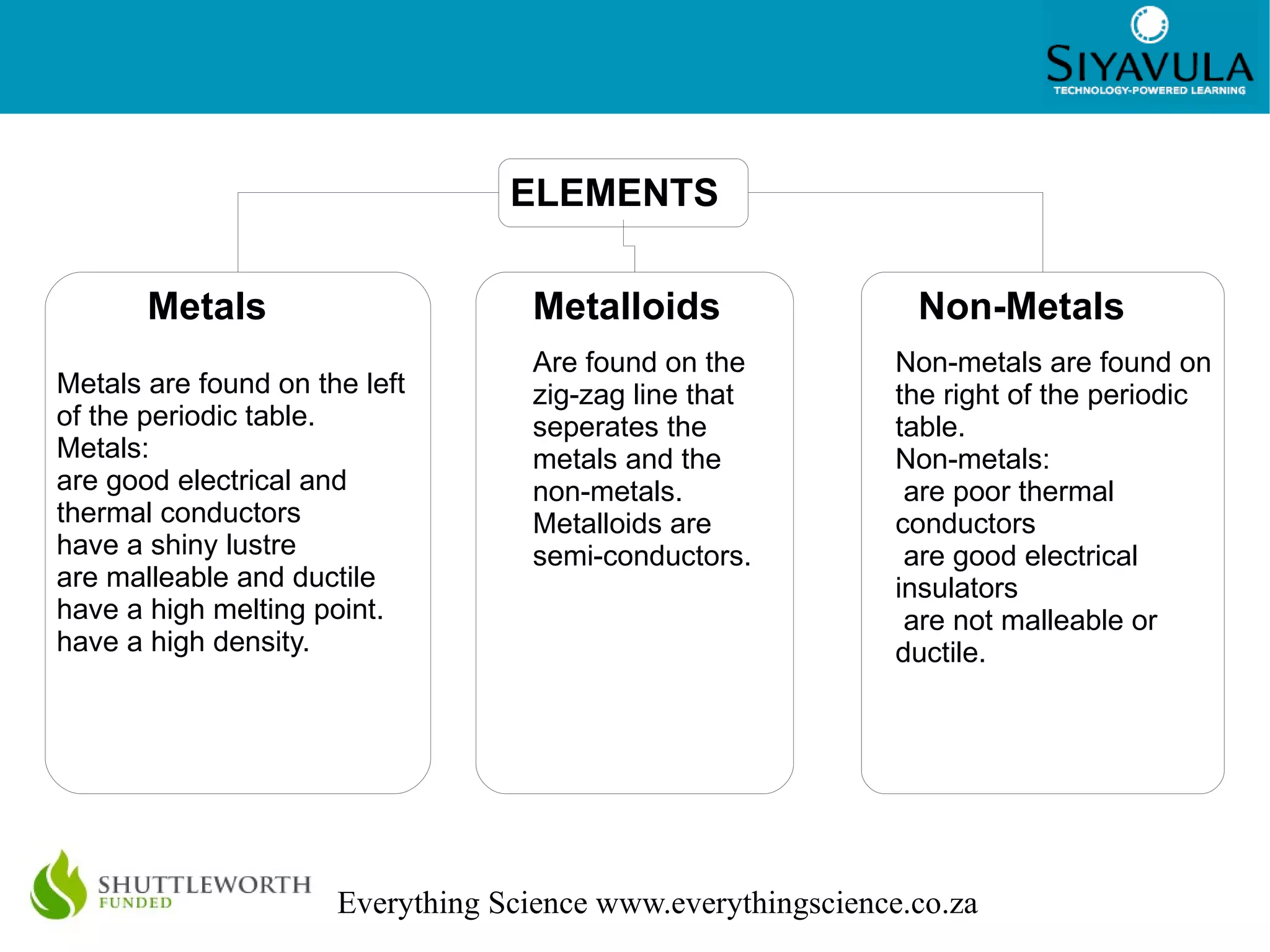
    ELEMENTS Metals Non-MetalsMetalloids Metals are found on the left of the periodic table. Metals: are good electrical and thermal conductors
  • 17.
  • 18.
  • 19.
    have a highmelting point.
  • 20.
    have a highdensity. Are found on the zig-zag line that seperates the metals and the non-metals. Metalloids are semi-conductors. Non-metals are found on the right of the periodic table. Non-metals: are poor thermal conductors
  • 21.
  • 22.
    are not malleableor ductile.
  • 23.
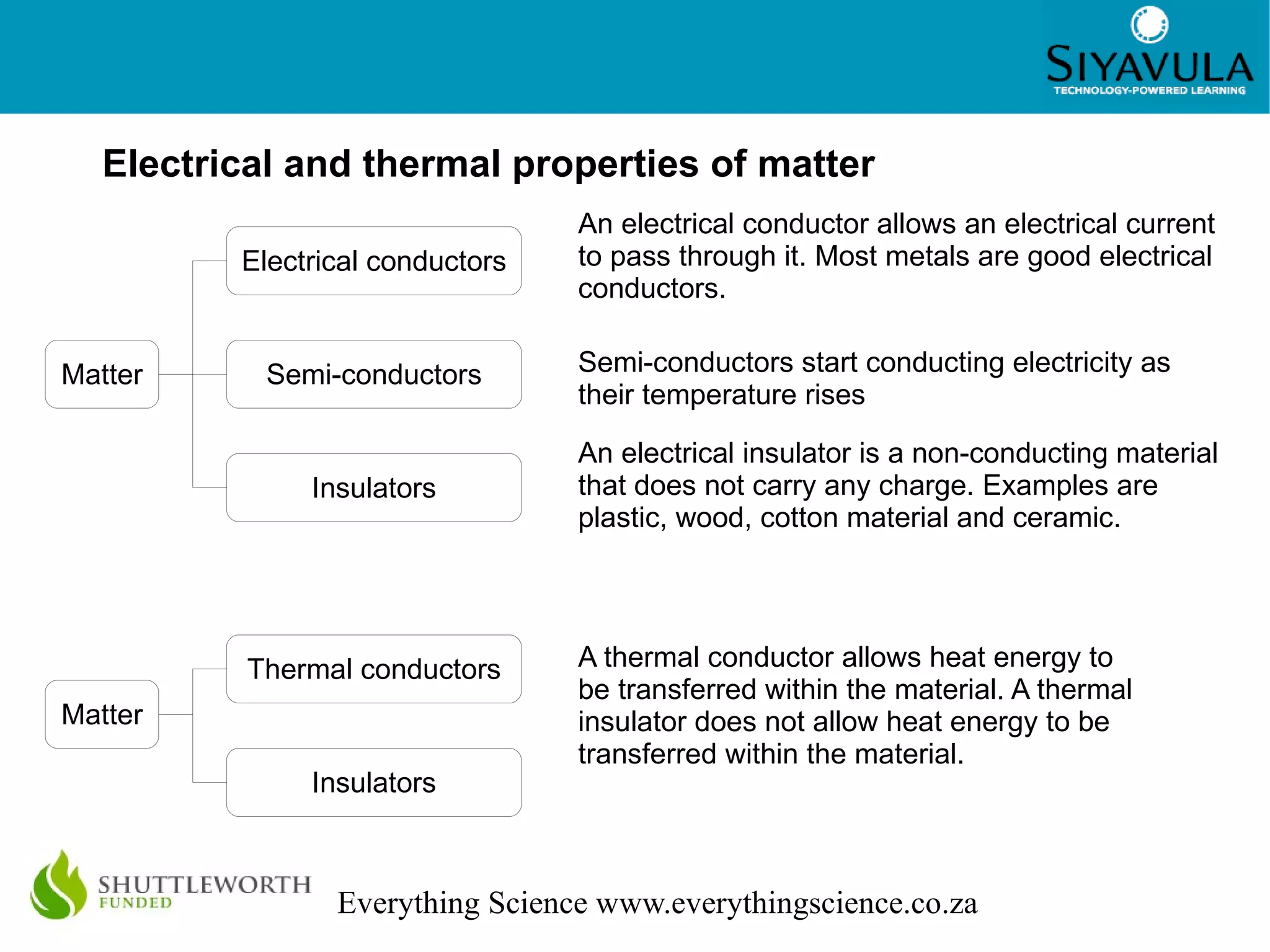
    Electrical and thermalproperties of matter An electrical conductor allows an electrical current to pass through it. Most metals are good electrical conductors. An electrical insulator is a non-conducting material that does not carry any charge. Examples are plastic, wood, cotton material and ceramic. Semi-conductors start conducting electricity as their temperature rises A thermal conductor allows heat energy to be transferred within the material. A thermal insulator does not allow heat energy to be transferred within the material. Matter Electrical conductors Semi-conductors Insulators Matter Thermal conductors Insulators
  • 24.
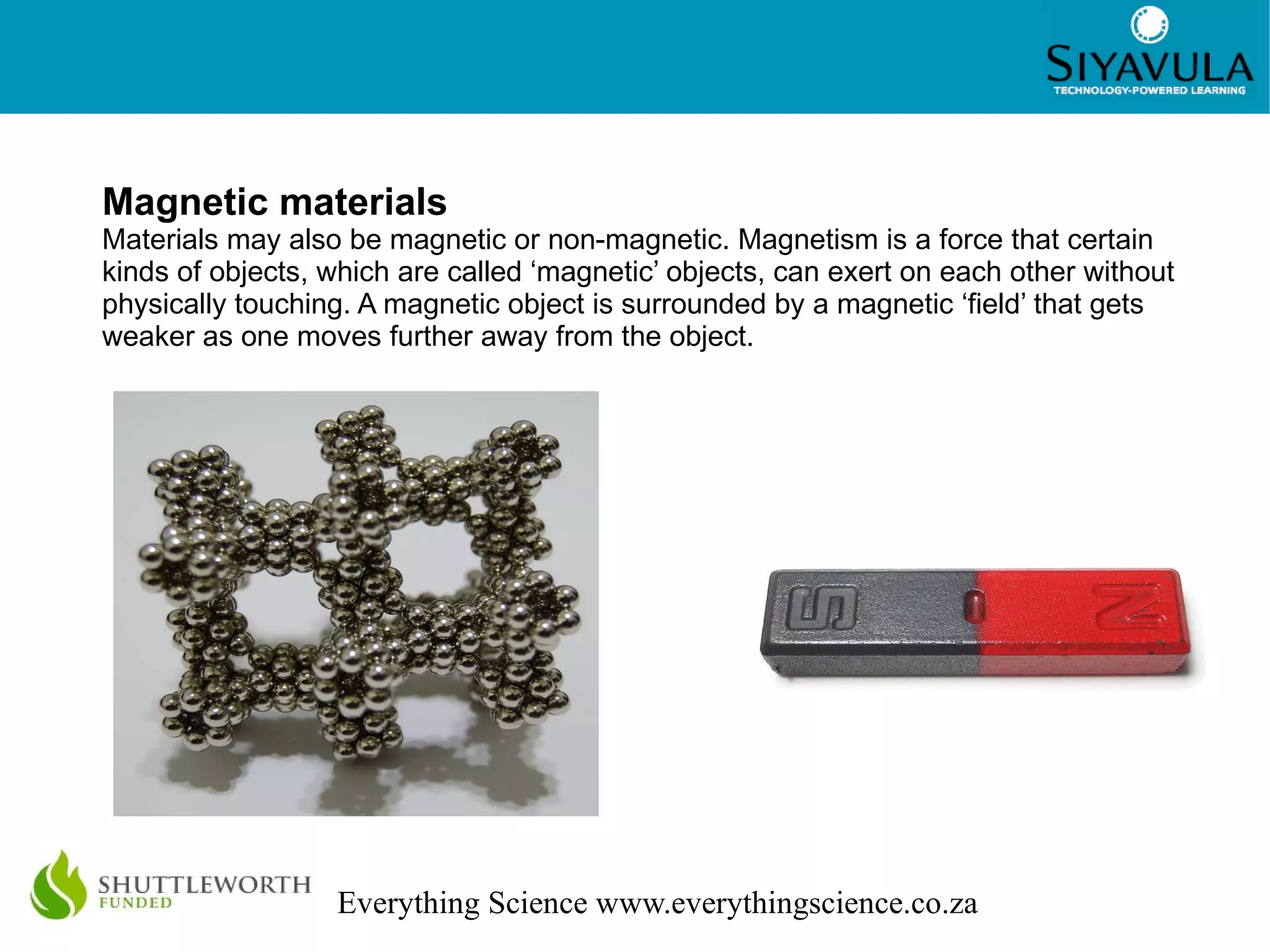
    Magnetic materials Materialsmay also be magnetic or non-magnetic. Magnetism is a force that certain kinds of objects, which are called ‘magnetic’ objects, can exert on each other without physically touching. A magnetic object is surrounded by a magnetic ‘field’ that gets weaker as one moves further away from the object.
  • 25.
    For more practiceor to ask an expert for help on this section see: www.everythingscience.co.za Shortcode: ESAV