Do Now What is the difference between a compound such as water and a mixture such as salsa?
Classifying Matter
Goals: To classify pure substances as elements or compounds. To distinguish between pure substances and mixtures. To classify mixtures as heterogeneous or homogeneous.
Materials can be divided into  pure substances  and  mixtures , depending on their composition.
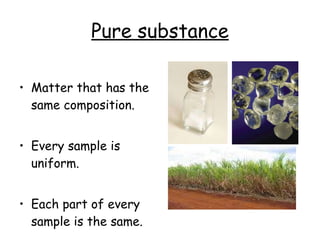
Pure substance Matter that has the same composition. Every sample is uniform. Each part of every sample is the same.
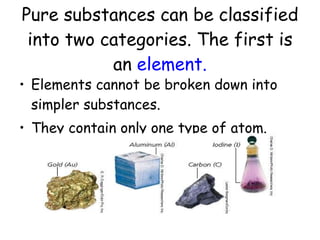
Pure substances can be classified into two categories. The first is an  element. Elements cannot be broken down into simpler substances. They contain only one type of atom.
When two or more elements chemically join together in a fixed proportion, they form a  compound. Example: WATER Hydrogen is a gas at room temperature and so is Oxygen. But when combined together, they form water – a liquid at room temperature.
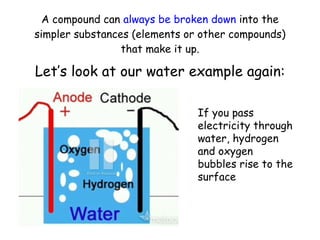
A compound can  always be broken down  into the simpler substances (elements or other compounds) that make it up. Let’s look at our water example again: If you pass electricity through water, hydrogen and oxygen bubbles rise to the surface
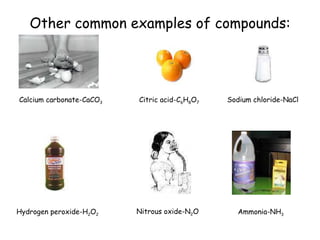
Other common examples of compounds: Calcium carbonate-CaCO 3 Citric acid-C 6 H 8 O 7 Sodium chloride-NaCl Hydrogen peroxide-H 2 O 2 Nitrous oxide-N 2 O Ammonia-NH 3
Mixtures A substance consisting of two or more substances mixed together. Mixtures retain some of the properties of the original substances. The composition of a mixture can vary. Mixtures are classified by how well the parts are distributed.
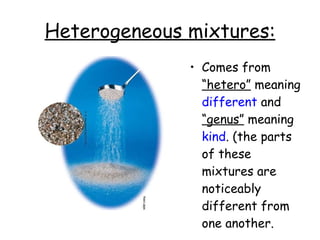
Heterogeneous mixtures: Comes from  “hetero”  meaning  different  and  “genus”  meaning  kind . (the parts of these mixtures are noticeably different from one another.
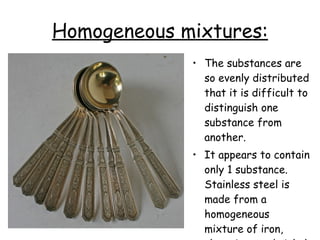
Homogeneous mixtures: The substances are so evenly distributed that it is difficult to distinguish one substance from another.  It appears to contain only 1 substance. Stainless steel is made from a homogeneous mixture of iron, chromium, and nickel.
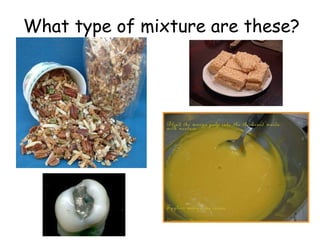
What type of mixture are these?

Classifying matter

  • 1.
    Do Now Whatis the difference between a compound such as water and a mixture such as salsa?
  • 2.
  • 3.
    Goals: To classifypure substances as elements or compounds. To distinguish between pure substances and mixtures. To classify mixtures as heterogeneous or homogeneous.
  • 4.
    Materials can bedivided into pure substances and mixtures , depending on their composition.
  • 5.
    Pure substance Matterthat has the same composition. Every sample is uniform. Each part of every sample is the same.
  • 6.
    Pure substances canbe classified into two categories. The first is an element. Elements cannot be broken down into simpler substances. They contain only one type of atom.
  • 7.
    When two ormore elements chemically join together in a fixed proportion, they form a compound. Example: WATER Hydrogen is a gas at room temperature and so is Oxygen. But when combined together, they form water – a liquid at room temperature.
  • 8.
    A compound can always be broken down into the simpler substances (elements or other compounds) that make it up. Let’s look at our water example again: If you pass electricity through water, hydrogen and oxygen bubbles rise to the surface
  • 9.
    Other common examplesof compounds: Calcium carbonate-CaCO 3 Citric acid-C 6 H 8 O 7 Sodium chloride-NaCl Hydrogen peroxide-H 2 O 2 Nitrous oxide-N 2 O Ammonia-NH 3
  • 10.
    Mixtures A substanceconsisting of two or more substances mixed together. Mixtures retain some of the properties of the original substances. The composition of a mixture can vary. Mixtures are classified by how well the parts are distributed.
  • 11.
    Heterogeneous mixtures: Comesfrom “hetero” meaning different and “genus” meaning kind . (the parts of these mixtures are noticeably different from one another.
  • 12.
    Homogeneous mixtures: Thesubstances are so evenly distributed that it is difficult to distinguish one substance from another. It appears to contain only 1 substance. Stainless steel is made from a homogeneous mixture of iron, chromium, and nickel.
  • 13.
    What type ofmixture are these?