The
Elementary
Science
Curriculum
Prepared by:
Glenadin Evangelista
Professor
Why science
is significant
to us?
SUMMER BY THE SEA COLORING BOOK - PICTURE 2
INTRODUCTION
Science is valued because it has helped in satisfying many
basic human needs and improving living conditions.
Advances in technology and science are transforming our
world at an incredible and unimaginable pace. We cannot
escape from and we cannot measure the significance of
science. Science has shaped the world. Technology and
the products of scientific knowledge surround us every
day. Public and private policy decisions that impact every
aspect of our lives are driven by scientific process and
scientific evidence. The enormously complex physical
world around us illustrates boundless scientific concepts.
Being “science literate” has become not just an advantage
but an absolute necessity in the 21st century.
What is
SCIENCE?
SUMMER BY THE SEA COLORING BOOK – PICTURE 3
The word “science” is derived
from the Latin word sciencia
meaning knowledge.
Science is commonly referred to
as a systematic and organized
body of knowledge in any area of
inquiry that is acquired using
“the scientific method.”
Science has many facets and
definition that can be summarized
into the following: Science as a
broad body of knowledge – Physical
sciences consists of disciplines such
as physics (the science of physical
objects), chemistry (the science of
matter), and astronomy (the science
of celestial objects). Earth sciences
consists of disciplines such as geology
(the science of the earth).
Science as a set of skills – The science
process skills form the foundation of
scientific methods. There are six
basic science process skills:
observation, communication,
classification, measurement,
inference, and prediction.
These basic skills are integrated when
scientists design and carry out
experiments. All six basic skills are
important individually as well as
when they are integrated.
Science is our way of
understanding the world – its
wondrous structure, natural
events, interrelated elements
and systems, and processes. It
is an exciting and, at the same
time, a useful endeavor that
benefits our community and
society at large.
Another important goal of science
has emerged during the past
decades: to find a way to
responsibly and ethically use natural
resources to guarantee their
continuity and that of humanity
itself; an endeavor and advocacy
that is referred to as
“sustainability”.
Aside from sustainability movement,
education could become the most
important application of science in the
next decades. It is crucial to provide
humanity with a basic understanding of
how science has shaped the world and
human civilization. It is for this reason
that education institutions need to
constantly equip science educators with
the tools and competence to advance
science education and to engage the
learners in the love for learning and
doing science.
 Science as a social activity – Science is a
social activity shaped by history,institutions,
beliefs, and values. Society shapes science
and vice versa.
 Science as problem-solving – Problem-
solving skills are necessary in all areas of
life, and the science class provides the
students opportunity to develop and utilize
their problem-solving skills, which include
the ability to critically analyze a problem,
determine all its elements, and prepare a
feasible solution. These are valuable skills
one can acquire in life.
 Science as a career – individuals who
have devoted themselves in studying and
doing science have established careers in
science, such as biologists, chemists,
environmentalists, astronomers, medical
practitioners, among others.
 Science as a global human endeavor –
Science is a result of human imagination,
ingenuity, and creativity. Individuals and
team from many nations and cultures
have contributed to advances in
technology.
Science as a process – The
scientific methods is a set of steps
for verifying and building scientific
knowledge. When performing this
process, one employs skills
necessary to research a topic,
develop a plan and timeline, and
draw conclusions from research
results
Activity 1: The Facets of Science
Science means several things to
various individuals and institutions.
You can see the various facets of
science in the first column below.
On the opposite column, write your
insights and reflection about each of
the facets of science.
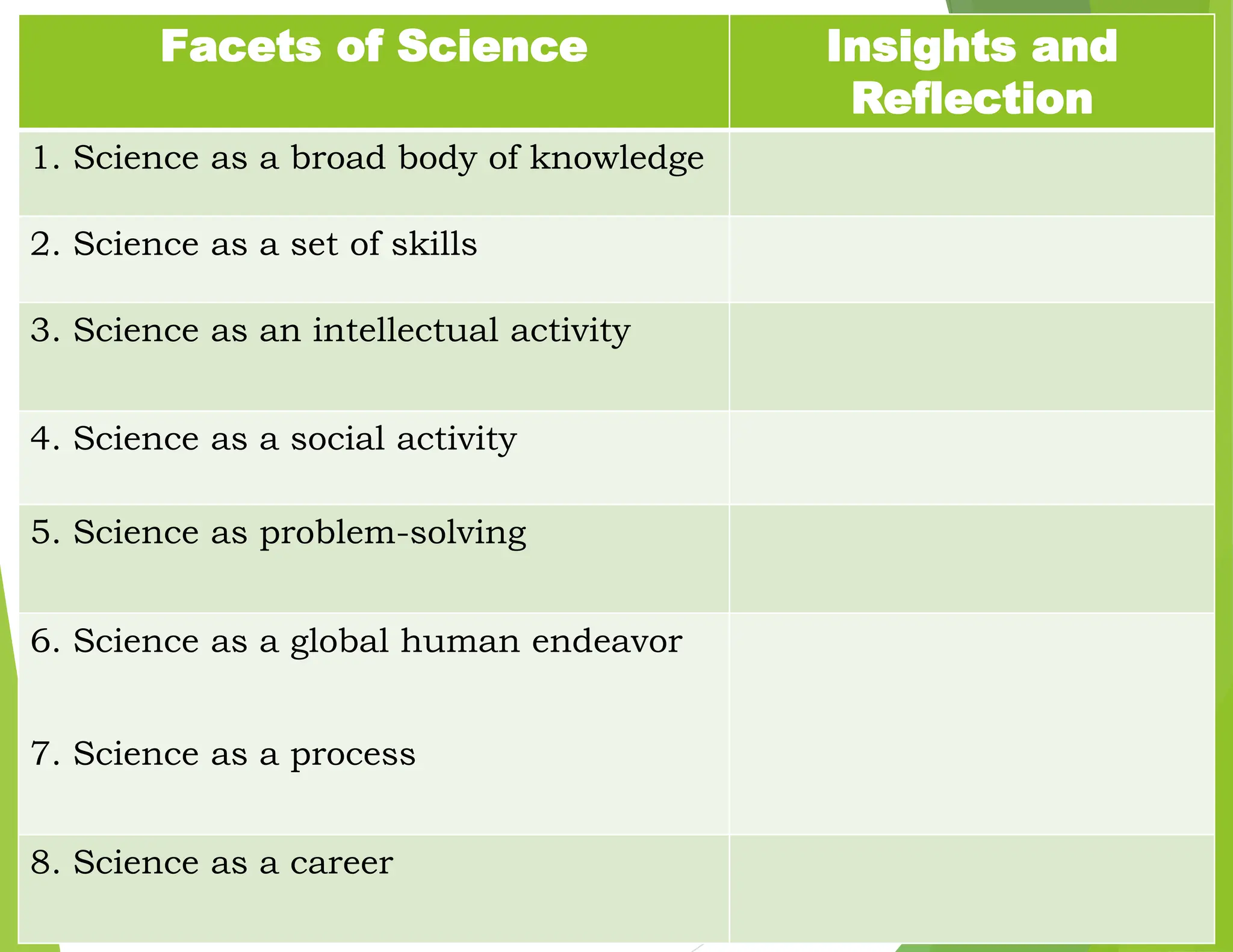
Facets of Science Insights and
Reflection
1. Science as a broad body of knowledge
2. Science as a set of skills
3. Science as an intellectual activity
4. Science as a social activity
5. Science as problem-solving
6. Science as a global human endeavor
7. Science as a process
8. Science as a career
ASSIGNMENT
1 Short bond paper.
Defining Science
Do you remember how your previous
teachers, readings, and classes define
science? Create a
word cloud to illustrate/show these
definitions or keywords. Be guided by the
sample word cloud on
knowledge below.
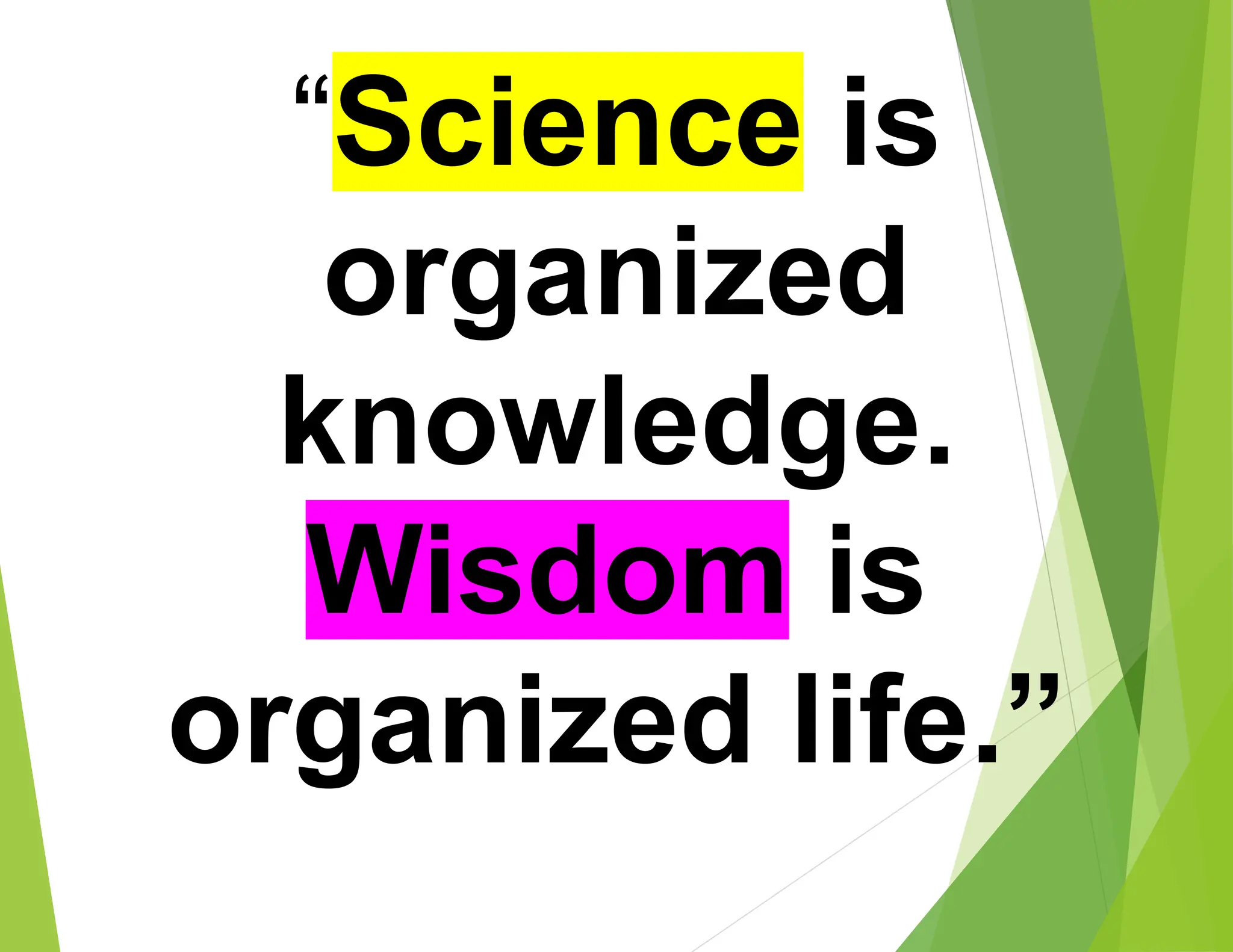
“Science is
organized
knowledge.
Wisdom is
organized life.”
Science in Elementary Grade Curriculum pptx

Science in Elementary Grade Curriculum pptx

  • 1.
  • 2.
  • 3.
    SUMMER BY THESEA COLORING BOOK - PICTURE 2 INTRODUCTION Science is valued because it has helped in satisfying many basic human needs and improving living conditions. Advances in technology and science are transforming our world at an incredible and unimaginable pace. We cannot escape from and we cannot measure the significance of science. Science has shaped the world. Technology and the products of scientific knowledge surround us every day. Public and private policy decisions that impact every aspect of our lives are driven by scientific process and scientific evidence. The enormously complex physical world around us illustrates boundless scientific concepts. Being “science literate” has become not just an advantage but an absolute necessity in the 21st century.
  • 4.
  • 5.
    SUMMER BY THESEA COLORING BOOK – PICTURE 3 The word “science” is derived from the Latin word sciencia meaning knowledge. Science is commonly referred to as a systematic and organized body of knowledge in any area of inquiry that is acquired using “the scientific method.”
  • 6.
    Science has manyfacets and definition that can be summarized into the following: Science as a broad body of knowledge – Physical sciences consists of disciplines such as physics (the science of physical objects), chemistry (the science of matter), and astronomy (the science of celestial objects). Earth sciences consists of disciplines such as geology (the science of the earth).
  • 7.
    Science as aset of skills – The science process skills form the foundation of scientific methods. There are six basic science process skills: observation, communication, classification, measurement, inference, and prediction. These basic skills are integrated when scientists design and carry out experiments. All six basic skills are important individually as well as when they are integrated.
  • 8.
    Science is ourway of understanding the world – its wondrous structure, natural events, interrelated elements and systems, and processes. It is an exciting and, at the same time, a useful endeavor that benefits our community and society at large.
  • 9.
    Another important goalof science has emerged during the past decades: to find a way to responsibly and ethically use natural resources to guarantee their continuity and that of humanity itself; an endeavor and advocacy that is referred to as “sustainability”.
  • 10.
    Aside from sustainabilitymovement, education could become the most important application of science in the next decades. It is crucial to provide humanity with a basic understanding of how science has shaped the world and human civilization. It is for this reason that education institutions need to constantly equip science educators with the tools and competence to advance science education and to engage the learners in the love for learning and doing science.
  • 11.
     Science asa social activity – Science is a social activity shaped by history,institutions, beliefs, and values. Society shapes science and vice versa.  Science as problem-solving – Problem- solving skills are necessary in all areas of life, and the science class provides the students opportunity to develop and utilize their problem-solving skills, which include the ability to critically analyze a problem, determine all its elements, and prepare a feasible solution. These are valuable skills one can acquire in life.
  • 12.
     Science asa career – individuals who have devoted themselves in studying and doing science have established careers in science, such as biologists, chemists, environmentalists, astronomers, medical practitioners, among others.  Science as a global human endeavor – Science is a result of human imagination, ingenuity, and creativity. Individuals and team from many nations and cultures have contributed to advances in technology.
  • 13.
    Science as aprocess – The scientific methods is a set of steps for verifying and building scientific knowledge. When performing this process, one employs skills necessary to research a topic, develop a plan and timeline, and draw conclusions from research results
  • 14.
    Activity 1: TheFacets of Science Science means several things to various individuals and institutions. You can see the various facets of science in the first column below. On the opposite column, write your insights and reflection about each of the facets of science.
  • 15.
    Facets of ScienceInsights and Reflection 1. Science as a broad body of knowledge 2. Science as a set of skills 3. Science as an intellectual activity 4. Science as a social activity 5. Science as problem-solving 6. Science as a global human endeavor 7. Science as a process 8. Science as a career
  • 16.
    ASSIGNMENT 1 Short bondpaper. Defining Science Do you remember how your previous teachers, readings, and classes define science? Create a word cloud to illustrate/show these definitions or keywords. Be guided by the sample word cloud on knowledge below.
  • 17.