DEPARTMENT OF ENT, HEAD & NECK
SURGERY. JUTH
SINONASAL TUMOURS
OKOYE
11/12/20
OUTLINE
• INTRODUCTION
– STATEMENT OF IMPORTANCE
• RELEVANT ANATOMY
• EPIDEMIOLOGY
• AETIOLOGY
• CLINICAL FEATURES
• INVESTIGATIONS
• CLASSIFICATION
• STAGING
• TREATMENT
• COMPLICATIONS
• PROGNOSIS
• PREVENTION
• CONCLUSION
• REFERENCES
INTRODUCTION
• Tumours of the sinonasal region comprise a
diverse group of BENIGN and MALIGNANT
neoplasms.
• The malignant type often masquerade as
chronic inflammatory conditions, thus they
may progress unrecognized and untreated.
.
STATEMENT OF IMPORTANCE
• The naturally hidden location of sinonasal
tumours at the early disease stages and its
nonspecific presentation contribute to delay in
management and thus morbidity and
mortality
RELEVANT ANATOMY
RELEVANT ANATOMY
RELEVANT ANATOMY
RELEVANT ANATOMY
RELEVANT ANATOMY
• Lymphatic drainage
SITES OF SINONASAL TUMORS
• Maxillary antrum- 60%
• Nasal cavity- 30%
• Ethmoid- 10%
• Sphenoid & frontal- rare.
EPIDEMIOLOGY
• It is a rare disease worldwide
• Account for less than 1% of all neoplasms
• The malignant type account for 3% of upper
aerodigestive tract neoplasms.
• Age- all age groups, Benign ones commonly
seen in children and the malignant types in
adults (4th to 7th decades of life).
• Sex- more in males than females (2:1 to 5:1)
AETIOLOGY/PREDISPOSING FACTORS
The exact cause is not known
• Wood dust exposure (hard & soft)
• Exposure to nickel, chrome, polycyclic
hydrocarbons, aflatoxin
• Ionizing radiation
• Tobacco
• Virus- HPV, EBV
CLASSIFICATION
• BENIGN
• MALIGNANT
BENIGN
• EPITHELIAL
– PAPILLOMAS (SQUAMOUS, INVERTED, FUNGIFORM)
– ADENOMAS (PLEOMORPHIC)
• NON-EPITHELIAL
– OSTEOMAS
– FIBROMAS
– CHONDROMAS
– HEMANGIOMAS
– NERVE SHEATH TUMOURS
MALIGNANT
• EPITHELIAL
– SQUAMOUS CELL CARCINOMAS
– ADENOCARCINOMAS
– ADENOID CYSTIC CARCINOMAS
– MELANOMAS
– ESTHESIONEUROBLASTOMAS
– MUCOEPIDERMOID CARCINOMAS
– TERATOMAS
MALIGNANT
• NON-EPITHELIAL
– RHABDOMYOSARCOMAS
– NEUROGENIC SARCOMAS
– FIBROSARCOMAS
– ANGIOSARCOMAS
– OSTEOGENIC SARCOMAS
– CHONDROSARCOMAS
– LYMPHOMAS
OSTEOMAS
• Is a form of mature lamellar bone tumour
• The most common site is frontal sinus, then
ethmoid and maxillary
• Types- Compact and Cancellous
• Age- 15-40yrs of age.
• Usually asymptomatic, but can obstruct ostium
• Treatment- Surgical excision, via Lynch-Howarth
or osteoplastic flap approach
OSTEOMAS
FIBROUS DYSPLASIA
• Slow growing benign tumour where medullary
bone is replaced by fibro-osseous tissue.
• Types- Monostotic and Polyostotic
• Commonly seen within the maxilla
• Usually asymptomatic
• Treatment- sculpturing excision
INVERTED PAPILLOMA
• A.K.A- Ringert’s tumour, Transitional cell,
Schneiderian cell papilloma.
• The squamous epithelium surrounding a
fibrovascular stroma with an endophytic growth.
• > males, 40- 70yrs of age
• Seen on lateral nasal wall, aggressive behaviour
• 5-15% chances of malignant transformation
• Treatment- Surgical excision via ESS or Lateral
Rhinotomy.
INVERTED PAPILLOMA
INVERTED PAPILLOMA
MALIGNANT SINONASAL TUMOURS
• The malignant epithelial tumours constitute
majority of sinonasal neoplasms
• SQUAMOUS CELL CARCINOMA (SCC) is the
most common, >80%.
• In the maxillary sinus, about 60%. Nasal cavity
-20-30%, Ethmoid,10-20%. 1% in the frontal
and sphenoid sinuses.
• Varying degrees of differentiation.
SQUAMOUS CELL CARCINOMA
• Is the most common malignant tumour in the
sinonasal tract
• Mostly found in Caucasians
• In their 5th and 6th decade
• It most commonly arises from the lateral nasal
wall followed by the nasal septum
• Its prognosis is related to extent and location
ADENOCARCINOMAS
• Representing 5-19% of sinonasal tumours,
• Common sites- upper nasal cavity and
ethmoid.
• Occupation- furniture making (wood dust),
leather work
• Classification- High and Low grade
• Treatment- Aggressive en bloc surgical
excision
ADENOID CYSTIC CARCINOMAS
Groups of small cells arranged in one of several
patterns-
• Tubular, Cribriform, Solid (low to high grade)
• Usually seen in maxillary antrum
• They all have predilection for perineural
invasion
MUCOEPIDERMOID CARCINOMA
• Extremely rare form of glandular carcinoma
• Composed of squamous cells and glandular,
mucus-producing basal cells.
• They have high propensity for distant
metastases
MALIGNANT MELANOMA
• Account for about 3% of all sinonasal tumours
• More in women than men
• Affect elderly
• Sites- nasal cavity and septum
• May or may not be pigmented
• Metastasizes less frequent than melanoma
elsewhere, but more often to the lungs and
brain
OLFACTORY NEUROBLASTOMA
• Arises from basal cell within the olfactory
neuroepithelium
• Age- bimodal
• More common in women
• Very vascular and bleeds profusely on biopsy
• Moderately radiosensitive
CLINICAL FEATURES
• The early symptoms are usually non specific-
nasal discharge, obstruction.
• Late symptoms will depends on the wall of the
sinus involved and the extent of involvement.
• The typical delay in diagnosis is commonly
cited as 8 months or more.
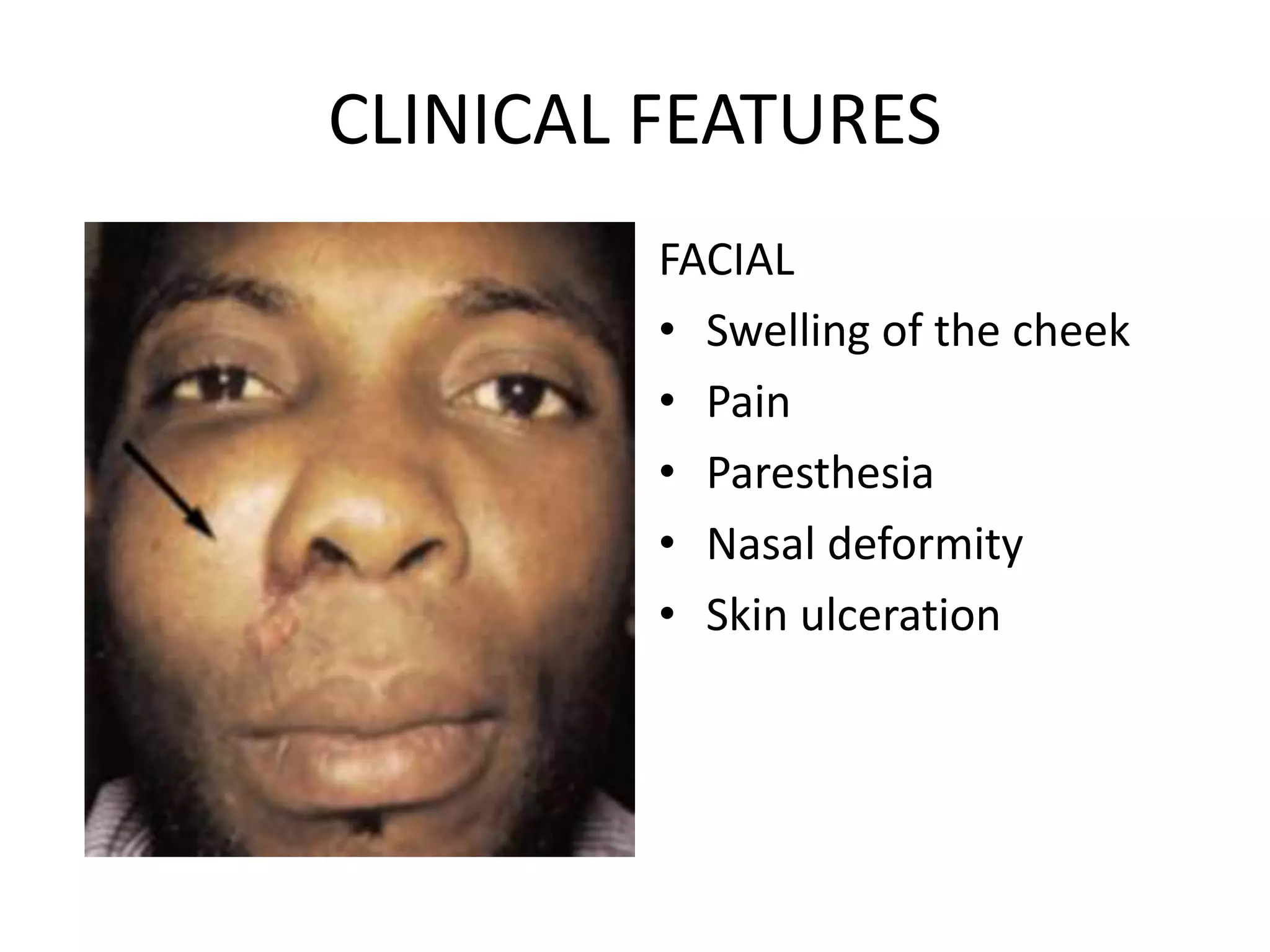
CLINICAL FEATURES
FACIAL
• Swelling of the cheek
• Pain
• Paresthesia
• Nasal deformity
• Skin ulceration
CLINICAL FEATURES
CLINICAL FEATURES
NASAL
• Nasal obstruction
• Nasal discharge
• Epistaxis
• Hyposmia
• Nasal deformity
SINONASAL TUMOURS
CLINICAL FEATURES
ORBITAL
• Swollen eyelid
• Proptosis
• Epiphora
• Diplopia
• Chemosis
• Visual loss
• Ophthalmoplegia
CLINICAL FEATURES
ORAL
• Trismus
• Poor oro-dental hygiene
• Palatal swelling
• Loosening of the tooth
• Ill-fitting denture
• Tenderness
CLINICAL FEATURES
NECK
• Lymph node
enlargement
NEUROLOGICAL
• Multiple cranial nerve
palsy
OTOLOGIC
• Aural fullness/blockage
• Referred otalgia
INVESTIGATIONS
SPECIFIC
• CT SCAN
• MRI
• ANGIOGRAPHY
• EUA / BIOPSY
GENERAL
• FBC, ESR
• U/E/Cr, FBS
• RVS
• Metastatic Work up
STAGING
STAGING
TNM- MAXILLARY TUMOUR
• Tx- Primary tumour cannot be assessed
• T0- No evidence of primary tumour
• Tis- Carcinoma in situ
• T1- Tumour limited to maxillary sinus mucosa
with no bony erosion or destruction.
• T2- Tumour causing bone erosion or destruction
including extension to the hard palate and/or the
middle nasal meatus, except extension to the
posterior maxillary wall and pterygoid plates
TNM- MAXILLARY TUMOUR
• T3- Tumour invades any of the following: Bone
of the posterior wall of the maxillary sinus,
subcutaneous tissue, medial wall or the floor
of the orbit, Pterygoid fossa and/or ethmoidal
sinuses.
• T4a- Tumour involving anterior orbital
contents, skin of the cheek, Pterygoid plates,
infratemporal fossa, cribriform plate, sphenoid
or frontal sinus
TNM- MAXILLARY TUMOUR
• T4b-Tumour invades any of the following:
Orbital apex, dura, brain, middle cranial fossa,
and/or cranial nerves other than V2,
nasopharynx or clivus.
TNM- NASAL CAVITY & ETHMOID
• Tx- Primary tumour cannot be assessed
• T0- No evidenced of primary tumour
• Tis- Carcinoma in situ
• T1- Tumour restricted to any one subsite of nasal
cavity or ethmoid sinus, +/_ bony invasion.
• T2- Tumour invading two subsites in a single
region or extending to involve an adjacent region
within the nasoethmoidal complex, +/_ bony
invasion.
TNM- NASAL CAVITY & ETHMOID
• T3- Tumour extend to invade the medial wall
or the floor of the orbit, maxillary sinus,
cribriform
• T4a-Tumour involving/invades any of the
following: anterior orbital contents, skin of the
nose or cheek, minimal extension to anterior
cranial fossa or pterygoid plates.
TNM- NASAL CAVITY & ETHMOID
• T4b- Tumour invades any of the following:
orbital apex, dura, brain, middle cranial fossa,
cranial nerves other than V2, nasopharynx or
clivus.
REGIONAL LYMPH NODE
• Nx- Regional nodes cannot be assessed
• N0- No regional lymph node metastasis
• N1- Metastasis in a single ipsilateral node, 3cm or
less
• N2a- Single ipsilateral node, >3cm but <6cm
• N2b- multiple ipsilateral nodes, none is >6cm
• N2c- Bilateral or contralateral nodes, none >6cm
• N3- Lymph node, >6cm
DISTANT METASTASIS (M)
• Mx- Distant metastasis cannot be assessed
• M0- No distant metastasis
• M1- Distant metastasis
• MULTIDISCIPLINARY- ENT Surgeon,
Orthodontist, Ophthalmologist, Speech
therapist, Radio-oncologist, Nutritionist
• MULTIMODAL-
– Surgery
– Radiotherapy
– Chemotherapy
TREATMENT
SURGERY
• ENDOSCOPIC APPROACH
• OPEN
– LATERAL RHINOTOMY
– MIDFACIAL DEGLOVING
– WEBER-FERGUSON
– CRANIOTOMY
• COMBINED
RADIOTHERAPY
• Either pre or post-operative
• About 65 Gy over 5weeks
CHEMOTHERAPY
• No definitive evidence that it improves
survival
• Platinum-based are effective against olfactory
neuroblastoma
COMPLICATIONS
• SURGERY
• RADIOTHERAPY
• CHEMOTHERAPY
PROGNOSIS
• 5-yr survival- 30- 70%
• Depends on the stage
REHABILITATION
Principles-
• Primary wound healing
• Preservation or reconstruction of the facial
contour
• Restoration of oronasal separation
• Separation of the nasal cavity from the cranial
cavity
• Prosthesis
FUTURE
• The role of endoscopic sinus surgery for the
resection of malignant tumours of the nasal
cavity and paranasal sinuses will continue to
evolve and the results closely scrutinized.
• The use of IMRT will continue to gain
acceptance and probably will be the standard
mode of radiation treatment given for all head
and neck patients in the future.
CONCLUSION
• Early presentation, high index of suspicion and
institution of management in these patients
will go a long way in improving their
treatment and quality of life
THANK YOU
REFERENCES
• Zimmer LA, Carrau RL. Neoplasms of the nose and paranasal sinuses. Bailey BJ,
Johnson JT, Newland SD, eds. Head & Neck Surgery - Otolaryngology. 4th.
Lippincott, Williams & Wilkins; 2006.
• Dean KE, Shatzkes D, Phillips CD. Imaging Review of New and Emerging Sinonasal
Tumors and Tumor-Like Entities from the Fourth Edition of the World Health
Organization Classification of Head and Neck Tumors. AJNR Am J Neuroradiol.
2019 Apr. 40 (4):584-90.
• Caplan LS, Hall I, Levine RS, Zhu K. Preventable risk factors for nasal cancer. Ann
Epidemiol. 2000. 10:186-91.
• Weymuller EA, Gal TJ. Neoplasms of the nasal cavity. Cummings CW, Flint PW,
Harker LA et al. eds. Otolaryngology - Head and Neck surgery. 4th. Mosby; 2005.
• Gerth DJ, Tashiro J, Thaller SR. Pediatric sinonasal tumors in the United States:
incidence and outcomes. J Surg Res. 2014 Jul. 190 (1):214-20.
• d'Errico A, Pasian S, Baratti A, et al. A case-controlled study on occupational risk
factors for sino-nasal cancer. Occup Environ Med. 2009. 66:448-55.
• Benninger MS. The impact of cigarette smoking and environmental tobacco smoke
on nasal and sinus disease: a review of the literature. Am J Rhinol. 1999 Nov-Dec.
13(6):435-8

Sinonasal Tumours - Okoye

  • 1.
    DEPARTMENT OF ENT,HEAD & NECK SURGERY. JUTH SINONASAL TUMOURS OKOYE 11/12/20
  • 2.
    OUTLINE • INTRODUCTION – STATEMENTOF IMPORTANCE • RELEVANT ANATOMY • EPIDEMIOLOGY • AETIOLOGY • CLINICAL FEATURES • INVESTIGATIONS • CLASSIFICATION • STAGING • TREATMENT • COMPLICATIONS • PROGNOSIS • PREVENTION • CONCLUSION • REFERENCES
  • 3.
    INTRODUCTION • Tumours ofthe sinonasal region comprise a diverse group of BENIGN and MALIGNANT neoplasms. • The malignant type often masquerade as chronic inflammatory conditions, thus they may progress unrecognized and untreated. .
  • 4.
    STATEMENT OF IMPORTANCE •The naturally hidden location of sinonasal tumours at the early disease stages and its nonspecific presentation contribute to delay in management and thus morbidity and mortality
  • 5.
  • 6.
  • 7.
  • 8.
  • 9.
  • 10.
    SITES OF SINONASALTUMORS • Maxillary antrum- 60% • Nasal cavity- 30% • Ethmoid- 10% • Sphenoid & frontal- rare.
  • 11.
    EPIDEMIOLOGY • It isa rare disease worldwide • Account for less than 1% of all neoplasms • The malignant type account for 3% of upper aerodigestive tract neoplasms. • Age- all age groups, Benign ones commonly seen in children and the malignant types in adults (4th to 7th decades of life). • Sex- more in males than females (2:1 to 5:1)
  • 12.
    AETIOLOGY/PREDISPOSING FACTORS The exactcause is not known • Wood dust exposure (hard & soft) • Exposure to nickel, chrome, polycyclic hydrocarbons, aflatoxin • Ionizing radiation • Tobacco • Virus- HPV, EBV
  • 13.
  • 14.
    BENIGN • EPITHELIAL – PAPILLOMAS(SQUAMOUS, INVERTED, FUNGIFORM) – ADENOMAS (PLEOMORPHIC) • NON-EPITHELIAL – OSTEOMAS – FIBROMAS – CHONDROMAS – HEMANGIOMAS – NERVE SHEATH TUMOURS
  • 15.
    MALIGNANT • EPITHELIAL – SQUAMOUSCELL CARCINOMAS – ADENOCARCINOMAS – ADENOID CYSTIC CARCINOMAS – MELANOMAS – ESTHESIONEUROBLASTOMAS – MUCOEPIDERMOID CARCINOMAS – TERATOMAS
  • 16.
    MALIGNANT • NON-EPITHELIAL – RHABDOMYOSARCOMAS –NEUROGENIC SARCOMAS – FIBROSARCOMAS – ANGIOSARCOMAS – OSTEOGENIC SARCOMAS – CHONDROSARCOMAS – LYMPHOMAS
  • 17.
    OSTEOMAS • Is aform of mature lamellar bone tumour • The most common site is frontal sinus, then ethmoid and maxillary • Types- Compact and Cancellous • Age- 15-40yrs of age. • Usually asymptomatic, but can obstruct ostium • Treatment- Surgical excision, via Lynch-Howarth or osteoplastic flap approach
  • 18.
  • 19.
    FIBROUS DYSPLASIA • Slowgrowing benign tumour where medullary bone is replaced by fibro-osseous tissue. • Types- Monostotic and Polyostotic • Commonly seen within the maxilla • Usually asymptomatic • Treatment- sculpturing excision
  • 21.
    INVERTED PAPILLOMA • A.K.A-Ringert’s tumour, Transitional cell, Schneiderian cell papilloma. • The squamous epithelium surrounding a fibrovascular stroma with an endophytic growth. • > males, 40- 70yrs of age • Seen on lateral nasal wall, aggressive behaviour • 5-15% chances of malignant transformation • Treatment- Surgical excision via ESS or Lateral Rhinotomy.
  • 22.
  • 23.
  • 24.
    MALIGNANT SINONASAL TUMOURS •The malignant epithelial tumours constitute majority of sinonasal neoplasms • SQUAMOUS CELL CARCINOMA (SCC) is the most common, >80%. • In the maxillary sinus, about 60%. Nasal cavity -20-30%, Ethmoid,10-20%. 1% in the frontal and sphenoid sinuses. • Varying degrees of differentiation.
  • 25.
    SQUAMOUS CELL CARCINOMA •Is the most common malignant tumour in the sinonasal tract • Mostly found in Caucasians • In their 5th and 6th decade • It most commonly arises from the lateral nasal wall followed by the nasal septum • Its prognosis is related to extent and location
  • 26.
    ADENOCARCINOMAS • Representing 5-19%of sinonasal tumours, • Common sites- upper nasal cavity and ethmoid. • Occupation- furniture making (wood dust), leather work • Classification- High and Low grade • Treatment- Aggressive en bloc surgical excision
  • 27.
    ADENOID CYSTIC CARCINOMAS Groupsof small cells arranged in one of several patterns- • Tubular, Cribriform, Solid (low to high grade) • Usually seen in maxillary antrum • They all have predilection for perineural invasion
  • 28.
    MUCOEPIDERMOID CARCINOMA • Extremelyrare form of glandular carcinoma • Composed of squamous cells and glandular, mucus-producing basal cells. • They have high propensity for distant metastases
  • 29.
    MALIGNANT MELANOMA • Accountfor about 3% of all sinonasal tumours • More in women than men • Affect elderly • Sites- nasal cavity and septum • May or may not be pigmented • Metastasizes less frequent than melanoma elsewhere, but more often to the lungs and brain
  • 30.
    OLFACTORY NEUROBLASTOMA • Arisesfrom basal cell within the olfactory neuroepithelium • Age- bimodal • More common in women • Very vascular and bleeds profusely on biopsy • Moderately radiosensitive
  • 31.
    CLINICAL FEATURES • Theearly symptoms are usually non specific- nasal discharge, obstruction. • Late symptoms will depends on the wall of the sinus involved and the extent of involvement. • The typical delay in diagnosis is commonly cited as 8 months or more.
  • 32.
    CLINICAL FEATURES FACIAL • Swellingof the cheek • Pain • Paresthesia • Nasal deformity • Skin ulceration
  • 33.
  • 34.
    CLINICAL FEATURES NASAL • Nasalobstruction • Nasal discharge • Epistaxis • Hyposmia • Nasal deformity
  • 35.
  • 36.
    CLINICAL FEATURES ORBITAL • Swolleneyelid • Proptosis • Epiphora • Diplopia • Chemosis • Visual loss • Ophthalmoplegia
  • 37.
    CLINICAL FEATURES ORAL • Trismus •Poor oro-dental hygiene • Palatal swelling • Loosening of the tooth • Ill-fitting denture • Tenderness
  • 38.
    CLINICAL FEATURES NECK • Lymphnode enlargement NEUROLOGICAL • Multiple cranial nerve palsy OTOLOGIC • Aural fullness/blockage • Referred otalgia
  • 39.
    INVESTIGATIONS SPECIFIC • CT SCAN •MRI • ANGIOGRAPHY • EUA / BIOPSY GENERAL • FBC, ESR • U/E/Cr, FBS • RVS • Metastatic Work up
  • 40.
  • 41.
  • 42.
    TNM- MAXILLARY TUMOUR •Tx- Primary tumour cannot be assessed • T0- No evidence of primary tumour • Tis- Carcinoma in situ • T1- Tumour limited to maxillary sinus mucosa with no bony erosion or destruction. • T2- Tumour causing bone erosion or destruction including extension to the hard palate and/or the middle nasal meatus, except extension to the posterior maxillary wall and pterygoid plates
  • 43.
    TNM- MAXILLARY TUMOUR •T3- Tumour invades any of the following: Bone of the posterior wall of the maxillary sinus, subcutaneous tissue, medial wall or the floor of the orbit, Pterygoid fossa and/or ethmoidal sinuses. • T4a- Tumour involving anterior orbital contents, skin of the cheek, Pterygoid plates, infratemporal fossa, cribriform plate, sphenoid or frontal sinus
  • 44.
    TNM- MAXILLARY TUMOUR •T4b-Tumour invades any of the following: Orbital apex, dura, brain, middle cranial fossa, and/or cranial nerves other than V2, nasopharynx or clivus.
  • 45.
    TNM- NASAL CAVITY& ETHMOID • Tx- Primary tumour cannot be assessed • T0- No evidenced of primary tumour • Tis- Carcinoma in situ • T1- Tumour restricted to any one subsite of nasal cavity or ethmoid sinus, +/_ bony invasion. • T2- Tumour invading two subsites in a single region or extending to involve an adjacent region within the nasoethmoidal complex, +/_ bony invasion.
  • 46.
    TNM- NASAL CAVITY& ETHMOID • T3- Tumour extend to invade the medial wall or the floor of the orbit, maxillary sinus, cribriform • T4a-Tumour involving/invades any of the following: anterior orbital contents, skin of the nose or cheek, minimal extension to anterior cranial fossa or pterygoid plates.
  • 47.
    TNM- NASAL CAVITY& ETHMOID • T4b- Tumour invades any of the following: orbital apex, dura, brain, middle cranial fossa, cranial nerves other than V2, nasopharynx or clivus.
  • 48.
    REGIONAL LYMPH NODE •Nx- Regional nodes cannot be assessed • N0- No regional lymph node metastasis • N1- Metastasis in a single ipsilateral node, 3cm or less • N2a- Single ipsilateral node, >3cm but <6cm • N2b- multiple ipsilateral nodes, none is >6cm • N2c- Bilateral or contralateral nodes, none >6cm • N3- Lymph node, >6cm
  • 49.
    DISTANT METASTASIS (M) •Mx- Distant metastasis cannot be assessed • M0- No distant metastasis • M1- Distant metastasis
  • 50.
    • MULTIDISCIPLINARY- ENTSurgeon, Orthodontist, Ophthalmologist, Speech therapist, Radio-oncologist, Nutritionist • MULTIMODAL- – Surgery – Radiotherapy – Chemotherapy TREATMENT
  • 51.
    SURGERY • ENDOSCOPIC APPROACH •OPEN – LATERAL RHINOTOMY – MIDFACIAL DEGLOVING – WEBER-FERGUSON – CRANIOTOMY • COMBINED
  • 52.
    RADIOTHERAPY • Either preor post-operative • About 65 Gy over 5weeks
  • 53.
    CHEMOTHERAPY • No definitiveevidence that it improves survival • Platinum-based are effective against olfactory neuroblastoma
  • 54.
  • 55.
    PROGNOSIS • 5-yr survival-30- 70% • Depends on the stage
  • 56.
    REHABILITATION Principles- • Primary woundhealing • Preservation or reconstruction of the facial contour • Restoration of oronasal separation • Separation of the nasal cavity from the cranial cavity • Prosthesis
  • 57.
    FUTURE • The roleof endoscopic sinus surgery for the resection of malignant tumours of the nasal cavity and paranasal sinuses will continue to evolve and the results closely scrutinized. • The use of IMRT will continue to gain acceptance and probably will be the standard mode of radiation treatment given for all head and neck patients in the future.
  • 58.
    CONCLUSION • Early presentation,high index of suspicion and institution of management in these patients will go a long way in improving their treatment and quality of life
  • 59.
  • 60.
    REFERENCES • Zimmer LA,Carrau RL. Neoplasms of the nose and paranasal sinuses. Bailey BJ, Johnson JT, Newland SD, eds. Head & Neck Surgery - Otolaryngology. 4th. Lippincott, Williams & Wilkins; 2006. • Dean KE, Shatzkes D, Phillips CD. Imaging Review of New and Emerging Sinonasal Tumors and Tumor-Like Entities from the Fourth Edition of the World Health Organization Classification of Head and Neck Tumors. AJNR Am J Neuroradiol. 2019 Apr. 40 (4):584-90. • Caplan LS, Hall I, Levine RS, Zhu K. Preventable risk factors for nasal cancer. Ann Epidemiol. 2000. 10:186-91. • Weymuller EA, Gal TJ. Neoplasms of the nasal cavity. Cummings CW, Flint PW, Harker LA et al. eds. Otolaryngology - Head and Neck surgery. 4th. Mosby; 2005. • Gerth DJ, Tashiro J, Thaller SR. Pediatric sinonasal tumors in the United States: incidence and outcomes. J Surg Res. 2014 Jul. 190 (1):214-20. • d'Errico A, Pasian S, Baratti A, et al. A case-controlled study on occupational risk factors for sino-nasal cancer. Occup Environ Med. 2009. 66:448-55. • Benninger MS. The impact of cigarette smoking and environmental tobacco smoke on nasal and sinus disease: a review of the literature. Am J Rhinol. 1999 Nov-Dec. 13(6):435-8

Editor's Notes

  • #4 Tumors of the nasal cavity proper are approximately evenly divided between benign and malignant neoplasia, with inverting papilloma predominating in the benign group and squamous cell carcinoma in the malignant. Therefore they constitute a great challenge to the head & neck surgeon as they often present with advanced disease
  • #5 Masqueradiong as CRS- Of course sociocultural belifs in our environment –herbs,self medication Prompt dx and appropriate Rx help achieve good outcome and improved QOL
  • #6 PNS- paired air containing bons…
  • #8 Right nasal cavity sagittal Note preformed pathways thru which Ca can spread or via direct invasion
  • #9 OSTIOMEATAL COMPLEX Bones (max ostium, middle turbinate, uncinate process) spaces( BIH bulla,infundibulum,hiatus semilunaris) The term “ostiomeatal unit” represents the area on the lateral nasal wall (middle meatus) that receives drainage from the anterior  and medial ethmoid cells, frontal sinus, and maxillary sinus. It is an antomically constricted area that is prone to blockage, especially in the presence of structural anomalies, mucosal swelling or tumors. In addition, ostia themselves are small. An impairment in the ventilation of sinus due to such reasons lead to Chronic rhinosinusitis (CRS).
  • #10 Lymphatic Drainage The anterior nose has the same lymphatic drainage as the external nose. These tend to spread to the submental or level I area. The posterior nose tends to drain to the retropharyngeal nodes as well as the lateral pharyngeal nodes, which eventually drain into the level II. The main part of the. Nasal cavity/PNS drains via the nasopharynx to retropharyngeal nodes and upper deep cervical nodes (levels 2a and 2b)…THE lower anterior portion to level 1b (submandibular) parotid and jugulodigastric (2a)
  • #19 Frontal sinus osteoma
  • #22 Inverting papilloma traces its name to the histologic appearance with squamous epithelium inverted in the polyps Inverted papillomas arise from the Schneiderian membrane, which is an invagination of the olfactory ectoderm that occurs during the fourth week of embryonic development. The mucosa creates a transitional zone between the endodermally-derived respiratory epithelium of the nasopharynx and keratinizing squamous epithelium with the nasal vestibule
  • #25  constitute majority of sinonasal neoplasms …45-80% of all sinus tumors.
  • #26 . Those that arise from the nasal vestibule or anterior nasal septum appear to have a poorer prognosis due to its ability to infiltrate the local soft tissues of the face, such as the columella, nasal floor, or upper lip that are associated with a higher risk of regional spread to the neck nodes. extent of disease is a more important prognostic factor than the degree of differentiation.
  • #28 Tubular pattern contains simple tubules composed of inner ductal and outer myoepithelial cells Cribriform pattern is composed of predominantly myoepithelial cells with myxoid or hyalinized globules Solid pattern is solid nests composed of sheets of basaloid cells
  • #31 bimodal, 20 and 50yrs of age
  • #39 Lymph node enlargement (sarcoma, melanoma, olfactory neuroblastoma
  • #55 bleeding, cerebrospinal fluid leak, infection (including intracranial abscess and meningitis), and blindness. Radio(postradiation retinopathy or optic neuropathy xerostomia, mucositis, trismus, and osteonecrosis..
  • #57 oronasal separation, thus facilitating speech and swallowing Don’t sacrifice function for aesthetics
  • #58 Surgeons embracing this approach need to understand the limits of this approach and continue to adhere to oncological principles. The emergence of proton therapy may further reduce the complications due to radiation therapy.