Complications Of CSOM
Moderator-Dr.Swaroop Dev
Presenter –Dr.Razal
1
Classified as
• Intra cranial
• Extra-cranial, Intra-temporal
2
Factors affecting
Pathogen Factors
• High virulence bacteria
• Antimicrobial resistance
Patient Factors
• Young age/Elderly
• Poor immune status
• Chronic disease(DM,TB)
• Poor socio-economic status
3
Routes of entry
• Bony erosion (cholesteatoma,osteitis)
• Anatomical pathway: oval window, round window,
internal auditory canal, suture line, cochlear &
vestibular aqueduct
• Retrograde Thrombophlebitis
• Congenital bony defects: facial canal, tegmen plate
• Acquired bony defects: fracture, neoplasm,
stapedectomy
4
Extra-Cranial
5
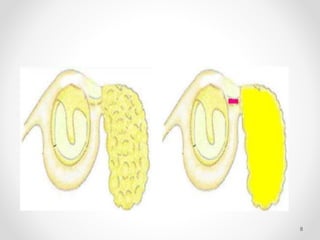
Mastoiditis
• It is the inflammation of mucosal lining of mastoid antrum
and air cells system.
• Pathology
o Production of pus under tension
o Hyperaemic decalcification
o Osteoclastic resorption of bony walls
6
Clinical Features
• Otorrhoea > 2 weeks, otalgia & deafness
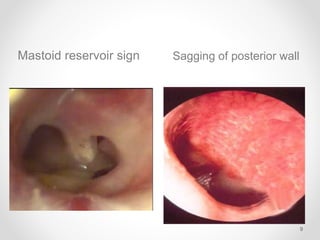
• Mastoid reservoir sign: pus fills up on mopping
• Sagging of postero-superior canal wall
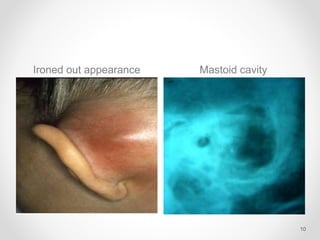
• Ironed out appearance of skin over mastoid due to
thickened periosteum
• Mastoid tenderness
Investigation
• X-ray & CT scan
7
8
Mastoid reservoir sign Sagging of posterior wall
9
Ironed out appearance Mastoid cavity
10
Treatment
• Urgent hospital admission
• Broad spectrum I.V. antibiotics
No response to medical treatment in 48 hrs
• Cortical Mastoidectomy
11
Facial Nerve
Paralysis
12
• Seen in AOM,COM(both mucosal and squamosal
variety)
• Predisposing factors:
1.congenital dehescence of FC
2.canal erosion by cholesteatoma/granulation
13
• AOM: sudden onset, full recovery
• COM: gradual onset, paralysis persist(erosion)
Treatment:
• Medical(Corticosteroids)
• Modified Radical Mastoidectomy(Sq CSOM)
• Facial nerve decompression if required
• Physioyheraphy
14
Labrynthitis
15
• Inflammation of bony labyrinth
Route of infection:
• Round window membrane
• Pre-formed opening (Stapedectomy)
• Retrograde spread of meningitis
types:
• Serous labyrinthitis
• Otogenic suppurative labyrinthitis
• Meningitic suppurative labyrinthitis
16
• Serous labyrinthitis occurs during acute or chronic
otitis media. It is presumed that bacterial exotoxins
enter the inner ear via the oval or round window or a
labyrinthine fistula.
• there is no clinical method for differentiating serous
from suppurative labyrinthitis. If vestibular and
auditory functions are partially or completely
retained, it can be assumed that the infection was
serous.
17
Treatment
• Bed rest (affected ear up). Avoid head movement.
• Labyrinthine sedative: Prochlorperazine, Cinnarizine
• Broad spectrum I.V. antibiotics
• Modified Radical Mastoidectomy: removes infection
18
PETROSITIS
19
• Spread of infection from middle ear and mastoid to the
(peumatised) petrous part of temporal bone.
• Petrous bone are of three types;
1.Well peumatised(25-30%)
2. Diploic
3. Sclerotic(Most common)
20
Gradenigo syndrome
• It is triad of,
• Persistent otorrhoea
• Retro-orbital pain: Trigeminal nerve involvement
• Diplopia: Convergent squint due to lateral rectus palsy
by injury to abducent nerve
21
Etiology:
• mastoiditis involving petrous apex along postero-
superior & anteroinferior tracts in relation to bony
labyrinth
• Anteroinferior tract : starts at the hypotympanum
near the eustachian tube runs around the cochlea to
reach the petrous .
• Posterosuperior tract :starts in the mastoid and
runs behind or above the bony labyrinth to the
petrous apex.
22
Diagnosis:
• C.T. scan temporal bone
• M.R.I. to differ b/w bone marrow & pus
Treatment:
• Modified radical mastoidectomy & clearance of petrous
apex cells
23
Sub-Periosteal
abscess & Fistula
24
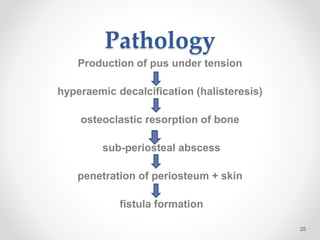
Pathology
Production of pus under tension
hyperaemic decalcification (halisteresis)
osteoclastic resorption of bone
sub-periosteal abscess
penetration of periosteum + skin
fistula formation
25
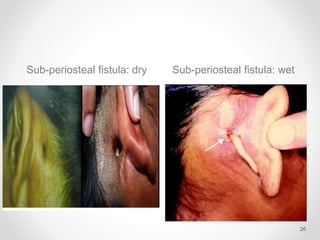
Sub-periosteal fistula: dry Sub-periosteal fistula: wet
26
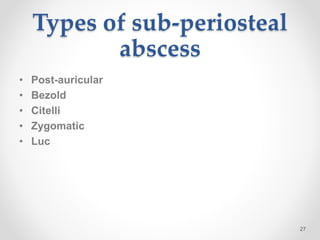
Types of sub-periosteal
abscess
• Post-auricular
• Bezold
• Citelli
• Zygomatic
• Luc
27
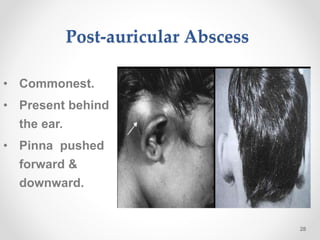
Post-auricular Abscess
• Commonest.
• Present behind
the ear.
• Pinna pushed
forward &
downward.
28
• Luc: swelling in external auditory canal
• Bezold absceses-swelling over sternocleidomastoid
muscle
• Citelli absceses-swelling over posterior belly of
digastric muscle
• Parapharyngeal & Retropharyngeal: due to spread of
pus along Eustachian tube
29
Intra Cranial
30
Meningitis
It defined as inflammation of leptomeninges (Pia &
Arachnoid) with bacterial invasion of CSF in
subarachnoid space.
31
Mode of invasion
• Preformed pathway (patent petro squamus suture or
labyrinth)
• Venous thrombophlebitis
• Direct erosion of bone by cholesteatoma
32
Clinical features
1. Fever with chills and rigor
2. Headache
3. Neck rigidity
4. Photophobia, irritability
5. Nausea, Vomiting
33
On examination
1. Kernig’s sign– Extension of leg with thigh flexed
causes pain
2. Brudzinski’s sign– Flexion of neck causes flexion
of hip and knee.
3. Exaggerated tendon reflex
4. Papilloedema
34
Otogenic brain abscess
• 50-70 % adult & 25% in child abscess are otogenic
• Route of infection:
1. Direct spread:
• via Tegmen plate: Temporal abscess
• via Trautmann’s triangle: Cerebellar abscess
2. Retrograde thrombophlebitis
35
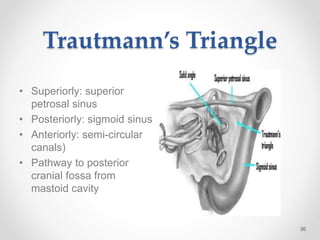
Trautmann’s Triangle
• Superiorly: superior
petrosal sinus
• Posteriorly: sigmoid sinus
• Anteriorly: semi-circular
canals)
• Pathway to posterior
cranial fossa from
mastoid cavity
36
Stages of Brain Abscess
• Early cerebritis(invasion)- 1-3 days
• Late cerebritis(Localization)-4-10days
• Early capsule formation(Enlargement)-10-13 days
• Late capsule formation(termination)-14 days.
37
Investigations
• CT scan of brain
• MRI brain
• Avoid lumbar puncture to prevent coning
38
Medical Treatment
• High dose broad spectrum I.V. antibiotics:
Ceftriaxone + Metronidazole + Gentamicin
• I.V. Dexamethasone : reduce oedema
• I.V. Mannitol : reduce I.C.T.
• Anti-epileptics: Phenytoin sodium
• Antibiotic ear drops & aural toilet
39
Surgical Treatment
• Repeated burr hole aspirations
• Excision of brain abscess with capsule
• Open incision & evacuation of pus
• Radical mastoidectomy after pt becomes stable
40
Otitic Hydrocephalus
• Defined as raised intracranial pressure with normal
CSF finding
• Seen in children and adolescent with acute and
chronic middle ear infection
41
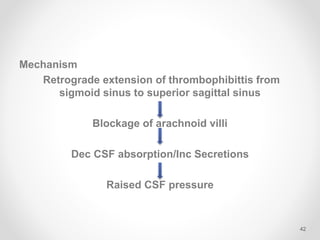
Mechanism
Retrograde extension of thrombophibittis from
sigmoid sinus to superior sagittal sinus
Blockage of arachnoid villi
Dec CSF absorption/Inc Secretions
Raised CSF pressure
42
Symptoms
• Severe headache,
• Drowsines
• Vomiting
• Blurring of vision,Diplopia
Signs
• Papilloedema
• Nystagmus
• CSF pressure > 300 mm of water.
43
Treatment
I.V. antibiotics & MRM
• Reducing CSF pressure (prevents optic atrophy) by:
I.V. Dexamethasone
I.V. Mannitol
Repeated lumbar puncture / lumbar drain
Ventriculo-peritoneal shunt
44
Extradural Abscess
• It is collection of pus between dura matter and the
bone of the IC
Pathology
• Bone over the dura destroyed by decalcification
(Acute) or cholesteatoma (Chronic)
• Spread of infection by venous thrombophlebitis
Clinical features
1. Persistent headache
2. Severe pain in the ear
3. Low grade fever and malaise.
45
Subdural abscess
• Collection of pus between dura and arachnoid
• Erosion of bone and dura by thrombophlebitic
process
• Pus may get loculated at various places in subdural
space
Clinical features –
1. Due to meningeal irritation – Fever, malaise,
headache, neck rigidity, positive kernig’s sign
2. Due to raised intra cranial tension – papilloedema,
ptosis.
46
Lateral sinus thrombosis
• Syn – Sigmoid sinus thrombosis
• Definition – It is an inflammation of inner wall of
lateral venous sinus with thrombus formation.
• Aetiology –CSOM with cholesteatoma.
47
Pathology
1. Formation of perisinus abscess(outer wall sinus)
2. Endophlebitis and mural thrombus formation(inner
Wall)
3. Thrombus enlarges to Obliterate the sinus lumen
and leads to intrasinus abscess
4. Extension of the thrombus-Septicemia.
48
• Clinical features
• Rise of temperature
• Headache, neck pain
• Papilloedema
• Tenderness along jugular vein
Investigation –
 CSF examination
 X-ray mastoid
 CECT scan, MRI
 Culture and sensitivity of ear swab
49
THANK YOU
50

COM complications

  • 1.
    Complications Of CSOM Moderator-Dr.SwaroopDev Presenter –Dr.Razal 1
  • 2.
    Classified as • Intracranial • Extra-cranial, Intra-temporal 2
  • 3.
    Factors affecting Pathogen Factors •High virulence bacteria • Antimicrobial resistance Patient Factors • Young age/Elderly • Poor immune status • Chronic disease(DM,TB) • Poor socio-economic status 3
  • 4.
    Routes of entry •Bony erosion (cholesteatoma,osteitis) • Anatomical pathway: oval window, round window, internal auditory canal, suture line, cochlear & vestibular aqueduct • Retrograde Thrombophlebitis • Congenital bony defects: facial canal, tegmen plate • Acquired bony defects: fracture, neoplasm, stapedectomy 4
  • 5.
  • 6.
    Mastoiditis • It isthe inflammation of mucosal lining of mastoid antrum and air cells system. • Pathology o Production of pus under tension o Hyperaemic decalcification o Osteoclastic resorption of bony walls 6
  • 7.
    Clinical Features • Otorrhoea> 2 weeks, otalgia & deafness • Mastoid reservoir sign: pus fills up on mopping • Sagging of postero-superior canal wall • Ironed out appearance of skin over mastoid due to thickened periosteum • Mastoid tenderness Investigation • X-ray & CT scan 7
  • 8.
  • 9.
    Mastoid reservoir signSagging of posterior wall 9
  • 10.
    Ironed out appearanceMastoid cavity 10
  • 11.
    Treatment • Urgent hospitaladmission • Broad spectrum I.V. antibiotics No response to medical treatment in 48 hrs • Cortical Mastoidectomy 11
  • 12.
  • 13.
    • Seen inAOM,COM(both mucosal and squamosal variety) • Predisposing factors: 1.congenital dehescence of FC 2.canal erosion by cholesteatoma/granulation 13
  • 14.
    • AOM: suddenonset, full recovery • COM: gradual onset, paralysis persist(erosion) Treatment: • Medical(Corticosteroids) • Modified Radical Mastoidectomy(Sq CSOM) • Facial nerve decompression if required • Physioyheraphy 14
  • 15.
  • 16.
    • Inflammation ofbony labyrinth Route of infection: • Round window membrane • Pre-formed opening (Stapedectomy) • Retrograde spread of meningitis types: • Serous labyrinthitis • Otogenic suppurative labyrinthitis • Meningitic suppurative labyrinthitis 16
  • 17.
    • Serous labyrinthitisoccurs during acute or chronic otitis media. It is presumed that bacterial exotoxins enter the inner ear via the oval or round window or a labyrinthine fistula. • there is no clinical method for differentiating serous from suppurative labyrinthitis. If vestibular and auditory functions are partially or completely retained, it can be assumed that the infection was serous. 17
  • 18.
    Treatment • Bed rest(affected ear up). Avoid head movement. • Labyrinthine sedative: Prochlorperazine, Cinnarizine • Broad spectrum I.V. antibiotics • Modified Radical Mastoidectomy: removes infection 18
  • 19.
  • 20.
    • Spread ofinfection from middle ear and mastoid to the (peumatised) petrous part of temporal bone. • Petrous bone are of three types; 1.Well peumatised(25-30%) 2. Diploic 3. Sclerotic(Most common) 20
  • 21.
    Gradenigo syndrome • Itis triad of, • Persistent otorrhoea • Retro-orbital pain: Trigeminal nerve involvement • Diplopia: Convergent squint due to lateral rectus palsy by injury to abducent nerve 21
  • 22.
    Etiology: • mastoiditis involvingpetrous apex along postero- superior & anteroinferior tracts in relation to bony labyrinth • Anteroinferior tract : starts at the hypotympanum near the eustachian tube runs around the cochlea to reach the petrous . • Posterosuperior tract :starts in the mastoid and runs behind or above the bony labyrinth to the petrous apex. 22
  • 23.
    Diagnosis: • C.T. scantemporal bone • M.R.I. to differ b/w bone marrow & pus Treatment: • Modified radical mastoidectomy & clearance of petrous apex cells 23
  • 24.
  • 25.
    Pathology Production of pusunder tension hyperaemic decalcification (halisteresis) osteoclastic resorption of bone sub-periosteal abscess penetration of periosteum + skin fistula formation 25
  • 26.
    Sub-periosteal fistula: drySub-periosteal fistula: wet 26
  • 27.
    Types of sub-periosteal abscess •Post-auricular • Bezold • Citelli • Zygomatic • Luc 27
  • 28.
    Post-auricular Abscess • Commonest. •Present behind the ear. • Pinna pushed forward & downward. 28
  • 29.
    • Luc: swellingin external auditory canal • Bezold absceses-swelling over sternocleidomastoid muscle • Citelli absceses-swelling over posterior belly of digastric muscle • Parapharyngeal & Retropharyngeal: due to spread of pus along Eustachian tube 29
  • 30.
  • 31.
    Meningitis It defined asinflammation of leptomeninges (Pia & Arachnoid) with bacterial invasion of CSF in subarachnoid space. 31
  • 32.
    Mode of invasion •Preformed pathway (patent petro squamus suture or labyrinth) • Venous thrombophlebitis • Direct erosion of bone by cholesteatoma 32
  • 33.
    Clinical features 1. Feverwith chills and rigor 2. Headache 3. Neck rigidity 4. Photophobia, irritability 5. Nausea, Vomiting 33
  • 34.
    On examination 1. Kernig’ssign– Extension of leg with thigh flexed causes pain 2. Brudzinski’s sign– Flexion of neck causes flexion of hip and knee. 3. Exaggerated tendon reflex 4. Papilloedema 34
  • 35.
    Otogenic brain abscess •50-70 % adult & 25% in child abscess are otogenic • Route of infection: 1. Direct spread: • via Tegmen plate: Temporal abscess • via Trautmann’s triangle: Cerebellar abscess 2. Retrograde thrombophlebitis 35
  • 36.
    Trautmann’s Triangle • Superiorly:superior petrosal sinus • Posteriorly: sigmoid sinus • Anteriorly: semi-circular canals) • Pathway to posterior cranial fossa from mastoid cavity 36
  • 37.
    Stages of BrainAbscess • Early cerebritis(invasion)- 1-3 days • Late cerebritis(Localization)-4-10days • Early capsule formation(Enlargement)-10-13 days • Late capsule formation(termination)-14 days. 37
  • 38.
    Investigations • CT scanof brain • MRI brain • Avoid lumbar puncture to prevent coning 38
  • 39.
    Medical Treatment • Highdose broad spectrum I.V. antibiotics: Ceftriaxone + Metronidazole + Gentamicin • I.V. Dexamethasone : reduce oedema • I.V. Mannitol : reduce I.C.T. • Anti-epileptics: Phenytoin sodium • Antibiotic ear drops & aural toilet 39
  • 40.
    Surgical Treatment • Repeatedburr hole aspirations • Excision of brain abscess with capsule • Open incision & evacuation of pus • Radical mastoidectomy after pt becomes stable 40
  • 41.
    Otitic Hydrocephalus • Definedas raised intracranial pressure with normal CSF finding • Seen in children and adolescent with acute and chronic middle ear infection 41
  • 42.
    Mechanism Retrograde extension ofthrombophibittis from sigmoid sinus to superior sagittal sinus Blockage of arachnoid villi Dec CSF absorption/Inc Secretions Raised CSF pressure 42
  • 43.
    Symptoms • Severe headache, •Drowsines • Vomiting • Blurring of vision,Diplopia Signs • Papilloedema • Nystagmus • CSF pressure > 300 mm of water. 43
  • 44.
    Treatment I.V. antibiotics &MRM • Reducing CSF pressure (prevents optic atrophy) by: I.V. Dexamethasone I.V. Mannitol Repeated lumbar puncture / lumbar drain Ventriculo-peritoneal shunt 44
  • 45.
    Extradural Abscess • Itis collection of pus between dura matter and the bone of the IC Pathology • Bone over the dura destroyed by decalcification (Acute) or cholesteatoma (Chronic) • Spread of infection by venous thrombophlebitis Clinical features 1. Persistent headache 2. Severe pain in the ear 3. Low grade fever and malaise. 45
  • 46.
    Subdural abscess • Collectionof pus between dura and arachnoid • Erosion of bone and dura by thrombophlebitic process • Pus may get loculated at various places in subdural space Clinical features – 1. Due to meningeal irritation – Fever, malaise, headache, neck rigidity, positive kernig’s sign 2. Due to raised intra cranial tension – papilloedema, ptosis. 46
  • 47.
    Lateral sinus thrombosis •Syn – Sigmoid sinus thrombosis • Definition – It is an inflammation of inner wall of lateral venous sinus with thrombus formation. • Aetiology –CSOM with cholesteatoma. 47
  • 48.
    Pathology 1. Formation ofperisinus abscess(outer wall sinus) 2. Endophlebitis and mural thrombus formation(inner Wall) 3. Thrombus enlarges to Obliterate the sinus lumen and leads to intrasinus abscess 4. Extension of the thrombus-Septicemia. 48
  • 49.
    • Clinical features •Rise of temperature • Headache, neck pain • Papilloedema • Tenderness along jugular vein Investigation –  CSF examination  X-ray mastoid  CECT scan, MRI  Culture and sensitivity of ear swab 49
  • 50.

Editor's Notes

  • #8 wall due to peri---osteitis of bony wall b/w antrum & posterior E.A.C.
  • #12 3rd gen cefelosporin
  • #39 & temporal bone with contrast