
















Utah Academy of Teachers
Educators will design quality… curriculum and instruction to insure student learning: Defining  quality classroom Aligning standards, curriculum, assessment Engaging curriculum and instruction Integrating for transfer of learning
Quality Classroom What defines a quality classroom for learning? Most important factor in student learning: Quality teaching Good teachers make good schools
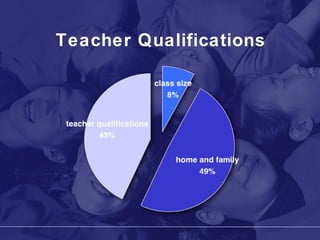
Teacher Qualifications
Cumulative Effects of Teaching
Effects of Educational Investments
90-90-90 Schools High poverty High minority enrollment High academic success rate
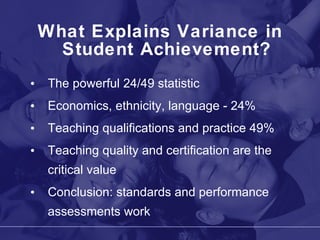
What Explains Variance in Student Achievement? The powerful 24/49 statistic Economics, ethnicity, language - 24% Teaching qualifications and practice 49% Teaching quality and certification are the critical value Conclusion: standards and performance assessments work
Programs  Do Not Teach Students; Teachers Do
Framework for Teaching Components of Professional Practice Domain 1 
Planning and Preparation Domain 2 
Classroom Environment Domain 3 
Instruction Domain 4 
Professional Responsibilities
Planning and Preparation Domain 1: includes comprehensive understanding of the  content  to be taught, knowledge of the  student's backgrounds , and  designing  instruction and assessment.
Classroom Environment Domain 2: is concerned with the teacher's skill in establishing an  environment  conducive to learning, including both the  physical  and  interpersonal  aspects of the environment.
Instruction Domain 3: is concerned with the teacher's skill in  engaging students  in learning the content, and includes the wide range of  instructional strategies  that enable students to learn.
Professional Responsibilities Domain 4: is concerned with a teacher's additional professional responsibilities, including  self-assessment  and  reflection , communication with  parents , participating in on-going  professional development , and  contributing  to the school and district environment.
Instructional Domain Themes Equity (principles of equity) Cultural sensitivity (principles of equity) High expectations (U-PASS, life skills) Development appropriateness Accommodating students with special needs Appropriate use of technology
Components of Domain One Planning and Preparation Component 1a:   Demonstrating Knowledge of Content and Pedagogy Component 1b:   Demonstrating Knowledge of Students Component 1c:   Selecting Instructional Goals Component 1d:   Demonstrating Knowledge of Resources Component 1e:   Designing Coherent Instruction Component 1f:   Assessing Student Learning
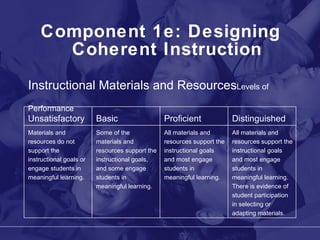
Component 1e: Designing Coherent Instruction Instructional Materials and Resources
 Levels of Performance Unsatisfactory Basic Proficient Distinguished Materials and resources do not support the instructional goals or engage students in meaningful learning. Some of the materials and resources support the instructional goals, and some engage students in meaningful learning. All materials and resources support the instructional goals and most engage students in meaningful learning. All materials and resources support the instructional goals and most engage students in meaningful learning. There is evidence of student participation in selecting or adapting materials.
How does aligning standards, curriculum and assessment enhance student learning?
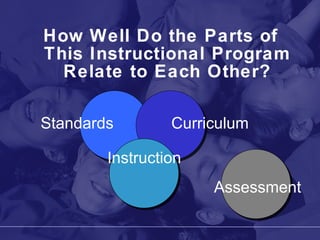
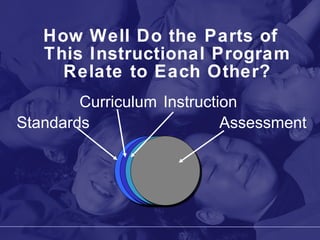
How Well Do the Parts of This Instructional Program Relate to Each Other? Standards Curriculum Instruction Assessment
WHAT IS UNDERSTANDING BY DESIGN? Utah State Office of Education


What is Understanding by Design? A curriculum model which affects--- Teacher planning Teacher delivery Student learning Student assessment
Backward Design Process Stage 1:   Identify Desired Results Stage 2:   Determine Acceptable Evidence Stage 3:   Plan Learning Experiences and Instruction
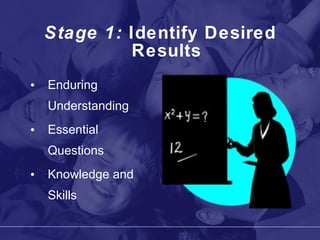
Stage 1:  Identify Desired Results Enduring Understanding Essential Questions Knowledge and Skills
Understanding "the capacity to apply facts, concepts and skills in new situations in appropriate ways" Howard Gardner
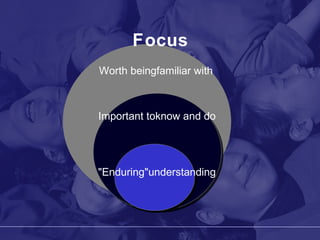
Focus Worth being
familiar with Important to
know and do "Enduring"
understanding
 
Reflection of a veteran high school teacher…
Key Questions What is worth understanding? What is understanding? How will we know that students really understand? How might we better anticipate and address predictable student misunderstandings?
Enduring Understanding Filters Fills state standards Represents a "big idea" having enduring value beyond the classroom Resides at the heart of the discipline Requires student uncoverage Engaging for students
Principles and Generalizations Examples: Democratic governments must balance rights of individuals with the common good Correlation does not insure causality Creating space away from the ball increases scoring opportunities (e.g. in soccer, football, basketball)
Content Standards Enduring big ideas, having lasting value beyond the classroom Big ideas and core processes at the heart of the discipline Possible Enduring Understandings?
"Unpack" Content Standards What "big ideas" are embedded within the standards?
Artistic Expression Oregon CIM: Recognize how technical, organizational and aesthetic elements contribute to the ideas, emotions and overall impact communicated by works of art. Students will understand that:
• Available tools and technologies influence the ways in which  artists express their ideas
• Great artists often break with established traditions, conventions and techniques to express what they see and feel
Essential Questions Have no one obvious right answer Raise other important questions, often across subject area boundaries Address the philosophical or conceptual foundations of a discipline Recur naturally Are framed to provoke and sustain student interest
Lesson Plan Students will understand the impact that World War II had on the United States: Why and when was World War II fought? How did WWII impact life inside the U.S.? How did WWII affect different groups of people within the United States?
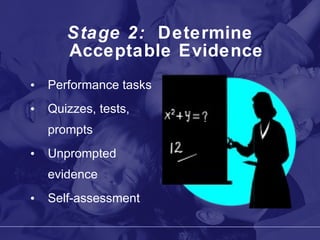
Stage 2:   Determine Acceptable Evidence Performance tasks Quizzes, tests, prompts Unprompted evidence Self-assessment
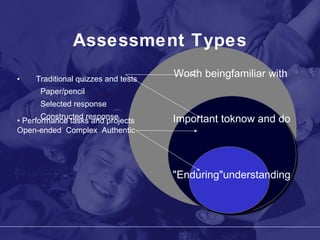
Assessment Types Traditional quizzes and tests   Paper/pencil   Selected response   Constructed response Worth being
familiar with Important to
know and do "Enduring"
understanding •  Performance tasks and projects
  Open-ended
  Complex
  Authentic
Think Like an Assessor Not an Activity Designer Design assessments  before  you design lessons and activities Be clear about what evidence of learning you seek
Multiple Sources Think "photo album" versus "snapshot" •  Sound assessment requires multiple sources of evidence, collected over time
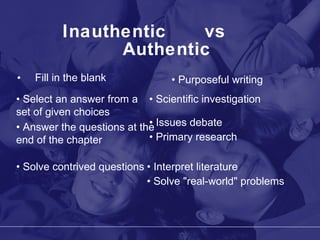
Inauthentic  vs  Authentic Fill in the blank •  Purposeful writing •  Select an answer from a set of given choices •  Scientific investigation •  Answer the questions at the end of the chapter •  Issues debate •  Primary research •  Solve contrived questions •  Interpret literature •  Solve "real-world" problems
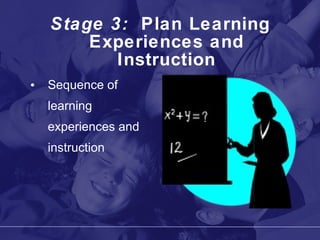
Stage 3:   Plan Learning Experiences and Instruction Sequence of learning experiences and instruction
How does  Understanding by Design   adhere to state core standards?
How does  Understanding by Design   impact the classroom and student learning?
Understanding by Design   Engaging Students
Understanding by Design   Curriculum Integration
Who Dares to Teach Must Never Cease to Learn For more information: Rebecca Anderson [email_address] Carolee Coleman [email_address]
Utah Teacher Development Continuum
The Teacher "I've come to a frightening conclusion that I am the decisive element in the classroom. It's my personal approach that creates the climate.  It's my daily mood that makes the weather.  As a teacher, I possess a tremendous power to make a child's life miserable or joyous.  I can be a tool of torture or an instrument of inspiration.  I can humiliate or humor, hurt or heal.  In all situations, it is my response that decides whether a crisis will be escalated or de-escalated and a child humanized or de-humanized."  Haim Ginott

Understanding PPT

  • 1.
  • 2.
    Educators will designquality… curriculum and instruction to insure student learning: Defining quality classroom Aligning standards, curriculum, assessment Engaging curriculum and instruction Integrating for transfer of learning
  • 3.
    Quality Classroom Whatdefines a quality classroom for learning? Most important factor in student learning: Quality teaching Good teachers make good schools
  • 4.
  • 5.
  • 6.
  • 7.
    90-90-90 Schools Highpoverty High minority enrollment High academic success rate
  • 8.
    What Explains Variancein Student Achievement? The powerful 24/49 statistic Economics, ethnicity, language - 24% Teaching qualifications and practice 49% Teaching quality and certification are the critical value Conclusion: standards and performance assessments work
  • 9.
    Programs DoNot Teach Students; Teachers Do
  • 10.
    Framework for TeachingComponents of Professional Practice Domain 1 
Planning and Preparation Domain 2 
Classroom Environment Domain 3 
Instruction Domain 4 
Professional Responsibilities
  • 11.
    Planning and PreparationDomain 1: includes comprehensive understanding of the content to be taught, knowledge of the student's backgrounds , and designing instruction and assessment.
  • 12.
    Classroom Environment Domain2: is concerned with the teacher's skill in establishing an environment conducive to learning, including both the physical and interpersonal aspects of the environment.
  • 13.
    Instruction Domain 3:is concerned with the teacher's skill in engaging students in learning the content, and includes the wide range of instructional strategies that enable students to learn.
  • 14.
    Professional Responsibilities Domain4: is concerned with a teacher's additional professional responsibilities, including self-assessment and reflection , communication with parents , participating in on-going professional development , and contributing to the school and district environment.
  • 15.
    Instructional Domain ThemesEquity (principles of equity) Cultural sensitivity (principles of equity) High expectations (U-PASS, life skills) Development appropriateness Accommodating students with special needs Appropriate use of technology
  • 16.
    Components of DomainOne Planning and Preparation Component 1a: Demonstrating Knowledge of Content and Pedagogy Component 1b: Demonstrating Knowledge of Students Component 1c: Selecting Instructional Goals Component 1d: Demonstrating Knowledge of Resources Component 1e: Designing Coherent Instruction Component 1f: Assessing Student Learning
  • 17.
    Component 1e: DesigningCoherent Instruction Instructional Materials and Resources
 Levels of Performance Unsatisfactory Basic Proficient Distinguished Materials and resources do not support the instructional goals or engage students in meaningful learning. Some of the materials and resources support the instructional goals, and some engage students in meaningful learning. All materials and resources support the instructional goals and most engage students in meaningful learning. All materials and resources support the instructional goals and most engage students in meaningful learning. There is evidence of student participation in selecting or adapting materials.
  • 18.
    How does aligningstandards, curriculum and assessment enhance student learning?
  • 19.
    How Well Dothe Parts of This Instructional Program Relate to Each Other? Standards Curriculum Instruction Assessment
  • 20.
    How Well Dothe Parts of This Instructional Program Relate to Each Other? Standards Curriculum Instruction Assessment
  • 21.
    WHAT IS UNDERSTANDINGBY DESIGN? Utah State Office of Education
  • 22.
  • 23.
  • 24.
  • 25.
    What is Understandingby Design? A curriculum model which affects--- Teacher planning Teacher delivery Student learning Student assessment
  • 26.
    Backward Design ProcessStage 1: Identify Desired Results Stage 2: Determine Acceptable Evidence Stage 3: Plan Learning Experiences and Instruction
  • 27.
    Stage 1: Identify Desired Results Enduring Understanding Essential Questions Knowledge and Skills
  • 28.
    Understanding "the capacityto apply facts, concepts and skills in new situations in appropriate ways" Howard Gardner
  • 29.
    Focus Worth being
familiarwith Important to
know and do "Enduring"
understanding
  • 30.
  • 31.
    Reflection of aveteran high school teacher…
  • 32.
    Key Questions Whatis worth understanding? What is understanding? How will we know that students really understand? How might we better anticipate and address predictable student misunderstandings?
  • 33.
    Enduring Understanding FiltersFills state standards Represents a "big idea" having enduring value beyond the classroom Resides at the heart of the discipline Requires student uncoverage Engaging for students
  • 34.
    Principles and GeneralizationsExamples: Democratic governments must balance rights of individuals with the common good Correlation does not insure causality Creating space away from the ball increases scoring opportunities (e.g. in soccer, football, basketball)
  • 35.
    Content Standards Enduringbig ideas, having lasting value beyond the classroom Big ideas and core processes at the heart of the discipline Possible Enduring Understandings?
  • 36.
    "Unpack" Content StandardsWhat "big ideas" are embedded within the standards?
  • 37.
    Artistic Expression OregonCIM: Recognize how technical, organizational and aesthetic elements contribute to the ideas, emotions and overall impact communicated by works of art. Students will understand that:
• Available tools and technologies influence the ways in which artists express their ideas
• Great artists often break with established traditions, conventions and techniques to express what they see and feel
  • 38.
    Essential Questions Haveno one obvious right answer Raise other important questions, often across subject area boundaries Address the philosophical or conceptual foundations of a discipline Recur naturally Are framed to provoke and sustain student interest
  • 39.
    Lesson Plan Studentswill understand the impact that World War II had on the United States: Why and when was World War II fought? How did WWII impact life inside the U.S.? How did WWII affect different groups of people within the United States?
  • 40.
    Stage 2: Determine Acceptable Evidence Performance tasks Quizzes, tests, prompts Unprompted evidence Self-assessment
  • 41.
    Assessment Types Traditionalquizzes and tests Paper/pencil Selected response Constructed response Worth being
familiar with Important to
know and do "Enduring"
understanding • Performance tasks and projects
 Open-ended
 Complex
 Authentic
  • 42.
    Think Like anAssessor Not an Activity Designer Design assessments before you design lessons and activities Be clear about what evidence of learning you seek
  • 43.
    Multiple Sources Think"photo album" versus "snapshot" • Sound assessment requires multiple sources of evidence, collected over time
  • 44.
    Inauthentic vs Authentic Fill in the blank • Purposeful writing • Select an answer from a set of given choices • Scientific investigation • Answer the questions at the end of the chapter • Issues debate • Primary research • Solve contrived questions • Interpret literature • Solve "real-world" problems
  • 45.
    Stage 3: Plan Learning Experiences and Instruction Sequence of learning experiences and instruction
  • 46.
    How does Understanding by Design adhere to state core standards?
  • 47.
    How does Understanding by Design impact the classroom and student learning?
  • 48.
    Understanding by Design Engaging Students
  • 49.
    Understanding by Design Curriculum Integration
  • 50.
    Who Dares toTeach Must Never Cease to Learn For more information: Rebecca Anderson [email_address] Carolee Coleman [email_address]
  • 51.
  • 52.
    The Teacher "I'vecome to a frightening conclusion that I am the decisive element in the classroom. It's my personal approach that creates the climate. It's my daily mood that makes the weather. As a teacher, I possess a tremendous power to make a child's life miserable or joyous. I can be a tool of torture or an instrument of inspiration. I can humiliate or humor, hurt or heal. In all situations, it is my response that decides whether a crisis will be escalated or de-escalated and a child humanized or de-humanized." Haim Ginott

Editor's Notes

  • #2 Rebecca Anderson [email_address] Carolee Coleman [email_address] http://www.usoe.k12.ut.us/
  • #3 Educators will understand how to design quality curriculum and instructions to insure student learning. 1. What defines a quality classroom for learning? 2. How does aligning standards, curriculum, and assessment enhance student learning? 3. How does engaging curriculum and instruction support student learning? 4. How does integration of subject areas build stronger transfer of learning in students?
  • #4 What defines a quality classroom for learning? The most important factor affecting student learning is quality teaching. Good teachers make good schools.
  • #5 Influence of Teacher Qualifications on Student Achievement Proportion of Explained Variance in Math Test Score Gains (grades 3-5) Due to: Class size: 8% Home and family factors: 49% parent education, income, language, background, race and location) Teacher qualifications: 43% (licencing, examination scores, education and experience)
  • #6 Cumulative Effects of teaching Fifth Grade Math and Sixth Grade Reading Scores: Dallas, Texas (Beginning Percentile = 60) Source: Jordan, Mendro & Weerasinghe, "Teacher Effects on Longitudinal Student Achievement" (1997)
  • #7 Effects of Educational Investments Size of Increase in Student Achievement for Every $500 Spent on: Lowering Pupil/Teacher Ratio: 0.04 Increasing Teacher Salaries: 0.16 Increasing Teacher Experience: 0.18 Increasing Teacher Education: 0.22 Achievement gains were calculated as standard deviation units on a range of achievement tests in the 60 studies reviewd. Source: Rob Greenwald, Larry V. Hedges, and Richard D. Laine (1996). The Effect of School Resources on Student Achievement Review of Educational Research 66(3). pp. 361-396
  • #11 Framework for Teaching Components of Professional Practice Domain 1 Planning and Preparation Includes comprehensive understand of the content to be taught, knowledge of the students' backgrounds, and designing instruction and assessment. Domain 2 Classroom Environment Is concerned with the teacher's skill in establishing an environment conducive to learning, including both the physical and interpersonal aspects of the environment. Domain 3 Instruction Is concerned with the teacher's skill in engaging students in learning the content, and includes the wide range of instructional strategies that enable students to learn. Domain 4 Professional Responsibilities Is concerned with a teacher's additional professional responsibilities, including self-assessment and reflection, communication with parents, participating in on-going professional development, and contributing to the school and district environment. Themes Reflected in Instructional Domains: Equity (Principles of Equity) Cultural Sensitivity (Principles of Equity) High Expectations (U-Pass, Life Skills) Development Appropriateness Accommodating Students with Special Needs Appropriate Use of Technology
  • #12 Planning and Preparation Domain 1 includes comprehensive understanding of the content to be taught, knowledge of the student's backgrounds , and designing instruction and assessment.
  • #13 Classroom Environment Domain 2 is concerned with the teacher's skill in establishing an environment conducive to learning, including both the physical and interpersonal aspects of the environment.
  • #14 Instruction Domain 3 is concerned with the teacher's skill in engaging students in learning the content, and includes the wide range of instructional strategies that enable students to learn.
  • #15 Professional Responsibilities Domain 4 is concerned with a teacher's additional professional responsibilities, including self-assessment and reflection , communication with parents , participating in on-going professional development , and contributing to the school and district environment.
  • #16 Themes Reflected in Instructional Domains Equity (principles of equity) Cultural sensitivity (principles of equity) High expectations (U-PASS, life skills) Development appropriateness Accommodating students with special needs Appropriate use of technology
  • #17 Components of Professional Practice Domain 1: Planning and Preparation Component 1a: Demonstrating Knowledge of Content and Pedagogy Component 1b: Demonstrating Knowledge of Students Component 1c: Selecting Instructional Goals Component 1d: Demonstrating Knowledge of Resources Component 1e: Designing Coherent Instruction Component 1f: Assessing Student Learning
  • #19 How does aligning standards, curriculum and assessment enhance student learning?
  • #22 ASCD publication by Grant Wiggins and Jay McTighe. Merrill Prentice Hall, 1998
  • #26 Understanding By Design is a curriculum model affecting teacher delivery and enhances student learning.
  • #27 Backward Design Process Stage 1: Identify Desired Results Stage 2: Determine Acceptable Evidence Stage 3: Plan Learning Experiences and Instruction
  • #32 Reflection of a veteran high school teacher… "Gardner's definition of understanding gives me a good perspective on my own high school education. I felt then that my brain was a weigh-station for material going in one ear and (after the test) out the other. I could memorize very easily and so became valedictorian, but I was embarrassed even then that I knew (understood) much less than some other students who cared less about grades."
  • #38 Sample Standard
  • #51 Who Dares to Teach Must
Never Cease to Learn -- Jon Cotton Dana For more information: Rebecca Anderson [email_address] Carolee Coleman [email_address]