Event Management
It’s not rocket science!
Taking the fear out of organising
Successful events every time
So where do we start?
The event
 What is the purpose of the event
 What do you want to achieve
 Who is your target audience.
Event timetable
 Make a checklist
 Include dates for completion of task.
Event timetable/checklist
NACO Annual Conference 2009
Organising Committee Mtg March 2008
Venue inspection visit March 2008
Accommodation inspection March 2008
Book Venue April
Book Accommodation April
Organising Committee Mtg May
Invite speakers/guests May
Prepare Budget May
Budget approved
Prepare Conference Programme
& Registration Form
Book entertainment
Book photographer
Programme & Reg Form to
Printers
August
Mailshot Conference Programme September
Return date: Registration Forms
(6 wks prior)
2nd
wk
January
Prepare joining instructions
Prepare final Programme
Final Programme to printers
Mail joining instructions (3 wks
prior) with attendance list
1st
wk
February
Printing of speakers name
boards
Prepare table plans etc
Press Release
Attend event 5/6 March
The Venue
 Where?
 What type of venue?
 When?
 CARDINAL RULE – Never book a venue
without an inspection visit!
Venue checklist
 Correct combination of rooms
 Accompanying exhibition required
 Obtain maximum capacity numbers
 What style of seating is required
Venue checklist
 Is a stage necessary – location
 Does the main room have any obstructing
pillars etc
 Does the main room have an
induction loop system
Venue checklist
 Is there natural light/will the room blackout
 How noisy is the heating/air con
 Does the venue have a dedicated
co-ordinator who can assist with
arrangements
Venue checklist
 What audio visual equipment is
needed
 Is there an adequate PA system
 Is there good access for disabled
delegates.
Booking the venue
 Meet with the conference co-ordinator
 Obtain room hire rates – negotiable!
 Conference venue – daily delegate rate
 Check cancellation fees
 Venue schedule.
Overnight accommodation
 If accommodation needed, is it important
for all delegates to remain in one location
 If using several hotels, is travel to main
venue required
 Single or twin rooms
Overnight accommodation
 INSPECT all accommodation
 Checklist
 Check latest release dates without
incurring cancellation fees.
The budget
 Anticipated number of delegates
 Is the event to break-even or profit desired
 Is sponsorship to be sought
 Always allow a ‘contingency’
 Be REALISTIC.
Anticipated No. of delegates 100
Projected
£
Actual
£
General Event:
Printing
• Preliminary Programme &
Reg Form
• Conference Programme
• Menu cards
• Speakers name boards
£250.00
£500.00
£60.00
£45.00
Stationery
• Name badges
• Delegate Wallets
£80.00
£150.00
Entertainment
• After dinner Band
• Caricature Artist
£500.00
£100.00
Photographer £95.00
Flowers £150.00
Speakers’ expenses
• Fees
• Travel
• Overnight accom
£1,200.00
£450.00
£720.00
Audio visual hire £780.00
Conference Office expenses
(travel, accommodation &
catering) £550.00
Total General £5,630.00
Contingency 15% £844.50
TOTAL GENERAL £6,474.50
Projected
£
Actual
£
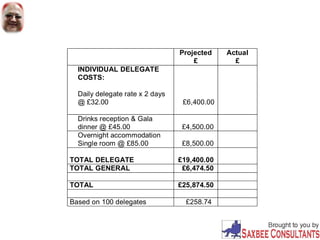
INDIVIDUAL DELEGATE
COSTS:
Daily delegate rate x 2 days
@ £32.00 £6,400.00
Drinks reception & Gala
dinner @ £45.00 £4,500.00
Overnight accommodation
Single room @ £85.00 £8,500.00
TOTAL DELEGATE £19,400.00
TOTAL GENERAL £6,474.50
TOTAL £25,874.50
Based on 100 delegates £258.74
Sponsorship
 Who to approach
 Sponsorship packages
 Level of publicity at event.
Invitation to speakers/official guests
 Seek commitment as soon as possible
 Are speakers’ fees/expenses payable
 Send ADV form.
SPEAKERS’ ADV FORM - Return by (date)
Full Name ___________________________________________ Title Mr/Mrs/Ms _______
Company/organisation ______________________________________________________
Address _________________________________________________________________
Tel: Office ________________ Mobile _______________ E:mail_____________________
Title of your talk ___________________________________________________
Brief synopsis (please provide a brief synopsis of your talk for publication)
___________________________________________________________
___________________________________________________________
___________________________________________________________
___________________________________________________________
Biographical details (please provide a brief biography for publication)
Audio Visual Equipment (please indicate your requirements)
Interactive whiteboard Multimedia projector
Standard whiteboard DVD player
OHP Projector Flipchart
Other equipment?
Signed _______________________________ Date ___________________
Conference Programme
 Decide whether preliminary or final
programme
 What to include
 CARDINAL RULE –
proof read thoroughly!
Registration Form
 Include to whom the form is to be returned
to with contact information
 Include the closing date for receipt – 6
weeks prior to event
 Include request for special requirements –
dietary/disabled access/help in an
emergency.
Joining Instructions
 3 weeks prior to event
 Include Registration Card
 Final materials and attendance list.
Organising an Exhibition
 As with Conferences, establish objectives
of exhibition and identify exhibitors
 If alongside conference, ensure
tea/coffee/lunch and/or other events are
integrated into the exhibition space
 Follow up initial mailshot with
telesales call
Organising an Exhibition
 Produce an Exhibitors manual for hire of
shell extras, furniture, flowers etc
 Always produce an Exhibitors showguide
 Always tie-in exhibition arrangements
within conference programme
 Complete a Risk Assessment
At the event
 Arrive at least the day before
 Meet key organising personnel
 Establish first aid contact
 Complete final risk assessment
 Ensure registration desk in prime location
 If something goes wrong:
DON’T PANIC!
Assessing failure or success
 Evaluation form
 At the event or sent out separately.
EVALUATION FORM
Your feedback is essential to monitor the effectiveness of our events.
Name: Company:
Conference:
Workshop(s) attended:WorkshopEvent:
How would you rate the content and relevance of today’s
Conference?
(Excellent = 4 Very Good =3 Good = 2 Poor = 1)
Comments:
Score
...
What could be done, if anything, to improve the quality of today’s workshop?
(consider timing and duration, location and environment)
How would you rate your Workshop Leader in the following key
areas?
(Excellent = 4 Very Good =3 Good = 2 Poor = 1)
Made you feel comfortable and at ease
Communicated well and provided clear and concise instructions
Encouraged questions and feedback
Knowledgeable about subject matter
Score
...
...
...
...
How would you rate the Conference materials in terms of:
(Excellent = 4 Very Good =3 Good = 2 Poor = 1)
Quality
Suitability as post-event support
...
...
Have your personal objectives for attending this event been met?
(Yes = 3 Mostly = 2 No = 1) If not, why not?
Thank you for completing this form.
What organising nightmares
have you experienced and in
hindsight what would you
have done differently?
Press Releases
 Decide if you want to prepare one
 Decide on target audience
 How will it be distributed.
How to write a press release
 Keep it short & sweet – max 2xA4 sides
 Decide for immediate release or to be
embargoed
 Must include the 5 ‘W’s – who, what,
when, where, why and then how.
PRESS RELEASE TEMPLATE
(logo)
PRESS RELEASE
Issued: (date)
For Immediate Release OR Embargoed Until: (date/time)
TITLE (make it brief and attention grabbing)
The first paragraph should be a summary of the story – including Who,
What, When, Where.
Expand on the details in the next paragraph using Why and How.
Remember: the journalist will want to know what is unique or new about
the story and why it will appeal to their readers.
Then back up your claims with facts and statistics.
Follow up your story with quotes in italics, if required. This will bring the
story to life.
Finish off with details such as dates, times, prices and how to contact
you.
## Ends ##
Notes to editors
1. Tell the editor who to contact for more information – incl.
mobile, landline and e:mail
2. Also include short background information on your organisation
3. Include company name, fax number, e:mail and website info
4. Include opening hours, prices, venues, dates as appropriate
5. You should also state whether you have photos available
Dealing with media interest
 If the media are interested in your story,
they will contact you as organiser first
 Always protect your guest/speaker
 Check with him/her to see if they are
happy to give an interview
 Schedule with journalist at a
convenient time.
Risk Assessments
 The safety of your delegates/guests is
paramount – reason enough to prepare one!
 It’s a careful examination of what could
cause harm to people, allowing you to
assess if you have taken enough precautions
or should do more to prevent harm.
Its being prepared!
Preparing a Risk Assessment
 The 5 steps are:
 Identify the hazard
 Decide who might be harmed
 Evaluate risks & decide on precaution
 Record your findings
 Review assessment & update if
necessary
What could go wrong at your
event and how would you
deal with it?
Health & Safety Issues
 Knowing your delegates/guests
 Having access to venue first aider or
consider your own training
 Knowing the venue emergency evacuation
procedure & alarm
 Consider making a ‘formal’ announcement
at the opening of your event.
What health & safety issues
affect the events you
organise?
Need more help / training
 Event Management –
 ACE – Association of Conference
Executives
 AEME – Association for Event
Management Education
Need more help / training
 Risk Assessments –
Health & Safety Executive
 Press & Media Relations –
The Press Association
What have we learnt today?
 In short –
 Never underestimate the task ahead
 Plan, plan, plan
 Maintain good effective working
relationships – you can’t do it alone!
What have we learnt today?
 Proof read everything
 Never assume anything
 Always be prepared!
For details and bookings contact:-
Parveen Kumar Chadha… THINK TANK
(Founder and C.E.O of Saxbee Consultants & Other-Mother
marketingandcommunicationconsultants.com)
Email :-saxbeeconsultants@gmail.com
Mobile No. +91-9818308353
Address:-First Floor G-20(A), Kirti Nagar, New Delhi India Postal
Code-110015
Thank you and good luck with
your event organising

Event management

  • 1.
  • 2.
    Taking the fearout of organising Successful events every time So where do we start?
  • 3.
    The event  Whatis the purpose of the event  What do you want to achieve  Who is your target audience.
  • 4.
    Event timetable  Makea checklist  Include dates for completion of task.
  • 5.
    Event timetable/checklist NACO AnnualConference 2009 Organising Committee Mtg March 2008 Venue inspection visit March 2008 Accommodation inspection March 2008 Book Venue April Book Accommodation April Organising Committee Mtg May Invite speakers/guests May Prepare Budget May Budget approved Prepare Conference Programme & Registration Form Book entertainment Book photographer Programme & Reg Form to Printers August Mailshot Conference Programme September Return date: Registration Forms (6 wks prior) 2nd wk January Prepare joining instructions Prepare final Programme Final Programme to printers Mail joining instructions (3 wks prior) with attendance list 1st wk February Printing of speakers name boards Prepare table plans etc Press Release Attend event 5/6 March
  • 6.
    The Venue  Where? What type of venue?  When?  CARDINAL RULE – Never book a venue without an inspection visit!
  • 7.
    Venue checklist  Correctcombination of rooms  Accompanying exhibition required  Obtain maximum capacity numbers  What style of seating is required
  • 8.
    Venue checklist  Isa stage necessary – location  Does the main room have any obstructing pillars etc  Does the main room have an induction loop system
  • 9.
    Venue checklist  Isthere natural light/will the room blackout  How noisy is the heating/air con  Does the venue have a dedicated co-ordinator who can assist with arrangements
  • 10.
    Venue checklist  Whataudio visual equipment is needed  Is there an adequate PA system  Is there good access for disabled delegates.
  • 11.
    Booking the venue Meet with the conference co-ordinator  Obtain room hire rates – negotiable!  Conference venue – daily delegate rate  Check cancellation fees  Venue schedule.
  • 12.
    Overnight accommodation  Ifaccommodation needed, is it important for all delegates to remain in one location  If using several hotels, is travel to main venue required  Single or twin rooms
  • 13.
    Overnight accommodation  INSPECTall accommodation  Checklist  Check latest release dates without incurring cancellation fees.
  • 14.
    The budget  Anticipatednumber of delegates  Is the event to break-even or profit desired  Is sponsorship to be sought  Always allow a ‘contingency’  Be REALISTIC.
  • 15.
    Anticipated No. ofdelegates 100 Projected £ Actual £ General Event: Printing • Preliminary Programme & Reg Form • Conference Programme • Menu cards • Speakers name boards £250.00 £500.00 £60.00 £45.00 Stationery • Name badges • Delegate Wallets £80.00 £150.00 Entertainment • After dinner Band • Caricature Artist £500.00 £100.00 Photographer £95.00 Flowers £150.00 Speakers’ expenses • Fees • Travel • Overnight accom £1,200.00 £450.00 £720.00 Audio visual hire £780.00 Conference Office expenses (travel, accommodation & catering) £550.00 Total General £5,630.00 Contingency 15% £844.50 TOTAL GENERAL £6,474.50
  • 16.
    Projected £ Actual £ INDIVIDUAL DELEGATE COSTS: Daily delegaterate x 2 days @ £32.00 £6,400.00 Drinks reception & Gala dinner @ £45.00 £4,500.00 Overnight accommodation Single room @ £85.00 £8,500.00 TOTAL DELEGATE £19,400.00 TOTAL GENERAL £6,474.50 TOTAL £25,874.50 Based on 100 delegates £258.74
  • 17.
    Sponsorship  Who toapproach  Sponsorship packages  Level of publicity at event.
  • 18.
    Invitation to speakers/officialguests  Seek commitment as soon as possible  Are speakers’ fees/expenses payable  Send ADV form.
  • 19.
    SPEAKERS’ ADV FORM- Return by (date) Full Name ___________________________________________ Title Mr/Mrs/Ms _______ Company/organisation ______________________________________________________ Address _________________________________________________________________ Tel: Office ________________ Mobile _______________ E:mail_____________________ Title of your talk ___________________________________________________ Brief synopsis (please provide a brief synopsis of your talk for publication) ___________________________________________________________ ___________________________________________________________ ___________________________________________________________ ___________________________________________________________ Biographical details (please provide a brief biography for publication) Audio Visual Equipment (please indicate your requirements) Interactive whiteboard Multimedia projector Standard whiteboard DVD player OHP Projector Flipchart Other equipment? Signed _______________________________ Date ___________________
  • 20.
    Conference Programme  Decidewhether preliminary or final programme  What to include  CARDINAL RULE – proof read thoroughly!
  • 21.
    Registration Form  Includeto whom the form is to be returned to with contact information  Include the closing date for receipt – 6 weeks prior to event  Include request for special requirements – dietary/disabled access/help in an emergency.
  • 22.
    Joining Instructions  3weeks prior to event  Include Registration Card  Final materials and attendance list.
  • 23.
    Organising an Exhibition As with Conferences, establish objectives of exhibition and identify exhibitors  If alongside conference, ensure tea/coffee/lunch and/or other events are integrated into the exhibition space  Follow up initial mailshot with telesales call
  • 24.
    Organising an Exhibition Produce an Exhibitors manual for hire of shell extras, furniture, flowers etc  Always produce an Exhibitors showguide  Always tie-in exhibition arrangements within conference programme  Complete a Risk Assessment
  • 25.
    At the event Arrive at least the day before  Meet key organising personnel  Establish first aid contact  Complete final risk assessment  Ensure registration desk in prime location  If something goes wrong: DON’T PANIC!
  • 26.
    Assessing failure orsuccess  Evaluation form  At the event or sent out separately.
  • 27.
    EVALUATION FORM Your feedbackis essential to monitor the effectiveness of our events. Name: Company: Conference: Workshop(s) attended:WorkshopEvent: How would you rate the content and relevance of today’s Conference? (Excellent = 4 Very Good =3 Good = 2 Poor = 1) Comments: Score ... What could be done, if anything, to improve the quality of today’s workshop? (consider timing and duration, location and environment) How would you rate your Workshop Leader in the following key areas? (Excellent = 4 Very Good =3 Good = 2 Poor = 1) Made you feel comfortable and at ease Communicated well and provided clear and concise instructions Encouraged questions and feedback Knowledgeable about subject matter Score ... ... ... ... How would you rate the Conference materials in terms of: (Excellent = 4 Very Good =3 Good = 2 Poor = 1) Quality Suitability as post-event support ... ... Have your personal objectives for attending this event been met? (Yes = 3 Mostly = 2 No = 1) If not, why not? Thank you for completing this form.
  • 28.
    What organising nightmares haveyou experienced and in hindsight what would you have done differently?
  • 29.
    Press Releases  Decideif you want to prepare one  Decide on target audience  How will it be distributed.
  • 30.
    How to writea press release  Keep it short & sweet – max 2xA4 sides  Decide for immediate release or to be embargoed  Must include the 5 ‘W’s – who, what, when, where, why and then how.
  • 31.
    PRESS RELEASE TEMPLATE (logo) PRESSRELEASE Issued: (date) For Immediate Release OR Embargoed Until: (date/time) TITLE (make it brief and attention grabbing) The first paragraph should be a summary of the story – including Who, What, When, Where. Expand on the details in the next paragraph using Why and How. Remember: the journalist will want to know what is unique or new about the story and why it will appeal to their readers. Then back up your claims with facts and statistics. Follow up your story with quotes in italics, if required. This will bring the story to life. Finish off with details such as dates, times, prices and how to contact you. ## Ends ## Notes to editors 1. Tell the editor who to contact for more information – incl. mobile, landline and e:mail 2. Also include short background information on your organisation 3. Include company name, fax number, e:mail and website info 4. Include opening hours, prices, venues, dates as appropriate 5. You should also state whether you have photos available
  • 32.
    Dealing with mediainterest  If the media are interested in your story, they will contact you as organiser first  Always protect your guest/speaker  Check with him/her to see if they are happy to give an interview  Schedule with journalist at a convenient time.
  • 33.
    Risk Assessments  Thesafety of your delegates/guests is paramount – reason enough to prepare one!  It’s a careful examination of what could cause harm to people, allowing you to assess if you have taken enough precautions or should do more to prevent harm. Its being prepared!
  • 34.
    Preparing a RiskAssessment  The 5 steps are:  Identify the hazard  Decide who might be harmed  Evaluate risks & decide on precaution  Record your findings  Review assessment & update if necessary
  • 36.
    What could gowrong at your event and how would you deal with it?
  • 37.
    Health & SafetyIssues  Knowing your delegates/guests  Having access to venue first aider or consider your own training  Knowing the venue emergency evacuation procedure & alarm  Consider making a ‘formal’ announcement at the opening of your event.
  • 38.
    What health &safety issues affect the events you organise?
  • 39.
    Need more help/ training  Event Management –  ACE – Association of Conference Executives  AEME – Association for Event Management Education
  • 40.
    Need more help/ training  Risk Assessments – Health & Safety Executive  Press & Media Relations – The Press Association
  • 41.
    What have welearnt today?  In short –  Never underestimate the task ahead  Plan, plan, plan  Maintain good effective working relationships – you can’t do it alone!
  • 42.
    What have welearnt today?  Proof read everything  Never assume anything  Always be prepared!
  • 43.
    For details andbookings contact:- Parveen Kumar Chadha… THINK TANK (Founder and C.E.O of Saxbee Consultants & Other-Mother marketingandcommunicationconsultants.com) Email :-saxbeeconsultants@gmail.com Mobile No. +91-9818308353 Address:-First Floor G-20(A), Kirti Nagar, New Delhi India Postal Code-110015
  • 44.
    Thank you andgood luck with your event organising