YASHWANT RAMAWAT
RAK COLLEGE OF NURSING
WHAT IS CPD?
OBJECTIVES
Keep up to date with new concepts and
development in the health field.
To increase their knowledge and skills
and develop positive attitudes.
Develop an ability to analyze problems
and to work with others.
Meet the challenge of changes in
technology
Maintain standards of health care at
acceptable level.
Help in setting standards of performance.
Motivate staff for better patient care.
 Meet new needs of the community.
To assist the nursing educator in increasing
the teaching effectiveness.
To develop leadership potential in nurses
NEED FOR CONTINUING PROFESSIONAL
DEVELOPMENT
• To ensure safe & effective nursing care
• To meet the needs of population& should cater to the
needs of service
• Development of nurses by updating their knowledge
• For career advancement – Example : pursuing higher
education
• To acquire specialized skills Example: Stoma care
nurse, CAPD nurse.
• It provides opportunity for professional growth.
• Nurses with research aptitude and
preparation are needed.
• Nurse in administrative position need to
increase their understanding of
administrative process.
• The demand for specialized nursing services
is increasing more rapidly.
• Planned programmes are needed to
increase their competence as practitioners.
PROCESS OF CPD
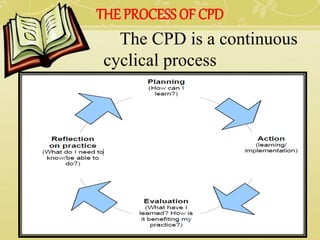
THE PROCESS OF CPD
The CPD is a continuous
cyclical process
Example
You are the responsible
authority for the In-
service education of
the hospital staff and
need to train the
nurses for the Basic
Life Support. A need
arises for you to
update your
knowledge and skill in
BLS
1.Planning – How can I
learn ?
• I need to get Training
and a certificate for the
same.
2.Action – Learning/
Action
• To get an AHA accredit,
attend a training course.
3. Evaluation – What
have I Learned/ How is
it benefitting my
practice.
• I have learned and
developed skills in the
BLS, and I am able to
properly guide the staff
nurse in the hospital
4. Reflect – What am I able
to do ?
• This program helped me
to develop skills and train
people in BLS. I have
already started to use
some of the skills I learnt
and it has helped me in
contributing to get things
happening for the
patients
Who is responsible for
CPD
• Employers (public or
private) - The In-service
Education, The Drills, The
NABH Accreditation are
all steps for professional
advancement of the staff
thereby development of
the institute.
Regulatory bodies - The INC
itself in its guidelines about
the competencies to be
achieved in various nursing
education programmes :
GNM, B.Sc. PB B.Sc, M.Sc,
Diploma Courses states that
On Completion of the
programme, the graduate
will be able to:-
• Demonstrate interest in
continued learning for
personal and professional
advancement
Example - Strengthening
institutional capacity for nursing on
HIV/AIDS in India under GFATM
round 7. An e-learning course by
the INC.
• Professional associations –
TNAI Journal.
A pharmaceutical company
conducting a class about
the available treatment for
the Ebola disease, the
swine flu disease.
• Government - ASHA
Individuals – staff attending an in-
service education programme about
the Ebola virus, the swine flu to
update her knowledge.
DO you think CPD is important and why?
• It gives new knowledge that may help
you to deal with new or complex
situations
• It will give confidence in your role
• It will demonstrate your commitment to
developing your knowledge and skills in
a subject area.
• The ultimate outcome of well planned
continuing professional development is
that it safeguards the public, the
employer, the profession and the
professional’s career.
• CPD ensures that your capabilities keep
pace with the current standards of
others in the same field
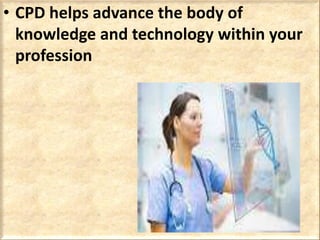
• CPD helps advance the body of
knowledge and technology within your
profession
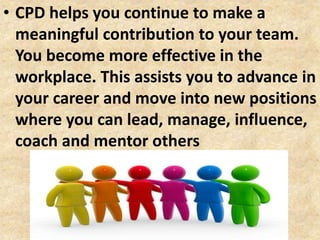
• CPD helps you continue to make a
meaningful contribution to your team.
You become more effective in the
workplace. This assists you to advance in
your career and move into new positions
where you can lead, manage, influence,
coach and mentor others
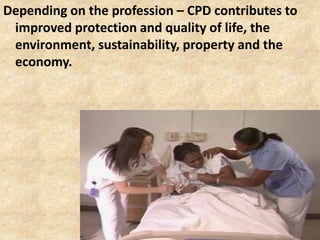
Depending on the profession – CPD contributes to
improved protection and quality of life, the
environment, sustainability, property and the
economy.
Sometimes it is mandated by
professional organisations or required
by codes of conduct or codes of ethics.
But at it’s core it is a personal
responsibility of professionals to keep
their knowledge and skills current so
that they can deliver the high quality of
service that safeguards the public and
meets the expectations of customers
and the requirements of their
profession.
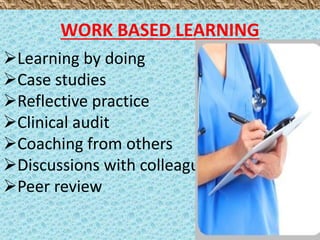
WORK BASED LEARNING
Learning by doing
Case studies
Reflective practice
Clinical audit
Coaching from others
Discussions with colleagues
Peer review
Gaining, and learning from,
experience
Involvement in wider work of
employer (for example, being a
representative on a committee)
Work shadowing
Secondments
Job rotation
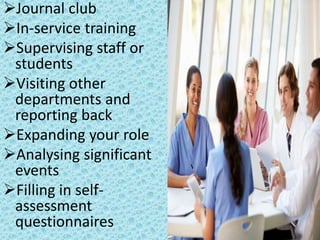
Journal club
In-service training
Supervising staff or
students
Visiting other
departments and
reporting back
Expanding your role
Analysing significant
events
Filling in self-
assessment
questionnaires
Project work or project management
Evidence of learning activities
undertaken as part of your
progression on the Knowledge and
Skills Framework
PROFESSIONAL ACTIVITY
• Involvement in a professional body
• Membership of a specialist interest
group
• Lecturing or teaching
• Mentoring
• Being an examiner
• Being a tutor
• Branch meetings
• Organizing journal clubs or other
specialist groups
• Maintaining or developing specialist
skills (for example, musical skills)
• Being an expert witness
• Membership of other professional
bodies or groups
• Giving presentations at conferences
• Organizing accredited courses
• Supervising research
• Being a national assessor
• Being promoted
FORMAL / EDUCATIONAL
Courses
Further education
Research
Attending conferences
Writing articles or papers
Going to seminars
Distance learning
Courses accredited by
professional body
Planning or running a course
SELF-DIRECTED LEARNING
Reading journals / articles
Reviewing books or articles
Updating knowledge through the
internet or TV
Keeping a file of your progress
OTHER
Public service
Voluntary work
Courses
How CPD benefits you ?
• Build confidence and credibility; you
can see your progression by tracking
your learning.
• Earn more by showcasing your
achievements. A handy tool for
appraisals.
• Achieve your career goals by
focussing on your training and
development.
• Cope positively with change by
constantly updating your skill set.
• Be more productive and efficient
by reflecting on your learning and
highlighting gaps in your
knowledge and experience.
How CPD benefits your organization?
• Helps maximize staff potential by
linking learning to actions and theory
to practice.
• Helps HR professionals to set SMART
(specific, measurable, achievable,
realistic and time-bound) objectives,
for training activity to be more
closely linked to business needs.
• Promotes staff development. This leads
to better staff morale and a motivated
workforce and helps give a positive
image/brand to organizations.
• Adds value; reflecting it will help staff to
consciously apply learning to their role
and the organization’s development.
• Linking to appraisals. This is a good tool
to help employees focus their
achievements throughout the year.
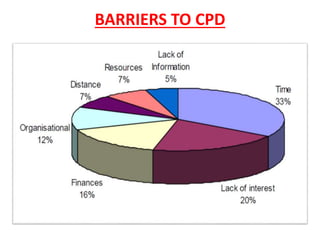
BARRIERS TO CPD
Knowing is not enough; we must apply.
Willing is not enough; we must do
continuous professional development in nursing

continuous professional development in nursing

  • 1.
  • 2.
  • 4.
    OBJECTIVES Keep up todate with new concepts and development in the health field. To increase their knowledge and skills and develop positive attitudes. Develop an ability to analyze problems and to work with others. Meet the challenge of changes in technology
  • 5.
    Maintain standards ofhealth care at acceptable level. Help in setting standards of performance. Motivate staff for better patient care.  Meet new needs of the community. To assist the nursing educator in increasing the teaching effectiveness. To develop leadership potential in nurses
  • 6.
    NEED FOR CONTINUINGPROFESSIONAL DEVELOPMENT • To ensure safe & effective nursing care • To meet the needs of population& should cater to the needs of service • Development of nurses by updating their knowledge • For career advancement – Example : pursuing higher education • To acquire specialized skills Example: Stoma care nurse, CAPD nurse. • It provides opportunity for professional growth.
  • 7.
    • Nurses withresearch aptitude and preparation are needed. • Nurse in administrative position need to increase their understanding of administrative process. • The demand for specialized nursing services is increasing more rapidly. • Planned programmes are needed to increase their competence as practitioners.
  • 9.
  • 10.
    THE PROCESS OFCPD The CPD is a continuous cyclical process
  • 11.
    Example You are theresponsible authority for the In- service education of the hospital staff and need to train the nurses for the Basic Life Support. A need arises for you to update your knowledge and skill in BLS
  • 12.
    1.Planning – Howcan I learn ? • I need to get Training and a certificate for the same. 2.Action – Learning/ Action • To get an AHA accredit, attend a training course.
  • 13.
    3. Evaluation –What have I Learned/ How is it benefitting my practice. • I have learned and developed skills in the BLS, and I am able to properly guide the staff nurse in the hospital
  • 14.
    4. Reflect –What am I able to do ? • This program helped me to develop skills and train people in BLS. I have already started to use some of the skills I learnt and it has helped me in contributing to get things happening for the patients
  • 15.
    Who is responsiblefor CPD • Employers (public or private) - The In-service Education, The Drills, The NABH Accreditation are all steps for professional advancement of the staff thereby development of the institute.
  • 16.
    Regulatory bodies -The INC itself in its guidelines about the competencies to be achieved in various nursing education programmes : GNM, B.Sc. PB B.Sc, M.Sc, Diploma Courses states that
  • 17.
    On Completion ofthe programme, the graduate will be able to:- • Demonstrate interest in continued learning for personal and professional advancement
  • 18.
    Example - Strengthening institutionalcapacity for nursing on HIV/AIDS in India under GFATM round 7. An e-learning course by the INC.
  • 19.
    • Professional associations– TNAI Journal. A pharmaceutical company conducting a class about the available treatment for the Ebola disease, the swine flu disease. • Government - ASHA
  • 20.
    Individuals – staffattending an in- service education programme about the Ebola virus, the swine flu to update her knowledge.
  • 21.
    DO you thinkCPD is important and why? • It gives new knowledge that may help you to deal with new or complex situations • It will give confidence in your role • It will demonstrate your commitment to developing your knowledge and skills in a subject area.
  • 22.
    • The ultimateoutcome of well planned continuing professional development is that it safeguards the public, the employer, the profession and the professional’s career. • CPD ensures that your capabilities keep pace with the current standards of others in the same field
  • 23.
    • CPD helpsadvance the body of knowledge and technology within your profession
  • 24.
    • CPD helpsyou continue to make a meaningful contribution to your team. You become more effective in the workplace. This assists you to advance in your career and move into new positions where you can lead, manage, influence, coach and mentor others
  • 25.
    Depending on theprofession – CPD contributes to improved protection and quality of life, the environment, sustainability, property and the economy.
  • 26.
    Sometimes it ismandated by professional organisations or required by codes of conduct or codes of ethics. But at it’s core it is a personal responsibility of professionals to keep their knowledge and skills current so that they can deliver the high quality of service that safeguards the public and meets the expectations of customers and the requirements of their profession.
  • 28.
    WORK BASED LEARNING Learningby doing Case studies Reflective practice Clinical audit Coaching from others Discussions with colleagues Peer review
  • 29.
    Gaining, and learningfrom, experience Involvement in wider work of employer (for example, being a representative on a committee) Work shadowing Secondments Job rotation
  • 30.
    Journal club In-service training Supervisingstaff or students Visiting other departments and reporting back Expanding your role Analysing significant events Filling in self- assessment questionnaires
  • 31.
    Project work orproject management Evidence of learning activities undertaken as part of your progression on the Knowledge and Skills Framework
  • 32.
    PROFESSIONAL ACTIVITY • Involvementin a professional body • Membership of a specialist interest group • Lecturing or teaching • Mentoring • Being an examiner • Being a tutor • Branch meetings
  • 33.
    • Organizing journalclubs or other specialist groups • Maintaining or developing specialist skills (for example, musical skills) • Being an expert witness • Membership of other professional bodies or groups • Giving presentations at conferences
  • 34.
    • Organizing accreditedcourses • Supervising research • Being a national assessor • Being promoted
  • 35.
    FORMAL / EDUCATIONAL Courses Furthereducation Research Attending conferences Writing articles or papers
  • 36.
    Going to seminars Distancelearning Courses accredited by professional body Planning or running a course
  • 37.
    SELF-DIRECTED LEARNING Reading journals/ articles Reviewing books or articles Updating knowledge through the internet or TV Keeping a file of your progress
  • 38.
  • 39.
    How CPD benefitsyou ? • Build confidence and credibility; you can see your progression by tracking your learning. • Earn more by showcasing your achievements. A handy tool for appraisals. • Achieve your career goals by focussing on your training and development.
  • 40.
    • Cope positivelywith change by constantly updating your skill set. • Be more productive and efficient by reflecting on your learning and highlighting gaps in your knowledge and experience.
  • 41.
    How CPD benefitsyour organization? • Helps maximize staff potential by linking learning to actions and theory to practice. • Helps HR professionals to set SMART (specific, measurable, achievable, realistic and time-bound) objectives, for training activity to be more closely linked to business needs.
  • 42.
    • Promotes staffdevelopment. This leads to better staff morale and a motivated workforce and helps give a positive image/brand to organizations. • Adds value; reflecting it will help staff to consciously apply learning to their role and the organization’s development. • Linking to appraisals. This is a good tool to help employees focus their achievements throughout the year.
  • 43.
  • 45.
    Knowing is notenough; we must apply. Willing is not enough; we must do