Curriculum Design
Curriculum Design
Curriculum Design
Curriculum Design ToolsCurriculum MapsStandards and benchmarksUnderstanding by Design (UbD)Atlas Rubicon
Curriculum Maps
Curriculum MapsMaps use a timeline to organize curriculum.Maps promote planning.Maps promote communication and collaboration.Maps promote an articulated curriculum.Maps promote professionalism and teaching creativeness.
Curriculum Maps
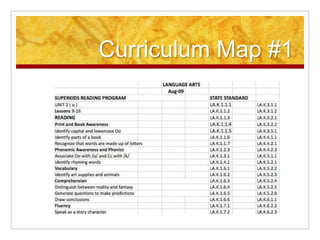
Curriculum Map #1
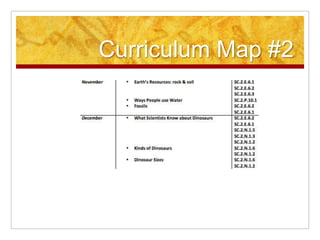
Curriculum Map #2
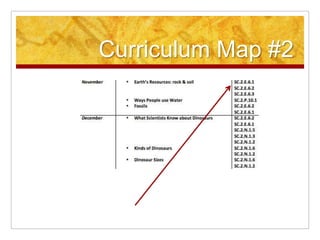
Curriculum Map #2
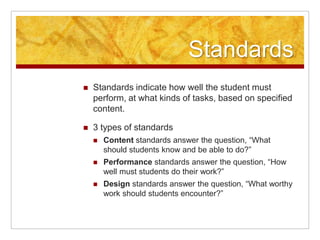
StandardsStandards indicate how well the student must perform, at what kinds of tasks, based on specified content.3 types of standardsContent standards answer the question, “What should students know and be able to do?”Performance standards answer the question, “How well must students do their work?”Design standards answer the question, “What worthy work should students encounter?”
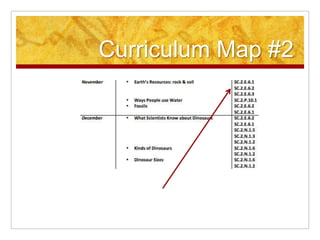
Curriculum Map #2
Standards and BenchmarksGrade 2 Science = Earth Science: Humans continue to explore the composition and structure of the surface of Earth. External sources of energy have continuously altered the feature of Earth by means of both constructive and destructive forces. All life, including human civilization is dependent on Earth’s water and natural resources. SC.2.E.6.1 = Recognize that Earth is made up of rocks. Rocks come in many sizes and shapes. SC.2.E.6.2 = Describe how small pieces of rock and dead plant and animal parts can be the basis of soil and explain the process by which soil is formed.
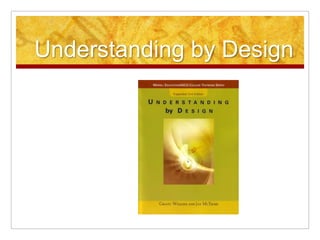
Understanding by Design
Understanding by DesignUnit = Short for a “unit of study”. Units represent a coherent chunk of work in courses or strands, across days or weeks. An example is a unit on natural habitats and adaptation that falls under the 3rd grade science (the subject).Though no hard and fast criteria signify what a unit is, educators generally think of a unit as a body of subject matter that is somewhere in length between a lesson and an entre course of study; that focuses on a major topic or process and that lasts between a few days and a few weeks.
Understanding by Design
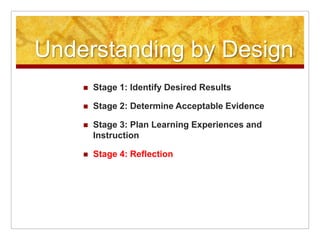
Understanding by DesignStage 1: Identify Desired ResultsStage 2: Determine Acceptable Evidence Stage 3: Plan Learning Experiences and InstructionStage 4: Reflection
Understanding by DesignStage 1: Identify Desired ResultsWhat are the desired student learning outcomes for the unit? What will students know and be able to do after they complete the unit?
Understanding by DesignStage 1: Identify Desired ResultsStage 2: Determine Acceptable Evidence What assessment tools, project completion, presentations, rubric design, tests, quizzes, etc. will appropriately assess and inform that students have met the desired outcomes?
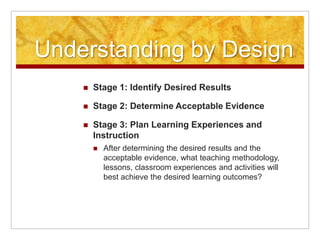
Understanding by DesignStage 1: Identify Desired ResultsStage 2: Determine Acceptable Evidence Stage 3: Plan Learning Experiences and InstructionAfter determining the desired results and the acceptable evidence, what teaching methodology, lessons, classroom experiences and activities will best achieve the desired learning outcomes?
Understanding by DesignStage 1: Identify Desired ResultsStage 2: Determine Acceptable Evidence Stage 3: Plan Learning Experiences and InstructionStage 4: Reflection
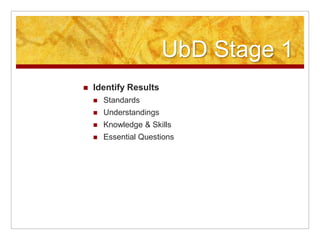
UbD Stage 1Identify ResultsStandardsUnderstandingsKnowledge & SkillsEssential Questions
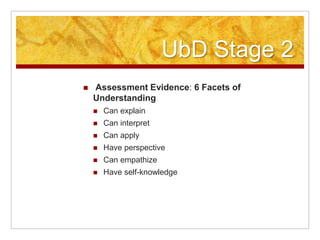
UbD Stage 2Assessment Evidence: 6 Facets of UnderstandingCan explainCan interpretCan applyHave perspectiveCan empathizeHave self-knowledge
UbD Stage 26 Facets of UnderstandingCan explain – provide thorough, supported and justifiable accounts of phenomena, fact and dataCan interpretCan applyHave perspectiveCan empathizeHave self-knowledge
UbD Stage 26 Facets of UnderstandingCan explainCan interpret – tell meaningful stories; offer apt translations; provide a revealing historical or personal dimension to ideas and events; make it personal or accessible through images, anecdotes, analogies and modelsCan applyHave perspectiveCan empathizeHave self-knowledge
UbD Stage 26 Facets of UnderstandingCan explainCan interpretCan apply – effectively use and adapt what we know in diverse contentsHave perspectiveCan empathizeHave self-knowledge
UbD Stage 26 Facets of UnderstandingCan explainCan interpretCan applyHave perspective – see and hear points of view through critical eyes and ears; see the big pictureCan empathizeHave self-knowledge
UbD Stage 26 Facets of UnderstandingCan explainCan interpretCan applyHave perspectiveCan empathize – find value in what others might find odd, alien or implausible, perceive sensitively on the basis of prior direct experienceHave self-knowledge
UbD Stage 26 Facets of UnderstandingCan explainCan interpretCan applyHave perspectiveCan empathizeHave self-knowledge – perceive the personal style, prejudices, projections, and habits of mind that both shape and impede our own understanding; we are aware of what we do not understanding and why understanding is so hard
UbD Stage 3Learning Activities“Note that the teacher will address the specifics of instructional planning – choices about teaching methods, sequence of lessons, and resource materials – after identifying the desired results and assessments. Teaching is a means to an end. Having a clear goal helps us as educators to focus our planning and guide purposeful action toward the intended results.”
UbD Stage 4ReflectionWhat worked and didn’t work? Should the sequence be changed?Should additional activities be added or some deleted?Are there supplemental activities that can be added to modify instruction for special needs students?
Atlas Rubicon
Assignment TodayWorking with your team, select a unit to begin to develop using the Understanding by Design template. Review the standards and benchmarks to ensure they are accurate for the unit.* Create a list of what knowledge students should have and what skills students should have.* Develop the enduring understanding(s) for the unit.

Curriculum Design

  • 1.
  • 2.
  • 3.
  • 4.
    Curriculum Design ToolsCurriculumMapsStandards and benchmarksUnderstanding by Design (UbD)Atlas Rubicon
  • 5.
  • 6.
    Curriculum MapsMaps usea timeline to organize curriculum.Maps promote planning.Maps promote communication and collaboration.Maps promote an articulated curriculum.Maps promote professionalism and teaching creativeness.
  • 7.
  • 8.
  • 9.
  • 10.
  • 11.
    StandardsStandards indicate howwell the student must perform, at what kinds of tasks, based on specified content.3 types of standardsContent standards answer the question, “What should students know and be able to do?”Performance standards answer the question, “How well must students do their work?”Design standards answer the question, “What worthy work should students encounter?”
  • 12.
  • 13.
    Standards and BenchmarksGrade2 Science = Earth Science: Humans continue to explore the composition and structure of the surface of Earth. External sources of energy have continuously altered the feature of Earth by means of both constructive and destructive forces. All life, including human civilization is dependent on Earth’s water and natural resources. SC.2.E.6.1 = Recognize that Earth is made up of rocks. Rocks come in many sizes and shapes. SC.2.E.6.2 = Describe how small pieces of rock and dead plant and animal parts can be the basis of soil and explain the process by which soil is formed.
  • 14.
  • 15.
    Understanding by DesignUnit= Short for a “unit of study”. Units represent a coherent chunk of work in courses or strands, across days or weeks. An example is a unit on natural habitats and adaptation that falls under the 3rd grade science (the subject).Though no hard and fast criteria signify what a unit is, educators generally think of a unit as a body of subject matter that is somewhere in length between a lesson and an entre course of study; that focuses on a major topic or process and that lasts between a few days and a few weeks.
  • 16.
  • 17.
  • 18.
    Understanding by DesignStage1: Identify Desired ResultsStage 2: Determine Acceptable Evidence Stage 3: Plan Learning Experiences and InstructionStage 4: Reflection
  • 19.
    Understanding by DesignStage1: Identify Desired ResultsWhat are the desired student learning outcomes for the unit? What will students know and be able to do after they complete the unit?
  • 20.
    Understanding by DesignStage1: Identify Desired ResultsStage 2: Determine Acceptable Evidence What assessment tools, project completion, presentations, rubric design, tests, quizzes, etc. will appropriately assess and inform that students have met the desired outcomes?
  • 21.
    Understanding by DesignStage1: Identify Desired ResultsStage 2: Determine Acceptable Evidence Stage 3: Plan Learning Experiences and InstructionAfter determining the desired results and the acceptable evidence, what teaching methodology, lessons, classroom experiences and activities will best achieve the desired learning outcomes?
  • 22.
    Understanding by DesignStage1: Identify Desired ResultsStage 2: Determine Acceptable Evidence Stage 3: Plan Learning Experiences and InstructionStage 4: Reflection
  • 23.
    UbD Stage 1IdentifyResultsStandardsUnderstandingsKnowledge & SkillsEssential Questions
  • 24.
    UbD Stage 2AssessmentEvidence: 6 Facets of UnderstandingCan explainCan interpretCan applyHave perspectiveCan empathizeHave self-knowledge
  • 25.
    UbD Stage 26Facets of UnderstandingCan explain – provide thorough, supported and justifiable accounts of phenomena, fact and dataCan interpretCan applyHave perspectiveCan empathizeHave self-knowledge
  • 26.
    UbD Stage 26Facets of UnderstandingCan explainCan interpret – tell meaningful stories; offer apt translations; provide a revealing historical or personal dimension to ideas and events; make it personal or accessible through images, anecdotes, analogies and modelsCan applyHave perspectiveCan empathizeHave self-knowledge
  • 27.
    UbD Stage 26Facets of UnderstandingCan explainCan interpretCan apply – effectively use and adapt what we know in diverse contentsHave perspectiveCan empathizeHave self-knowledge
  • 28.
    UbD Stage 26Facets of UnderstandingCan explainCan interpretCan applyHave perspective – see and hear points of view through critical eyes and ears; see the big pictureCan empathizeHave self-knowledge
  • 29.
    UbD Stage 26Facets of UnderstandingCan explainCan interpretCan applyHave perspectiveCan empathize – find value in what others might find odd, alien or implausible, perceive sensitively on the basis of prior direct experienceHave self-knowledge
  • 30.
    UbD Stage 26Facets of UnderstandingCan explainCan interpretCan applyHave perspectiveCan empathizeHave self-knowledge – perceive the personal style, prejudices, projections, and habits of mind that both shape and impede our own understanding; we are aware of what we do not understanding and why understanding is so hard
  • 31.
    UbD Stage 3LearningActivities“Note that the teacher will address the specifics of instructional planning – choices about teaching methods, sequence of lessons, and resource materials – after identifying the desired results and assessments. Teaching is a means to an end. Having a clear goal helps us as educators to focus our planning and guide purposeful action toward the intended results.”
  • 32.
    UbD Stage 4ReflectionWhatworked and didn’t work? Should the sequence be changed?Should additional activities be added or some deleted?Are there supplemental activities that can be added to modify instruction for special needs students?
  • 33.
  • 34.
    Assignment TodayWorking withyour team, select a unit to begin to develop using the Understanding by Design template. Review the standards and benchmarks to ensure they are accurate for the unit.* Create a list of what knowledge students should have and what skills students should have.* Develop the enduring understanding(s) for the unit.

Editor's Notes

  • #3 Suitcase curriculum
  • #4 Have realized that curriculum development should not be teacher-based and should not be designed by each teacher in each classroom. It must be articulated and transparent. Tools have been developed to help the process.
  • #5 Will not discuss Atlas Rubicon today
  • #6 Tool #1Heidi Hayes Jacobs used the term “Curriculum Maps”.
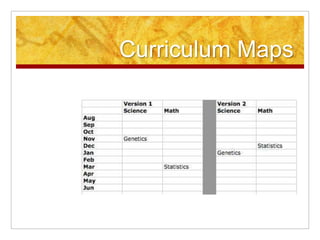
  • #7 Her concept of a curriculum map was based on a timeline.
  • #8 Curriculum timeline example – with slight modification, the curriculum was readjusted to make the curriculum more meaningful for students and so students saw the articulation of knowledge across the curriculum.
  • #9 They don’t all look alike.KGLA unit - Reading
  • #10 They don’t all look alike.Grade 2 Science unit – Earth Science and Dinosaurs
  • #11 Not just topics on a timeline, but also include standards
  • #12 Most state standards are contest basedUnderstanding by Design addresses the design standards
  • #13 What does this mean? Many dinosaur units & Many weather units. – OK if the standards are appropriate!!
  • #14 Sample science contentstandards and benchmarks
  • #15 Tool #2Grant Wiggins and Jay McTighe
  • #17 Familiar problem – the activity-oriented curriculum. May be theme based w/ interdisciplinary connections. But … what are the enduring understandings and important skills to be developed? Do students understand the learning targets? What evidence of learning reflect worthwhile content standards? What understandings will emerge from the unit and will endure? (p. 3)
  • #18 Curriculum should lay out the most effective ways of achieving specific results. It is analogous to travel planning. Our frameworks should provide a set of itineraries deliberately designed to meet cultural goals. Rather than a purposeless tour of all the major sites in a foreign country. In short, the best designs derive backward from the learnings sought. (p. 14)
  • #19 Please look at the blank template as we discuss the 4 stages of UbD.
  • #21 “This backward approach encourages teachers and curriculum planners to first think like an assessor before designing specific units and lessons, and thus to consider up front how they will determine whether students have attained the desired understandings. When planning to collect evidence of understanding, teachers should consider a range of assessment methods.: (Wiggins and McTighe, 1998, p. 12)
  • #23 Get out the sample Health Unit.
  • #24 Sample Health unit
  • #25 Health Unit:
  • #26 Health
  • #31 (Animal Farm)
  • #32 (Wiggins and McTighe, 1998, p. 12)
  • #35 * Note that if this is a new unit you have never taught, then start with the understandings then go on to the other sections.