Mica Grace C. Navarro
What is school?
• It is the institution for educating children
granted that children spend the greatest
part of their life.
• It is a place for learning, gathering
information and skills that are essential
to a child’s integration to the adult world.
Schooling
• refers to academic education and
qualification that a person
receives in school, college,
universities.
What is the purpose of the school?
• Is to help students identify their
interests and abilities
• Is to assess student’s skills and
learning styles to facilitate learning
and promote personal excellence.
What is the purpose of the school?
• Is to strengthen children for the
future, to train them for good
citizenship so that they be useful to
themselves and to their society.
• Is to support students in a process
of self-discovery.
What is the purpose of the school?
• Is to prepare students for
productive careers and teaching
proper civic behavior.
Meaning
And
Application
Ramona S. Projemo
The meaning and application of
curriculum based on the different
teachers from different levels.
1. What is curriculum?
 “A curriculum is a systematic process to
create improvements in the educational
in the educational system.”
2. How do you apply curriculum in a
classroom setting?
 “We applied our curriculum in
kindergarten pupils by learning through
playing.”
Ma’am Ferjelyn S. Glory
 A kindergarten Teacher
Ma’am Ferjelyn S. Glory
 A kindergarten Teacher
3. What method or approaches you often use
in applying curriculum inside the
classroom?
 “The teaching method or approaches are
often used in applying curriculum to our
learners are role playing, games and
differentiated instruction,”
Ma'am Coney Figueroa
Primary Level Teacher
1. What is curriculum?
 "Curriculum is the total learning
experience"
2. How do you apply curriculum in a
classroom setting?
 "As a teacher, we are giving the child the
best learning experience. Knowledge,
skills and emotional impact are always
emphasized on whatever activity takes
place."
Ma'am Coney Figueroa
Primary Level Teacher
3. What method or approaches you often use
in applying curriculum inside the
classroom?
 "As a teacher, I often used mixed
method. Old but gold techniques are still
used but it was mixed with the modern
trends."
Ma'am Sherryl Ann F. Fronda
Secondary Level Teacher
1. What is Curriculum?
 "Curriculum, or 'Programs of Study', is
defined as what students are expected to
know, understand, and be able to do in
each subject and grade. Curriculum also
determines 'what' students need to
learn."
Ma'am Sherryl Ann F. Fronda
Secondary Level Teacher
2. How do you apply curriculum in a
classroom setting?
 "In a classroom setting, I encourage my
students to participate in every
classroom activities. Most of the time
there were some students who were not
active, but i encourage them to be part of
the discussion"
Ma'am Sherryl Ann F. Fronda
Secondary Level Teacher
3. What method or approaches you often use
in applying curriculum inside the
classroom?
 "In a classroom setting, nowadays we
are now in a student-centered approach
where in the students performing
different activities in the classroom and
the role of the teacher is facilitator of the
learner."
Prof. Rosielyn Bermudez
Tertiary Level Teacher
1. What is curriculum?
 "Curriculum is a blueprint of education or
a school. It contains course outlines, time
allotment in teaching, instructional
materials used facilities and the different
strategies and classroom management
of teachers."
Prof. Rosielyn Bermudez
Tertiary Level Teacher
2. How do you apply curriculum in a
classroom setting?
 "Curriculum serves as a guide in the
teaching and learning process. It can be
utilized, I applied through following the
logical order of the course outline, giving
rules to the students aligned to the
curriculum vision/mission, and
implementing techniques in the
classroom setting stated in the
curriculum"
Prof. Rosielyn Bermudez
Tertiary Level Teacher
3. What method or approaches you often use
in applying curriculum inside the
classroom?
 "Since TCU supports the OBE approach,
I commonly create activities &
techniques which highlights the outcome
performance of the students"
School Goals
Sourcesof
Curriculum
Mercy G. Naputo
School goals
• School goals are general statements
that delineate the outcomes of
schooling. The scope of the
educational program of a school can
be summed up in the goal statements
of the school. Goals are the basic
elements or building blocks of
educational planning.
The Association for Supervision
and Curriculum Development
(ASCD) working group in research
and theory identified a ''cluster of
goals'' the reflect the holistic nature
of individuals. These are the
following:
• Self-concept and self esteem
• Understanding others
• Basic skills
• Interest in and capability for continuous
learning
• Responsible membership in society
• Mental and physical health
• Creativity
• Informed participation in the economic
world or production and consumption
• Use of accumulated knowledge to the
understand the world
• Coping with change
A school may state its goals under
the following headings:
• As a Catholic school
• As a Jesuit school
• As a Filipino school
• As an elementary school
 Sources of School Goals provide a
philosophically-based structure that
unifies and relates all aspects of school
learning from the development of an
overall curriculum blueprint to the
lesson plans used in the classroom.
Tyler suggest three sources of data or
inputs that have a major claim to
consideration as curriculum planners and
developers make choices on what to
include among their goals namely:
• The Learner. The purposes, interests,
developmental needs and
characteristics of the learner should
guide our choice of appropriate goals.
• Society. The values and behaviors
defined as desirable by a given society
help shape the goals of education in
that society
• Fund of knowledge. Human Knowledge
that has been accumulated and
organized for universal use and
application now and in the future. this
also include updated and newly
generated knowledge.
Data
on the
Learner
Maria Judy Ann P. Leria
“For assessment to be
successful, it is necessary to put
aside the question, ‘What’s the
best possible knowledge? And
instead to ask, ‘Do we have good
enough knowledge to try
something different that might
benefit our students?”
Key Definitions & Frameworks
Data sources that are useful to
consider in assessing student
learning are:
1. Evidence of Learning outcomes
2. Background information about the
students in the course or curriculum.
3. Documentation of the learning experience.
4. Multiple Methods of Assessment
5. Direct Evidence of Learning
1. Evidence of Learning Outcomes
• Direct Measures of Learning
These allow students to demonstrate their
learning for faculty to assess how well a
program’s students are meeting the
expected level of proficiency for skills or
knowledge.
• Indirect Measures of Learning
These gather student’s perceptions of and
satisfaction with their learning.
2. Background information about the
students in the course or curriculum.
• Alumni and Exit Surveys
a. Assessing Service Learning
b. Common Natural Standardized Tests
• Focus Groups
 Focus groups involve a discussion of 8-10
students to reflect on the curriculum. Focus
groups can be useful for allowing students to
collectively hear other student’s experiences and
reflect on achievement of key learning goals for a
course, curriculum, or educational innovation.
3. Documentation of the learning
experience.
• The effectiveness of a curriculum/program as a
whole or a particular sequence of courses;
• The effectiveness of a unit’s training program for
graduate student instructors; or
• A unit’s climate for teaching and learning.
4. Direct Evidence of Learning
• Rubrics
• Concept Inventories
 Concept inventories are reliable and valid
tests that are designed to test student’s
knowledge of key concepts in a field. Often,
they can be used to make comparisons in
student learning over time or between
students at different universities.
5. Multiple Methods of Assessment
• Portfolio
 Portfolio can be used to directly assess
students work, as well as to prompt students
for their reflection on their learning.
 The widespread collection of data in
education has given rise to vast amounts
of information. For classroom educators,
using data to inform instruction has had a
transformative impact on their ability to
identify student strengths and weaknesses
and differentiate learning.
“It can be challenging to change the culture of a
school or district from one that bases decisions on
the one-time-a-year outcome measure to one that
makes decisions based on data collected
throughout the year. However, to substantially
improve student’s outcomes, it is critical that
schools and districts develop a culture in which
data are used at all levels to make decisions
related to policies, programs, placement, and
practice.” (Geiger, 2012.)
Data
on the
Contemporary
Society
Dimples L. Globasa
Philosophical Perspectives
 Before formalized research, state constitutions,
or legislative requirements, philosophers had
already given a great deal of thought to the
different purposes of education and schooling.
Philosophical Perspectives
 American educational philosophers such
as John Dewey, George Counts, and Mortimer
Adler have each proposed systematic and
detailed arguments regarding the purpose of
schooling in American society. In 1938, Dewey
argued that the primary purpose of education
and schooling is not so much
to prepare students to live a useful life, but to
teach them how to live pragmatically
and immediately in their current environment.
Philosophical Perspectives
 By contrast, Counts, a leading progressive
educator in the 1930s, critiqued Dewey’s
philosophy stating, “The weakness of
progressive education thus lies in the fact that it
has elaborated no theory of social welfare,
unless it be that of anarchy or extreme
individualism”.
Philosophical Perspectives
 To Counts, the purpose of school was less
about preparing individuals to live
independently and more about preparing
individuals to live as members of a society. In
other words, Counts felt the role of schooling
was to equip individuals with the skills
necessary to participate in the social life of their
community and to change the nature of the
social order as needed or desired.
In the 1980s, the noted educator and philosopher
Mortimore Adler put forth the Paideia
Proposal which integrated the ideas of Dewey and
Counts, as well as his own. Specifically, Adler
suggested that there are three objectives of
children’s schooling:
• The development of citizenship,
• Personal growth or self-improvement; and
• Occupational preparation.
Historian of education David Tyack has argued that
from an historical perspective, the purpose of
schooling has been tied to social and economic
needs. More recently, some sociologists have
argued that schools exist primarily to serve a
practical credentialing function in society. Expanding
on the pragmatic purpose of school, deMarrais and
LeCompte (1995) outlined four major purposes of
schooling that include:
• Intellectual purposes such as the development of
mathematical and reading skills;
• Political purposes such as the assimilation of
immigrants;
• Economic purposes such as job preparation; and
• Social purposes such as the development of
social and moral responsibility.
The Fund of
Knowledge
Rufino B. Ardiano III
Funds of knowledge is defined by researchers Luis
Moll, Cathy Amanti, Deborah Neff, and Norma
Gonzalez (2001) “to refer to the historically
accumulated and culturally developed bodies
of knowledge and skills essential for household or
individual functioning and well-being”
What does the term “funds of
knowledge” mean?
When teachers shed their
role of teacher and expert
and, instead, take on a
new role as learner, they
can come to know their
students and the families
of their students in new
and distinct ways.
Why is it important to understand the
background of my students?
Funds of knowledge is
one way to help you
connect with your child
and with their family. It is
the responsibility of each
teacher to attempt to
learn something special
about each child they
teach.
How do I find out what my students’
family backgrounds are and what funds
of knowledge come from their
households?
In order for teachers to gain this kind of
knowledge about the households and social
networks of their students, teachers must be
willing to go into the homes and communities
of their students to observe and learn not
simply about, but also from and with their
students and the families of their students.
In order to become “researchers” about
students’ funds of knowledge teachers must be
willing not only to talk more to their students
but to be willing to travel to the homes of their
students to meet and visit with the family
members of the child’s household. An example
of how a teacher might go into a household to
learn more about a child’s background
appears below. This example was adapted from
the Moll et al. article “Funds of Knowledge for
Teaching: Using a Qualitative Approach to
Connect Homes and Classrooms” (2001).
STUDYING HOUSEHOLD
KNOWLEDGE
Working in bilingual teams teachers conducted
household interviews with several parents from
Spanish-dominant immigrant households.
Teacher teams worked off a set of established
questions regarding the family’s life in their
country of origin, the school systems in their
country of origin, and their family life both in
the United States and in their home country.
How do I use funds of knowledge in
my classroom?
Once a teacher has taken
the steps to understand a
child’s funds of
knowledge they can utilize
that knowledge to connect
with their children in the
classroom. Below is an
example of a creative
lesson plan that was
developed around
Mexican candy.
Jofel M. Tomaquin
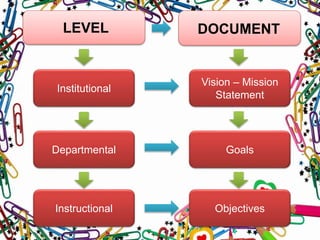
LEVEL
Instructional
Institutional
DOCUMENT
Departmental
Objectives
Vision – Mission
Statement
Goals
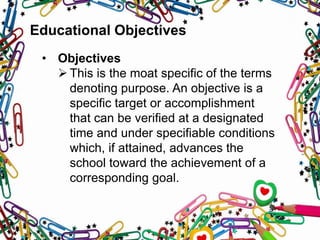
Educational Objectives
• Objectives
 This is the moat specific of the terms
denoting purpose. An objective is a
specific target or accomplishment
that can be verified at a designated
time and under specifiable conditions
which, if attained, advances the
school toward the achievement of a
corresponding goal.
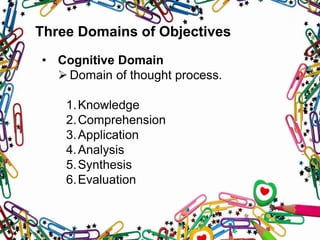
Three Domains of Objectives
• Cognitive Domain
 Domain of thought process.
1.Knowledge
2.Comprehension
3.Application
4.Analysis
5.Synthesis
6.Evaluation
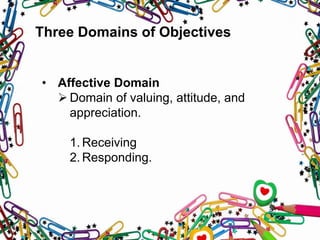
Three Domains of Objectives
• Affective Domain
 Domain of valuing, attitude, and
appreciation.
1. Receiving
2. Responding.
Three Domains of Objectives
• Psychomotor Domain
 Domain of the use of psychomotor
attributes.
1. Perception
2. Set
3. Guided Response
4. Mechanism
Thank you for listening 
- Group 3

The school purposes in curriculum development

  • 2.
  • 3.
    What is school? •It is the institution for educating children granted that children spend the greatest part of their life. • It is a place for learning, gathering information and skills that are essential to a child’s integration to the adult world.
  • 4.
    Schooling • refers toacademic education and qualification that a person receives in school, college, universities.
  • 5.
    What is thepurpose of the school? • Is to help students identify their interests and abilities • Is to assess student’s skills and learning styles to facilitate learning and promote personal excellence.
  • 6.
    What is thepurpose of the school? • Is to strengthen children for the future, to train them for good citizenship so that they be useful to themselves and to their society. • Is to support students in a process of self-discovery.
  • 7.
    What is thepurpose of the school? • Is to prepare students for productive careers and teaching proper civic behavior.
  • 8.
  • 9.
    The meaning andapplication of curriculum based on the different teachers from different levels.
  • 10.
    1. What iscurriculum?  “A curriculum is a systematic process to create improvements in the educational in the educational system.” 2. How do you apply curriculum in a classroom setting?  “We applied our curriculum in kindergarten pupils by learning through playing.” Ma’am Ferjelyn S. Glory  A kindergarten Teacher
  • 11.
    Ma’am Ferjelyn S.Glory  A kindergarten Teacher 3. What method or approaches you often use in applying curriculum inside the classroom?  “The teaching method or approaches are often used in applying curriculum to our learners are role playing, games and differentiated instruction,”
  • 12.
    Ma'am Coney Figueroa PrimaryLevel Teacher 1. What is curriculum?  "Curriculum is the total learning experience" 2. How do you apply curriculum in a classroom setting?  "As a teacher, we are giving the child the best learning experience. Knowledge, skills and emotional impact are always emphasized on whatever activity takes place."
  • 13.
    Ma'am Coney Figueroa PrimaryLevel Teacher 3. What method or approaches you often use in applying curriculum inside the classroom?  "As a teacher, I often used mixed method. Old but gold techniques are still used but it was mixed with the modern trends."
  • 14.
    Ma'am Sherryl AnnF. Fronda Secondary Level Teacher 1. What is Curriculum?  "Curriculum, or 'Programs of Study', is defined as what students are expected to know, understand, and be able to do in each subject and grade. Curriculum also determines 'what' students need to learn."
  • 15.
    Ma'am Sherryl AnnF. Fronda Secondary Level Teacher 2. How do you apply curriculum in a classroom setting?  "In a classroom setting, I encourage my students to participate in every classroom activities. Most of the time there were some students who were not active, but i encourage them to be part of the discussion"
  • 16.
    Ma'am Sherryl AnnF. Fronda Secondary Level Teacher 3. What method or approaches you often use in applying curriculum inside the classroom?  "In a classroom setting, nowadays we are now in a student-centered approach where in the students performing different activities in the classroom and the role of the teacher is facilitator of the learner."
  • 17.
    Prof. Rosielyn Bermudez TertiaryLevel Teacher 1. What is curriculum?  "Curriculum is a blueprint of education or a school. It contains course outlines, time allotment in teaching, instructional materials used facilities and the different strategies and classroom management of teachers."
  • 18.
    Prof. Rosielyn Bermudez TertiaryLevel Teacher 2. How do you apply curriculum in a classroom setting?  "Curriculum serves as a guide in the teaching and learning process. It can be utilized, I applied through following the logical order of the course outline, giving rules to the students aligned to the curriculum vision/mission, and implementing techniques in the classroom setting stated in the curriculum"
  • 19.
    Prof. Rosielyn Bermudez TertiaryLevel Teacher 3. What method or approaches you often use in applying curriculum inside the classroom?  "Since TCU supports the OBE approach, I commonly create activities & techniques which highlights the outcome performance of the students"
  • 20.
  • 21.
    School goals • Schoolgoals are general statements that delineate the outcomes of schooling. The scope of the educational program of a school can be summed up in the goal statements of the school. Goals are the basic elements or building blocks of educational planning.
  • 22.
    The Association forSupervision and Curriculum Development (ASCD) working group in research and theory identified a ''cluster of goals'' the reflect the holistic nature of individuals. These are the following: • Self-concept and self esteem • Understanding others • Basic skills
  • 23.
    • Interest inand capability for continuous learning • Responsible membership in society • Mental and physical health • Creativity • Informed participation in the economic world or production and consumption • Use of accumulated knowledge to the understand the world • Coping with change
  • 24.
    A school maystate its goals under the following headings: • As a Catholic school • As a Jesuit school • As a Filipino school • As an elementary school
  • 25.
     Sources ofSchool Goals provide a philosophically-based structure that unifies and relates all aspects of school learning from the development of an overall curriculum blueprint to the lesson plans used in the classroom.
  • 26.
    Tyler suggest threesources of data or inputs that have a major claim to consideration as curriculum planners and developers make choices on what to include among their goals namely: • The Learner. The purposes, interests, developmental needs and characteristics of the learner should guide our choice of appropriate goals.
  • 27.
    • Society. Thevalues and behaviors defined as desirable by a given society help shape the goals of education in that society • Fund of knowledge. Human Knowledge that has been accumulated and organized for universal use and application now and in the future. this also include updated and newly generated knowledge.
  • 28.
  • 29.
    “For assessment tobe successful, it is necessary to put aside the question, ‘What’s the best possible knowledge? And instead to ask, ‘Do we have good enough knowledge to try something different that might benefit our students?”
  • 30.
    Key Definitions &Frameworks Data sources that are useful to consider in assessing student learning are: 1. Evidence of Learning outcomes 2. Background information about the students in the course or curriculum. 3. Documentation of the learning experience. 4. Multiple Methods of Assessment 5. Direct Evidence of Learning
  • 31.
    1. Evidence ofLearning Outcomes • Direct Measures of Learning These allow students to demonstrate their learning for faculty to assess how well a program’s students are meeting the expected level of proficiency for skills or knowledge. • Indirect Measures of Learning These gather student’s perceptions of and satisfaction with their learning.
  • 32.
    2. Background informationabout the students in the course or curriculum. • Alumni and Exit Surveys a. Assessing Service Learning b. Common Natural Standardized Tests • Focus Groups  Focus groups involve a discussion of 8-10 students to reflect on the curriculum. Focus groups can be useful for allowing students to collectively hear other student’s experiences and reflect on achievement of key learning goals for a course, curriculum, or educational innovation.
  • 33.
    3. Documentation ofthe learning experience. • The effectiveness of a curriculum/program as a whole or a particular sequence of courses; • The effectiveness of a unit’s training program for graduate student instructors; or • A unit’s climate for teaching and learning.
  • 34.
    4. Direct Evidenceof Learning • Rubrics • Concept Inventories  Concept inventories are reliable and valid tests that are designed to test student’s knowledge of key concepts in a field. Often, they can be used to make comparisons in student learning over time or between students at different universities.
  • 35.
    5. Multiple Methodsof Assessment • Portfolio  Portfolio can be used to directly assess students work, as well as to prompt students for their reflection on their learning.
  • 36.
     The widespreadcollection of data in education has given rise to vast amounts of information. For classroom educators, using data to inform instruction has had a transformative impact on their ability to identify student strengths and weaknesses and differentiate learning.
  • 37.
    “It can bechallenging to change the culture of a school or district from one that bases decisions on the one-time-a-year outcome measure to one that makes decisions based on data collected throughout the year. However, to substantially improve student’s outcomes, it is critical that schools and districts develop a culture in which data are used at all levels to make decisions related to policies, programs, placement, and practice.” (Geiger, 2012.)
  • 38.
  • 39.
    Philosophical Perspectives  Beforeformalized research, state constitutions, or legislative requirements, philosophers had already given a great deal of thought to the different purposes of education and schooling.
  • 40.
    Philosophical Perspectives  Americaneducational philosophers such as John Dewey, George Counts, and Mortimer Adler have each proposed systematic and detailed arguments regarding the purpose of schooling in American society. In 1938, Dewey argued that the primary purpose of education and schooling is not so much to prepare students to live a useful life, but to teach them how to live pragmatically and immediately in their current environment.
  • 41.
    Philosophical Perspectives  Bycontrast, Counts, a leading progressive educator in the 1930s, critiqued Dewey’s philosophy stating, “The weakness of progressive education thus lies in the fact that it has elaborated no theory of social welfare, unless it be that of anarchy or extreme individualism”.
  • 42.
    Philosophical Perspectives  ToCounts, the purpose of school was less about preparing individuals to live independently and more about preparing individuals to live as members of a society. In other words, Counts felt the role of schooling was to equip individuals with the skills necessary to participate in the social life of their community and to change the nature of the social order as needed or desired.
  • 43.
    In the 1980s,the noted educator and philosopher Mortimore Adler put forth the Paideia Proposal which integrated the ideas of Dewey and Counts, as well as his own. Specifically, Adler suggested that there are three objectives of children’s schooling: • The development of citizenship, • Personal growth or self-improvement; and • Occupational preparation.
  • 44.
    Historian of educationDavid Tyack has argued that from an historical perspective, the purpose of schooling has been tied to social and economic needs. More recently, some sociologists have argued that schools exist primarily to serve a practical credentialing function in society. Expanding on the pragmatic purpose of school, deMarrais and LeCompte (1995) outlined four major purposes of schooling that include:
  • 45.
    • Intellectual purposessuch as the development of mathematical and reading skills; • Political purposes such as the assimilation of immigrants; • Economic purposes such as job preparation; and • Social purposes such as the development of social and moral responsibility.
  • 46.
  • 47.
    Funds of knowledgeis defined by researchers Luis Moll, Cathy Amanti, Deborah Neff, and Norma Gonzalez (2001) “to refer to the historically accumulated and culturally developed bodies of knowledge and skills essential for household or individual functioning and well-being”
  • 48.
    What does theterm “funds of knowledge” mean? When teachers shed their role of teacher and expert and, instead, take on a new role as learner, they can come to know their students and the families of their students in new and distinct ways.
  • 49.
    Why is itimportant to understand the background of my students? Funds of knowledge is one way to help you connect with your child and with their family. It is the responsibility of each teacher to attempt to learn something special about each child they teach.
  • 50.
    How do Ifind out what my students’ family backgrounds are and what funds of knowledge come from their households? In order for teachers to gain this kind of knowledge about the households and social networks of their students, teachers must be willing to go into the homes and communities of their students to observe and learn not simply about, but also from and with their students and the families of their students.
  • 51.
    In order tobecome “researchers” about students’ funds of knowledge teachers must be willing not only to talk more to their students but to be willing to travel to the homes of their students to meet and visit with the family members of the child’s household. An example of how a teacher might go into a household to learn more about a child’s background appears below. This example was adapted from the Moll et al. article “Funds of Knowledge for Teaching: Using a Qualitative Approach to Connect Homes and Classrooms” (2001).
  • 52.
    STUDYING HOUSEHOLD KNOWLEDGE Working inbilingual teams teachers conducted household interviews with several parents from Spanish-dominant immigrant households. Teacher teams worked off a set of established questions regarding the family’s life in their country of origin, the school systems in their country of origin, and their family life both in the United States and in their home country.
  • 53.
    How do Iuse funds of knowledge in my classroom? Once a teacher has taken the steps to understand a child’s funds of knowledge they can utilize that knowledge to connect with their children in the classroom. Below is an example of a creative lesson plan that was developed around Mexican candy.
  • 54.
  • 55.
  • 56.
    Educational Objectives • Objectives This is the moat specific of the terms denoting purpose. An objective is a specific target or accomplishment that can be verified at a designated time and under specifiable conditions which, if attained, advances the school toward the achievement of a corresponding goal.
  • 57.
    Three Domains ofObjectives • Cognitive Domain  Domain of thought process. 1.Knowledge 2.Comprehension 3.Application 4.Analysis 5.Synthesis 6.Evaluation
  • 58.
    Three Domains ofObjectives • Affective Domain  Domain of valuing, attitude, and appreciation. 1. Receiving 2. Responding.
  • 59.
    Three Domains ofObjectives • Psychomotor Domain  Domain of the use of psychomotor attributes. 1. Perception 2. Set 3. Guided Response 4. Mechanism
  • 60.
    Thank you forlistening  - Group 3