PREPARED BY
Meena dahre
Msc nursing
content
 Definition
 Purpose
 Principle
 Guidelines for selection of teaching methods
 factor influencing clinical teaching methods
 Role of clinical instructor
 Responsibility of clinical instructor
Definition
 A clinical teaching method is individualized or group
teaching to the nursing students in the clinical area by
the nurse educators, staff nurse and clinical nurse
manager.
 Clinical teaching methods in nursing is a type of group
conference in which a patient or patients are observed,
studied, discussed, demonstrated and directed
towards the improvement and further improvement of
nursing care provided by nursing student.
PURPOSE
 To provide individual care in a systematic holistic approach
 To develop high technical competent skills
 To practice various procedure
 To collect and analyze the data
 To develop communication skills and maintain interpersonal
relationship
 To maintain high standard of nursing practice
 To develop cognitive, affective and psychomotor skills
 To learn various diagnostic procedures
 To learn various skills in giving health education technique to
the client
 To develop proficiency and efficiency in carrying out various
PRINCIPLES OF CLINICAL TEACHING
 Clinical education should reflect the nature of
professionals practice
 Clinical teaching is supported by climate of mutual
trust and respect
 Clinical teaching and learning should focus on
essential knowledge, skill and attitude
GUIDELINES FOR SELECTION OF TEACHING
METHODS
 Must be in accordance with availability of resources.
 Must be in accordance with the capacity of the
student.
 Must be in accordance with principles of learning.
 Must be appropriate to objectives and desired
behavioral changes.
 Must be in accordance with the teacher’s ability to use
it effectively and creatively.
FACTORS INFLUENCINIG CLINICAL TEACHING
 Group interaction skills
 Clinical supervision skills
 Clinical competence and professionalism
 Knowledge and analytical ability
 Organization and clarity of presentation
 Enthusiasm and stimulation of interest
ROLE OF CLINICAL INSTRUCTOR
 Supporter
 Facilitator
 Challenger
 Manager
 Coordinator
 Observer
 Evaluator
 Expert
RESPONSIBILITY OF CLINICAL INSTRUCTOR
 Set objective, standard for practice
 Develop take permission of the institute
 Should take permission of the institute
 Prepare master rotation plan
 Set up the clinical area in an instead manner
 Keep ready equipment in working condition to provide
nursing care
CLINICAL TEACHING METHODS
 Bedside clinic
 Nursing rounds
 Client family centered method
 Conferences-
 Group conference
 Staff conference
 Individual conference
 Team conference
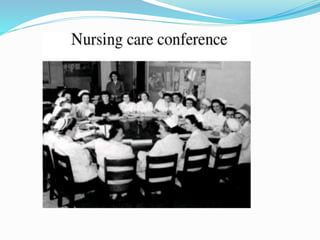
 Nursing care conference
 Demonstration
 Nursing Care study
Cont.....
 Process Recording
 Laboratory method
 Nursing assignment
 Field trip
 Group discussion
 Ward teaching
 Ward class
 Ward clinic
 Case method
 Brain storming method
 Health talks
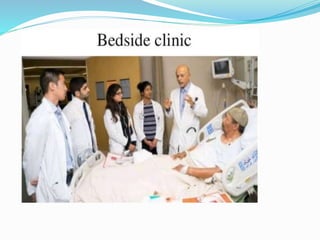
BEDSIDE CLINIC
PURPOSES
 To provide learning experience
 To improve the problem solving ability
 To help for nursing observation in systematic way
 To understand different equipments used on patients
 To prepare nursing care plan
PHASES
 Introduction phase
 Patient centered discussion
 Post clinic evaluation
Cont..
ADVANTAGES
 It puts the student in an active actual situation.
 Covers limited group of students
 Develop qualities of observation and decision taking
 Ensures close contact with reality
 Permits comparison between reality and theory
DISADVANTAGES
 Sometimes put the patient in a difficult situation
 Poor standardization
 Narrow limits of utilization
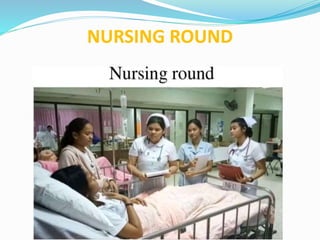
NURSING ROUND
Cont…
PURPOSES
 Demonstrate symptoms important in nursing care,
clarifies terminology studied
 Compare patient’s reaction to disease and disease
condition.
 Demonstrate the effects of drugs.
 Illustrates skillful nursing care
 Understands methods of meeting nursing needs

Cont..
ADVANTAGES
 It develops student’s psychomotor skills and
inculcate proper attitude among them.
 Promote team spirit and professionalism
 Motivated to learn more about nursing
management of patients in the ward
 Discriminate patients risk categories.
DISADVANTAGES
 Require careful planning
 Only applicable for small group of students. Require
careful planning.
CLIENT FAMILY CENTERD APPROACH
  Staff
  Group
  Individual
  Clinical
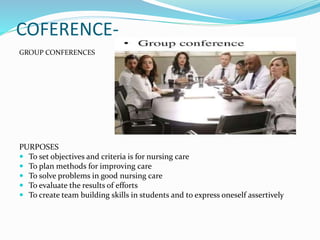
COFERENCE-
GROUP CONFERENCES
PURPOSES
 To set objectives and criteria is for nursing care
 To plan methods for improving care
 To solve problems in good nursing care
 To evaluate the results of efforts
 To create team building skills in students and to express oneself assertively
STAFF CONFERENCES
 These type of conference will be held in teaching
institution e.g. faculty meeting in hospital. E.g.
nursing superintendent will conduct conference to all
nurses.
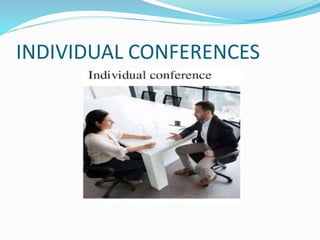
INDIVIDUAL CONFERENCES
TYPES
 Unplanned or incidental conference
 Planned conference
PURPOSES
 To guide in teaching
 To acquire more knowledge
 To discover the interests, needs and problems of
individual students
 To help the students to help herself or himself
 To clarify class knowledge
TEAM CONFERENCE
 Team nursing as started by Miss Dorothy Finkbiner
 The assignment method should be used which will possible
the best nursing care to the staff members giving them
interest and challenge and that will keep the unit
functioning smoothly and effectively.
ADVANTAGES OIF THE NURSING TEAM CONFERENCE
 It is used to plan for the daily continuity of nursing care
that best meets the patients need.
 As a teaching tool, nursing team conference offers valuable
opportunities for learning.
 It gives an ability to observe report and analyze significant
finding input to its greatest test, as students are conference
with their daily responsibility.
Cont..
 Purpose
 To portray the nursing problems typically associated
with a particular disease with such factors as social,
age, or ethical background and to picture the related
nursing care with specific individual.
 To learn ways to help clients identify their needs and
solve their own problems.
 To suggest approaches to the patients and planning
ways to help himself
Cont..
PHASES
 Opening phase
 Working phase
 Closing phase
ADVANTAGES
 Sharpens the critical thinking
 Helps the students to know about their progress and boosts their self
confidence
 Develop problem solving skills
DISADVANTAGES
 Time consuming
 Conflict of opinion
WARD TEACHING METHODS
PURPOSES
 To enable the student to gain a real understanding of
different clinical situations
 To make the students to apply correct scientific
principles based on the nursing activity
 To supplement to integrate and to utilizes classroom
instruction
 To inspire the students for self development
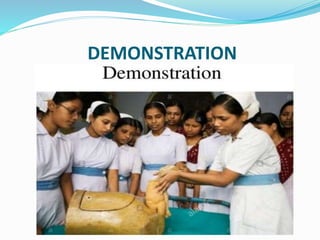
DEMONSTRATION
Cont..
 Demonstration teachers by exhibition & explanation
 It trains the students in the art of careful observation
 USES
 To demonstrate procedures in the classroom and the ward
 To demonstration experiments and its uses
 To teach the patient, a procedure or treatment
ADVANTAGES
 Activates sense
 Opportunity for observation and learning
 Creates interest by use of illustration
 Correlates theory and practice
DISADVANTAGES
 Expensive
 Time consuming
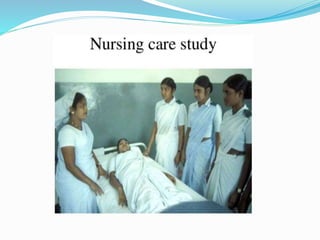
NURSING CARE STUDY
• Method, which focuses on information and facts about
patient the disease condition social and personal history and
the application of this knowledge in rendering nursing care
• Students select one patient for intensive study
• Students are given opportunity to take care of the patients
study their treatment modalities until they are discharged.
ADVANTAGES
 Students learn problem-solving approach
 Reports acts as reference material for students
 Evaluate patients progress
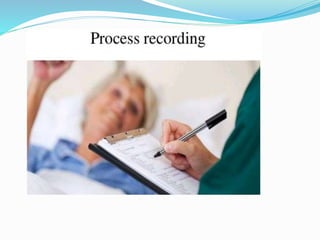
PROCESS RECORDING
 DEFINITION • Process recording is an exact written
report of the conversation between the nurse and the
patient during the time they were together “Hudson”
 USES OF THE PROCESS RECORDING
 As a therapeutic tool
 As an evaluation tool
 As a teaching learning tool
Cont…
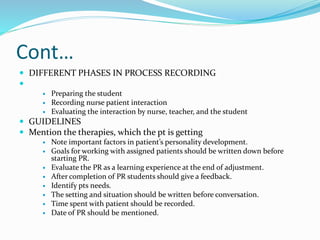
 DIFFERENT PHASES IN PROCESS RECORDING

 Preparing the student
 Recording nurse patient interaction
 Evaluating the interaction by nurse, teacher, and the student
 GUIDELINES
 Mention the therapies, which the pt is getting
 Note important factors in patient’s personality development.
 Goals for working with assigned patients should be written down before
starting PR.
 Evaluate the PR as a learning experience at the end of adjustment.
 After completion of PR students should give a feedback.
 Identify pts needs.
 The setting and situation should be written before conversation.
 Time spent with patient should be recorded.
 Date of PR should be mentioned.
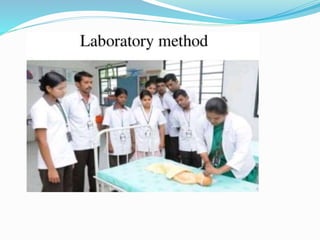
LABORATORY METHOD
 Laboratory is a part of clinical teaching that offers students
with the opportunities to apply their theoretical knowledge
or previous learning and practice in controlled situation
under guidance and supervision where there is no client
 ADVANTAGES
 Increase students participation
 Prepare students for actual situation.
 Clarify doubts and queries regarding to demonstration.
 DISADVANTAGES
 Budget
 Time consuming
 Lack of apparatus

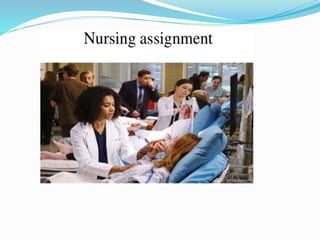
NURSING ASSIGNMENT
 It is the part of learning experience where the students are
assigned with patients or other activities concerning to
patients in clinical laboratory.

 METHODS
 Functional method
 Team method
 Case method

 FUNCTIONAL METHOD
 Nurses are assigned specific functions such as
administering medication, monitoring vital signs etc.
cont…
 TEAM METHOD
 In this method a group of patients are looked after by
nursing team, comprised of nursing staff & student nurse.
 CASE METHOD
 In this type is the single nurse is assigned the responsibility
for the care of each patient admitted to the hospital till the
patient is discharge.

 ADVANTAGE
 Time efficient
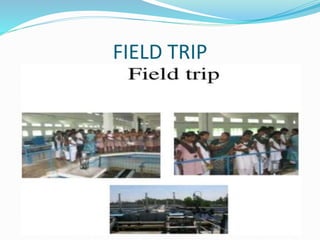
FIELD TRIP
PURPOSE
 To provide real life situations
 To serve as a preview of a lesson and for gathering
instructional materials
 To verify previous information, class discussion,
and conclusion of individual experience
 To serve as a mean to develop positive attitudes,
values and special skills
ORGANIZATION AND PROCEDURE FOR FIELD TRIPS
 Follow up and evaluation
 Supervision
 Preparation of the students
 Time and transport
 Objectives
 Rapport
 Knowledge
 Pre-requisites

Cont..
 VALUES
 Breaks monotony of classroom
 Opportunity for learning attitudes and positive values
 Opportunity for learning and acquring skills
 Correlate school life with outside world
 Arouse interest and motivation
 DISADVANTAGES
 Time consuming
 Careful planning is required
 Transportation problem
 Safety precautions are required
 Observation difficulty for large group
GROUP DISCUSSION
Cont….
 VALUES
 It encourages the student to think for her, to develop
critical habits of study.
 Helps her to advance in creative thought
 It gives the student an opportunity to learn how to
adjust to social situations.
 Gives an opportunity to cooperate with others in the
reflective solving of a problem
 Self activity is increased
 Leadership skills will be developed
Cont..
 DISCUSSION TECHNIQUES
 The individual conference
 Class group discussion
 The seminar
 The clinical conference
 Role-playing
 Multiple discussion groups
 Symposium
 Panel
WARD TEACHING METHODS

 PURPOSES
 To enable the student to gain a real understanding of
different clinical situations
 To make the students to apply correct scientific
principles based on the nursing activity
 To supplement to integrate and to unities classroom
instruction
 To inspire the students for self development.

WARD CLASS
 A class will be conducted based upon current clinical
experience of the student for whom the class is
planned
WARD CLINIC
 In this type, a client presented to the group, who illustrates
all signs and symptom
 Permission should be taken from the physician.
 Instructor should explain before hand, to the client
about the purpose of
 the clinic
 The student will be able to practice procedure in real
situation.
 Suitable place should be selected.

CASE METHOD
 Used in three forms
 Case study
 Case analysis
 Case incident technique

BRAIN STORMING METHOD
 Here the intellectual capacities of trainees will be
utilized in solving or suggesting solutions to problems
and make a group to active and answer the problems
among them only

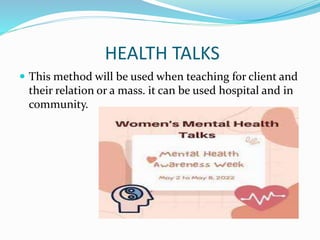
HEALTH TALKS
 This method will be used when teaching for client and
their relation or a mass. it can be used hospital and in
community.
CLINICAL TEACHING-1.pptx

CLINICAL TEACHING-1.pptx

  • 1.
  • 2.
    content  Definition  Purpose Principle  Guidelines for selection of teaching methods  factor influencing clinical teaching methods  Role of clinical instructor  Responsibility of clinical instructor
  • 3.
    Definition  A clinicalteaching method is individualized or group teaching to the nursing students in the clinical area by the nurse educators, staff nurse and clinical nurse manager.  Clinical teaching methods in nursing is a type of group conference in which a patient or patients are observed, studied, discussed, demonstrated and directed towards the improvement and further improvement of nursing care provided by nursing student.
  • 4.
    PURPOSE  To provideindividual care in a systematic holistic approach  To develop high technical competent skills  To practice various procedure  To collect and analyze the data  To develop communication skills and maintain interpersonal relationship  To maintain high standard of nursing practice  To develop cognitive, affective and psychomotor skills  To learn various diagnostic procedures  To learn various skills in giving health education technique to the client  To develop proficiency and efficiency in carrying out various
  • 5.
    PRINCIPLES OF CLINICALTEACHING  Clinical education should reflect the nature of professionals practice  Clinical teaching is supported by climate of mutual trust and respect  Clinical teaching and learning should focus on essential knowledge, skill and attitude
  • 6.
    GUIDELINES FOR SELECTIONOF TEACHING METHODS  Must be in accordance with availability of resources.  Must be in accordance with the capacity of the student.  Must be in accordance with principles of learning.  Must be appropriate to objectives and desired behavioral changes.  Must be in accordance with the teacher’s ability to use it effectively and creatively.
  • 7.
    FACTORS INFLUENCINIG CLINICALTEACHING  Group interaction skills  Clinical supervision skills  Clinical competence and professionalism  Knowledge and analytical ability  Organization and clarity of presentation  Enthusiasm and stimulation of interest
  • 8.
    ROLE OF CLINICALINSTRUCTOR  Supporter  Facilitator  Challenger  Manager  Coordinator  Observer  Evaluator  Expert
  • 9.
    RESPONSIBILITY OF CLINICALINSTRUCTOR  Set objective, standard for practice  Develop take permission of the institute  Should take permission of the institute  Prepare master rotation plan  Set up the clinical area in an instead manner  Keep ready equipment in working condition to provide nursing care
  • 10.
    CLINICAL TEACHING METHODS Bedside clinic  Nursing rounds  Client family centered method  Conferences-  Group conference  Staff conference  Individual conference  Team conference  Nursing care conference  Demonstration  Nursing Care study
  • 11.
    Cont.....  Process Recording Laboratory method  Nursing assignment  Field trip  Group discussion  Ward teaching  Ward class  Ward clinic  Case method  Brain storming method  Health talks
  • 13.
    BEDSIDE CLINIC PURPOSES  Toprovide learning experience  To improve the problem solving ability  To help for nursing observation in systematic way  To understand different equipments used on patients  To prepare nursing care plan PHASES  Introduction phase  Patient centered discussion  Post clinic evaluation
  • 14.
    Cont.. ADVANTAGES  It putsthe student in an active actual situation.  Covers limited group of students  Develop qualities of observation and decision taking  Ensures close contact with reality  Permits comparison between reality and theory DISADVANTAGES  Sometimes put the patient in a difficult situation  Poor standardization  Narrow limits of utilization
  • 15.
  • 16.
    Cont… PURPOSES  Demonstrate symptomsimportant in nursing care, clarifies terminology studied  Compare patient’s reaction to disease and disease condition.  Demonstrate the effects of drugs.  Illustrates skillful nursing care  Understands methods of meeting nursing needs 
  • 17.
    Cont.. ADVANTAGES  It developsstudent’s psychomotor skills and inculcate proper attitude among them.  Promote team spirit and professionalism  Motivated to learn more about nursing management of patients in the ward  Discriminate patients risk categories. DISADVANTAGES  Require careful planning  Only applicable for small group of students. Require careful planning.
  • 18.
    CLIENT FAMILY CENTERDAPPROACH   Staff   Group   Individual   Clinical
  • 19.
    COFERENCE- GROUP CONFERENCES PURPOSES  Toset objectives and criteria is for nursing care  To plan methods for improving care  To solve problems in good nursing care  To evaluate the results of efforts  To create team building skills in students and to express oneself assertively
  • 20.
    STAFF CONFERENCES  Thesetype of conference will be held in teaching institution e.g. faculty meeting in hospital. E.g. nursing superintendent will conduct conference to all nurses.
  • 21.
  • 22.
    INDIVIDUAL CONFERENCES TYPES  Unplannedor incidental conference  Planned conference PURPOSES  To guide in teaching  To acquire more knowledge  To discover the interests, needs and problems of individual students  To help the students to help herself or himself  To clarify class knowledge
  • 23.
    TEAM CONFERENCE  Teamnursing as started by Miss Dorothy Finkbiner  The assignment method should be used which will possible the best nursing care to the staff members giving them interest and challenge and that will keep the unit functioning smoothly and effectively. ADVANTAGES OIF THE NURSING TEAM CONFERENCE  It is used to plan for the daily continuity of nursing care that best meets the patients need.  As a teaching tool, nursing team conference offers valuable opportunities for learning.  It gives an ability to observe report and analyze significant finding input to its greatest test, as students are conference with their daily responsibility.
  • 25.
    Cont..  Purpose  Toportray the nursing problems typically associated with a particular disease with such factors as social, age, or ethical background and to picture the related nursing care with specific individual.  To learn ways to help clients identify their needs and solve their own problems.  To suggest approaches to the patients and planning ways to help himself
  • 26.
    Cont.. PHASES  Opening phase Working phase  Closing phase ADVANTAGES  Sharpens the critical thinking  Helps the students to know about their progress and boosts their self confidence  Develop problem solving skills DISADVANTAGES  Time consuming  Conflict of opinion
  • 27.
    WARD TEACHING METHODS PURPOSES To enable the student to gain a real understanding of different clinical situations  To make the students to apply correct scientific principles based on the nursing activity  To supplement to integrate and to utilizes classroom instruction  To inspire the students for self development
  • 28.
  • 29.
    Cont..  Demonstration teachersby exhibition & explanation  It trains the students in the art of careful observation  USES  To demonstrate procedures in the classroom and the ward  To demonstration experiments and its uses  To teach the patient, a procedure or treatment ADVANTAGES  Activates sense  Opportunity for observation and learning  Creates interest by use of illustration  Correlates theory and practice DISADVANTAGES  Expensive  Time consuming
  • 31.
    NURSING CARE STUDY •Method, which focuses on information and facts about patient the disease condition social and personal history and the application of this knowledge in rendering nursing care • Students select one patient for intensive study • Students are given opportunity to take care of the patients study their treatment modalities until they are discharged. ADVANTAGES  Students learn problem-solving approach  Reports acts as reference material for students  Evaluate patients progress
  • 32.
    PROCESS RECORDING  DEFINITION• Process recording is an exact written report of the conversation between the nurse and the patient during the time they were together “Hudson”  USES OF THE PROCESS RECORDING  As a therapeutic tool  As an evaluation tool  As a teaching learning tool
  • 34.
    Cont…  DIFFERENT PHASESIN PROCESS RECORDING   Preparing the student  Recording nurse patient interaction  Evaluating the interaction by nurse, teacher, and the student  GUIDELINES  Mention the therapies, which the pt is getting  Note important factors in patient’s personality development.  Goals for working with assigned patients should be written down before starting PR.  Evaluate the PR as a learning experience at the end of adjustment.  After completion of PR students should give a feedback.  Identify pts needs.  The setting and situation should be written before conversation.  Time spent with patient should be recorded.  Date of PR should be mentioned.
  • 36.
    LABORATORY METHOD  Laboratoryis a part of clinical teaching that offers students with the opportunities to apply their theoretical knowledge or previous learning and practice in controlled situation under guidance and supervision where there is no client  ADVANTAGES  Increase students participation  Prepare students for actual situation.  Clarify doubts and queries regarding to demonstration.  DISADVANTAGES  Budget  Time consuming  Lack of apparatus 
  • 38.
    NURSING ASSIGNMENT  Itis the part of learning experience where the students are assigned with patients or other activities concerning to patients in clinical laboratory.   METHODS  Functional method  Team method  Case method   FUNCTIONAL METHOD  Nurses are assigned specific functions such as administering medication, monitoring vital signs etc.
  • 39.
    cont…  TEAM METHOD In this method a group of patients are looked after by nursing team, comprised of nursing staff & student nurse.  CASE METHOD  In this type is the single nurse is assigned the responsibility for the care of each patient admitted to the hospital till the patient is discharge.   ADVANTAGE  Time efficient
  • 40.
  • 41.
    PURPOSE  To providereal life situations  To serve as a preview of a lesson and for gathering instructional materials  To verify previous information, class discussion, and conclusion of individual experience  To serve as a mean to develop positive attitudes, values and special skills
  • 42.
    ORGANIZATION AND PROCEDUREFOR FIELD TRIPS  Follow up and evaluation  Supervision  Preparation of the students  Time and transport  Objectives  Rapport  Knowledge  Pre-requisites 
  • 43.
    Cont..  VALUES  Breaksmonotony of classroom  Opportunity for learning attitudes and positive values  Opportunity for learning and acquring skills  Correlate school life with outside world  Arouse interest and motivation  DISADVANTAGES  Time consuming  Careful planning is required  Transportation problem  Safety precautions are required  Observation difficulty for large group
  • 44.
  • 45.
    Cont….  VALUES  Itencourages the student to think for her, to develop critical habits of study.  Helps her to advance in creative thought  It gives the student an opportunity to learn how to adjust to social situations.  Gives an opportunity to cooperate with others in the reflective solving of a problem  Self activity is increased  Leadership skills will be developed
  • 46.
    Cont..  DISCUSSION TECHNIQUES The individual conference  Class group discussion  The seminar  The clinical conference  Role-playing  Multiple discussion groups  Symposium  Panel
  • 47.
    WARD TEACHING METHODS  PURPOSES  To enable the student to gain a real understanding of different clinical situations  To make the students to apply correct scientific principles based on the nursing activity  To supplement to integrate and to unities classroom instruction  To inspire the students for self development. 
  • 48.
    WARD CLASS  Aclass will be conducted based upon current clinical experience of the student for whom the class is planned
  • 49.
    WARD CLINIC  Inthis type, a client presented to the group, who illustrates all signs and symptom  Permission should be taken from the physician.  Instructor should explain before hand, to the client about the purpose of  the clinic  The student will be able to practice procedure in real situation.  Suitable place should be selected. 
  • 50.
    CASE METHOD  Usedin three forms  Case study  Case analysis  Case incident technique 
  • 51.
    BRAIN STORMING METHOD Here the intellectual capacities of trainees will be utilized in solving or suggesting solutions to problems and make a group to active and answer the problems among them only 
  • 52.
    HEALTH TALKS  Thismethod will be used when teaching for client and their relation or a mass. it can be used hospital and in community.