
Understanding IT Strategy, 
Sourcing 
and Vendor Relationships 
Goutama Bachtiar 
IT Advisor, Auditor, Consultant and Trainer 
@goudotmobi
Wh a t ’s i n t h e 3rd Session 
 Valuing IT Strategy and Strategic Plan 
 Aligning IT with Business Strategy 
 Exploring IT Governance 
 IT Operating Plans and Sourcing Strategies 
 Commencing IT Vendor Relationships 
2
VALUING IT STRATEGY AND 
STRATEGIC PLAN 
3
IT Strategy Must Support Business Strategy 
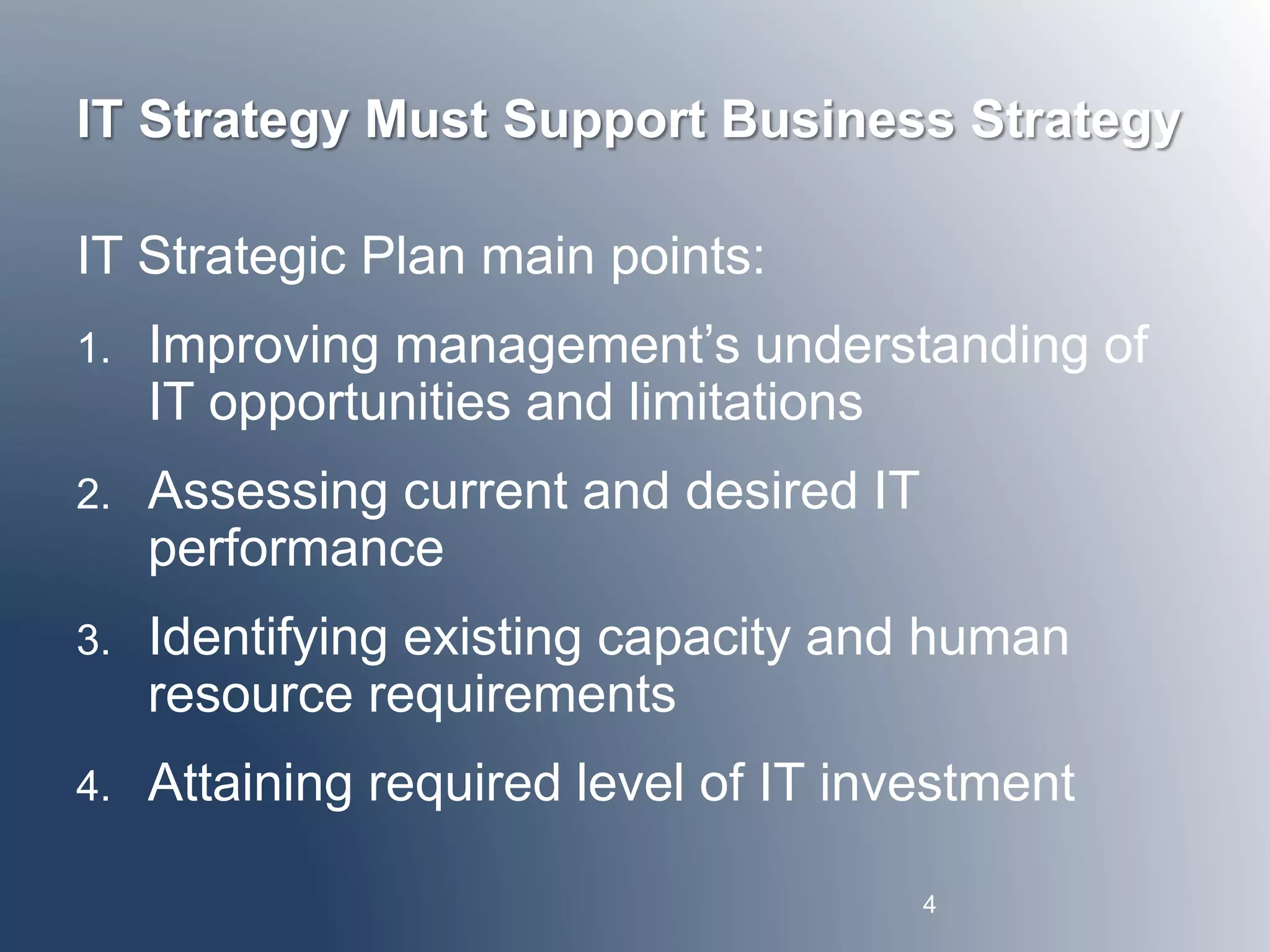
IT Strategic Plan main points: 
1. Improving management’s understanding of 
IT opportunities and limitations 
2. Assessing current and desired IT 
performance 
3. Identifying existing capacity and human 
resource requirements 
4. Attaining required level of IT investment 
4
12-5 
Types of IT Strategies 
1. In-house development 
2. Outsource development 
 On-shore (domestic) 
 Offshore 
3. Co-source 
In reality, organizations use combinations of these 
strategies to achieve their objectives and goals whilst 
keep focusing on their core business, let alone the 
cost saving motives.
IT Steering Committees 
 Direction setting 
Planning is the key activity. “If you fail to plan, 
you plan to fail”. 
 Rationing 
Approving human and non-human resources 
allocation for and within IS organization. 
 Structuring 
Defining how IS department is positioned within 
the organization (centralization or 
decentralization). 
6
IT Steering Committees (cont’d) 
 Staffing 
Coordinating and approving key IT 
personnel decisions including outsourcing 
activities. 
 Communication 
Information regarding IT activities should 
flow freely. 
 Evaluating 
Establishing performance measures for IS 
department. 
7
ALIGNING IT WITH BUSINESS STRATEGY 
8
IT Strategic Planning Process 
CIOs undertake IT strategic planning on 
a yearly, quarterly, or monthly basis. 
 Recalling the focus of IT strategy is on how 
IT creates business value. 
 Annual planning cycles established to: 
• Identify potentially beneficial IT services. 
• Perform Cost-Benefit Analysis. 
• List down potential projects. 
9
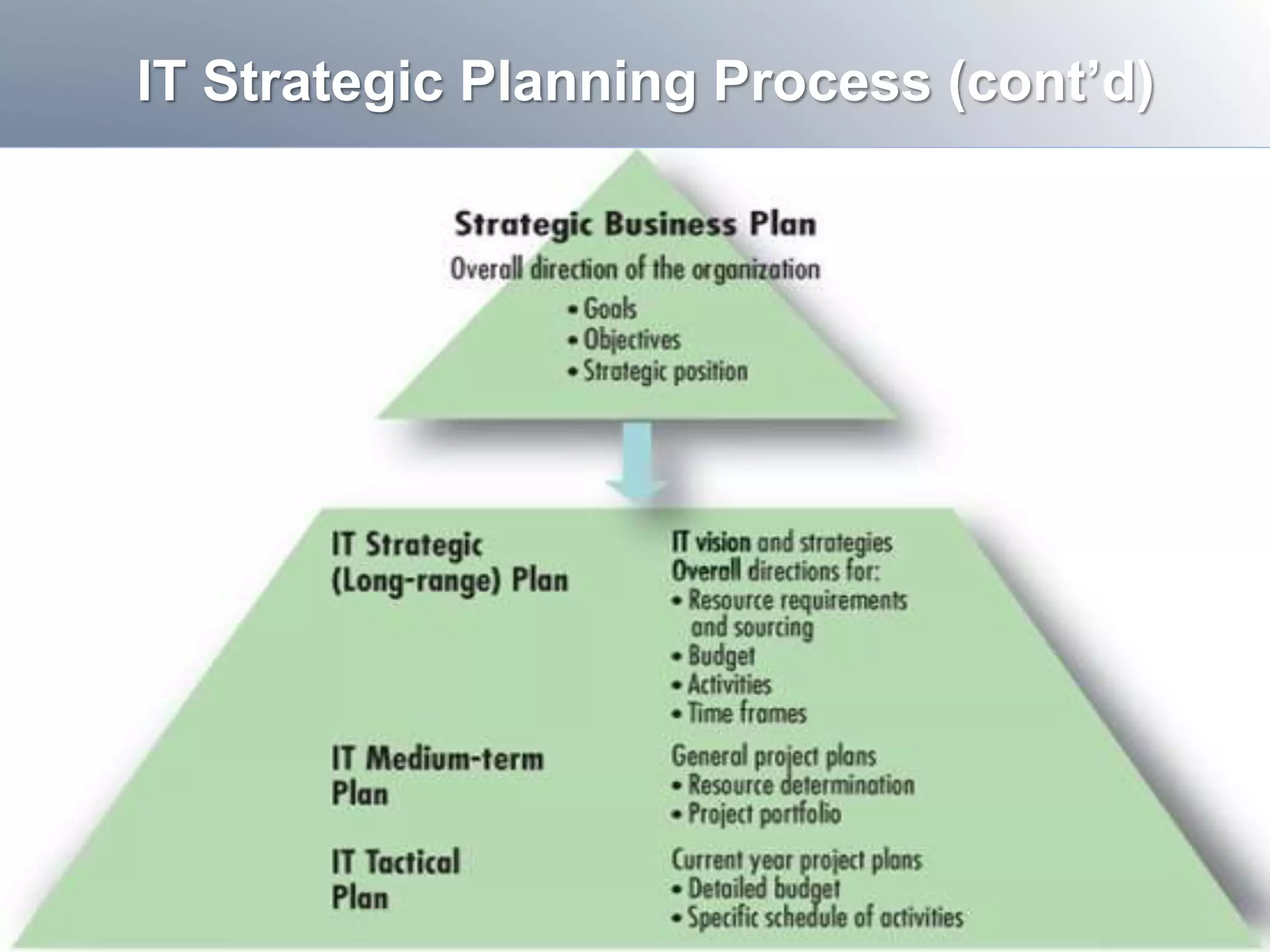
IT Strategic Planning Process (cont’d)
Tools and Methodologies 
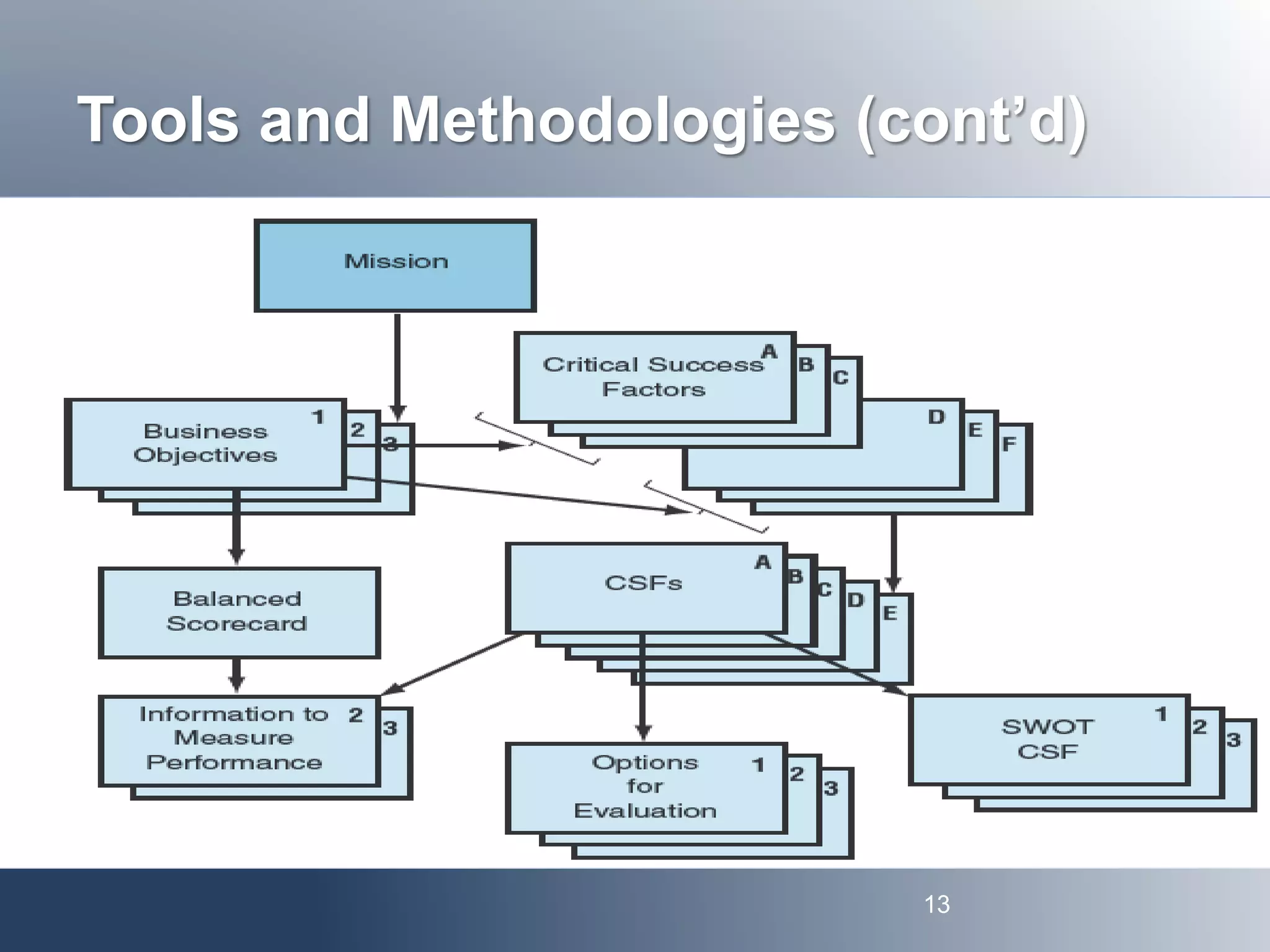
 Business Service Management 
Linking Business Goals to KPIs of IT. 
 Business Systems Planning Model 
A top-down approach starts business 
processes and data classes. 
 Balanced Scorecard 
Framework that transforms financial and 
nonfinancial data into a detailed roadmap. 
11
Tools and Methodologies (cont’d) 
 Critical Success Factors Model (CSFs) 
Most essential factors ensuring organization’s 
survival and success. 
 Scenario Planning 
Method utilized to plan situations that involve 
much uncertainty (recession, normal, boom). 
 Resource Allocation 
A contentious process because requests for 
spending far exceed the available funds. 
12
Tools and Methodologies (cont’d) 
13
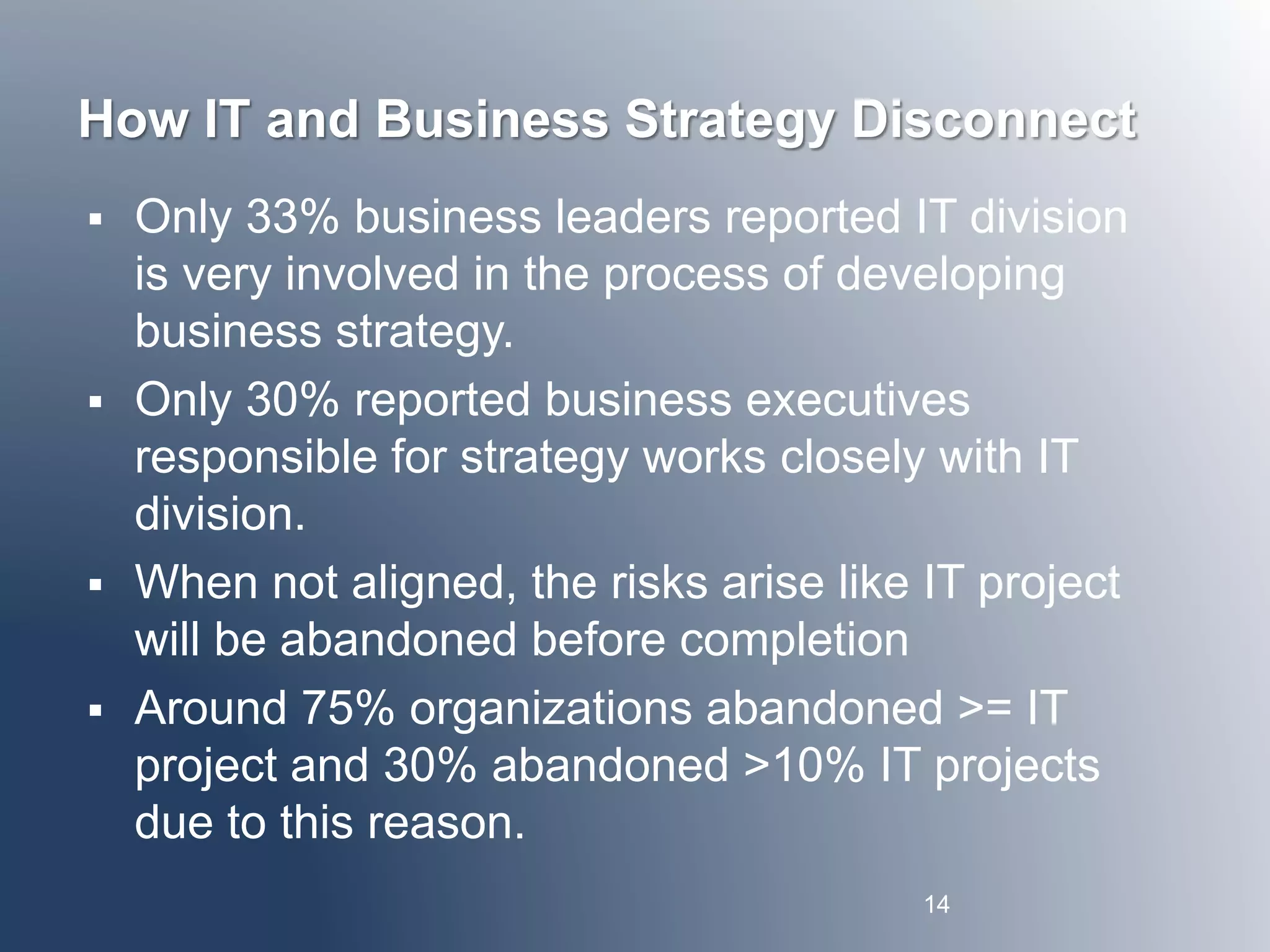
How IT and Business Strategy Disconnect 
 Only 33% business leaders reported IT division 
is very involved in the process of developing 
business strategy. 
 Only 30% reported business executives 
responsible for strategy works closely with IT 
division. 
 When not aligned, the risks arise like IT project 
will be abandoned before completion 
 Around 75% organizations abandoned >= IT 
project and 30% abandoned >10% IT projects 
due to this reason. 
14
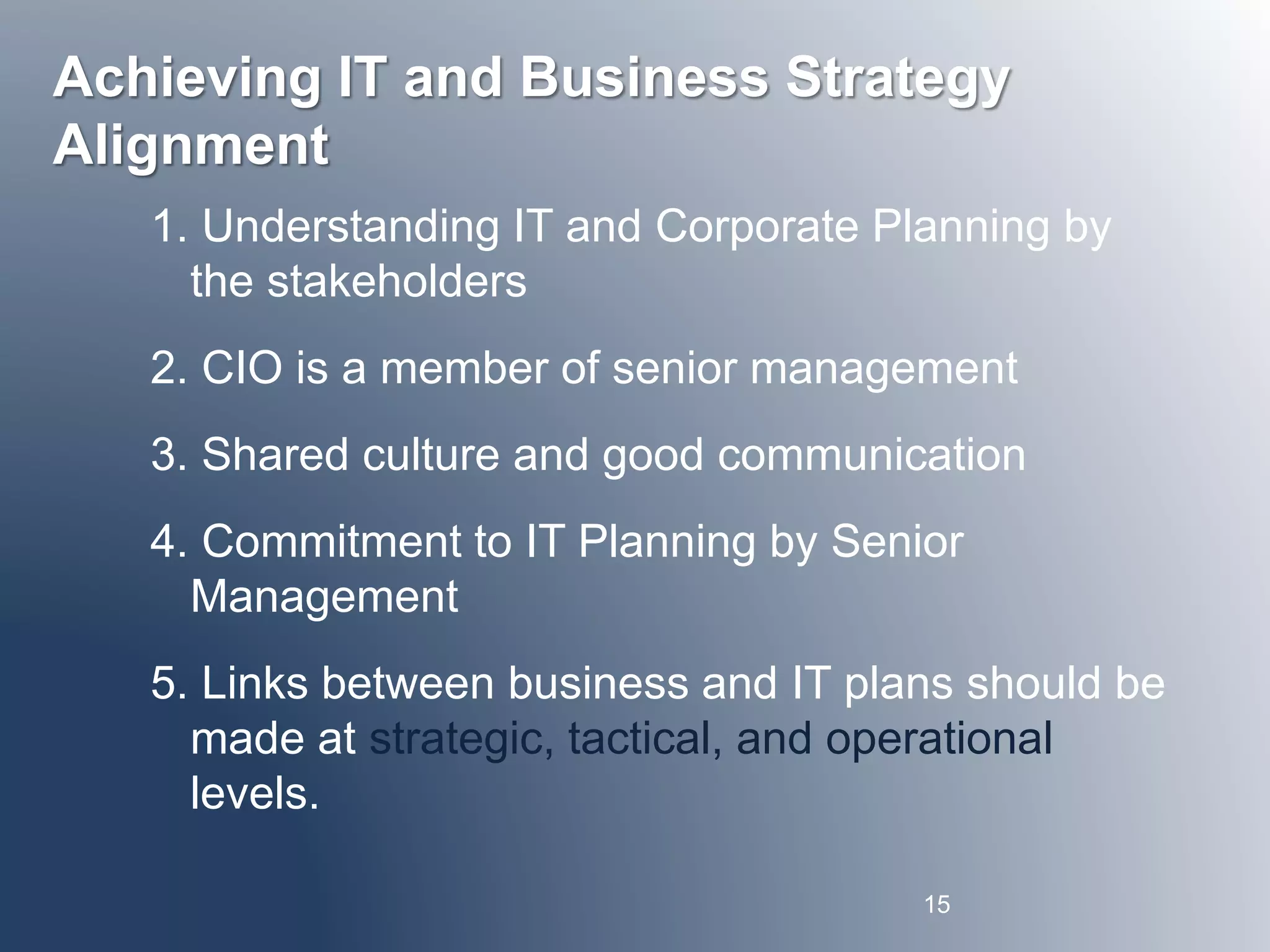
Achieving IT and Business Strategy 
Alignment 
1. Understanding IT and Corporate Planning by 
the stakeholders 
2. CIO is a member of senior management 
3. Shared culture and good communication 
4. Commitment to IT Planning by Senior 
Management 
5. Links between business and IT plans should be 
made at strategic, tactical, and operational 
levels. 
15
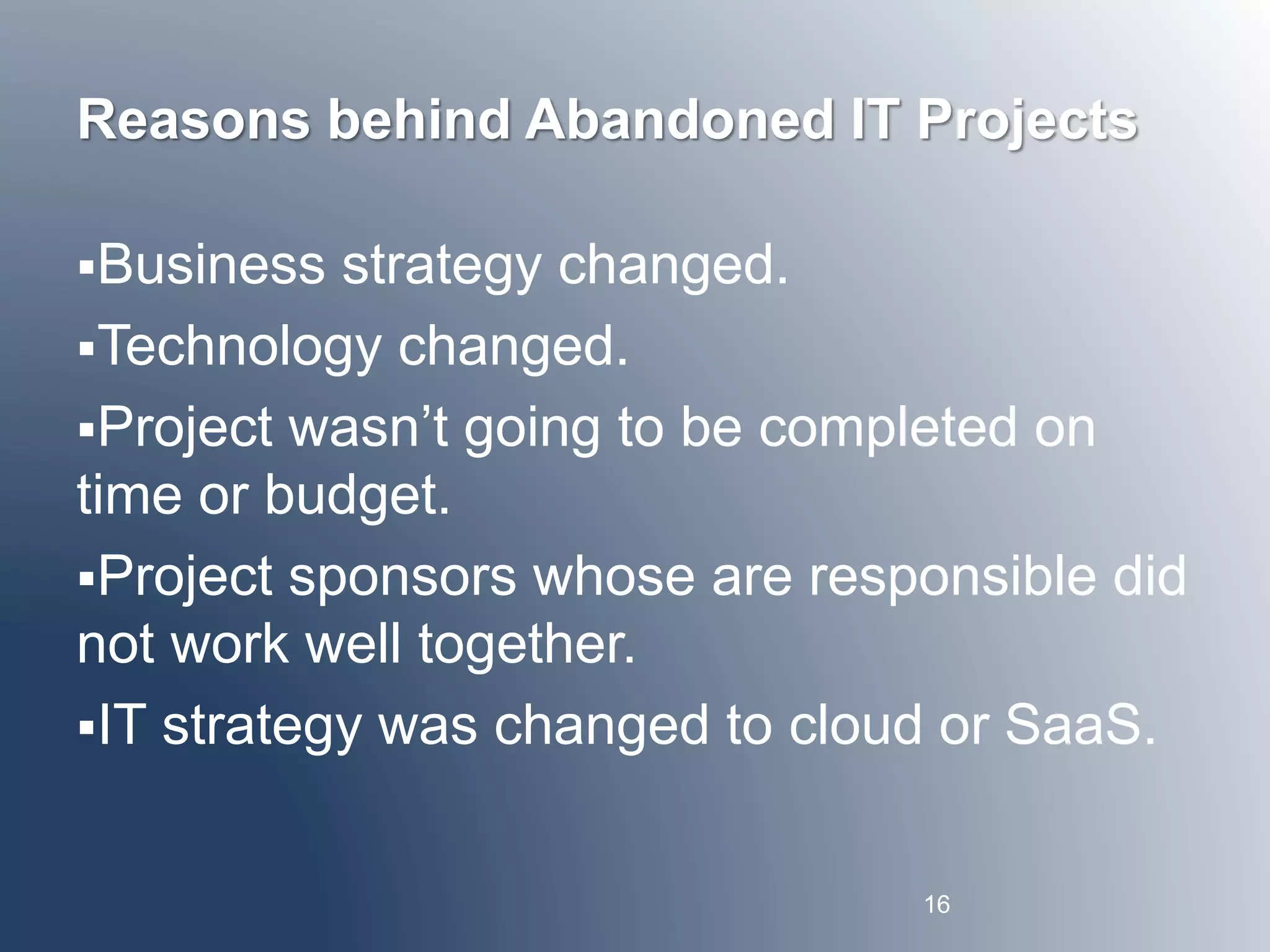
Reasons behind Abandoned IT Projects 
Business strategy changed. 
Technology changed. 
Project wasn’t going to be completed on 
time or budget. 
Project sponsors whose are responsible did 
not work well together. 
IT strategy was changed to cloud or SaaS. 
16
Success Stories 
 For Travelers Companies, Inc. 
A property and casualty insurance company, 
a 75% increase in new customer sales was 
realized by utilizing a new software by its 
independent agents. 
 Kraft Foods Inc. 
Launched a master data management (MDM) 
project to simplify and harmonize global 
business processes and enable strategic 
enterprise information capabilities. 
17
EXPLORING IT GOVERNANCE 
18
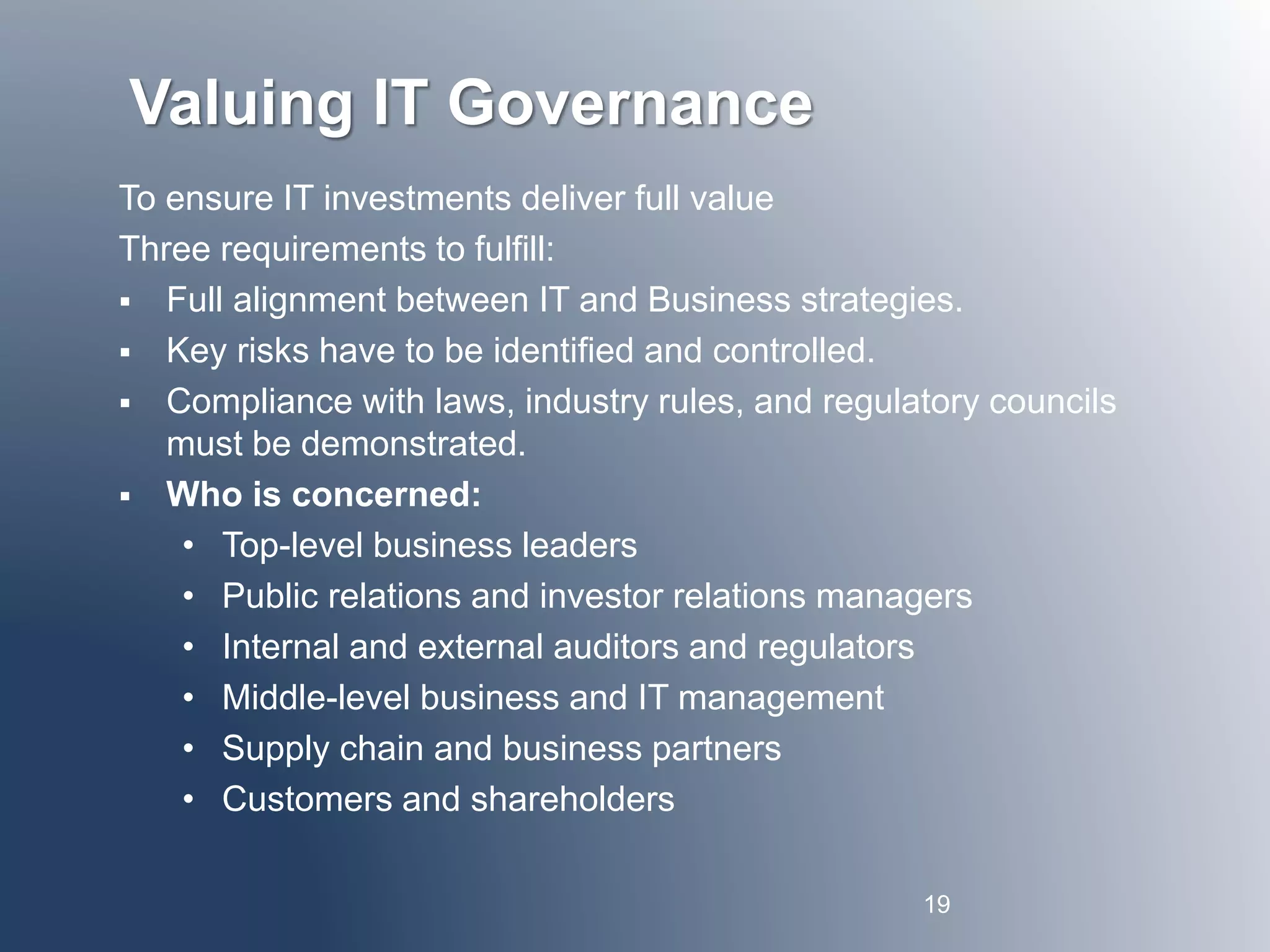
Valuing IT Governance 
To ensure IT investments deliver full value 
Three requirements to fulfill: 
 Full alignment between IT and Business strategies. 
 Key risks have to be identified and controlled. 
 Compliance with laws, industry rules, and regulatory councils 
must be demonstrated. 
 Who is concerned: 
• Top-level business leaders 
• Public relations and investor relations managers 
• Internal and external auditors and regulators 
• Middle-level business and IT management 
• Supply chain and business partners 
• Customers and shareholders 
19
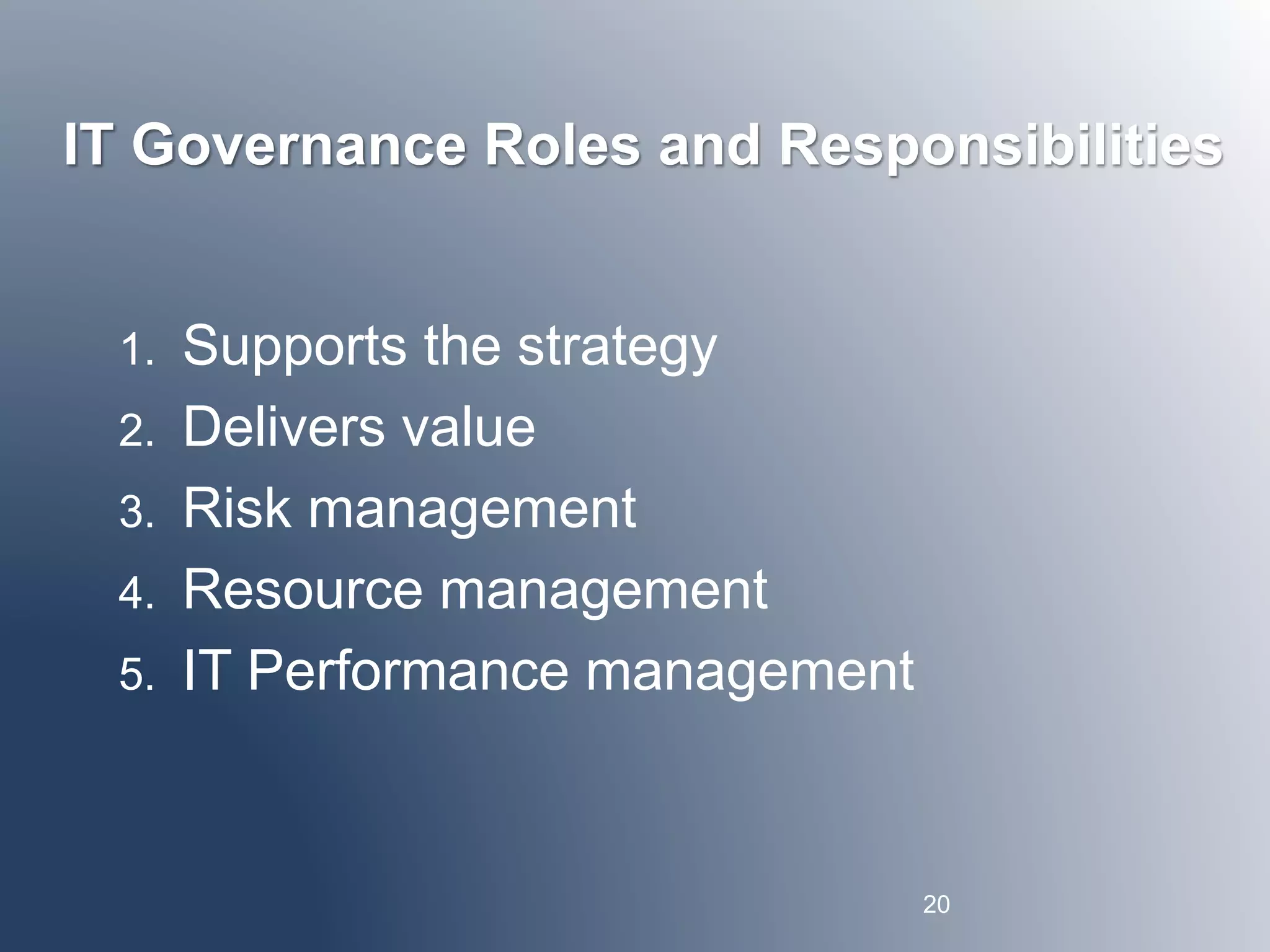
IT Governance Roles and Responsibilities 
1. Supports the strategy 
2. Delivers value 
3. Risk management 
4. Resource management 
5. IT Performance management 
20
IT OPERATING PLANS AND 
SOURCING STRATEGIES 
21
IT Operating Plans and Sourcing 
Strategies 
 Many organizations implement outsourcing as 
an IT strategy. 
 The economy has triggered Business Process 
Outsourcing (BPO) as a viable option. Ever 
heard about “Do More with Less”? 
 It’s time for business outcomes, deliverables, 
results and process optimization – no longer 
about price, cost, and labor arbitrage. 
22
BPO Implementation: eBay Case 
In 2005, eBay migrated all of their Asia Pacific operations to Genpact, a 
BPO provider. 
It was not without challenges, but was ultimately a success. 
Lessons learned 
 Manage change by securing senior leaders commitment. 
 Assess organizational readiness for a BPO transition and set 
realistic expectations 
 Anticipate risks and formulate a plan for mitigating them 
 Build project management infrastructure to manage activities 
and processes being transitioned 
 Create a governance mechanism that provides feedback and 
oversight 
 Properly define how success will be measured, qualitatively and 
quantitatively 
23
Outsourcing Risks and Hidden Costs 
 Shirking 
Vendor underperforms while claiming full payment 
 Poaching 
Vendor develops a strategic app for a client then uses it 
for other clients. 
 Opportunistic re-pricing 
Vendor over-charges for unanticipated enhancements 
 Inability to deliver 
 Loss of control over data 
24
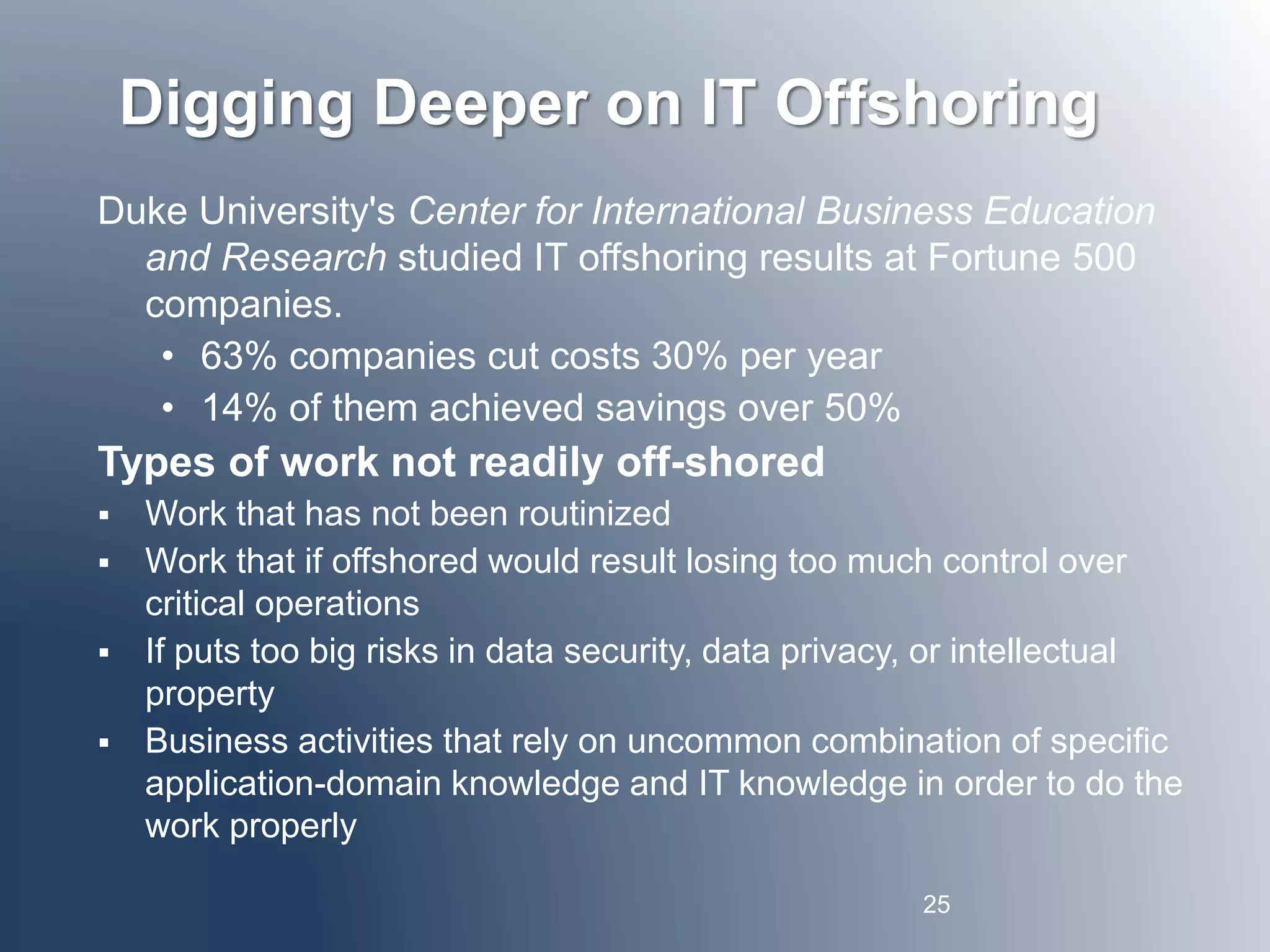
Digging Deeper on IT Offshoring 
Duke University's Center for International Business Education 
and Research studied IT offshoring results at Fortune 500 
companies. 
• 63% companies cut costs 30% per year 
• 14% of them achieved savings over 50% 
Types of work not readily off-shored 
 Work that has not been routinized 
 Work that if offshored would result losing too much control over 
critical operations 
 If puts too big risks in data security, data privacy, or intellectual 
property 
 Business activities that rely on uncommon combination of specific 
application-domain knowledge and IT knowledge in order to do the 
work properly 
25
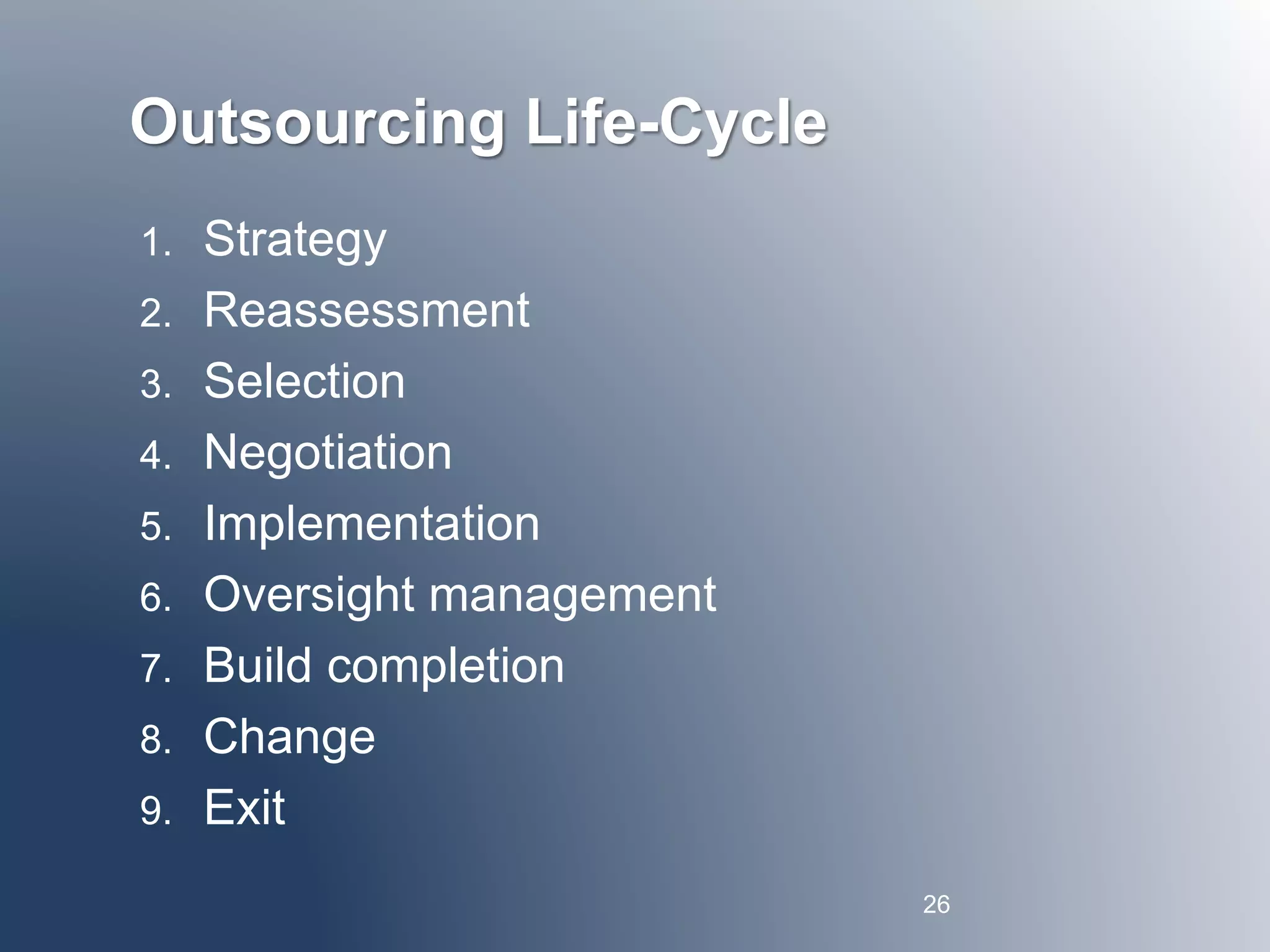
Outsourcing Life-Cycle 
1. Strategy 
2. Reassessment 
3. Selection 
4. Negotiation 
5. Implementation 
6. Oversight management 
7. Build completion 
8. Change 
9. Exit 
26
COMMENCING IT VENDOR RELATIONSHIPS 
27
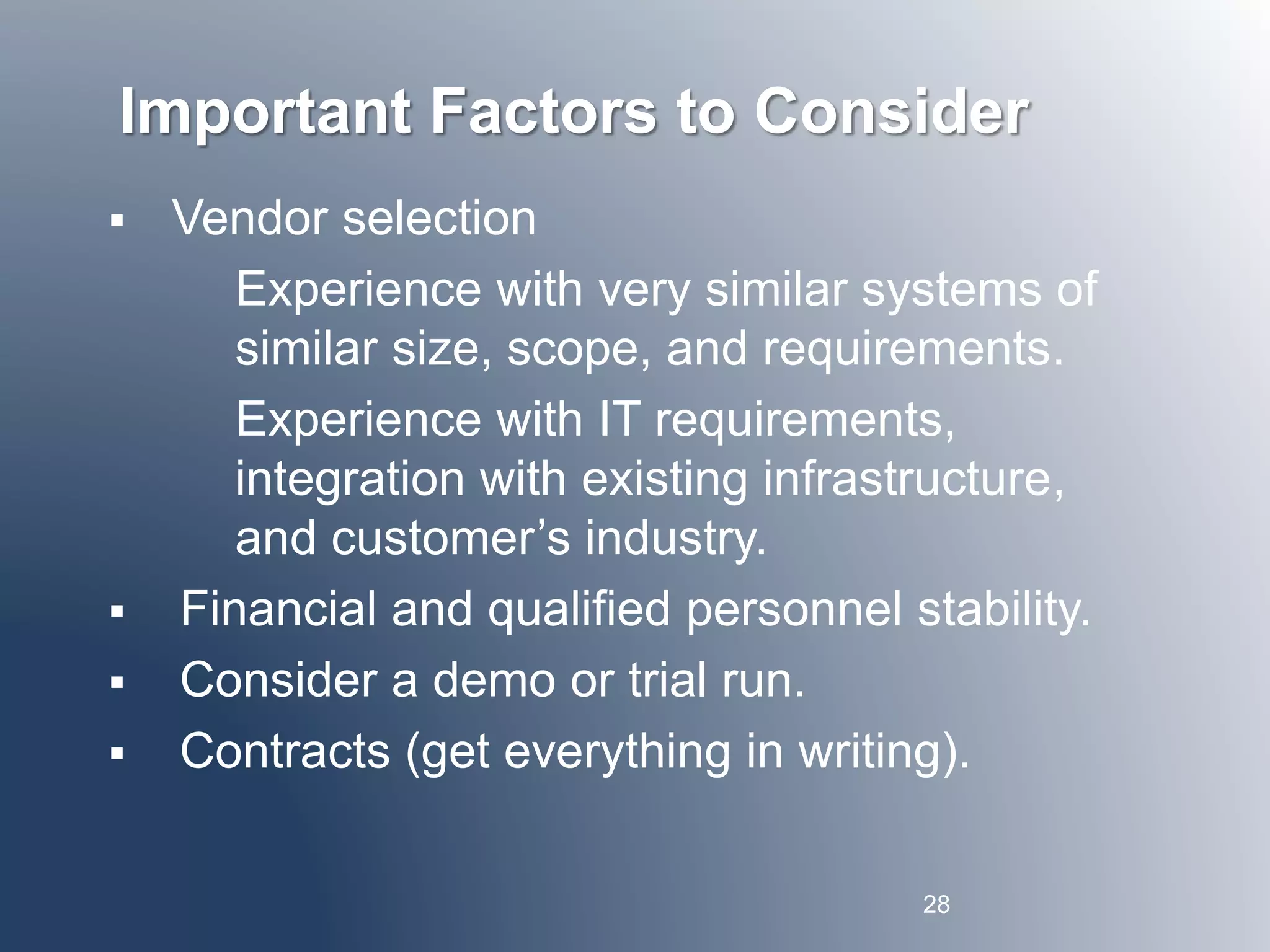
Important Factors to Consider 
 Vendor selection 
Experience with very similar systems of 
similar size, scope, and requirements. 
Experience with IT requirements, 
integration with existing infrastructure, 
and customer’s industry. 
 Financial and qualified personnel stability. 
 Consider a demo or trial run. 
 Contracts (get everything in writing). 
28
References 
Information Technology for Management: 
Advancing Sustainable, Profitable Business 
Growth 9th Edition, authored by Turban, 
Volonino and Wood, published by John Wiley 
and Sons, Inc., 2013. 
29
Thank You! 
30

Understanding IT Strategy, Sourcing and Vendor Relationships

  • 1.
    Understanding IT Strategy, Sourcing and Vendor Relationships Goutama Bachtiar IT Advisor, Auditor, Consultant and Trainer @goudotmobi
  • 2.
    Wh a t’s i n t h e 3rd Session  Valuing IT Strategy and Strategic Plan  Aligning IT with Business Strategy  Exploring IT Governance  IT Operating Plans and Sourcing Strategies  Commencing IT Vendor Relationships 2
  • 3.
    VALUING IT STRATEGYAND STRATEGIC PLAN 3
  • 4.
    IT Strategy MustSupport Business Strategy IT Strategic Plan main points: 1. Improving management’s understanding of IT opportunities and limitations 2. Assessing current and desired IT performance 3. Identifying existing capacity and human resource requirements 4. Attaining required level of IT investment 4
  • 5.
    12-5 Types ofIT Strategies 1. In-house development 2. Outsource development  On-shore (domestic)  Offshore 3. Co-source In reality, organizations use combinations of these strategies to achieve their objectives and goals whilst keep focusing on their core business, let alone the cost saving motives.
  • 6.
    IT Steering Committees  Direction setting Planning is the key activity. “If you fail to plan, you plan to fail”.  Rationing Approving human and non-human resources allocation for and within IS organization.  Structuring Defining how IS department is positioned within the organization (centralization or decentralization). 6
  • 7.
    IT Steering Committees(cont’d)  Staffing Coordinating and approving key IT personnel decisions including outsourcing activities.  Communication Information regarding IT activities should flow freely.  Evaluating Establishing performance measures for IS department. 7
  • 8.
    ALIGNING IT WITHBUSINESS STRATEGY 8
  • 9.
    IT Strategic PlanningProcess CIOs undertake IT strategic planning on a yearly, quarterly, or monthly basis.  Recalling the focus of IT strategy is on how IT creates business value.  Annual planning cycles established to: • Identify potentially beneficial IT services. • Perform Cost-Benefit Analysis. • List down potential projects. 9
  • 10.
    IT Strategic PlanningProcess (cont’d)
  • 11.
    Tools and Methodologies  Business Service Management Linking Business Goals to KPIs of IT.  Business Systems Planning Model A top-down approach starts business processes and data classes.  Balanced Scorecard Framework that transforms financial and nonfinancial data into a detailed roadmap. 11
  • 12.
    Tools and Methodologies(cont’d)  Critical Success Factors Model (CSFs) Most essential factors ensuring organization’s survival and success.  Scenario Planning Method utilized to plan situations that involve much uncertainty (recession, normal, boom).  Resource Allocation A contentious process because requests for spending far exceed the available funds. 12
  • 13.
  • 14.
    How IT andBusiness Strategy Disconnect  Only 33% business leaders reported IT division is very involved in the process of developing business strategy.  Only 30% reported business executives responsible for strategy works closely with IT division.  When not aligned, the risks arise like IT project will be abandoned before completion  Around 75% organizations abandoned >= IT project and 30% abandoned >10% IT projects due to this reason. 14
  • 15.
    Achieving IT andBusiness Strategy Alignment 1. Understanding IT and Corporate Planning by the stakeholders 2. CIO is a member of senior management 3. Shared culture and good communication 4. Commitment to IT Planning by Senior Management 5. Links between business and IT plans should be made at strategic, tactical, and operational levels. 15
  • 16.
    Reasons behind AbandonedIT Projects Business strategy changed. Technology changed. Project wasn’t going to be completed on time or budget. Project sponsors whose are responsible did not work well together. IT strategy was changed to cloud or SaaS. 16
  • 17.
    Success Stories For Travelers Companies, Inc. A property and casualty insurance company, a 75% increase in new customer sales was realized by utilizing a new software by its independent agents.  Kraft Foods Inc. Launched a master data management (MDM) project to simplify and harmonize global business processes and enable strategic enterprise information capabilities. 17
  • 18.
  • 19.
    Valuing IT Governance To ensure IT investments deliver full value Three requirements to fulfill:  Full alignment between IT and Business strategies.  Key risks have to be identified and controlled.  Compliance with laws, industry rules, and regulatory councils must be demonstrated.  Who is concerned: • Top-level business leaders • Public relations and investor relations managers • Internal and external auditors and regulators • Middle-level business and IT management • Supply chain and business partners • Customers and shareholders 19
  • 20.
    IT Governance Rolesand Responsibilities 1. Supports the strategy 2. Delivers value 3. Risk management 4. Resource management 5. IT Performance management 20
  • 21.
    IT OPERATING PLANSAND SOURCING STRATEGIES 21
  • 22.
    IT Operating Plansand Sourcing Strategies  Many organizations implement outsourcing as an IT strategy.  The economy has triggered Business Process Outsourcing (BPO) as a viable option. Ever heard about “Do More with Less”?  It’s time for business outcomes, deliverables, results and process optimization – no longer about price, cost, and labor arbitrage. 22
  • 23.
    BPO Implementation: eBayCase In 2005, eBay migrated all of their Asia Pacific operations to Genpact, a BPO provider. It was not without challenges, but was ultimately a success. Lessons learned  Manage change by securing senior leaders commitment.  Assess organizational readiness for a BPO transition and set realistic expectations  Anticipate risks and formulate a plan for mitigating them  Build project management infrastructure to manage activities and processes being transitioned  Create a governance mechanism that provides feedback and oversight  Properly define how success will be measured, qualitatively and quantitatively 23
  • 24.
    Outsourcing Risks andHidden Costs  Shirking Vendor underperforms while claiming full payment  Poaching Vendor develops a strategic app for a client then uses it for other clients.  Opportunistic re-pricing Vendor over-charges for unanticipated enhancements  Inability to deliver  Loss of control over data 24
  • 25.
    Digging Deeper onIT Offshoring Duke University's Center for International Business Education and Research studied IT offshoring results at Fortune 500 companies. • 63% companies cut costs 30% per year • 14% of them achieved savings over 50% Types of work not readily off-shored  Work that has not been routinized  Work that if offshored would result losing too much control over critical operations  If puts too big risks in data security, data privacy, or intellectual property  Business activities that rely on uncommon combination of specific application-domain knowledge and IT knowledge in order to do the work properly 25
  • 26.
    Outsourcing Life-Cycle 1.Strategy 2. Reassessment 3. Selection 4. Negotiation 5. Implementation 6. Oversight management 7. Build completion 8. Change 9. Exit 26
  • 27.
    COMMENCING IT VENDORRELATIONSHIPS 27
  • 28.
    Important Factors toConsider  Vendor selection Experience with very similar systems of similar size, scope, and requirements. Experience with IT requirements, integration with existing infrastructure, and customer’s industry.  Financial and qualified personnel stability.  Consider a demo or trial run.  Contracts (get everything in writing). 28
  • 29.
    References Information Technologyfor Management: Advancing Sustainable, Profitable Business Growth 9th Edition, authored by Turban, Volonino and Wood, published by John Wiley and Sons, Inc., 2013. 29
  • 30.