
By
Anurag Purohit
Sep 2018
References..
• ISACA.org
• CISA Manual
• CISM Manual
• CRISC Manual
• Various Publications of COBIT
• ISO.org
• PMI.org
• Google.com and many other websites for diagrams, logos
and Pictures
• IBM.com
• Microsoft.com
• Breach of copyright is totally unintentional and for
knowledge sharing purpose only.
• View Presented in the Presentation are purely author’s
understanding of the subject. It may defer than the actual
subject.
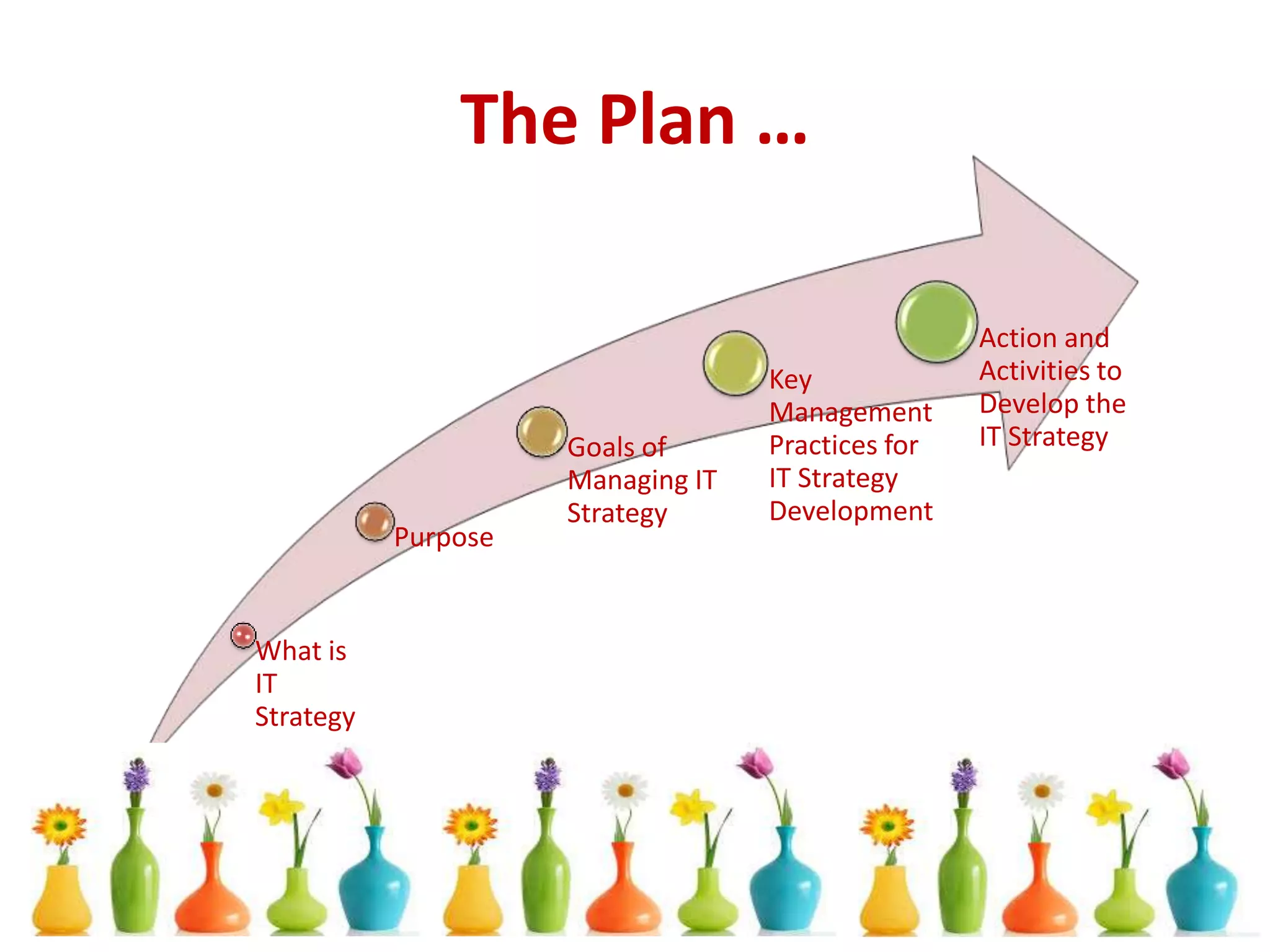
The Plan …
What is
IT
Strategy
Purpose
Goals of
Managing IT
Strategy
Key
Management
Practices for
IT Strategy
Development
Action and
Activities to
Develop the
IT Strategy
Provides Holistic View of:
• Current Business and IT Environment
• The Future Direction and
• Initiatives required to migrate to the desired
future Environment
IT Strategy
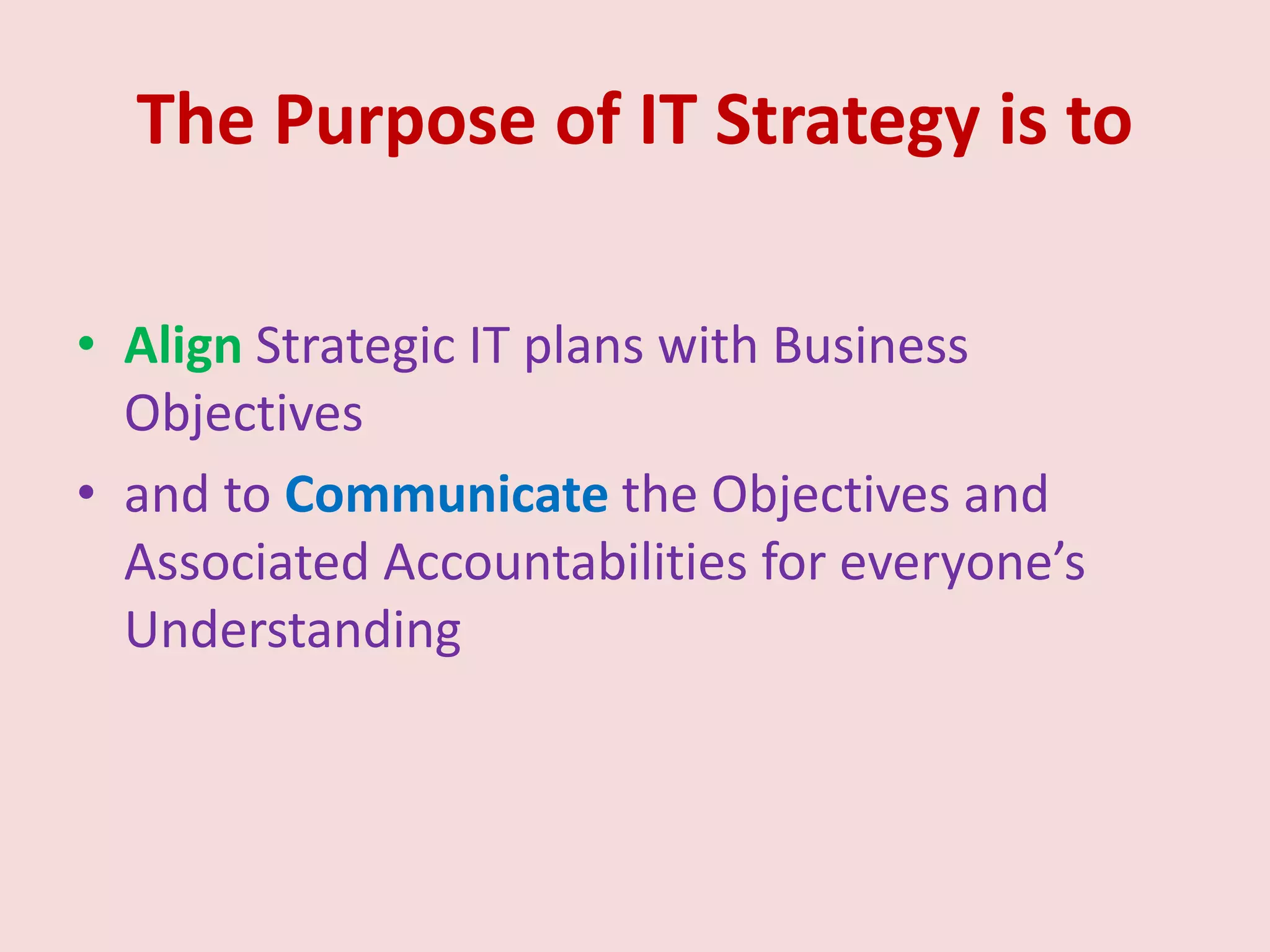
The Purpose of IT Strategy is to
• Align Strategic IT plans with Business
Objectives
• and to Communicate the Objectives and
Associated Accountabilities for everyone’s
Understanding
Managing
IT Strategy Effectively Means
Assuring
IT Strategy is
Aligned With
Enterprise
Strategy
Cost-
effectiveness
Appropriate
Realistic
Achievable
Enterprise-
focussed
Balanced
Direct Link
• From Short-term
goals to long-
term initiatives
and to
operational plans
Clear
Assignment of
Accountability
for Delivery
Corporate IT Strategy
Goal
Setting
Stretagy
Evolution
Approval
Strategy
Imple-
mentation
Strategy
Control and
Monitoring
6
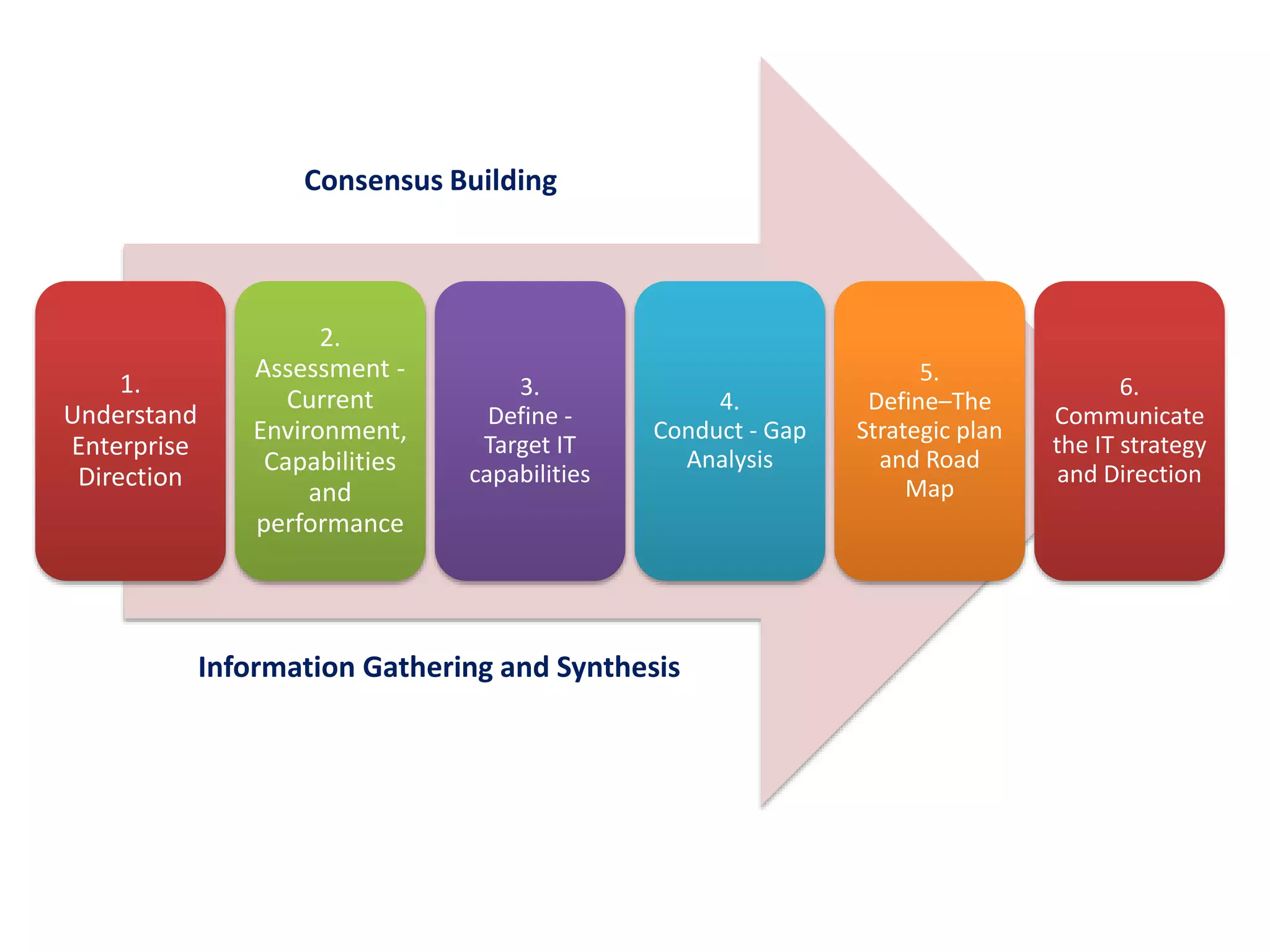
Key Management Practices/Process
of
IT Strategy Development
by COBIT
1.
Understand
Enterprise
Direction
2.
Assessment -
Current
Environment,
Capabilities
and
performance
3.
Define -
Target IT
capabilities
4.
Conduct - Gap
Analysis
5.
Define–The
Strategic plan
and Road
Map
6.
Communicate
the IT strategy
and Direction
Consensus Building
Information Gathering and Synthesis
Action and Activities to Develop the
IT Strategy
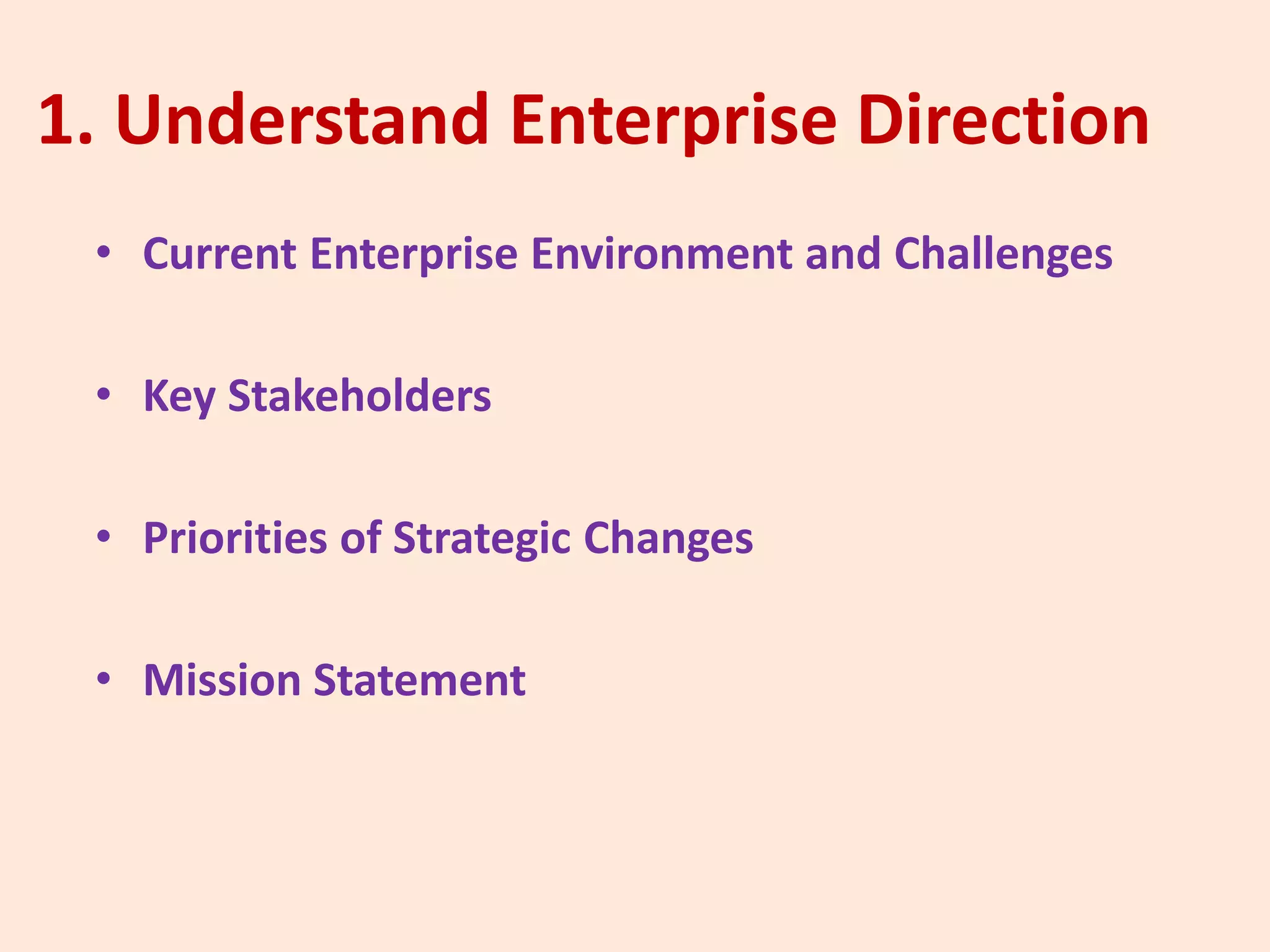
1. Understand Enterprise Direction
• Current Enterprise Environment and Challenges
• Key Stakeholders
• Priorities of Strategic Changes
• Mission Statement
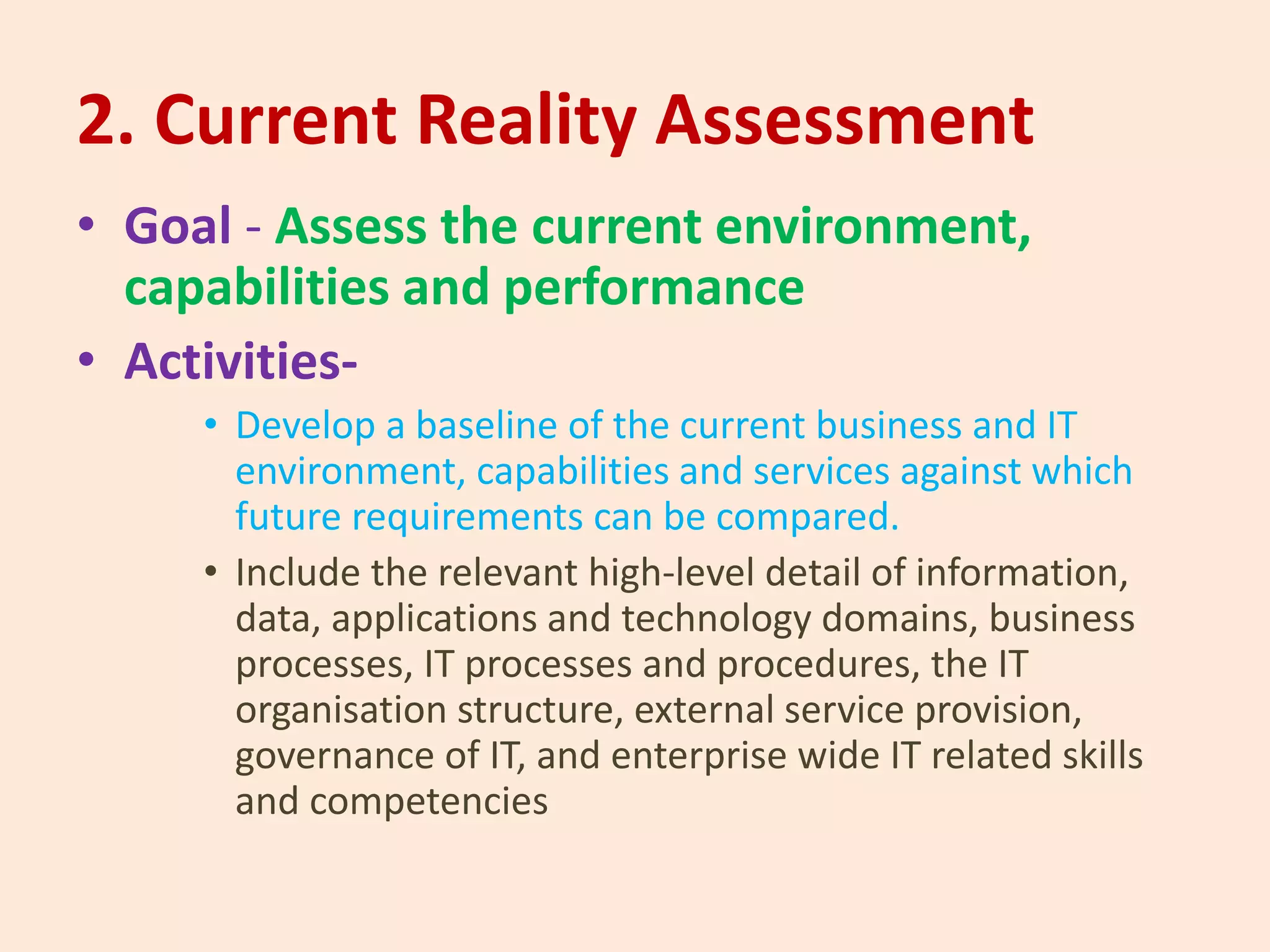
2. Current Reality Assessment
• Goal - Assess the current environment,
capabilities and performance
• Activities-
• Develop a baseline of the current business and IT
environment, capabilities and services against which
future requirements can be compared.
• Include the relevant high-level detail of information,
data, applications and technology domains, business
processes, IT processes and procedures, the IT
organisation structure, external service provision,
governance of IT, and enterprise wide IT related skills
and competencies
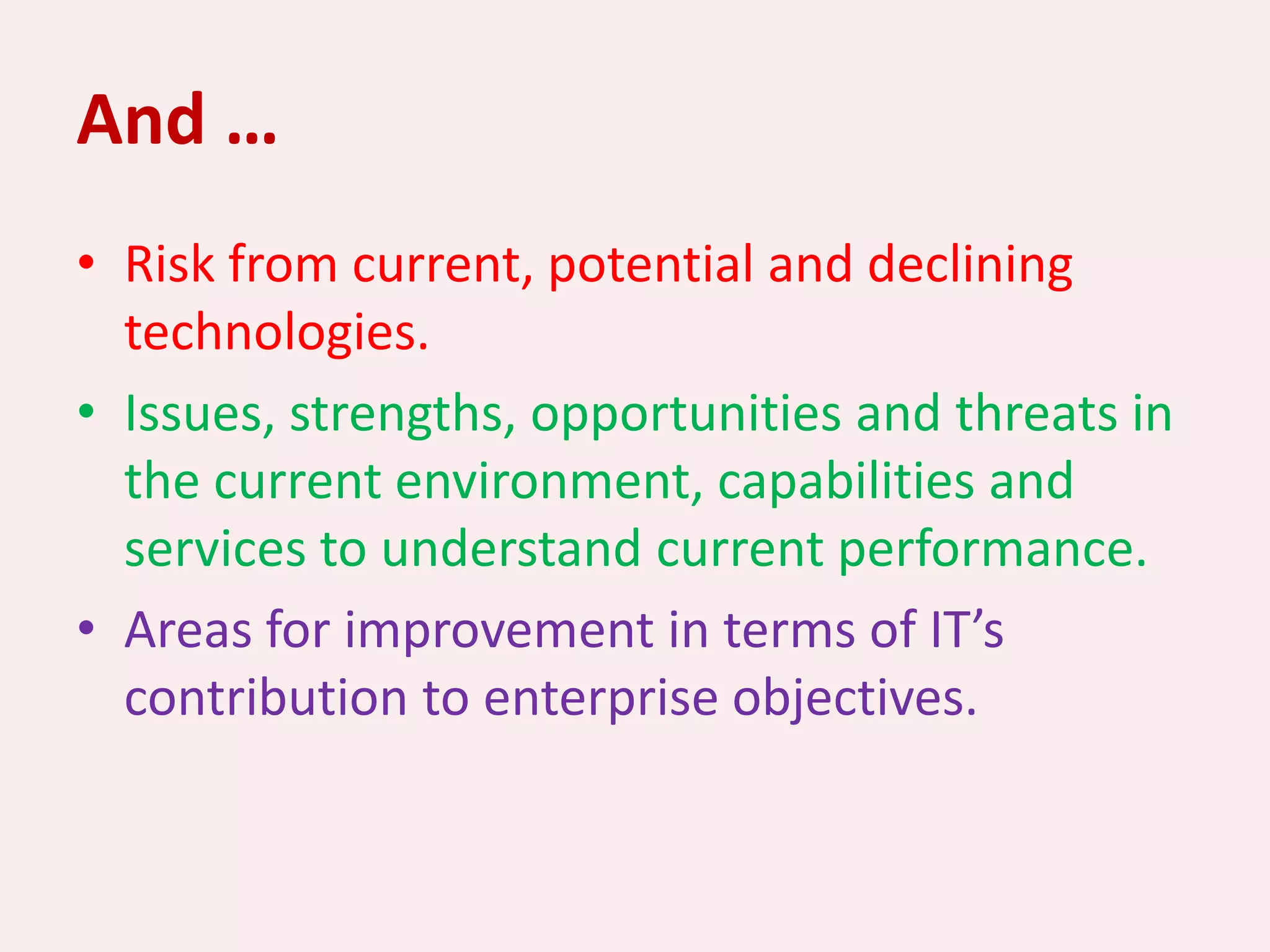
And …
• Risk from current, potential and declining
technologies.
• Issues, strengths, opportunities and threats in
the current environment, capabilities and
services to understand current performance.
• Areas for improvement in terms of IT’s
contribution to enterprise objectives.
3. Target IT capabilities
• Goal - Statement of Future Vision
• Activities –
• Analysis of Rejected Initiatives
• Results and Recommendations from Proof of
Concept Initiatives
• High Level IT Goals
• Required Business and IT Capabilities
• Consider validated emerging technology or
innovation ideas.
• Identify threats from declining, current and
newly acquired technologies.
and..
• Define high-level IT objectives/goals and how they will
contribute to the enterprise’s business objectives.
• Define required and desired business process and IT
capabilities and IT services and describe the high-level
changes in the business, information, data, applications
& technology domains, IT processes and procedures,
the IT organisation structure, IT service providers,
governance of IT, and IT skills and competencies.
• Align and agree with the enterprise architect on
proposed enterprise architecture changes.
• Demonstrate traceability to the enterprise strategy and
requirements
4. Gap Analysis
• Goal – Finding Gaps in Outcomes of Step 3 and 4
• Activities –
• Gaps and changes required to realise target Capabilities
• Value benefit statement for target environment
• The high-level implications of all gaps. The value of potential
changes to business, IT capabilities and IT services.
• Implications if no changes are realised.
• Impact of potential changes on the business and IT operating
models, development capabilities, and IT investment plans.
• Target environment definition and a value statement with
the benefits of the target environment.
5. The Strategic plan and Road map
• Goal – Finding Gaps in Outcomes of Step 3 and 4
• Activities –
• Final resources plan, allocation and effectiveness of
resources and capabilities
• Remedial actions to address resource management
deviations
• Defined scope of architecture and Information architecture
Model
• High Level Implementation and Migration Strategy
• Feedbacks on Strategy and Goals
• Funding Options, IT Budget Allocation and Plan
• Information Security
• Approved Strategic Options
• Definition of Strategic Initiatives
• Risk Assessment
And Finally..
The Strategy
Is the Guiding Document to Communicate
• Detail of Initiatives required closing the gaps and
migrating from current to the target environment
(including investment /operational budget).
• Address risk, costs and implications of
organizational changes, technology evolution,
regulatory requirements, business process re-
engineering, staffing, insourcing and outsourcing
opportunities.
• Dependencies, overlaps, synergies and impacts
amongst initiatives, prioritize the initiatives.
………..
The Strategy Constitutes..
And …
• Resource requirements, schedule and
investment/operational budgets for each
of the initiatives.
• Roadmap Indicating the relative
scheduling and interdependencies of the
initiatives.
Also ..
• Translation of the objectives into outcome
measures represented by metrics (what) and
targets (how much) that can be related to
enterprise benefits.
• Formal support from stakeholders and
approval for the plan
In Summary..
Notes to Print for Reference
(Obviously Without Decoration  )
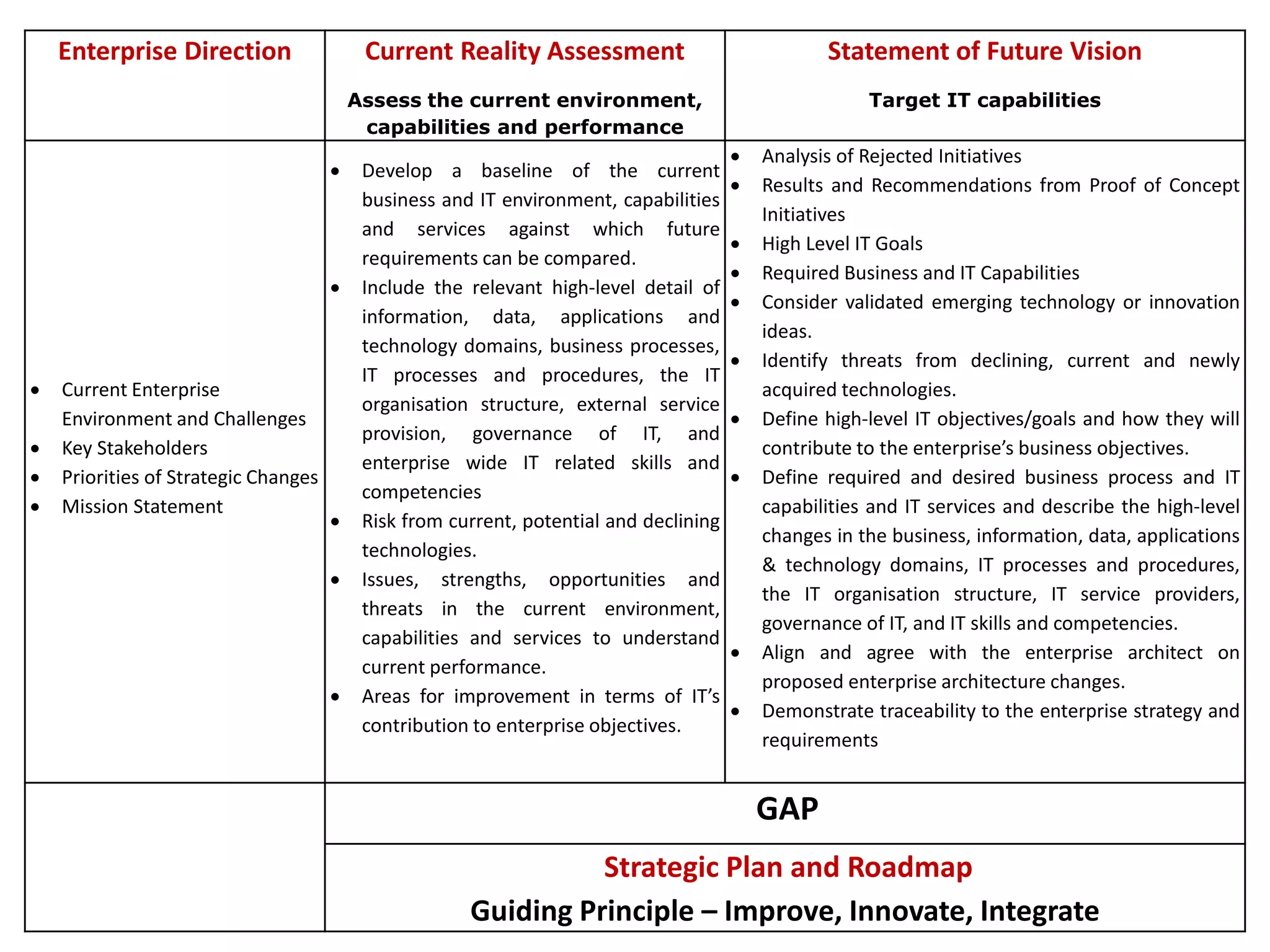
Enterprise Direction Current Reality Assessment
Assess the current environment,
capabilities and performance
Statement of Future Vision
Target IT capabilities
 Current Enterprise
Environment and Challenges
 Key Stakeholders
 Priorities of Strategic Changes
 Mission Statement
 Develop a baseline of the current
business and IT environment, capabilities
and services against which future
requirements can be compared.
 Include the relevant high-level detail of
information, data, applications and
technology domains, business processes,
IT processes and procedures, the IT
organisation structure, external service
provision, governance of IT, and
enterprise wide IT related skills and
competencies
 Risk from current, potential and declining
technologies.
 Issues, strengths, opportunities and
threats in the current environment,
capabilities and services to understand
current performance.
 Areas for improvement in terms of IT’s
contribution to enterprise objectives.
 Analysis of Rejected Initiatives
 Results and Recommendations from Proof of Concept
Initiatives
 High Level IT Goals
 Required Business and IT Capabilities
 Consider validated emerging technology or innovation
ideas.
 Identify threats from declining, current and newly
acquired technologies.
 Define high-level IT objectives/goals and how they will
contribute to the enterprise’s business objectives.
 Define required and desired business process and IT
capabilities and IT services and describe the high-level
changes in the business, information, data, applications
& technology domains, IT processes and procedures,
the IT organisation structure, IT service providers,
governance of IT, and IT skills and competencies.
 Align and agree with the enterprise architect on
proposed enterprise architecture changes.
 Demonstrate traceability to the enterprise strategy and
requirements
GAP
Strategic Plan and Roadmap
Guiding Principle – Improve, Innovate, Integrate
Thanks
You may reach me at
purohitanu@gmail.com

Developing IT strategy

  • 1.
  • 4.
    References.. • ISACA.org • CISAManual • CISM Manual • CRISC Manual • Various Publications of COBIT • ISO.org • PMI.org • Google.com and many other websites for diagrams, logos and Pictures • IBM.com • Microsoft.com • Breach of copyright is totally unintentional and for knowledge sharing purpose only. • View Presented in the Presentation are purely author’s understanding of the subject. It may defer than the actual subject.
  • 5.
    The Plan … Whatis IT Strategy Purpose Goals of Managing IT Strategy Key Management Practices for IT Strategy Development Action and Activities to Develop the IT Strategy
  • 6.
    Provides Holistic Viewof: • Current Business and IT Environment • The Future Direction and • Initiatives required to migrate to the desired future Environment IT Strategy
  • 7.
    The Purpose ofIT Strategy is to • Align Strategic IT plans with Business Objectives • and to Communicate the Objectives and Associated Accountabilities for everyone’s Understanding
  • 8.
  • 9.
  • 10.
    IT Strategy is AlignedWith Enterprise Strategy Cost- effectiveness Appropriate Realistic Achievable Enterprise- focussed Balanced Direct Link • From Short-term goals to long- term initiatives and to operational plans Clear Assignment of Accountability for Delivery
  • 11.
  • 12.
    6 Key Management Practices/Process of ITStrategy Development by COBIT
  • 13.
    1. Understand Enterprise Direction 2. Assessment - Current Environment, Capabilities and performance 3. Define - TargetIT capabilities 4. Conduct - Gap Analysis 5. Define–The Strategic plan and Road Map 6. Communicate the IT strategy and Direction Consensus Building Information Gathering and Synthesis
  • 14.
    Action and Activitiesto Develop the IT Strategy
  • 15.
    1. Understand EnterpriseDirection • Current Enterprise Environment and Challenges • Key Stakeholders • Priorities of Strategic Changes • Mission Statement
  • 16.
    2. Current RealityAssessment • Goal - Assess the current environment, capabilities and performance • Activities- • Develop a baseline of the current business and IT environment, capabilities and services against which future requirements can be compared. • Include the relevant high-level detail of information, data, applications and technology domains, business processes, IT processes and procedures, the IT organisation structure, external service provision, governance of IT, and enterprise wide IT related skills and competencies
  • 17.
    And … • Riskfrom current, potential and declining technologies. • Issues, strengths, opportunities and threats in the current environment, capabilities and services to understand current performance. • Areas for improvement in terms of IT’s contribution to enterprise objectives.
  • 18.
    3. Target ITcapabilities • Goal - Statement of Future Vision • Activities – • Analysis of Rejected Initiatives • Results and Recommendations from Proof of Concept Initiatives • High Level IT Goals • Required Business and IT Capabilities • Consider validated emerging technology or innovation ideas. • Identify threats from declining, current and newly acquired technologies.
  • 19.
    and.. • Define high-levelIT objectives/goals and how they will contribute to the enterprise’s business objectives. • Define required and desired business process and IT capabilities and IT services and describe the high-level changes in the business, information, data, applications & technology domains, IT processes and procedures, the IT organisation structure, IT service providers, governance of IT, and IT skills and competencies. • Align and agree with the enterprise architect on proposed enterprise architecture changes. • Demonstrate traceability to the enterprise strategy and requirements
  • 20.
    4. Gap Analysis •Goal – Finding Gaps in Outcomes of Step 3 and 4 • Activities – • Gaps and changes required to realise target Capabilities • Value benefit statement for target environment • The high-level implications of all gaps. The value of potential changes to business, IT capabilities and IT services. • Implications if no changes are realised. • Impact of potential changes on the business and IT operating models, development capabilities, and IT investment plans. • Target environment definition and a value statement with the benefits of the target environment.
  • 21.
    5. The Strategicplan and Road map • Goal – Finding Gaps in Outcomes of Step 3 and 4 • Activities – • Final resources plan, allocation and effectiveness of resources and capabilities • Remedial actions to address resource management deviations • Defined scope of architecture and Information architecture Model • High Level Implementation and Migration Strategy • Feedbacks on Strategy and Goals • Funding Options, IT Budget Allocation and Plan • Information Security • Approved Strategic Options • Definition of Strategic Initiatives • Risk Assessment
  • 22.
    And Finally.. The Strategy Isthe Guiding Document to Communicate
  • 23.
    • Detail ofInitiatives required closing the gaps and migrating from current to the target environment (including investment /operational budget). • Address risk, costs and implications of organizational changes, technology evolution, regulatory requirements, business process re- engineering, staffing, insourcing and outsourcing opportunities. • Dependencies, overlaps, synergies and impacts amongst initiatives, prioritize the initiatives. ……….. The Strategy Constitutes..
  • 24.
    And … • Resourcerequirements, schedule and investment/operational budgets for each of the initiatives. • Roadmap Indicating the relative scheduling and interdependencies of the initiatives.
  • 25.
    Also .. • Translationof the objectives into outcome measures represented by metrics (what) and targets (how much) that can be related to enterprise benefits. • Formal support from stakeholders and approval for the plan
  • 26.
    In Summary.. Notes toPrint for Reference (Obviously Without Decoration  )
  • 27.
    Enterprise Direction CurrentReality Assessment Assess the current environment, capabilities and performance Statement of Future Vision Target IT capabilities  Current Enterprise Environment and Challenges  Key Stakeholders  Priorities of Strategic Changes  Mission Statement  Develop a baseline of the current business and IT environment, capabilities and services against which future requirements can be compared.  Include the relevant high-level detail of information, data, applications and technology domains, business processes, IT processes and procedures, the IT organisation structure, external service provision, governance of IT, and enterprise wide IT related skills and competencies  Risk from current, potential and declining technologies.  Issues, strengths, opportunities and threats in the current environment, capabilities and services to understand current performance.  Areas for improvement in terms of IT’s contribution to enterprise objectives.  Analysis of Rejected Initiatives  Results and Recommendations from Proof of Concept Initiatives  High Level IT Goals  Required Business and IT Capabilities  Consider validated emerging technology or innovation ideas.  Identify threats from declining, current and newly acquired technologies.  Define high-level IT objectives/goals and how they will contribute to the enterprise’s business objectives.  Define required and desired business process and IT capabilities and IT services and describe the high-level changes in the business, information, data, applications & technology domains, IT processes and procedures, the IT organisation structure, IT service providers, governance of IT, and IT skills and competencies.  Align and agree with the enterprise architect on proposed enterprise architecture changes.  Demonstrate traceability to the enterprise strategy and requirements GAP Strategic Plan and Roadmap Guiding Principle – Improve, Innovate, Integrate
  • 28.
    Thanks You may reachme at purohitanu@gmail.com