N° 01 JULY 2011
      The challenges of the digital revolution
    • L’Oreal’s choices by Marc Menesguen • Transform to the Power of Digital: Digital
Transformation as a Driver of Corporate Performance by Capgemini Consulting • No sector
  is immune by Andrew McAfee, MIT • The boom of Chinese e-commerce by Brian Xin,
     StarryMedia • A transformed society is emerging by philosopher Bernard Stiegler
summary


eDitorial                              vision                                          guest   writer

Digital and Transformation:            No sector is immune from digital                Digital as Bearer of Another
Are they now indivisible?              transformation                                  Society
By Capgemini Consulting’s              Interview with Andrew McAfee,                   By Bernard Stiegler, philosopher,
Editorial Board                        principal research scientist at the             President of Ars Industrialis,
                              page 4   Center for Digital Business, MIT                Director of the Pompidou Center
                                       Sloan School of Management                      Institute for Research and
                                                                     page 30           Innovation
                                                                                                                     page 43


strategy
Beauty and digital: A magical
match                                                                                  Capgemini Consulting’s
Interview with Marc Menesguen,                                                         Editorial Board:
Managing Director of Strategic         telesCope                                       Pierre-Yves Cros, CEO
Marketing for L’Oréal                                                                  Tom Blacksell, UK Regional Head
                                       Chinese entrepreneurs take full                 Didier Bonnet, Global Head of
                            page 6                                                     Practices
                                       advantage of the e-commerce
                                                                                       Patrick Ferraris, Global Leader,
                                       boom                                            Technology Transformation
                                       Interview with Brian Xin, founder               Xavier Hochet, France Regional Head
                                       of StarryMedia, a Chinese start-up              Ton de Jong, Netherlands Regional Head
                                       for social marketing and digital                Eric Roudil, North South Europe
Close-up                               research                                        Regional Head
                                                                   page 36             Michael Schulte, Germany Regional
                                                                                       Head
Transform to the Power of Digital:                                                     Ken Toombs, USA Regional Head
Digital Transformation as a Driver
of Corporate Performance                                                               Coordination Editor:
                                                                                       Claire Thiebaut
By Didier Bonnet, Global Head of
Practices, Capgemini Consulting                                                        Design and Production:
and Patrick Ferraris, Global Leader,                                                   Les Ateliers Corporate
Technology Transformation,             Key    figures
                                                                                       Printing:Solutioncom
Capgemini Consulting
                             page 14                              pages 35 and 42      Cover illustration:
                                                                                       Fernando Togni


                                             Digital transformation review n°01 - 03
eDitorial


                     Digital and Transformation:
                      Are they now indivisible?
                     By Capgemini Consulting’s Editorial Board


W        elcome to the first issue of Capgemini
         Consulting’s Digital Transformation
Review. The rise of new digital technologies
                                                            the opportunities offered by these new tech-
                                                            nologies and their related applications. While
                                                            transformation is not just digital, transforma-
is one of the most exhilarating challenges fa-              tion cannot do without digital.
cing companies today. No sector or organiza-
tion is immune from the digital phenomenon,                 Second, digital is shaping the competitive
which dictates its own pace and presence in                 battleground in all sectors. The data shows a
the management agenda. The question is no                   growing performance gap between the best di-
longer when companies need to make digital                  gital learners and the others. The more a sec-
a strategic priority – this tipping point is past           tor relies on technology, the greater the gap
– but how to embrace it and turn it to compe-               between the most effective companies and the
titive advantage.                                           rest. And yet, the digital phenomenon doesn’t
                                                            stop at the borders of «traditional» sectors. Di-
Given this urgency, should we now view the                  gital technology allows a more targeted busi-
rise of digital as the alpha and omega of trans-            ness approach, more scientific decision-ma-
formation strategies, the focal point for every             king and a new type of customer relationship.
aspect of corporate change? Our hypothesis is               Companies in every business sector need to
that transformation strategy is its own master,             master digital tools.
but we have reached a stage where transfor-
mation cannot be done in isolation from digi-               We do think it is important to stress that this
tal. There are two reasons for this.                        emphasis on a technology-driven digital re-
                                                            volution in no way diminishes the importance
First, digital has a fundamental impact on how              of human initiative and responsibility. Indeed,
change takes place. Moving forward, every                   the truth is quite the opposite. It is more im-
strategy that is devised must take account of               portant than ever to acquire the right skills


                                      Digital transformation review n°01 - 04
eDitorial


and place them strategically to support trans-            Media, a Chinese start-up connecting marke-
formation programs.                                       ting and social media, offers particular insight
                                                          into the speed of change in China today.
In this publication we are determined to em-
brace just this sort of complexity and coun-              Finally, philosopher Bernard Stiegler provides
ter-intuition, through a viewpoint that cros-             the necessary distance for understanding the
ses geographical boundaries and domain                    social impact of the digital revolution, which
boundaries, with contributions from faculty               he compares in the scale of human history to
experts, practitioners, start-up pioneers and             the invention of writing.
philosophers:


Marc Menesguen, Managing Director of Stra-                We hope you enjoy the thoughts and strong
tegic Marketing for L’Oréal, explains how the             convictions of all our authors.
digital revolution has impacted the organiza-
tion and strategy of this global beauty pro-
ducts leader.


Prof. Andrew McAfee of MIT paints a picture
of how these digital technologies are disrup-
ting work processes and corporate strategy.
Along the way he describes profound changes
in American consumer habits and their im-
pact on traditional marketing approaches.


The article by Brian Xin, founder of Starry-


                                    Digital transformation review n°01 - 05
strategy


Beauty and digital: A magical match

                                                                    an impact on how our consu-
Marc Menesguen, Managing Director of                                mers relate to information and
Strategic Marketing for L’Oréal, explains                           advertising, and thus to our
                                                                    brands. According to a study by
how the digital revolution has impacted                             the Forrester group, 7% of sales
                                                                    around the world today take
the organization and strategy of the                                place online, and almost 40%
global beauty products leader.                                      of off-line sales are influenced
                                                                    by internet research. So almost
                                                                    half of purchases in the world
                                                                    are already somehow digitally

                       H   as the rise of the digital
                           phenomenon changed
                       your customers’ habits?
                                                                    influenced.

                                                                    This trend in any given country
                                                                    depends on its digital maturity.
                       Digital transformation is one                In the United States, where the
                       of the major drivers of change               phenomenon first developed,
                       in today’s world. I believe we               the internet plays a very signi-
                       are witnessing the start of a true           ficant role today in purchasing
                       revolution, given how the major              decisions and in how we sup-
                       players are powering forward –               port our consumers. This is a
                       Google, Apple, Microsoft, Face-              little less the case in Europe,
                       book... – and the speed at which             although things are advancing
                       digital tools are proliferating.             more quickly. And in the newer
                       There are expected to be 20                  markets digital technology has
                       billion connected devices (tele-             a considerable impact. In China,
                       phones, tablets, game consoles,              internet penetration is already
                       etc.) by 2015.                               almost 30%. These changes are
                                                                    of fundamental importance to
                       This revolution naturally has                L’Oréal.


                          Digital transformation review n°01 - 06
strategy


How does the company view          you see emerging with digital                The final opportunity involves
this revolution?                   transformation?                              innovation. Research & Innova-
                                                                                tion is at the heart of the L’Oréal
Digital    transformation    re-   First of all, digital transforma-            model, and digital transforma-
presents     an    extraordinary   tion is a chance to strengthen               tion helps our researchers’ work.
opportunity to strengthen our      our brands’ images by impro-                 For example, in the United Sta-
current business model and be-     ving the efficiency of our com-              tes we have a social network
come even better at being the      munication and advertising.                  of 250 women who test our
world’s number-one beauty                                                       cosmetic or facial care products,
group. In fact, beauty and di-                                                  and give their feedback online.
gital are something of a magi-       “ The digital world                        We examine their reactions
cal match, because beauty is an                                                 and take them into account
                                     multiplies the ways
emotion and the digital world                                                   when designing new products.
                                     our brands can create
multiplies the ways our brands                                                  We have truly reached the stage
can create an emotional-filled
                                     an emotional-filled                        of co-innovation!
relationship with their custo-       relationship with
mers.                                their customers. ”                         How is L’Oréal reacting
                                                                                to take advantage of these
Also, using our products isn’t                                                  opportunities?
always self-evident, and digi-     Second, the internet is an ama-
tal tools allow us to help our     zing tool for supporting custo-              Our Chairman and CEO, Jean-
consumers understand and use       mers throughout a product’s cy-              Paul Agon, named 2010 the
them better, and to offer them     cle of use, and for strengthening            «Digital Year» for L’Oréal. Suc-
personalized, one-to-one ser-      brand loyalty. The third advan-              ceeding in the digital revolution
vice so we can increase the        tage is one of sales. The inter-             is a major strategic challenge
quality and perceived value of     net makes it possible for brands             for the company at the global
using our products.                to project themselves right into             level, along with winning one
                                   people’s homes, and generate                 billion new consumers over the
Could you tell us more spe-        purchases and repeat purchases               coming decade. The year 2010
cifically what opportunities       through online sales.                        was therefore one of intense


                                      Digital transformation review n°01 - 07
strategy


Beauty and digital: A magical match


effort, particularly for a crisis
exit phase, with strategic po-
licies impacting our 23 brands
and all our countries.

This mobilization was expressed
in a number of ways. First, we
made sure we had the necessary
expertise in-house. We formed a
team of 300 people specialized
in digital technologies, with
the goal of providing digital
expertise at every strategic point
in the company, and we have
a global digital manager to pilot
this cross-functional network
who reports to me directly.
I would point out here that
digital transformation doesn’t
only concern marketing; rather,
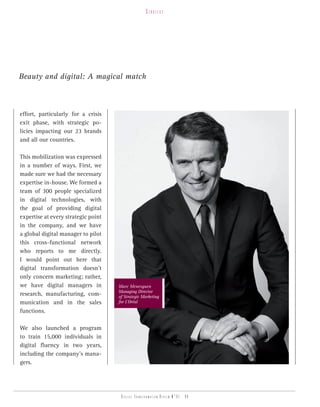
we have digital managers in          Marc Menesguen
                                     Managing Director
research, manufacturing, com-        of Strategic Marketing
munication and in the sales          for L’Oréal

functions.

We also launched a program
to train 15,000 individuals in
digital fluency in two years,
including the company’s mana-
gers.


                                      Digital transformation review n°01 - 08
strategy


Have you defined measurable         developing m-commerce, sales                 strategy. Whereas in the mass
objectives for your digital         via mobile phones. And within                media model, typically centered
strategy?                           Europe, the United Kingdom is                on television, everyone received
                                    coming off the starting block                the same message, with digital
We plan to double investment        first.                                       media we can design much
in digital media in 2011, from                                                   more targeted marketing.
5% to almost 10%. L’Oréal is the    Marketing is key to L’Oréal’s
third largest advertiser in the     business model. Has the tra-
world, so you can imagine the       ditional marketing mix been
scope of this goal. More gene-      transformed by the emergence                   “ The real goal
rally, I would note that we work    of digital tools?                              is to raise our
using a test & learn approach:
                                                                                   digital IQ as a
The real goal is to raise our di-   Of course. The difference
                                                                                   way to structurally
gital IQ as a way to structurally   between the traditional model
reinforce our business model.       and the new one that is emer-
                                                                                   reinforce our
                                    ging, is a difference between                  business model. ”
We have chosen specific units       positioning and movement.
within the group to play a pio-     Today it’s not enough to think
neering role. Their job is to       about brand positioning. Digital
prepare the ground and assem-       transformation allows brands                 I think this trend will become
ble the skills needed, and then     to interact directly with their              even more marked in the future
transmit them to the other units.   customers. This communica-                   with the rise of mobile devices,
In e-business, for example, the     tion requires an agility from                which will become an increasin-
luxury products divisions in        the brands as well as an ability             gly important interface between
the United States and Korea         to remain in motion and adapt                brands and consumers. With
are leading the charge, so they     continuously. It’s a challenge,              geolocation, for example, we
have gained a head start with       but also an extraordinary op-                can target messages more pre-
6% and 12% of their sales on-       portunity. In the new marketing              cisely and adjust to customers
line, respectively. Japan, on the   that is developing, the consu-               whether they are out shopping
other hand, is responsible for      mer is even more central to our              or at home.


                                       Digital transformation review n°01 - 09
strategy


Beauty and digital: A magical match


Does digital transformation          priorities and guidelines. They              greater proximity and interacti-
increase the complexity of           deploy integrated marketing                  vity, but in the end customers
managing your brands?                campaigns to ensure that the                 want the same thing: They want
                                     brand receives the same expres-
L’Oréal is historically a compa-     sion no matter what the point
ny of innovation and conquest,       of contact.                                    “ We plan to
so our teams are excited by this                                                    double investment
new challenge. That said, like       As for monitoring economic effi-
                                                                                    in digital media
any major change, digital trans-     ciency, it has been strengthened
                                                                                    in 2011, from 5%
formation brings with it ques-       with the creation of the Stra-
tions and risks, two of which        tegic Marketing division that I
                                                                                    to almost 10%. ”
come to mind.                        run. This organization is meant
                                     to support the markets in iden-
The first is the risk of a frag-     tifying best practices, and those            to be surprised, seduced, drawn
mented image and loss of brand       that are less effective. We work             in by a great story. Digital
equity, in the sense that multiple   on aligning key performance                  transformation lets ad writers
points of contact with a brand       indicators for digital campaigns             tell even more fabulous stories
can lead to divergences between      worldwide, which allows us to                to reinforce our brands.
the global and the local. There is   measure the effectiveness of our
also a risk of insufficient return   digital initiatives and organize             Do social networks accentuate
on investment, of our economic       reporting of experiences and                 the risks of a negative
resources being spread thin.         sharing of best practices.                   reputation?

We are prepared to respond to        Has the way you advertise                    The internet has held risks for re-
these risks with a matrix struc-     changed?                                     putations even before the emer-
ture for our 23 global brands                                                     gence of social networks. This
and the large regions that pilot     Whether on- or off-line, let’s               risk is real, whether we like it or
business in the different coun-      not forget that the main success             not, and we are very attentive
tries. Each brand develops its       factor for a campaign is its crea-           to it. We are part of the conver-
own digital strategy with clear      tivity. Digital channels allow               sation, interacting ourselves


                                        Digital transformation review n°01 - 10
strategy


on the internet around every-       This is a significant aid in choo-           gering 72% of them came from
thing that is said. This has been   sing and buying cosmetics.                   emerging markets, which shows
part of our company strategy                                                     how digital transformation lar-
for several years already.          In Human Resources, last year                gely coincides with the geo-
                                    we developed “Reveal”, a re-                 graphic shift that is underway.
How is your digital strategy        cruiting website that takes                  We recruited 120 people in
expressed in other functions?       the form of a business game                  20 countries with this game.
                                    (www.reveal-thegame.com).
In Research & Innovation, our                                                    I could give you similar details
strategy has always been based                                                   for Manufacturing, Corporate
on proximity to our consu-                                                       Communications, and all the
mers around the world, with           “ The difference                           group’s functions. The digital
more than 3,400 researchers           between the                                revolution truly impacts every
working at 18 research centers        traditional model                          area of the company.
in 12 countries. Digital techno-      and the new one
logy allows us to achieve even        that is emerging,                          Is the impact of the same
greater proximity, practically                                                   scope for every division?
                                      is a difference
entering consumers’ homes and,
                                      between positioning
thanks to imaging technology,                                                    The impact is strong everywhe-
we can get «inside their skin.»
                                      and movement. ”                            re, but is expressed differently
                                                                                 depending on the business.
Sales functions, for their part,                                                 Each division and each brand
need to integrate e-distribution    The applicant enters L’Oréal                 develops its own digital stra-
techniques. For example, we         as a virtual       trainee, takes            tegy based on its specific cha-
are testing on-line promotions.     part in the activities he or she             racteristics.
We’re also taking part in a very    is interested in – product inno-
interesting experiment launched     vation, marketing, production –              The Luxury division sees digital
by Carrefour Planet, an interac-    and receives a grade. Last year              tools as an opportunity to create
tive makeup counter where wo-       61,000 people participated from              an image with incredible global
men can apply virtual makeup.       160 different countries. A stag-             consistency, but also as a way


                                       Digital transformation review n°01 - 11
strategy


Beauty and digital: A magical match


to improve personalized service    example, Redken, in the Uni-                 in this area, the Luxury Pro-
and a path to increasing busi-     ted States, designed a strategy              ducts division, generates 6% of
ness through e-business tools.     for animating its network on                 its sales in the United States on-
To date, this division has made    Facebook, with highly targeted               line. Where direct contact with
the greatest strides in imple-     distribution of samples and ex-              our customers through e-com-
menting online sales.              cellent return on investment.                merce offers the greatest value,
                                                                                is in terms of marketing, and
For the Consumer Products di-      In the Active Cosmetics division,            assessing the effectiveness of
vision, the primary challenge is   Vichy has developed a comple-                our strategies. This higher awa-
to optimize advertising impact.    tely novel website for online skin           reness also benefits our off-line
                                   diagnosis (www.vichyconsult.fr),             business, and thus our distribu-
                                   only made possible by the in-                tor partners. The brands with
  “ Digital transfor-              ternet.                                      the best online performance are
                                                                                also those that sell best in sto-
  mation lets ad
                                   Finally, the Body Shop, which                res, such as Kiehl’s.
  writers tell even
                                   is both a global brand and a
  more fabulous                    network of stores, has expanded              What are the main successes
  stories to reinforce             its online service and sales pos-            of your digital strategy?
  our brands. ”                    sibilities with the internet.
                                                                                Lancôme had a number of di-
                                   Does this direct channel                     gital successes in 2010, both in
Digital tools help generate more   between the brand and consu-                 support of product launches and
relevant, targeted messages with   mers bring your relationships                through a very impactful colla-
more content.                      with your distributors into                  boration with Michelle Phan, a
                                   question?                                    video blogger in the United Sta-
In the Professional Products                                                    tes. She is a huge fan of Lan-
division, we have an extraor-      No, not really. For one thing,               côme, and became the brand’s
dinary chance to enhance our       e-commerce is still a fairly mar-            online beauty advisor. Every
relationships with our global      ginal phenomenon. Our division               month she posts a video with
network of hair stylists. For      that has advanced the farthest               advice that is seen by more than


                                      Digital transformation review n°01 - 12
strategy


a million viewers. They are so       Apple has listed us among their              It’s a challenge for all of us. We
successful that five of the ten      best apps!                                   can legitimately characterize
top make-up videos on YouTube                                                     this as a cultural revolution.
are hers!                            What lessons do you draw                     But the pioneering spirit is a va-
                                     from your failures?                          lue that has been shared by all
Lancôme has a similar ap-                                                         L’Oréal employees for decades.
proach in China, with a social       We haven’t experienced any                   Don’t forget that Lancôme was
network called Rose Beauty.          real failures, as every expe-                the first luxury cosmetic brand
With 500,000 fans and more           rience contributes to our digital            to launch a website, in 1999!
than two million posts per year,     learning. However, we have no-               One year later, we were again
the website is an excellent lever    ticed some dispersion and frag-              the first luxury brand to launch
for Lancôme, which I remind          mentation effects in past years,             an e-commerce website in the
you is the top luxury brand in       with local initiatives that may              United States! Today, digital
China.                               have been very interesting, but              transformation is an exciting
                                     were not entirely in sync with               challenge that involves all of
In the Consumer Products divi-       the brand values. This led us                our 66,000 employees around
sion we launched Instant Beau-       to strengthen the brands’ stra-              the world.
ty, a mobile phone application       tegic priorities and develop in-
that lets customers scan a pro-      tegrated campaigns. The main
duct’s bar code in the store and     lesson from these experiences
get complete information about       is the need for consistency of
the product and how to use it.       off-line and online strategies:
For Maybelline, we are also cur-     Our strength lies in a compre-
rently testing iAD, a new gene-      hensive vision, and mistakes
ration of advertising for iPhone.    mainly come from a lack of
In particular, it allows very pre-   consistency.
cise targeting, and raises vi-
sibility in the Apple universe,      What are the reactions to this
which aligns with the brand’s        transformation within the
“hip” character. Especially since    company?


                                        Digital transformation review n°01 - 13
Close-up


Transform to the Power of Digital:
Digital Transformation as a Driver
of Corporate Performance
By Didier Bonnet, Global Head of Practices, Capgemini Consulting and
Patrick Ferraris, Global Leader, Technology Transformation, Capgemini
Consulting

Digital tools and technologies have invaded the business
environment, triggering significant changes in the way we
work, communicate, and sell. Industries and governments alike
are undergoing a digital transformation either crisis-induced,
as part of a core strategy, or as part of a more controlled
business transition. Under all circumstances, leaders need
to be well prepared to anticipate the current and future impact
of this enduring trend and steer their corporations accordingly
at the right speed.


T   he journey toward digi-
    tal transformation entails
harnessing its benefits - such
                                      journey depending on its starting
                                      point and the digital maturity of
                                      its industry and products or ser-
                                                                                   An Enduring TrEnd AffEc-
                                                                                   Ting EvEry indusTry… buT
                                                                                   AT A diffErEnT PAcE
as productivity improvement,          vices. It is imperative for busi-
cost reduction, and innovation        nesses to remember that digital              Over the past decades, digital
- while navigating through the        transformation is not just about             technologies have progressively
complexity and ambiguity brou-        technology. Instead, like any                been embraced by organizations
ght about by the changes in the       other business transformation, a             driven by advancement in tech-
digital economy.                      roadmap across people, proces-               nology, changing consumer be-
We believe that every organiza-       ses, and technology will enable              havior, increasing globalization
tion is likely to tread a different   organizations to successfully                of the workforce, and a desire
path in its digital transformation    navigate this transformation.                to be more productive and inno-


                                         Digital transformation review n°01 - 14
Close-up


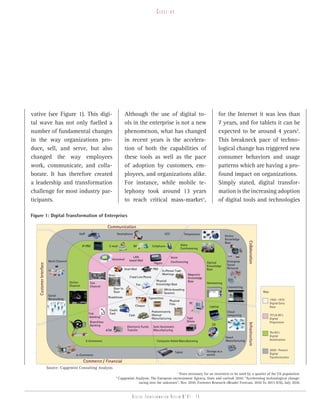
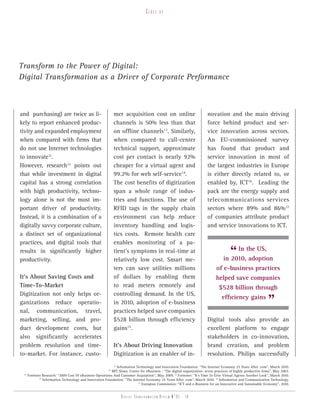
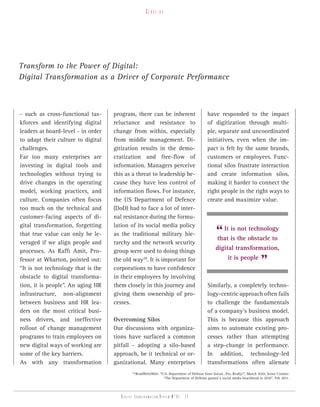
vative (see Figure 1). This digi-                                                      Although the use of digital to-                                           for the Internet it was less than
tal wave has not only fuelled a                                                        ols in the enterprise is not a new                                        7 years, and for tablets it can be
number of fundamental changes                                                          phenomenon, what has changed                                              expected to be around 4 years2.
in the way organizations pro-                                                          in recent years is the accelera-                                          This breakneck pace of techno-
duce, sell, and serve, but also                                                        tion of both the capabilities of                                          logical change has triggered new
changed the way employees                                                              these tools as well as the pace                                           consumer behaviors and usage
work, communicate, and colla-                                                          of adoption by customers, em-                                             patterns which are having a pro-
borate. It has therefore created                                                       ployees, and organizations alike.                                         found impact on organizations.
a leadership and transformation                                                        For instance, while mobile te-                                            Simply stated, digital transfor-
challenge for most industry par-                                                       lephony took around 13 years                                              mation is the increasing adoption
ticipants.                                                                             to reach critical mass-market1,                                           of digital tools and technologies

Figure 1: Digital Transformation of Enterprises

                                                                      Communication
                                                VoIP                           Smartphone                               UCC              Telepresence
                                                                                                                                                                       Online
                                                                                                                                                                       Knowledge

                                                                                                                                                                                       Collaboration
                                                                                                                                                                       Base
                                                    IP-PBX             E-mail                 IM              Cellphone               Video
                                                                                                                                      Conferencing

                                                                                             LAN                              Voice
                                                                            Voicemail
                                                                            V             based Mail
                          Multi Channel                                                                                       Conferencing              Optical         Enterprise
                                                                                                               Pagers
                                                                                                               P
    Customer Interface


                                                                                                                                                        Knowledge       Social
                                                                                       Snail Mail             PBX                                       Base            Network
                                                                                                                    In-Person Team
                                                                       Store                                        Meetings               Magnetic
                                                                                           Fixed Line Phone                                Knowledge
                                          Online                                                                 Physical                  Base
                                                         Tele                                    Fax             Knowledge Base                         Netmeeting
                                          Channel        Channel                                                                                                        Livemeeting
                                                                             Door to                                    White-boarding
                                                                             Door                                       Sessions                                                                        Key:
                          Social
                                                                       Roadshows                          Typewriters
                          Networking                                                                                                                                                                           1950 -1970
                                                                                                                           Physical
                                                                                                                           Files             PC                                                                Digital Early
                                                                                                 Cheque                                                   Laptop                                               Days
                                                                       Credit                                 Predominantly                                             Cloud
                                                        Tele           Card                                   Manual
                                                                                          Cash                                                                          computing                              70’s & 80’s
                                                         b
                                                        -banking                                              Manufacturing                Tape                                                                Digital
                                                         B
                                                         Branchless                                                                        Drives                                                              Progression
                                                                                                                                                                                       Infrastructure


                                                         B
                                                         Banking                                                                                            CD
                                                                                         Electronic Funds      Semi Automatic
                                                                      ATM                Transfer              Manufacturing
                                                                                                                                                                                                               The 90’s
                                                                                                                                                                       Smart                                   Digital
                                                       E-Commerce                                                Computer Aided Manufacturing                          Manufacturing                           Acceleration


                                                                                                                                                        Storage as a                                           2000 - Present
                                                                                                                                Tablet                                                                         Digital
                                              m-Commerce                                                                                                service
                                                                                                                                                                                                               Transformation
                                                    Commerce / Financial
                         Source: Capgemini Consulting Analysis
                                                                                                                      1
                                                                                                                        Years necessary for an invention to be used by a quarter of the US population.
                                                                               2
                                                                                   Capgemini Analysis; The European environment Agency, State and outlook 2010: “Accelerating technological change:
                                                                                              racing into the unknown”, Nov 2010; Forrester Research eReader Forecast, 2010 To 2015 (US), July 2010.


                                                                                             Digital transformation review n°01 - 15
Close-up


Transform to the Power of Digital:
Digital Transformation as a Driver of Corporate Performance


by an organization to funda-                  Faced with this transformation                               HArnEssing              THE     bEnEfiTs          of
mentally alter both its internal              challenge and the need to stay                               digiTizATion
and external processes and func-              relevant in one’s industry, lea-
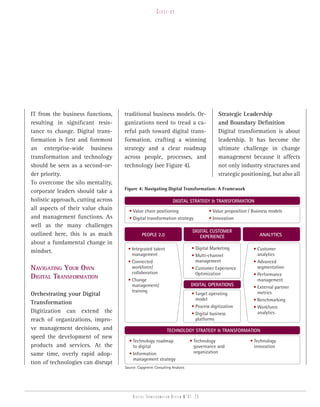
tions. All industry segments and              ders have to embrace the impli-                              Digital transformation should
governments have been touched                 cations of this enduring trend                               not be an end in itself. Like all
by this new digital reality, which            on their organizations in order                              other forms of business trans-
has significantly altered mana-               to steer their strategy and drive                            formation it should be guided
gement practices in areas from                better operational performance.                              by clear managerial goals and
hospitals to hypermarkets and                 Unfortunately, recent history is                             realizable business benefits.
financial services to the future              replete with examples of orga-                               Once a clear roadmap has been
of public services. As a result,              nizations which have not been                                defined, digital transformation
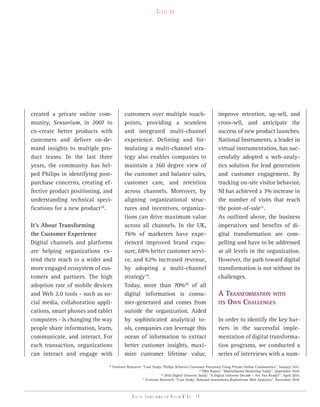
it has become a high priority                 able to keep pace with this new                              can help organizations address
on the leadership agenda, with                digital reality. The recent ban-                             their most significant priorities
nearly 90%3 of business leaders               kruptcy of movie rental com-                                 and achieve both internal and
in the US and UK expecting an                 pany, Blockbuster, owing largely                             external benefits, in areas such
increasing strategic contribution             to its inability to rapidly hone a                           as innovation, customer expe-
of IT and digital technologies                new business model5, is one such                             rience, efficiency, or producti-
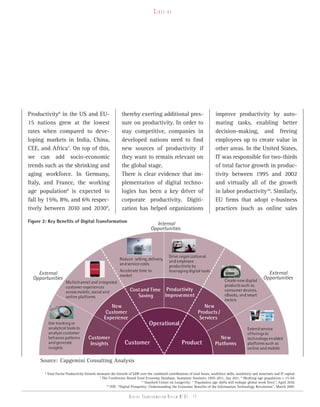
on their overall business in the              example.                                                     vity (see Figure 2).
coming decade. With the Inter-                Every industry is going through
net, Hi-Tech, and Media sectors               a digital transformation, some                               It’s About Productivity
only accounting for approxima-                crisis-induced, some as part of                              Improving productivity is a key
tely 10% of US GDP, we believe                their core strategy, and some as                             driver for sustainable growth. In
that the real transformation will             part of a more controlled transi-                            recent years, productivity growth
be seen in the remaining 90% of               tion process. Under all circums-                             in developed economies has been
‘traditional’ industries’4, where             tances, leaders have to steer their                          steadily falling and is signifi-
customer and employee behavior                corporations at the right speed,                             cantly lower when compared to
is fast evolving. We can expect a             taking into account the current                              emerging markets. For instance,
largely similar trend in other de-            and future competitive situation                             during the periods 1995-2005
veloped countries as well.                    in their respective industry.                                and 2005-2008, Total Factor

                                 3
                                   Gartner: “Gartner CEO and Senior Business Executive Survey, 2010: Anticipating the Post-Recession Landscape”, March 2010.
                            4
                                Interview with Andrew McAfee, Author of Enterprise 2.0: New Collaborative Tools for Your Organization’s Toughest Challenges.
                                                                             5
                                                                               Blockbuster failed to effectively adapt its storefront model to online technology.


                                                   Digital transformation review n°01 - 16
Close-up


Productivity6 in the US and EU-                              thereby exerting additional pres-                              improve productivity by auto-
15 nations grew at the lowest                                sure on productivity. In order to                              mating tasks, enabling better
rates when compared to deve-                                 stay competitive, companies in                                 decision-making, and freeing
loping markets in India, China,                              developed nations need to find                                 employees up to create value in
CEE, and Africa7. On top of this,                            new sources of productivity if                                 other areas. In the United States,
we can add socio-economic                                    they want to remain relevant on                                IT was responsible for two-thirds
trends such as the shrinking and                             the global stage.                                              of total factor growth in produc-
aging workforce. In Germany,                                 There is clear evidence that im-                               tivity between 1995 and 2002
Italy, and France, the working                               plementation of digital techno-                                and virtually all of the growth
age population8 is expected to                               logies has been a key driver of                                in labor productivity10. Similarly,
fall by 15%, 8%, and 6% respec-                              corporate productivity. Digiti-                                EU firms that adopt e-business
tively between 2010 and 20309,                               zation has helped organizations                                practices (such as online sales

Figure 2: Key Benefits of Digital Transformation
                                                                                   Internal
                                                                                 Opportunities


                                                                                             Drive organizational
                                                            Reduce selling, delivery,        and employee
                                                            and service costs                productivity by
                                                            Accelerate time to               leveraging digital tools
    External                                                market
                                                                                                                                                              External
  Opportunities                                                                                                                   Create new digital
                                                                                                                                                            Opportunities
                        Multichannel and integrated
                        customer experiences                                                                                      products such as
                        across mobile, social and                  Cost and Time Productivity                                     consumer devices,
                        online platforms                              Saving     Improvement                                      eBooks, and smart
                                                                                                                                  meters
                                                     New                                                           New
                                                   Customer                                                     Products /
                                                  Experience                                                     Services
            Use tracking or                                                     Operational
            analytical tools to                                                                                                                   Extend service
            analyze customer                                                                                                                      offerings to
            behavior patterns          Customer                                                                                New                technology enabled
            and generate                Insights               Customer                               Product               Platforms             platforms such as
            insights                                                                                                                              online and mobile

     Source: Capgemini Consulting Analysis

        6
            Total Factor Productivity Growth measures the Growth of GDP over the combined contributions of total hours, workforce skills, machinery and structures and IT capital.
                                              7
                                                The Conference Board Total Economy Database, Summary Statistics 1995-2011, Jan 2011. 8 Working-age population = 15-64.
                                                                            9
                                                                              Stanford Center on Longevity: “ Population age shifts will reshape global work force”, April 2010.
                                                   10
                                                      ITIF: “Digital Prosperity: Understanding the Economic Benefits of the Information Technology Revolution”, March 2007.

                                                                   Digital transformation review n°01 - 17
Close-up


Transform to the Power of Digital:
Digital Transformation as a Driver of Corporate Performance


and purchasing) are twice as li-                            mer acquisition cost on online                             novation and the main driving
kely to report enhanced produc-                             channels is 50% less than that                             force behind product and ser-
tivity and expanded employment                              on offline channels13. Similarly,                          vice innovation across sectors.
when compared with firms that                               when compared to call-center                               An EU-commissioned survey
do not use Internet technologies                            technical support, approximate                             has found that product and
to innovate11.                                              cost per contact is nearly 92%                             service innovation in most of
However, research12 points out                              cheaper for a virtual agent and                            the largest industries in Europe
that while investment in digital                            99.2% for web self-service14.                              is either directly related to, or
capital has a strong correlation                            The cost benefits of digitization                          enabled by, ICT16. Leading the
with high productivity, techno-                             span a whole range of indus-                               pack are the energy supply and
logy alone is not the most im-                              tries and functions. The use of                            telecommunications services
portant driver of productivity.                             RFID tags in the supply chain                              sectors where 89% and 86%17
Instead, it is a combination of a                           environment can help reduce                                of companies attribute product
digitally savvy corporate culture,                          inventory handling and logis-                              and service innovations to ICT.
a distinct set of organizational                            tics costs. Remote health care
practices, and digital tools that                           enables monitoring of a pa-
results in significantly higher
productivity.
                                                            tient’s symptoms in real-time at
                                                            relatively low cost. Smart me-
                                                                                                                                    “ In the US,
                                                                                                                                 in 2010, adoption
                                                            ters can save utilities millions                                of e-business practices
It’s About Saving Costs and                                 of dollars by enabling them                                     helped save companies
Time-To-Market                                              to read meters remotely and                                       $528 billion through
Digitization not only helps or-                             controlling demand. In the US,
ganizations reduce operatio-
nal, communication, travel,
                                                            in 2010, adoption of e-business
                                                            practices helped save companies
                                                                                                                                efficiency gains
                                                                                                                                                              ”
marketing, selling, and pro-                                $528 billion through efficiency                            Digital tools also provide an
duct development costs, but                                 gains15.                                                   excellent platform to engage
also significantly accelerates                                                                                         stakeholders in co-innovation,
problem resolution and time-                                It’s About Driving Innovation                              brand creation, and problem
to-market. For instance, custo-                             Digitization is an enabler of in-                          resolution. Philips successfully
                                                           11
                                                              Information Technology and Innovation Foundation: “The Internet Economy 25 Years After .com”, March 2010.
                                                       12
                                                         MIT Sloan, Center for eBusiness : “The digital organization: seven practices of highly productive firms”, May 2003.
 13
    Forrester Research: “2009 Cost Of eBusiness Operations And Customer Acquisition”, May 2009. 14 Forrester: “It’s Time To Give Virtual Agents Another Look”, March 2010.
            15
               Information Technology and Innovation Foundation: “The Internet Economy 25 Years After .com”, March 2010. 16 Information and Communication Technology.
                                                                           17
                                                                              European Commission: “ICT and e-Business for an Innovative and Sustainable Economy”, 2010.


                                                               Digital transformation review n°01 - 18
Close-up


created a private online com-             customers over multiple touch-                               improve retention, up-sell, and
munity, Sensorium, in 2007 to             points, providing a seamless                                 cross-sell, and anticipate the
co-create better products with            and integrated multi-channel                                 success of new product launches.
customers and deliver on-de-              experience. Defining and for-                                National Instruments, a leader in
mand insights to multiple pro-            mulating a multi-channel stra-                               virtual instrumentation, has suc-
duct teams. In the last three             tegy also enables companies to                               cessfully adopted a web-analy-
years, the community has hel-             maintain a 360 degree view of                                tics solution for lead generation
ped Philips in identifying post-          the customer and balance sales,                              and customer engagement. By
purchase concerns, creating ef-           customer care, and retention                                 tracking on-site visitor behavior,
fective product positioning, and          across channels. Moreover, by                                NI has achieved a 3% increase in
understanding technical speci-            aligning organizational struc-                               the number of visits that reach
fications for a new product18.            tures and incentives, organiza-                              the point-of-sale21.
                                          tions can drive maximum value                                As outlined above, the business
It’s About Transforming                   across all channels. In the UK,                              imperatives and benefits of di-
the Customer Experience                   76% of marketers have expe-                                  gital transformation are com-
Digital channels and platforms            rienced improved brand expo-                                 pelling and have to be addressed
are helping organizations ex-             sure, 68% better customer servi-                             at all levels in the organization.
tend their reach to a wider and           ce, and 62% increased revenue,                               However, the path toward digital
more engaged ecosystem of cus-            by adopting a multi-channel                                  transformation is not without its
tomers and partners. The high             strategy19.                                                  challenges.
adoption rate of mobile devices           Today, more than 70%20 of all
and Web 2.0 tools - such as so-           digital information is consu-                                A TrAnsformATion wiTH
cial media, collaboration appli-          mer-generated and comes from                                 iTs own cHAllEngEs
cations, smart phones and tablet          outside the organization. Aided
computers - is changing the way           by sophisticated analytical to-                              In order to identify the key bar-
people share information, learn,          ols, companies can leverage this                             riers in the successful imple-
communicate, and interact. For            ocean of information to extract                              mentation of digital transforma-
each transaction, organizations           better customer insights, maxi-                              tion programs, we conducted a
can interact and engage with              mize customer lifetime value,                                series of interviews with a num-
                              18
                                   Forrester Research: “Case Study: Philips Achieves Consumer Proximity Using Private Online Communities”, January 2011.
                                                                                             19
                                                                                                DBG Report: “Multichannel Marketing Today”, September 2010.
                                                                    20
                                                                       2010 Digital Universe Study: “A Digital Universe Decade – Are You Ready?”, April 2010.
                                                       21
                                                          Forrester Research: “Case Study: National Instruments Replatforms Web Analytics”, November 2010.


                                                Digital transformation review n°01 - 19
Close-up


Transform to the Power of Digital:
Digital Transformation as a Driver of Corporate Performance


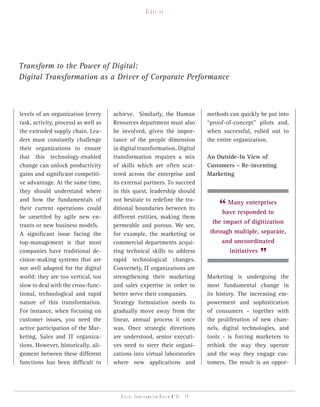
ber of global corporations from                                 ocean of data. Between 2009                                pour an overwhelming amount
across different industries. Our                                and 2020, the amount of digi-                              of data into the digital ocean.
analysis suggests that organiza-                                tal information created and re-                            The more information organi-
tions across the globe are facing                               plicated in the world is expec-                            zations receive, the harder it
a common set of challenges as                                   ted to grow 44 times to reach                              gets to decipher what is credible
they tackle these new digital                                   an unprecedented 35 trillion                               and useful. Moreover, it beco-
realities. These challenges can                                 gigabytes22. In fact, according                            mes even more difficult to per-
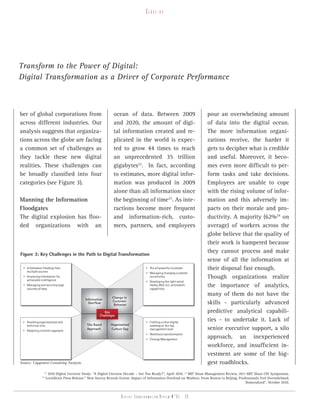
be broadly classified into four                                 to estimates, more digital infor-                          form tasks and take decisions.
categories (see Figure 3).                                      mation was produced in 2009                                Employees are unable to cope
                                                                alone than all information since                           with the rising volume of infor-
Manning the Information                                         the beginning of time23. As inte-                          mation and this adversely im-
Floodgates                                                      ractions become more frequent                              pacts on their morale and pro-
The digital explosion has floo-                                 and information-rich, custo-                               ductivity. A majority (62%24 on
ded organizations with an                                       mers, partners, and employees                              average) of workers across the
                                                                                                                           globe believe that the quality of
                                                                                                                           their work is hampered because
Figure 3: Key Challenges in the Path to Digital Transformation
                                                                                                                           they cannot process and make
                                                                                                                           sense of all the information at
  Information flooding from
    multiple sources
                                                                                     The all-powerful customer            their disposal fast enough.
                                                                                     Managing changing customer
  Analyzing information for
    actionable intelligence
                                                                                       sensitivities                       Though organizations realize
                                                                                     Developing the right social
  Managing and securing large
    volumes of data
                                                                                       media, Web 2.0, and mobile
                                                                                       capabilities
                                                                                                                           the importance of analytics,
                                                               Change in
                                                                                                                           many of them do not have the
                                              Information
                                                Overflow
                                                               Customer
                                                                Behavior                                                   skills - particularly advanced
                                                          Key                                                              predictive analytical capabili-
                                                       Challenges
  Avoiding organizational and                                                       Crafting a clear digital
                                                                                                                           ties - to undertake it. Lack of
    technical silos                            Silo Based     Organization/            roadmap at the top
  Adopting a holistic approach
                                               Approach       Culture Gap              management level                    senior executive support, a silo
                                                                                     Workforce transformation
                                                                                     Change Management
                                                                                                                           approach, an inexperienced
                                                                                                                           workforce, and insufficient in-
                                                                                                                           vestment are some of the big-
Source: Capgemini Consulting Analysis                                                                                      gest roadblocks.
                  22
                       2010 Digital Universe Study: “A Digital Universe Decade – Are You Ready?”, April 2010. 23 MIT Sloan Management Review, 2011 MIT Sloan CIO Symposium.
                24
                      LexisNexis Press Release:” New Survey Reveals Extent, Impact of Information Overload on Workers; From Boston to Beijing, Professionals Feel Overwhelmed,
                                                                                                                                                   Demoralized”, October 2010.


                                                                     Digital transformation review n°01 - 20
Close-up


Keeping Pace with Customer          pany had to scrap the launch.                              of clarity around customer and
Expectation                         In certain industries, such as                             social-media ownership, ina-
The increasing proliferation of     music, changes in consumer be-                             bility to tailor business models
digital platforms has funda-        havior have completely disrup-                             catering to changing consumer
mentally altered the way cus-       ted traditional models and ren-                            behavior, and failure to take an
tomers interact with brands,        dered many players obsolete.                               “outside-in view” of their busi-
research and buy products, and                                                                 ness.
influence the decision making
of other customers. Customers
are increasingly becoming wary
                                             “ More digital
                                            information was
                                                                                               Adapting the Organization
                                                                                               and Culture
and distrusting of traditional         produced in 2009 alone                                  Alligning the existing corporate
marketing vehicles and ins-              than all information                                  culture with new digital realities
tead are turning to online so-            since the beginning                                  is one of the main inhibitors in
cial networks, blogs, wikis, and                                                               the digital transition of compa-
community forums to formu-
late their brand perceptions and
                                               of time
                                                                  ”                            nies. One of the clearest indica-
                                                                                               tors is that a clear governance
make purchase decisions. To-        Despite being faced with this                              process for the transformation is
day, consumers trust consumers      very visible customer expecta-                             often lacking. In our interviews
more than they trust brands.        tion challenge, many companies                             with CXOs, it has become clear
While 50%25 of consumers do         have been slow in developing                               that one of the major issues is
not believe in the advertising      the right skills and capabilities                          the lack of accountability in di-
promises of brands, 73%26 trust     to manage this new customer                                gital transformation programs.
the recommendations of friends      sophistication. For instance,                              Further, enterprises’ traditional
and family.                         56% of Fortune 50 companies                                decision-making systems are
Companies can no longer afford      still do not have social-media                             too vertical and too intrinsical-
to ignore the voice and preferen-   icons on their home pages while                            ly slow to keep pace with rapid
ces of the customer. Customer       60% hide their twitter streams27.                          technology-driven transforma-
backlash against GAP’s recently     This failure of organizations to                           tion. Consequently, corporations
launched new logo was so in-        rapidly adapt themselves can be                            have started to experiment with
tense on the web that the com-      attributed to factors such as lack                         various organizational formats
                                                                          25
                                                                             “The future of advertising agencies: learnings from Forrester”, Feb 2010.
                                                          26
                                                               Forrester Research: “Three Ways To Find, Create, And Energize Advocates”, Sep 2010.
                                                                     27
                                                                        Adage: “Most Fortune 50 Brands Still Hiding Their Social Media”, April 2011.


                                       Digital transformation review n°01 - 21
Close-up


Transform to the Power of Digital:
Digital Transformation as a Driver of Corporate Performance


- such as cross-functional tas-     program, there can be inherent                            have responded to the impact
kforces and identifying digital     reluctance and resistance to                              of digitization through multi-
leaders at board-level - in order   change from within, especially                            ple, separate and uncoordinated
to adapt their culture to digital   from middle management. Di-                               initiatives, even when the im-
challenges.                         gitization results in the demo-                           pact is felt by the same brands,
Far too many enterprises are        cratization and free-flow of                              customers or employees. Func-
investing in digital tools and      information. Managers perceive                            tional silos frustrate interaction
technologies without trying to      this as a threat to leadership be-                        and create information silos,
drive changes in the operating      cause they have less control of                           making it harder to connect the
model, working practices, and       information flows. For instance,                          right people in the right ways to
culture. Companies often focus      the US Department of Defence                              create and maximize value.
too much on the technical and       (DoD) had to face a lot of inter-
customer-facing aspects of di-      nal resistance during the formu-

                                                                                                   “ It is the obstacle to
gital transformation, forgetting    lation of its social media policy
                                                                                                        is not technology
that true value can only be le-     as the traditional military hie-
                                                                                                   that
veraged if we align people and      rarchy and the network security
processes. As Raffi Amit, Pro-      group were used to doing things                                digital transformation,
fessor at Wharton, pointed out:
“It is not technology that is the
                                    the old way28. It is important for
                                    corporations to have confidence
                                                                                                        it is people
                                                                                                                               ”
obstacle to digital transforma-     in their employees by involving
tion, it is people”. An aging HR    them closely in this journey and                          Similarly, a completely techno-
infrastructure, non-alignment       giving them ownership of pro-                             logy-centric approach often fails
between business and HR lea-        cesses.                                                   to challenge the fundamentals
ders on the most critical busi-                                                               of a company’s business model.
ness drivers, and ineffective       Overcoming Silos                                          This is because this approach
rollout of change management        Our discussions with organiza-                            aims to automate existing pro-
programs to train employees on      tions have surfaced a common                              cesses rather than attempting
new digital ways of working are     pitfall - adopting a silo-based                           a step-change in performance.
some of the key barriers.           approach, be it technical or or-                          In addition, technology-led
As with any transformation          ganizational. Many enterprises                            transformations often alienate
                                             28
                                                  ReadWriteWeb: “U.S. Department of Defense Goes Social...Yes, Really!”, March 2010; Scout Comms:
                                                                  “The Department of Defense gained a social media beachhead in 2010”, Feb 2011.


                                       Digital transformation review n°01 - 22
Close-up


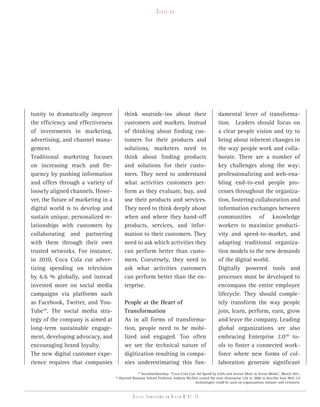
IT from the business functions,     traditional business models. Or-                      Strategic Leadership
resulting in significant resis-     ganizations need to tread a ca-                       and Boundary Definition
tance to change. Digital trans-     reful path toward digital trans-                      Digital transformation is about
formation is first and foremost     formation, crafting a winning                         leadership. It has become the
an enterprise-wide business         strategy and a clear roadmap                          ultimate challenge in change
transformation and technology       across people, processes, and                         management because it affects
should be seen as a second-or-      technology (see Figure 4).                            not only industry structures and
der priority.                                                                             strategic positioning, but also all
To overcome the silo mentality,
                                    Figure 4: Navigating Digital Transformation: A Framework
corporate leaders should take a
holistic approach, cutting across                                Digital Strategy & tranSformation
all aspects of their value chain      • Value chain positioning                      • Value proposition / Business models
and management functions. As          • Digital transformation strategy              • Innovation
well as the many challenges
                                                                             Digital cuStomer
outlined here, this is as much                people 2.0                        experience                    analyticS
about a fundamental change in
                                      • Integrated talent                   • Digital Marketing            • Customer
mindset.
                                        management                          • Multi-channel                  analytics
                                      • Connected                             management                   • Advanced
nAvigATing your own                     workforce/                          • Customer Experience            segmentation
                                        collaboration                         Optimization                 • Performance
digiTAl TrAnsformATion                • Change                                                               management
                                        management/                         Digital operationS
                                                                                                           • External partner
                                        training                                                             metrics
Orchestrating your Digital                                                  • Target operating
                                                                              model                        • Benchmarking
Transformation
                                                                            • Process digitization         • Workforce
Digitization can extend the                                                 • Digital business               analytics
reach of organizations, impro-                                                platforms
ve management decisions, and                                  technology Strategy & tranSformation
speed the development of new
                                      • Technology roadmap                  • Technology                 • Technology
products and services. At the           to digital                            governance and               innovation
same time, overly rapid adop-         • Information                           organization
                                        management strategy
tion of technologies can disrupt
                                    Source: Capgemini Consulting Analysis


                                         Digital transformation review n°01 -23
Close-up


Transform to the Power of Digital:
Digital Transformation as a Driver of Corporate Performance


levels of an organization (every      achieve. Similarly, the Human                methods can quickly be put into
task, activity, process) as well as   Resources department must also               “proof-of-concept” pilots and,
the extended supply chain. Lea-       be involved, given the impor-                when successful, rolled out to
ders must constantly challenge        tance of the people dimension                the entire organization.
their organizations to ensure         in digital transformation. Digital
that this technology-enabled          transformation requires a mix                An Outside-In View of
change can unlock productivity        of skills which are often scat-              Customers – Re-inventing
gains and significant competiti-      tered across the enterprise and              Marketing
ve advantage. At the same time,       its external partners. To succeed
they should understand where          in this quest, leadership should

                                                                                       “ Many enterprises
and how the fundamentals of           not hesitate to redefine the tra-
their current operations could        ditional boundaries between its
                                                                                       have responded to
be unsettled by agile new en-         different entities, making them
                                                                                     the impact of digitization
trants or new business models.        permeable and porous. We see,
A significant issue facing the        for example, the marketing or                 through multiple, separate,
top-management is that most           commercial departments acqui-                     and uncoordinated
companies have traditional de-
cision-making systems that are
                                      ring technical skills to address
                                      rapid technological changes.
                                                                                          initiatives
                                                                                                      ”
not well adapted for the digital      Conversely, IT organizations are
world: they are too vertical, too     strengthening their marketing                Marketing is undergoing the
slow to deal with the cross-func-     and sales expertise in order to              most fundamental change in
tional, technological and rapid       better serve their companies.                its history. The increasing em-
nature of this transformation.        Strategy formulation needs to                powerment and sophistication
For instance, when focusing on        gradually move away from the                 of consumers - together with
customer issues, you need the         linear, annual process it once               the proliferation of new chan-
active participation of the Mar-      was. Once strategic directions               nels, digital technologies, and
keting, Sales and IT organiza-        are understood, senior executi-              tools - is forcing marketers to
tions. However, historically, ali-    ves need to steer their organi-              rethink the way they operate
gnment between these different        zations into virtual laboratories            and the way they engage cus-
functions has been difficult to       where new applications and                   tomers. The result is an oppor-


                                         Digital transformation review n°01 - 24
Close-up


tunity to dramatically improve              think «outside-in» about their                             damental lever of transforma-
the efficiency and effectiveness            customers and markets. Instead                             tion. Leaders should focus on
of investments in marketing,                of thinking about finding cus-                             a clear people vision and try to
advertising, and channel mana-              tomers for their products and                              bring about inherent changes in
gement.                                     solutions, marketers need to                               the way people work and colla-
Traditional marketing focuses               think about finding products                               borate. There are a number of
on increasing reach and fre-                and solutions for their custo-                             key challenges along the way:
quency by pushing information               mers. They need to understand                              professionalizing and web-ena-
and offers through a variety of             what activities customers per-                             bling end-to-end people pro-
loosely aligned channels. Howe-             form as they evaluate, buy, and                            cesses throughout the organiza-
ver, the future of marketing in a           use their products and services.                           tion, fostering collaboration and
digital world is to develop and             They need to think deeply about                            information exchanges between
sustain unique, personalized re-            when and where they hand-off                               communities of knowledge
lationships with customers by               products, services, and infor-                             workers to maximize producti-
collaborating and partnering                mation to their customers. They                            vity and speed-to-market, and
with them through their own                 need to ask which activities they                          adapting traditional organiza-
trusted networks. For instance,             can perform better than custo-                             tion models to the new demands
in 2010, Coca Cola cut adver-               mers. Conversely, they need to                             of the digital world.
tizing spending on television               ask what activities customers                              Digitally powered tools and
by 6.6 % globally, and instead              can perform better than the en-                            processes must be developed to
invested more on social media               terprise.                                                  encompass the entire employee
campaigns via platforms such                                                                           lifecycle. They should comple-
as Facebook, Twitter, and You-              People at the Heart of                                     tely transform the way people
Tube29. The social media stra-              Transformation                                             join, learn, perform, earn, grow
tegy of the company is aimed at             As in all forms of transforma-                             and leave the company. Leading
long-term sustainable engage-               tion, people need to be mobi-                              global organizations are also
ment, developing advocacy, and              lized and engaged. Too often                               embracing Enterprise 2.030 to-
encouraging brand loyalty.                  we see the technical nature of                             ols to foster a connected work-
The new digital customer expe-              digitization resulting in compa-                           force where new forms of col-
rience requires that companies              nies underestimating this fun-                             laboration generate significant
                                                    29
                                                       Socialmediatoday: “Coca-Cola Cuts Ad Spend by 6.6% and Invests More in Social Media”, March 2011.
                                    30
                                         Harvard Business School Professor Andrew McAfee coined the term «Enterprise 2.0» in 2006 to describe how Web 2.0
                                                                                        technologies could be used on organizations intranet and extranets.


                                                 Digital transformation review n°01 -25
Close-up


Transform to the Power of Digital:
Digital Transformation as a Driver of Corporate Performance


business benefits. For instance,                        is closely linked to the business                            “Organizational Capital”33 and
Pfizer uses a range of collabora-                       strategy and customer priorities.                            obtain the highest gains from
tion tools such as Pfizerpedia (an                      For example, the physical distri-                            their digital transformation.
integrated platform including                           bution network and fulfilment                                Data-Driven Decision Making
people, projects, events, blogs,                        processes should be optimally                                for a Smarter Organization
and discussion group to promo-                          designed to support new digi-                                In recent years, digitization has
te knowledge sharing) and Pfa-                          tally-enabled multi-channel go-                              brought a wealth of both inter-
cebook (platform for employees                          to-market strategies from both                               nal and external data sources
to interact) to connect its people                      a cost and customer experience                               - such as supply-chain metrics,
worldwide in a way that fos-                            perspective.                                                 customer online data, and so-
ters innovation and speeds the                          IBM was able to save $6 billion                              cial-media commentaries - into
pharmaceutical       development                        by re-engineering its supply                                 organizations. Today, the notion
process . Of course, technology
        31
                                                        chain processes, which inclu-                                that hard data and good analy-
does not foster collaboration on                        ded process-automation throu-                                sis beats experience and intui-
its own, so it is essential that                        gh web-based applications and                                tion is generally well accepted.
organizations properly imple-                           consolidation of functions. In                               However, as the technology for
ment these tools with work pat-                         addition, the company esta-                                  capturing and analyzing infor-
terns and knowledge flows truly                         blished an e-procurement system                              mation becomes widely availa-
understood.                                             which helped reduce the average                              ble, at ever-lower price points,
                                                        contract cycle time from 6 to 12                             most organizations are still
Digitizing Your Operations                              months to less than 30 days32.                               learning how to leverage them
for Maximum Efficiency                                  Digital Operating Models should                              to the fullest.
As companies transform their                            be designed around four key                                  In order to maximize the bene-
business models in the face of                          dimensions: governance and                                   fits of analytics, organizations
new digital realities, transfor-                        performance management prin-                                 should look beyond descriptive
ming their operations becomes                           ciples, organization and mana-                               models, which provide simple
a pre-requisite to successful                           gement practices, process model,                             operational statistics, such as
execution. Organizations need                           and system architecture. Only by                             sales-per-store or average pro-
a clear roadmap in the form of                          integrating all these dimensions                             fit-per-employee, and focus
a Digital Operating Model that                          can an organization create real                              instead on predictive models
                                     31
                                        Various Websites.32 Information Technology and Innovation Foundation: “The Internet Economy 25 Years After .com”, March 2010.
            33
                 Because effective work organization can be costly to develop and implement but yields a stream of cash flows over time, it can be thought of as an asset.
                                 This asset is called “Organizational Capital”- Erik Brynjolfsson, “Intangible Assets: Computers and Organizational Capital”, October 2002.


                                                             Digital transformation review n°01 - 26
Close-up


to generate deeper insights. For           damental changes required in                               security, legislation, and infor-
instance, Seven Eleven Japan               culture, people, processes, and                            mation-management should be
uses a sophisticated analytics             technology. Further, adopting                              a key leadership prerogative. In
system to manage the limited               an enterprise-wide centralized                             addition, the historical quest to
shelf-space at its stores. Point-          approach to analytics, rather                              align IT with business strategy
of-sale and customer demogra-              than a department-level focus,                             and with key functions such as
phic data is analyzed on a real-           makes more sense for an orga-                              marketing and sales has been
time basis to gather statistics            nization as it ensures that there                          difficult to achieve in practice.
such as hourly sales trend for             is a critical-mass of analytical                           What is needed in the digital
individual items, stockout ran-            expertise, data from different                             world is a true fusion of skills
king by individual items, and              departments can be correlated,                             and functions to achieve ac-
hourly sales trends by customer            and security and governance is                             countability and speed of exe-
profile, to better match supply            centralized36.                                             cution. This often requires new
with demand34.                                                                                        types of skills as well as flexible
Data-driven decision making                Adapting IT Governance                                     organizational model.
should be made an integral part            and Processes for Effective
of organizational culture and              Transition
companies should use it as a               The most effective companies
lever to compete on analytics.
Recent evidence points out, that
                                           have taken years to optimize
                                           their IT governance, and must                                 “ Digital transformation
                                                                                                         is first and foremost an
organizations which adopt data-            now re-examine it in the light
                                                                                                         enterprise-wide business
driven decision-making achieve             of the particular rhythms and
a 5% to 6%35 higher producti-
vity than those that do not. This
                                           characteristics of digital trans-
                                           formation, where technology
                                                                                                            transformation
                                                                                                                                           ”
significant boost in productivi-           decisions, investments and ini-
ty can clearly separate winners            tiatives are spread out throu-                             Since technology is a key ena-
from losers in most industries.            ghout the whole organization.                              bler of digital transformation
The transition to analytics                Formulating an enterprise-wide                             the role of a CIO becomes in-
should be driven by top ma-                IT policy and governance which                             creasingly important in today’s
nagement because of the fun-               addresses key issues such as                               enterprise. CIOs must focus on
                                                              34
                                                                Graduate School of Business, Stanford University: “Operational Analytics”, September 2007.
                                                               35
                                                                  New York Times: “When There’s No Such Thing as Too Much Information”, April 23, 2011.
                                36
                                     Babson Executive Education: “Competing on Analytics”, Thomas H .Davenport, Don Cohen, and Al Jacobson, May 2005.


                                                 Digital transformation review n°01 -27
Close-up


Transform to the Power of Digital:
Digital Transformation as a Driver of Corporate Performance


equipping the workforce and the                   Every organization is likely to                            pany, Journal Register38, spea-
IT organization with new skills                   tread a different path in its di-                          rheaded its turn-around from
and tools required in a digital                   gital transformation journey                               bankruptcy in less than a year
context. Interfacing these new                    depending on its starting point                            by championing the firm’s digi-
tools such as social networks                     and the digital maturity of its                            tal transformation strategy, “Di-
and connected devices to the                      industry and products or servi-                            gital First”. The company, which
legacy systems in order to drive                  ces. In addition, with constant                            filed for bankruptcy in 2009,
value needs to be a top priority                  technological innovation and                               recorded a $40 million profit at
for organizations.                                competitive activity, crafting a                           the end of 2010 by adopting a
Finally, the increasing com-                      transformation journey is not                              series of digital initiatives39.
plexity of managing large vo-                     an event but a continuous pro-                             It is also important for mana-
lumes of digital information,                     cess. Our analysis suggests a few                          gement to educate the board on
from both within and outside, is                  best-practice pointers on how to                           the need for, and benefits of, this
exerting significant pressure on                  successfully craft and execute a                           transformation in order to achieve
the IT organization. Companies                    digital transformation.                                    complete buy-in on digital initia-
which handle this stress better                                                                              tives from all stakeholders.
are more likely to gain an edge                   Lead and Educate
over the competition. Organi-                     As with most successful bu-                                Evaluate and Set Priorities
zations therefore need to start                   siness transformations, senior                             Organizations need to carefully
considering virtual solutions                     team commitment is essential.                              review their current digital ini-
such as cloud computing. In ad-                   Leaders should create awareness                            tiatives and conduct a “digital
dition, they should deploy tools                  and alignment in their top team                            fitness” test on their operations
for prioritized storage as well as                around the possibilities created                           so as to craft a coherent transfor-
security and privacy protection                   by the digital economy. The CEO                            mation map toward their digital
in hybrid (both physical and                      should take charge and become                              future. Companies should also
virtual) environments37.                          the principal advocate of the                              undertake a benchmarking exer-
                                                  transformation program, with                               cise in order to identify best prac-
A diffErEnT TyPE     of                           a strong backing from top lea-                             tices both within and outside their
TrAnsformATion                                    dership. For instance, the CEO                             own sectors. Priorities need to be
                                                  of US-based print media com-                               set based on the areas - customer
                          37
                               Journal Register Company Owns and operates 18 daily newspapers and more than 150 non-daily publications and affiliated websites.
                                                                                                       38
                                                                                                          Company Websites; CEO John Paton’s Digital First Blog.
                                                                  39
                                                                     ScreenDigest: “Netflix dominates physical rental even as it moves toward digital”, May 2011.


                                                       Digital transformation review n°01 - 28
Close-up


value, revenues, cost position, etc    In 2010, Netflix had the largest                          must translate that vision into
- where digitization is likely to      single-company share of the phy-                          a set of measures and targets to
have the most positive impact.         sical disc rental market as it grew                       drive the desired results from their
                                       from under 26% in 2009 to nearly                          digital transformation. People in
Communicate and Mobilize on            35% in 201040.                                            all functions need to understand
a Large Scale                                                                                    “what good looks like” in terms
Communication and mobiliza-            Invest in Skills and                                      of customer metrics, cost posi-
tion are essential first steps to      Competency Development                                    tion, and productivity. Leaders
get the entire organization en-        The right digital competences will                        need to decide the timeframe and
gaged around the transforma-           not be widely available across the                        the level of ambitions based on
tion as well as to manage the          organization, so it is important to                       the particular responsiveness, the
traditional resistance to change.      have a well-articulated talent and                        competitive situation, and the
Enterprise 2.0 tools - such as         people plan to start injecting the                        culture of their organization.
social media, wikis, and discus-       right skills in the right places at
sion forums - can help mobilize        the right time. Further, it is impe-                      The road toward successful di-
and align the workforce on digi-       rative to develop a mix of digital                        gital transformation is indeed a
tal objectives by building awa-        competences across all functions,                         long one. However, every indus-
reness, creating transparency,         such as marketing, HR, sales, and                         try will be impacted at some point
and establishing open channels         IT. Equally, investing in people                          so those that do not take advan-
of communication.                      development and connecting the                            tage of “the power of digital” will
A careful operational balance also     workforce to improve sharing                              be at a competitive disadvantage
needs to be set between mana-          and exchange will be key to le-                           in the short- to medium-term.
ging the digital and the physical      veraging the people side of the                           Industry leaders have a unique
side-by-side. For instance, even as    transformation.                                           opportunity to start steering their
Netflix moves toward streaming                                                                   organization from the physical to
digital media services, it still do-   Set the Ambition and Iterate                              the digital in an orchestrated way
minates the physical rental market     Once the company is mobilized                             in order to improve their corpo-
and has not lost focus in this area.   around a clear vision, leaders                            rate performance.

                                                                Contact the authors: didier.bonnet@capgemini.com
                                                                                   patrick.ferraris@capgemini.com
                                                     40
                                                          ScreenDigest: “Netflix dominates physical rental even as it moves toward digital”, May 2011.


                                          Digital transformation review n°01 -29
vision


I can’t think of any industry sector or company
which is immune from digital transformation

Andrew McAfee is a principal research scientist at
the Center for Digital Business in the MIT Sloan School of
Management, and a fellow at Harvard’s Berkman Center
for Internet and Society.


 Andrew McAfee
 professor at MIT


                        Digital transformation review n°01 - 30
vision


                                    gories of usage. The first inclu-            built in. Their digital environ-
                                    des tools that allow companies               ments are very open; they offer
                                    to become more scientific in                 every participant the chance to
                                    their decision-making, to rely               adapt it at will. But the ama-
                                    less on gut feelings and be more             zing thing is that the arrival of
                                    data-driven. Many companies                  these technologies hasn’t led
                                    actually commit to projects, ini-            to chaos or disorganization. In
                                    tiatives or investments without              fact, we can see extremely in-
                                    carrying out in-depth studies to             novative structures and models

H    ow would you define di-
     gital transformation?
                                    validate them. Or these studies
                                    are done with the single goal of
                                    confirming the initial objective.
                                                                                 taking shape. Corporations tend
                                                                                 to use self-organization techno-
                                                                                 logies either in the interactions
It is characterized by the ever     Now companies have a fantas-                 of their employees and partners
growing penetration of digital      tic tool kit to test the relevance           or in the relationships with their
technologies into every facet of    of their hypotheses with near-               customers.
business life. By digital techno-   scientific validity.
logies, I not only mean classic
                                                                                   “ The emergence of
enterprise applications but also    The second category, which I
the corporate usage of techno-      call Self-organization, includes
                                                                                   social media and
logies such as mobile, analytics,   everything that helps people                   interactive websites
web 2.0, localization, …            (employees or consumers) come                  has served to lessen
                                    together, increases their ability              the importance of
Beyond the technologies them-       to communicate and to work                     traditional experts or
selves, the real interesting phe-   together without specifying in                 brands in favor of
nomenon is how corporations         advance how they should do                     our own networks. ”
and public institutions are using   so. We include social media and
these technologies to deeply        related web 2.0 tools in this ca-
transform every facet of their      tegory. It’s important to note               Finally, the third category,which
business.                           that 2.0 technologies don’t have             I call orchestration, is in some
I would distinguish three cate-     a lot of workflow or hierarchy               ways the opposite of the second.


                                       Digital transformation review n°01 - 31
vision


I can’t think of any industry sector or company
which is immune from digital transformation


                           It includes technology usages-               and interactive websites has
                           that allow companies to specify              served to lessen the importance
                           and monitor their operating mo-              of traditional experts or brands
                           dels on a global scale. This isn’t           in favor of our own networks.
                           new and typically emerged with               Now I no longer rely on a gui-
                           the ERP systems that came out                de written by a food critic to
                           in the late1990s, but we are now             choose a restaurant. Instead,
                           reaching out a level of maturity             I check out consumer opinions
                           where corporations are able to               on Tripadvisor and those of
                           execute their operating models               my «friends» on Facebook or
                           and processes on a global scale,             Foursquare. Trust from consu-
                           exactly as they were designed                mers is more critical than ever
                           and planned.                                 and it has shifted from experts
                                                                        and brands to people whose
                                                                        opinions are more valued.
                             “ Technology used
                             to be frustrating                          In some sectors this upheaval
                             and isolating, it has                      requires an urgent response. We
                             become interesting,                        noticed in the United States that
                             intuitive and social. ”                    the major financial institutions
                                                                        – banks and insurance compa-
                                                                        nies – were not very well-per-
                           How has the digital revolution               ceived by younger consumers.
                           transformed consumer habits                  This population doesn’t like a
                           in the United States?                        sales approach based on a sales-
                                                                        person or a brand which comes
                           The way consumers make deci-                 to you and proposes a solution.
                           sions, especially younger consu-             Young people don’t trust this
                           mers, has profoundly changed.                kind of expertise anymore, es-
                           The emergence of social media                pecially when they see how


                              Digital transformation review n°01 - 32
vision


badly designed these compa-          industry has changed far more                and we are reaching out a level
nies’ websites are for maintai-      than oil transport. It all depends           of complexity in the manage-
ning their relationship in a sa-     on the products, the market                  ment and performance of global
tisfactory manner.                   and how things are organized.                operating models and proces-
                                     I can’t think of any company                 ses which has never been rea-
Our traditional Marketing mo-        or sector which is immune                    ched before. On the other hand,
del is broken, and not just for      from digital transformation.                 we are just at the beginning of
young consumers. More and            And the bad news is that the                 self-organization. Let’s take for
more consumers in older age          speed of change will only in-                instance the innovation process:
groups are now changing their        crease as technology adoption                Many corporations are looking
consumer habits. The consu-          and usage further blossom!                   at ways to open up their inno-
merization of technology is a        Economist Joseph Schumpeter’s                vation processes which used
profound phenomenon. Tech-           «creative destruction» is taking             to be run from the guys in the
nology used to be frustrating        place before our eyes.                       labs, into an open ecosystem of
and isolating, it has become                                                      employees and partners where
interesting, intuitive and social.                                                even consumers play a critical
The gap between digital natives        “ What is at stake                         role!
and immigrants is rapidly clo-         is the transformation
sing… Companies need to be             of the 90% of                              Do you think we’ll face
right there with their consu-          all the ‘traditional’                      a disruption of traditional
mers.                                                                             business models?
                                       industries and
How are companies respon-
                                       companies. ”                               We’ve definitely seen new busi-
ding to this technology revo-                                                     ness models appear on the scene,
lution? Are they all affected        Now, if we come back to our ini-             often very innovative, for exam-
the same way?                        tial three responses from corpo-             ple in media or travel distribu-
                                     rations and institutions, I think            tion. But we shouldn’t overstate
Naturally, this phenomenon           we can find different levels of              things. The Media, HiTech and
disrupts some sectors more than      maturity. Orchestration has                  the internet sectors account for
others. For example, the music       been around for a while already              less than 10% of the GDP in the


                                        Digital transformation review n°01 - 33
vision


I can’t think of any industry sector or company
which is immune from digital transformation


United States! What is at stake      What are the main barriers                   times they’re unwilling to en-
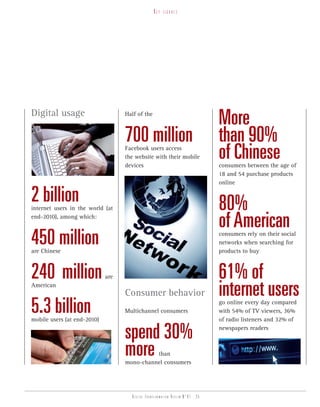
is the transformation of the re-     to change?                                   ter into a field they know little
maining 90% of all the ‘tradi-                                                    about. Sometimes they just
tional’ industries and compa-        There are several. The cost of               don’t think it’s their job to take
nies. The US economy is still        making these investments can                 the initiative. In other words,
primarily founded on traditio-       be one. But the most impor-                  a little intellectual revolution
nal businesses which are less        tant without a doubt is com-                 is needed to draw benefit from
likely to transform their busi-      panies’ resistance to change                 these new technologies. This is
ness model than to adapt it. I       and may be managerial inertia.               not only true of the older indus-
don’t share the opinion some                                                      tries. Unwillingness to change
have expressed, that companies         “ You should never                         also affects businesses in newer
will be completely restructu-                                                     fields.
                                       underestimate
red by these developments, or
even that what we recognize
                                       the fondness of people                     Is it relevant to talk about
today as companies will di-            and organizations                          digital winners and losers?
sappear altogether. Traditional        for the status quo. ”
structures still have their value,                                                Yes, the data shows a growing
hierarchy and organization are       You should never underestimate               performance gap between the
useful. Even newer companies         the fondness of people and or-               best digital leaders and the
that have perfectly integrated       ganizations for the status quo.              others. We have found a strong
new information technologies         Many executives recognize that               correlation between the tech-
rely on experienced managers,        using new technologies will in-              nology adoption of an industry
rely on full-time employees          crease their ability to analyze and          and its level of competition: the
and organize career planning.        effect change within the com-                higher the technology intensity
In fact, they are very similar to    pany, and change how people                  of an industry, the larger the
traditional companies. Silicon       work, but many still don’t really            gap between the best perfor-
Valley companies, for example,       understand what this means for               mers of this industry and the
still face the familiar challenge    themselves or their company,                 others. So yes, mastering digital
of continuously seeking out the      and don’t see where the inno-                transformation definitely makes
best talent.                         vations will come from. Some-                a difference for corporations.


                                        Digital transformation review n°01 - 34
Key   figures


Digital usage                      Half of the
                                                                               More
                                   700 million                                 than 90%
                                   Facebook users access
                                   the website with their mobile
                                   devices
                                                                               of Chinese
                                                                               consumers between the age of
                                                                               18 and 54 purchase products
                                                                               online

2 billion
internet users in the world (at                                                80%
end-2010), among which:
                                                                               of American
450 million
are Chinese
                                                                               consumers rely on their social
                                                                               networks when searching for
                                                                               products to buy


240 million                  are                                               61% of
American
                                   Consumer behavior                           internet users
5.3 billion
mobile users (at end-2010)
                                   Multichannel consumers
                                                                               go online every day compared
                                                                               with 54% of TV viewers, 36%
                                                                               of radio listeners and 32% of

                                   spend 30%                                   newspapers readers


                                   more      than
                                   mono-channel consumers


                                     Digital transformation review n°01 - 35
telesCope


Chinese entrepreneurs are taking full
advantage of the e-commerce boom


Brian Xin, age 40, belongs to the generation that graduated
from top universities in China and went abroad to start their
professional lives, before coming back and creating their own
businesses. For him, it was Tsinghua university and then Silicon
Valley, before his return to China where he eventually became
Chief Technological Officer of MSN. By 2009, he decided it was
the right time for him to found StarryMedia and focus on social
marketing and digital research.


                      H     ow would you define
                            digital transformation?
                                                                   through the digital chain and
                                                                   keep searching for even easier
                                                                   and quicker access to an ex-
                      Digital transformation is a broad            panding volume of content and
                      concept, but I would define it as            goods.
                      follows: getting online, getting             On my way here in the subway, I
                      social, getting mobile.                      had time to finish several tasks,
                      It started much earlier in the               read my tweets, check your pro-
                      US, but China is following very              file on Facebook, and send a
                      quickly, especially in the social            presentation on my iPad. Digital
                      arena. Businesses and indivi-                transformation is about access
                      duals all are communicating                  anywhere, anytime.


                         Digital transformation review n°01 - 36
telesCope


Can you describe to us the           to support this revolution. Now                    $1 billion, acquiring 50 million
revolution going on in China?        the online world is not only                       users within a year.
                                     the place to discuss and make
The figures for internet in China    friends, but the place to do mar-                  However, the main difference
are quite impressive. By June        keting and look for revenue.                       with the US is that China’s di-
2010, there were 420 million                                                            gital market is not consolida-
internet users including 364                                                            ted yet. For one Facebook, you
million broadband users, and                                                            have five or six Chinese players:
                                       “ Digital
2.79 million websites1. Many                                                            Renren, Kaixin, Sina… Last year
are incredibly successful. Bai-
                                       transformation is                                China numbered 1,000 Groupon
du, the Chinese equivalent of          a broad concept,                                 copycats. Now the top three or
Google, created in 2000, listed        but I would define                               four are taking over most of the
on Nasdaq in 2005, is worth            it as follows:                                   market share. In our case that is
$44 billion today. Nine out of         getting online,                                  a very good opportunity as we
ten Chinese internet users use         getting social,                                  provide a transversal social me-
Baidu for their searches. Ali-         getting mobile. ”                                dia research platform.
baba Group completed its $1.7
billion initial public offering on                                                      How are the Chinese expe-
the Hong Kong Stock Exchange         The first hint came from mas-                      riencing this transformation?
in November 2007, the biggest        sive investments by venture
Internet IPO at that time since      capitalists. Some think there                      Well, don’t ask my parents to
Google’s 2004 offering on the        is a bubble forming, but make                      become digital actors, although
Nasdaq.                              no mistake: a long term trend                      they do browse news online.
                                     is emerging. ETC, a Russian in-                    They will never place an order,
We must remember that e-com-         vestment company that funded                       because they don’t trust the on-
merce only started booming in        Facebook, Groupon and Twitter,                     line transaction. In fact, most
China two years ago. Before,         is now supporting Chinese di-                      people their age don’t even have
there was no trust in online         gital companies. Lashou, built                     a payment card.
transactions. Payment and lo-        on the Groupon model, saw its                      While people below the age of
gistics were initially not ready     value soar from $1 million to                      50 have grown used to the inter-
                                                                                  1
                                                                                      Source : Chine Internet Network Information Center


                                        Digital transformation review n°01 - 37
telesCope


Chinese entrepreneurs are taking full advantage
of the e-commerce boom


net, populations younger than       example, I buy everything on                 agent also became a money
30 are the main users. Most are     the internet, both products and              collector.
from the eastern and coastal        services, and I use price compa-
regions in Tier 1 cities such as    rison sites to make my decisions.            How is this transition to
Shanghai, Beijing, Guangzhou.       The younger generation, also                 an internet digital economy
Some Tier 2 and 3 cities such       uses the internet for purchases.             viewed by “traditional”
as Hangzhou, Nanjing are also       They are also highly reactive                companies in China?
highly digitalized. China counts    to push mobile promotion. The
more than 420 million Netizens,     e-commerce site Alibaba regis-               Traditional companies are sit-
with 30% growth each year. In-      tered transactions for a value of            ting up and taking notice. They
terestingly, 61% of online ac-      some 200 billion renminbi (€21               see the strong rise of the e-eco-
cess is through mobile devices      billion) in 2010.                            nomy, but they don’t know how
(phone, iPad, etc.).                                                             to take advantage of the oppor-
                                                                                 tunities offered by new digital
Each segment of the population        “ The main difference                      tools. They are cautious and still
has its preference. MSN is used       with the US is that                        skeptical about the results they
daily by 20 million white collar      China’s digital                            can achieve. So they’re sticking
workers to chat and do business.      market is not                              to traditional media for their
Renren attracts 140 millions          consolidated yet. ”                        advertising. I think they need
teenagers and recent college                                                     advice and time to convince
graduates.                                                                       themselves of the effectiveness
                                    We developed a model which                   of the new digital media.
How is digital                      is quite specific to China. As
transformation influencing          e-commerce initially faced trust             Even so, competition increased
Chinese consumers?                  issues, and part of the older po-            in the past three years. The focus
                                    pulation was reluctant or una-               is on getting the largest market
There are different profiles, de-   ble to pay for orders online,                share, rather than on the profit
pending on age and on perso-        China ensured home delivery                  to be made. This is obviously the
nal experience and proximity        with at-the-door payment for                 best situation for consumers.
to digital tools. In my case, for   online orders. Your delivery                 We could estimate that in China,


                                       Digital transformation review n°01 - 38
telesCope


around 10% of advertising bud-    strategy to cope with this trans-           The social media constitutes
gets are devoted to the new me-   formation.                                  pools of consumers that express
dia, or probably 15% to 20% for                                               needs, making it possible to tar-
digital transformation pioneers   What companies also see now is              get offers leading to immediate
that do lots of e-commerce, and   that the growth of e-commerce               purchase.
5% for the others. But things     goes hand-in-hand with the ex-
are changing fast. For example,   pansion of social networks. The             You lived in the United
Procter & Gamble just asked its   Chinese like to give their opi-             States for ten years. What
advertising agencies to focus     nions and hear those of other               similarities or differences do
on these new consumer trends.     people, and the new websites are            you see between the Chinese
Many companies still need to      perfect for this. They contribute           and American approaches?
address the question of their     to a rise in consumer power.
                                                                              From a professional point of
                                                                              view, the approaches are quite
                                                                              similar. However, there are big
                                                                              differences in behavior. The
                                                                              Chinese like to ask other people
                                                                              for their opinion. You might say
                                                                              they were predisposed to use
                                                                              social networks, which explains
                                                                              the success of these websites in
                                                                              China. But Western companies
                                                                              have a hard time understanding
                                                                              the specifics of Chinese culture.
                                                                              Their offer is often not adapted
 Brian Xin,                                                                   to the expectations of Chinese
 founder of
 StarryMedia                                                                  consumers, which limits them
                                                                              in benefiting from this exci-
                                                                              ting and booming market in
                                                                              China.


                                     Digital transformation review n°01 -39
telesCope


StarryMedia, a new approach to social media
marketing and digital research

                                             Brian Xin has an engineering de-             platform with ‘social connect’ links
                                             gree from Tsinghua University,               to all major social networks and
                                             known as the Chinese MIT. He wor-            communities in China. Segmen-
                                             ked in Silicon Valley in the US for          tation and analysis of consumer
                                             ten years before returning to China          groups will lead to very precise un-
                                             in 2006.                                     derstanding of the expectations of
                                                                                          Chinese consumers, and give client
                                             In 2009 he founded StarryMedia, a            companies – from multinationals to
                                             start-up that aims to use the huge           SMEs – high-added-value informa-
                                             success of social networking in China        tion. The participants in this social
                                             to carry out extremely targeted mar-         marketing community receive bene-
                                                                                          fits (coupons, exclusive promotions,
                                                                                          etc.) from the companies that com-


                                               “    THE    goAl is To build               mission the research and promo-
                                                                                          tions, to help generate loyalty and
                                               THE bEsT consumEr dATAbAsE
                                                                                          stickiness. Reward-based research
                                              Among THE      cHinEsE     PoPulATion,
                                                                                          also brings an alternative payment
                                                To suPPorT HigHly EfficiEnT
                                                                                          solution to partnership communi-
    kEy    inTErnET figurEs
            in   cHinA1
                                                mArkETing for businEss.
                                                                                  ”       ties. Such a consumer engagement
                                                                                          platform helps businesses move
    420   million inTErnET usErs                                                          beyond research in the consumer
           in JunE 2010                      keting and research. It includes Xin-        community to carry out effective
     50%    of THE PoPulATion                gDian consumer engagement portal             marketing. On the consumer side,
          onlinE in 2013
                                             with twitter style user experience           StarryMedia delivers personalized
    277   million inTErnET usErs
                                             and StarrySurvey digital research            and targeted benefits, such as pro-
          on mobilE PHonEs
                                             DIY platform. The goal is to build           motions, coupons, paid surveys,
THE cHinEsE  sPEnd 70% of THEir
    frEE TimE on THE inTErnET
                                             the best consumer database among             etc., to consumers and builds a
1
  Source : Chine Internet Network Informa-   the Chinese population, to support           strong daily relationship between
tion Center, ESSEC / Capgemini Consulting    highly efficient marketing for bu-           brands and consumers. It can lead
                                             siness. The consumer engagement              to a next generation Groupon type


                                                Digital transformation review n°01 - 40
telesCope


of services for each consumer, which    curacy many users via the Kaixin                 users for feedback and a deeper
means more personalized, targeted,      network,        and      provides       Kaixin   user/taste experience survey. At the
relevant, and enjoyable interaction     and its users with a good method                 end of the campaign, StarryMedia
and offerings.                          for monetization. It’s a win-win                 helps YesMyWine spread the word
                                        situation for both Starry- Me-                   in social media, get high quality
StarryMedia has already formed          dia      and      Kaixin.       StarrySurvey     customers, and also maintain cus-
close relationships with major in-      will also work on several deep inte-             tomer satisfaction for long term re-
ternet players. The company plans       gration cases with Kaixin to offer               lationships.
to develop in the Chinese and Asian     an alternative payment solution in
markets first.                          other apps, especially games, to                 StarryMedia will target three client
                                        Kaixin users.                                    categories at this stage:
Client references:
1. StarrySurvey on Kaixin001.com        2. StarryMedia with                              - Large companies that understand
                                          YesMyWine.com                                   this type of marketing approach
StarrySurvey is the digital research                                                      and are willing to try it out, such as
platforms of StarryMedia. It created    YesMyWine is the No.1 B2C wine                    retail chains or shopping centers.
the extension app on kaixin001.com      e-commerce company in China.
(considered to be China’s Facebook      StarryMedia and YesMyWine are                    - The financial sector: banks that
focusing on high-end white collar       carrying out a joint market cam-                  need to promote their products
people). The StarrySurvey app on        paign targeting social media popu-                and cards with their customers.
Kaixin allows StarryMedia client        lations. StarryMedia publishes the
companies to potentially reach 120      online survey to recruit potential               - Major brands, particularly luxury
million Kaixin users. Kaixin, one of    participants through social network               brands that want to expand into
the largest social network platforms,   channels. With the survey answers,                China.
opened up its APIs for 3rd party        StarryMedia           helps      YesMyWine
apps in late 2010. The StarrySurvey     screen participants by preferred
app is the first digital research and   criteria and generate target users
marketing oriented app on Kaixin.       (Lead generation). YesMyWine de-
This cooperation helps StarryMedia      livers free wine sample bottles to
locate with a high degree of ac-        the users. StarryMedia follows the


                                              Digital transformation review n°01 - 41
Key   figures


Business
perspective                   100 billion                                 Tipping points
                              searches
                              month on Google
                                                            each
                                                                          Amazon.com
                                                                          announced in May 2011 that

                              3 billion                                   it is now selling more electro-
                                                                          nic books through Kindle

                              videos
                              watched each day on YouTube
                                                                          than printed books


$680 billion
expected global e-commerce
revenues in 2011 (+19% year
on year)


                                                                          .

77% of                        3 million
Fortune                       tweets
Global 100                                           each day

companies have Twitter
accounts in 2011, compared    125 pictures
with 65% in 2010              added on Flickr every second


                                Digital transformation review n°01 - 42
guest    writer


               Digital as Bearer of Another Society
                                                  By Bernard Stiegler


I n 1919 Valéry began “The Crisis of the Mind” (“La
  crise de l’esprit”) with the following words:
We later civilizations… we too now know that we are
                                                                             It can only be through the capacity to confront this
                                                                             question that humanity will remain human, or will no
                                                                             longer be human.
mortal.1
We, the earthlings of the twenty-first century, know                                                                   *
that we are capable of self-destruction. In his analysis                     Western knowledge is said to be rational in the sense
in 1919 of what he called a crisis of spirit, Valéry em-                     that it is founded on demonstrative, deductive, cumulati-
phasized above all the fundamental ambiguity of this                         ve and non-contradictory reasoning, the model of which
spirit (of reason, science, knowledge, and even of the                       is geometry, and it is said to be logical in the sense that it
moral elevation that made possible so many ruins and                         respects the laws of logos, that is, of thought insofar as it
deaths, and so much devastation, in Western Europe,                          is capable of reaching a universalizable truth.
beyond anything that could have been imagined in any
previous historical epoch):                                                  The broad contours of Western knowledge, and the dis-
So many horrors could not have been possible without                         ciplinary divisions to which it gave rise and that we
so many virtues. Doubtless, much science was needed                          today know as the natural, the human and the social
to kill so many, to waste so much property, annihilate                       sciences, emerged from what was produced at the end
so many cities in so short a time; but moral qualities                       of the fifth century BCE in Athens, when Socrates, and
in like number were also needed. Knowledge and Duty,                         then those who were called philosophers (the friends of
then, are suspect.2
                                                                             wisdom), began to fight against the way that writing
                                                                             was being used by the Sophists. According to Socrates
This constitutes that which, in what follows, I am going                     and Plato, the Sophists, abusing the power of writing,
to call the question of the pharmakon—that is, of what,                      prevented the Athenians from thinking—and in particu-
as cure for the ills of humanity (for example, as technics                   lar Athenian youth.
and as science), can also become the very thing that
poisons it and even threatens it with self-destruction.                      The foundation of Western knowledge—insofar as this
This question, one that occupied certain twentieth-cen-                      took place, through Socrates, Plato and Aristotle, with
tury intellectuals around the world, is no longer only an                    the establishment of the rational conditions of logical
academic issue of concern to scholarly philosophers: it                      thought—rests on the critique and the rejection of what
obsesses all of us. It is the fundamental question of the                    philosophy presented as false knowledge, as a delusion
twenty-first century.                                                        or a trap, the illusory aspect of which derives, according
                                      1
                                          Paul Valéry, “The Crisis of the Mind,” The Outlook for Intelligence (Princeton: Princeton University Press, 1962), p. 23.
                                                                                                    2
                                                                                                      Valéry, “The Crisis of the Mind,” p. 24, translation modified.


                                                   Digital transformation review n°01 - 43
guest    writer


Digital as Bearer of Another Society


to Socrates and Plato, from the practice of alphabetical
writing, the usage of which had become massively wi-
despread in the Athenian society of the fifth century.


Now, this historical fact is eminently paradoxical. And
this is so because writing, as many authors have esta-
blished—from Hegel3 to Vernant4, and passing through
Husserl and Derrida5—is also the condition of possibility
of the forms of knowledge that we call rational. This is
so for the original model of rational knowledge, geo-
metry, but also for all the extensions into fields such
as history, geography and, certainly, philosophy itself.
And it was doubtless the writing of Plato’s Dialogues6
that made possible the rational and cumulative process
that began with philosophy, and through which Plato
“immortalized” the figure of his master, Socrates.


But more than anything—and it is primarily on this point
that Vernant insists—alphabetical writing is the condi-
tion of the establishment of public law, and therefore of
a public thing, a res publica, which does not mean the
founding of scientific knowledge—even if, like the latter,
it is subjected to the question of the criterion of truth
                                                                                           Bernard Stiegler, philosopher,
(the courtroom is the institution that aims to establish                                   President of Ars Industrialis,
juridical truth through the application of legal rules):                                   Director of the Pompidou
                                                                                           Center Institute for Research
it founds a new way of life, the conditions of being-                                      and Innovation
together as citizens, something that also constitutes a
characteristic trait of Western society.
Public law, that is, law that is made public through wri-

                              3
                                Georg Wilhelm Friedrich Hegel, The Encyclopedia Logic: Part 1 of the Encyclopedia of Philosophical Sciences (Indianapolis: Hackett, 1991).
          4
              Jean-Pierre Vernant, Myth and Thought Among the Greeks (New York: Zone Books, 2006). 5 Edmund Husserl, “The Origin of Geometry,” and Jacques Derrida,
                                 “An Introduction to The Origin of Geometry,” both in Derrida, Edmund Husserl’s Origin of Geometry: An Introduction (Lincoln & London:
                                                                                       University of Nebraska Press, 1989). 6 Cf., Léon Robin, Platon (Paris: Alcan, 1935).


                                                              Digital transformation review n°01 - 44
guest    writer


ting, founds the Western way of life insofar as it consti-                               geometrically if we apprehend and reconstitute in our-
tutes a form of political power that is perpetually ex-                                  selves and for ourselves the demonstrative character of
posed to critique. This question of critique, that Marcel                                the demonstration, and not simply the result that one
Detienne7 has shown presupposes the written publica-                                     calls the theorem—that one can, nevertheless, make use
tion of that which is to be critiqued , is here absolutely
                                                   8
                                                                                         of empirically.
fundamental: it is critique that constitutes the dynamic
principle which means that societies of public law are                                   In the Phaedrus9, Socrates, in conversation with the
incessantly evolving.                                                                    young Athenian who lends his name to the dialogue,
                                                                                         explains to him that writing—which the Sophists use
In the city of Athens, however, at the end of the fifth                                  and abuse in order to manipulate the minds of the noble
century (if at least we are to believe Socrates and Plato),                              and ambitious youth in exchange for money—is both a
the Sophists implemented a practice of writing that no                                   remedy and a poison: a pharmakon.
longer aimed to increase the individual and collective
critical capacity of that social group known as the polis,                               This pharmakon is the remedy for a living memory that
but, on the contrary, short-circuited this critical activity,                            is continuously being lost, for a memory that is limi-
and enabled the Sophists to manipulate thinking—that                                     ted, a remedy that makes up for this flaw in psychic
is, to prevent thinking. Because to think is always to                                   and cerebral memory by adding a memory that is ar-
think for oneself, whereas Sophistic writing consisted                                   tificial, mnemotechnical (of which alphabetical writing
in spreading received ideas, commonplaces (topoi) that                                   is an advanced stage, but of which there exist archaic
were all the more dangerous in that they granted the                                     forms dating back to Prehistory). It thus makes possible
illusion of thinking to those of whom they took hold,                                    culture in general, that is, the transmission of individual
at the very moment that they in fact prevented them                                      experience from generation to generation, and thus as
from thinking. This engenders what can then be called                                    collective experience: as the accumulation of knowled-
stupidity.                                                                               ge, knowledge that, with alphabetical writing, becomes
                                                                                         deductive and demonstrative in the proper sense, and
                                      *                                                  transmissible as such, that is, literally, to the letter.
Those who think only think if they think for themsel-
ves, say the philosophers. We all know that we only                                      Writing, however, is also what enables individual mnesic
understand the concepts of geometry and only think                                       activity to be short-circuited: instead of memorizing

                                                                  Marcel Detienne, Les Savoirs de l’écriture en Grèce ancienne (Lille: Presses universitaires de Lille, 1988).
                                                                   7

                                                                  Cf., Jack Goody, The Domestication of the Savage Mind (Cambridge: Cambridge University Press, 1979).
                                                                   8

             9
                 Plato, Phaedrus, in Edith Hamilton & Huntington Cairns (eds.), The Collected Dialogues of Plato (Princeton: Princeton University Press, 1961), pp. 475–525.


                                                                Digital transformation review n°01 - 45
guest    writer


Digital as Bearer of Another Society


and in this sense learning—to count, for example—I can                        of systemic perverse effects, leading to the depletion or
simply pick up a calculator, or again, instead of learning                    the exhaustion not only of the interior milieu, but of the
and memorizing a telephone number, I can just store                           exterior milieu itself, that is, the environment, the human
it on my phone. This technical exteriorization of my                          world in its totality. And hence the conclusions reached
memory can lead to its weakening, to its atrophy, and                         by Paul Valéry ninety-two years ago have now become
eventually to the destruction of this psychic memory                          those of everybody—resulting in a very disturbing apo-
that is the foundation of the capacity to think for one-                      calyptic climate. Things have moved in this direction
self—that is, of the capacity to think full stop.                             because economic as well as political powers are in
                                                                              need of new forms of knowledge, forms that may be
This is why Socrates and Plato can claim that, even if                        required by the development of industrial technologies,
writing founds the possibility of knowledge as the poli-                      but that for the moment remain completely lacking.
tical way of life, as rational public debate, it remains a
threat to all of this just as much as it has made it possi-                   The human situation must be understood in its totality,
ble. It is as such that it constitutes a pharmakon, that is,                  and as the dynamic system that constitutes this totality,
a poison as much as a cure.                                                   from the perspective of a general pharmacology, itself
                                                                              based on a general organology. Drawing upon a solid
                             *                                                basis in scientific evidence, the palaeo-anthropologist
What Socrates and Plato say about writing can be ge-                          André Leroi-Gourhan showed that it was through the
neralized to everything technical—and in the first place                      exteriorization of their memories that human beings
to medicines and drugs themselves, the abuse of which                         were able to accumulate individual experiences trans-
leads to a weakening of the capacities belonging to the                       missible from generation to generation, thereby forming
interior milieu that forms an organism10, which may                           that collective memory we call culture: this memory is
thereby become dependent, and which may at that point                         technics.
develop pathologies that we refer to as “side effects”,
requiring other drugs that in their turn provoke further                      During the course of the prehistory and protohistory
side effects, and so on.                                                      of technics, mnemotechnical forms appeared, and were
                                                                              continually changed and improved, the most important
This vicious circle can now be seen everywhere, in every                      of these being, of course, alphabetical writing: this form
sphere, with all of technics having in the end these kinds                    has today spread across the planet. Digital is an evo-

                                      10
                                           Claude Bernard, Introduction à l’Etude de la Médecine expérimentale (Paris & New York: Librairie J. B. Baillière, 1865).


                                                     Digital transformation review n°01 - 46
guest    writer


 lution and extension—into electronic and multimedia                                          pability11 and the loss of autonomy, that is, the loss of
 spheres—of this form of writing.                                                             knowledge.


 Mnemotechnics, technics in general, and technologies                                         From writing, as analysed by Plato, up until what is ta-
 are always two-sided.                                                                        king place today in the digital field, and having passed
                                                                                              through the stage of the machine-tool—which Adam
 Their beneficial side intensifies what the philosopher                                       Smith (and then Marx) showed “corrupts” the mind of
 Gilbert Simondon called processes of individuation, that                                     the worker, sending it into a “torpor”12, workers being,
 is, processes of transformation through which beings                                         thereby, transformed into the proletariat insofar as they
 realize potentials, increases and augmentations of what                                      are deprived of their knowledge, this knowledge having
 Spinoza called their “potential to act”—for example,                                         been exteriorized in the machine, and the workers dis-
 augmenting their memory, and thereby increasing their                                        covering that in this sense they have been dis-indivi-
 capacity for calculation, for discernment, for critique, for                                 duated13—processes of dis-individuation are therefore
 reason, and so on. This augmentation, which can also                                         continually operating at the same time as processes of
 mean improvements of the individual’s physical perfor-                                       individuation.
 mance, is individual as well as collective, and is even
 the very foundation of the collective: the distribution                                      All this proceeds from the pharmakon that, always and
 through society of technical augmentations constitutes                                       irreducibly, both individuates (produces individuation,
 a division of labour configuring social organizations,                                       increases of the potential to act) and dis-individuates
 such as, for example, businesses or institutions.                                            (produces dis-individuation, deprivations of the poten-
                                                                                              tial to act). In this regard, we, men and women of the
 At the same time that they constitute the basis of the                                       twenty-first century, find ourselves in a very particular
 individuation and transformation processes of psychic                                        situation, of which I shall here draw attention, essenti-
 and social individuals, however, these processes of the                                      ally, to two aspects.
 technicization of human relations (to which technical
 developments of every kind always lead) always also                                                                                   *
 contain the possibility of short-circuiting relational mo-                                                                            1.
 des and individual capabilities, and they may, therefore,                                    We live in the epoch of industrial technology, and ever
 create phenomena of dis-individuation, that is, of inca-                                     since the Industrial Revolution technological evolution

11
     Capability and incapability are major themes of the approach developed by Amartya Sen, beginning with Amartya K. Sen, “Equality of What,” in Sterling M. McMurrin (ed.),
       The Tanner Lectures on Human Value (Salt Lake City: University of Utah Press, 1980), pp. 195–220. Among many other works, see also: Sen, Commodities and Capabilities
                                                          (Oxford: Elsevier Science Publishers, 1985); and Sen, Development As Freedom (Oxford: Oxford University Press, 1999).
                                                    12
                                                       Adam Smith, An Inquiry into the Nature and Causes of the Wealth of Nations (New York: Random House, 1937), pp. 734–5.
                 13
                    This is Simondon’s analysis of what occurs with the machine-tool in the nineteenth century, in Du mode d’existence des objet techniques (Paris: Aubier, 1989).


                                                                     Digital transformation review n°01 - 47
guest   writer


Digital as Bearer of Another Society


has accelerated and deterritorialized: it slowly but su-               systems mostly lasted for more than a century, and in
rely emancipates territories, and therefore national po-               the Palaeolithic era they could last for several hundred
litical structures.                                                    thousand years. As for ourselves, however, we live in an
                                                                       industrial world where the technical system never stops
Ever since the nineteenth century, since this accelera-                evolving.
tion in the transformation of the relation to time, since
the advent of technology, it has become no longer a                    The duration of the first industrial technical system, a
matter of (empirical) technics but rather of (scientific)              system we refer to as thermodynamic because it was
industrial technology, the evolution of which is now                   constituted around the steam engine, was seventy years.
programmed and organized by the economic world.                        Then came chemistry, electricity and the Lenoir engine,
Whereas, on the territorial plane, and therefore in space              followed by the electronic system, so that the technical
in the sense that the technical and now technological                  system of today now seems to be caught in a perpetual
system tends to globalize itself ever more rapidly, phe-               process of re-elaborating itself, and to have been strip-
nomena of “disadjustment” have been produced.                          ped of all stability.
Disadjustment is a term employed by Bertrand Gille in
order to describe the way in which, from one age to                    To the extent that a form of technics is pharmacological,
another, the evolution of a technical system, which is a               it always has effects that may eventually be positive,
dynamic system, leads to a rupture of the system, during               but that in the first place are negative, and Gille thus
which the technical system begins to evolve very rapidly               argues that the only way of constituting a viable socio-
and decouples itself from the social systems that were                 technical system—that is, of combining and integrating
formed around it during the stage preceding the rupture.               the dynamics of the technological system with those of
Social tensions then arise, at times provoking revolu-                 the social systems, but also with those of psychic sys-
tions and all manner of troubles, disrupting society at                tems, biological systems and geographical systems (with
the very moment it is reinventing itself: this is in certain           the constraints of such systems, as, for example, their
respects a moment of great “creative destruction”—and                  seismic potentials)—is to organize the readjustment.
Bertrand Gille himself cites Joseph Schumpeter14.
                                                                       This organization of readjustment is the modernization
Disadjustment is a regular occurrence whenever there                   of society founded on the idea of progress, which in
is a change of technical system. For a very long time,                 France was implemented by the Napoleonic state, and
in any case up until the nineteenth century, technical                 which throughout almost the whole world was imple-
                                                                  14
                                                                       Joseph Schumpeter, Capitalism, Socialism and Democracy (New York: Harper, 1975).


                                               Digital transformation review n°01 - 48
guest   writer


mented in various ways by the state, in particular by the          1970s absolutely crucial for large-scale commercial en-
Prussian state—it is thus a process of becoming at the             terprises—short-circuits social systems.
heart of which states have played a fundamental role.
                                                                   This short-circuit is even more extreme, since it has
The process of disadjustment is inevitable, and it must            been accompanied by a process of financialization, re-
always be assimilated and overcome by a process of                 sulting in financialized capitalism—which is no longer
adoption through which society must rethink itself, and            an investment-based capitalism, becoming instead a
where the choice of technical orientations (which are              speculative form of capitalism—that relates in a direct
always a socio-technical combination) must be elabora-             way to consumers via marketing subjected to the pres-
ted according to the objectives of this readjustment.              sure of shareholders, who have themselves become more
                                                                   and more speculative.
                            *
                            2.                                     Now, what is thus short-circuited is not only the so-
All this is tied to the history of capitalism: the history         cial function of social systems: it is the entrepreneurial
of industrial society is also that of capitalist society.          function. And all this leads to an accumulation of pro-
Between the nineteenth and twentieth centuries, capita-            blems that are not only social but environmental and
lism passes from productivism to consumerism, that is,             psychic, and which, combined with the weakening of
from obtaining gains in productivity through the pro-              social bonds, constitute a massive process of dis-indivi-
letarianization of the producer and the rationalization            duation, now painfully felt by populations, and percei-
of modes of production through mechanization, to a                 ved by them to be intolerable—a situation that is trans-
society in which the central figure becomes the consu-             lated into a regression both social and psychic.
mer, of whom it is a matter of transforming behavioural
modes: of making behaviour plastic, and permeable to                                                *
technical evolution.                                               It is in this highly “pharmacological” context that,
                                                                   after     twenty    years   of       digital   reticular   techno-
It is no longer simply social systems that are transfor-           logy, there emerges a new electronic form of wri-
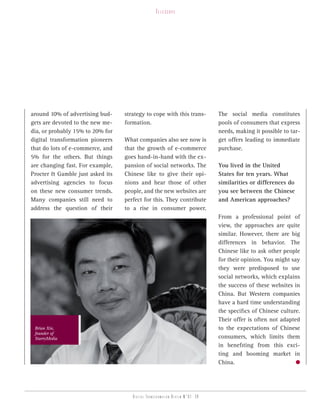
med by the organization of readjustment on the scale               ting that absolutely affects all individual and col-
of the state: it is psychic individuals who are here di-           lective activities through a constant connectivity
rectly solicited, and this solicitation—through marketing          that winds up producing everything under the sun.
which, as strategic marketing, has become since the                Digital is a pharmakon, and all the evidence suggests it


                                             Digital transformation review n°01 - 49
guest    writer


Digital as Bearer of Another Society


is the bearer of another society. It is the bearer of a social                 sharpened flint characterizes the first hominid);
organization no longer founded on Fordist consumerism,
but instead on the economy of contribution15.                               • collective individuals, which form social organizations
                                                                               (social systems that have as a goal to make compatible
In order to implement the potentials for psychic and                           and efficient the connections between physiological
collective individuation brought about by digital, and                         organology and technological organology).
in order to struggle against its potentially dis-individua-
ting effects, it is necessary to adopt the pharmacological                  It is through the implementation of this dual approach
approach founded on general organology.                                     (pharmacological and organological) that reticular
                                                                            society, network society, will be able to confront the
General organology is a method of making scientific                         collapse of the consumerist model and implement an
disciplines work together in relation to three spheres of                   economy of contribution that is also an economy of
individuation:                                                              the reconstitution of knowledge, that is, of the strug-
                                                                            gle against the processes of proletarianization that the
• psychosomatic individuals (a psychic individual                           pharmakon tends to spread to “all levels of society.”
  always has a body, and its “psychism” is inseparable
  from the organs of its body, the brain, heart, kidneys,                   Alan Greenspan thus confessed to the House of Repre-
  etc., the neuro-vegetative system, perceptual organs,                     sentatives that he had lost the possibility of apprehen-
  and so on);                                                               ding a financial technology that in fact short-circuited
                                                                            his ability to make decisions, just as the advent of nu-
• technical individuals (a technical system links together                  clear systems guided and performed by central compu-
  artificial organs each one of which is dependent on                       ters, and linked to radar systems and missile launchers
  the others—a technical object never functions on its                      via Arpanet (forerunner of the internet), had “proleta-
  own, just as, for example, a brain cannot function wi-                    rianized” the politician, who was thus deprived of the
  thout the heart, since it needs to be irrigated by blood,                 possibility of knowing and deciding—this being the very
  whereas a smartphone needs to be fed either by an                         reason that, according to Paul Virilio16, Richard Nixon
  electrical network or by a photovoltaic battery—these                     and Leonid Brezhnev were forced to enter negotiations
  artificial organs equipping psychosomatic organs: a                       with a view to limiting nuclear armaments…
  pair of glasses equips a pair of eyes, a bicycle equips
  the moving body, writing equips memory, and the                                                                        Translated by Daniel Ross
                                                        15
                                                             The economy of contribution is the principal object of the work of the Ars Industrialis association.
                                                                    16
                                                                       Paul Virilio, Speed and Politics: An Essay on Dromology (New York: Semiotext(e), 1986).


                                                 Digital transformation review n°01 - 50
About Capgemini Consulting

Capgemini Consulting is the Global Strategy and Transformation
Consulting brand of the Capgemini Group, specializing in advising
and supporting organizations in transforming their business, from
the development of innovative strategy through to execution,
with a consistent focus on sustainable results. Capgemini
Consulting proposes to leading companies and governments a
fresh approach which uses innovative methods, technology and
the talents of over 3,600 consultants worldwide.

For more information: www.capgemini.com/consulting


                       About Capgemini
Capgemini, one of the world’s foremost providers of consulting,
technology and outsourcing services, enables its clients to transform
and perform through technologies. Capgemini provides its clients
with insights and capabilities that boost their freedom to achieve
superior results through a unique way of working, the Collaborative
Business Experience™. The Group relies on its global delivery model
called Rightshore®, which aims to get the right balance of the best
talent from multiple locations, working as one team to create and
deliver the optimum solution for clients. Present in 40 countries,
Capgemini reported 2010 global revenues of EUR 8.7 billion and
employs around 110,000 people worldwide.
                                               www.capgemini.com

Capgemini Consulting - Digital Transformation

  • 1.
    N° 01 JULY2011 The challenges of the digital revolution • L’Oreal’s choices by Marc Menesguen • Transform to the Power of Digital: Digital Transformation as a Driver of Corporate Performance by Capgemini Consulting • No sector is immune by Andrew McAfee, MIT • The boom of Chinese e-commerce by Brian Xin, StarryMedia • A transformed society is emerging by philosopher Bernard Stiegler
  • 2.
    summary eDitorial vision guest writer Digital and Transformation: No sector is immune from digital Digital as Bearer of Another Are they now indivisible? transformation Society By Capgemini Consulting’s Interview with Andrew McAfee, By Bernard Stiegler, philosopher, Editorial Board principal research scientist at the President of Ars Industrialis, page 4 Center for Digital Business, MIT Director of the Pompidou Center Sloan School of Management Institute for Research and page 30 Innovation page 43 strategy Beauty and digital: A magical match Capgemini Consulting’s Interview with Marc Menesguen, Editorial Board: Managing Director of Strategic telesCope Pierre-Yves Cros, CEO Marketing for L’Oréal Tom Blacksell, UK Regional Head Chinese entrepreneurs take full Didier Bonnet, Global Head of page 6 Practices advantage of the e-commerce Patrick Ferraris, Global Leader, boom Technology Transformation Interview with Brian Xin, founder Xavier Hochet, France Regional Head of StarryMedia, a Chinese start-up Ton de Jong, Netherlands Regional Head for social marketing and digital Eric Roudil, North South Europe Close-up research Regional Head page 36 Michael Schulte, Germany Regional Head Transform to the Power of Digital: Ken Toombs, USA Regional Head Digital Transformation as a Driver of Corporate Performance Coordination Editor: Claire Thiebaut By Didier Bonnet, Global Head of Practices, Capgemini Consulting Design and Production: and Patrick Ferraris, Global Leader, Les Ateliers Corporate Technology Transformation, Key figures Printing:Solutioncom Capgemini Consulting page 14 pages 35 and 42 Cover illustration: Fernando Togni Digital transformation review n°01 - 03
  • 3.
    eDitorial Digital and Transformation: Are they now indivisible? By Capgemini Consulting’s Editorial Board W elcome to the first issue of Capgemini Consulting’s Digital Transformation Review. The rise of new digital technologies the opportunities offered by these new tech- nologies and their related applications. While transformation is not just digital, transforma- is one of the most exhilarating challenges fa- tion cannot do without digital. cing companies today. No sector or organiza- tion is immune from the digital phenomenon, Second, digital is shaping the competitive which dictates its own pace and presence in battleground in all sectors. The data shows a the management agenda. The question is no growing performance gap between the best di- longer when companies need to make digital gital learners and the others. The more a sec- a strategic priority – this tipping point is past tor relies on technology, the greater the gap – but how to embrace it and turn it to compe- between the most effective companies and the titive advantage. rest. And yet, the digital phenomenon doesn’t stop at the borders of «traditional» sectors. Di- Given this urgency, should we now view the gital technology allows a more targeted busi- rise of digital as the alpha and omega of trans- ness approach, more scientific decision-ma- formation strategies, the focal point for every king and a new type of customer relationship. aspect of corporate change? Our hypothesis is Companies in every business sector need to that transformation strategy is its own master, master digital tools. but we have reached a stage where transfor- mation cannot be done in isolation from digi- We do think it is important to stress that this tal. There are two reasons for this. emphasis on a technology-driven digital re- volution in no way diminishes the importance First, digital has a fundamental impact on how of human initiative and responsibility. Indeed, change takes place. Moving forward, every the truth is quite the opposite. It is more im- strategy that is devised must take account of portant than ever to acquire the right skills Digital transformation review n°01 - 04
  • 4.
    eDitorial and place themstrategically to support trans- Media, a Chinese start-up connecting marke- formation programs. ting and social media, offers particular insight into the speed of change in China today. In this publication we are determined to em- brace just this sort of complexity and coun- Finally, philosopher Bernard Stiegler provides ter-intuition, through a viewpoint that cros- the necessary distance for understanding the ses geographical boundaries and domain social impact of the digital revolution, which boundaries, with contributions from faculty he compares in the scale of human history to experts, practitioners, start-up pioneers and the invention of writing. philosophers: Marc Menesguen, Managing Director of Stra- We hope you enjoy the thoughts and strong tegic Marketing for L’Oréal, explains how the convictions of all our authors. digital revolution has impacted the organiza- tion and strategy of this global beauty pro- ducts leader. Prof. Andrew McAfee of MIT paints a picture of how these digital technologies are disrup- ting work processes and corporate strategy. Along the way he describes profound changes in American consumer habits and their im- pact on traditional marketing approaches. The article by Brian Xin, founder of Starry- Digital transformation review n°01 - 05
  • 5.
    strategy Beauty and digital:A magical match an impact on how our consu- Marc Menesguen, Managing Director of mers relate to information and Strategic Marketing for L’Oréal, explains advertising, and thus to our brands. According to a study by how the digital revolution has impacted the Forrester group, 7% of sales around the world today take the organization and strategy of the place online, and almost 40% global beauty products leader. of off-line sales are influenced by internet research. So almost half of purchases in the world are already somehow digitally H as the rise of the digital phenomenon changed your customers’ habits? influenced. This trend in any given country depends on its digital maturity. Digital transformation is one In the United States, where the of the major drivers of change phenomenon first developed, in today’s world. I believe we the internet plays a very signi- are witnessing the start of a true ficant role today in purchasing revolution, given how the major decisions and in how we sup- players are powering forward – port our consumers. This is a Google, Apple, Microsoft, Face- little less the case in Europe, book... – and the speed at which although things are advancing digital tools are proliferating. more quickly. And in the newer There are expected to be 20 markets digital technology has billion connected devices (tele- a considerable impact. In China, phones, tablets, game consoles, internet penetration is already etc.) by 2015. almost 30%. These changes are of fundamental importance to This revolution naturally has L’Oréal. Digital transformation review n°01 - 06
  • 6.
    strategy How does thecompany view you see emerging with digital The final opportunity involves this revolution? transformation? innovation. Research & Innova- tion is at the heart of the L’Oréal Digital transformation re- First of all, digital transforma- model, and digital transforma- presents an extraordinary tion is a chance to strengthen tion helps our researchers’ work. opportunity to strengthen our our brands’ images by impro- For example, in the United Sta- current business model and be- ving the efficiency of our com- tes we have a social network come even better at being the munication and advertising. of 250 women who test our world’s number-one beauty cosmetic or facial care products, group. In fact, beauty and di- and give their feedback online. gital are something of a magi- “ The digital world We examine their reactions cal match, because beauty is an and take them into account multiplies the ways emotion and the digital world when designing new products. our brands can create multiplies the ways our brands We have truly reached the stage can create an emotional-filled an emotional-filled of co-innovation! relationship with their custo- relationship with mers. their customers. ” How is L’Oréal reacting to take advantage of these Also, using our products isn’t opportunities? always self-evident, and digi- Second, the internet is an ama- tal tools allow us to help our zing tool for supporting custo- Our Chairman and CEO, Jean- consumers understand and use mers throughout a product’s cy- Paul Agon, named 2010 the them better, and to offer them cle of use, and for strengthening «Digital Year» for L’Oréal. Suc- personalized, one-to-one ser- brand loyalty. The third advan- ceeding in the digital revolution vice so we can increase the tage is one of sales. The inter- is a major strategic challenge quality and perceived value of net makes it possible for brands for the company at the global using our products. to project themselves right into level, along with winning one people’s homes, and generate billion new consumers over the Could you tell us more spe- purchases and repeat purchases coming decade. The year 2010 cifically what opportunities through online sales. was therefore one of intense Digital transformation review n°01 - 07
  • 7.
    strategy Beauty and digital:A magical match effort, particularly for a crisis exit phase, with strategic po- licies impacting our 23 brands and all our countries. This mobilization was expressed in a number of ways. First, we made sure we had the necessary expertise in-house. We formed a team of 300 people specialized in digital technologies, with the goal of providing digital expertise at every strategic point in the company, and we have a global digital manager to pilot this cross-functional network who reports to me directly. I would point out here that digital transformation doesn’t only concern marketing; rather, we have digital managers in Marc Menesguen Managing Director research, manufacturing, com- of Strategic Marketing munication and in the sales for L’Oréal functions. We also launched a program to train 15,000 individuals in digital fluency in two years, including the company’s mana- gers. Digital transformation review n°01 - 08
  • 8.
    strategy Have you definedmeasurable developing m-commerce, sales strategy. Whereas in the mass objectives for your digital via mobile phones. And within media model, typically centered strategy? Europe, the United Kingdom is on television, everyone received coming off the starting block the same message, with digital We plan to double investment first. media we can design much in digital media in 2011, from more targeted marketing. 5% to almost 10%. L’Oréal is the Marketing is key to L’Oréal’s third largest advertiser in the business model. Has the tra- world, so you can imagine the ditional marketing mix been scope of this goal. More gene- transformed by the emergence “ The real goal rally, I would note that we work of digital tools? is to raise our using a test & learn approach: digital IQ as a The real goal is to raise our di- Of course. The difference way to structurally gital IQ as a way to structurally between the traditional model reinforce our business model. and the new one that is emer- reinforce our ging, is a difference between business model. ” We have chosen specific units positioning and movement. within the group to play a pio- Today it’s not enough to think neering role. Their job is to about brand positioning. Digital prepare the ground and assem- transformation allows brands I think this trend will become ble the skills needed, and then to interact directly with their even more marked in the future transmit them to the other units. customers. This communica- with the rise of mobile devices, In e-business, for example, the tion requires an agility from which will become an increasin- luxury products divisions in the brands as well as an ability gly important interface between the United States and Korea to remain in motion and adapt brands and consumers. With are leading the charge, so they continuously. It’s a challenge, geolocation, for example, we have gained a head start with but also an extraordinary op- can target messages more pre- 6% and 12% of their sales on- portunity. In the new marketing cisely and adjust to customers line, respectively. Japan, on the that is developing, the consu- whether they are out shopping other hand, is responsible for mer is even more central to our or at home. Digital transformation review n°01 - 09
  • 9.
    strategy Beauty and digital:A magical match Does digital transformation priorities and guidelines. They greater proximity and interacti- increase the complexity of deploy integrated marketing vity, but in the end customers managing your brands? campaigns to ensure that the want the same thing: They want brand receives the same expres- L’Oréal is historically a compa- sion no matter what the point ny of innovation and conquest, of contact. “ We plan to so our teams are excited by this double investment new challenge. That said, like As for monitoring economic effi- in digital media any major change, digital trans- ciency, it has been strengthened in 2011, from 5% formation brings with it ques- with the creation of the Stra- tions and risks, two of which tegic Marketing division that I to almost 10%. ” come to mind. run. This organization is meant to support the markets in iden- The first is the risk of a frag- tifying best practices, and those to be surprised, seduced, drawn mented image and loss of brand that are less effective. We work in by a great story. Digital equity, in the sense that multiple on aligning key performance transformation lets ad writers points of contact with a brand indicators for digital campaigns tell even more fabulous stories can lead to divergences between worldwide, which allows us to to reinforce our brands. the global and the local. There is measure the effectiveness of our also a risk of insufficient return digital initiatives and organize Do social networks accentuate on investment, of our economic reporting of experiences and the risks of a negative resources being spread thin. sharing of best practices. reputation? We are prepared to respond to Has the way you advertise The internet has held risks for re- these risks with a matrix struc- changed? putations even before the emer- ture for our 23 global brands gence of social networks. This and the large regions that pilot Whether on- or off-line, let’s risk is real, whether we like it or business in the different coun- not forget that the main success not, and we are very attentive tries. Each brand develops its factor for a campaign is its crea- to it. We are part of the conver- own digital strategy with clear tivity. Digital channels allow sation, interacting ourselves Digital transformation review n°01 - 10
  • 10.
    strategy on the internetaround every- This is a significant aid in choo- gering 72% of them came from thing that is said. This has been sing and buying cosmetics. emerging markets, which shows part of our company strategy how digital transformation lar- for several years already. In Human Resources, last year gely coincides with the geo- we developed “Reveal”, a re- graphic shift that is underway. How is your digital strategy cruiting website that takes We recruited 120 people in expressed in other functions? the form of a business game 20 countries with this game. (www.reveal-thegame.com). In Research & Innovation, our I could give you similar details strategy has always been based for Manufacturing, Corporate on proximity to our consu- Communications, and all the mers around the world, with “ The difference group’s functions. The digital more than 3,400 researchers between the revolution truly impacts every working at 18 research centers traditional model area of the company. in 12 countries. Digital techno- and the new one logy allows us to achieve even that is emerging, Is the impact of the same greater proximity, practically scope for every division? is a difference entering consumers’ homes and, between positioning thanks to imaging technology, The impact is strong everywhe- we can get «inside their skin.» and movement. ” re, but is expressed differently depending on the business. Sales functions, for their part, Each division and each brand need to integrate e-distribution The applicant enters L’Oréal develops its own digital stra- techniques. For example, we as a virtual trainee, takes tegy based on its specific cha- are testing on-line promotions. part in the activities he or she racteristics. We’re also taking part in a very is interested in – product inno- interesting experiment launched vation, marketing, production – The Luxury division sees digital by Carrefour Planet, an interac- and receives a grade. Last year tools as an opportunity to create tive makeup counter where wo- 61,000 people participated from an image with incredible global men can apply virtual makeup. 160 different countries. A stag- consistency, but also as a way Digital transformation review n°01 - 11
  • 11.
    strategy Beauty and digital:A magical match to improve personalized service example, Redken, in the Uni- in this area, the Luxury Pro- and a path to increasing busi- ted States, designed a strategy ducts division, generates 6% of ness through e-business tools. for animating its network on its sales in the United States on- To date, this division has made Facebook, with highly targeted line. Where direct contact with the greatest strides in imple- distribution of samples and ex- our customers through e-com- menting online sales. cellent return on investment. merce offers the greatest value, is in terms of marketing, and For the Consumer Products di- In the Active Cosmetics division, assessing the effectiveness of vision, the primary challenge is Vichy has developed a comple- our strategies. This higher awa- to optimize advertising impact. tely novel website for online skin reness also benefits our off-line diagnosis (www.vichyconsult.fr), business, and thus our distribu- only made possible by the in- tor partners. The brands with “ Digital transfor- ternet. the best online performance are also those that sell best in sto- mation lets ad Finally, the Body Shop, which res, such as Kiehl’s. writers tell even is both a global brand and a more fabulous network of stores, has expanded What are the main successes stories to reinforce its online service and sales pos- of your digital strategy? our brands. ” sibilities with the internet. Lancôme had a number of di- Does this direct channel gital successes in 2010, both in Digital tools help generate more between the brand and consu- support of product launches and relevant, targeted messages with mers bring your relationships through a very impactful colla- more content. with your distributors into boration with Michelle Phan, a question? video blogger in the United Sta- In the Professional Products tes. She is a huge fan of Lan- division, we have an extraor- No, not really. For one thing, côme, and became the brand’s dinary chance to enhance our e-commerce is still a fairly mar- online beauty advisor. Every relationships with our global ginal phenomenon. Our division month she posts a video with network of hair stylists. For that has advanced the farthest advice that is seen by more than Digital transformation review n°01 - 12
  • 12.
    strategy a million viewers.They are so Apple has listed us among their It’s a challenge for all of us. We successful that five of the ten best apps! can legitimately characterize top make-up videos on YouTube this as a cultural revolution. are hers! What lessons do you draw But the pioneering spirit is a va- from your failures? lue that has been shared by all Lancôme has a similar ap- L’Oréal employees for decades. proach in China, with a social We haven’t experienced any Don’t forget that Lancôme was network called Rose Beauty. real failures, as every expe- the first luxury cosmetic brand With 500,000 fans and more rience contributes to our digital to launch a website, in 1999! than two million posts per year, learning. However, we have no- One year later, we were again the website is an excellent lever ticed some dispersion and frag- the first luxury brand to launch for Lancôme, which I remind mentation effects in past years, an e-commerce website in the you is the top luxury brand in with local initiatives that may United States! Today, digital China. have been very interesting, but transformation is an exciting were not entirely in sync with challenge that involves all of In the Consumer Products divi- the brand values. This led us our 66,000 employees around sion we launched Instant Beau- to strengthen the brands’ stra- the world. ty, a mobile phone application tegic priorities and develop in- that lets customers scan a pro- tegrated campaigns. The main duct’s bar code in the store and lesson from these experiences get complete information about is the need for consistency of the product and how to use it. off-line and online strategies: For Maybelline, we are also cur- Our strength lies in a compre- rently testing iAD, a new gene- hensive vision, and mistakes ration of advertising for iPhone. mainly come from a lack of In particular, it allows very pre- consistency. cise targeting, and raises vi- sibility in the Apple universe, What are the reactions to this which aligns with the brand’s transformation within the “hip” character. Especially since company? Digital transformation review n°01 - 13
  • 13.
    Close-up Transform to thePower of Digital: Digital Transformation as a Driver of Corporate Performance By Didier Bonnet, Global Head of Practices, Capgemini Consulting and Patrick Ferraris, Global Leader, Technology Transformation, Capgemini Consulting Digital tools and technologies have invaded the business environment, triggering significant changes in the way we work, communicate, and sell. Industries and governments alike are undergoing a digital transformation either crisis-induced, as part of a core strategy, or as part of a more controlled business transition. Under all circumstances, leaders need to be well prepared to anticipate the current and future impact of this enduring trend and steer their corporations accordingly at the right speed. T he journey toward digi- tal transformation entails harnessing its benefits - such journey depending on its starting point and the digital maturity of its industry and products or ser- An Enduring TrEnd AffEc- Ting EvEry indusTry… buT AT A diffErEnT PAcE as productivity improvement, vices. It is imperative for busi- cost reduction, and innovation nesses to remember that digital Over the past decades, digital - while navigating through the transformation is not just about technologies have progressively complexity and ambiguity brou- technology. Instead, like any been embraced by organizations ght about by the changes in the other business transformation, a driven by advancement in tech- digital economy. roadmap across people, proces- nology, changing consumer be- We believe that every organiza- ses, and technology will enable havior, increasing globalization tion is likely to tread a different organizations to successfully of the workforce, and a desire path in its digital transformation navigate this transformation. to be more productive and inno- Digital transformation review n°01 - 14
  • 14.
    Close-up vative (see Figure1). This digi- Although the use of digital to- for the Internet it was less than tal wave has not only fuelled a ols in the enterprise is not a new 7 years, and for tablets it can be number of fundamental changes phenomenon, what has changed expected to be around 4 years2. in the way organizations pro- in recent years is the accelera- This breakneck pace of techno- duce, sell, and serve, but also tion of both the capabilities of logical change has triggered new changed the way employees these tools as well as the pace consumer behaviors and usage work, communicate, and colla- of adoption by customers, em- patterns which are having a pro- borate. It has therefore created ployees, and organizations alike. found impact on organizations. a leadership and transformation For instance, while mobile te- Simply stated, digital transfor- challenge for most industry par- lephony took around 13 years mation is the increasing adoption ticipants. to reach critical mass-market1, of digital tools and technologies Figure 1: Digital Transformation of Enterprises Communication VoIP Smartphone UCC Telepresence Online Knowledge Collaboration Base IP-PBX E-mail IM Cellphone Video Conferencing LAN Voice Voicemail V based Mail Multi Channel Conferencing Optical Enterprise Pagers P Customer Interface Knowledge Social Snail Mail PBX Base Network In-Person Team Store Meetings Magnetic Fixed Line Phone Knowledge Online Physical Base Tele Fax Knowledge Base Netmeeting Channel Channel Livemeeting Door to White-boarding Door Sessions Key: Social Roadshows Typewriters Networking 1950 -1970 Physical Files PC Digital Early Cheque Laptop Days Credit Predominantly Cloud Tele Card Manual Cash computing 70’s & 80’s b -banking Manufacturing Tape Digital B Branchless Drives Progression Infrastructure B Banking CD Electronic Funds Semi Automatic ATM Transfer Manufacturing The 90’s Smart Digital E-Commerce Computer Aided Manufacturing Manufacturing Acceleration Storage as a 2000 - Present Tablet Digital m-Commerce service Transformation Commerce / Financial Source: Capgemini Consulting Analysis 1 Years necessary for an invention to be used by a quarter of the US population. 2 Capgemini Analysis; The European environment Agency, State and outlook 2010: “Accelerating technological change: racing into the unknown”, Nov 2010; Forrester Research eReader Forecast, 2010 To 2015 (US), July 2010. Digital transformation review n°01 - 15
  • 15.
    Close-up Transform to thePower of Digital: Digital Transformation as a Driver of Corporate Performance by an organization to funda- Faced with this transformation HArnEssing THE bEnEfiTs of mentally alter both its internal challenge and the need to stay digiTizATion and external processes and func- relevant in one’s industry, lea- tions. All industry segments and ders have to embrace the impli- Digital transformation should governments have been touched cations of this enduring trend not be an end in itself. Like all by this new digital reality, which on their organizations in order other forms of business trans- has significantly altered mana- to steer their strategy and drive formation it should be guided gement practices in areas from better operational performance. by clear managerial goals and hospitals to hypermarkets and Unfortunately, recent history is realizable business benefits. financial services to the future replete with examples of orga- Once a clear roadmap has been of public services. As a result, nizations which have not been defined, digital transformation it has become a high priority able to keep pace with this new can help organizations address on the leadership agenda, with digital reality. The recent ban- their most significant priorities nearly 90%3 of business leaders kruptcy of movie rental com- and achieve both internal and in the US and UK expecting an pany, Blockbuster, owing largely external benefits, in areas such increasing strategic contribution to its inability to rapidly hone a as innovation, customer expe- of IT and digital technologies new business model5, is one such rience, efficiency, or producti- on their overall business in the example. vity (see Figure 2). coming decade. With the Inter- Every industry is going through net, Hi-Tech, and Media sectors a digital transformation, some It’s About Productivity only accounting for approxima- crisis-induced, some as part of Improving productivity is a key tely 10% of US GDP, we believe their core strategy, and some as driver for sustainable growth. In that the real transformation will part of a more controlled transi- recent years, productivity growth be seen in the remaining 90% of tion process. Under all circums- in developed economies has been ‘traditional’ industries’4, where tances, leaders have to steer their steadily falling and is signifi- customer and employee behavior corporations at the right speed, cantly lower when compared to is fast evolving. We can expect a taking into account the current emerging markets. For instance, largely similar trend in other de- and future competitive situation during the periods 1995-2005 veloped countries as well. in their respective industry. and 2005-2008, Total Factor 3 Gartner: “Gartner CEO and Senior Business Executive Survey, 2010: Anticipating the Post-Recession Landscape”, March 2010. 4 Interview with Andrew McAfee, Author of Enterprise 2.0: New Collaborative Tools for Your Organization’s Toughest Challenges. 5 Blockbuster failed to effectively adapt its storefront model to online technology. Digital transformation review n°01 - 16
  • 16.
    Close-up Productivity6 in theUS and EU- thereby exerting additional pres- improve productivity by auto- 15 nations grew at the lowest sure on productivity. In order to mating tasks, enabling better rates when compared to deve- stay competitive, companies in decision-making, and freeing loping markets in India, China, developed nations need to find employees up to create value in CEE, and Africa7. On top of this, new sources of productivity if other areas. In the United States, we can add socio-economic they want to remain relevant on IT was responsible for two-thirds trends such as the shrinking and the global stage. of total factor growth in produc- aging workforce. In Germany, There is clear evidence that im- tivity between 1995 and 2002 Italy, and France, the working plementation of digital techno- and virtually all of the growth age population8 is expected to logies has been a key driver of in labor productivity10. Similarly, fall by 15%, 8%, and 6% respec- corporate productivity. Digiti- EU firms that adopt e-business tively between 2010 and 20309, zation has helped organizations practices (such as online sales Figure 2: Key Benefits of Digital Transformation Internal Opportunities Drive organizational Reduce selling, delivery, and employee and service costs productivity by Accelerate time to leveraging digital tools External market External Opportunities Create new digital Opportunities Multichannel and integrated customer experiences products such as across mobile, social and Cost and Time Productivity consumer devices, online platforms Saving Improvement eBooks, and smart meters New New Customer Products / Experience Services Use tracking or Operational analytical tools to Extend service analyze customer offerings to behavior patterns Customer New technology enabled and generate Insights Customer Product Platforms platforms such as insights online and mobile Source: Capgemini Consulting Analysis 6 Total Factor Productivity Growth measures the Growth of GDP over the combined contributions of total hours, workforce skills, machinery and structures and IT capital. 7 The Conference Board Total Economy Database, Summary Statistics 1995-2011, Jan 2011. 8 Working-age population = 15-64. 9 Stanford Center on Longevity: “ Population age shifts will reshape global work force”, April 2010. 10 ITIF: “Digital Prosperity: Understanding the Economic Benefits of the Information Technology Revolution”, March 2007. Digital transformation review n°01 - 17
  • 17.
    Close-up Transform to thePower of Digital: Digital Transformation as a Driver of Corporate Performance and purchasing) are twice as li- mer acquisition cost on online novation and the main driving kely to report enhanced produc- channels is 50% less than that force behind product and ser- tivity and expanded employment on offline channels13. Similarly, vice innovation across sectors. when compared with firms that when compared to call-center An EU-commissioned survey do not use Internet technologies technical support, approximate has found that product and to innovate11. cost per contact is nearly 92% service innovation in most of However, research12 points out cheaper for a virtual agent and the largest industries in Europe that while investment in digital 99.2% for web self-service14. is either directly related to, or capital has a strong correlation The cost benefits of digitization enabled by, ICT16. Leading the with high productivity, techno- span a whole range of indus- pack are the energy supply and logy alone is not the most im- tries and functions. The use of telecommunications services portant driver of productivity. RFID tags in the supply chain sectors where 89% and 86%17 Instead, it is a combination of a environment can help reduce of companies attribute product digitally savvy corporate culture, inventory handling and logis- and service innovations to ICT. a distinct set of organizational tics costs. Remote health care practices, and digital tools that enables monitoring of a pa- results in significantly higher productivity. tient’s symptoms in real-time at relatively low cost. Smart me- “ In the US, in 2010, adoption ters can save utilities millions of e-business practices It’s About Saving Costs and of dollars by enabling them helped save companies Time-To-Market to read meters remotely and $528 billion through Digitization not only helps or- controlling demand. In the US, ganizations reduce operatio- nal, communication, travel, in 2010, adoption of e-business practices helped save companies efficiency gains ” marketing, selling, and pro- $528 billion through efficiency Digital tools also provide an duct development costs, but gains15. excellent platform to engage also significantly accelerates stakeholders in co-innovation, problem resolution and time- It’s About Driving Innovation brand creation, and problem to-market. For instance, custo- Digitization is an enabler of in- resolution. Philips successfully 11 Information Technology and Innovation Foundation: “The Internet Economy 25 Years After .com”, March 2010. 12 MIT Sloan, Center for eBusiness : “The digital organization: seven practices of highly productive firms”, May 2003. 13 Forrester Research: “2009 Cost Of eBusiness Operations And Customer Acquisition”, May 2009. 14 Forrester: “It’s Time To Give Virtual Agents Another Look”, March 2010. 15 Information Technology and Innovation Foundation: “The Internet Economy 25 Years After .com”, March 2010. 16 Information and Communication Technology. 17 European Commission: “ICT and e-Business for an Innovative and Sustainable Economy”, 2010. Digital transformation review n°01 - 18
  • 18.
    Close-up created a privateonline com- customers over multiple touch- improve retention, up-sell, and munity, Sensorium, in 2007 to points, providing a seamless cross-sell, and anticipate the co-create better products with and integrated multi-channel success of new product launches. customers and deliver on-de- experience. Defining and for- National Instruments, a leader in mand insights to multiple pro- mulating a multi-channel stra- virtual instrumentation, has suc- duct teams. In the last three tegy also enables companies to cessfully adopted a web-analy- years, the community has hel- maintain a 360 degree view of tics solution for lead generation ped Philips in identifying post- the customer and balance sales, and customer engagement. By purchase concerns, creating ef- customer care, and retention tracking on-site visitor behavior, fective product positioning, and across channels. Moreover, by NI has achieved a 3% increase in understanding technical speci- aligning organizational struc- the number of visits that reach fications for a new product18. tures and incentives, organiza- the point-of-sale21. tions can drive maximum value As outlined above, the business It’s About Transforming across all channels. In the UK, imperatives and benefits of di- the Customer Experience 76% of marketers have expe- gital transformation are com- Digital channels and platforms rienced improved brand expo- pelling and have to be addressed are helping organizations ex- sure, 68% better customer servi- at all levels in the organization. tend their reach to a wider and ce, and 62% increased revenue, However, the path toward digital more engaged ecosystem of cus- by adopting a multi-channel transformation is not without its tomers and partners. The high strategy19. challenges. adoption rate of mobile devices Today, more than 70%20 of all and Web 2.0 tools - such as so- digital information is consu- A TrAnsformATion wiTH cial media, collaboration appli- mer-generated and comes from iTs own cHAllEngEs cations, smart phones and tablet outside the organization. Aided computers - is changing the way by sophisticated analytical to- In order to identify the key bar- people share information, learn, ols, companies can leverage this riers in the successful imple- communicate, and interact. For ocean of information to extract mentation of digital transforma- each transaction, organizations better customer insights, maxi- tion programs, we conducted a can interact and engage with mize customer lifetime value, series of interviews with a num- 18 Forrester Research: “Case Study: Philips Achieves Consumer Proximity Using Private Online Communities”, January 2011. 19 DBG Report: “Multichannel Marketing Today”, September 2010. 20 2010 Digital Universe Study: “A Digital Universe Decade – Are You Ready?”, April 2010. 21 Forrester Research: “Case Study: National Instruments Replatforms Web Analytics”, November 2010. Digital transformation review n°01 - 19
  • 19.
    Close-up Transform to thePower of Digital: Digital Transformation as a Driver of Corporate Performance ber of global corporations from ocean of data. Between 2009 pour an overwhelming amount across different industries. Our and 2020, the amount of digi- of data into the digital ocean. analysis suggests that organiza- tal information created and re- The more information organi- tions across the globe are facing plicated in the world is expec- zations receive, the harder it a common set of challenges as ted to grow 44 times to reach gets to decipher what is credible they tackle these new digital an unprecedented 35 trillion and useful. Moreover, it beco- realities. These challenges can gigabytes22. In fact, according mes even more difficult to per- be broadly classified into four to estimates, more digital infor- form tasks and take decisions. categories (see Figure 3). mation was produced in 2009 Employees are unable to cope alone than all information since with the rising volume of infor- Manning the Information the beginning of time23. As inte- mation and this adversely im- Floodgates ractions become more frequent pacts on their morale and pro- The digital explosion has floo- and information-rich, custo- ductivity. A majority (62%24 on ded organizations with an mers, partners, and employees average) of workers across the globe believe that the quality of their work is hampered because Figure 3: Key Challenges in the Path to Digital Transformation they cannot process and make sense of all the information at  Information flooding from multiple sources  The all-powerful customer their disposal fast enough.  Managing changing customer  Analyzing information for actionable intelligence sensitivities Though organizations realize  Developing the right social  Managing and securing large volumes of data media, Web 2.0, and mobile capabilities the importance of analytics, Change in many of them do not have the Information Overflow Customer Behavior skills - particularly advanced Key predictive analytical capabili- Challenges  Avoiding organizational and  Crafting a clear digital ties - to undertake it. Lack of technical silos Silo Based Organization/ roadmap at the top  Adopting a holistic approach Approach Culture Gap management level senior executive support, a silo  Workforce transformation  Change Management approach, an inexperienced workforce, and insufficient in- vestment are some of the big- Source: Capgemini Consulting Analysis gest roadblocks. 22 2010 Digital Universe Study: “A Digital Universe Decade – Are You Ready?”, April 2010. 23 MIT Sloan Management Review, 2011 MIT Sloan CIO Symposium. 24 LexisNexis Press Release:” New Survey Reveals Extent, Impact of Information Overload on Workers; From Boston to Beijing, Professionals Feel Overwhelmed, Demoralized”, October 2010. Digital transformation review n°01 - 20
  • 20.
    Close-up Keeping Pace withCustomer pany had to scrap the launch. of clarity around customer and Expectation In certain industries, such as social-media ownership, ina- The increasing proliferation of music, changes in consumer be- bility to tailor business models digital platforms has funda- havior have completely disrup- catering to changing consumer mentally altered the way cus- ted traditional models and ren- behavior, and failure to take an tomers interact with brands, dered many players obsolete. “outside-in view” of their busi- research and buy products, and ness. influence the decision making of other customers. Customers are increasingly becoming wary “ More digital information was Adapting the Organization and Culture and distrusting of traditional produced in 2009 alone Alligning the existing corporate marketing vehicles and ins- than all information culture with new digital realities tead are turning to online so- since the beginning is one of the main inhibitors in cial networks, blogs, wikis, and the digital transition of compa- community forums to formu- late their brand perceptions and of time ” nies. One of the clearest indica- tors is that a clear governance make purchase decisions. To- Despite being faced with this process for the transformation is day, consumers trust consumers very visible customer expecta- often lacking. In our interviews more than they trust brands. tion challenge, many companies with CXOs, it has become clear While 50%25 of consumers do have been slow in developing that one of the major issues is not believe in the advertising the right skills and capabilities the lack of accountability in di- promises of brands, 73%26 trust to manage this new customer gital transformation programs. the recommendations of friends sophistication. For instance, Further, enterprises’ traditional and family. 56% of Fortune 50 companies decision-making systems are Companies can no longer afford still do not have social-media too vertical and too intrinsical- to ignore the voice and preferen- icons on their home pages while ly slow to keep pace with rapid ces of the customer. Customer 60% hide their twitter streams27. technology-driven transforma- backlash against GAP’s recently This failure of organizations to tion. Consequently, corporations launched new logo was so in- rapidly adapt themselves can be have started to experiment with tense on the web that the com- attributed to factors such as lack various organizational formats 25 “The future of advertising agencies: learnings from Forrester”, Feb 2010. 26 Forrester Research: “Three Ways To Find, Create, And Energize Advocates”, Sep 2010. 27 Adage: “Most Fortune 50 Brands Still Hiding Their Social Media”, April 2011. Digital transformation review n°01 - 21
  • 21.
    Close-up Transform to thePower of Digital: Digital Transformation as a Driver of Corporate Performance - such as cross-functional tas- program, there can be inherent have responded to the impact kforces and identifying digital reluctance and resistance to of digitization through multi- leaders at board-level - in order change from within, especially ple, separate and uncoordinated to adapt their culture to digital from middle management. Di- initiatives, even when the im- challenges. gitization results in the demo- pact is felt by the same brands, Far too many enterprises are cratization and free-flow of customers or employees. Func- investing in digital tools and information. Managers perceive tional silos frustrate interaction technologies without trying to this as a threat to leadership be- and create information silos, drive changes in the operating cause they have less control of making it harder to connect the model, working practices, and information flows. For instance, right people in the right ways to culture. Companies often focus the US Department of Defence create and maximize value. too much on the technical and (DoD) had to face a lot of inter- customer-facing aspects of di- nal resistance during the formu- “ It is the obstacle to gital transformation, forgetting lation of its social media policy is not technology that true value can only be le- as the traditional military hie- that veraged if we align people and rarchy and the network security processes. As Raffi Amit, Pro- group were used to doing things digital transformation, fessor at Wharton, pointed out: “It is not technology that is the the old way28. It is important for corporations to have confidence it is people ” obstacle to digital transforma- in their employees by involving tion, it is people”. An aging HR them closely in this journey and Similarly, a completely techno- infrastructure, non-alignment giving them ownership of pro- logy-centric approach often fails between business and HR lea- cesses. to challenge the fundamentals ders on the most critical busi- of a company’s business model. ness drivers, and ineffective Overcoming Silos This is because this approach rollout of change management Our discussions with organiza- aims to automate existing pro- programs to train employees on tions have surfaced a common cesses rather than attempting new digital ways of working are pitfall - adopting a silo-based a step-change in performance. some of the key barriers. approach, be it technical or or- In addition, technology-led As with any transformation ganizational. Many enterprises transformations often alienate 28 ReadWriteWeb: “U.S. Department of Defense Goes Social...Yes, Really!”, March 2010; Scout Comms: “The Department of Defense gained a social media beachhead in 2010”, Feb 2011. Digital transformation review n°01 - 22
  • 22.
    Close-up IT from thebusiness functions, traditional business models. Or- Strategic Leadership resulting in significant resis- ganizations need to tread a ca- and Boundary Definition tance to change. Digital trans- reful path toward digital trans- Digital transformation is about formation is first and foremost formation, crafting a winning leadership. It has become the an enterprise-wide business strategy and a clear roadmap ultimate challenge in change transformation and technology across people, processes, and management because it affects should be seen as a second-or- technology (see Figure 4). not only industry structures and der priority. strategic positioning, but also all To overcome the silo mentality, Figure 4: Navigating Digital Transformation: A Framework corporate leaders should take a holistic approach, cutting across Digital Strategy & tranSformation all aspects of their value chain • Value chain positioning • Value proposition / Business models and management functions. As • Digital transformation strategy • Innovation well as the many challenges Digital cuStomer outlined here, this is as much people 2.0 experience analyticS about a fundamental change in • Integrated talent • Digital Marketing • Customer mindset. management • Multi-channel analytics • Connected management • Advanced nAvigATing your own workforce/ • Customer Experience segmentation collaboration Optimization • Performance digiTAl TrAnsformATion • Change management management/ Digital operationS • External partner training metrics Orchestrating your Digital • Target operating model • Benchmarking Transformation • Process digitization • Workforce Digitization can extend the • Digital business analytics reach of organizations, impro- platforms ve management decisions, and technology Strategy & tranSformation speed the development of new • Technology roadmap • Technology • Technology products and services. At the to digital governance and innovation same time, overly rapid adop- • Information organization management strategy tion of technologies can disrupt Source: Capgemini Consulting Analysis Digital transformation review n°01 -23
  • 23.
    Close-up Transform to thePower of Digital: Digital Transformation as a Driver of Corporate Performance levels of an organization (every achieve. Similarly, the Human methods can quickly be put into task, activity, process) as well as Resources department must also “proof-of-concept” pilots and, the extended supply chain. Lea- be involved, given the impor- when successful, rolled out to ders must constantly challenge tance of the people dimension the entire organization. their organizations to ensure in digital transformation. Digital that this technology-enabled transformation requires a mix An Outside-In View of change can unlock productivity of skills which are often scat- Customers – Re-inventing gains and significant competiti- tered across the enterprise and Marketing ve advantage. At the same time, its external partners. To succeed they should understand where in this quest, leadership should “ Many enterprises and how the fundamentals of not hesitate to redefine the tra- their current operations could ditional boundaries between its have responded to be unsettled by agile new en- different entities, making them the impact of digitization trants or new business models. permeable and porous. We see, A significant issue facing the for example, the marketing or through multiple, separate, top-management is that most commercial departments acqui- and uncoordinated companies have traditional de- cision-making systems that are ring technical skills to address rapid technological changes. initiatives ” not well adapted for the digital Conversely, IT organizations are world: they are too vertical, too strengthening their marketing Marketing is undergoing the slow to deal with the cross-func- and sales expertise in order to most fundamental change in tional, technological and rapid better serve their companies. its history. The increasing em- nature of this transformation. Strategy formulation needs to powerment and sophistication For instance, when focusing on gradually move away from the of consumers - together with customer issues, you need the linear, annual process it once the proliferation of new chan- active participation of the Mar- was. Once strategic directions nels, digital technologies, and keting, Sales and IT organiza- are understood, senior executi- tools - is forcing marketers to tions. However, historically, ali- ves need to steer their organi- rethink the way they operate gnment between these different zations into virtual laboratories and the way they engage cus- functions has been difficult to where new applications and tomers. The result is an oppor- Digital transformation review n°01 - 24
  • 24.
    Close-up tunity to dramaticallyimprove think «outside-in» about their damental lever of transforma- the efficiency and effectiveness customers and markets. Instead tion. Leaders should focus on of investments in marketing, of thinking about finding cus- a clear people vision and try to advertising, and channel mana- tomers for their products and bring about inherent changes in gement. solutions, marketers need to the way people work and colla- Traditional marketing focuses think about finding products borate. There are a number of on increasing reach and fre- and solutions for their custo- key challenges along the way: quency by pushing information mers. They need to understand professionalizing and web-ena- and offers through a variety of what activities customers per- bling end-to-end people pro- loosely aligned channels. Howe- form as they evaluate, buy, and cesses throughout the organiza- ver, the future of marketing in a use their products and services. tion, fostering collaboration and digital world is to develop and They need to think deeply about information exchanges between sustain unique, personalized re- when and where they hand-off communities of knowledge lationships with customers by products, services, and infor- workers to maximize producti- collaborating and partnering mation to their customers. They vity and speed-to-market, and with them through their own need to ask which activities they adapting traditional organiza- trusted networks. For instance, can perform better than custo- tion models to the new demands in 2010, Coca Cola cut adver- mers. Conversely, they need to of the digital world. tizing spending on television ask what activities customers Digitally powered tools and by 6.6 % globally, and instead can perform better than the en- processes must be developed to invested more on social media terprise. encompass the entire employee campaigns via platforms such lifecycle. They should comple- as Facebook, Twitter, and You- People at the Heart of tely transform the way people Tube29. The social media stra- Transformation join, learn, perform, earn, grow tegy of the company is aimed at As in all forms of transforma- and leave the company. Leading long-term sustainable engage- tion, people need to be mobi- global organizations are also ment, developing advocacy, and lized and engaged. Too often embracing Enterprise 2.030 to- encouraging brand loyalty. we see the technical nature of ols to foster a connected work- The new digital customer expe- digitization resulting in compa- force where new forms of col- rience requires that companies nies underestimating this fun- laboration generate significant 29 Socialmediatoday: “Coca-Cola Cuts Ad Spend by 6.6% and Invests More in Social Media”, March 2011. 30 Harvard Business School Professor Andrew McAfee coined the term «Enterprise 2.0» in 2006 to describe how Web 2.0 technologies could be used on organizations intranet and extranets. Digital transformation review n°01 -25
  • 25.
    Close-up Transform to thePower of Digital: Digital Transformation as a Driver of Corporate Performance business benefits. For instance, is closely linked to the business “Organizational Capital”33 and Pfizer uses a range of collabora- strategy and customer priorities. obtain the highest gains from tion tools such as Pfizerpedia (an For example, the physical distri- their digital transformation. integrated platform including bution network and fulfilment Data-Driven Decision Making people, projects, events, blogs, processes should be optimally for a Smarter Organization and discussion group to promo- designed to support new digi- In recent years, digitization has te knowledge sharing) and Pfa- tally-enabled multi-channel go- brought a wealth of both inter- cebook (platform for employees to-market strategies from both nal and external data sources to interact) to connect its people a cost and customer experience - such as supply-chain metrics, worldwide in a way that fos- perspective. customer online data, and so- ters innovation and speeds the IBM was able to save $6 billion cial-media commentaries - into pharmaceutical development by re-engineering its supply organizations. Today, the notion process . Of course, technology 31 chain processes, which inclu- that hard data and good analy- does not foster collaboration on ded process-automation throu- sis beats experience and intui- its own, so it is essential that gh web-based applications and tion is generally well accepted. organizations properly imple- consolidation of functions. In However, as the technology for ment these tools with work pat- addition, the company esta- capturing and analyzing infor- terns and knowledge flows truly blished an e-procurement system mation becomes widely availa- understood. which helped reduce the average ble, at ever-lower price points, contract cycle time from 6 to 12 most organizations are still Digitizing Your Operations months to less than 30 days32. learning how to leverage them for Maximum Efficiency Digital Operating Models should to the fullest. As companies transform their be designed around four key In order to maximize the bene- business models in the face of dimensions: governance and fits of analytics, organizations new digital realities, transfor- performance management prin- should look beyond descriptive ming their operations becomes ciples, organization and mana- models, which provide simple a pre-requisite to successful gement practices, process model, operational statistics, such as execution. Organizations need and system architecture. Only by sales-per-store or average pro- a clear roadmap in the form of integrating all these dimensions fit-per-employee, and focus a Digital Operating Model that can an organization create real instead on predictive models 31 Various Websites.32 Information Technology and Innovation Foundation: “The Internet Economy 25 Years After .com”, March 2010. 33 Because effective work organization can be costly to develop and implement but yields a stream of cash flows over time, it can be thought of as an asset. This asset is called “Organizational Capital”- Erik Brynjolfsson, “Intangible Assets: Computers and Organizational Capital”, October 2002. Digital transformation review n°01 - 26
  • 26.
    Close-up to generate deeperinsights. For damental changes required in security, legislation, and infor- instance, Seven Eleven Japan culture, people, processes, and mation-management should be uses a sophisticated analytics technology. Further, adopting a key leadership prerogative. In system to manage the limited an enterprise-wide centralized addition, the historical quest to shelf-space at its stores. Point- approach to analytics, rather align IT with business strategy of-sale and customer demogra- than a department-level focus, and with key functions such as phic data is analyzed on a real- makes more sense for an orga- marketing and sales has been time basis to gather statistics nization as it ensures that there difficult to achieve in practice. such as hourly sales trend for is a critical-mass of analytical What is needed in the digital individual items, stockout ran- expertise, data from different world is a true fusion of skills king by individual items, and departments can be correlated, and functions to achieve ac- hourly sales trends by customer and security and governance is countability and speed of exe- profile, to better match supply centralized36. cution. This often requires new with demand34. types of skills as well as flexible Data-driven decision making Adapting IT Governance organizational model. should be made an integral part and Processes for Effective of organizational culture and Transition companies should use it as a The most effective companies lever to compete on analytics. Recent evidence points out, that have taken years to optimize their IT governance, and must “ Digital transformation is first and foremost an organizations which adopt data- now re-examine it in the light enterprise-wide business driven decision-making achieve of the particular rhythms and a 5% to 6%35 higher producti- vity than those that do not. This characteristics of digital trans- formation, where technology transformation ” significant boost in productivi- decisions, investments and ini- ty can clearly separate winners tiatives are spread out throu- Since technology is a key ena- from losers in most industries. ghout the whole organization. bler of digital transformation The transition to analytics Formulating an enterprise-wide the role of a CIO becomes in- should be driven by top ma- IT policy and governance which creasingly important in today’s nagement because of the fun- addresses key issues such as enterprise. CIOs must focus on 34 Graduate School of Business, Stanford University: “Operational Analytics”, September 2007. 35 New York Times: “When There’s No Such Thing as Too Much Information”, April 23, 2011. 36 Babson Executive Education: “Competing on Analytics”, Thomas H .Davenport, Don Cohen, and Al Jacobson, May 2005. Digital transformation review n°01 -27
  • 27.
    Close-up Transform to thePower of Digital: Digital Transformation as a Driver of Corporate Performance equipping the workforce and the Every organization is likely to pany, Journal Register38, spea- IT organization with new skills tread a different path in its di- rheaded its turn-around from and tools required in a digital gital transformation journey bankruptcy in less than a year context. Interfacing these new depending on its starting point by championing the firm’s digi- tools such as social networks and the digital maturity of its tal transformation strategy, “Di- and connected devices to the industry and products or servi- gital First”. The company, which legacy systems in order to drive ces. In addition, with constant filed for bankruptcy in 2009, value needs to be a top priority technological innovation and recorded a $40 million profit at for organizations. competitive activity, crafting a the end of 2010 by adopting a Finally, the increasing com- transformation journey is not series of digital initiatives39. plexity of managing large vo- an event but a continuous pro- It is also important for mana- lumes of digital information, cess. Our analysis suggests a few gement to educate the board on from both within and outside, is best-practice pointers on how to the need for, and benefits of, this exerting significant pressure on successfully craft and execute a transformation in order to achieve the IT organization. Companies digital transformation. complete buy-in on digital initia- which handle this stress better tives from all stakeholders. are more likely to gain an edge Lead and Educate over the competition. Organi- As with most successful bu- Evaluate and Set Priorities zations therefore need to start siness transformations, senior Organizations need to carefully considering virtual solutions team commitment is essential. review their current digital ini- such as cloud computing. In ad- Leaders should create awareness tiatives and conduct a “digital dition, they should deploy tools and alignment in their top team fitness” test on their operations for prioritized storage as well as around the possibilities created so as to craft a coherent transfor- security and privacy protection by the digital economy. The CEO mation map toward their digital in hybrid (both physical and should take charge and become future. Companies should also virtual) environments37. the principal advocate of the undertake a benchmarking exer- transformation program, with cise in order to identify best prac- A diffErEnT TyPE of a strong backing from top lea- tices both within and outside their TrAnsformATion dership. For instance, the CEO own sectors. Priorities need to be of US-based print media com- set based on the areas - customer 37 Journal Register Company Owns and operates 18 daily newspapers and more than 150 non-daily publications and affiliated websites. 38 Company Websites; CEO John Paton’s Digital First Blog. 39 ScreenDigest: “Netflix dominates physical rental even as it moves toward digital”, May 2011. Digital transformation review n°01 - 28
  • 28.
    Close-up value, revenues, costposition, etc In 2010, Netflix had the largest must translate that vision into - where digitization is likely to single-company share of the phy- a set of measures and targets to have the most positive impact. sical disc rental market as it grew drive the desired results from their from under 26% in 2009 to nearly digital transformation. People in Communicate and Mobilize on 35% in 201040. all functions need to understand a Large Scale “what good looks like” in terms Communication and mobiliza- Invest in Skills and of customer metrics, cost posi- tion are essential first steps to Competency Development tion, and productivity. Leaders get the entire organization en- The right digital competences will need to decide the timeframe and gaged around the transforma- not be widely available across the the level of ambitions based on tion as well as to manage the organization, so it is important to the particular responsiveness, the traditional resistance to change. have a well-articulated talent and competitive situation, and the Enterprise 2.0 tools - such as people plan to start injecting the culture of their organization. social media, wikis, and discus- right skills in the right places at sion forums - can help mobilize the right time. Further, it is impe- The road toward successful di- and align the workforce on digi- rative to develop a mix of digital gital transformation is indeed a tal objectives by building awa- competences across all functions, long one. However, every indus- reness, creating transparency, such as marketing, HR, sales, and try will be impacted at some point and establishing open channels IT. Equally, investing in people so those that do not take advan- of communication. development and connecting the tage of “the power of digital” will A careful operational balance also workforce to improve sharing be at a competitive disadvantage needs to be set between mana- and exchange will be key to le- in the short- to medium-term. ging the digital and the physical veraging the people side of the Industry leaders have a unique side-by-side. For instance, even as transformation. opportunity to start steering their Netflix moves toward streaming organization from the physical to digital media services, it still do- Set the Ambition and Iterate the digital in an orchestrated way minates the physical rental market Once the company is mobilized in order to improve their corpo- and has not lost focus in this area. around a clear vision, leaders rate performance. Contact the authors: didier.bonnet@capgemini.com patrick.ferraris@capgemini.com 40 ScreenDigest: “Netflix dominates physical rental even as it moves toward digital”, May 2011. Digital transformation review n°01 -29
  • 29.
    vision I can’t thinkof any industry sector or company which is immune from digital transformation Andrew McAfee is a principal research scientist at the Center for Digital Business in the MIT Sloan School of Management, and a fellow at Harvard’s Berkman Center for Internet and Society. Andrew McAfee professor at MIT Digital transformation review n°01 - 30
  • 30.
    vision gories of usage. The first inclu- built in. Their digital environ- des tools that allow companies ments are very open; they offer to become more scientific in every participant the chance to their decision-making, to rely adapt it at will. But the ama- less on gut feelings and be more zing thing is that the arrival of data-driven. Many companies these technologies hasn’t led actually commit to projects, ini- to chaos or disorganization. In tiatives or investments without fact, we can see extremely in- carrying out in-depth studies to novative structures and models H ow would you define di- gital transformation? validate them. Or these studies are done with the single goal of confirming the initial objective. taking shape. Corporations tend to use self-organization techno- logies either in the interactions It is characterized by the ever Now companies have a fantas- of their employees and partners growing penetration of digital tic tool kit to test the relevance or in the relationships with their technologies into every facet of of their hypotheses with near- customers. business life. By digital techno- scientific validity. logies, I not only mean classic “ The emergence of enterprise applications but also The second category, which I the corporate usage of techno- call Self-organization, includes social media and logies such as mobile, analytics, everything that helps people interactive websites web 2.0, localization, … (employees or consumers) come has served to lessen together, increases their ability the importance of Beyond the technologies them- to communicate and to work traditional experts or selves, the real interesting phe- together without specifying in brands in favor of nomenon is how corporations advance how they should do our own networks. ” and public institutions are using so. We include social media and these technologies to deeply related web 2.0 tools in this ca- transform every facet of their tegory. It’s important to note Finally, the third category,which business. that 2.0 technologies don’t have I call orchestration, is in some I would distinguish three cate- a lot of workflow or hierarchy ways the opposite of the second. Digital transformation review n°01 - 31
  • 31.
    vision I can’t thinkof any industry sector or company which is immune from digital transformation It includes technology usages- and interactive websites has that allow companies to specify served to lessen the importance and monitor their operating mo- of traditional experts or brands dels on a global scale. This isn’t in favor of our own networks. new and typically emerged with Now I no longer rely on a gui- the ERP systems that came out de written by a food critic to in the late1990s, but we are now choose a restaurant. Instead, reaching out a level of maturity I check out consumer opinions where corporations are able to on Tripadvisor and those of execute their operating models my «friends» on Facebook or and processes on a global scale, Foursquare. Trust from consu- exactly as they were designed mers is more critical than ever and planned. and it has shifted from experts and brands to people whose opinions are more valued. “ Technology used to be frustrating In some sectors this upheaval and isolating, it has requires an urgent response. We become interesting, noticed in the United States that intuitive and social. ” the major financial institutions – banks and insurance compa- nies – were not very well-per- How has the digital revolution ceived by younger consumers. transformed consumer habits This population doesn’t like a in the United States? sales approach based on a sales- person or a brand which comes The way consumers make deci- to you and proposes a solution. sions, especially younger consu- Young people don’t trust this mers, has profoundly changed. kind of expertise anymore, es- The emergence of social media pecially when they see how Digital transformation review n°01 - 32
  • 32.
    vision badly designed thesecompa- industry has changed far more and we are reaching out a level nies’ websites are for maintai- than oil transport. It all depends of complexity in the manage- ning their relationship in a sa- on the products, the market ment and performance of global tisfactory manner. and how things are organized. operating models and proces- I can’t think of any company ses which has never been rea- Our traditional Marketing mo- or sector which is immune ched before. On the other hand, del is broken, and not just for from digital transformation. we are just at the beginning of young consumers. More and And the bad news is that the self-organization. Let’s take for more consumers in older age speed of change will only in- instance the innovation process: groups are now changing their crease as technology adoption Many corporations are looking consumer habits. The consu- and usage further blossom! at ways to open up their inno- merization of technology is a Economist Joseph Schumpeter’s vation processes which used profound phenomenon. Tech- «creative destruction» is taking to be run from the guys in the nology used to be frustrating place before our eyes. labs, into an open ecosystem of and isolating, it has become employees and partners where interesting, intuitive and social. even consumers play a critical The gap between digital natives “ What is at stake role! and immigrants is rapidly clo- is the transformation sing… Companies need to be of the 90% of Do you think we’ll face right there with their consu- all the ‘traditional’ a disruption of traditional mers. business models? industries and How are companies respon- companies. ” We’ve definitely seen new busi- ding to this technology revo- ness models appear on the scene, lution? Are they all affected Now, if we come back to our ini- often very innovative, for exam- the same way? tial three responses from corpo- ple in media or travel distribu- rations and institutions, I think tion. But we shouldn’t overstate Naturally, this phenomenon we can find different levels of things. The Media, HiTech and disrupts some sectors more than maturity. Orchestration has the internet sectors account for others. For example, the music been around for a while already less than 10% of the GDP in the Digital transformation review n°01 - 33
  • 33.
    vision I can’t thinkof any industry sector or company which is immune from digital transformation United States! What is at stake What are the main barriers times they’re unwilling to en- is the transformation of the re- to change? ter into a field they know little maining 90% of all the ‘tradi- about. Sometimes they just tional’ industries and compa- There are several. The cost of don’t think it’s their job to take nies. The US economy is still making these investments can the initiative. In other words, primarily founded on traditio- be one. But the most impor- a little intellectual revolution nal businesses which are less tant without a doubt is com- is needed to draw benefit from likely to transform their busi- panies’ resistance to change these new technologies. This is ness model than to adapt it. I and may be managerial inertia. not only true of the older indus- don’t share the opinion some tries. Unwillingness to change have expressed, that companies “ You should never also affects businesses in newer will be completely restructu- fields. underestimate red by these developments, or even that what we recognize the fondness of people Is it relevant to talk about today as companies will di- and organizations digital winners and losers? sappear altogether. Traditional for the status quo. ” structures still have their value, Yes, the data shows a growing hierarchy and organization are You should never underestimate performance gap between the useful. Even newer companies the fondness of people and or- best digital leaders and the that have perfectly integrated ganizations for the status quo. others. We have found a strong new information technologies Many executives recognize that correlation between the tech- rely on experienced managers, using new technologies will in- nology adoption of an industry rely on full-time employees crease their ability to analyze and and its level of competition: the and organize career planning. effect change within the com- higher the technology intensity In fact, they are very similar to pany, and change how people of an industry, the larger the traditional companies. Silicon work, but many still don’t really gap between the best perfor- Valley companies, for example, understand what this means for mers of this industry and the still face the familiar challenge themselves or their company, others. So yes, mastering digital of continuously seeking out the and don’t see where the inno- transformation definitely makes best talent. vations will come from. Some- a difference for corporations. Digital transformation review n°01 - 34
  • 34.
    Key figures Digital usage Half of the More 700 million than 90% Facebook users access the website with their mobile devices of Chinese consumers between the age of 18 and 54 purchase products online 2 billion internet users in the world (at 80% end-2010), among which: of American 450 million are Chinese consumers rely on their social networks when searching for products to buy 240 million are 61% of American Consumer behavior internet users 5.3 billion mobile users (at end-2010) Multichannel consumers go online every day compared with 54% of TV viewers, 36% of radio listeners and 32% of spend 30% newspapers readers more than mono-channel consumers Digital transformation review n°01 - 35
  • 35.
    telesCope Chinese entrepreneurs aretaking full advantage of the e-commerce boom Brian Xin, age 40, belongs to the generation that graduated from top universities in China and went abroad to start their professional lives, before coming back and creating their own businesses. For him, it was Tsinghua university and then Silicon Valley, before his return to China where he eventually became Chief Technological Officer of MSN. By 2009, he decided it was the right time for him to found StarryMedia and focus on social marketing and digital research. H ow would you define digital transformation? through the digital chain and keep searching for even easier and quicker access to an ex- Digital transformation is a broad panding volume of content and concept, but I would define it as goods. follows: getting online, getting On my way here in the subway, I social, getting mobile. had time to finish several tasks, It started much earlier in the read my tweets, check your pro- US, but China is following very file on Facebook, and send a quickly, especially in the social presentation on my iPad. Digital arena. Businesses and indivi- transformation is about access duals all are communicating anywhere, anytime. Digital transformation review n°01 - 36
  • 36.
    telesCope Can you describeto us the to support this revolution. Now $1 billion, acquiring 50 million revolution going on in China? the online world is not only users within a year. the place to discuss and make The figures for internet in China friends, but the place to do mar- However, the main difference are quite impressive. By June keting and look for revenue. with the US is that China’s di- 2010, there were 420 million gital market is not consolida- internet users including 364 ted yet. For one Facebook, you million broadband users, and have five or six Chinese players: “ Digital 2.79 million websites1. Many Renren, Kaixin, Sina… Last year are incredibly successful. Bai- transformation is China numbered 1,000 Groupon du, the Chinese equivalent of a broad concept, copycats. Now the top three or Google, created in 2000, listed but I would define four are taking over most of the on Nasdaq in 2005, is worth it as follows: market share. In our case that is $44 billion today. Nine out of getting online, a very good opportunity as we ten Chinese internet users use getting social, provide a transversal social me- Baidu for their searches. Ali- getting mobile. ” dia research platform. baba Group completed its $1.7 billion initial public offering on How are the Chinese expe- the Hong Kong Stock Exchange The first hint came from mas- riencing this transformation? in November 2007, the biggest sive investments by venture Internet IPO at that time since capitalists. Some think there Well, don’t ask my parents to Google’s 2004 offering on the is a bubble forming, but make become digital actors, although Nasdaq. no mistake: a long term trend they do browse news online. is emerging. ETC, a Russian in- They will never place an order, We must remember that e-com- vestment company that funded because they don’t trust the on- merce only started booming in Facebook, Groupon and Twitter, line transaction. In fact, most China two years ago. Before, is now supporting Chinese di- people their age don’t even have there was no trust in online gital companies. Lashou, built a payment card. transactions. Payment and lo- on the Groupon model, saw its While people below the age of gistics were initially not ready value soar from $1 million to 50 have grown used to the inter- 1 Source : Chine Internet Network Information Center Digital transformation review n°01 - 37
  • 37.
    telesCope Chinese entrepreneurs aretaking full advantage of the e-commerce boom net, populations younger than example, I buy everything on agent also became a money 30 are the main users. Most are the internet, both products and collector. from the eastern and coastal services, and I use price compa- regions in Tier 1 cities such as rison sites to make my decisions. How is this transition to Shanghai, Beijing, Guangzhou. The younger generation, also an internet digital economy Some Tier 2 and 3 cities such uses the internet for purchases. viewed by “traditional” as Hangzhou, Nanjing are also They are also highly reactive companies in China? highly digitalized. China counts to push mobile promotion. The more than 420 million Netizens, e-commerce site Alibaba regis- Traditional companies are sit- with 30% growth each year. In- tered transactions for a value of ting up and taking notice. They terestingly, 61% of online ac- some 200 billion renminbi (€21 see the strong rise of the e-eco- cess is through mobile devices billion) in 2010. nomy, but they don’t know how (phone, iPad, etc.). to take advantage of the oppor- tunities offered by new digital Each segment of the population “ The main difference tools. They are cautious and still has its preference. MSN is used with the US is that skeptical about the results they daily by 20 million white collar China’s digital can achieve. So they’re sticking workers to chat and do business. market is not to traditional media for their Renren attracts 140 millions consolidated yet. ” advertising. I think they need teenagers and recent college advice and time to convince graduates. themselves of the effectiveness We developed a model which of the new digital media. How is digital is quite specific to China. As transformation influencing e-commerce initially faced trust Even so, competition increased Chinese consumers? issues, and part of the older po- in the past three years. The focus pulation was reluctant or una- is on getting the largest market There are different profiles, de- ble to pay for orders online, share, rather than on the profit pending on age and on perso- China ensured home delivery to be made. This is obviously the nal experience and proximity with at-the-door payment for best situation for consumers. to digital tools. In my case, for online orders. Your delivery We could estimate that in China, Digital transformation review n°01 - 38
  • 38.
    telesCope around 10% ofadvertising bud- strategy to cope with this trans- The social media constitutes gets are devoted to the new me- formation. pools of consumers that express dia, or probably 15% to 20% for needs, making it possible to tar- digital transformation pioneers What companies also see now is get offers leading to immediate that do lots of e-commerce, and that the growth of e-commerce purchase. 5% for the others. But things goes hand-in-hand with the ex- are changing fast. For example, pansion of social networks. The You lived in the United Procter & Gamble just asked its Chinese like to give their opi- States for ten years. What advertising agencies to focus nions and hear those of other similarities or differences do on these new consumer trends. people, and the new websites are you see between the Chinese Many companies still need to perfect for this. They contribute and American approaches? address the question of their to a rise in consumer power. From a professional point of view, the approaches are quite similar. However, there are big differences in behavior. The Chinese like to ask other people for their opinion. You might say they were predisposed to use social networks, which explains the success of these websites in China. But Western companies have a hard time understanding the specifics of Chinese culture. Their offer is often not adapted Brian Xin, to the expectations of Chinese founder of StarryMedia consumers, which limits them in benefiting from this exci- ting and booming market in China. Digital transformation review n°01 -39
  • 39.
    telesCope StarryMedia, a newapproach to social media marketing and digital research Brian Xin has an engineering de- platform with ‘social connect’ links gree from Tsinghua University, to all major social networks and known as the Chinese MIT. He wor- communities in China. Segmen- ked in Silicon Valley in the US for tation and analysis of consumer ten years before returning to China groups will lead to very precise un- in 2006. derstanding of the expectations of Chinese consumers, and give client In 2009 he founded StarryMedia, a companies – from multinationals to start-up that aims to use the huge SMEs – high-added-value informa- success of social networking in China tion. The participants in this social to carry out extremely targeted mar- marketing community receive bene- fits (coupons, exclusive promotions, etc.) from the companies that com- “ THE goAl is To build mission the research and promo- tions, to help generate loyalty and THE bEsT consumEr dATAbAsE stickiness. Reward-based research Among THE cHinEsE PoPulATion, also brings an alternative payment To suPPorT HigHly EfficiEnT solution to partnership communi- kEy inTErnET figurEs in cHinA1 mArkETing for businEss. ” ties. Such a consumer engagement platform helps businesses move 420 million inTErnET usErs beyond research in the consumer in JunE 2010 keting and research. It includes Xin- community to carry out effective 50% of THE PoPulATion gDian consumer engagement portal marketing. On the consumer side, onlinE in 2013 with twitter style user experience StarryMedia delivers personalized 277 million inTErnET usErs and StarrySurvey digital research and targeted benefits, such as pro- on mobilE PHonEs DIY platform. The goal is to build motions, coupons, paid surveys, THE cHinEsE sPEnd 70% of THEir frEE TimE on THE inTErnET the best consumer database among etc., to consumers and builds a 1 Source : Chine Internet Network Informa- the Chinese population, to support strong daily relationship between tion Center, ESSEC / Capgemini Consulting highly efficient marketing for bu- brands and consumers. It can lead siness. The consumer engagement to a next generation Groupon type Digital transformation review n°01 - 40
  • 40.
    telesCope of services foreach consumer, which curacy many users via the Kaixin users for feedback and a deeper means more personalized, targeted, network, and provides Kaixin user/taste experience survey. At the relevant, and enjoyable interaction and its users with a good method end of the campaign, StarryMedia and offerings. for monetization. It’s a win-win helps YesMyWine spread the word situation for both Starry- Me- in social media, get high quality StarryMedia has already formed dia and Kaixin. StarrySurvey customers, and also maintain cus- close relationships with major in- will also work on several deep inte- tomer satisfaction for long term re- ternet players. The company plans gration cases with Kaixin to offer lationships. to develop in the Chinese and Asian an alternative payment solution in markets first. other apps, especially games, to StarryMedia will target three client Kaixin users. categories at this stage: Client references: 1. StarrySurvey on Kaixin001.com 2. StarryMedia with - Large companies that understand YesMyWine.com this type of marketing approach StarrySurvey is the digital research and are willing to try it out, such as platforms of StarryMedia. It created YesMyWine is the No.1 B2C wine retail chains or shopping centers. the extension app on kaixin001.com e-commerce company in China. (considered to be China’s Facebook StarryMedia and YesMyWine are - The financial sector: banks that focusing on high-end white collar carrying out a joint market cam- need to promote their products people). The StarrySurvey app on paign targeting social media popu- and cards with their customers. Kaixin allows StarryMedia client lations. StarryMedia publishes the companies to potentially reach 120 online survey to recruit potential - Major brands, particularly luxury million Kaixin users. Kaixin, one of participants through social network brands that want to expand into the largest social network platforms, channels. With the survey answers, China. opened up its APIs for 3rd party StarryMedia helps YesMyWine apps in late 2010. The StarrySurvey screen participants by preferred app is the first digital research and criteria and generate target users marketing oriented app on Kaixin. (Lead generation). YesMyWine de- This cooperation helps StarryMedia livers free wine sample bottles to locate with a high degree of ac- the users. StarryMedia follows the Digital transformation review n°01 - 41
  • 41.
    Key figures Business perspective 100 billion Tipping points searches month on Google each Amazon.com announced in May 2011 that 3 billion it is now selling more electro- nic books through Kindle videos watched each day on YouTube than printed books $680 billion expected global e-commerce revenues in 2011 (+19% year on year) . 77% of 3 million Fortune tweets Global 100 each day companies have Twitter accounts in 2011, compared 125 pictures with 65% in 2010 added on Flickr every second Digital transformation review n°01 - 42
  • 42.
    guest writer Digital as Bearer of Another Society By Bernard Stiegler I n 1919 Valéry began “The Crisis of the Mind” (“La crise de l’esprit”) with the following words: We later civilizations… we too now know that we are It can only be through the capacity to confront this question that humanity will remain human, or will no longer be human. mortal.1 We, the earthlings of the twenty-first century, know * that we are capable of self-destruction. In his analysis Western knowledge is said to be rational in the sense in 1919 of what he called a crisis of spirit, Valéry em- that it is founded on demonstrative, deductive, cumulati- phasized above all the fundamental ambiguity of this ve and non-contradictory reasoning, the model of which spirit (of reason, science, knowledge, and even of the is geometry, and it is said to be logical in the sense that it moral elevation that made possible so many ruins and respects the laws of logos, that is, of thought insofar as it deaths, and so much devastation, in Western Europe, is capable of reaching a universalizable truth. beyond anything that could have been imagined in any previous historical epoch): The broad contours of Western knowledge, and the dis- So many horrors could not have been possible without ciplinary divisions to which it gave rise and that we so many virtues. Doubtless, much science was needed today know as the natural, the human and the social to kill so many, to waste so much property, annihilate sciences, emerged from what was produced at the end so many cities in so short a time; but moral qualities of the fifth century BCE in Athens, when Socrates, and in like number were also needed. Knowledge and Duty, then those who were called philosophers (the friends of then, are suspect.2 wisdom), began to fight against the way that writing was being used by the Sophists. According to Socrates This constitutes that which, in what follows, I am going and Plato, the Sophists, abusing the power of writing, to call the question of the pharmakon—that is, of what, prevented the Athenians from thinking—and in particu- as cure for the ills of humanity (for example, as technics lar Athenian youth. and as science), can also become the very thing that poisons it and even threatens it with self-destruction. The foundation of Western knowledge—insofar as this This question, one that occupied certain twentieth-cen- took place, through Socrates, Plato and Aristotle, with tury intellectuals around the world, is no longer only an the establishment of the rational conditions of logical academic issue of concern to scholarly philosophers: it thought—rests on the critique and the rejection of what obsesses all of us. It is the fundamental question of the philosophy presented as false knowledge, as a delusion twenty-first century. or a trap, the illusory aspect of which derives, according 1 Paul Valéry, “The Crisis of the Mind,” The Outlook for Intelligence (Princeton: Princeton University Press, 1962), p. 23. 2 Valéry, “The Crisis of the Mind,” p. 24, translation modified. Digital transformation review n°01 - 43
  • 43.
    guest writer Digital as Bearer of Another Society to Socrates and Plato, from the practice of alphabetical writing, the usage of which had become massively wi- despread in the Athenian society of the fifth century. Now, this historical fact is eminently paradoxical. And this is so because writing, as many authors have esta- blished—from Hegel3 to Vernant4, and passing through Husserl and Derrida5—is also the condition of possibility of the forms of knowledge that we call rational. This is so for the original model of rational knowledge, geo- metry, but also for all the extensions into fields such as history, geography and, certainly, philosophy itself. And it was doubtless the writing of Plato’s Dialogues6 that made possible the rational and cumulative process that began with philosophy, and through which Plato “immortalized” the figure of his master, Socrates. But more than anything—and it is primarily on this point that Vernant insists—alphabetical writing is the condi- tion of the establishment of public law, and therefore of a public thing, a res publica, which does not mean the founding of scientific knowledge—even if, like the latter, it is subjected to the question of the criterion of truth Bernard Stiegler, philosopher, (the courtroom is the institution that aims to establish President of Ars Industrialis, juridical truth through the application of legal rules): Director of the Pompidou Center Institute for Research it founds a new way of life, the conditions of being- and Innovation together as citizens, something that also constitutes a characteristic trait of Western society. Public law, that is, law that is made public through wri- 3 Georg Wilhelm Friedrich Hegel, The Encyclopedia Logic: Part 1 of the Encyclopedia of Philosophical Sciences (Indianapolis: Hackett, 1991). 4 Jean-Pierre Vernant, Myth and Thought Among the Greeks (New York: Zone Books, 2006). 5 Edmund Husserl, “The Origin of Geometry,” and Jacques Derrida, “An Introduction to The Origin of Geometry,” both in Derrida, Edmund Husserl’s Origin of Geometry: An Introduction (Lincoln & London: University of Nebraska Press, 1989). 6 Cf., Léon Robin, Platon (Paris: Alcan, 1935). Digital transformation review n°01 - 44
  • 44.
    guest writer ting, founds the Western way of life insofar as it consti- geometrically if we apprehend and reconstitute in our- tutes a form of political power that is perpetually ex- selves and for ourselves the demonstrative character of posed to critique. This question of critique, that Marcel the demonstration, and not simply the result that one Detienne7 has shown presupposes the written publica- calls the theorem—that one can, nevertheless, make use tion of that which is to be critiqued , is here absolutely 8 of empirically. fundamental: it is critique that constitutes the dynamic principle which means that societies of public law are In the Phaedrus9, Socrates, in conversation with the incessantly evolving. young Athenian who lends his name to the dialogue, explains to him that writing—which the Sophists use In the city of Athens, however, at the end of the fifth and abuse in order to manipulate the minds of the noble century (if at least we are to believe Socrates and Plato), and ambitious youth in exchange for money—is both a the Sophists implemented a practice of writing that no remedy and a poison: a pharmakon. longer aimed to increase the individual and collective critical capacity of that social group known as the polis, This pharmakon is the remedy for a living memory that but, on the contrary, short-circuited this critical activity, is continuously being lost, for a memory that is limi- and enabled the Sophists to manipulate thinking—that ted, a remedy that makes up for this flaw in psychic is, to prevent thinking. Because to think is always to and cerebral memory by adding a memory that is ar- think for oneself, whereas Sophistic writing consisted tificial, mnemotechnical (of which alphabetical writing in spreading received ideas, commonplaces (topoi) that is an advanced stage, but of which there exist archaic were all the more dangerous in that they granted the forms dating back to Prehistory). It thus makes possible illusion of thinking to those of whom they took hold, culture in general, that is, the transmission of individual at the very moment that they in fact prevented them experience from generation to generation, and thus as from thinking. This engenders what can then be called collective experience: as the accumulation of knowled- stupidity. ge, knowledge that, with alphabetical writing, becomes deductive and demonstrative in the proper sense, and * transmissible as such, that is, literally, to the letter. Those who think only think if they think for themsel- ves, say the philosophers. We all know that we only Writing, however, is also what enables individual mnesic understand the concepts of geometry and only think activity to be short-circuited: instead of memorizing Marcel Detienne, Les Savoirs de l’écriture en Grèce ancienne (Lille: Presses universitaires de Lille, 1988). 7 Cf., Jack Goody, The Domestication of the Savage Mind (Cambridge: Cambridge University Press, 1979). 8 9 Plato, Phaedrus, in Edith Hamilton & Huntington Cairns (eds.), The Collected Dialogues of Plato (Princeton: Princeton University Press, 1961), pp. 475–525. Digital transformation review n°01 - 45
  • 45.
    guest writer Digital as Bearer of Another Society and in this sense learning—to count, for example—I can of systemic perverse effects, leading to the depletion or simply pick up a calculator, or again, instead of learning the exhaustion not only of the interior milieu, but of the and memorizing a telephone number, I can just store exterior milieu itself, that is, the environment, the human it on my phone. This technical exteriorization of my world in its totality. And hence the conclusions reached memory can lead to its weakening, to its atrophy, and by Paul Valéry ninety-two years ago have now become eventually to the destruction of this psychic memory those of everybody—resulting in a very disturbing apo- that is the foundation of the capacity to think for one- calyptic climate. Things have moved in this direction self—that is, of the capacity to think full stop. because economic as well as political powers are in need of new forms of knowledge, forms that may be This is why Socrates and Plato can claim that, even if required by the development of industrial technologies, writing founds the possibility of knowledge as the poli- but that for the moment remain completely lacking. tical way of life, as rational public debate, it remains a threat to all of this just as much as it has made it possi- The human situation must be understood in its totality, ble. It is as such that it constitutes a pharmakon, that is, and as the dynamic system that constitutes this totality, a poison as much as a cure. from the perspective of a general pharmacology, itself based on a general organology. Drawing upon a solid * basis in scientific evidence, the palaeo-anthropologist What Socrates and Plato say about writing can be ge- André Leroi-Gourhan showed that it was through the neralized to everything technical—and in the first place exteriorization of their memories that human beings to medicines and drugs themselves, the abuse of which were able to accumulate individual experiences trans- leads to a weakening of the capacities belonging to the missible from generation to generation, thereby forming interior milieu that forms an organism10, which may that collective memory we call culture: this memory is thereby become dependent, and which may at that point technics. develop pathologies that we refer to as “side effects”, requiring other drugs that in their turn provoke further During the course of the prehistory and protohistory side effects, and so on. of technics, mnemotechnical forms appeared, and were continually changed and improved, the most important This vicious circle can now be seen everywhere, in every of these being, of course, alphabetical writing: this form sphere, with all of technics having in the end these kinds has today spread across the planet. Digital is an evo- 10 Claude Bernard, Introduction à l’Etude de la Médecine expérimentale (Paris & New York: Librairie J. B. Baillière, 1865). Digital transformation review n°01 - 46
  • 46.
    guest writer lution and extension—into electronic and multimedia pability11 and the loss of autonomy, that is, the loss of spheres—of this form of writing. knowledge. Mnemotechnics, technics in general, and technologies From writing, as analysed by Plato, up until what is ta- are always two-sided. king place today in the digital field, and having passed through the stage of the machine-tool—which Adam Their beneficial side intensifies what the philosopher Smith (and then Marx) showed “corrupts” the mind of Gilbert Simondon called processes of individuation, that the worker, sending it into a “torpor”12, workers being, is, processes of transformation through which beings thereby, transformed into the proletariat insofar as they realize potentials, increases and augmentations of what are deprived of their knowledge, this knowledge having Spinoza called their “potential to act”—for example, been exteriorized in the machine, and the workers dis- augmenting their memory, and thereby increasing their covering that in this sense they have been dis-indivi- capacity for calculation, for discernment, for critique, for duated13—processes of dis-individuation are therefore reason, and so on. This augmentation, which can also continually operating at the same time as processes of mean improvements of the individual’s physical perfor- individuation. mance, is individual as well as collective, and is even the very foundation of the collective: the distribution All this proceeds from the pharmakon that, always and through society of technical augmentations constitutes irreducibly, both individuates (produces individuation, a division of labour configuring social organizations, increases of the potential to act) and dis-individuates such as, for example, businesses or institutions. (produces dis-individuation, deprivations of the poten- tial to act). In this regard, we, men and women of the At the same time that they constitute the basis of the twenty-first century, find ourselves in a very particular individuation and transformation processes of psychic situation, of which I shall here draw attention, essenti- and social individuals, however, these processes of the ally, to two aspects. technicization of human relations (to which technical developments of every kind always lead) always also * contain the possibility of short-circuiting relational mo- 1. des and individual capabilities, and they may, therefore, We live in the epoch of industrial technology, and ever create phenomena of dis-individuation, that is, of inca- since the Industrial Revolution technological evolution 11 Capability and incapability are major themes of the approach developed by Amartya Sen, beginning with Amartya K. Sen, “Equality of What,” in Sterling M. McMurrin (ed.), The Tanner Lectures on Human Value (Salt Lake City: University of Utah Press, 1980), pp. 195–220. Among many other works, see also: Sen, Commodities and Capabilities (Oxford: Elsevier Science Publishers, 1985); and Sen, Development As Freedom (Oxford: Oxford University Press, 1999). 12 Adam Smith, An Inquiry into the Nature and Causes of the Wealth of Nations (New York: Random House, 1937), pp. 734–5. 13 This is Simondon’s analysis of what occurs with the machine-tool in the nineteenth century, in Du mode d’existence des objet techniques (Paris: Aubier, 1989). Digital transformation review n°01 - 47
  • 47.
    guest writer Digital as Bearer of Another Society has accelerated and deterritorialized: it slowly but su- systems mostly lasted for more than a century, and in rely emancipates territories, and therefore national po- the Palaeolithic era they could last for several hundred litical structures. thousand years. As for ourselves, however, we live in an industrial world where the technical system never stops Ever since the nineteenth century, since this accelera- evolving. tion in the transformation of the relation to time, since the advent of technology, it has become no longer a The duration of the first industrial technical system, a matter of (empirical) technics but rather of (scientific) system we refer to as thermodynamic because it was industrial technology, the evolution of which is now constituted around the steam engine, was seventy years. programmed and organized by the economic world. Then came chemistry, electricity and the Lenoir engine, Whereas, on the territorial plane, and therefore in space followed by the electronic system, so that the technical in the sense that the technical and now technological system of today now seems to be caught in a perpetual system tends to globalize itself ever more rapidly, phe- process of re-elaborating itself, and to have been strip- nomena of “disadjustment” have been produced. ped of all stability. Disadjustment is a term employed by Bertrand Gille in order to describe the way in which, from one age to To the extent that a form of technics is pharmacological, another, the evolution of a technical system, which is a it always has effects that may eventually be positive, dynamic system, leads to a rupture of the system, during but that in the first place are negative, and Gille thus which the technical system begins to evolve very rapidly argues that the only way of constituting a viable socio- and decouples itself from the social systems that were technical system—that is, of combining and integrating formed around it during the stage preceding the rupture. the dynamics of the technological system with those of Social tensions then arise, at times provoking revolu- the social systems, but also with those of psychic sys- tions and all manner of troubles, disrupting society at tems, biological systems and geographical systems (with the very moment it is reinventing itself: this is in certain the constraints of such systems, as, for example, their respects a moment of great “creative destruction”—and seismic potentials)—is to organize the readjustment. Bertrand Gille himself cites Joseph Schumpeter14. This organization of readjustment is the modernization Disadjustment is a regular occurrence whenever there of society founded on the idea of progress, which in is a change of technical system. For a very long time, France was implemented by the Napoleonic state, and in any case up until the nineteenth century, technical which throughout almost the whole world was imple- 14 Joseph Schumpeter, Capitalism, Socialism and Democracy (New York: Harper, 1975). Digital transformation review n°01 - 48
  • 48.
    guest writer mented in various ways by the state, in particular by the 1970s absolutely crucial for large-scale commercial en- Prussian state—it is thus a process of becoming at the terprises—short-circuits social systems. heart of which states have played a fundamental role. This short-circuit is even more extreme, since it has The process of disadjustment is inevitable, and it must been accompanied by a process of financialization, re- always be assimilated and overcome by a process of sulting in financialized capitalism—which is no longer adoption through which society must rethink itself, and an investment-based capitalism, becoming instead a where the choice of technical orientations (which are speculative form of capitalism—that relates in a direct always a socio-technical combination) must be elabora- way to consumers via marketing subjected to the pres- ted according to the objectives of this readjustment. sure of shareholders, who have themselves become more and more speculative. * 2. Now, what is thus short-circuited is not only the so- All this is tied to the history of capitalism: the history cial function of social systems: it is the entrepreneurial of industrial society is also that of capitalist society. function. And all this leads to an accumulation of pro- Between the nineteenth and twentieth centuries, capita- blems that are not only social but environmental and lism passes from productivism to consumerism, that is, psychic, and which, combined with the weakening of from obtaining gains in productivity through the pro- social bonds, constitute a massive process of dis-indivi- letarianization of the producer and the rationalization duation, now painfully felt by populations, and percei- of modes of production through mechanization, to a ved by them to be intolerable—a situation that is trans- society in which the central figure becomes the consu- lated into a regression both social and psychic. mer, of whom it is a matter of transforming behavioural modes: of making behaviour plastic, and permeable to * technical evolution. It is in this highly “pharmacological” context that, after twenty years of digital reticular techno- It is no longer simply social systems that are transfor- logy, there emerges a new electronic form of wri- med by the organization of readjustment on the scale ting that absolutely affects all individual and col- of the state: it is psychic individuals who are here di- lective activities through a constant connectivity rectly solicited, and this solicitation—through marketing that winds up producing everything under the sun. which, as strategic marketing, has become since the Digital is a pharmakon, and all the evidence suggests it Digital transformation review n°01 - 49
  • 49.
    guest writer Digital as Bearer of Another Society is the bearer of another society. It is the bearer of a social sharpened flint characterizes the first hominid); organization no longer founded on Fordist consumerism, but instead on the economy of contribution15. • collective individuals, which form social organizations (social systems that have as a goal to make compatible In order to implement the potentials for psychic and and efficient the connections between physiological collective individuation brought about by digital, and organology and technological organology). in order to struggle against its potentially dis-individua- ting effects, it is necessary to adopt the pharmacological It is through the implementation of this dual approach approach founded on general organology. (pharmacological and organological) that reticular society, network society, will be able to confront the General organology is a method of making scientific collapse of the consumerist model and implement an disciplines work together in relation to three spheres of economy of contribution that is also an economy of individuation: the reconstitution of knowledge, that is, of the strug- gle against the processes of proletarianization that the • psychosomatic individuals (a psychic individual pharmakon tends to spread to “all levels of society.” always has a body, and its “psychism” is inseparable from the organs of its body, the brain, heart, kidneys, Alan Greenspan thus confessed to the House of Repre- etc., the neuro-vegetative system, perceptual organs, sentatives that he had lost the possibility of apprehen- and so on); ding a financial technology that in fact short-circuited his ability to make decisions, just as the advent of nu- • technical individuals (a technical system links together clear systems guided and performed by central compu- artificial organs each one of which is dependent on ters, and linked to radar systems and missile launchers the others—a technical object never functions on its via Arpanet (forerunner of the internet), had “proleta- own, just as, for example, a brain cannot function wi- rianized” the politician, who was thus deprived of the thout the heart, since it needs to be irrigated by blood, possibility of knowing and deciding—this being the very whereas a smartphone needs to be fed either by an reason that, according to Paul Virilio16, Richard Nixon electrical network or by a photovoltaic battery—these and Leonid Brezhnev were forced to enter negotiations artificial organs equipping psychosomatic organs: a with a view to limiting nuclear armaments… pair of glasses equips a pair of eyes, a bicycle equips the moving body, writing equips memory, and the Translated by Daniel Ross 15 The economy of contribution is the principal object of the work of the Ars Industrialis association. 16 Paul Virilio, Speed and Politics: An Essay on Dromology (New York: Semiotext(e), 1986). Digital transformation review n°01 - 50
  • 50.
    About Capgemini Consulting CapgeminiConsulting is the Global Strategy and Transformation Consulting brand of the Capgemini Group, specializing in advising and supporting organizations in transforming their business, from the development of innovative strategy through to execution, with a consistent focus on sustainable results. Capgemini Consulting proposes to leading companies and governments a fresh approach which uses innovative methods, technology and the talents of over 3,600 consultants worldwide. For more information: www.capgemini.com/consulting About Capgemini Capgemini, one of the world’s foremost providers of consulting, technology and outsourcing services, enables its clients to transform and perform through technologies. Capgemini provides its clients with insights and capabilities that boost their freedom to achieve superior results through a unique way of working, the Collaborative Business Experience™. The Group relies on its global delivery model called Rightshore®, which aims to get the right balance of the best talent from multiple locations, working as one team to create and deliver the optimum solution for clients. Present in 40 countries, Capgemini reported 2010 global revenues of EUR 8.7 billion and employs around 110,000 people worldwide. www.capgemini.com