Pritam Dey [email_address] Using Technology Transformation Effectively to Improve Business-IT Alignment 2009
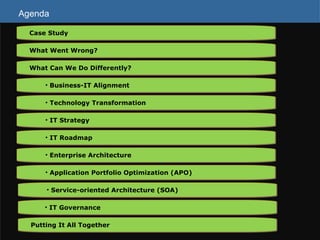
Agenda Agenda Case Study What Went Wrong? What Can We Do Differently? IT Roadmap Enterprise Architecture Application Portfolio Optimization (APO) Business-IT Alignment Service-oriented Architecture (SOA) IT Governance Technology Transformation IT Strategy Putting It All Together
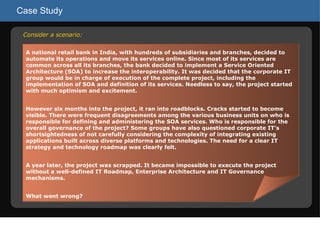
Case Study Consider a scenario: A national retail bank in India, with hundreds of subsidiaries and branches, decided to automate its operations and move its services online. Since most of its services are common across all its branches, the bank decided to implement a Service Oriented Architecture (SOA) to increase the interoperability. It was decided that the corporate IT group would be in charge of execution of the complete project, including the implementation of SOA and definition of its services. Needless to say, the project started with much optimism and excitement. However six months into the project, it ran into roadblocks. Cracks started to become visible. There were frequent disagreements among the various business units on who is responsible for defining and administering the SOA services. Who is responsible for the overall governance of the project? Some groups have also questioned corporate IT’s shortsightedness of not carefully considering the complexity of integrating existing applications built across diverse platforms and technologies. The need for a clear IT strategy and technology roadmap was clearly felt. A year later, the project was scrapped. It became impossible to execute the project without a well-defined IT Roadmap, Enterprise Architecture and IT Governance mechanisms.  What went wrong?
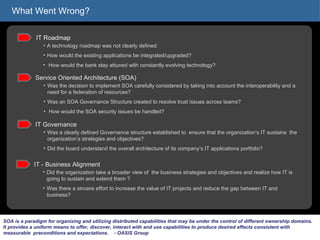
What Went Wrong? SOA is a paradigm for organizing and utilizing distributed capabilities that may be under the control of different ownership domains. It provides a uniform means to offer, discover, interact with and use capabilities to produce desired effects consistent with measurable  preconditions and expectations.  - OASIS Group IT Roadmap A technology roadmap was not clearly defined. How would the existing applications be integrated/upgraded? How would the bank stay attuned with constantly evolving technology? Service Oriented Architecture (SOA) Was the decision to implement SOA carefully considered by taking into account the interoperability and a need for a   federation   of   resources? Was an SOA Governance Structure created to resolve trust issues across teams? How would the SOA security issues be handled? IT Governance Was a clearly defined Governance structure established to  ensure that the organization’s IT sustains  the organization’s strategies and objectives? Did the board understand the overall architecture of its company’s IT applications portfolio? IT - Business Alignment Did the organization take a broader view of  the business strategies and objectives and realize how IT is going to sustain and extend them ? Was there a sincere effort to increase the value of IT projects and reduce the gap between IT and business?
What Can We Do Differently? “ Winners don’t do different things, they do things differently.” -  Shiv Khera
What Can We Do Differently?
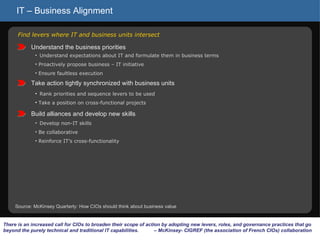
IT – Business Alignment There is an increased call for CIOs to broaden their scope of action by adopting new levers, roles, and governance practices that go beyond the purely technical and traditional IT capabilities.  – McKinsey- CIGREF (the association of French CIOs) collaboration Understand the business priorities Understand expectations about IT and formulate them in business terms Proactively propose business – IT initiative Ensure faultless execution Take action tightly synchronized with business units Rank priorities and sequence levers to be used Take a position on cross-functional projects Build alliances and develop new skills  Develop non-IT skills Be collaborative Reinforce IT’s cross-functionality Find levers where IT and business units intersect Source: McKinsey Quarterly: How CIOs should think about business value
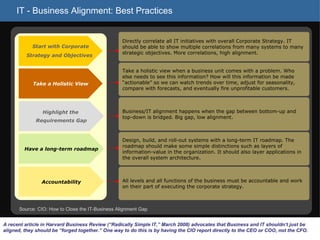
IT - Business Alignment: Best Practices Source: CIO: How to Close the IT-Business Alignment Gap A recent article in Harvard Business Review (“Radically Simple IT,” March 2008) advocates that Business and IT shouldn’t just be aligned, they should be “forged together.” One way to do this is by having the CIO report directly to the CEO or COO, not the CFO.  All levels and all functions of the business must be accountable and work on their part of executing the corporate strategy. Start with Corporate Strategy and Objectives   Take a Holistic View Highlight the  Requirements Gap Have a long-term roadmap Accountability Design, build, and roll-out systems with a long-term IT roadmap. The roadmap should make some simple distinctions such as layers of information-value in the organization. It should also layer applications in the overall system architecture. Business/IT alignment happens when the gap between bottom-up and top-down is bridged. Big gap, low alignment. Take a holistic view when a business unit comes with a problem. Who else needs to see this information? How will this information be made “actionable” so we can watch trends over time, adjust for seasonality, compare with forecasts, and eventually fire unprofitable customers. Directly correlate all IT initiatives with overall Corporate Strategy. IT should be able to show multiple correlations from many systems to many strategic objectives. More correlations, high alignment.
What Can We Do Differently?
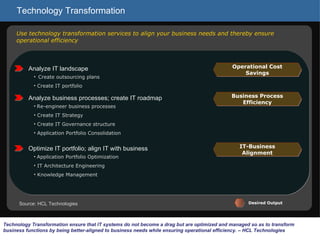
Technology Transformation Source: HCL Technologies Use technology transformation services to align your business needs and thereby ensure operational efficiency Desired Output Technology Transformation ensure that IT systems do not become a drag but are optimized and managed so as to transform business functions by being better-aligned to business needs while ensuring operational efficiency. – HCL Technologies Analyze IT landscape Create outsourcing plans Create IT portfolio  Operational Cost Savings Analyze business processes; create IT roadmap Re-engineer business processes Create IT Strategy Create IT Governance structure Application Portfolio Consolidation Business Process Efficiency Optimize IT portfolio; align IT with business Application Portfolio Optimization IT Architecture Engineering Knowledge Management IT-Business Alignment
What Can We Do Differently?
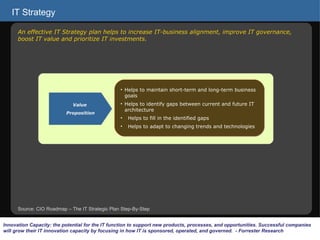
IT Strategy Innovation Capacity: the potential for the IT function to support new products, processes, and opportunities. Successful companies will grow their IT innovation capacity by focusing in how IT is sponsored, operated, and governed.  - Forrester Research An effective IT Strategy plan helps to increase IT-business alignment, improve IT governance, boost IT value and prioritize IT investments. Source: CIO Roadmap – The IT Strategic Plan Step-By-Step Value  Proposition Helps to maintain short-term and long-term business goals Helps to identify gaps between current and future IT  architecture Helps to fill in the identified gaps Helps to adapt to changing trends and technologies
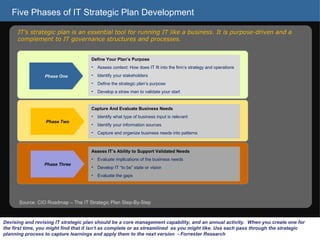
Five Phases of IT Strategic Plan Development Devising and revising IT strategic plan should be a core management capability, and an annual activity.  When you create one for the first time, you might find that it isn’t as complete or as streamlined  as you might like. Use each pass through the strategic planning process to capture learnings and apply them to the next version  - Forrester Research IT’s strategic plan is an essential tool for running IT like a business. It is purpose-driven and a complement to IT governance structures and processes. Source: CIO Roadmap – The IT Strategic Plan Step-By-Step Phase One Define Your Plan’s Purpose Assess context: How does IT fit into the firm’s strategy and operations Identify your stakeholders Define the strategic plan’s purpose Develop a straw man to validate your start Phase Two Capture And Evaluate Business Needs Identify what type of business input is relevant Identify your information sources Capture and organize business needs into patterns Phase Three Assess IT’s Ability to Support Validated Needs Evaluate implications of the business needs Develop IT “to be” state or vision Evaluate the gaps
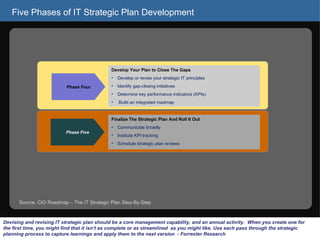
Five Phases of IT Strategic Plan Development Devising and revising IT strategic plan should be a core management capability, and an annual activity.  When you create one for the first time, you might find that it isn’t as complete or as streamlined  as you might like. Use each pass through the strategic planning process to capture learnings and apply them to the next version  - Forrester Research Phase Four Develop Your Plan to Close The Gaps Develop or revise your strategic IT principles Identify gap-closing initiatives Determine key performance indicators (KPIs) Build an integrated roadmap Source: CIO Roadmap – The IT Strategic Plan Step-By-Step Phase Five Finalize The Strategic Plan And Roll It Out Communicate broadly Institute KPI tracking Schedule strategic plan reviews
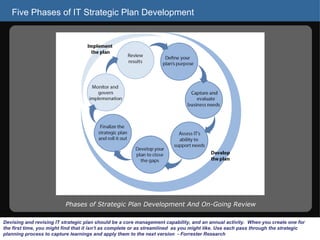
Five Phases of IT Strategic Plan Development Devising and revising IT strategic plan should be a core management capability, and an annual activity.  When you create one for the first time, you might find that it isn’t as complete or as streamlined  as you might like. Use each pass through the strategic planning process to capture learnings and apply them to the next version  - Forrester Research Phases of Strategic Plan Development And On-Going Review
What Can We Do Differently?
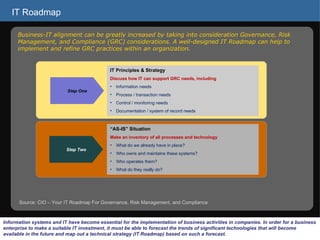
IT Roadmap Business-IT alignment can be greatly increased by taking into consideration Governance, Risk Management, and Compliance (GRC) considerations. A well-designed IT Roadmap can help to implement and refine GRC practices within an organization. Source: CIO – Your IT Roadmap For Governance, Risk Management, and Compliance  Step One IT Principles & Strategy Discuss how IT can support GRC needs, including Information needs Process / transaction needs Control / monitoring needs Documentation / system of record needs Step Two “ AS-IS” Situation Make an inventory of all processes and technology What do we already have in place? Who owns and maintains these systems? Who operates them? What do they really do? Information systems and IT have become essential for the implementation of business activities in companies. In order for a business enterprise to make a suitable IT investment, it must be able to forecast the trends of significant technologies that will become available in the future and map out a technical strategy (IT Roadmap) based on such a forecast.
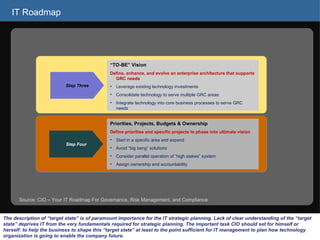
IT Roadmap Source: CIO – Your IT Roadmap For Governance, Risk Management, and Compliance  Step Three “ TO-BE” Vision Define, enhance, and evolve an enterprise architecture that supports GRC needs Leverage existing technology investments Consolidate technology to serve multiple GRC areas Integrate technology into core business processes to serve GRC needs Step Four Priorities, Projects, Budgets & Ownership Define priorities and specific projects to phase into ultimate vision Start in a specific area and expand Avoid “big bang” solutions Consider parallel operation of “high stakes” system Assign ownership and accountability The description of “target state” is of paramount importance for the IT strategic planning. Lack of clear understanding of the “target state” deprives IT from the very fundamentals required for strategic planning. The important task CIO should set for himself or herself: to help the business to shape this “target state” at least to the point sufficient for IT management to plan how technology organization is going to enable the company future.
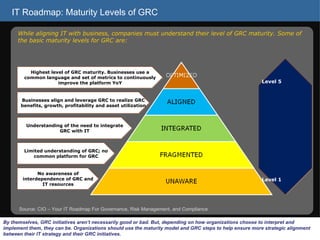
IT Roadmap: Maturity Levels of GRC  While aligning IT with business, companies must understand their level of GRC maturity. Some of the basic maturity levels for GRC are: Source: CIO – Your IT Roadmap For Governance, Risk Management, and Compliance  No awareness of interdependence of GRC and IT resources Limited understanding of GRC; no common platform for GRC Understanding of the need to integrate GRC with IT Businesses align and leverage GRC to realize GRC benefits, growth, profitability and asset utilization Highest level of GRC maturity. Businesses use a common language and set of metrics to continuously improve the platform YoY Level 5 Level 1 By themselves, GRC initiatives aren’t necessarily good or bad. But, depending on how organizations choose to interpret and implement them, they can be. Organizations should use the maturity model and GRC steps to help ensure more strategic alignment between their IT strategy and their GRC initiatives.
What Can We Do Differently?
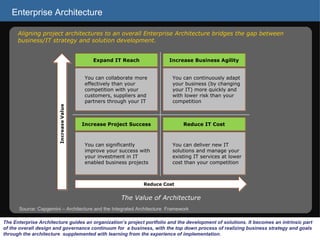
Enterprise Architecture The Enterprise Architecture guides an organization’s project portfolio and the development of solutions. It becomes an intrinsic part of the overall design and governance continuum for  a business, with the top down process of realizing business strategy and goals through the architecture  supplemented with learning from the experience of implementation. Aligning project architectures to an overall Enterprise Architecture bridges the gap between business/IT strategy and solution development. Source: Capgemini – Architecture and the Integrated Architecture  Framework Expand IT Reach You can collaborate more effectively than your competition with your customers, suppliers and partners through your IT Increase Business Agility You can continuously adapt your business (by changing your IT) more quickly and with lower risk than your competition Increase Project Success You can significantly improve your success with your investment in IT enabled business projects Reduce IT Cost You can deliver new IT solutions and manage your existing IT services at lower cost than your competition Reduce Cost The Value of Architecture
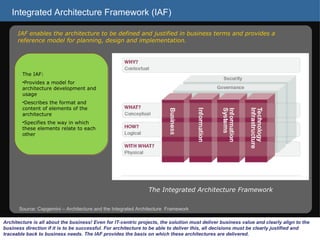
Integrated Architecture Framework (IAF) Architecture is all about the business! Even for IT-centric projects, the solution must deliver business value and clearly align to the business direction if it is to be successful. For architecture to be able to deliver this, all decisions must be clearly justified and traceable back to business needs. The IAF provides the basis on which these architectures are delivered. IAF enables the architecture to be defined and justified in business terms and provides a reference model for planning, design and implementation. Source: Capgemini – Architecture and the Integrated Architecture  Framework The Integrated Architecture Framework The IAF: Provides a model for architecture development and usage Describes the format and content of elements of the architecture Specifies the way in which these elements relate to each other
What Can We Do Differently?
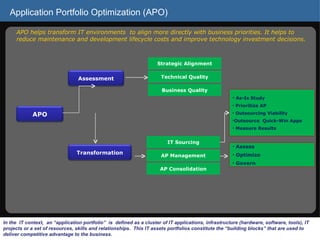
Application Portfolio Optimization (APO) In the  IT context,  an “application portfolio”  is  defined as a cluster of IT applications, infrastructure (hardware, software, tools), IT projects or a set of resources, skills and relationships.  This IT assets portfolios constitute the “building blocks” that are used to deliver competitive advantage to the business. APO helps transform IT environments  to align more directly with business priorities. It helps to reduce maintenance and development lifecycle costs and improve technology investment decisions.  Assess Optimize  Govern As-Is Study Prioritize AP Outsourcing Viability Outsource  Quick-Win Apps Measure Results Strategic Alignment Technical Quality Business Quality IT Sourcing AP Management AP Consolidation APO Assessment Transformation
What Can We Do Differently?
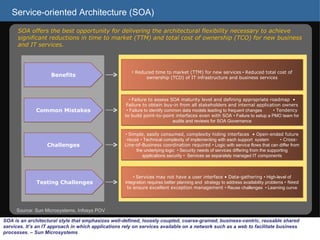
Service-oriented Architecture (SOA) SOA is an architectural style that emphasizes well-defined, loosely coupled, coarse-grained, business-centric, reusable shared services. It’s an IT approach in which applications rely on services available on a network such as a web to facilitate business processes. – Sun Microsystems SOA offers the best opportunity for delivering the architectural flexibility necessary to achieve significant reductions in time to market (TTM) and total cost of ownership (TCO) for new business and IT services. Source: Sun Microsystems, Infosys POV Benefits Common Mistakes Challenges Reduced time to market (TTM) for new services  •  Reduced total cost of ownership (TCO) of IT infrastructure and business services •  Failure to assess SOA maturity level and defining appropriate roadmap  • Failure to obtain buy-in from all stakeholders and internal application owners  • Failure to identify common data models leading to frequent changes  •  Tendency to build point-to-point interfaces even with SOA  • Failure to setup a PMO team for audits and reviews for SOA Governance •  Simple, easily consumed, complexity hiding interfaces  • Open-ended future reuse  • Technical complexity of implementing with each support  system  •  Cross-Line-of-Business coordination required  • Logic with service flows that can differ from the underlying logic  • Security needs of services differing from the supporting applications security •  Services as separately managed IT components Testing Challenges •  Services may not have a user interface • Data-gathering  • High-level of integration requires better planning and  strategy to address availability problems •  Need to ensure excellent exception management  • Reuse challenges  • Learning curve
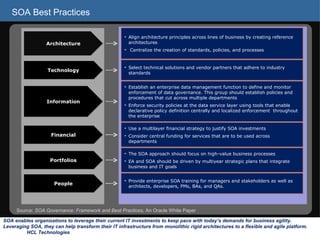
SOA Best Practices SOA enables organizations to leverage their current IT investments to keep pace with today’s demands for business agility. Leveraging SOA, they can help transform their IT infrastructure from monolithic rigid architectures to a flexible and agile platform.  HCL Technologies Source:  SOA Governance: Framework and Best Practices,  An Oracle White Paper Architecture Technology Align architecture principles across lines of business by creating reference architectures Centralize the creation of standards, policies, and processes Select technical solutions and vendor partners that adhere to industry standards Information Establish an enterprise data management function to define and monitor enforcement of data governance. This group should establish policies and procedures that cut across multiple departments Enforce security policies at the data service layer using tools that enable declarative policy definition centrally and localized enforcement  throughout the enterprise Financial Use a multilayer financial strategy to justify SOA investments Consider central funding for services that are to be used across departments Portfolios The SOA approach should focus on high-value business processes EA and SOA should be driven by multiyear strategic plans that integrate business and IT goals People Provide enterprise SOA training for managers and stakeholders as well as architects, developers, PMs, BAs, and QAs.
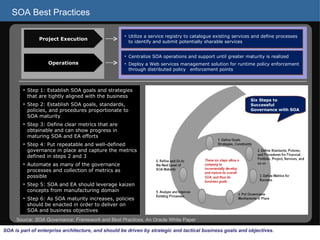
SOA Best Practices Source:  SOA Governance: Framework and Best Practices,  An Oracle White Paper Project Execution Operations Utilize a service registry to catalogue existing services and define processes to identify and submit potentially sharable services Centralize SOA operations and support until greater maturity is realized Deploy a Web services management solution for runtime policy enforcement through distributed policy  enforcement points Six Steps to Successful Governance with SOA Step 1: Establish SOA goals and strategies that are tightly aligned with the business Step 2: Establish SOA goals, standards, policies, and procedures proportionate to SOA maturity Step 3: Define clear metrics that are obtainable and can show progress in maturing SOA and EA efforts Step 4: Put repeatable and well-defined governance in place and capture the metrics defined in steps 2 and 3 Automate as many of the governance processes and collection of metrics as possible Step 5: SOA and EA should leverage kaizen concepts from manufacturing domain Step 6: As SOA maturity increases, policies should be enacted in order to deliver on SOA and business objectives SOA is part of enterprise architecture, and should be driven by strategic and tactical business goals and objectives.
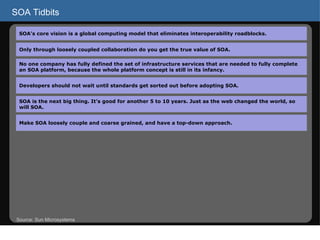
SOA Tidbits Source: Sun Microsystems SOA’s core vision is a global computing model that eliminates interoperability roadblocks.  Only through loosely coupled collaboration do you get the true value of SOA. No one company has fully defined the set of infrastructure services that are needed to fully complete an SOA platform, because the whole platform concept is still in its infancy. Developers should not wait until standards get sorted out before adopting SOA. SOA is the next big thing. It’s good for another 5 to 10 years. Just as the web changed the world, so will SOA. Make SOA loosely couple and coarse grained, and have a top-down approach.
What Can We Do Differently?
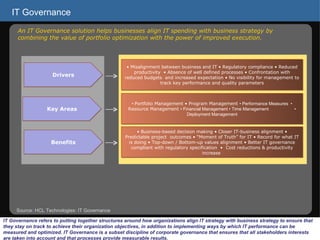
IT Governance IT Governance refers to putting together structures around how organizations align IT strategy with business strategy to ensure that they stay on track to achieve their organization objectives, in addition to implementing ways by which IT performance can be measured and optimized. IT Governance is a subset discipline of corporate governance that ensures that all stakeholders interests are taken into account and that processes provide measurable results.  An IT Governance solution helps businesses align IT spending with business strategy by combining the value of portfolio optimization with the power of improved execution. Source: HCL Technologies: IT Governance Drivers Key Areas Benefits •  Misalignment between business and IT • Regulatory compliance • Reduced productivity  • Absence of well defined processes • Confrontation with reduced budgets  and increased expectation • No visibility for management to track key performance and quality parameters •  Portfolio Management • Program Management  • Performance Measures  •  Resource Management  • Financial Management • Time Management  • Deployment Management •  Business-based decision making • Closer IT-business alignment • Predictable project  outcomes • “Moment of Truth” for IT • Record for what IT is doing • Top-down / Bottom-up values alignment • Better IT governance compliant with regulatory specification  •  Cost reductions & productivity increase
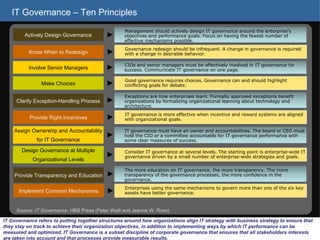
IT Governance – Ten Principles IT Governance refers to putting together structures around how organizations align IT strategy with business strategy to ensure that they stay on track to achieve their organization objectives, in addition to implementing ways by which IT performance can be measured and optimized. IT Governance is a subset discipline of corporate governance that ensures that all stakeholders interests are taken into account and that processes provide measurable results.  Source:  IT Governance : HBS Press (Peter Weill and Jeanne W. Ross) Actively Design Governance Management should actively design IT governance around the enterprise’s objectives and performance goals. Focus on having the fewest number of effective mechanisms possible. Know When to Redesign Governance redesign should be infrequent. A change in governance is required with a change in desirable behavior. Involve Senior Managers CIOs and senior managers must be effectively involved in IT governance for success. Communicate IT governance on one page. Make Choices Good governance requires choices. Governance can and should highlight conflicting goals for debate. Clarify Exception-Handling Process Exceptions are how enterprises learn. Formally approved exceptions benefit organizations by formalizing organizational learning about technology and architecture. Provide Right Incentives IT governance is more effective when incentive and reward systems are aligned with organizational goals. Assign Ownership and Accountability for IT Governance IT governance must have an owner and accountabilities. The board or CEO must hold the CIO or a committee accountable for IT governance performance with some clear measures of success. Design Governance at Multiple Organizational Levels Consider IT governance at several levels. The starting point is enterprise-wide IT governance driven by a small number of enterprise-wide strategies and goals.  Provide Transparency and Education The more education on IT governance, the more transparency. The more transparency of the governance processes, the more confidence in the governance. Implement Common Mechanisms Enterprises using the same mechanisms to govern more than one of the six key assets have better governance.
Putting It All Together
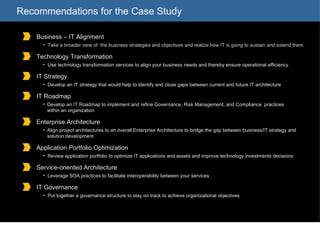
Recommendations for the Case Study Business – IT Alignment Take a broader view of  the business strategies and objectives and realize how IT is going to sustain and extend them Technology Transformation Use technology transformation services to align your business needs and thereby ensure operational efficiency IT Strategy Develop an IT strategy that would help to identify and close gaps between current and future IT architecture   IT Roadmap Develop an IT Roadmap to implement and refine Governance, Risk Management, and Compliance  practices within an organization Enterprise Architecture Align project architectures to an overall Enterprise Architecture to bridge the gap between business/IT strategy and solution development Application Portfolio Optimization Review application portfolio to optimize IT applications and assets and improve technology investments decisions Service-oriented Architecture Leverage SOA practices to facilitate interoperability between your services IT Governance Put together a governance structure to stay on track to achieve organizational objectives
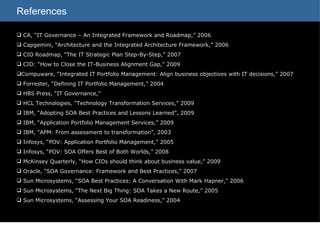
References CA, “IT Governance – An Integrated Framework and Roadmap,” 2006 Capgemini, “Architecture and the Integrated Architecture Framework,” 2006 CIO Roadmap, “The IT Strategic Plan Step-By-Step,” 2007 CIO: “How to Close the IT-Business Alignment Gap,” 2009 Compuware, “Integrated IT Portfolio Management: Align business objectives with IT decisions,” 2007 Forrester, “Defining IT Portfolio Management,” 2004 HBS Press, “IT Governance,”  HCL Technologies, “Technology Transformation Services,” 2009 IBM, “Adopting SOA Best Practices and Lessons Learned”, 2009 IBM, “Application Portfolio Management Services,” 2009 IBM, “APM: From assessment to transformation”, 2003 Infosys, “POV: Application Portfolio Management,” 2005 Infosys, “POV: SOA Offers Best of Both Worlds,” 2008 McKinsey Quarterly, “How CIOs should think about business value,” 2009  Oracle, “SOA Governance: Framework and Best Practices,” 2007 Sun Microsystems, “SOA Best Practices: A Conversation With Mark Hapner,” 2006 Sun Microsystems, “The Next Big Thing: SOA Takes a New Route,” 2005 Sun Microsystems, “Assessing Your SOA Readiness,” 2004
THANK YOU For questions and feedback, email [email_address]
APPENDIX
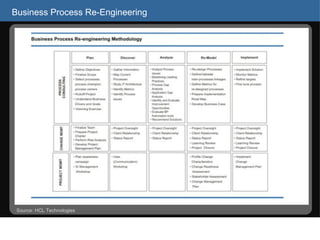
Business Process Re-Engineering Source: HCL Technologies

Using Technology Transformation Effectively To Improve It Business Alignment

  • 1.
    Pritam Dey [email_address]Using Technology Transformation Effectively to Improve Business-IT Alignment 2009
  • 2.
    Agenda Agenda CaseStudy What Went Wrong? What Can We Do Differently? IT Roadmap Enterprise Architecture Application Portfolio Optimization (APO) Business-IT Alignment Service-oriented Architecture (SOA) IT Governance Technology Transformation IT Strategy Putting It All Together
  • 3.
    Case Study Considera scenario: A national retail bank in India, with hundreds of subsidiaries and branches, decided to automate its operations and move its services online. Since most of its services are common across all its branches, the bank decided to implement a Service Oriented Architecture (SOA) to increase the interoperability. It was decided that the corporate IT group would be in charge of execution of the complete project, including the implementation of SOA and definition of its services. Needless to say, the project started with much optimism and excitement. However six months into the project, it ran into roadblocks. Cracks started to become visible. There were frequent disagreements among the various business units on who is responsible for defining and administering the SOA services. Who is responsible for the overall governance of the project? Some groups have also questioned corporate IT’s shortsightedness of not carefully considering the complexity of integrating existing applications built across diverse platforms and technologies. The need for a clear IT strategy and technology roadmap was clearly felt. A year later, the project was scrapped. It became impossible to execute the project without a well-defined IT Roadmap, Enterprise Architecture and IT Governance mechanisms. What went wrong?
  • 4.
    What Went Wrong?SOA is a paradigm for organizing and utilizing distributed capabilities that may be under the control of different ownership domains. It provides a uniform means to offer, discover, interact with and use capabilities to produce desired effects consistent with measurable preconditions and expectations. - OASIS Group IT Roadmap A technology roadmap was not clearly defined. How would the existing applications be integrated/upgraded? How would the bank stay attuned with constantly evolving technology? Service Oriented Architecture (SOA) Was the decision to implement SOA carefully considered by taking into account the interoperability and a need for a federation of resources? Was an SOA Governance Structure created to resolve trust issues across teams? How would the SOA security issues be handled? IT Governance Was a clearly defined Governance structure established to ensure that the organization’s IT sustains the organization’s strategies and objectives? Did the board understand the overall architecture of its company’s IT applications portfolio? IT - Business Alignment Did the organization take a broader view of the business strategies and objectives and realize how IT is going to sustain and extend them ? Was there a sincere effort to increase the value of IT projects and reduce the gap between IT and business?
  • 5.
    What Can WeDo Differently? “ Winners don’t do different things, they do things differently.” - Shiv Khera
  • 6.
    What Can WeDo Differently?
  • 7.
    IT – BusinessAlignment There is an increased call for CIOs to broaden their scope of action by adopting new levers, roles, and governance practices that go beyond the purely technical and traditional IT capabilities. – McKinsey- CIGREF (the association of French CIOs) collaboration Understand the business priorities Understand expectations about IT and formulate them in business terms Proactively propose business – IT initiative Ensure faultless execution Take action tightly synchronized with business units Rank priorities and sequence levers to be used Take a position on cross-functional projects Build alliances and develop new skills Develop non-IT skills Be collaborative Reinforce IT’s cross-functionality Find levers where IT and business units intersect Source: McKinsey Quarterly: How CIOs should think about business value
  • 8.
    IT - BusinessAlignment: Best Practices Source: CIO: How to Close the IT-Business Alignment Gap A recent article in Harvard Business Review (“Radically Simple IT,” March 2008) advocates that Business and IT shouldn’t just be aligned, they should be “forged together.” One way to do this is by having the CIO report directly to the CEO or COO, not the CFO. All levels and all functions of the business must be accountable and work on their part of executing the corporate strategy. Start with Corporate Strategy and Objectives Take a Holistic View Highlight the Requirements Gap Have a long-term roadmap Accountability Design, build, and roll-out systems with a long-term IT roadmap. The roadmap should make some simple distinctions such as layers of information-value in the organization. It should also layer applications in the overall system architecture. Business/IT alignment happens when the gap between bottom-up and top-down is bridged. Big gap, low alignment. Take a holistic view when a business unit comes with a problem. Who else needs to see this information? How will this information be made “actionable” so we can watch trends over time, adjust for seasonality, compare with forecasts, and eventually fire unprofitable customers. Directly correlate all IT initiatives with overall Corporate Strategy. IT should be able to show multiple correlations from many systems to many strategic objectives. More correlations, high alignment.
  • 9.
    What Can WeDo Differently?
  • 10.
    Technology Transformation Source:HCL Technologies Use technology transformation services to align your business needs and thereby ensure operational efficiency Desired Output Technology Transformation ensure that IT systems do not become a drag but are optimized and managed so as to transform business functions by being better-aligned to business needs while ensuring operational efficiency. – HCL Technologies Analyze IT landscape Create outsourcing plans Create IT portfolio Operational Cost Savings Analyze business processes; create IT roadmap Re-engineer business processes Create IT Strategy Create IT Governance structure Application Portfolio Consolidation Business Process Efficiency Optimize IT portfolio; align IT with business Application Portfolio Optimization IT Architecture Engineering Knowledge Management IT-Business Alignment
  • 11.
    What Can WeDo Differently?
  • 12.
    IT Strategy InnovationCapacity: the potential for the IT function to support new products, processes, and opportunities. Successful companies will grow their IT innovation capacity by focusing in how IT is sponsored, operated, and governed. - Forrester Research An effective IT Strategy plan helps to increase IT-business alignment, improve IT governance, boost IT value and prioritize IT investments. Source: CIO Roadmap – The IT Strategic Plan Step-By-Step Value Proposition Helps to maintain short-term and long-term business goals Helps to identify gaps between current and future IT architecture Helps to fill in the identified gaps Helps to adapt to changing trends and technologies
  • 13.
    Five Phases ofIT Strategic Plan Development Devising and revising IT strategic plan should be a core management capability, and an annual activity. When you create one for the first time, you might find that it isn’t as complete or as streamlined as you might like. Use each pass through the strategic planning process to capture learnings and apply them to the next version - Forrester Research IT’s strategic plan is an essential tool for running IT like a business. It is purpose-driven and a complement to IT governance structures and processes. Source: CIO Roadmap – The IT Strategic Plan Step-By-Step Phase One Define Your Plan’s Purpose Assess context: How does IT fit into the firm’s strategy and operations Identify your stakeholders Define the strategic plan’s purpose Develop a straw man to validate your start Phase Two Capture And Evaluate Business Needs Identify what type of business input is relevant Identify your information sources Capture and organize business needs into patterns Phase Three Assess IT’s Ability to Support Validated Needs Evaluate implications of the business needs Develop IT “to be” state or vision Evaluate the gaps
  • 14.
    Five Phases ofIT Strategic Plan Development Devising and revising IT strategic plan should be a core management capability, and an annual activity. When you create one for the first time, you might find that it isn’t as complete or as streamlined as you might like. Use each pass through the strategic planning process to capture learnings and apply them to the next version - Forrester Research Phase Four Develop Your Plan to Close The Gaps Develop or revise your strategic IT principles Identify gap-closing initiatives Determine key performance indicators (KPIs) Build an integrated roadmap Source: CIO Roadmap – The IT Strategic Plan Step-By-Step Phase Five Finalize The Strategic Plan And Roll It Out Communicate broadly Institute KPI tracking Schedule strategic plan reviews
  • 15.
    Five Phases ofIT Strategic Plan Development Devising and revising IT strategic plan should be a core management capability, and an annual activity. When you create one for the first time, you might find that it isn’t as complete or as streamlined as you might like. Use each pass through the strategic planning process to capture learnings and apply them to the next version - Forrester Research Phases of Strategic Plan Development And On-Going Review
  • 16.
    What Can WeDo Differently?
  • 17.
    IT Roadmap Business-ITalignment can be greatly increased by taking into consideration Governance, Risk Management, and Compliance (GRC) considerations. A well-designed IT Roadmap can help to implement and refine GRC practices within an organization. Source: CIO – Your IT Roadmap For Governance, Risk Management, and Compliance Step One IT Principles & Strategy Discuss how IT can support GRC needs, including Information needs Process / transaction needs Control / monitoring needs Documentation / system of record needs Step Two “ AS-IS” Situation Make an inventory of all processes and technology What do we already have in place? Who owns and maintains these systems? Who operates them? What do they really do? Information systems and IT have become essential for the implementation of business activities in companies. In order for a business enterprise to make a suitable IT investment, it must be able to forecast the trends of significant technologies that will become available in the future and map out a technical strategy (IT Roadmap) based on such a forecast.
  • 18.
    IT Roadmap Source:CIO – Your IT Roadmap For Governance, Risk Management, and Compliance Step Three “ TO-BE” Vision Define, enhance, and evolve an enterprise architecture that supports GRC needs Leverage existing technology investments Consolidate technology to serve multiple GRC areas Integrate technology into core business processes to serve GRC needs Step Four Priorities, Projects, Budgets & Ownership Define priorities and specific projects to phase into ultimate vision Start in a specific area and expand Avoid “big bang” solutions Consider parallel operation of “high stakes” system Assign ownership and accountability The description of “target state” is of paramount importance for the IT strategic planning. Lack of clear understanding of the “target state” deprives IT from the very fundamentals required for strategic planning. The important task CIO should set for himself or herself: to help the business to shape this “target state” at least to the point sufficient for IT management to plan how technology organization is going to enable the company future.
  • 19.
    IT Roadmap: MaturityLevels of GRC While aligning IT with business, companies must understand their level of GRC maturity. Some of the basic maturity levels for GRC are: Source: CIO – Your IT Roadmap For Governance, Risk Management, and Compliance No awareness of interdependence of GRC and IT resources Limited understanding of GRC; no common platform for GRC Understanding of the need to integrate GRC with IT Businesses align and leverage GRC to realize GRC benefits, growth, profitability and asset utilization Highest level of GRC maturity. Businesses use a common language and set of metrics to continuously improve the platform YoY Level 5 Level 1 By themselves, GRC initiatives aren’t necessarily good or bad. But, depending on how organizations choose to interpret and implement them, they can be. Organizations should use the maturity model and GRC steps to help ensure more strategic alignment between their IT strategy and their GRC initiatives.
  • 20.
    What Can WeDo Differently?
  • 21.
    Enterprise Architecture TheEnterprise Architecture guides an organization’s project portfolio and the development of solutions. It becomes an intrinsic part of the overall design and governance continuum for a business, with the top down process of realizing business strategy and goals through the architecture supplemented with learning from the experience of implementation. Aligning project architectures to an overall Enterprise Architecture bridges the gap between business/IT strategy and solution development. Source: Capgemini – Architecture and the Integrated Architecture Framework Expand IT Reach You can collaborate more effectively than your competition with your customers, suppliers and partners through your IT Increase Business Agility You can continuously adapt your business (by changing your IT) more quickly and with lower risk than your competition Increase Project Success You can significantly improve your success with your investment in IT enabled business projects Reduce IT Cost You can deliver new IT solutions and manage your existing IT services at lower cost than your competition Reduce Cost The Value of Architecture
  • 22.
    Integrated Architecture Framework(IAF) Architecture is all about the business! Even for IT-centric projects, the solution must deliver business value and clearly align to the business direction if it is to be successful. For architecture to be able to deliver this, all decisions must be clearly justified and traceable back to business needs. The IAF provides the basis on which these architectures are delivered. IAF enables the architecture to be defined and justified in business terms and provides a reference model for planning, design and implementation. Source: Capgemini – Architecture and the Integrated Architecture Framework The Integrated Architecture Framework The IAF: Provides a model for architecture development and usage Describes the format and content of elements of the architecture Specifies the way in which these elements relate to each other
  • 23.
    What Can WeDo Differently?
  • 24.
    Application Portfolio Optimization(APO) In the IT context, an “application portfolio” is defined as a cluster of IT applications, infrastructure (hardware, software, tools), IT projects or a set of resources, skills and relationships. This IT assets portfolios constitute the “building blocks” that are used to deliver competitive advantage to the business. APO helps transform IT environments to align more directly with business priorities. It helps to reduce maintenance and development lifecycle costs and improve technology investment decisions. Assess Optimize Govern As-Is Study Prioritize AP Outsourcing Viability Outsource Quick-Win Apps Measure Results Strategic Alignment Technical Quality Business Quality IT Sourcing AP Management AP Consolidation APO Assessment Transformation
  • 25.
    What Can WeDo Differently?
  • 26.
    Service-oriented Architecture (SOA)SOA is an architectural style that emphasizes well-defined, loosely coupled, coarse-grained, business-centric, reusable shared services. It’s an IT approach in which applications rely on services available on a network such as a web to facilitate business processes. – Sun Microsystems SOA offers the best opportunity for delivering the architectural flexibility necessary to achieve significant reductions in time to market (TTM) and total cost of ownership (TCO) for new business and IT services. Source: Sun Microsystems, Infosys POV Benefits Common Mistakes Challenges Reduced time to market (TTM) for new services • Reduced total cost of ownership (TCO) of IT infrastructure and business services • Failure to assess SOA maturity level and defining appropriate roadmap • Failure to obtain buy-in from all stakeholders and internal application owners • Failure to identify common data models leading to frequent changes • Tendency to build point-to-point interfaces even with SOA • Failure to setup a PMO team for audits and reviews for SOA Governance • Simple, easily consumed, complexity hiding interfaces • Open-ended future reuse • Technical complexity of implementing with each support system • Cross-Line-of-Business coordination required • Logic with service flows that can differ from the underlying logic • Security needs of services differing from the supporting applications security • Services as separately managed IT components Testing Challenges • Services may not have a user interface • Data-gathering • High-level of integration requires better planning and strategy to address availability problems • Need to ensure excellent exception management • Reuse challenges • Learning curve
  • 27.
    SOA Best PracticesSOA enables organizations to leverage their current IT investments to keep pace with today’s demands for business agility. Leveraging SOA, they can help transform their IT infrastructure from monolithic rigid architectures to a flexible and agile platform. HCL Technologies Source: SOA Governance: Framework and Best Practices, An Oracle White Paper Architecture Technology Align architecture principles across lines of business by creating reference architectures Centralize the creation of standards, policies, and processes Select technical solutions and vendor partners that adhere to industry standards Information Establish an enterprise data management function to define and monitor enforcement of data governance. This group should establish policies and procedures that cut across multiple departments Enforce security policies at the data service layer using tools that enable declarative policy definition centrally and localized enforcement throughout the enterprise Financial Use a multilayer financial strategy to justify SOA investments Consider central funding for services that are to be used across departments Portfolios The SOA approach should focus on high-value business processes EA and SOA should be driven by multiyear strategic plans that integrate business and IT goals People Provide enterprise SOA training for managers and stakeholders as well as architects, developers, PMs, BAs, and QAs.
  • 28.
    SOA Best PracticesSource: SOA Governance: Framework and Best Practices, An Oracle White Paper Project Execution Operations Utilize a service registry to catalogue existing services and define processes to identify and submit potentially sharable services Centralize SOA operations and support until greater maturity is realized Deploy a Web services management solution for runtime policy enforcement through distributed policy enforcement points Six Steps to Successful Governance with SOA Step 1: Establish SOA goals and strategies that are tightly aligned with the business Step 2: Establish SOA goals, standards, policies, and procedures proportionate to SOA maturity Step 3: Define clear metrics that are obtainable and can show progress in maturing SOA and EA efforts Step 4: Put repeatable and well-defined governance in place and capture the metrics defined in steps 2 and 3 Automate as many of the governance processes and collection of metrics as possible Step 5: SOA and EA should leverage kaizen concepts from manufacturing domain Step 6: As SOA maturity increases, policies should be enacted in order to deliver on SOA and business objectives SOA is part of enterprise architecture, and should be driven by strategic and tactical business goals and objectives.
  • 29.
    SOA Tidbits Source:Sun Microsystems SOA’s core vision is a global computing model that eliminates interoperability roadblocks. Only through loosely coupled collaboration do you get the true value of SOA. No one company has fully defined the set of infrastructure services that are needed to fully complete an SOA platform, because the whole platform concept is still in its infancy. Developers should not wait until standards get sorted out before adopting SOA. SOA is the next big thing. It’s good for another 5 to 10 years. Just as the web changed the world, so will SOA. Make SOA loosely couple and coarse grained, and have a top-down approach.
  • 30.
    What Can WeDo Differently?
  • 31.
    IT Governance ITGovernance refers to putting together structures around how organizations align IT strategy with business strategy to ensure that they stay on track to achieve their organization objectives, in addition to implementing ways by which IT performance can be measured and optimized. IT Governance is a subset discipline of corporate governance that ensures that all stakeholders interests are taken into account and that processes provide measurable results. An IT Governance solution helps businesses align IT spending with business strategy by combining the value of portfolio optimization with the power of improved execution. Source: HCL Technologies: IT Governance Drivers Key Areas Benefits • Misalignment between business and IT • Regulatory compliance • Reduced productivity • Absence of well defined processes • Confrontation with reduced budgets and increased expectation • No visibility for management to track key performance and quality parameters • Portfolio Management • Program Management • Performance Measures • Resource Management • Financial Management • Time Management • Deployment Management • Business-based decision making • Closer IT-business alignment • Predictable project outcomes • “Moment of Truth” for IT • Record for what IT is doing • Top-down / Bottom-up values alignment • Better IT governance compliant with regulatory specification • Cost reductions & productivity increase
  • 32.
    IT Governance –Ten Principles IT Governance refers to putting together structures around how organizations align IT strategy with business strategy to ensure that they stay on track to achieve their organization objectives, in addition to implementing ways by which IT performance can be measured and optimized. IT Governance is a subset discipline of corporate governance that ensures that all stakeholders interests are taken into account and that processes provide measurable results. Source: IT Governance : HBS Press (Peter Weill and Jeanne W. Ross) Actively Design Governance Management should actively design IT governance around the enterprise’s objectives and performance goals. Focus on having the fewest number of effective mechanisms possible. Know When to Redesign Governance redesign should be infrequent. A change in governance is required with a change in desirable behavior. Involve Senior Managers CIOs and senior managers must be effectively involved in IT governance for success. Communicate IT governance on one page. Make Choices Good governance requires choices. Governance can and should highlight conflicting goals for debate. Clarify Exception-Handling Process Exceptions are how enterprises learn. Formally approved exceptions benefit organizations by formalizing organizational learning about technology and architecture. Provide Right Incentives IT governance is more effective when incentive and reward systems are aligned with organizational goals. Assign Ownership and Accountability for IT Governance IT governance must have an owner and accountabilities. The board or CEO must hold the CIO or a committee accountable for IT governance performance with some clear measures of success. Design Governance at Multiple Organizational Levels Consider IT governance at several levels. The starting point is enterprise-wide IT governance driven by a small number of enterprise-wide strategies and goals. Provide Transparency and Education The more education on IT governance, the more transparency. The more transparency of the governance processes, the more confidence in the governance. Implement Common Mechanisms Enterprises using the same mechanisms to govern more than one of the six key assets have better governance.
  • 33.
  • 34.
    Recommendations for theCase Study Business – IT Alignment Take a broader view of the business strategies and objectives and realize how IT is going to sustain and extend them Technology Transformation Use technology transformation services to align your business needs and thereby ensure operational efficiency IT Strategy Develop an IT strategy that would help to identify and close gaps between current and future IT architecture IT Roadmap Develop an IT Roadmap to implement and refine Governance, Risk Management, and Compliance practices within an organization Enterprise Architecture Align project architectures to an overall Enterprise Architecture to bridge the gap between business/IT strategy and solution development Application Portfolio Optimization Review application portfolio to optimize IT applications and assets and improve technology investments decisions Service-oriented Architecture Leverage SOA practices to facilitate interoperability between your services IT Governance Put together a governance structure to stay on track to achieve organizational objectives
  • 35.
    References CA, “ITGovernance – An Integrated Framework and Roadmap,” 2006 Capgemini, “Architecture and the Integrated Architecture Framework,” 2006 CIO Roadmap, “The IT Strategic Plan Step-By-Step,” 2007 CIO: “How to Close the IT-Business Alignment Gap,” 2009 Compuware, “Integrated IT Portfolio Management: Align business objectives with IT decisions,” 2007 Forrester, “Defining IT Portfolio Management,” 2004 HBS Press, “IT Governance,” HCL Technologies, “Technology Transformation Services,” 2009 IBM, “Adopting SOA Best Practices and Lessons Learned”, 2009 IBM, “Application Portfolio Management Services,” 2009 IBM, “APM: From assessment to transformation”, 2003 Infosys, “POV: Application Portfolio Management,” 2005 Infosys, “POV: SOA Offers Best of Both Worlds,” 2008 McKinsey Quarterly, “How CIOs should think about business value,” 2009 Oracle, “SOA Governance: Framework and Best Practices,” 2007 Sun Microsystems, “SOA Best Practices: A Conversation With Mark Hapner,” 2006 Sun Microsystems, “The Next Big Thing: SOA Takes a New Route,” 2005 Sun Microsystems, “Assessing Your SOA Readiness,” 2004
  • 36.
    THANK YOU Forquestions and feedback, email [email_address]
  • 37.
  • 38.
    Business Process Re-EngineeringSource: HCL Technologies