Presentation on AsepticPresentation on Aseptic
Filling TechniquesFilling Techniques
Presented By:
Muhammad Samie
Lecturer HIPS
“Aseptic filling Techniques: A series of
actions used to minimize
contamination during manufacturing
of Sterile drug Products”.
“Sterile product is Said to be a Product
which is free from micro-organisms
and their spores”.
While to make a sterile product we
need an environment which should be
free from micro-organisms and the no.
of Air borne particles Should be in a
controlled Limit and that is known as
aseptic Environment.
or
“An Area with defined environmental
control of Particulate and microbial
count”.
The main aim of Aseptic filling
techniques is to Improve Product
quality
To Maintain an Aseptic filling
environment we need to control
the Contamination.
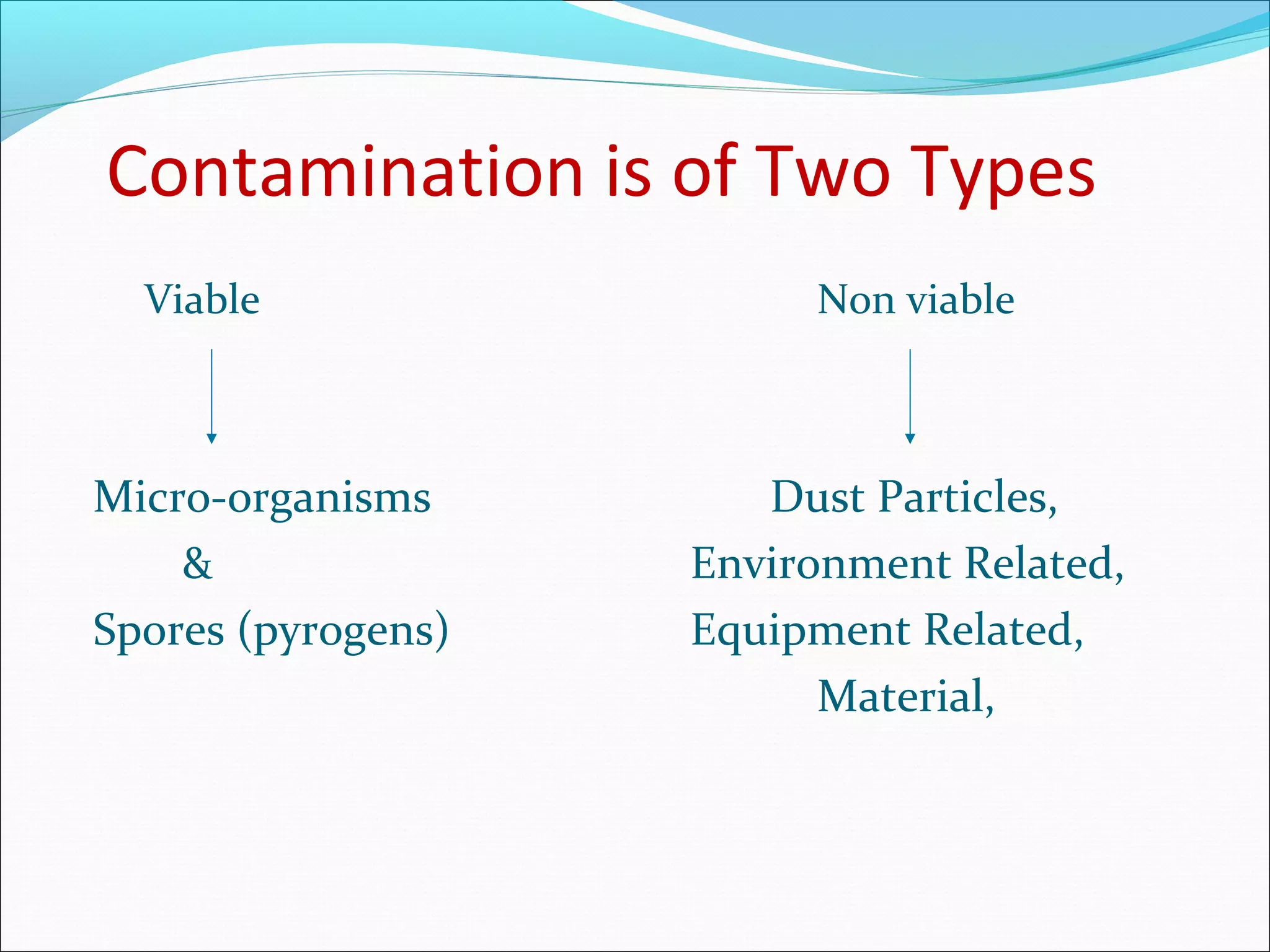
Contamination is of Two Types
Viable Non viable
Micro-organisms Dust Particles,
& Environment Related,
Spores (pyrogens) Equipment Related,
Material,
Sources of ContaminationSources of Contamination
Facilities:
Walls, Floors and Ceiling
Paint and Coatings
Construction material
Air Conditioning Debris
Spills and Leaks
Peoples:
Skin flakes and oil
Cosmetics and perfumes
Hairs
Clothing Debris
Spitting
Tools Generated:
Friction
Lubrication
Vibration
Mops and Dusters
Fluids:
Cleaning Chemicals
De-ionized water
Humidity in Air
Product Generated:
Aluminum Particles
Rubber gaskets
How to Control Contamination?
Three main types are there to Control
Contamination
 Environmental Control.
HEPA Filters , HVAC System
& Fumigation of Area
 Equipment Control.
Sterilization & Sanitization
 Individual Control.
Personnel Hygiene & Aseptic Gowning
1.Environmental Control:1.Environmental Control:
The Design of The Clean Room Play a major Role
in Maintaining The Aseptic Area.
Different types of processes needs different
cleanliness levels depending on viable and non
viable count.
Two major areas are there
Critical Area
Less critical / General Area
Basic design of clean room is:
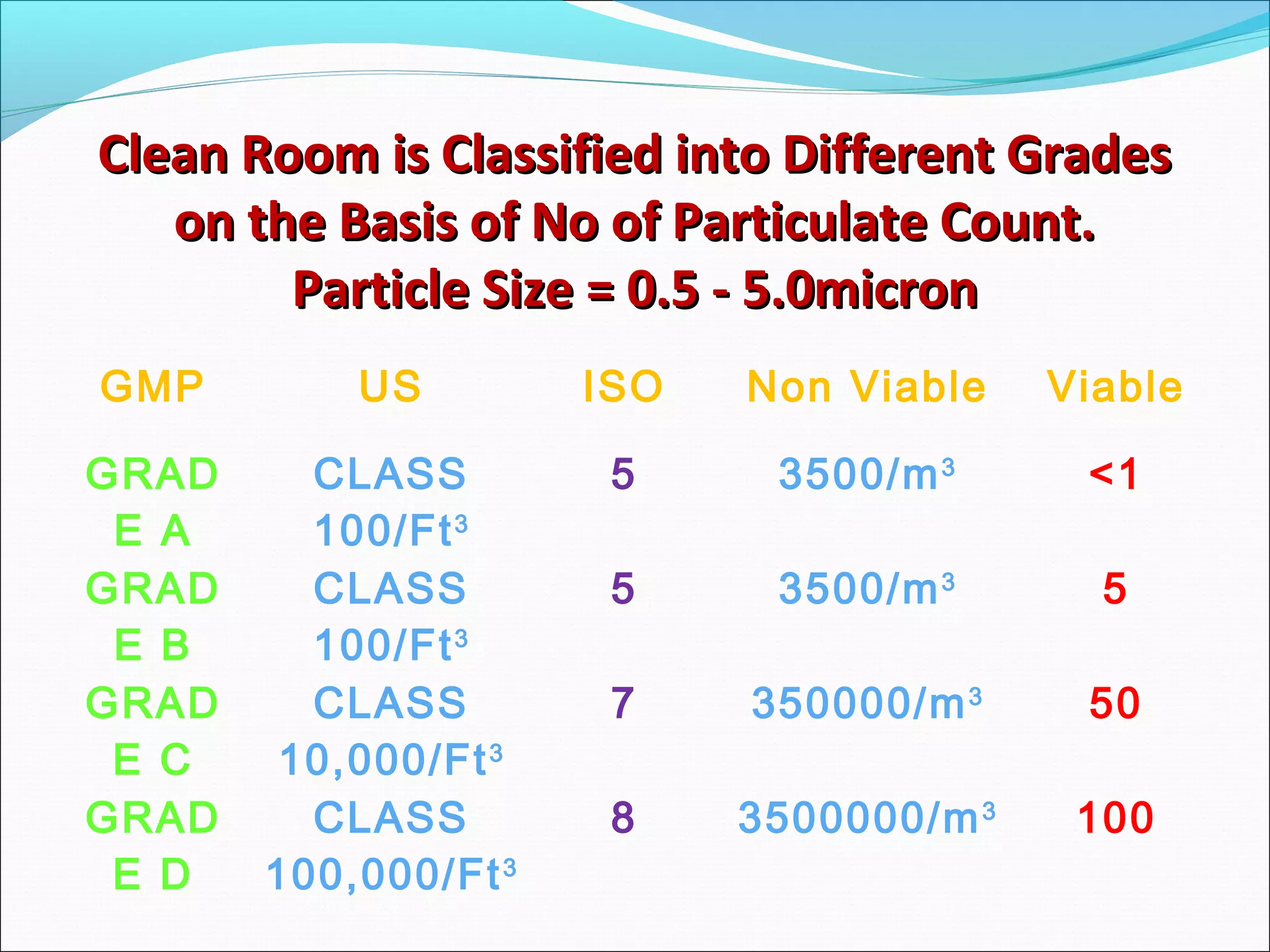
Clean Room is Classified into Different GradesClean Room is Classified into Different Grades
on the Basis of No of Particulate Count.on the Basis of No of Particulate Count.
Particle Size = 0.5 - 5.0micronParticle Size = 0.5 - 5.0micron
GMP US ISO Non Viable Viable
GRAD
E A
CLASS
100/Ft3
5 3500/m3
<1
GRAD
E B
CLASS
100/Ft3
5 3500/m3
5
GRAD
E C
CLASS
10,000/Ft3
7 350000/m3
50
GRAD
E D
CLASS
100,000/Ft3
8 3500000/m3
100
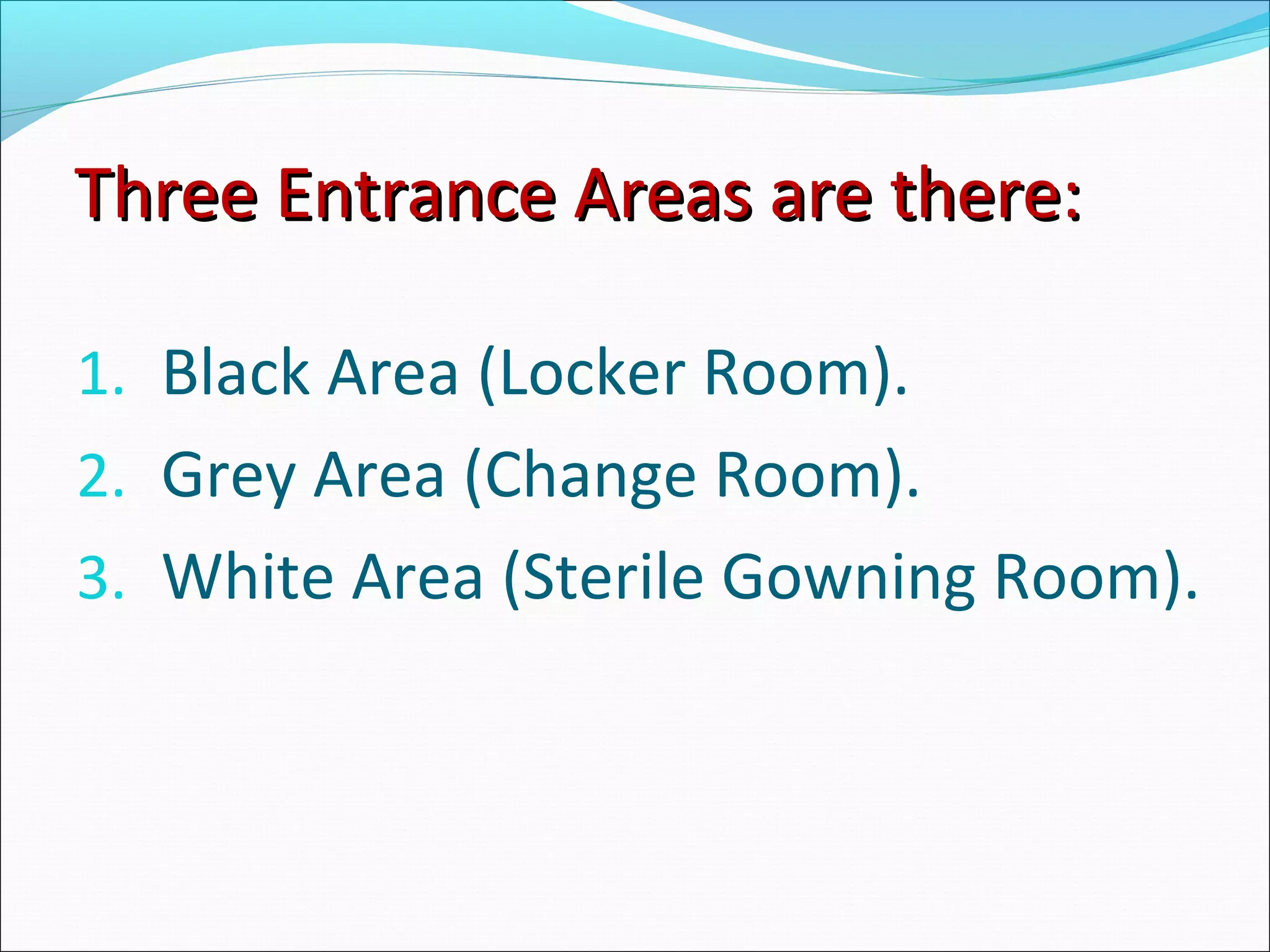
Three Entrance Areas are there:Three Entrance Areas are there:
1. Black Area (Locker Room).
2. Grey Area (Change Room).
3. White Area (Sterile Gowning Room).
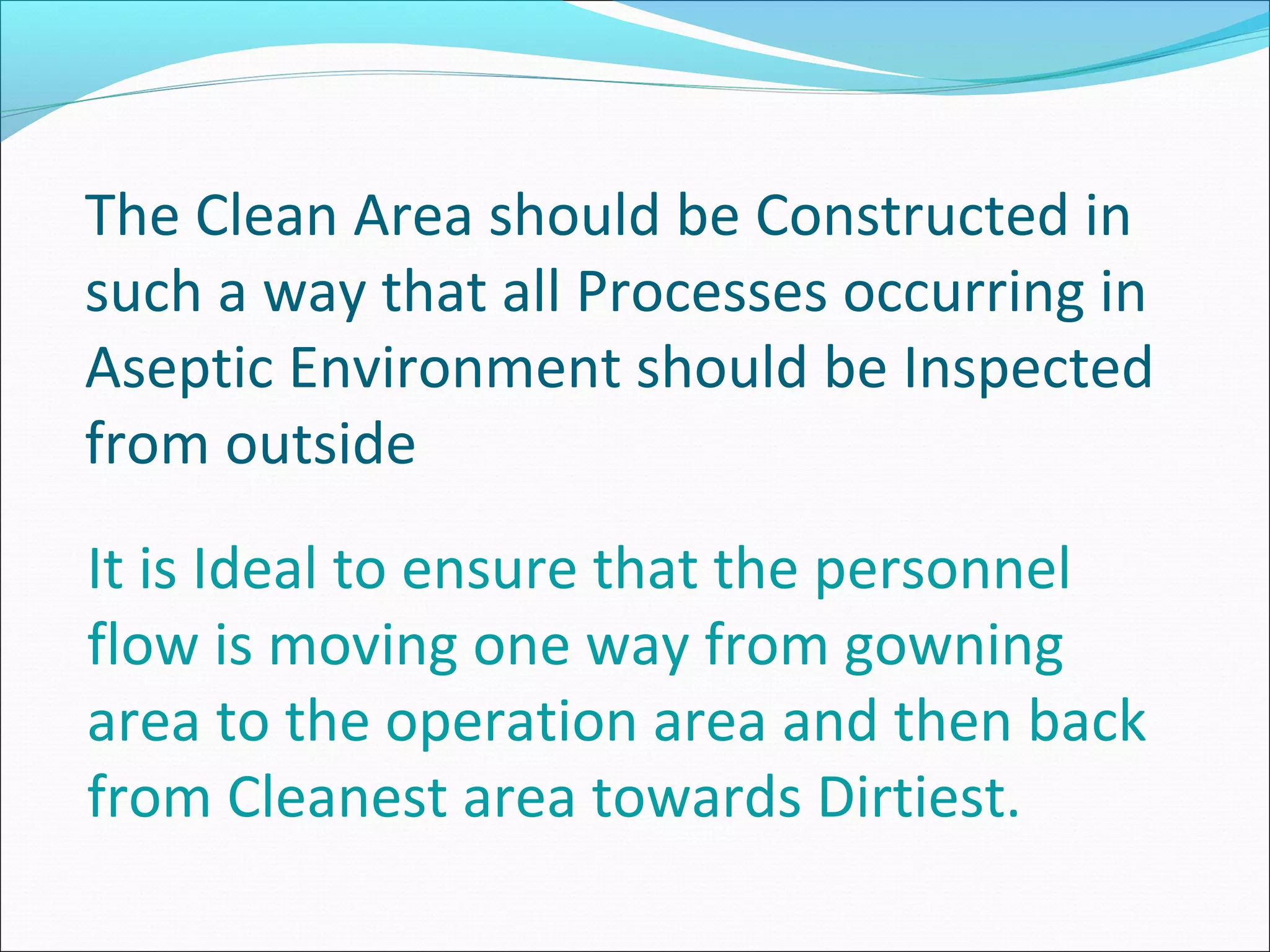
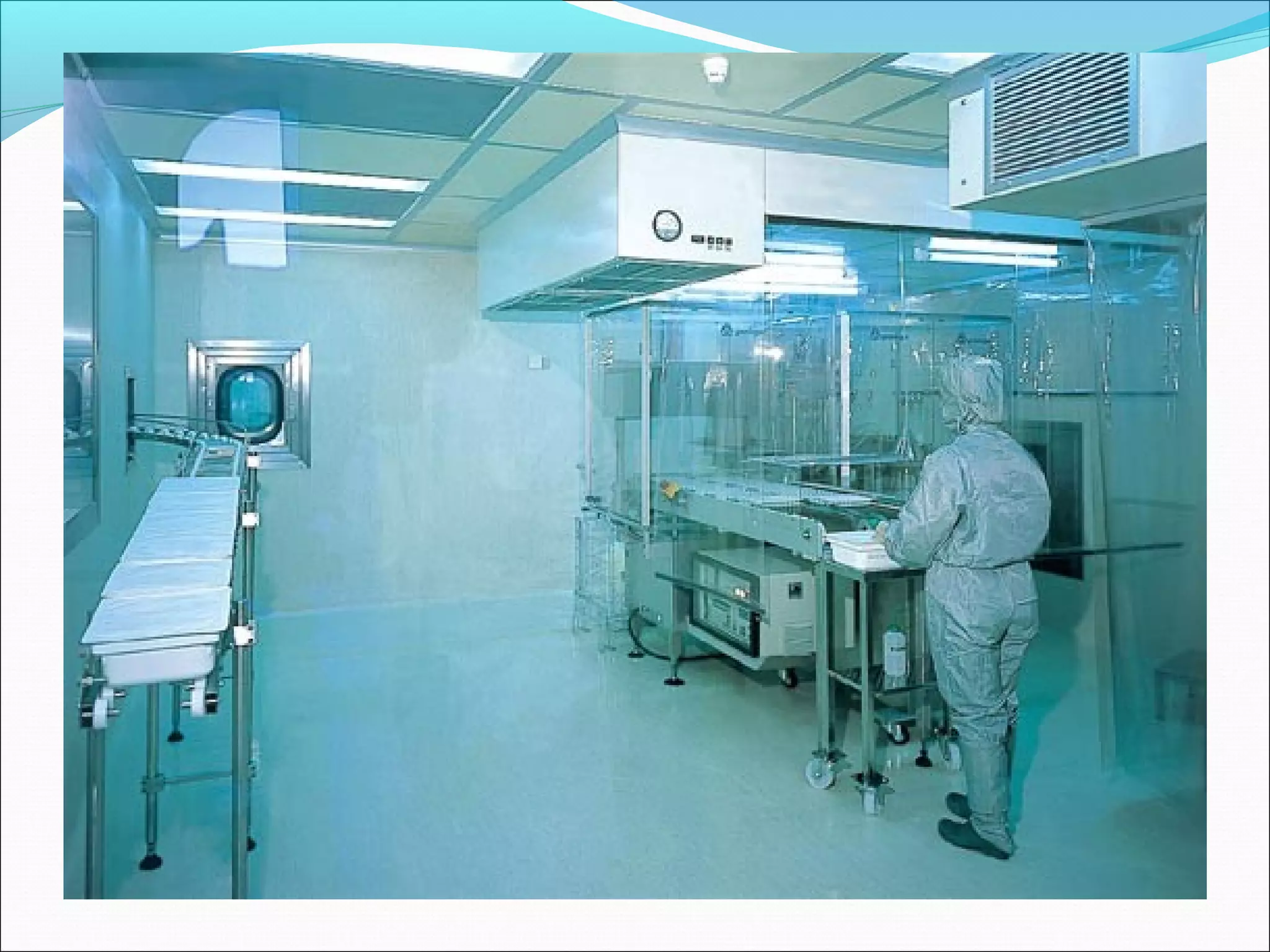
The Clean Area should be Constructed in
such a way that all Processes occurring in
Aseptic Environment should be Inspected
from outside
It is Ideal to ensure that the personnel
flow is moving one way from gowning
area to the operation area and then back
from Cleanest area towards Dirtiest.
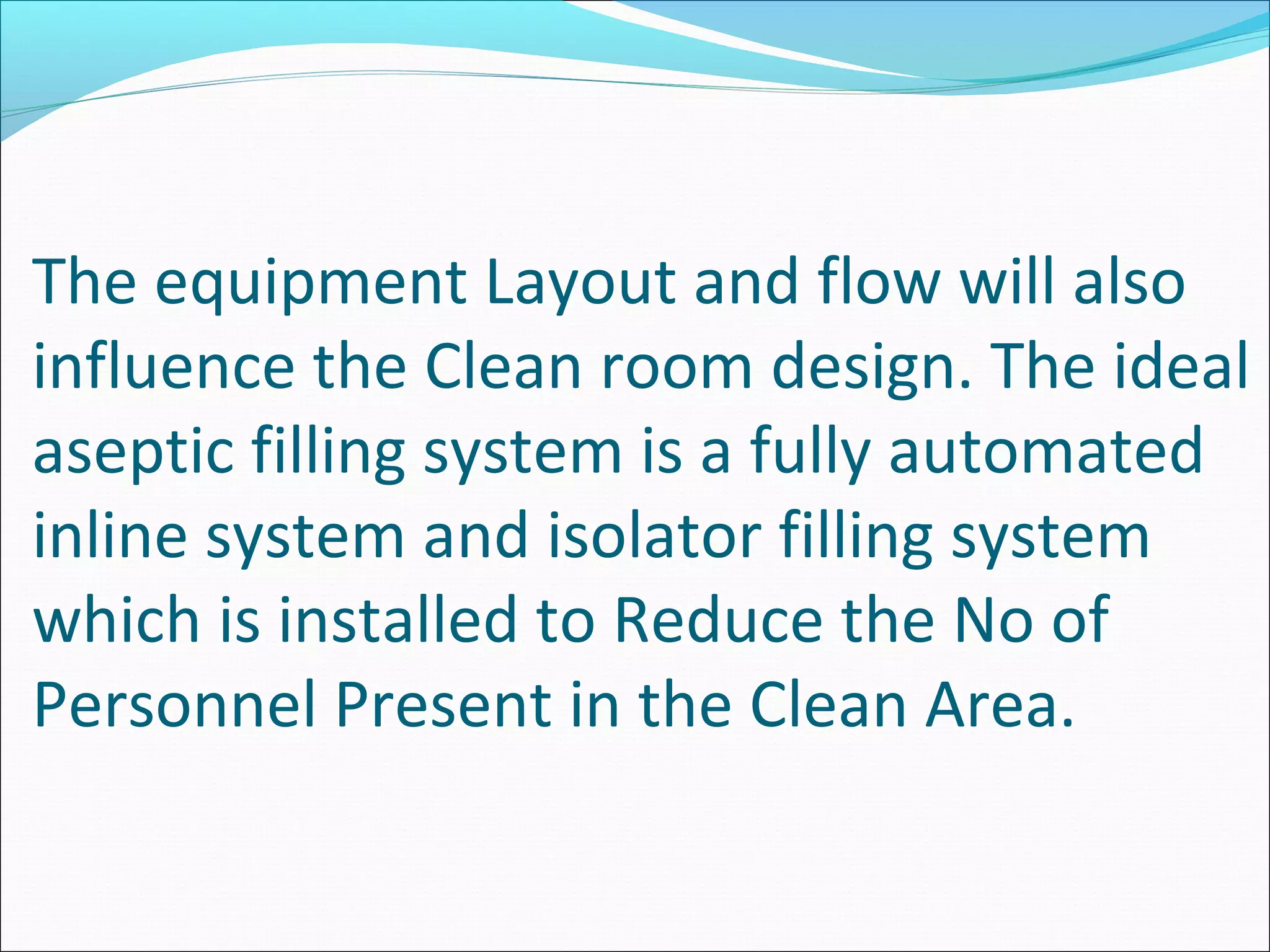
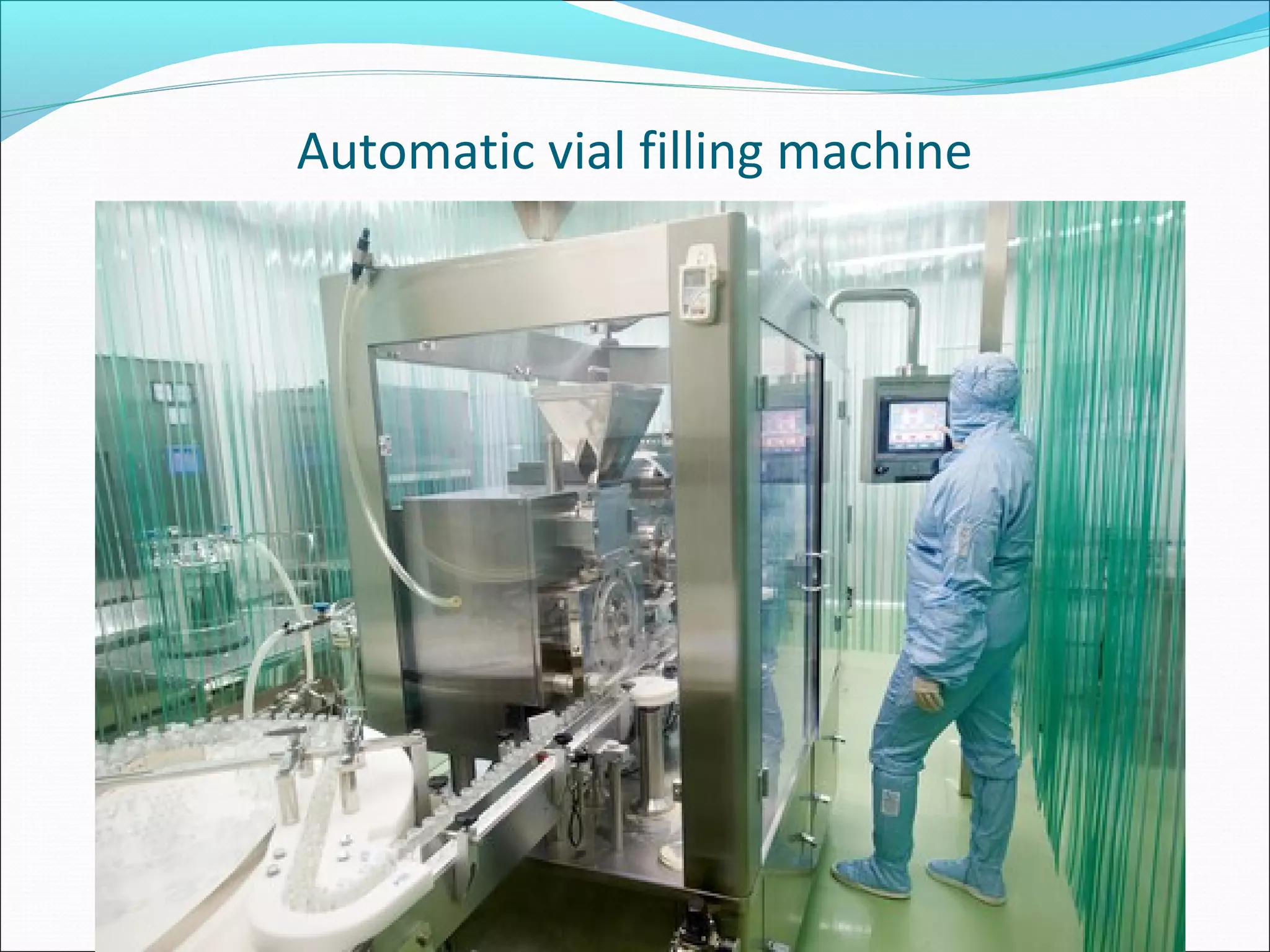
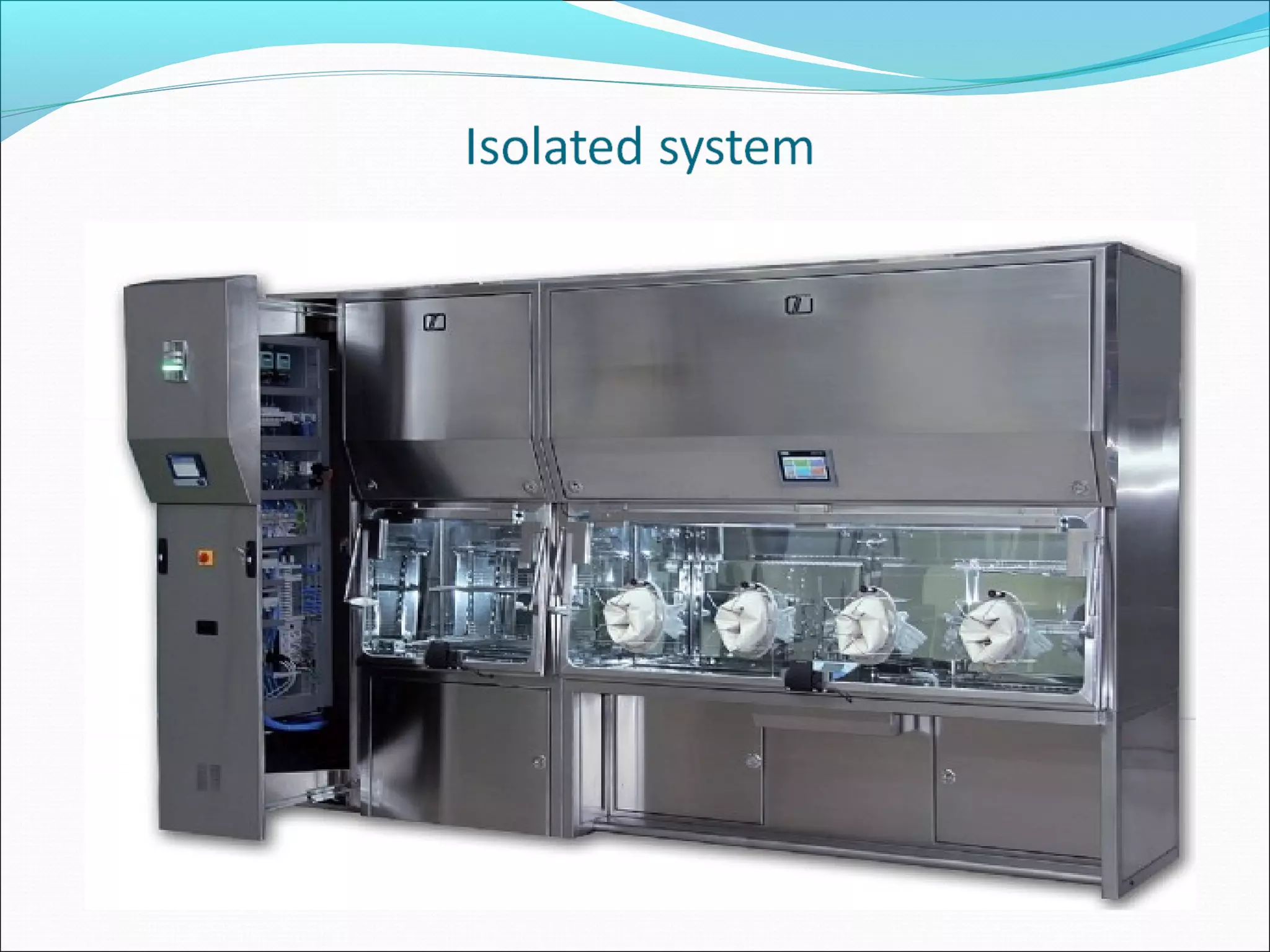
The equipment Layout and flow will also
influence the Clean room design. The ideal
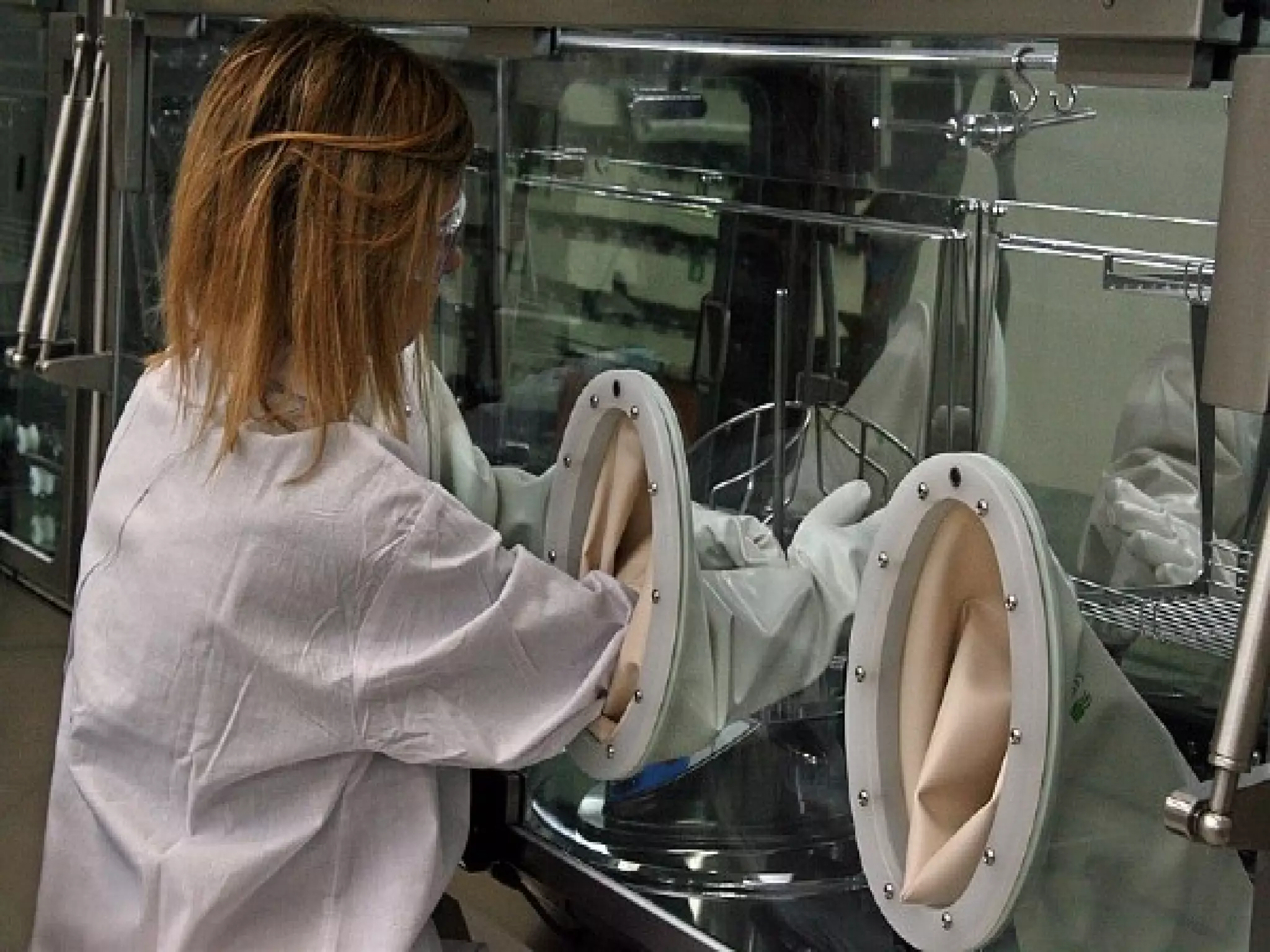
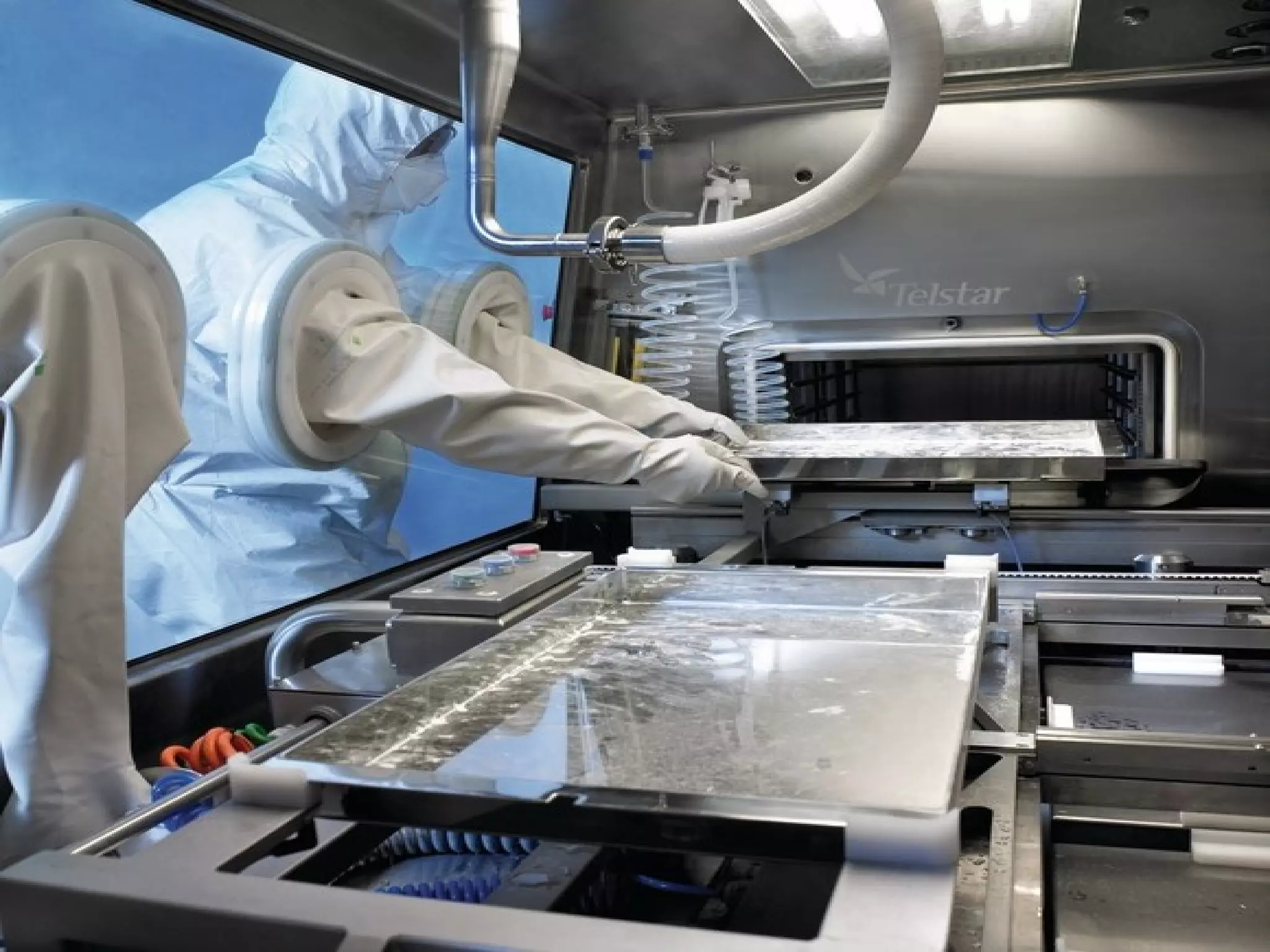
aseptic filling system is a fully automated
inline system and isolator filling system
which is installed to Reduce the No of
Personnel Present in the Clean Area.
Automatic vial filling machine
HVAC System:HVAC System:
An essential Component of the Clean room is
HVAC System. It is provided with HEPA filters
and a series of Pre filters prior to HEPA filters.
The heating and cooling functions are needed
for environmental control and operators
comfort. Ventilation function provides the
necessary circulation to maintain the aseptic
core by the use of +ve pressure that extends
away from the core.
The comfortable working Environment
is having temperature 25 degree
Celsius and the relative humidity
between 30% to 60% (Depending on
nature of the product) to control
organism growth and personnel from
sweating.
HEPA filter:HEPA filter:
These are the major components of LFH work
station.
The pore size of HEPA filter is 0.22micron & are
capable of retaining particles up to 0.3micron.
Life of a HEPA filter depends on DOP test results.
They can filter organisms i.e. Yeast, Molds &
Bacteria.
Air velocity of HEPA filter should be 100±20ft/min
Air Locks or Buffer zones:Air Locks or Buffer zones:
To retain separate two different cleanliness levels
normally we need air locks or buffer zones.
It is used for personnel or Equipments.
It should consist of at least two doors.
Don’t have a gowned & ungowned person in the
same air lock.
Do disinfect all equipments in the air lock prior to
enter in aseptic area or an aseptically gowned
person contact it.
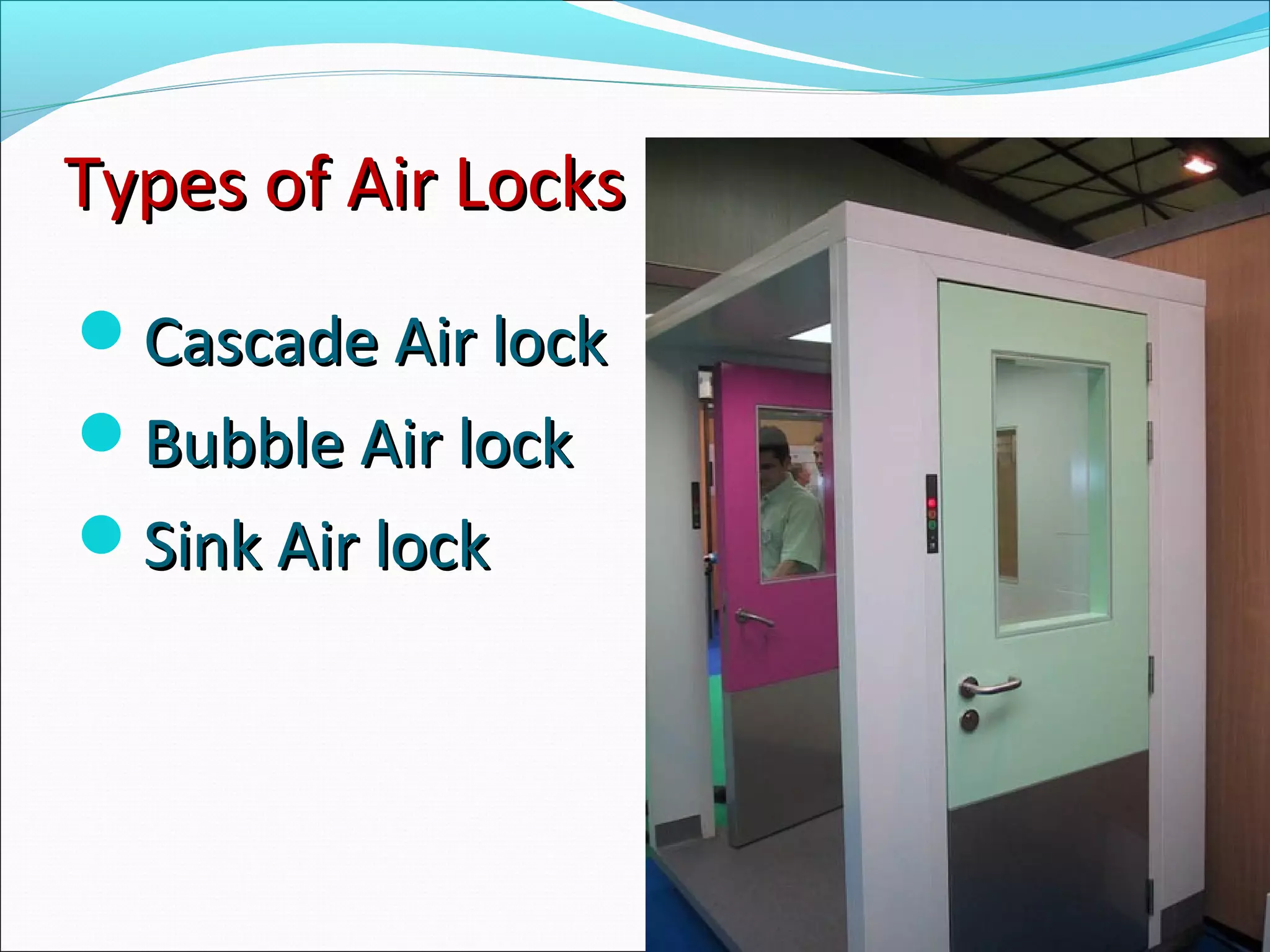
Types of Air LocksTypes of Air Locks
Cascade Air lockCascade Air lock
Bubble Air lockBubble Air lock
Sink Air lockSink Air lock
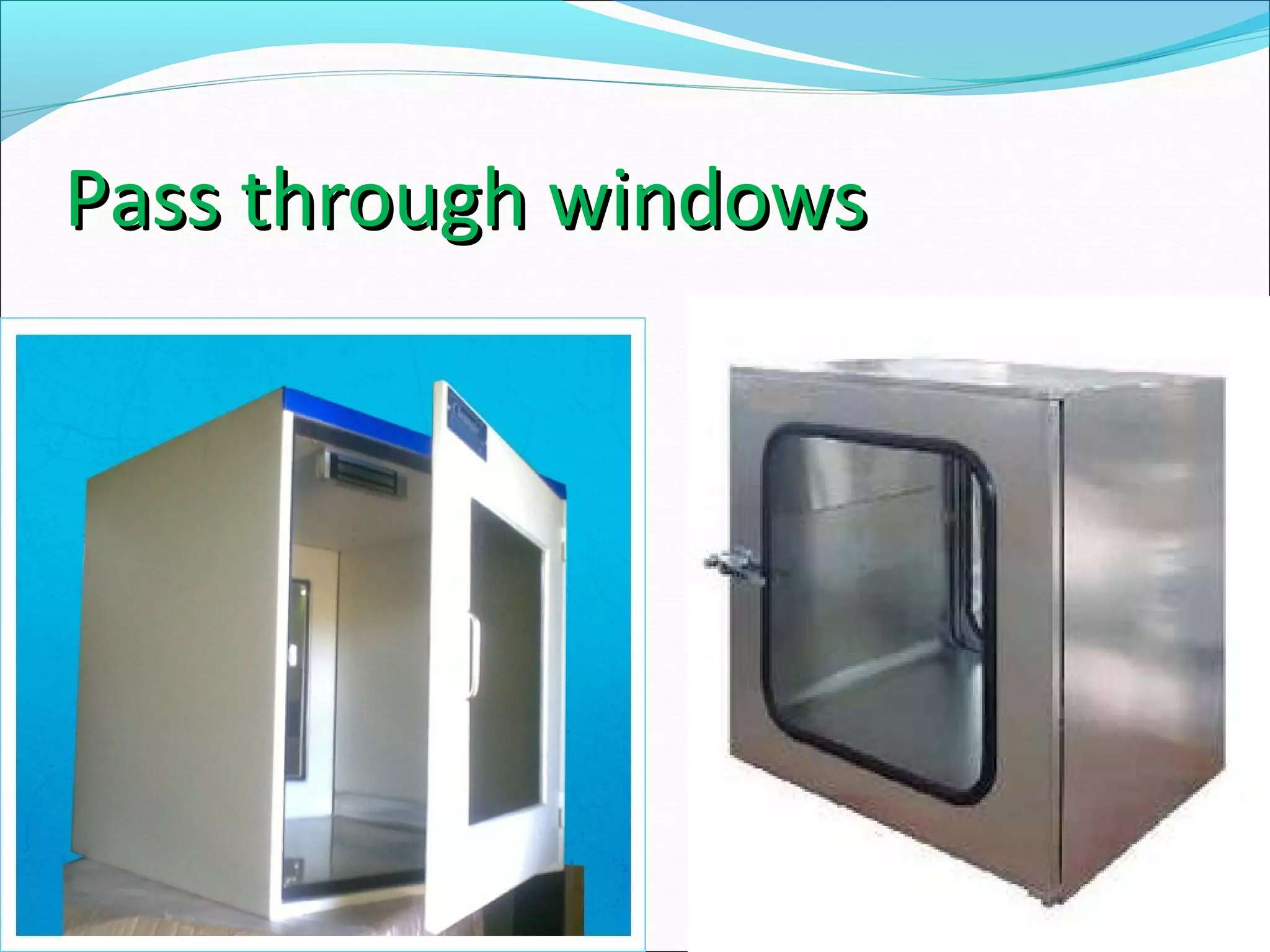
Pass through windowsPass through windows
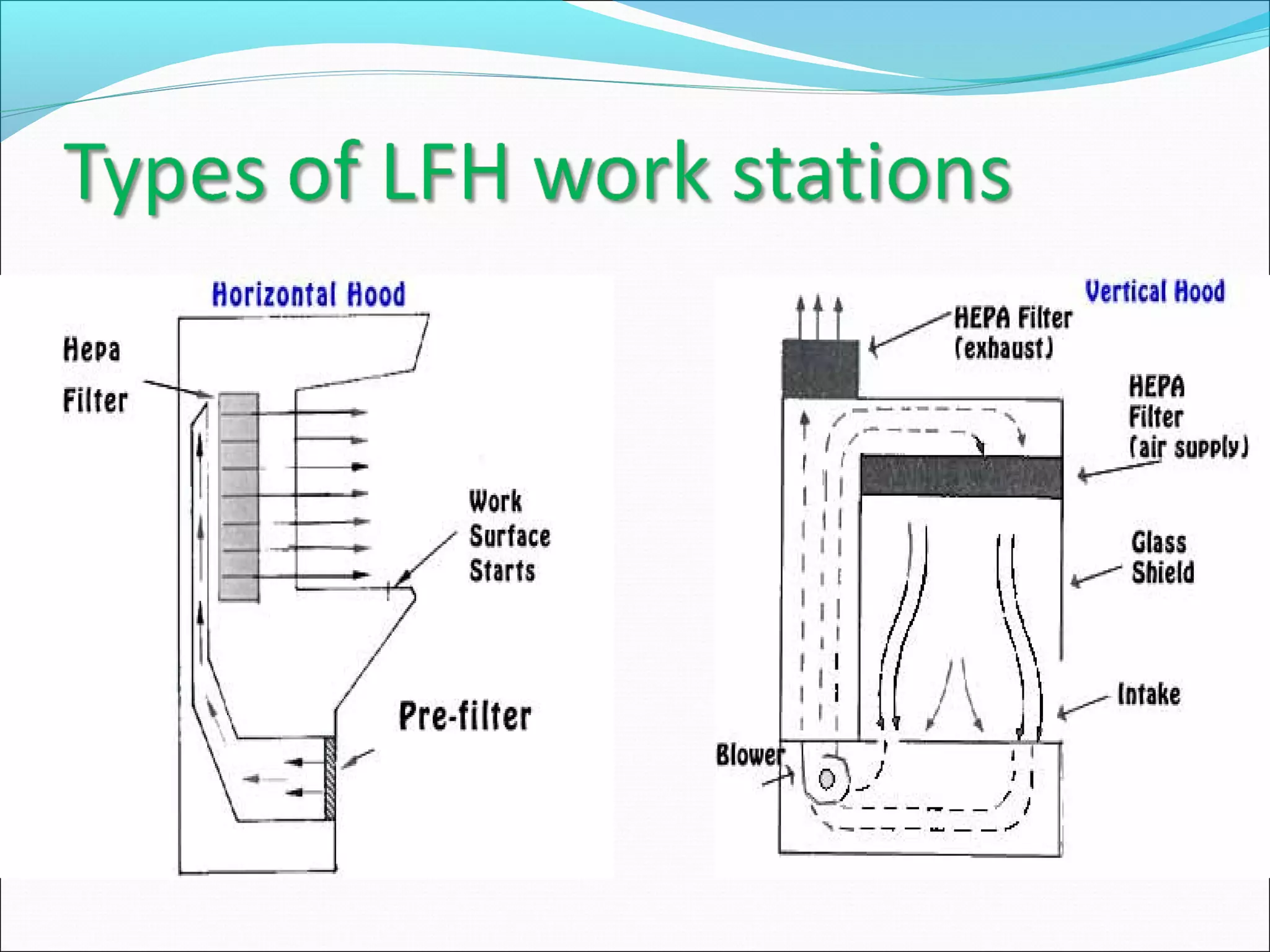
Laminar Flow Hood:Laminar Flow Hood:
The most crucial area of a clean room is
under LFH in which the sterile drug is
directly exposed to the Environment.
This technique was first introduced by an
Electronics company in 1960 to control
particulate contamination in electronic
devices.
Very strict control of viable count is
recommended under LFH.
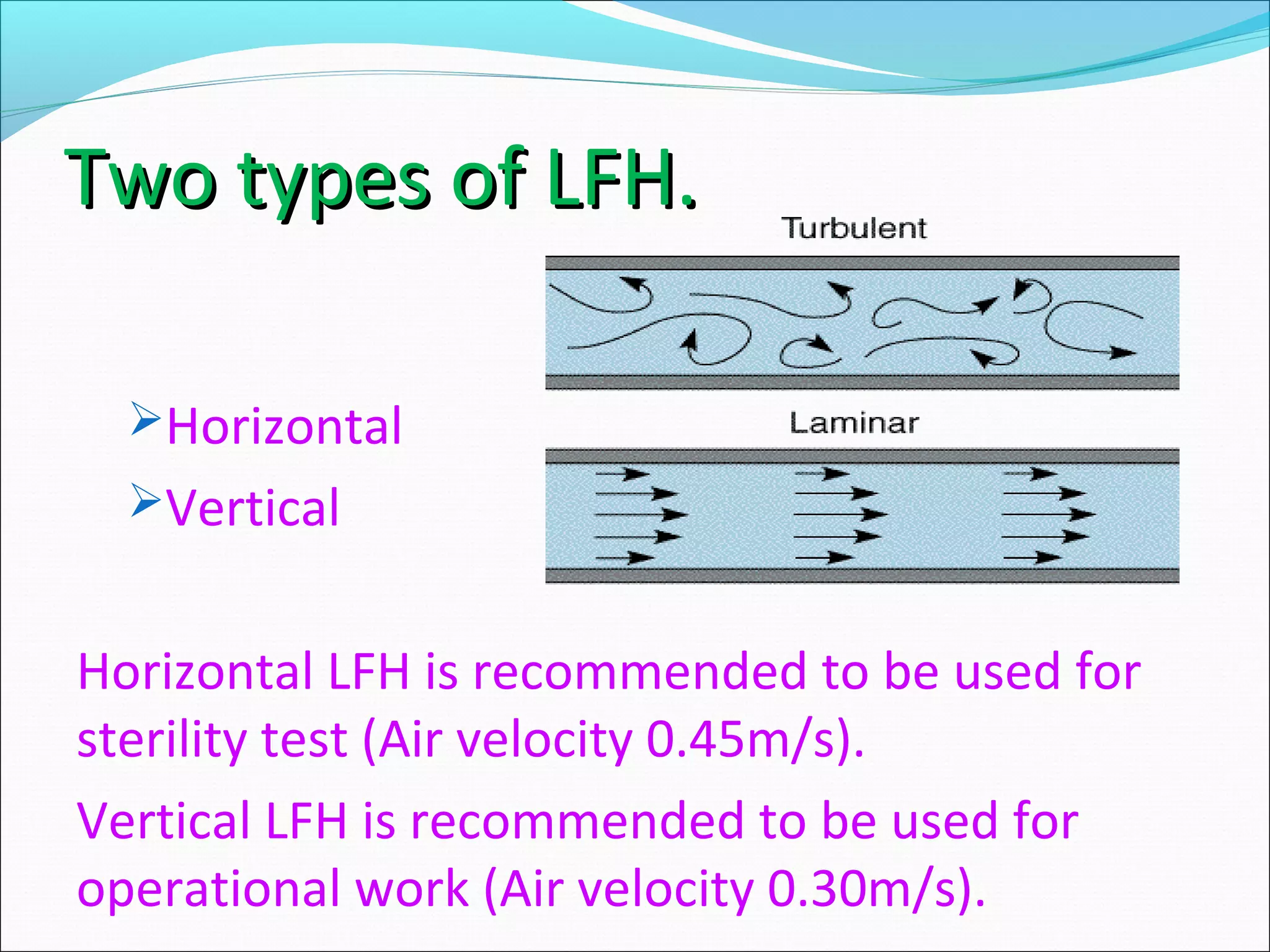
Two types of LFH.Two types of LFH.
Horizontal
Vertical
Horizontal LFH is recommended to be used for
sterility test (Air velocity 0.45m/s).
Vertical LFH is recommended to be used for
operational work (Air velocity 0.30m/s).
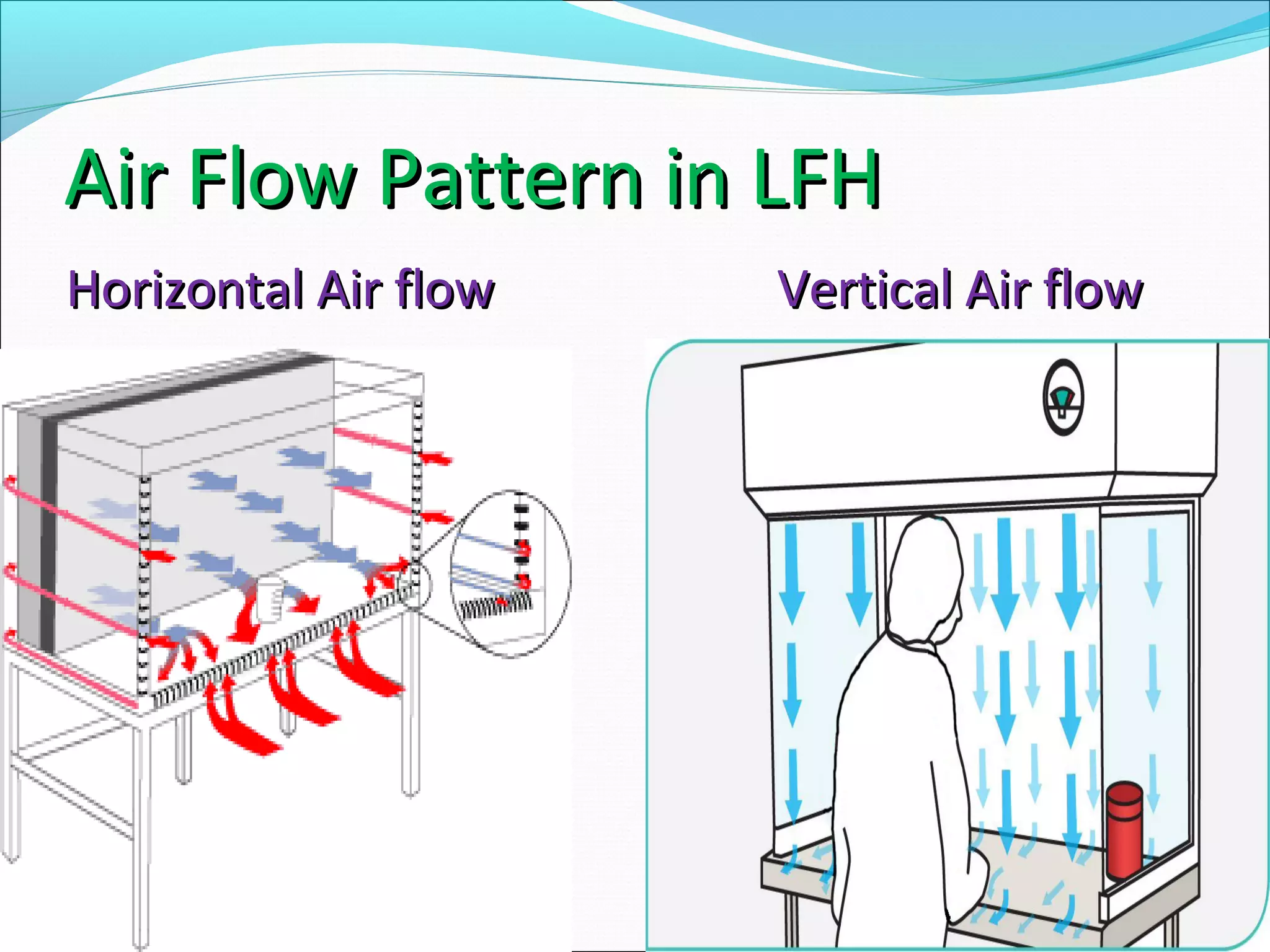
Air Flow Pattern in LFHAir Flow Pattern in LFH
Horizontal Air flowHorizontal Air flow Vertical Air flowVertical Air flow
Pressure Differential:Pressure Differential:
A very simplified illustration is the clean
room cascade type of pressure
differential.
It should not be less than 0.06 IOW.
10-15 pascals
2.Machine and Equipment Control:2.Machine and Equipment Control:
To complete an aseptic filling process we
need to terminally sterilize the drug
product, filling components, machine parts
and in place equipments.
Sterilization is usually done with steam
autoclave, hot air oven, chemicals,
filtration and radiations.
There are many considerations in the
selection of your filling equipment
according to the nature of sterile drug
to be filled.
Sterile filling of glass vials and bottles
is achieved by rinsing to remove
endotoxins and loose particles and
then depyrogenation in hot air oven.
The small parts like filling needles,
cylinders, forceps, bulk assembly,
rubber tubing's and stoppers must be
washed first and then wrap the parts
for sterilization in autoclave.
Depending on the formulation the
stoppers may also be sterilized by
irradiation.
Aseptic filling operation may vary from
a clinical hand fill trial to a high speed
filling lines.
The stoppering and capping should be
done as soon as possible.
The sealing should be done out side the
LFH to reduce particle generation from
aluminum seals.
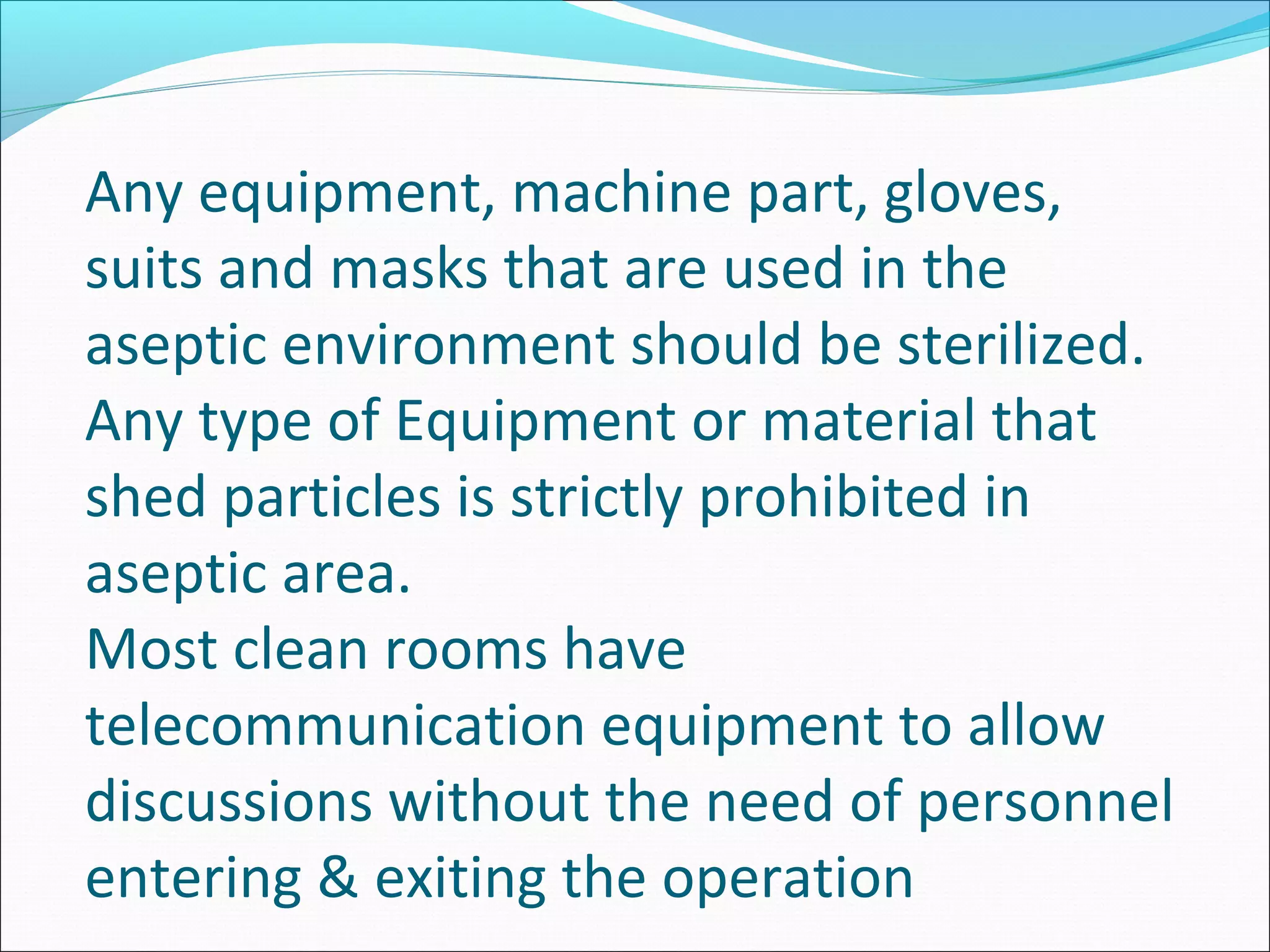
Any equipment, machine part, gloves,
suits and masks that are used in the
aseptic environment should be sterilized.
Any type of Equipment or material that
shed particles is strictly prohibited in
aseptic area.
Most clean rooms have
telecommunication equipment to allow
discussions without the need of personnel
entering & exiting the operation
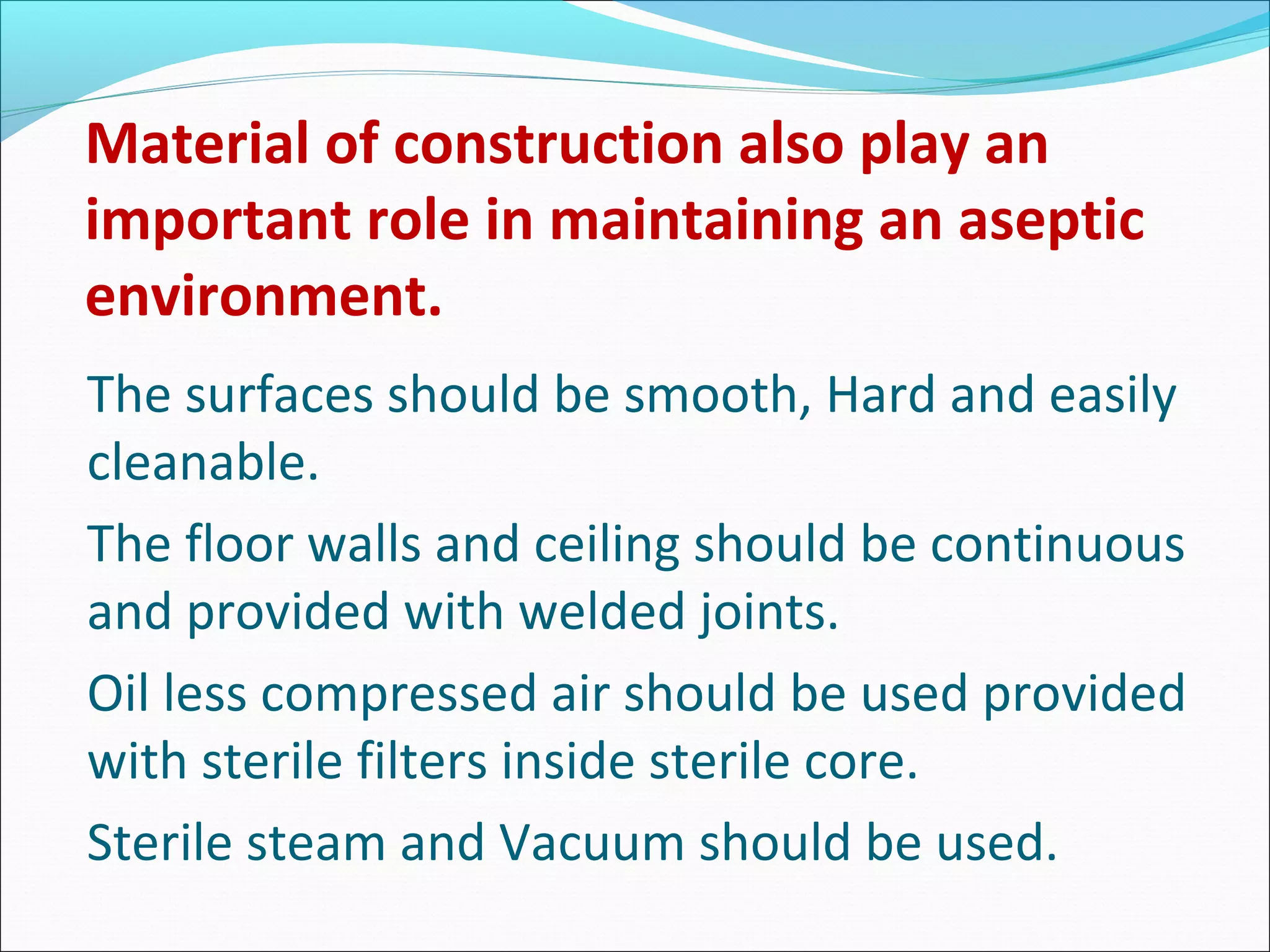
Material of construction also play an
important role in maintaining an aseptic
environment.
The surfaces should be smooth, Hard and easily
cleanable.
The floor walls and ceiling should be continuous
and provided with welded joints.
Oil less compressed air should be used provided
with sterile filters inside sterile core.
Sterile steam and Vacuum should be used.
3.Individual Control:3.Individual Control:
A room can be disinfected, an object can be
sterilized, air can be filtered but we can’t
sterilize a person.
The personnel in the clean room are like the
“double edge” sword .
They are absolutely necessary to complete an
aseptic process but at the same time provide
the greatest microbial risk to the sterile product.
A human body constantly regenerates
itself and in this process shedding a
huge amount of dead skin and other
particles.
An average person is capable of
shedding 10million particles /day.
Proper personnel hygiene is necessary
to work in Aseptic filling area.
Personnel entry to the asepticPersonnel entry to the aseptic
area require:area require:
One must have a positive thinking.
Proper personal hygiene.
The will to work in a precise
manner.
The awareness about the critical
nature of the process.
The personnel entering the aseptic area
should be properly trained.
Written and qualified procedures
should be available to further minimize
microbial contamination.
Any personnel entering the aseptic
area must wear a sterilized gown.
Each time you must get a new
complete set of gowning component.
Disposable gowns may also be
used and should be immediately
discarded upon exiting the area.
Sterile outer garments are usually
made of synthetic or natural
materials which have no or less
particle shedding characteristics.
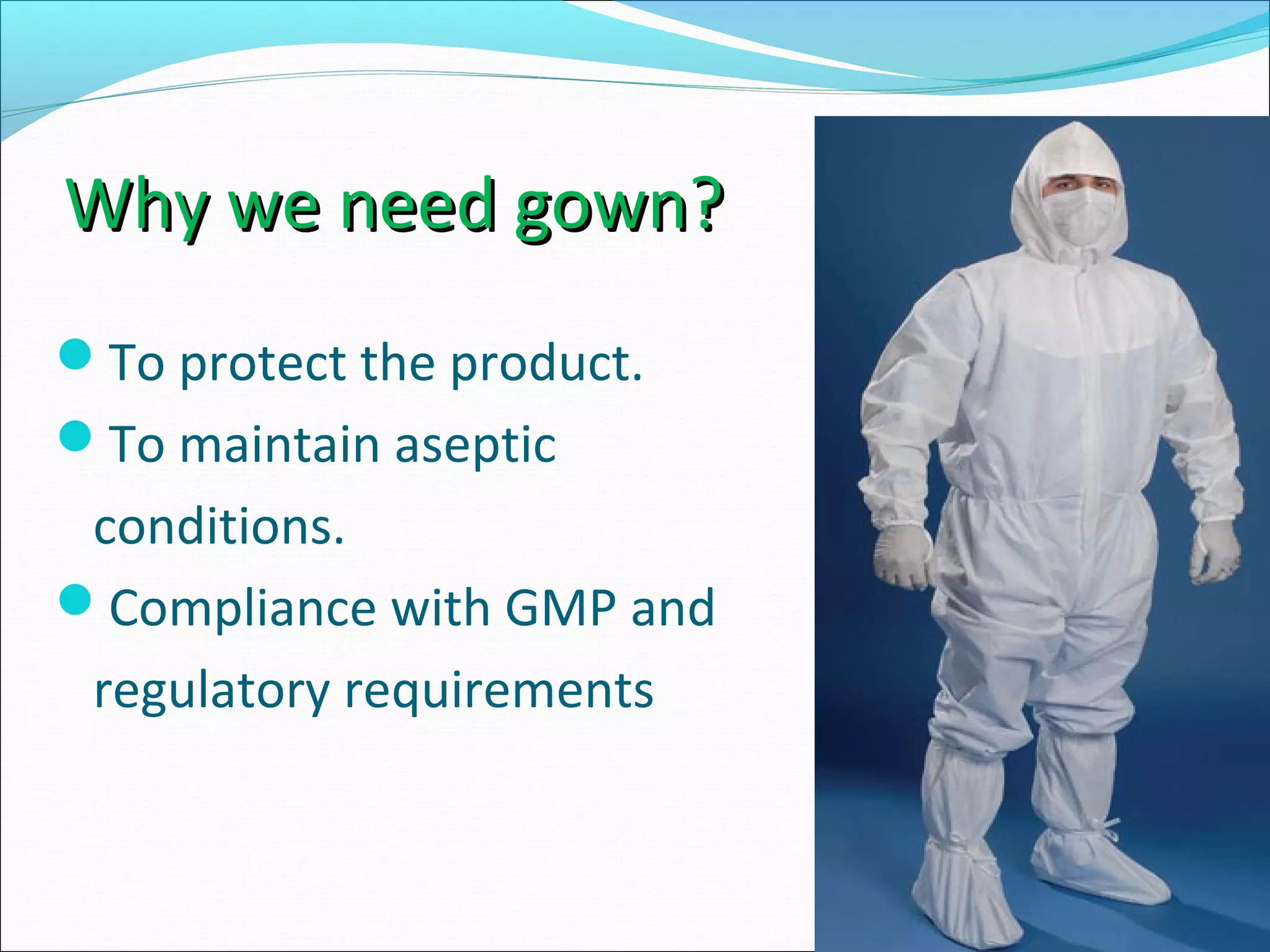
Why we need gown?Why we need gown?
To protect the product.
To maintain aseptic
conditions.
Compliance with GMP and
regulatory requirements
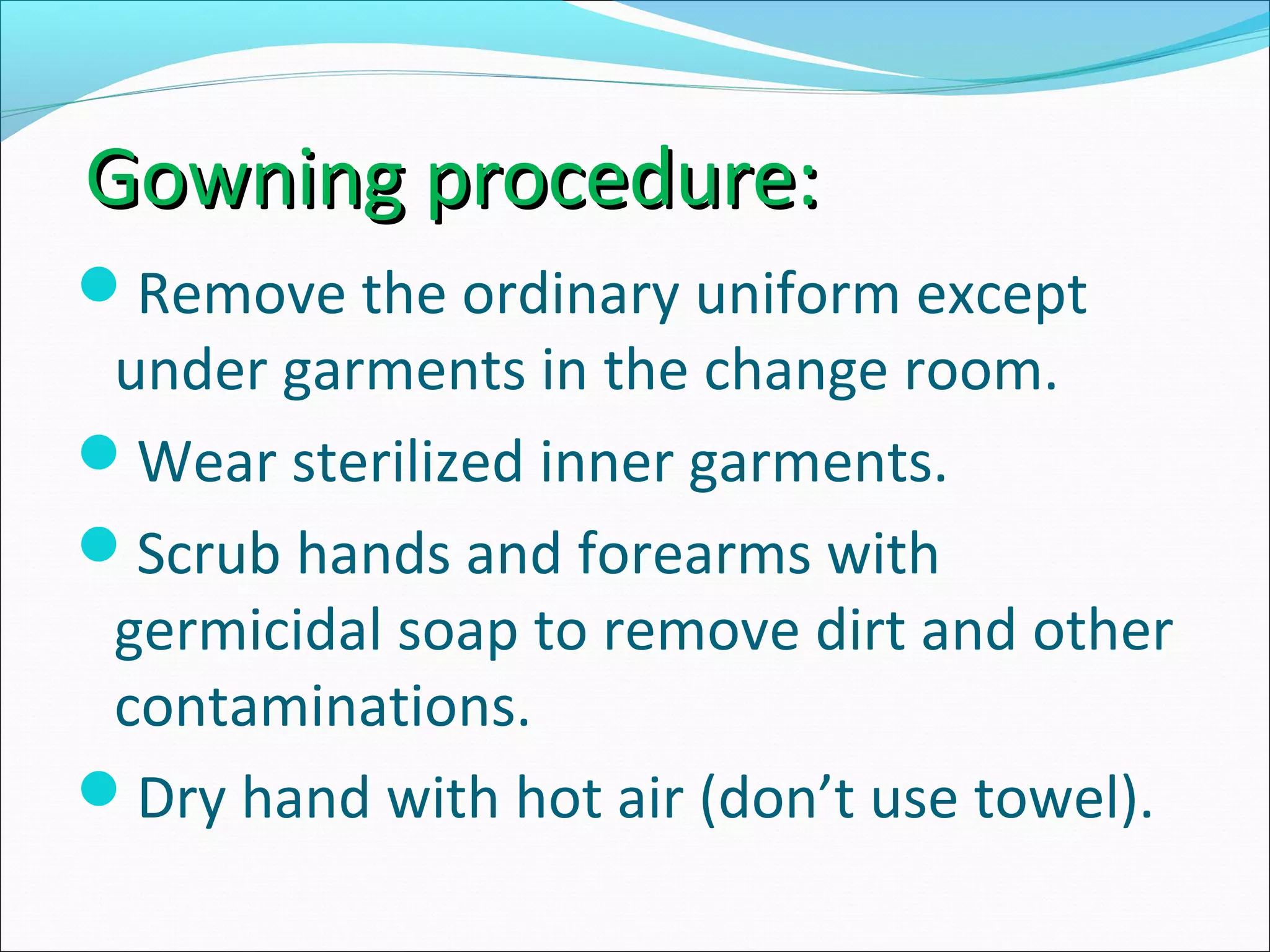
Gowning procedure:Gowning procedure:
Remove the ordinary uniform except
under garments in the change room.
Wear sterilized inner garments.
Scrub hands and forearms with
germicidal soap to remove dirt and other
contaminations.
Dry hand with hot air (don’t use towel).
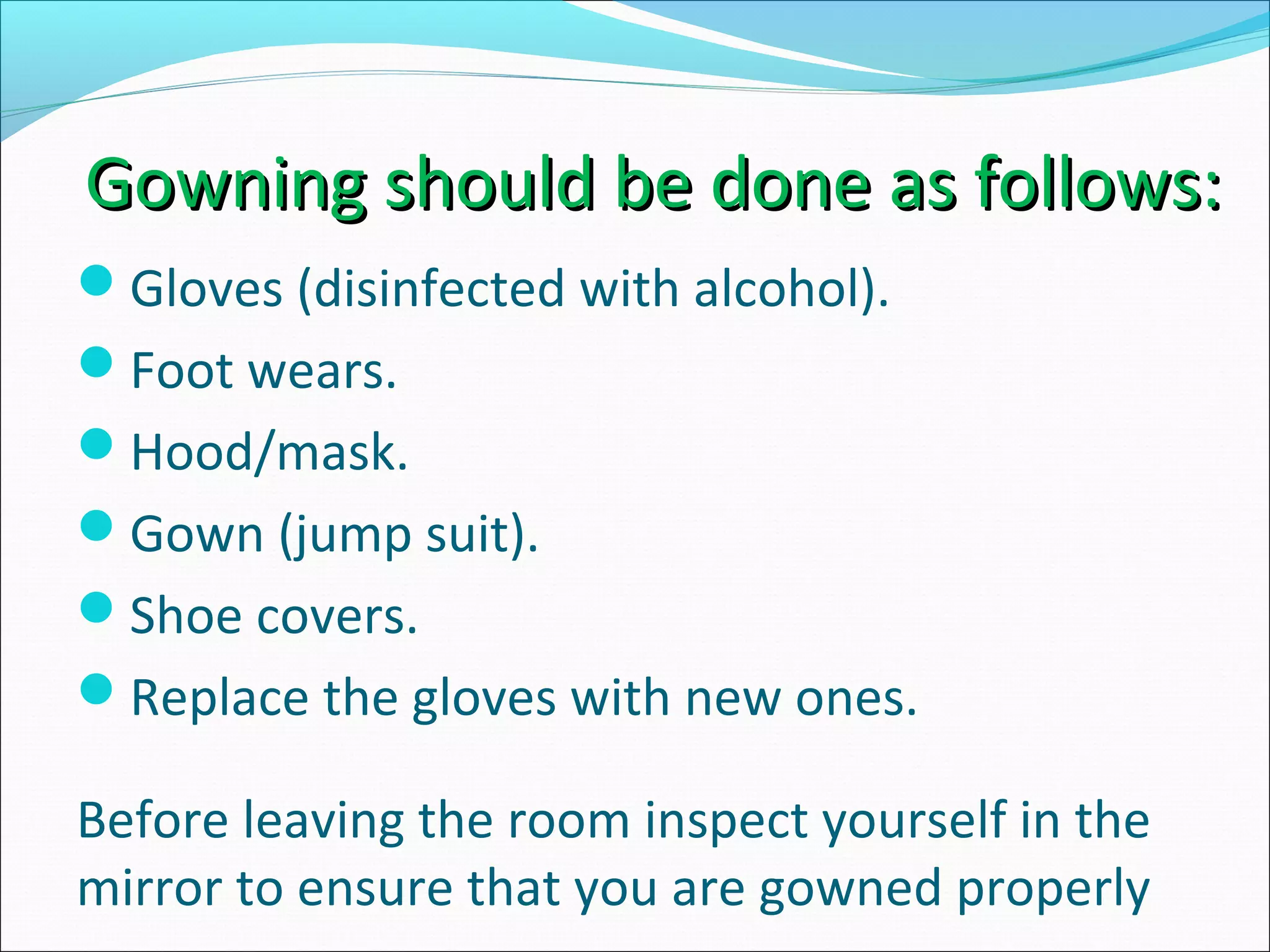
Gowning should be done as follows:Gowning should be done as follows:
Gloves (disinfected with alcohol).
Foot wears.
Hood/mask.
Gown (jump suit).
Shoe covers.
Replace the gloves with new ones.
Before leaving the room inspect yourself in the
mirror to ensure that you are gowned properly
Disinfect your hands with disinfectant
and enter the aseptic area:
Remember
Never touch a critical surface directly
i.e.
Vials, stoppers and surfaces that are in direct contact
with the product.
Only use sterile forceps or an implement that has been
sterilized to touch a critical surface.
How one should behave in a clean room?
Do limit the No of peoples under LFH and in Clean
room.
Don’t enter the hood unless you need it.
Do keep all talking to necessary communication.
Do use intercom or telephone to communicate to
some one out side the aseptic area.
Do rinse your hands (gloves) with IPA after every 10-
15min while working under LFH.
Do work slowly in the aseptic area.
Don’t open sterile gown in the filling area.
How to assemble the machine parts?
Wipe the equipment or container with
IPA before entering the LFH.
Wipe the gloves with IPA immediately
after entering the LFH.
Wipe or squirt your tools with IPA to
disinfect them.
Hold the tools as far away from the
operating ends as possible.
Frequently disinfect the tools and gloves
if working for a long time.
Keep other parts of body away from the
adjustment area.
Work slowly (carefully) but efficiently.
If a spill occurs wipe up it immediately.
Micro contamination is very small and
surfaces and environment that looks clean
and sterile may not be…
So
How we can consider an environment to
be aseptic?
Environmental monitoring is the process to
ensure that the clean room is under
control for potential viable and non
viable contamination.
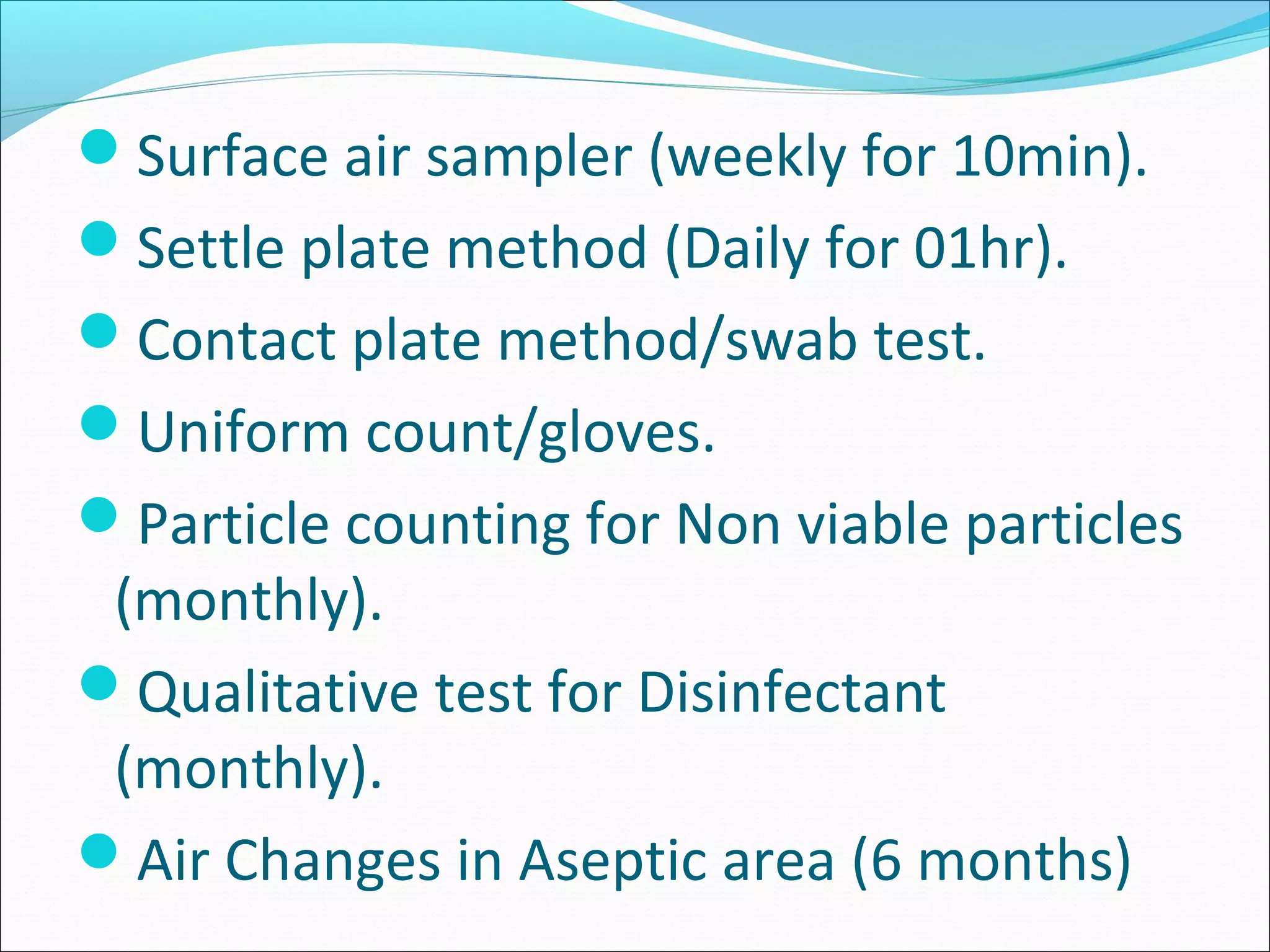
Surface air sampler (weekly for 10min).
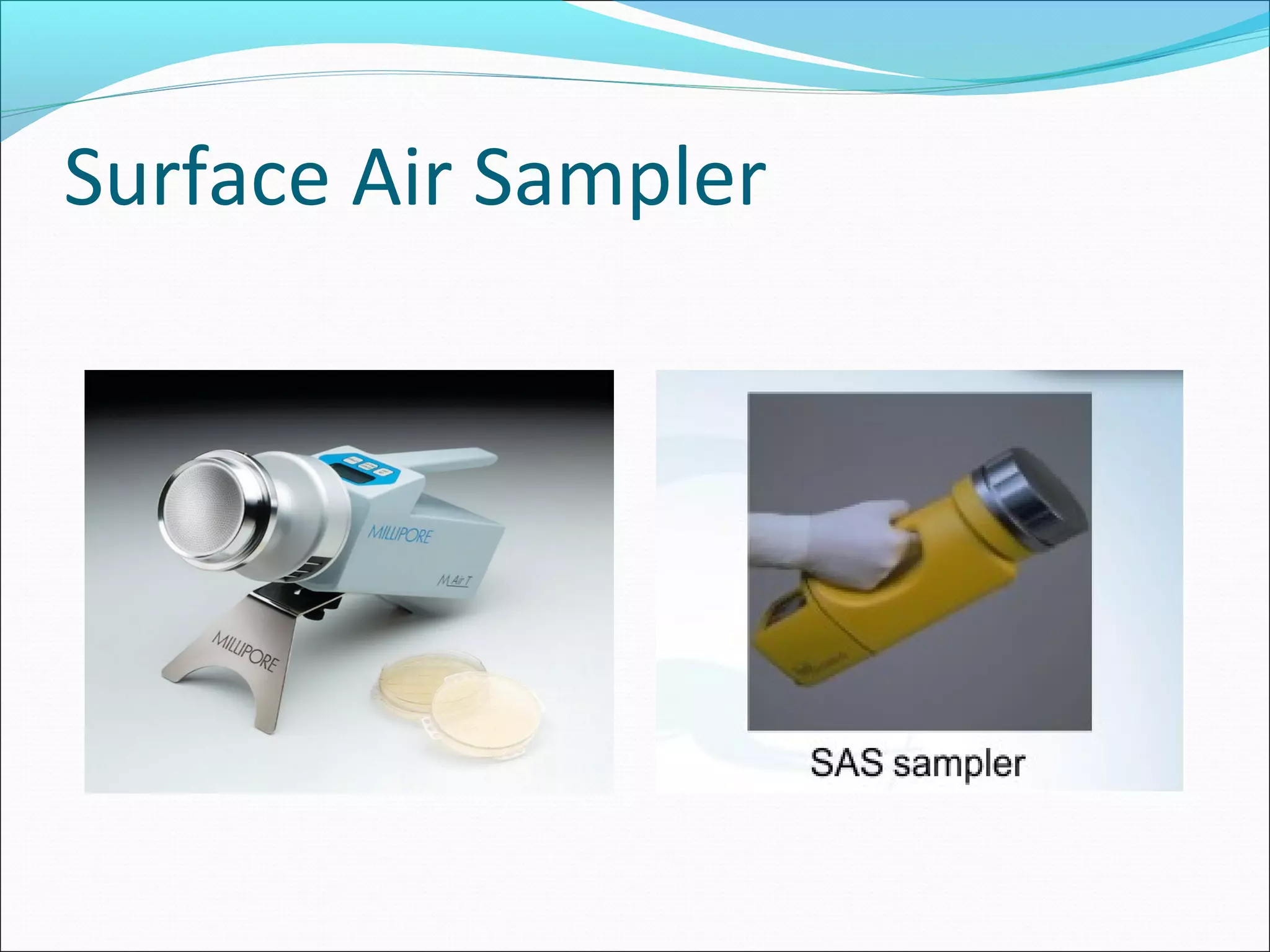
Settle plate method (Daily for 01hr).
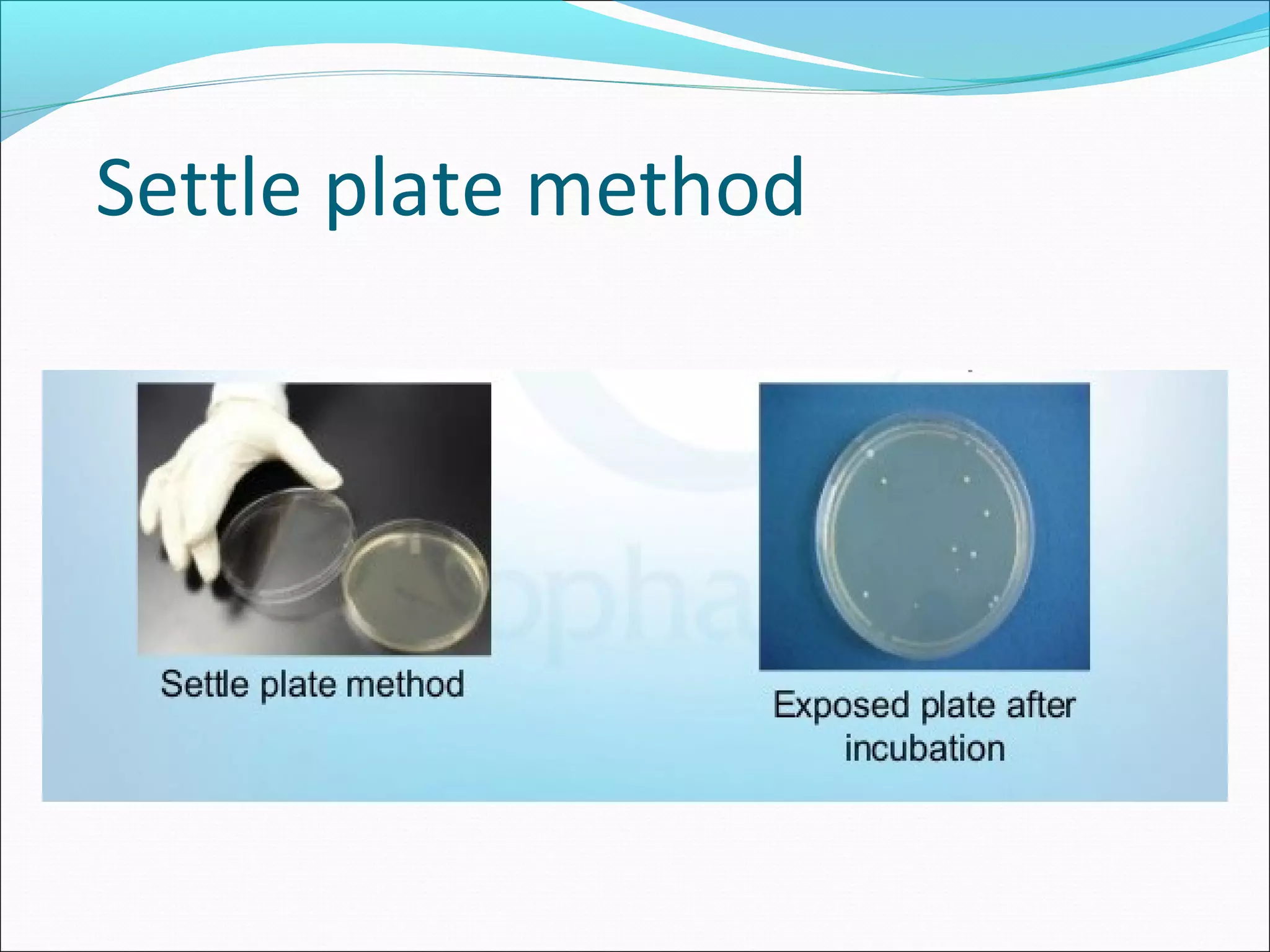
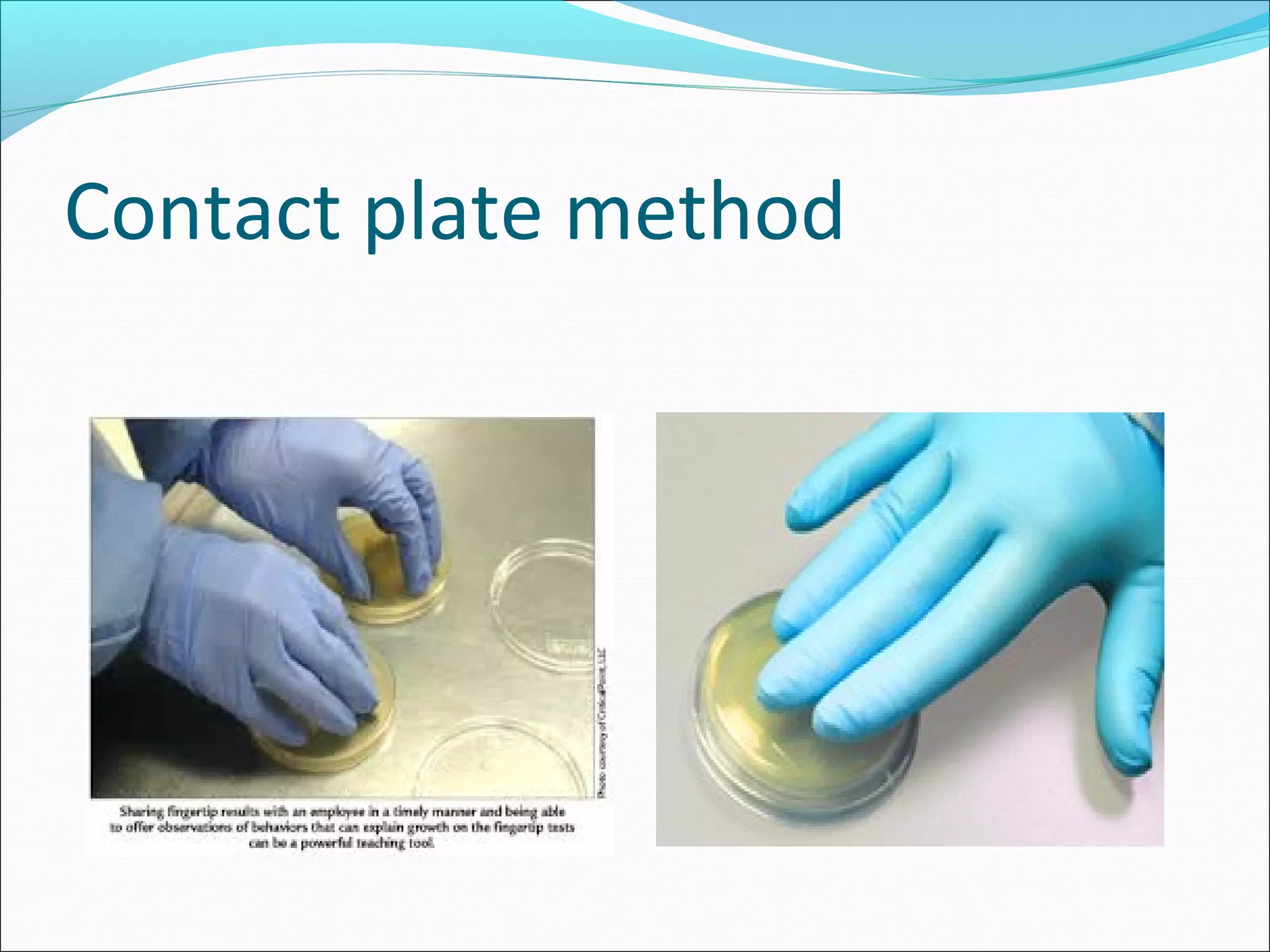
Contact plate method/swab test.
Uniform count/gloves.
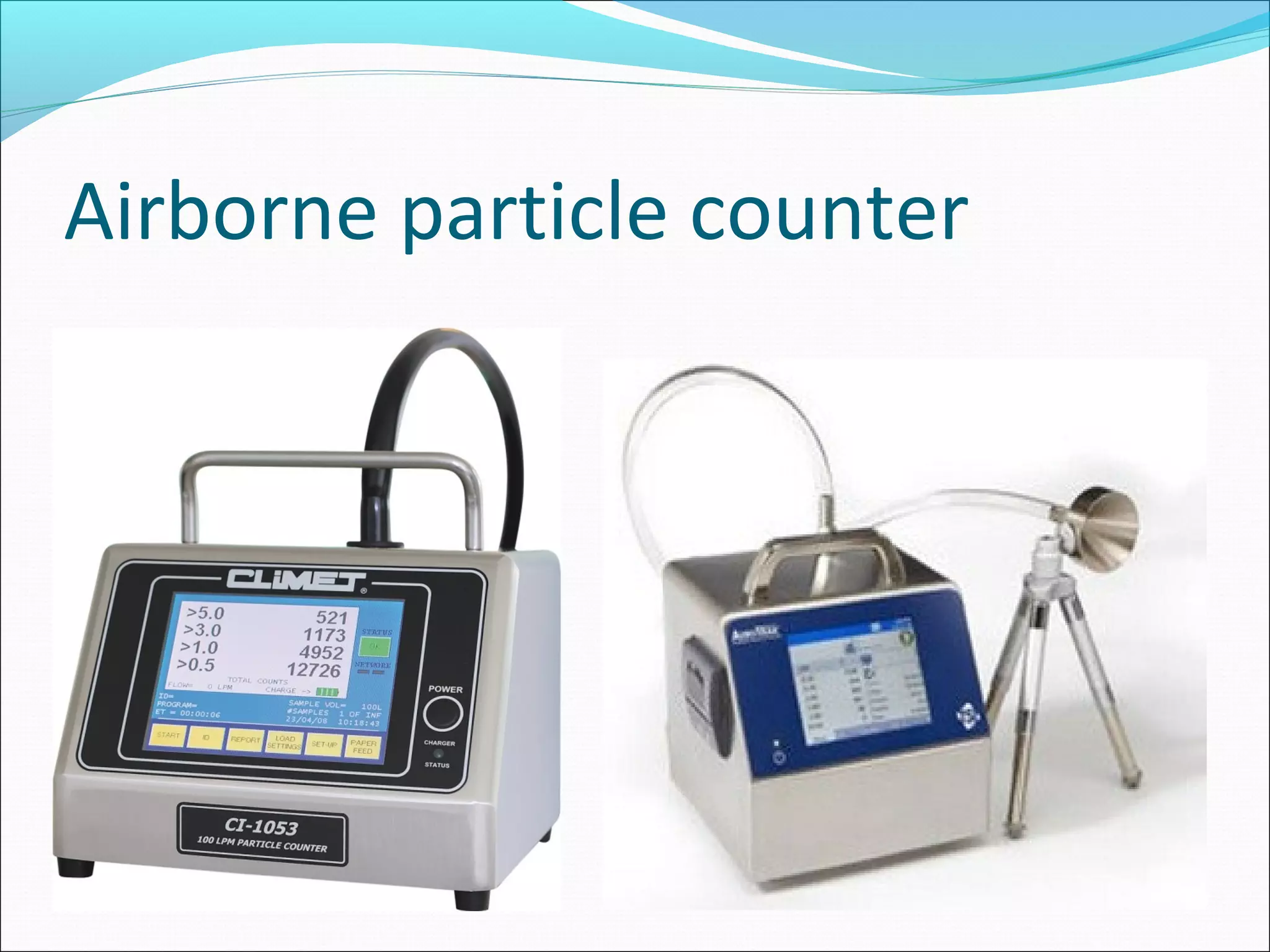
Particle counting for Non viable particles
(monthly).
Qualitative test for Disinfectant
(monthly).
Air Changes in Aseptic area (6 months)
Surface Air Sampler
Settle plate method
Contact plate method
Airborne particle counter
Presentation on aseptic filling

Presentation on aseptic filling

  • 1.
    Presentation on AsepticPresentationon Aseptic Filling TechniquesFilling Techniques Presented By: Muhammad Samie Lecturer HIPS
  • 2.
    “Aseptic filling Techniques:A series of actions used to minimize contamination during manufacturing of Sterile drug Products”. “Sterile product is Said to be a Product which is free from micro-organisms and their spores”.
  • 3.
    While to makea sterile product we need an environment which should be free from micro-organisms and the no. of Air borne particles Should be in a controlled Limit and that is known as aseptic Environment. or “An Area with defined environmental control of Particulate and microbial count”.
  • 4.
    The main aimof Aseptic filling techniques is to Improve Product quality To Maintain an Aseptic filling environment we need to control the Contamination.
  • 5.
    Contamination is ofTwo Types Viable Non viable Micro-organisms Dust Particles, & Environment Related, Spores (pyrogens) Equipment Related, Material,
  • 6.
    Sources of ContaminationSourcesof Contamination Facilities: Walls, Floors and Ceiling Paint and Coatings Construction material Air Conditioning Debris Spills and Leaks Peoples: Skin flakes and oil Cosmetics and perfumes Hairs Clothing Debris Spitting
  • 7.
    Tools Generated: Friction Lubrication Vibration Mops andDusters Fluids: Cleaning Chemicals De-ionized water Humidity in Air Product Generated: Aluminum Particles Rubber gaskets
  • 8.
    How to ControlContamination? Three main types are there to Control Contamination  Environmental Control. HEPA Filters , HVAC System & Fumigation of Area  Equipment Control. Sterilization & Sanitization  Individual Control. Personnel Hygiene & Aseptic Gowning
  • 9.
    1.Environmental Control:1.Environmental Control: TheDesign of The Clean Room Play a major Role in Maintaining The Aseptic Area. Different types of processes needs different cleanliness levels depending on viable and non viable count. Two major areas are there Critical Area Less critical / General Area Basic design of clean room is:
  • 10.
    Clean Room isClassified into Different GradesClean Room is Classified into Different Grades on the Basis of No of Particulate Count.on the Basis of No of Particulate Count. Particle Size = 0.5 - 5.0micronParticle Size = 0.5 - 5.0micron GMP US ISO Non Viable Viable GRAD E A CLASS 100/Ft3 5 3500/m3 <1 GRAD E B CLASS 100/Ft3 5 3500/m3 5 GRAD E C CLASS 10,000/Ft3 7 350000/m3 50 GRAD E D CLASS 100,000/Ft3 8 3500000/m3 100
  • 11.
    Three Entrance Areasare there:Three Entrance Areas are there: 1. Black Area (Locker Room). 2. Grey Area (Change Room). 3. White Area (Sterile Gowning Room).
  • 12.
    The Clean Areashould be Constructed in such a way that all Processes occurring in Aseptic Environment should be Inspected from outside It is Ideal to ensure that the personnel flow is moving one way from gowning area to the operation area and then back from Cleanest area towards Dirtiest.
  • 13.
    The equipment Layoutand flow will also influence the Clean room design. The ideal aseptic filling system is a fully automated inline system and isolator filling system which is installed to Reduce the No of Personnel Present in the Clean Area.
  • 14.
  • 19.
    HVAC System:HVAC System: Anessential Component of the Clean room is HVAC System. It is provided with HEPA filters and a series of Pre filters prior to HEPA filters. The heating and cooling functions are needed for environmental control and operators comfort. Ventilation function provides the necessary circulation to maintain the aseptic core by the use of +ve pressure that extends away from the core.
  • 20.
    The comfortable workingEnvironment is having temperature 25 degree Celsius and the relative humidity between 30% to 60% (Depending on nature of the product) to control organism growth and personnel from sweating.
  • 21.
    HEPA filter:HEPA filter: Theseare the major components of LFH work station. The pore size of HEPA filter is 0.22micron & are capable of retaining particles up to 0.3micron. Life of a HEPA filter depends on DOP test results. They can filter organisms i.e. Yeast, Molds & Bacteria. Air velocity of HEPA filter should be 100±20ft/min
  • 22.
    Air Locks orBuffer zones:Air Locks or Buffer zones: To retain separate two different cleanliness levels normally we need air locks or buffer zones. It is used for personnel or Equipments. It should consist of at least two doors. Don’t have a gowned & ungowned person in the same air lock. Do disinfect all equipments in the air lock prior to enter in aseptic area or an aseptically gowned person contact it.
  • 23.
    Types of AirLocksTypes of Air Locks Cascade Air lockCascade Air lock Bubble Air lockBubble Air lock Sink Air lockSink Air lock
  • 24.
    Pass through windowsPassthrough windows
  • 25.
    Laminar Flow Hood:LaminarFlow Hood: The most crucial area of a clean room is under LFH in which the sterile drug is directly exposed to the Environment. This technique was first introduced by an Electronics company in 1960 to control particulate contamination in electronic devices. Very strict control of viable count is recommended under LFH.
  • 26.
    Two types ofLFH.Two types of LFH. Horizontal Vertical Horizontal LFH is recommended to be used for sterility test (Air velocity 0.45m/s). Vertical LFH is recommended to be used for operational work (Air velocity 0.30m/s).
  • 28.
    Air Flow Patternin LFHAir Flow Pattern in LFH Horizontal Air flowHorizontal Air flow Vertical Air flowVertical Air flow
  • 29.
    Pressure Differential:Pressure Differential: Avery simplified illustration is the clean room cascade type of pressure differential. It should not be less than 0.06 IOW. 10-15 pascals
  • 30.
    2.Machine and EquipmentControl:2.Machine and Equipment Control: To complete an aseptic filling process we need to terminally sterilize the drug product, filling components, machine parts and in place equipments. Sterilization is usually done with steam autoclave, hot air oven, chemicals, filtration and radiations.
  • 31.
    There are manyconsiderations in the selection of your filling equipment according to the nature of sterile drug to be filled. Sterile filling of glass vials and bottles is achieved by rinsing to remove endotoxins and loose particles and then depyrogenation in hot air oven.
  • 32.
    The small partslike filling needles, cylinders, forceps, bulk assembly, rubber tubing's and stoppers must be washed first and then wrap the parts for sterilization in autoclave. Depending on the formulation the stoppers may also be sterilized by irradiation.
  • 33.
    Aseptic filling operationmay vary from a clinical hand fill trial to a high speed filling lines. The stoppering and capping should be done as soon as possible. The sealing should be done out side the LFH to reduce particle generation from aluminum seals.
  • 34.
    Any equipment, machinepart, gloves, suits and masks that are used in the aseptic environment should be sterilized. Any type of Equipment or material that shed particles is strictly prohibited in aseptic area. Most clean rooms have telecommunication equipment to allow discussions without the need of personnel entering & exiting the operation
  • 35.
    Material of constructionalso play an important role in maintaining an aseptic environment. The surfaces should be smooth, Hard and easily cleanable. The floor walls and ceiling should be continuous and provided with welded joints. Oil less compressed air should be used provided with sterile filters inside sterile core. Sterile steam and Vacuum should be used.
  • 36.
    3.Individual Control:3.Individual Control: Aroom can be disinfected, an object can be sterilized, air can be filtered but we can’t sterilize a person. The personnel in the clean room are like the “double edge” sword . They are absolutely necessary to complete an aseptic process but at the same time provide the greatest microbial risk to the sterile product.
  • 37.
    A human bodyconstantly regenerates itself and in this process shedding a huge amount of dead skin and other particles. An average person is capable of shedding 10million particles /day. Proper personnel hygiene is necessary to work in Aseptic filling area.
  • 38.
    Personnel entry tothe asepticPersonnel entry to the aseptic area require:area require: One must have a positive thinking. Proper personal hygiene. The will to work in a precise manner. The awareness about the critical nature of the process.
  • 39.
    The personnel enteringthe aseptic area should be properly trained. Written and qualified procedures should be available to further minimize microbial contamination. Any personnel entering the aseptic area must wear a sterilized gown. Each time you must get a new complete set of gowning component.
  • 40.
    Disposable gowns mayalso be used and should be immediately discarded upon exiting the area. Sterile outer garments are usually made of synthetic or natural materials which have no or less particle shedding characteristics.
  • 41.
    Why we needgown?Why we need gown? To protect the product. To maintain aseptic conditions. Compliance with GMP and regulatory requirements
  • 42.
    Gowning procedure:Gowning procedure: Removethe ordinary uniform except under garments in the change room. Wear sterilized inner garments. Scrub hands and forearms with germicidal soap to remove dirt and other contaminations. Dry hand with hot air (don’t use towel).
  • 43.
    Gowning should bedone as follows:Gowning should be done as follows: Gloves (disinfected with alcohol). Foot wears. Hood/mask. Gown (jump suit). Shoe covers. Replace the gloves with new ones. Before leaving the room inspect yourself in the mirror to ensure that you are gowned properly
  • 44.
    Disinfect your handswith disinfectant and enter the aseptic area: Remember Never touch a critical surface directly i.e. Vials, stoppers and surfaces that are in direct contact with the product. Only use sterile forceps or an implement that has been sterilized to touch a critical surface.
  • 45.
    How one shouldbehave in a clean room? Do limit the No of peoples under LFH and in Clean room. Don’t enter the hood unless you need it. Do keep all talking to necessary communication. Do use intercom or telephone to communicate to some one out side the aseptic area. Do rinse your hands (gloves) with IPA after every 10- 15min while working under LFH. Do work slowly in the aseptic area. Don’t open sterile gown in the filling area.
  • 46.
    How to assemblethe machine parts? Wipe the equipment or container with IPA before entering the LFH. Wipe the gloves with IPA immediately after entering the LFH. Wipe or squirt your tools with IPA to disinfect them.
  • 47.
    Hold the toolsas far away from the operating ends as possible. Frequently disinfect the tools and gloves if working for a long time. Keep other parts of body away from the adjustment area. Work slowly (carefully) but efficiently. If a spill occurs wipe up it immediately.
  • 48.
    Micro contamination isvery small and surfaces and environment that looks clean and sterile may not be… So How we can consider an environment to be aseptic? Environmental monitoring is the process to ensure that the clean room is under control for potential viable and non viable contamination.
  • 49.
    Surface air sampler(weekly for 10min). Settle plate method (Daily for 01hr). Contact plate method/swab test. Uniform count/gloves. Particle counting for Non viable particles (monthly). Qualitative test for Disinfectant (monthly). Air Changes in Aseptic area (6 months)
  • 50.
  • 51.
  • 52.
  • 53.
  • 54.