INFECTION CONTROL
UNIT
 INFECTION CONTROL IS A SERIES OF
PROCEDURES AND GUIDELINES TO PREVENT
HOSPITAL ASSOCIATED INFECTIONS (HAI)
WHAT IS INFECTION CONTROL?
 INFECTIONS THAT ARE ACQUIRED BY
PATIENTS DURING THEIR STAY IN HOSPITAL.
(WITHIN 24 HOURS AFTER ADMISSION OR
DISCHARGE)
 INFECTIONS THAT ARE ACQUIRED BY HEALTH
CARE WORKERS WHILE WORKING IN
HOSPITAL.
WHAT ARE HOSPITAL ASSOCIATED
INFECTIONS (HAI)
 URINARY TRACT INFECTIONS (COLIFORM)
 SURGICAL WOUND INFECTIONS(MRSA)
 RESPIRATORY TRACT INFECTIONS(CHICKEN
POX,MEASLES,H1N1)
 BLOOD STREAM INFECTIONS
(MRSA,COLIFORM,ACINETOBACTER)
 HEPATITIS B INFECTION
WHAT ARE THE COMMON HAI?
 PATIENT TO PATIENT
 HEALTH CARE WORKER TO PATIENT
 PATIENT TO HEALTH CARE WORKERS
HOW ARE THESE INFECTION
TRANSMITTED?
 CONTACT-
 DROPLETS
 AIRBORNE
 FOOD & WATER
 BLOOD & BODY FLUIDS
 VECTORS
MODES OF TRANSMISSION
 MANY HAI ARE CAUSED BY HOSPITAL BACTERIA.
 THESE BACTERIA SURVIVE IN THE HOSPITAL
BECAUSE THEY ARE RESISTENT TO THE
COMMONLY USED ANTIBIOTICS.
 THESE BACTERIA INCLUDE MRSA,EXTENDED
SPECTRUM BETA
LACTAMASE(ESBL),ACINETOBACTER
 THESE BACTERIA MULTI DRUG RESISTANT.
 ANTIBIOTICS USED TO TREAT VERY EXPENSIVE.
WHY IS HAI A PROBLEM?
 INFECTIONS CAN BE PREVENTED BY
FOLLOWING A SET OF VERY SIMPLE,PRACTICAL
GUIDELINES CALLED STANDARD PRECAUTIONS.
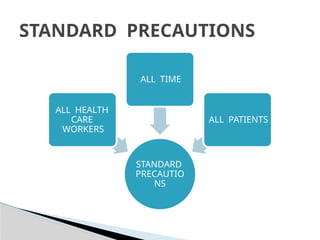
 STANDARD PRECAUTIONS SHOULD BE
FOLLOWED BY ALL HEALTH CARE WORKERS IN
ALL PATIENTS AT ALL TIMES.
WHAT CAN WE DO PREVENT
INFECTIONS?
STANDARD
PRECAUTIO
NS
ALL HEALTH
CARE
WORKERS
ALL TIME
ALL PATIENTS
STANDARD PRECAUTIONS
 HAND WASHING
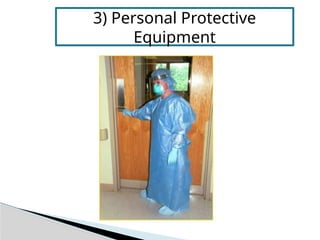
 GLOVES & PERSONAL PROTECTIVE EQUIPMENT
 PATIENT CARE EQUIPMENT
 ENVIRONMENTAL CONTROL
 LINEN
 OCCUPATIONAL HEALTH
 PATIENT ISOLATION
PRINCIPLES OF STANDARD
PRECAUTIONS
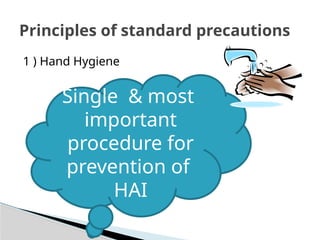
1 ) Hand Hygiene
Principles of standard precautions
Single & most
important
procedure for
prevention of
HAI
 RUNNING WATER
 SOAP
 SINGLE USE HAND TOWELS
REQUIREMENTS
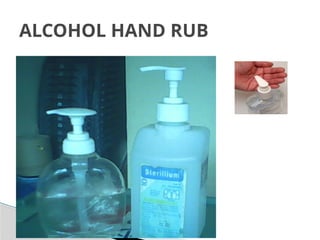
ALCOHOL HAND RUB
 Used and alternative to hand washing
 Do not used visibly soiled hands
 Has good immediate activity
 Does not require drying with a towel
 Less time consuming
 Does not cause drying of skin
 Does not destroy clostridium dificilae
 Can prepared in 97ml of 70% alcohol + 03ml
glycerol
ALCOHOL HAND RUB
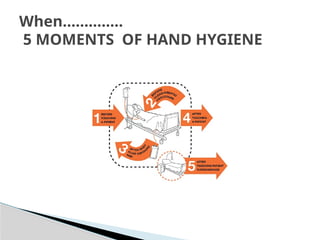
When…………..
5 MOMENTS OF HAND HYGIENE
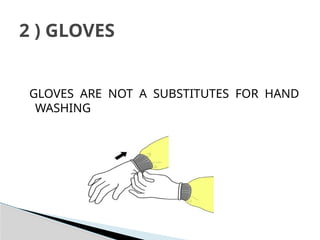
GLOVES ARE NOT A SUBSTITUTES FOR HAND
WASHING
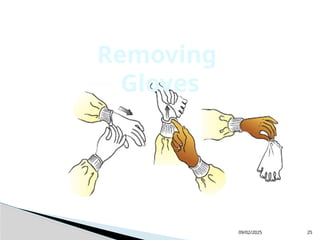
2 ) GLOVES
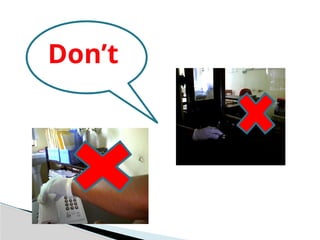
Don’t
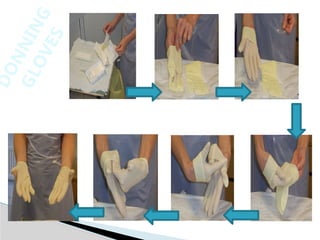
D
O
N
N
I
N
G
G
L
O
V
E
S
09/02/2025 25
Removing
Gloves
3) Personal Protective
Equipment
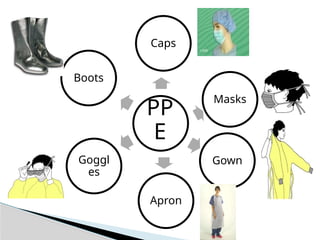
PP
E
Caps
Masks
Gown
Apron
Goggl
es
Boots
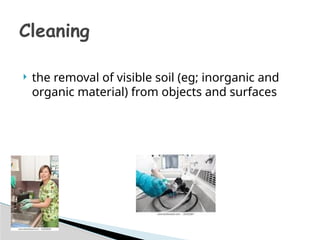
 the removal of visible soil (eg; inorganic and
organic material) from objects and surfaces
Cleaning
 elimination of micro-organisms on inanimate
objects with the exception of bacterial spores
Disinfection
Disinfection
 High Level Disinfection
- It is a process that kills all viable micro-organisms
including some of the bacterial spores
 Intermediate Level Disinfection
- It is a process that kills all viable microorganisms
excluding bacterial spores
 Low Level Disinfection
-It is a process that kills most of the vegetative
bacteria and some viruses e.g.- enveloped viruses
 2% GLUTARALDEHYDE (CIDEX) .
 0.55% ORTHOPTHALDEHYDE (CYDEX OPA )
 PARASAFE
 1% CHLORINE RELEASING SOLUTION
(T.C.L )
 LYSOL (2.5 % OR 5% ) ,
DISINFECTANTS
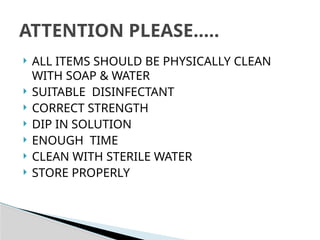
 ALL ITEMS SHOULD BE PHYSICALLY CLEAN
WITH SOAP & WATER
 SUITABLE DISINFECTANT
 CORRECT STRENGTH
 DIP IN SOLUTION
 ENOUGH TIME
 CLEAN WITH STERILE WATER
 STORE PROPERLY
ATTENTION PLEASE…..
 70 % ETHYL ALCOHOL (SURGICAL SPIRITS)
 BETADINE
 CHLORHEXIDINE COMPOUNDS (HIBITANE )
 HYDROGEN PEROXIDE
ANTISEPTICTS
Sterilization –
complete elimination or destruction of all
forms of microbial life (including spores)
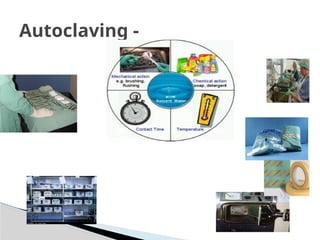
Autoclaving -
 Items in clinical practice
- Critical items (high risk)
- Semi critical items (intermediate risk)
- Non-critical items (low risk)
- Minimal risk items
Disinfection & Sterilization (cont.)
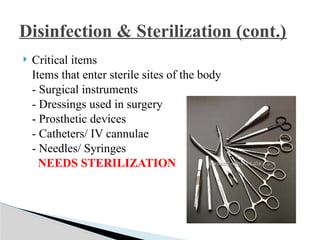
 Critical items
Items that enter sterile sites of the body
- Surgical instruments
- Dressings used in surgery
- Prosthetic devices
- Catheters/ IV cannulae
- Needles/ Syringes
NEEDS STERILIZATION
Disinfection & Sterilization (cont.)
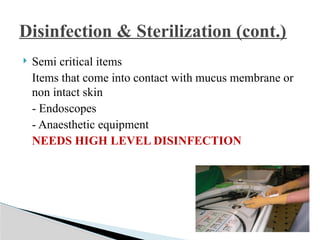
 Semi critical items
Items that come into contact with mucus membrane or
non intact skin
- Endoscopes
- Anaesthetic equipment
NEEDS HIGH LEVEL DISINFECTION
Disinfection & Sterilization (cont.)
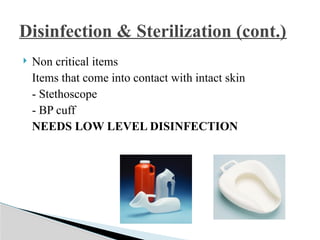
 Non critical items
Items that come into contact with intact skin
- Stethoscope
- BP cuff
NEEDS LOW LEVEL DISINFECTION
Disinfection & Sterilization (cont.)
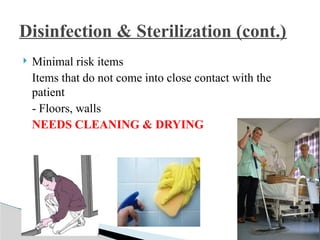
 Minimal risk items
Items that do not come into close contact with the
patient
- Floors, walls
NEEDS CLEANING & DRYING
Disinfection & Sterilization (cont.)
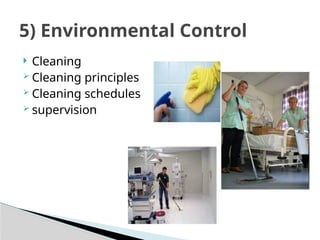
 Cleaning
 Cleaning principles
 Cleaning schedules
 supervision
5) Environmental Control
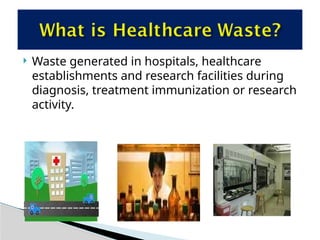
 Waste generated in hospitals, healthcare
establishments and research facilities during
diagnosis, treatment immunization or research
activity.
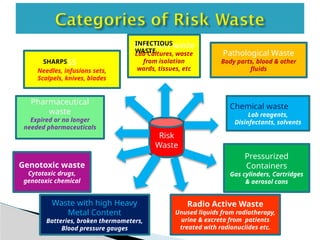
Risk
Waste
Pathological Waste
Body parts, blood & other
fluids
Chemical waste
Lab reagents,
Disinfectants, solvents
Genotoxic waste
Cytotoxic drugs,
genotoxic chemical
Waste with high Heavy
Metal Content
Batteries, broken thermometers,
Blood pressure gauges
Pressurized
Containers
Gas cylinders, Cartridges
& aerosol cans
SS
Needles, infusions sets,
Scalpels, knives, blades
Pharmaceutical
waste
Expired or no longer
needed pharmaceuticals
Infectious waste
Lab Cultures, waste
from isolation
wards, tissues, etc
Radio Active Waste
Unused liquids from radiotherapy,
urine & excreta from patients
treated with radionuclides etc.
SHARPS
INFECTIOUS
WASTE
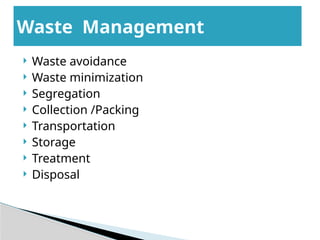
 Waste avoidance
 Waste minimization
 Segregation
 Collection /Packing
 Transportation
 Storage
 Treatment
 Disposal
Waste Management
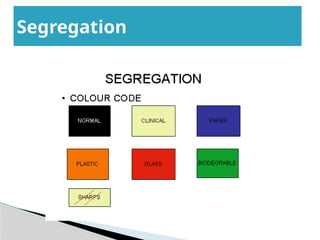
Segregation
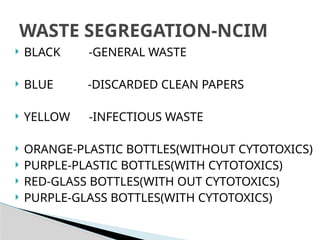
 BLACK -GENERAL WASTE
 BLUE -DISCARDED CLEAN PAPERS
 YELLOW -INFECTIOUS WASTE
 ORANGE-PLASTIC BOTTLES(WITHOUT CYTOTOXICS)
 PURPLE-PLASTIC BOTTLES(WITH CYTOTOXICS)
 RED-GLASS BOTTLES(WITH OUT CYTOTOXICS)
 PURPLE-GLASS BOTTLES(WITH CYTOTOXICS)
WASTE SEGREGATION-NCIM
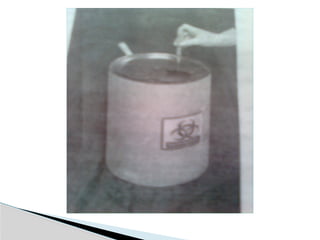
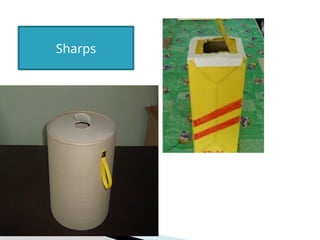
Sharps
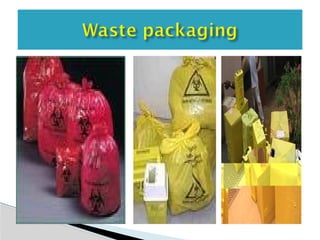
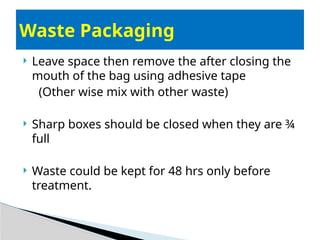
 Leave space then remove the after closing the
mouth of the bag using adhesive tape
(Other wise mix with other waste)
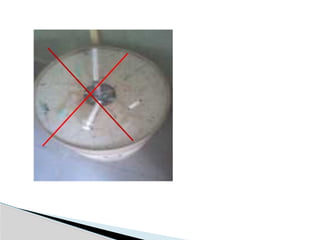
 Sharp boxes should be closed when they are ¾
full
 Waste could be kept for 48 hrs only before
treatment.
Waste Packaging
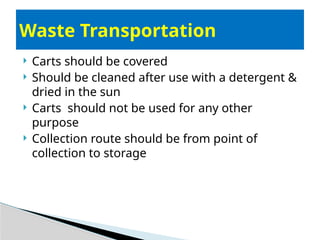
 Carts should be covered
 Should be cleaned after use with a detergent &
dried in the sun
 Carts should not be used for any other
purpose
 Collection route should be from point of
collection to storage
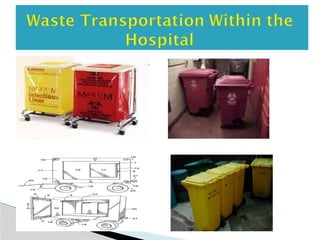
Waste Transportation
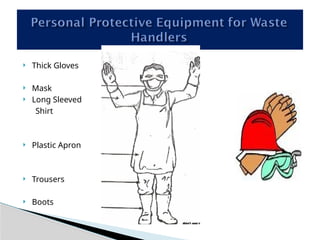
 Thick Gloves
 Mask
 Long Sleeved
Shirt
 Plastic Apron
 Trousers
 Boots
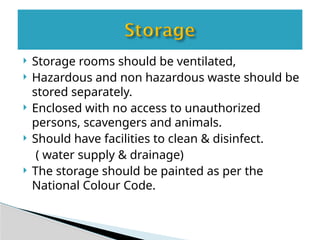
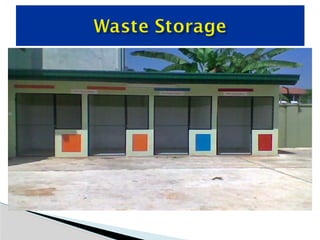
 Storage rooms should be ventilated,
 Hazardous and non hazardous waste should be
stored separately.
 Enclosed with no access to unauthorized
persons, scavengers and animals.
 Should have facilities to clean & disinfect.
( water supply & drainage)
 The storage should be painted as per the
National Colour Code.
 Castle Street Hospital
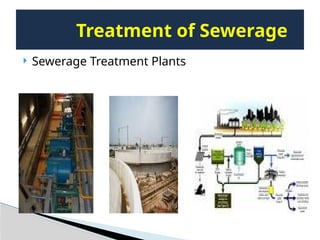
 Sewerage Treatment Plants
Treatment of Sewerage
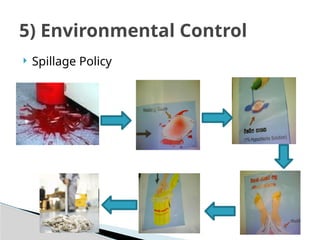
 Spillage Policy
5) Environmental Control
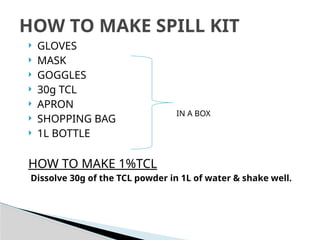
 GLOVES
 MASK
 GOGGLES
 30g TCL
 APRON
 SHOPPING BAG
 1L BOTTLE
HOW TO MAKE 1%TCL
Dissolve 30g of the TCL powder in 1L of water & shake well.
HOW TO MAKE SPILL KIT
IN A BOX
 Dissolve 30g of the TCL powder in 1L of water &
shake well.
HOW TO MAKE 1%TCL
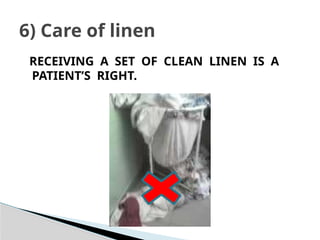
RECEIVING A SET OF CLEAN LINEN IS A
PATIENT’S RIGHT.
6) Care of linen
 PERSONAL HYGIENE
 VACCINATION
 PREVENTION OF ACCIDENTAL EXPOSURES
 MANAGEMENT OF ACCIDENTAL EXPOSURES
7) Occupational health
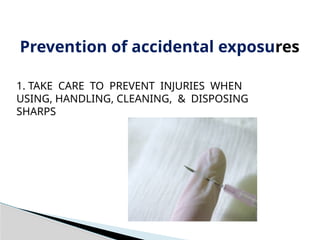
Prevention of accidental exposures
1. TAKE CARE TO PREVENT INJURIES WHEN
USING, HANDLING, CLEANING, & DISPOSING
SHARPS
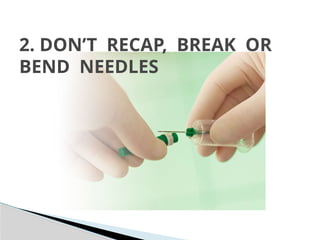
2. DON’T RECAP, BREAK OR
BEND NEEDLES
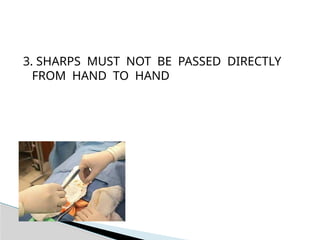
3. SHARPS MUST NOT BE PASSED DIRECTLY
FROM HAND TO HAND
5. DISPOSE OF THE SHARP BIN WHEN IT IS ¾ FULL.
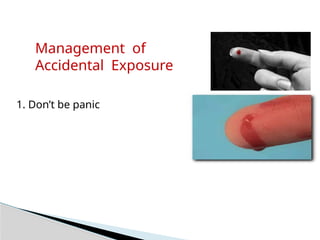
1. Don’t be panic
Management of
Accidental Exposure
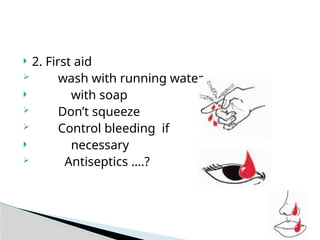
 2. First aid
 wash with running water
 with soap
 Don’t squeeze
 Control bleeding if
 necessary
 Antiseptics ….?
3. Inform to Infection control unit
 For further instructions
 For documentation
4. Assess the situation
 what are the risks of patient ?
 Depth and exposure level of HCW
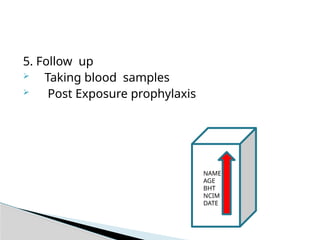
5. Follow up
 Taking blood samples
 Post Exposure prophylaxis
NAME
NAGE
NCIM
BHT
DATE
NAME
AGE
BHT
NCIM
DATE
Good infection control
practices
Patient +
You
Good
Bye…..HAI

INFECTION CONTROL FOR NURSES - Copy.pptx

  • 1.
  • 2.
     INFECTION CONTROLIS A SERIES OF PROCEDURES AND GUIDELINES TO PREVENT HOSPITAL ASSOCIATED INFECTIONS (HAI) WHAT IS INFECTION CONTROL?
  • 3.
     INFECTIONS THATARE ACQUIRED BY PATIENTS DURING THEIR STAY IN HOSPITAL. (WITHIN 24 HOURS AFTER ADMISSION OR DISCHARGE)  INFECTIONS THAT ARE ACQUIRED BY HEALTH CARE WORKERS WHILE WORKING IN HOSPITAL. WHAT ARE HOSPITAL ASSOCIATED INFECTIONS (HAI)
  • 4.
     URINARY TRACTINFECTIONS (COLIFORM)  SURGICAL WOUND INFECTIONS(MRSA)  RESPIRATORY TRACT INFECTIONS(CHICKEN POX,MEASLES,H1N1)  BLOOD STREAM INFECTIONS (MRSA,COLIFORM,ACINETOBACTER)  HEPATITIS B INFECTION WHAT ARE THE COMMON HAI?
  • 5.
     PATIENT TOPATIENT  HEALTH CARE WORKER TO PATIENT  PATIENT TO HEALTH CARE WORKERS HOW ARE THESE INFECTION TRANSMITTED?
  • 6.
     CONTACT-  DROPLETS AIRBORNE  FOOD & WATER  BLOOD & BODY FLUIDS  VECTORS MODES OF TRANSMISSION
  • 7.
     MANY HAIARE CAUSED BY HOSPITAL BACTERIA.  THESE BACTERIA SURVIVE IN THE HOSPITAL BECAUSE THEY ARE RESISTENT TO THE COMMONLY USED ANTIBIOTICS.  THESE BACTERIA INCLUDE MRSA,EXTENDED SPECTRUM BETA LACTAMASE(ESBL),ACINETOBACTER  THESE BACTERIA MULTI DRUG RESISTANT.  ANTIBIOTICS USED TO TREAT VERY EXPENSIVE. WHY IS HAI A PROBLEM?
  • 8.
     INFECTIONS CANBE PREVENTED BY FOLLOWING A SET OF VERY SIMPLE,PRACTICAL GUIDELINES CALLED STANDARD PRECAUTIONS.  STANDARD PRECAUTIONS SHOULD BE FOLLOWED BY ALL HEALTH CARE WORKERS IN ALL PATIENTS AT ALL TIMES. WHAT CAN WE DO PREVENT INFECTIONS?
  • 9.
  • 10.
     HAND WASHING GLOVES & PERSONAL PROTECTIVE EQUIPMENT  PATIENT CARE EQUIPMENT  ENVIRONMENTAL CONTROL  LINEN  OCCUPATIONAL HEALTH  PATIENT ISOLATION PRINCIPLES OF STANDARD PRECAUTIONS
  • 12.
    1 ) HandHygiene Principles of standard precautions Single & most important procedure for prevention of HAI
  • 13.
     RUNNING WATER SOAP  SINGLE USE HAND TOWELS REQUIREMENTS
  • 19.
  • 20.
     Used andalternative to hand washing  Do not used visibly soiled hands  Has good immediate activity  Does not require drying with a towel  Less time consuming  Does not cause drying of skin  Does not destroy clostridium dificilae  Can prepared in 97ml of 70% alcohol + 03ml glycerol ALCOHOL HAND RUB
  • 21.
  • 22.
    GLOVES ARE NOTA SUBSTITUTES FOR HAND WASHING 2 ) GLOVES
  • 23.
  • 24.
  • 25.
  • 26.
  • 27.
  • 28.
     the removalof visible soil (eg; inorganic and organic material) from objects and surfaces Cleaning
  • 29.
     elimination ofmicro-organisms on inanimate objects with the exception of bacterial spores Disinfection
  • 30.
    Disinfection  High LevelDisinfection - It is a process that kills all viable micro-organisms including some of the bacterial spores  Intermediate Level Disinfection - It is a process that kills all viable microorganisms excluding bacterial spores  Low Level Disinfection -It is a process that kills most of the vegetative bacteria and some viruses e.g.- enveloped viruses
  • 31.
     2% GLUTARALDEHYDE(CIDEX) .  0.55% ORTHOPTHALDEHYDE (CYDEX OPA )  PARASAFE  1% CHLORINE RELEASING SOLUTION (T.C.L )  LYSOL (2.5 % OR 5% ) , DISINFECTANTS
  • 32.
     ALL ITEMSSHOULD BE PHYSICALLY CLEAN WITH SOAP & WATER  SUITABLE DISINFECTANT  CORRECT STRENGTH  DIP IN SOLUTION  ENOUGH TIME  CLEAN WITH STERILE WATER  STORE PROPERLY ATTENTION PLEASE…..
  • 33.
     70 %ETHYL ALCOHOL (SURGICAL SPIRITS)  BETADINE  CHLORHEXIDINE COMPOUNDS (HIBITANE )  HYDROGEN PEROXIDE ANTISEPTICTS
  • 34.
    Sterilization – complete eliminationor destruction of all forms of microbial life (including spores)
  • 35.
  • 36.
     Items inclinical practice - Critical items (high risk) - Semi critical items (intermediate risk) - Non-critical items (low risk) - Minimal risk items Disinfection & Sterilization (cont.)
  • 37.
     Critical items Itemsthat enter sterile sites of the body - Surgical instruments - Dressings used in surgery - Prosthetic devices - Catheters/ IV cannulae - Needles/ Syringes NEEDS STERILIZATION Disinfection & Sterilization (cont.)
  • 38.
     Semi criticalitems Items that come into contact with mucus membrane or non intact skin - Endoscopes - Anaesthetic equipment NEEDS HIGH LEVEL DISINFECTION Disinfection & Sterilization (cont.)
  • 39.
     Non criticalitems Items that come into contact with intact skin - Stethoscope - BP cuff NEEDS LOW LEVEL DISINFECTION Disinfection & Sterilization (cont.)
  • 40.
     Minimal riskitems Items that do not come into close contact with the patient - Floors, walls NEEDS CLEANING & DRYING Disinfection & Sterilization (cont.)
  • 41.
     Cleaning  Cleaningprinciples  Cleaning schedules  supervision 5) Environmental Control
  • 42.
     Waste generatedin hospitals, healthcare establishments and research facilities during diagnosis, treatment immunization or research activity.
  • 43.
    Risk Waste Pathological Waste Body parts,blood & other fluids Chemical waste Lab reagents, Disinfectants, solvents Genotoxic waste Cytotoxic drugs, genotoxic chemical Waste with high Heavy Metal Content Batteries, broken thermometers, Blood pressure gauges Pressurized Containers Gas cylinders, Cartridges & aerosol cans SS Needles, infusions sets, Scalpels, knives, blades Pharmaceutical waste Expired or no longer needed pharmaceuticals Infectious waste Lab Cultures, waste from isolation wards, tissues, etc Radio Active Waste Unused liquids from radiotherapy, urine & excreta from patients treated with radionuclides etc. SHARPS INFECTIOUS WASTE
  • 44.
     Waste avoidance Waste minimization  Segregation  Collection /Packing  Transportation  Storage  Treatment  Disposal Waste Management
  • 45.
  • 46.
     BLACK -GENERALWASTE  BLUE -DISCARDED CLEAN PAPERS  YELLOW -INFECTIOUS WASTE  ORANGE-PLASTIC BOTTLES(WITHOUT CYTOTOXICS)  PURPLE-PLASTIC BOTTLES(WITH CYTOTOXICS)  RED-GLASS BOTTLES(WITH OUT CYTOTOXICS)  PURPLE-GLASS BOTTLES(WITH CYTOTOXICS) WASTE SEGREGATION-NCIM
  • 48.
  • 50.
     Leave spacethen remove the after closing the mouth of the bag using adhesive tape (Other wise mix with other waste)  Sharp boxes should be closed when they are ¾ full  Waste could be kept for 48 hrs only before treatment. Waste Packaging
  • 52.
     Carts shouldbe covered  Should be cleaned after use with a detergent & dried in the sun  Carts should not be used for any other purpose  Collection route should be from point of collection to storage Waste Transportation
  • 54.
     Thick Gloves Mask  Long Sleeved Shirt  Plastic Apron  Trousers  Boots
  • 55.
     Storage roomsshould be ventilated,  Hazardous and non hazardous waste should be stored separately.  Enclosed with no access to unauthorized persons, scavengers and animals.  Should have facilities to clean & disinfect. ( water supply & drainage)  The storage should be painted as per the National Colour Code.
  • 56.
  • 57.
     Sewerage TreatmentPlants Treatment of Sewerage
  • 58.
     Spillage Policy 5)Environmental Control
  • 59.
     GLOVES  MASK GOGGLES  30g TCL  APRON  SHOPPING BAG  1L BOTTLE HOW TO MAKE 1%TCL Dissolve 30g of the TCL powder in 1L of water & shake well. HOW TO MAKE SPILL KIT IN A BOX
  • 60.
     Dissolve 30gof the TCL powder in 1L of water & shake well. HOW TO MAKE 1%TCL
  • 61.
    RECEIVING A SETOF CLEAN LINEN IS A PATIENT’S RIGHT. 6) Care of linen
  • 62.
     PERSONAL HYGIENE VACCINATION  PREVENTION OF ACCIDENTAL EXPOSURES  MANAGEMENT OF ACCIDENTAL EXPOSURES 7) Occupational health
  • 63.
    Prevention of accidentalexposures 1. TAKE CARE TO PREVENT INJURIES WHEN USING, HANDLING, CLEANING, & DISPOSING SHARPS
  • 64.
    2. DON’T RECAP,BREAK OR BEND NEEDLES
  • 65.
    3. SHARPS MUSTNOT BE PASSED DIRECTLY FROM HAND TO HAND
  • 66.
    5. DISPOSE OFTHE SHARP BIN WHEN IT IS ¾ FULL.
  • 67.
    1. Don’t bepanic Management of Accidental Exposure
  • 68.
     2. Firstaid  wash with running water  with soap  Don’t squeeze  Control bleeding if  necessary  Antiseptics ….?
  • 69.
    3. Inform toInfection control unit  For further instructions  For documentation
  • 70.
    4. Assess thesituation  what are the risks of patient ?  Depth and exposure level of HCW
  • 71.
    5. Follow up Taking blood samples  Post Exposure prophylaxis NAME NAGE NCIM BHT DATE NAME AGE BHT NCIM DATE
  • 72.