Cleanroom clothing - why, what and how? 
Heidi Tuomi 
R3 Nordic symposium 
20.5.2014
Contents 
• People as a source of contamination 
• Cleanroom clothing 
– Requirements for cleanroom clothing 
– Cleanroom apparel 
• Gowning for the cleanroom
People as a source of contamination
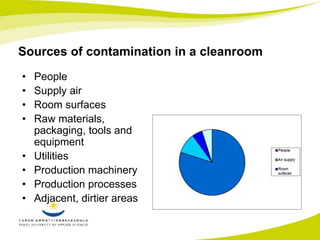
Sources of contamination in a cleanroom 
• People 
• Supply air 
• Room surfaces 
• Raw materials, 
packaging, tools and 
equipment 
• Utilities 
• Production machinery 
• Production processes 
• Adjacent, dirtier areas
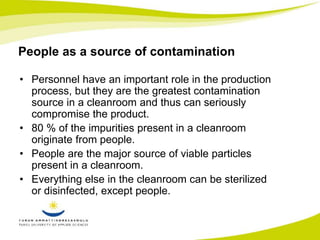
People as a source of contamination 
• Personnel have an important role in the production 
process, but they are the greatest contamination 
source in a cleanroom and thus can seriously 
compromise the product. 
• 80 % of the impurities present in a cleanroom 
originate from people. 
• People are the major source of viable particles 
present in a cleanroom. 
• Everything else in the cleanroom can be sterilized 
or disinfected, except people.
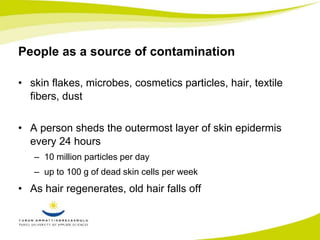
People as a source of contamination 
• skin flakes, microbes, cosmetics particles, hair, textile 
fibers, dust 
• A person sheds the outermost layer of skin epidermis 
every 24 hours 
– 10 million particles per day 
– up to 100 g of dead skin cells per week 
• As hair regenerates, old hair falls off
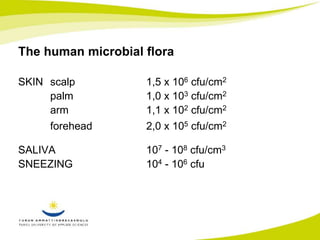
The human microbial flora 
SKIN scalp 1,5 x 10⁶ cfu/cm2 
palm 1,0 x 10³ cfu/cm2 
arm 1,1 x 10² cfu/cm2 
forehead 2,0 x 10⁵ cfu/cm2 
SALIVA 107 - 108 cfu/cm3 
SNEEZING 104 - 106 cfu
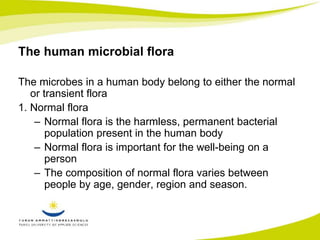
The human microbial flora 
The microbes in a human body belong to either the normal 
or transient flora 
1. Normal flora 
– Normal flora is the harmless, permanent bacterial 
population present in the human body 
– Normal flora is important for the well-being on a 
person 
– The composition of normal flora varies between 
people by age, gender, region and season.
The human microbial flora 
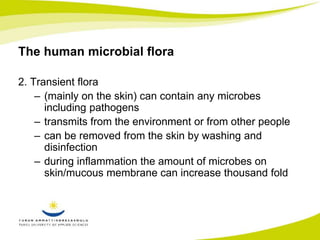
2. Transient flora 
– (mainly on the skin) can contain any microbes 
including pathogens 
– transmits from the environment or from other people 
– can be removed from the skin by washing and 
disinfection 
– during inflammation the amount of microbes on 
skin/mucous membrane can increase thousand fold
The human microbial flora 
• Microbes are detached from people with skin flakes or 
secretions (e.g. saliva)
People as a source of contamination 
• The number of particles generated from a person 
is increased by: 
– Movement: a person walking generates 10 times 
more particles than one sitting down 
– talking and coughing 
– smoking; exhalation air contains a great number of 
particles 
– the use of cosmetics = particles applied on the skin
People as a source of contamination 
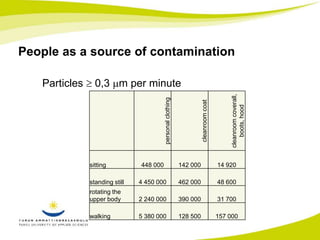
Particles  0,3 m per minute 
personal clothing 
cleanroom coat 
cleanroom coverall, 
boots, hood 
sitting 448 000 142 000 14 920 
standing still 4 450 000 462 000 48 600 
rotating the 
upper body 2 240 000 390 000 31 700 
walking 5 380 000 128 500 157 000
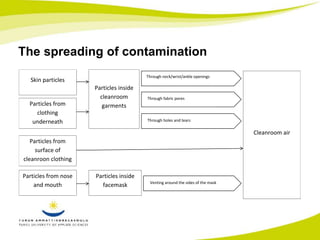
The spreading of contamination 
Skin particles 
Particles from 
clothing 
underneath 
Particles from 
surface of 
cleanroon clothing 
Particles from nose 
and mouth 
Cleanroom air 
Particles inside 
cleanroom 
garments 
Particles inside 
facemask 
Through neck/wrist/ankle openings 
Through fabric pores 
Through holes and tears 
Venting around the sides of the mask
Decreasing the amount contamination from 
people 
Ways to decrease the amount contamination: 
• Efficient and correctly worn protective clothing 
• Slow movements and correct work methods 
• Good personal hygiene 
Training the employees is most important !
Cleanroom clothing
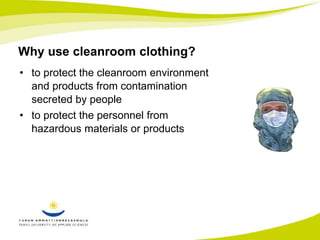
Why use cleanroom clothing? 
• to protect the cleanroom environment 
and products from contamination 
secreted by people 
• to protect the personnel from 
hazardous materials or products
Requirements for cleanroom clothing 
Cleanroom clothing should 
• protect the cleanroom environment from contamination 
• shed no particles 
• be easy to put on 
• be comfortable to wear 
• be dirt repellent and easily cleanable 
• withstand washing and sterilization 
• have adequate strength and resistance to break-up 
• have desirable electrostatic properties
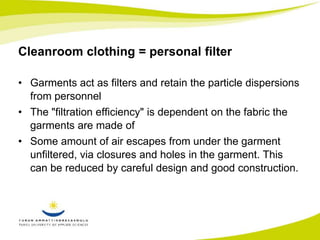
Cleanroom clothing = personal filter 
• Garments act as filters and retain the particle dispersions 
from personnel 
• The "filtration efficiency" is dependent on the fabric the 
garments are made of 
• Some amount of air escapes from under the garment 
unfiltered, via closures and holes in the garment. This 
can be reduced by careful design and good construction.
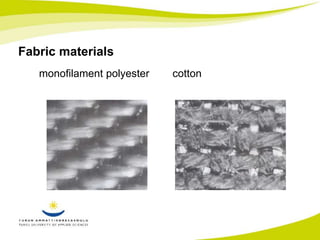
Fabric materials 
monofilament polyester cotton
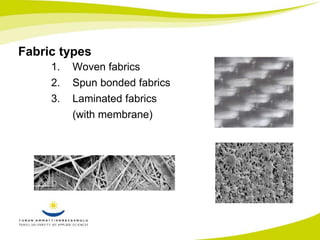
Fabric types 
1. Woven fabrics 
2. Spun bonded fabrics 
3. Laminated fabrics 
(with membrane)
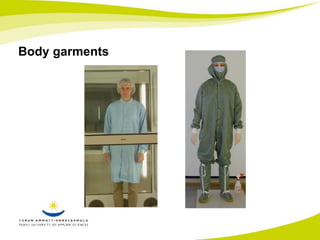
Body garments
Body garments 
• coat and trousers or coverall (bunny-suit) 
– simple and straight-lined model 
– no pockets, belt pleats or tucks 
– minimum of seams 
– coverall/coat is sealed with a zipper covered with a 
placket (=zipper covering) 
– secure closures at the wrist, neck and ankle openings; 
adjustable (with snaps) or rib knit 
– garments should be a bit loose (not too large)
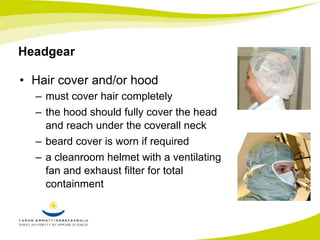
Headgear 
• Hair cover and/or hood 
– must cover hair completely 
– the hood should fully cover the head 
and reach under the coverall neck 
– beard cover is worn if required 
– a cleanroom helmet with a ventilating 
fan and exhaust filter for total 
containment
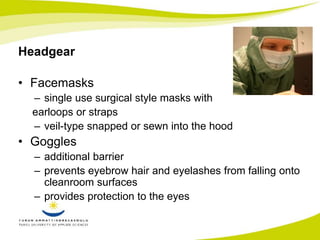
Headgear 
• Facemasks 
– single use surgical style masks with 
earloops or straps 
– veil-type snapped or sewn into the hood 
• Goggles 
– additional barrier 
– prevents eyebrow hair and eyelashes from falling onto 
cleanroom surfaces 
– provides protection to the eyes
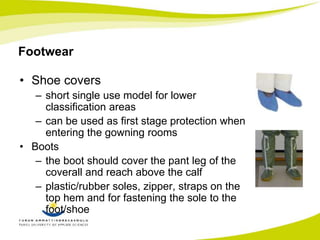
Footwear 
• Shoe covers 
– short single use model for lower 
classification areas 
– can be used as first stage protection when 
entering the gowning rooms 
• Boots 
– the boot should cover the pant leg of the 
coverall and reach above the calf 
– plastic/rubber soles, zipper, straps on the 
top hem and for fastening the sole to the 
foot/shoe
Gloves 
Selection of material depends on the use 
• knitted/woven gloves may be suitable for 
inspection and assembly work 
• barrier gloves are made of latex, nitrile or vinyl 
• latex; excellent fit, feel and comfort; allergenic 
• nitrile; excellent tear and chemical resistance 
• vinyl; economical, susceptible to tears, breakage 
and pinholes
Gloves 
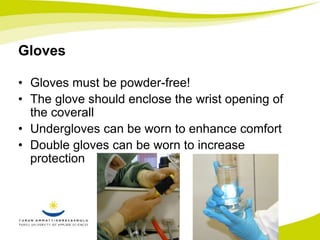
• Gloves must be powder-free! 
• The glove should enclose the wrist opening of 
the coverall 
• Undergloves can be worn to enhance comfort 
• Double gloves can be worn to increase 
protection
Clothing in different cleanroom classes 
• The required filtration efficiency depends on: 
– the cleanroom class 
– the product/process (sterile product? aseptic 
process?) 
• It defines the material and model of the clothing
Clothing in different cleanroom classes 
• Garment systems may include several layers of 
garments; by using cleanroom undersuits, the 
effectiveness of the cleanroom apparel can be 
increased 
• By combining various types of garments and 
accessories a suitable combination for different 
cleanroom classes and applications can be found 
• Clothing manufacturers give recommendations 
on which products to use at different cleanroom 
classes
Clothing requirements in GMP 
Grade D: Hair and, where relevant, beard should be 
covered. A general protective suit and appropriate shoes 
or overshoes should be worn. Appropriate measures 
should be taken to avoid any contamination coming from 
outside the clean area. 
Grade C: Hair and where relevant beard and moustache 
should be covered. A single or two-piece trouser suit, 
gathered at the wrists and with high neck and appropriate 
shoes or overshoes should be worn. They should shed 
virtually no fibres or particulate matter.
Clothing requirements in GMP 
• Grade A/B: Headgear should totally enclose hair and, 
where relevant, beard and moustache; it should be 
tucked into the neck of the suit; a face mask should be 
worn to prevent the shedding of droplets. Appropriate 
sterilized, non-powdered rubber or plastic gloves and 
sterilized or disinfected footwear should be worn. 
Trouser-legs should be tucked inside the footwear and 
garment sleeves into the gloves. The protective clothing 
should shed virtually no fibers or particulate matter and 
retain particles shed by the body.
ISO 14644-5 
• Clothing should be made of fabrics that do not shed 
particles/contamination 
• The frequency of clothing change varies according to the 
use of the cleanroom 
• Cleanroom clothing should not leave the controlled area 
expect for cleaning or service/repair 
• Clothing must be stored and transported in a way to 
minimize contamination 
• Clothing should be donned and disrobed in a manner to 
minimize the generation and spreading of contamination 
• Clothing should be regularly inspected to ensure 
continued compliance to specifications
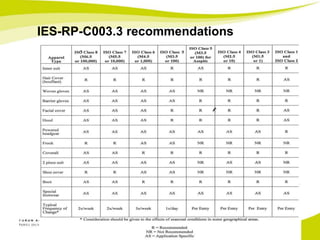
IES-RP-C003.3 recommendations
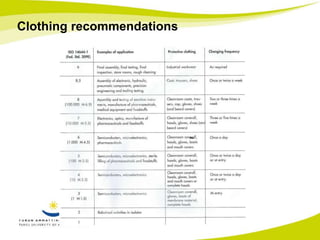
Clothing recommendations
Gowning for the cleanroom
Gowning for the cleanroom 
• Cleanroom garments are donned prior to entering the 
cleanroom 
• There is no single right practice to put on cleanroom 
clothing, but it varies with the clothing used 
• The best method of changing into cleanroom garments is 
the one that minimizes the amount of contamination 
getting onto outside of the garments. 
• A written instruction should be available in the changing 
room(s)!
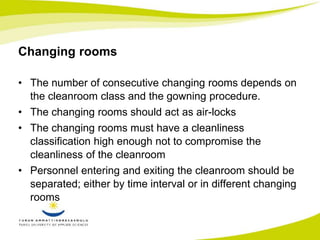
Changing rooms 
• The number of consecutive changing rooms depends on 
the cleanroom class and the gowning procedure. 
• The changing rooms should act as air-locks 
• The changing rooms must have a cleanliness 
classification high enough not to compromise the 
cleanliness of the cleanroom 
• Personnel entering and exiting the cleanroom should be 
separated; either by time interval or in different changing 
rooms
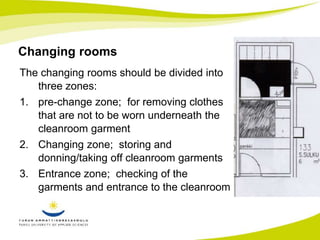
Changing rooms 
The changing rooms should be divided into 
three zones: 
1. pre-change zone; for removing clothes 
that are not to be worn underneath the 
cleanroom garment 
2. Changing zone; storing and 
donning/taking off cleanroom garments 
3. Entrance zone; checking of the 
garments and entrance to the cleanroom
Outside the cleanroom 
• Take a shower, preferably at least 6 hours before 
• Don clean underwear and socks 
• Remove jewelry, watches etc. 
• Don clean working clothes suitable for entry in the pre-change 
area 
• Put on clean shoes 
• Don clean hair-cover (and beard cover)
Hand hygiene 
• An effective scrub-up with soap removes dirt, microbes 
transmitted from the environment and a part of the skins 
normal flora. 
• Microbes of the skins normal flora start to multiply fast 
after washing hands. 
• By using disinfectants, the multiplication of bacteria can 
be significantly slowed down. 
• A sterile moisturizer after scrub-up is recommended for 
keeping up healthy skin.
Hand hygiene 
Instruction for washing hands: 
• Moisten hands and arms down from the elbows. 
• Take washing liquid from the dispenser and scrub it in 
your hands, with special care taken in between fingers, 
nail walls and nails 
• Scrub hands together for at least 30 seconds. 
• Rinse hands carefully 
• Dry hands with a non-linting single use towel. 
• Close the tap with the towel 
• Scrub disinfectant on the hands.
Suggested gowning protocol 
1. Remove make-up and jewelry before entering the pre-change 
area. 
2. When entering the cleanroom pre-change area you 
should wear clean working clothes, hair cover and 
indoor shoes. The cap should cover all hair completely.
Changing room 1 
3. Clean shoe soles by stepping on the sticky mat. 
4. Take off clothing not to be worn under the cleanroom 
garments. 
5. Wash hands thoroughly with washing liquid. Dry them 
with a paper towel. Disinfect the hands. 
6. Move on to the next changing room.
Changing room 2 
7. Remove gloves from the packaging and don them. 
8. Disinfect the pass-over bench. 
9. Select the garments to be worn (2 bags; coverall + boots) 
and place them on the bench. 
10. Remove face mask from the packaging and tie it on. Do 
not touch anything else but the straps and the 
“nosepiece”. Disinfect the gloves. 
11. Take the hood from the packaging and don it. Do not 
touch anything else but the lower fringe and the straps. 
Disinfect the gloves.
Changing room 2 
12. Remove the coverall from the packaging and grab it 
from the waist, legs and cuffs. Be careful not to touch the 
floor or other surfaces with the coverall. Don the coverall. 
The outer side of the coverall should not touch your 
clothing or skin. Lift the glove cuffs over the coverall cuffs. 
Disinfect the gloves. 
13. Remove the boots from the packaging put them on while 
crossing over the bench at the same time. The cleanroom 
boots should not touch the floor on the “dirty” side of the 
bench.
Changing room 2 
14. Check the clothing in a mirror for correct wear. 
15. Check that the gloves are intact; in case of damage 
change a new pair. Disinfect gloves. 
16. Enter the cleanroom.
Thank you!

Cleanroom clothing - Why, what and how?

  • 1.
    Cleanroom clothing -why, what and how? Heidi Tuomi R3 Nordic symposium 20.5.2014
  • 2.
    Contents • Peopleas a source of contamination • Cleanroom clothing – Requirements for cleanroom clothing – Cleanroom apparel • Gowning for the cleanroom
  • 3.
    People as asource of contamination
  • 4.
    Sources of contaminationin a cleanroom • People • Supply air • Room surfaces • Raw materials, packaging, tools and equipment • Utilities • Production machinery • Production processes • Adjacent, dirtier areas
  • 5.
    People as asource of contamination • Personnel have an important role in the production process, but they are the greatest contamination source in a cleanroom and thus can seriously compromise the product. • 80 % of the impurities present in a cleanroom originate from people. • People are the major source of viable particles present in a cleanroom. • Everything else in the cleanroom can be sterilized or disinfected, except people.
  • 6.
    People as asource of contamination • skin flakes, microbes, cosmetics particles, hair, textile fibers, dust • A person sheds the outermost layer of skin epidermis every 24 hours – 10 million particles per day – up to 100 g of dead skin cells per week • As hair regenerates, old hair falls off
  • 7.
    The human microbialflora SKIN scalp 1,5 x 10⁶ cfu/cm2 palm 1,0 x 10³ cfu/cm2 arm 1,1 x 10² cfu/cm2 forehead 2,0 x 10⁵ cfu/cm2 SALIVA 107 - 108 cfu/cm3 SNEEZING 104 - 106 cfu
  • 8.
    The human microbialflora The microbes in a human body belong to either the normal or transient flora 1. Normal flora – Normal flora is the harmless, permanent bacterial population present in the human body – Normal flora is important for the well-being on a person – The composition of normal flora varies between people by age, gender, region and season.
  • 9.
    The human microbialflora 2. Transient flora – (mainly on the skin) can contain any microbes including pathogens – transmits from the environment or from other people – can be removed from the skin by washing and disinfection – during inflammation the amount of microbes on skin/mucous membrane can increase thousand fold
  • 10.
    The human microbialflora • Microbes are detached from people with skin flakes or secretions (e.g. saliva)
  • 11.
    People as asource of contamination • The number of particles generated from a person is increased by: – Movement: a person walking generates 10 times more particles than one sitting down – talking and coughing – smoking; exhalation air contains a great number of particles – the use of cosmetics = particles applied on the skin
  • 12.
    People as asource of contamination Particles  0,3 m per minute personal clothing cleanroom coat cleanroom coverall, boots, hood sitting 448 000 142 000 14 920 standing still 4 450 000 462 000 48 600 rotating the upper body 2 240 000 390 000 31 700 walking 5 380 000 128 500 157 000
  • 13.
    The spreading ofcontamination Skin particles Particles from clothing underneath Particles from surface of cleanroon clothing Particles from nose and mouth Cleanroom air Particles inside cleanroom garments Particles inside facemask Through neck/wrist/ankle openings Through fabric pores Through holes and tears Venting around the sides of the mask
  • 14.
    Decreasing the amountcontamination from people Ways to decrease the amount contamination: • Efficient and correctly worn protective clothing • Slow movements and correct work methods • Good personal hygiene Training the employees is most important !
  • 15.
  • 16.
    Why use cleanroomclothing? • to protect the cleanroom environment and products from contamination secreted by people • to protect the personnel from hazardous materials or products
  • 17.
    Requirements for cleanroomclothing Cleanroom clothing should • protect the cleanroom environment from contamination • shed no particles • be easy to put on • be comfortable to wear • be dirt repellent and easily cleanable • withstand washing and sterilization • have adequate strength and resistance to break-up • have desirable electrostatic properties
  • 18.
    Cleanroom clothing =personal filter • Garments act as filters and retain the particle dispersions from personnel • The "filtration efficiency" is dependent on the fabric the garments are made of • Some amount of air escapes from under the garment unfiltered, via closures and holes in the garment. This can be reduced by careful design and good construction.
  • 19.
  • 20.
    Fabric types 1.Woven fabrics 2. Spun bonded fabrics 3. Laminated fabrics (with membrane)
  • 21.
  • 22.
    Body garments •coat and trousers or coverall (bunny-suit) – simple and straight-lined model – no pockets, belt pleats or tucks – minimum of seams – coverall/coat is sealed with a zipper covered with a placket (=zipper covering) – secure closures at the wrist, neck and ankle openings; adjustable (with snaps) or rib knit – garments should be a bit loose (not too large)
  • 23.
    Headgear • Haircover and/or hood – must cover hair completely – the hood should fully cover the head and reach under the coverall neck – beard cover is worn if required – a cleanroom helmet with a ventilating fan and exhaust filter for total containment
  • 24.
    Headgear • Facemasks – single use surgical style masks with earloops or straps – veil-type snapped or sewn into the hood • Goggles – additional barrier – prevents eyebrow hair and eyelashes from falling onto cleanroom surfaces – provides protection to the eyes
  • 25.
    Footwear • Shoecovers – short single use model for lower classification areas – can be used as first stage protection when entering the gowning rooms • Boots – the boot should cover the pant leg of the coverall and reach above the calf – plastic/rubber soles, zipper, straps on the top hem and for fastening the sole to the foot/shoe
  • 26.
    Gloves Selection ofmaterial depends on the use • knitted/woven gloves may be suitable for inspection and assembly work • barrier gloves are made of latex, nitrile or vinyl • latex; excellent fit, feel and comfort; allergenic • nitrile; excellent tear and chemical resistance • vinyl; economical, susceptible to tears, breakage and pinholes
  • 27.
    Gloves • Glovesmust be powder-free! • The glove should enclose the wrist opening of the coverall • Undergloves can be worn to enhance comfort • Double gloves can be worn to increase protection
  • 28.
    Clothing in differentcleanroom classes • The required filtration efficiency depends on: – the cleanroom class – the product/process (sterile product? aseptic process?) • It defines the material and model of the clothing
  • 29.
    Clothing in differentcleanroom classes • Garment systems may include several layers of garments; by using cleanroom undersuits, the effectiveness of the cleanroom apparel can be increased • By combining various types of garments and accessories a suitable combination for different cleanroom classes and applications can be found • Clothing manufacturers give recommendations on which products to use at different cleanroom classes
  • 30.
    Clothing requirements inGMP Grade D: Hair and, where relevant, beard should be covered. A general protective suit and appropriate shoes or overshoes should be worn. Appropriate measures should be taken to avoid any contamination coming from outside the clean area. Grade C: Hair and where relevant beard and moustache should be covered. A single or two-piece trouser suit, gathered at the wrists and with high neck and appropriate shoes or overshoes should be worn. They should shed virtually no fibres or particulate matter.
  • 31.
    Clothing requirements inGMP • Grade A/B: Headgear should totally enclose hair and, where relevant, beard and moustache; it should be tucked into the neck of the suit; a face mask should be worn to prevent the shedding of droplets. Appropriate sterilized, non-powdered rubber or plastic gloves and sterilized or disinfected footwear should be worn. Trouser-legs should be tucked inside the footwear and garment sleeves into the gloves. The protective clothing should shed virtually no fibers or particulate matter and retain particles shed by the body.
  • 32.
    ISO 14644-5 •Clothing should be made of fabrics that do not shed particles/contamination • The frequency of clothing change varies according to the use of the cleanroom • Cleanroom clothing should not leave the controlled area expect for cleaning or service/repair • Clothing must be stored and transported in a way to minimize contamination • Clothing should be donned and disrobed in a manner to minimize the generation and spreading of contamination • Clothing should be regularly inspected to ensure continued compliance to specifications
  • 33.
  • 34.
  • 35.
    Gowning for thecleanroom
  • 36.
    Gowning for thecleanroom • Cleanroom garments are donned prior to entering the cleanroom • There is no single right practice to put on cleanroom clothing, but it varies with the clothing used • The best method of changing into cleanroom garments is the one that minimizes the amount of contamination getting onto outside of the garments. • A written instruction should be available in the changing room(s)!
  • 37.
    Changing rooms •The number of consecutive changing rooms depends on the cleanroom class and the gowning procedure. • The changing rooms should act as air-locks • The changing rooms must have a cleanliness classification high enough not to compromise the cleanliness of the cleanroom • Personnel entering and exiting the cleanroom should be separated; either by time interval or in different changing rooms
  • 38.
    Changing rooms Thechanging rooms should be divided into three zones: 1. pre-change zone; for removing clothes that are not to be worn underneath the cleanroom garment 2. Changing zone; storing and donning/taking off cleanroom garments 3. Entrance zone; checking of the garments and entrance to the cleanroom
  • 39.
    Outside the cleanroom • Take a shower, preferably at least 6 hours before • Don clean underwear and socks • Remove jewelry, watches etc. • Don clean working clothes suitable for entry in the pre-change area • Put on clean shoes • Don clean hair-cover (and beard cover)
  • 40.
    Hand hygiene •An effective scrub-up with soap removes dirt, microbes transmitted from the environment and a part of the skins normal flora. • Microbes of the skins normal flora start to multiply fast after washing hands. • By using disinfectants, the multiplication of bacteria can be significantly slowed down. • A sterile moisturizer after scrub-up is recommended for keeping up healthy skin.
  • 41.
    Hand hygiene Instructionfor washing hands: • Moisten hands and arms down from the elbows. • Take washing liquid from the dispenser and scrub it in your hands, with special care taken in between fingers, nail walls and nails • Scrub hands together for at least 30 seconds. • Rinse hands carefully • Dry hands with a non-linting single use towel. • Close the tap with the towel • Scrub disinfectant on the hands.
  • 42.
    Suggested gowning protocol 1. Remove make-up and jewelry before entering the pre-change area. 2. When entering the cleanroom pre-change area you should wear clean working clothes, hair cover and indoor shoes. The cap should cover all hair completely.
  • 43.
    Changing room 1 3. Clean shoe soles by stepping on the sticky mat. 4. Take off clothing not to be worn under the cleanroom garments. 5. Wash hands thoroughly with washing liquid. Dry them with a paper towel. Disinfect the hands. 6. Move on to the next changing room.
  • 44.
    Changing room 2 7. Remove gloves from the packaging and don them. 8. Disinfect the pass-over bench. 9. Select the garments to be worn (2 bags; coverall + boots) and place them on the bench. 10. Remove face mask from the packaging and tie it on. Do not touch anything else but the straps and the “nosepiece”. Disinfect the gloves. 11. Take the hood from the packaging and don it. Do not touch anything else but the lower fringe and the straps. Disinfect the gloves.
  • 45.
    Changing room 2 12. Remove the coverall from the packaging and grab it from the waist, legs and cuffs. Be careful not to touch the floor or other surfaces with the coverall. Don the coverall. The outer side of the coverall should not touch your clothing or skin. Lift the glove cuffs over the coverall cuffs. Disinfect the gloves. 13. Remove the boots from the packaging put them on while crossing over the bench at the same time. The cleanroom boots should not touch the floor on the “dirty” side of the bench.
  • 46.
    Changing room 2 14. Check the clothing in a mirror for correct wear. 15. Check that the gloves are intact; in case of damage change a new pair. Disinfect gloves. 16. Enter the cleanroom.
  • 47.