


Understanding and Managing Workplace Bullying Professor Tim Bentley Healthy Work Group School of Management Presentation to OHSIG 2011
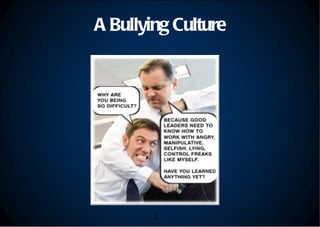
A Bullying Culture
Workplace Bullying: The Problem Exposure is claimed to be a “more crippling and devastating problem for employees than all other kinds of work-related stress put together”  (Einarsen et al., 2011).  New Zealand employers have a legal and moral duty to ensure that employees are not harmed while at work.  Several court decisions have ruled in favour of the targets of workplace bullying. Emphasised the employers’ non-delegable duty to provide a safe working environment with the organisation, rather than the bully, held legally responsible.
Direct costs: turnover increases, recruitment and training, legal fees, temporary staff Indirect costs: low productivity, high absenteeism, low morale and a stressful environment In 2001, Griffith University estimated the costs of WB to the Australian economy at between A$6-13B pa. In the UK, the cost of conflict at work = over 30B Stirling (=1000 pounds per working adult per year) Costs of Workplace Bullying
Defining Bullying Workplace bullying is:  “a situation where a person feels they have repeatedly been on the receiving end of negative actions from one or more other people, in a situation where it is difficult to defend themselves against these actions. These negative actions could be physical or non-physical. A one-off incident is not defined as bullying”  (Einarsen et al., 2011).
Bullying: What Does it Look Like? A repetition of destructive targeted behaviours Is about the workplace bully’s control needs Is about the focused and systematic selection of targets Is not tough management Can create chaos within an organisation
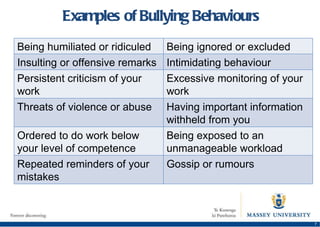
Examples of Bullying Behaviours Being humiliated or ridiculed Being ignored or excluded Insulting or offensive remarks Intimidating behaviour Persistent criticism of your work Excessive monitoring of your work Threats of violence or abuse Having important information withheld from you Ordered to do work below your level of competence Being exposed to an unmanageable workload Repeated reminders of your mistakes Gossip or rumours
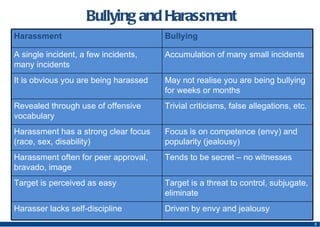
Bullying and Harassment Harassment Bullying A single incident, a few incidents, many incidents Accumulation of many small incidents It is obvious you are being harassed May not realise you are being bullying for weeks or months Revealed through use of offensive vocabulary Trivial criticisms, false allegations, etc. Harassment has a strong clear focus (race, sex, disability) Focus is on competence (envy) and popularity (jealousy) Harassment often for peer approval, bravado, image Tends to be secret – no witnesses Target is perceived as easy Target is a threat to control, subjugate, eliminate Harasser lacks self-discipline Driven by envy and jealousy
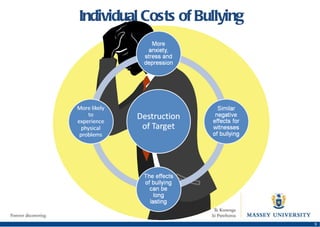
Individual Costs of Bullying
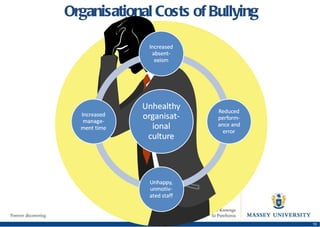
Organisational Costs of Bullying
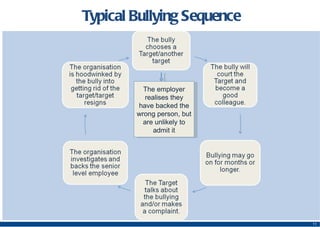
Typical Bullying Sequence The employer realises they have backed the wrong person, but are unlikely to admit it
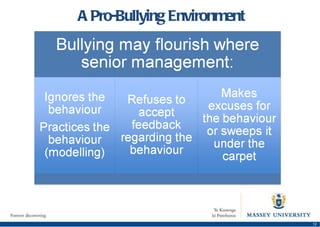
A Pro-Bullying Environment
The NZ Workplace Bullying Study
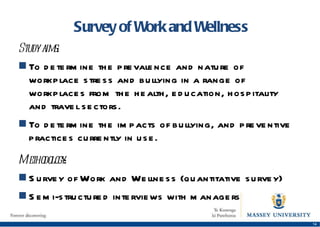
Survey of Work and Wellness Study aims : To determine the prevalence and nature of  workplace stress and bullying in a range of  workplaces from the health, education, hospitality  and travel sectors. To determine the impacts of bullying, and preventive practices currently in use. Methodology : Survey of Work and Wellness (quantitative survey) Semi-structured interviews with managers
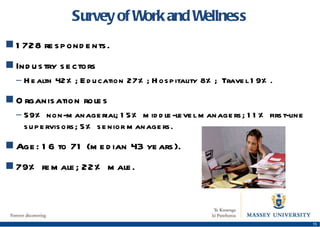
Survey of Work and Wellness  1728 respondents. Industry sectors Health 42%; Education 27%; Hospitality 8%;  Travel 19%. Organisation roles 59% non-managerial; 15% middle-level managers; 11% first-line supervisors; 5% senior managers. Age: 16 to 71 (median 43 years). 79% female; 22% male.
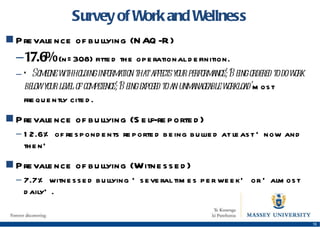
Survey of Work and Wellness  Prevalence of bullying (NAQ-R) 17.6%  (n=308)  fitted the operational definition. ‘ Someone withholding information that affects your performance ’ ;  ‘ Being ordered to do work below your level of competence ’ ;  ‘ Being exposed to an unmanageable workload ’   most frequently cited. Prevalence of bullying (Self-reported) 12.6% of respondents reported being bullied at least ‘now and then’ Prevalence of bullying (Witnessed) 7.7% witnessed bullying ‘several times per week’ or ‘almost daily’.
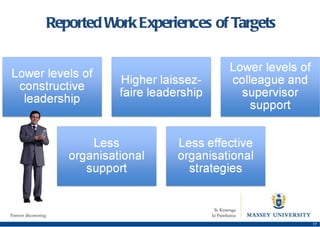
Reported Work Experiences of Targets
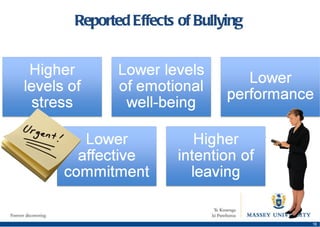
Reported Effects of Bullying
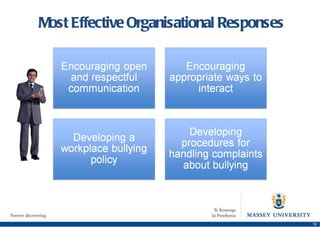
Most Effective Organisational Responses
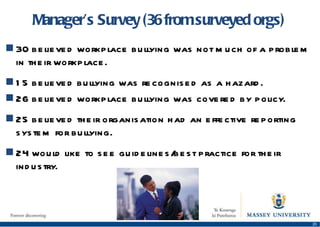
Manager’s Survey (36 from surveyed orgs) 30 believed workplace bullying was not much of a problem in their workplace. 15 believed bullying was recognised as a hazard. 26 believed workplace bullying was covered by policy. 25 believed their organisation had an effective reporting system for bullying. 24 would like to see guidelines/best practice for their industry.
Survey of OHS Practitioners
Survey of OHS Practitioners Background Few studies concerned with the management of workplace bullying – none in NZ context Survey designed to see if the findings from the Managers’ Survey (from our Survey of Work and Wellness) held up in a larger, more diverse sample The study sought to determine whether our model for influences on organisational bullying prevention activities was valid
Sample Demographics 252 respondents from 400 who attended ACC OHS workshops for managers 45% senior or middle managers 36% in non-managerial role 77% in role for 2 years or longer Health, forestry, administration, manufacturing the most represented sectors
Survey of OHS Practitioners Results 70%  reported WB in their organisation in the last 2 years Low perceived understanding of the concept of WB (27%) Leaders often not willing to confront bullies (41%) WB had high impact on staff morale, motivation, productivity 2/3 organisations had a formal WB policy 41% recognised WB as a hazard 19% had given staff and/or management WB training
Survey of OHS Practitioners Results Study found no support for the proposition that preventive activity is likely to be determined by managers’ perceptions of extent of the problem or perceived impact.  Study found support for the proposition that the perceived work environment predicted prevention activity Work environment items: Leadership tolerance of WB, understanding of what is and isn’t acceptable, an effective reporting system and HR response
Study Conclusions Supports the importance of leadership and the establishment of an effective bully-free environment in the prevention of workplace bullying. Factors best predicting anti-bullying activity were in-line with factors rated as most effective’ in Work and Wellness study. Can’t rely on strategies at the interpersonal level  alone
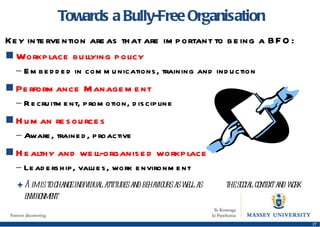
Towards a Bully-Free Organisation Key intervention areas that are important to being a BFO: Workplace bullying policy Embedded in communications, training and induction Performance Management Recruitment, promotion, discipline Human resources Aware, trained, proactive Healthy and well-organised workplace Leadership, values, work environment Aim is to change individual attitudes and behaviours as well as  the social context and work environment
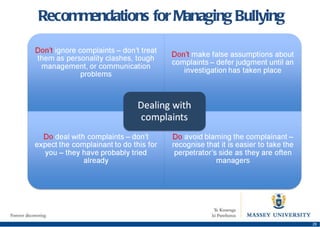
Recommendations for Managing Bullying
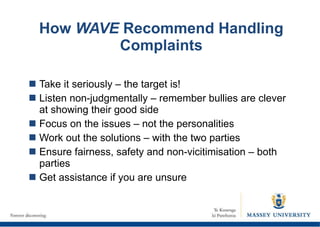
How  WAVE  Recommend Handling Complaints Take it seriously – the target is! Listen non-judgmentally – remember bullies are clever at showing their good side Focus on the issues – not the personalities Work out the solutions – with the two parties Ensure fairness, safety and non-vicitimisation – both parties Get assistance if you are unsure
Useful Resources… WAVE – www.wave.org.nz. Equal Employment Opportunities Trust. Needham, A. (2005). Workplace Bullying: The Costly Business Secret. Penguin Books: Auckland. The Healthy Work Group.  @HealthyWorkGrp
Conclusions WB is a costly workplace problem and not well understood It involves repetition of a ‘negative acts’ over time It is often poorly managed Stressful and poorly organised workplaces = conditions for WB A supportive work environment is necessary for a BFO Leadership is key to prevention Have a clear, positively focused, policy
Questions for you! How well is bullying currently understood in your organisation and sector? Does your organisational environment support bullying or does it promote a bully-free culture? How well do you manage the problem of bullying? Do you have (and communicate) an anti-bullying/pro-respect policy in your organisation?
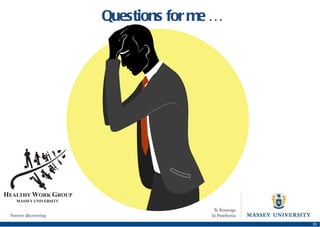
Questions for me …

Understanding and Managing Workplace Bullying

  • 1.
    Understanding and ManagingWorkplace Bullying Professor Tim Bentley Healthy Work Group School of Management Presentation to OHSIG 2011
  • 2.
  • 3.
    Workplace Bullying: TheProblem Exposure is claimed to be a “more crippling and devastating problem for employees than all other kinds of work-related stress put together” (Einarsen et al., 2011). New Zealand employers have a legal and moral duty to ensure that employees are not harmed while at work. Several court decisions have ruled in favour of the targets of workplace bullying. Emphasised the employers’ non-delegable duty to provide a safe working environment with the organisation, rather than the bully, held legally responsible.
  • 4.
    Direct costs: turnoverincreases, recruitment and training, legal fees, temporary staff Indirect costs: low productivity, high absenteeism, low morale and a stressful environment In 2001, Griffith University estimated the costs of WB to the Australian economy at between A$6-13B pa. In the UK, the cost of conflict at work = over 30B Stirling (=1000 pounds per working adult per year) Costs of Workplace Bullying
  • 5.
    Defining Bullying Workplacebullying is: “a situation where a person feels they have repeatedly been on the receiving end of negative actions from one or more other people, in a situation where it is difficult to defend themselves against these actions. These negative actions could be physical or non-physical. A one-off incident is not defined as bullying” (Einarsen et al., 2011).
  • 6.
    Bullying: What Doesit Look Like? A repetition of destructive targeted behaviours Is about the workplace bully’s control needs Is about the focused and systematic selection of targets Is not tough management Can create chaos within an organisation
  • 7.
    Examples of BullyingBehaviours Being humiliated or ridiculed Being ignored or excluded Insulting or offensive remarks Intimidating behaviour Persistent criticism of your work Excessive monitoring of your work Threats of violence or abuse Having important information withheld from you Ordered to do work below your level of competence Being exposed to an unmanageable workload Repeated reminders of your mistakes Gossip or rumours
  • 8.
    Bullying and HarassmentHarassment Bullying A single incident, a few incidents, many incidents Accumulation of many small incidents It is obvious you are being harassed May not realise you are being bullying for weeks or months Revealed through use of offensive vocabulary Trivial criticisms, false allegations, etc. Harassment has a strong clear focus (race, sex, disability) Focus is on competence (envy) and popularity (jealousy) Harassment often for peer approval, bravado, image Tends to be secret – no witnesses Target is perceived as easy Target is a threat to control, subjugate, eliminate Harasser lacks self-discipline Driven by envy and jealousy
  • 9.
  • 10.
  • 11.
    Typical Bullying SequenceThe employer realises they have backed the wrong person, but are unlikely to admit it
  • 12.
  • 13.
    The NZ WorkplaceBullying Study
  • 14.
    Survey of Workand Wellness Study aims : To determine the prevalence and nature of workplace stress and bullying in a range of workplaces from the health, education, hospitality and travel sectors. To determine the impacts of bullying, and preventive practices currently in use. Methodology : Survey of Work and Wellness (quantitative survey) Semi-structured interviews with managers
  • 15.
    Survey of Workand Wellness 1728 respondents. Industry sectors Health 42%; Education 27%; Hospitality 8%; Travel 19%. Organisation roles 59% non-managerial; 15% middle-level managers; 11% first-line supervisors; 5% senior managers. Age: 16 to 71 (median 43 years). 79% female; 22% male.
  • 16.
    Survey of Workand Wellness Prevalence of bullying (NAQ-R) 17.6% (n=308) fitted the operational definition. ‘ Someone withholding information that affects your performance ’ ; ‘ Being ordered to do work below your level of competence ’ ; ‘ Being exposed to an unmanageable workload ’ most frequently cited. Prevalence of bullying (Self-reported) 12.6% of respondents reported being bullied at least ‘now and then’ Prevalence of bullying (Witnessed) 7.7% witnessed bullying ‘several times per week’ or ‘almost daily’.
  • 17.
  • 18.
  • 19.
  • 20.
    Manager’s Survey (36from surveyed orgs) 30 believed workplace bullying was not much of a problem in their workplace. 15 believed bullying was recognised as a hazard. 26 believed workplace bullying was covered by policy. 25 believed their organisation had an effective reporting system for bullying. 24 would like to see guidelines/best practice for their industry.
  • 21.
    Survey of OHSPractitioners
  • 22.
    Survey of OHSPractitioners Background Few studies concerned with the management of workplace bullying – none in NZ context Survey designed to see if the findings from the Managers’ Survey (from our Survey of Work and Wellness) held up in a larger, more diverse sample The study sought to determine whether our model for influences on organisational bullying prevention activities was valid
  • 23.
    Sample Demographics 252respondents from 400 who attended ACC OHS workshops for managers 45% senior or middle managers 36% in non-managerial role 77% in role for 2 years or longer Health, forestry, administration, manufacturing the most represented sectors
  • 24.
    Survey of OHSPractitioners Results 70% reported WB in their organisation in the last 2 years Low perceived understanding of the concept of WB (27%) Leaders often not willing to confront bullies (41%) WB had high impact on staff morale, motivation, productivity 2/3 organisations had a formal WB policy 41% recognised WB as a hazard 19% had given staff and/or management WB training
  • 25.
    Survey of OHSPractitioners Results Study found no support for the proposition that preventive activity is likely to be determined by managers’ perceptions of extent of the problem or perceived impact. Study found support for the proposition that the perceived work environment predicted prevention activity Work environment items: Leadership tolerance of WB, understanding of what is and isn’t acceptable, an effective reporting system and HR response
  • 26.
    Study Conclusions Supportsthe importance of leadership and the establishment of an effective bully-free environment in the prevention of workplace bullying. Factors best predicting anti-bullying activity were in-line with factors rated as most effective’ in Work and Wellness study. Can’t rely on strategies at the interpersonal level alone
  • 27.
    Towards a Bully-FreeOrganisation Key intervention areas that are important to being a BFO: Workplace bullying policy Embedded in communications, training and induction Performance Management Recruitment, promotion, discipline Human resources Aware, trained, proactive Healthy and well-organised workplace Leadership, values, work environment Aim is to change individual attitudes and behaviours as well as the social context and work environment
  • 28.
  • 29.
    How WAVE Recommend Handling Complaints Take it seriously – the target is! Listen non-judgmentally – remember bullies are clever at showing their good side Focus on the issues – not the personalities Work out the solutions – with the two parties Ensure fairness, safety and non-vicitimisation – both parties Get assistance if you are unsure
  • 30.
    Useful Resources… WAVE– www.wave.org.nz. Equal Employment Opportunities Trust. Needham, A. (2005). Workplace Bullying: The Costly Business Secret. Penguin Books: Auckland. The Healthy Work Group. @HealthyWorkGrp
  • 31.
    Conclusions WB isa costly workplace problem and not well understood It involves repetition of a ‘negative acts’ over time It is often poorly managed Stressful and poorly organised workplaces = conditions for WB A supportive work environment is necessary for a BFO Leadership is key to prevention Have a clear, positively focused, policy
  • 32.
    Questions for you!How well is bullying currently understood in your organisation and sector? Does your organisational environment support bullying or does it promote a bully-free culture? How well do you manage the problem of bullying? Do you have (and communicate) an anti-bullying/pro-respect policy in your organisation?
  • 33.

Editor's Notes

  • #2 Workplace bullying is a problem many feel is connected only with the school yard, and not so much a problem for organisations. However, the reality is that bullying is a growing problem in workplaces, and has an important impact on health, productivity and the experience of work for people in organisations. In NZ we are only beginning to understand the problem, and are very poor at managing it. Our mission is to help organisations and employees better understand what bullying is and how to manage it.
  • #3 This speaks to the core of the problem – the bullying culture – socialising middle managers and subordinates in the wrong way to communicate and manage in the workplace!
  • #4 According to one group of leading researchers, the majority of employees will, at some time during their careers, be exposed to workplace bullying directly, or indirectly as observers (Einarsen et al., 2003b).
  • #5 In the US, 25% of orgs report bullying in their org.
  • #8 The behaviours most likely to relate to health effects were those suggesting marginalisation or exclusion such as criticism, ignoring or hints to quit (Hoel et al., 2004), judging work unjustly or in an offending manner, restricting the expression of opinions, and assaults on private life (Vartia, 2001). The most damaging forms of bullying were those such as undermining and belittlement which harmed a targets’ self-image and reduced the ability to use effective coping strategies.
  • #17 Note, 2 ways to measure bullying … Experienced two or more negative behaviours, at least weekly during the past 6 months See nature of behaviours – many argue that this would be regarded as normal working life – and certainly there is a real need to develop more effective tools for the measurement of bullying
  • #18 Compared to non-targets …significant difference in reporting experiences Same for witnesses to bullying!
  • #19 Compared to non-targets, these outcomes were significantly more likely to be reported. Also for witnesses to bullying.
  • #20 Respondents reported these org responses to be most effective – this fits well with what we know about what works in bullying prevention, and the idea of promoting a positive and healthy work environment. It also shows that the org needs tools/measures to manage bullying.
  • #21 Example findings from the interview survey of managers from the surveyed organisations. At odds with survey findings – high prevalence of bullying but low acknowledgement. Some options: 1. not willing to believe there is a problem; 2. not wanting to acknowledge the problem; 3. ignorance of problem. Les than one-half recognised bullying as a hazard; quite a few without policy or reporting system. Encouraging number want to see guidelines for best practice.
  • #22 The findings that org factors and management bullying prevention activity were so important led to the HWG undertaking this study.
  • #25 Here’s some of the key findings – suggest a low understanding of the concept and issues with leading an anti-bullying culture, developing policy and training staff.
  • #26 The key thing here is was that the work environment was the best predictor of whether orgs took anti-bullying actions – with these factors being most important – not how they match well with the factors respondents to the bullying prevalence survey rated most highly!
  • #28 Policy A policy that defines bullying, details consequences along with complaint and resolution procedures; also confidentiality Set within in a context of just and fair treatment for all employees and emphasing organisations core values Recognises and focuses on organisational as well as interpersonal factors Weaves many aspects of the organisation together i.e. linked to other key organisaitonal systems Suggest a positive approach to policy – e.g. “respectful work environment/climate’ or ‘healthy work culture’. Performance Ensure the org hires sound, well-adjusted people whose values are appropriate. With changes to the legislation around stress, orgs need to be very careful who they appoint and promote – can use assessment centre and psychometric testing. Interviews alone are no good. Must speak to previous employer! 360 survey; done by a review team, feedback from each person carries equal weight, - but note, great care needed as TARGET may be vulnerable where the manager is the WB Need to review an individual’s contribution to the team and org; plan to develop them; recognition of what’s going well; and agreement on working to fix what’s not so good. HR Need to have the skills and authority to stand up to senior management and work with them to do the right thing for the org. This includes: working with management to get the right culture, policy and systems to eliminate WB. They should never collaborate with the WB, but can be tough – they can become targets themselves if they seek to support the Target. Healthy work Develop a relationship of trust and loyalty; reward staff on basis of performance and contribution to total effort. Management the key to developing trust.
  • #31 It would be nice to be able to tell you to access the DoL’s guidelines for best practice, but as things stand they are not available. There is a draft WorkSafe Code of Practice – this may be helpful.