Bullying and stress in three New Zealand industry sectors Michael O’Driscoll, U of Waikato Tim Bentley, Massey U Bevan Catley, Massey U Helena Cooper-Thomas, U of Auckland Dianne Gardner, Massey U Linda Trenberth, Birkbeck College (London) Presentation to NZ Psychological Society annual conference Palmerston North, 27-30 August 2009 Project funded by the Health Research Council and the Department of Labour
What is  bullying ? “ a situation where a person feels they have  repeatedly   been on the receiving end of  negative actions   from one or more other people, in a situation where it is difficult to defend themselves against these actions.  These negative actions could be physical or non-physical (e.g. verbal abuse). A one-off incident is  not  defined as bullying.”  (Einarsen et al., 2003) Key features : negative actions, repeated, perceived victimization, unjustified Related concepts : Aggression Harassment Violence Incivility Anti-social behaviour ‘ Mobbing’
Example behaviours (from the Negative Acts Questionnaire, Einarsen & Rakne, 1997) Being humiliated or ridiculed Gossip or rumours Being ignored or excluded Insulting or offensive remarks Intimidating behaviour, e.g. invasion of personal space, physical violence Repeated reminders of your mistakes Persistent criticism of your work Allegations made against you Excessive monitoring of your work Threats of violence or abuse (physical or verbal) Having important information withheld from you Ordered to do work below your level of competence Having responsibilities removed or replaced with trivial tasks Being exposed to an unmanageable workload
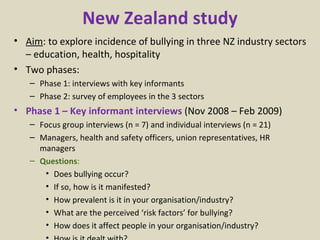
New Zealand study Aim : to explore incidence of bullying in three NZ industry sectors – education, health, hospitality Two phases: Phase 1: interviews with key informants Phase 2: survey of employees in the 3 sectors Phase 1 – Key informant interviews  (Nov 2008 – Feb 2009) Focus group interviews (n = 7) and individual interviews (n = 21) Managers, health and safety officers, union representatives, HR managers Questions :  Does bullying occur? If so, how is it manifested? How prevalent is it in your organisation/industry? What are the perceived ‘risk factors’ for bullying? How does it affect people in your organisation/industry? How is it dealt with?
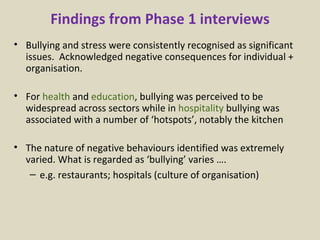
Findings from Phase 1 interviews Bullying and stress were consistently recognised as significant issues.  Acknowledged negative consequences for individual + organisation. For  health  and  education , bullying was perceived to be widespread across sectors while in  hospitality  bullying was associated with a number of ‘hotspots’, notably the kitchen The nature of negative behaviours identified was extremely varied. What is regarded as ‘bullying’ varies ….  e.g. restaurants; hospitals (culture of organisation)
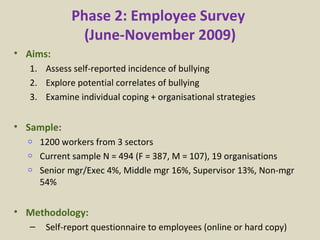
Phase 2: Employee Survey  (June-November 2009) Aims: Assess self-reported incidence of bullying Explore potential correlates of bullying Examine individual coping + organisational strategies Sample : 1200 workers from 3 sectors Current sample N = 494 (F = 387, M = 107), 19 organisations Senior mgr/Exec 4%, Middle mgr 16%, Supervisor 13%, Non-mgr 54% Methodology: Self-report questionnaire to employees (online or hard copy)
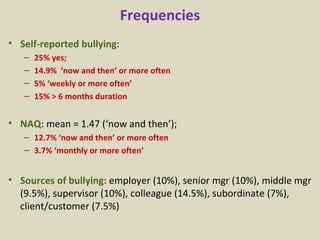
Frequencies Self-reported bullying :  25% yes;  14.9%  ‘now and then’ or more often 5% ‘weekly or more often’ 15% > 6 months duration NAQ : mean = 1.47 (‘now and then’);  12.7% ‘now and then’ or more often 3.7% ‘monthly or more often’ Sources of bullying:  employer (10%), senior mgr (10%), middle mgr (9.5%), supervisor (10%), colleague (14.5%), subordinate (7%), client/customer (7.5%)
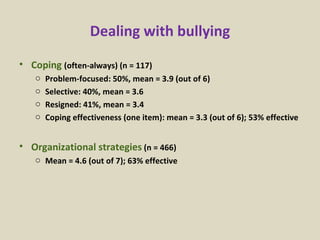
Dealing with bullying Coping  (often-always) (n = 117) Problem-focused: 50%, mean = 3.9 (out of 6) Selective: 40%, mean = 3.6 Resigned: 41%, mean = 3.4 Coping effectiveness (one item): mean = 3.3 (out of 6); 53% effective Organizational strategies  (n = 466) Mean = 4.6 (out of 7); 63% effective
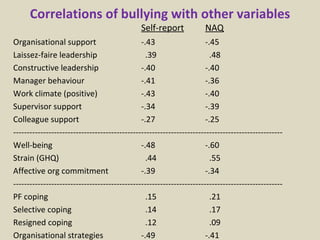
Correlations of bullying with other variables Self-report NAQ Organisational support -.43 -.45 Laissez-faire leadership   .39   .48 Constructive leadership -.40 -.40 Manager behaviour -.41 -.36 Work climate (positive) -.43 -.40 Supervisor support -.34 -.39 Colleague support -.27 -.25 --------------------------------------------------------------------------------------------------- Well-being -.48 -.60 Strain (GHQ)   .44   .55 Affective org commitment -.39 -.34 --------------------------------------------------------------------------------------------------- PF coping   .15   .21 Selective coping   .14   .17 Resigned coping   .12   .09 Organisational strategies -.49 -.41
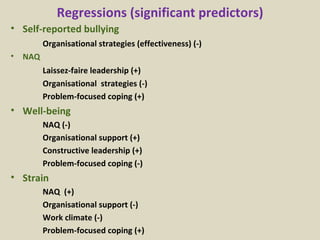
Regressions (significant predictors) Self-reported bullying Organisational strategies (effectiveness) (-) NAQ Laissez-faire leadership (+) Organisational  strategies (-) Problem-focused coping (+) Well-being NAQ (-) Organisational support (+) Constructive leadership (+) Problem-focused coping (-) Strain NAQ  (+) Organisational support (-) Work climate (-) Problem-focused coping (+)
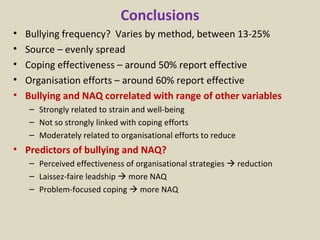
Conclusions Bullying frequency?  Varies by method, between 13-25% Source – evenly spread Coping effectiveness – around 50% report effective Organisation efforts – around 60% report effective Bullying and NAQ correlated with range of other variables Strongly related to strain and well-being  Not so strongly linked with coping efforts Moderately related to organisational efforts to reduce  Predictors of bullying and NAQ? Perceived effectiveness of organisational strategies    reduction Laissez-faire leadship    more NAQ Problem-focused coping    more NAQ
Implications Significance of bullying? Prevalence Effects on individuals and organisations Few systematic efforts to address persistent bullying problems.  Interventions : Typically focused on the individual, either the target of bullying or the perpetrator.  Bullying typically treated as an ‘individual’ problem rather than a system problem Lack of constructive leadership approaches perceived to be a significant contributor to inaction Need systemic approach which focuses not just on personal attributes (e.g. of perpetrator), but also on organizational factors which may contribute to bullying climate Differentiate bullying behaviours from accepted practices

Nz Ps S Conference 2009

  • 1.
    Bullying and stressin three New Zealand industry sectors Michael O’Driscoll, U of Waikato Tim Bentley, Massey U Bevan Catley, Massey U Helena Cooper-Thomas, U of Auckland Dianne Gardner, Massey U Linda Trenberth, Birkbeck College (London) Presentation to NZ Psychological Society annual conference Palmerston North, 27-30 August 2009 Project funded by the Health Research Council and the Department of Labour
  • 2.
    What is bullying ? “ a situation where a person feels they have repeatedly been on the receiving end of negative actions from one or more other people, in a situation where it is difficult to defend themselves against these actions. These negative actions could be physical or non-physical (e.g. verbal abuse). A one-off incident is not defined as bullying.” (Einarsen et al., 2003) Key features : negative actions, repeated, perceived victimization, unjustified Related concepts : Aggression Harassment Violence Incivility Anti-social behaviour ‘ Mobbing’
  • 3.
    Example behaviours (fromthe Negative Acts Questionnaire, Einarsen & Rakne, 1997) Being humiliated or ridiculed Gossip or rumours Being ignored or excluded Insulting or offensive remarks Intimidating behaviour, e.g. invasion of personal space, physical violence Repeated reminders of your mistakes Persistent criticism of your work Allegations made against you Excessive monitoring of your work Threats of violence or abuse (physical or verbal) Having important information withheld from you Ordered to do work below your level of competence Having responsibilities removed or replaced with trivial tasks Being exposed to an unmanageable workload
  • 4.
    New Zealand studyAim : to explore incidence of bullying in three NZ industry sectors – education, health, hospitality Two phases: Phase 1: interviews with key informants Phase 2: survey of employees in the 3 sectors Phase 1 – Key informant interviews (Nov 2008 – Feb 2009) Focus group interviews (n = 7) and individual interviews (n = 21) Managers, health and safety officers, union representatives, HR managers Questions : Does bullying occur? If so, how is it manifested? How prevalent is it in your organisation/industry? What are the perceived ‘risk factors’ for bullying? How does it affect people in your organisation/industry? How is it dealt with?
  • 5.
    Findings from Phase1 interviews Bullying and stress were consistently recognised as significant issues. Acknowledged negative consequences for individual + organisation. For health and education , bullying was perceived to be widespread across sectors while in hospitality bullying was associated with a number of ‘hotspots’, notably the kitchen The nature of negative behaviours identified was extremely varied. What is regarded as ‘bullying’ varies …. e.g. restaurants; hospitals (culture of organisation)
  • 6.
    Phase 2: EmployeeSurvey (June-November 2009) Aims: Assess self-reported incidence of bullying Explore potential correlates of bullying Examine individual coping + organisational strategies Sample : 1200 workers from 3 sectors Current sample N = 494 (F = 387, M = 107), 19 organisations Senior mgr/Exec 4%, Middle mgr 16%, Supervisor 13%, Non-mgr 54% Methodology: Self-report questionnaire to employees (online or hard copy)
  • 7.
    Frequencies Self-reported bullying: 25% yes; 14.9% ‘now and then’ or more often 5% ‘weekly or more often’ 15% > 6 months duration NAQ : mean = 1.47 (‘now and then’); 12.7% ‘now and then’ or more often 3.7% ‘monthly or more often’ Sources of bullying: employer (10%), senior mgr (10%), middle mgr (9.5%), supervisor (10%), colleague (14.5%), subordinate (7%), client/customer (7.5%)
  • 8.
    Dealing with bullyingCoping (often-always) (n = 117) Problem-focused: 50%, mean = 3.9 (out of 6) Selective: 40%, mean = 3.6 Resigned: 41%, mean = 3.4 Coping effectiveness (one item): mean = 3.3 (out of 6); 53% effective Organizational strategies (n = 466) Mean = 4.6 (out of 7); 63% effective
  • 9.
    Correlations of bullyingwith other variables Self-report NAQ Organisational support -.43 -.45 Laissez-faire leadership .39 .48 Constructive leadership -.40 -.40 Manager behaviour -.41 -.36 Work climate (positive) -.43 -.40 Supervisor support -.34 -.39 Colleague support -.27 -.25 --------------------------------------------------------------------------------------------------- Well-being -.48 -.60 Strain (GHQ) .44 .55 Affective org commitment -.39 -.34 --------------------------------------------------------------------------------------------------- PF coping .15 .21 Selective coping .14 .17 Resigned coping .12 .09 Organisational strategies -.49 -.41
  • 10.
    Regressions (significant predictors)Self-reported bullying Organisational strategies (effectiveness) (-) NAQ Laissez-faire leadership (+) Organisational strategies (-) Problem-focused coping (+) Well-being NAQ (-) Organisational support (+) Constructive leadership (+) Problem-focused coping (-) Strain NAQ (+) Organisational support (-) Work climate (-) Problem-focused coping (+)
  • 11.
    Conclusions Bullying frequency? Varies by method, between 13-25% Source – evenly spread Coping effectiveness – around 50% report effective Organisation efforts – around 60% report effective Bullying and NAQ correlated with range of other variables Strongly related to strain and well-being Not so strongly linked with coping efforts Moderately related to organisational efforts to reduce Predictors of bullying and NAQ? Perceived effectiveness of organisational strategies  reduction Laissez-faire leadship  more NAQ Problem-focused coping  more NAQ
  • 12.
    Implications Significance ofbullying? Prevalence Effects on individuals and organisations Few systematic efforts to address persistent bullying problems. Interventions : Typically focused on the individual, either the target of bullying or the perpetrator. Bullying typically treated as an ‘individual’ problem rather than a system problem Lack of constructive leadership approaches perceived to be a significant contributor to inaction Need systemic approach which focuses not just on personal attributes (e.g. of perpetrator), but also on organizational factors which may contribute to bullying climate Differentiate bullying behaviours from accepted practices