 Business Ethics course
 Instructor: Kristina Limarenko
 What is workplace bullying?
 How does workplace bullying occur?
 What motivates the bully?
 What types of people are at risk for becoming targeted?
 What are its effects on victims, observers, & businesses?
 What can be done about it?
 How can social change agents help combat the problem?
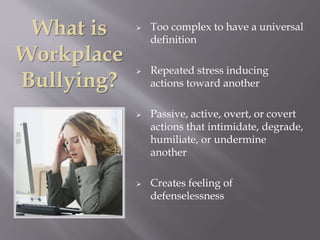
What is
Workplace
Bullying?
 Too complex to have a universal
definition
 Repeated stress inducing
actions toward another
 Passive, active, overt, or covert
actions that intimidate, degrade,
humiliate, or undermine
another
 Creates feeling of
defenselessness
 Spreading malicious rumors, gossiping
 Undermining or intentionally impeding
another’s work
 Blame or unwarranted criticism without
factual justification
 Exclusion, social isolation
 Excessive monitoring, micromanaging,
unwarranted punishment
 Blocking training, leave or promotion
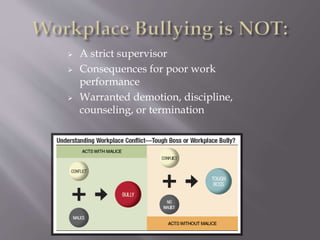
 A strict supervisor
 Consequences for poor work
performance
 Warranted demotion, discipline,
counseling, or termination
How Does
Workplace
Bullying
Happen?
 Ignorance of the issue
 Bully supported
through action or
inaction of management
 Stressed employees
taking frustrations out
on others
 No system of reporting
or protection for victims
 Lack of recognition and
anti-bullying laws
worldwide
How Do Targets Handle Bullying?
 Targets accept the bullying
behavior as part of employment
 Victims fear retribution or losing
position for making waves
 75% of victims end bullying
behavior only by leaving the
company entirely
Bullies work to
psychologically &
systematically wear the
target down to:
 Ensure own job
security
 Further own career
 Exert or gain a sense
of power
 Instill fear in the
target or observers
Work Environments
Can Perpetuate
Bullying
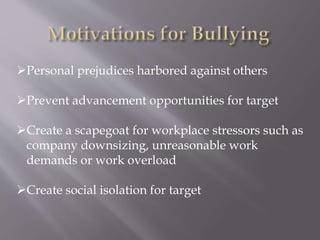
Personal prejudices harbored against others
Prevent advancement opportunities for target
Create a scapegoat for workplace stressors such as
company downsizing, unreasonable work
demands or work overload
Create social isolation for target
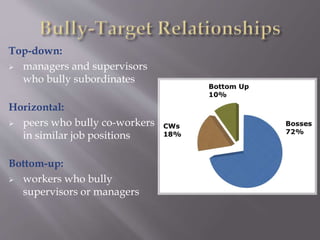
Top-down:
 managers and supervisors
who bully subordinates
Horizontal:
 peers who bully co-workers
in similar job positions
Bottom-up:
 workers who bully
supervisors or managers
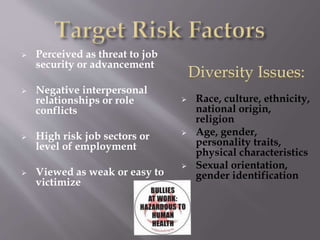
 Perceived as threat to job
security or advancement
 Negative interpersonal
relationships or role
conflicts
 High risk job sectors or
level of employment
 Viewed as weak or easy to
victimize
Diversity Issues:
 Race, culture, ethnicity,
national origin,
religion
 Age, gender,
personality traits,
physical characteristics
 Sexual orientation,
gender identification
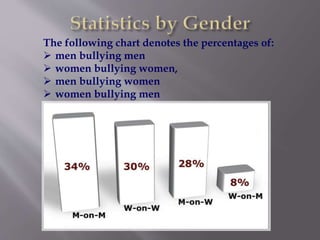
The following chart denotes the percentages of:
 men bullying men
 women bullying women,
 men bullying women
 women bullying men
Effects of Bullying on the Victim
 Stress & job dissatisfaction
 High absenteeism
 Hyper-vigilance
 Psychological and
psychosocial distress
 Job loss
3.6%
9.8%
14.6
%
22.6
%
49.4
%
Under 1 month
1-3 Months
3-6 Months
6-12 Minths
Over one year
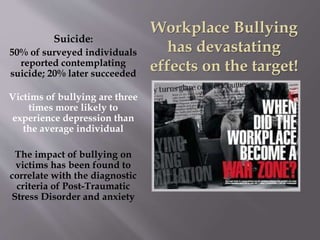
Suicide:
50% of surveyed individuals
reported contemplating
suicide; 20% later succeeded
Victims of bullying are three
times more likely to
experience depression than
the average individual
The impact of bullying on
victims has been found to
correlate with the diagnostic
criteria of Post-Traumatic
Stress Disorder and anxiety
Workplace Bullying
has devastating
effects on the target!
“Bystander effect" - the idea that observers stand by,
unwilling to assist someone in need of help
• 12% of observers report that they have witnessed
bullying
• Bystanders fear that the workplace bully will turn on
them
In order for bystanders to feel comfortable enough to
intervene, they need to know they can do something
about it. Witnesses need to feel empowered and
supported when they report bullying behavior.
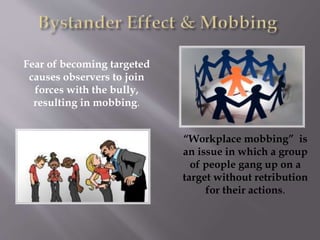
Fear of becoming targeted
causes observers to join
forces with the bully,
resulting in mobbing.
“Workplace mobbing” is
an issue in which a group
of people gang up on a
target without retribution
for their actions.
Billions of dollars lost
worldwide each year
due to:
High employee turnover
Decreased productivity
Low job satisfaction
High absenteeism
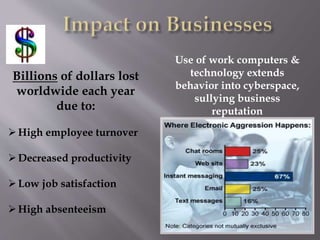
Use of work computers &
technology extends
behavior into cyberspace,
sullying business
reputation
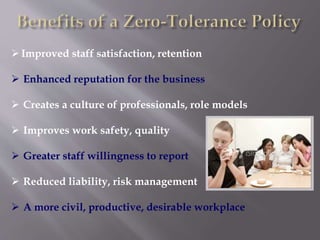
Improved staff satisfaction, retention
 Enhanced reputation for the business
 Creates a culture of professionals, role models
 Improves work safety, quality
 Greater staff willingness to report
 Reduced liability, risk management
 A more civil, productive, desirable workplace
0
10
20
30
40
50
60
70
80
% employee
turnover
% employees
reporting
chronic stress
% employees
seeking work
eleswhere
% employees
who would
recommend
as a good place
to work
% employee
satisfaction
APA's 2010
PHWA award
winners
U.S.
Average
19%
Difference
13%
Difference
8%
Difference
32%
Difference
11%
Difference
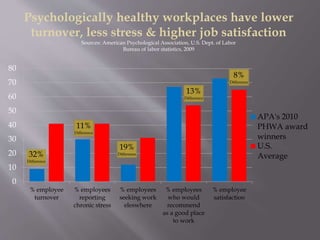
Psychologically healthy workplaces have lower
turnover, less stress & higher job satisfaction
Sources: American Psychological Association, U.S. Dept. of Labor
Bureau of labor statistics, 2009
Employees:
NEVER become a bully under any circumstances
Recognize when you are being bullied, realize it is
not your fault
Alert management immediately
Ask witnesses to testify that they observed bullying
Employers:
 Provide conferences or workshops to educate
and empower
 Create & enforce a zero tolerance anti-bullying
policy
 Determine & enforce possible courses of action
for bullying behaviors
 Promote & endorse anti-bullying legislation
Employers must establish and enforce strict guidelines
 Have employees submit a signed statement
regarding commitment to abide by conduct rules
 Encourage reporting
 Have focus groups to “conduct surveys” to be
analyzed regularly
Three levels of intervention for bullies, victims,
and observers:
 Informal Intervention: conduct interviews to discuss
events, listen to responses, get perspectives of all
people involved
 Awareness Intervention: Compilation and divulge
complaints from data in a supportive manner to raise
awareness
 Authority Intervention: specify behaviors that need
improvement, give timeline to improve behavior
Employers can support victims, observers,
and bullies by:
 Offering healthcare support, evaluation,
treatment plans & wellness programs
 Providing training on professional behavior
 Participating in the recovery of those who
experienced or witnessed disruptive bullying
behavior
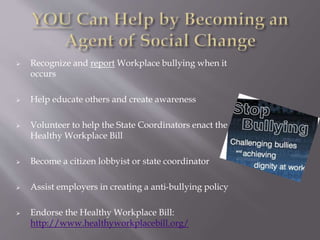
 Recognize and report Workplace bullying when it
occurs
 Help educate others and create awareness
 Volunteer to help the State Coordinators enact the
Healthy Workplace Bill
 Become a citizen lobbyist or state coordinator
 Assist employers in creating a anti-bullying policy
 Endorse the Healthy Workplace Bill:
http://www.healthyworkplacebill.org/
Recent recognition of the problem and
increasing awareness are improving the future
outlook of this issue.
 Companies worldwide are establishing annual
training courses and codes of conduct regarding
workplace bullying
 A safe and comfortable work environment where all
employees feel secure and able to be productive is the
ultimate goal
 5-10 years will likely not see the eradication of this
issue, however, each individual commitment can
contribute to overall social change
“As a victim who was fired for being a victim, I am
absolutely incensed at the injustice and inhumanity of
executives and managers who let this continue!
As a victim who has suffered many of the debilitating
symptoms of bullying, I am sickened by the
hypocrisy of company "codes of ethics and conduct".
Signed, a victim
 Workplace bullying is a serious, yet preventable,
problem that results in harmful effects victims,
witnesses and businesses alike
 There are currently few laws against workplace
bullying but companies and individuals choosing
to take a stand can have a huge impact and work
toward its elimination
Abel, C. (2010). The effects of bullying for victims: What are the effects of
bullying? Retrieved from, web site:
http://dealingwithbullies.org/the-effects- of-bullying-for-victims
American College Personnel (2011). College Student Educators International, in
collaboration with the U.S. Partnership for Education for Sustainable
Development: Sustainability Resources and Publications; Change
agent abilities required to help create a sustainable future. Retrieved
June 30, 2011 from, web site:
http://www.acpa.nche.edu/task- force/sustainability/
Bond, S., Dollard, M., & Tuckey, M. (2010). Psychosocial safety climate,
workplace bullying, and symptoms of posttraumatic stress.
Organization Development Journal, 28(1), 37-56. Retrieved from:
http://psycnet.apa.org/index.cfm?fa=buy.optionToBuy&id=2010-2
3921-004
Branch, S., Ramsay, S., & Barker, M. (2007). Managers in the firing line:
Contributing factors to workplace bullying by staff –an interview
study. Journal of Management & Organization 13, 264-281.
Retrieved June 15, 2011, from: Behavioral Studies and
Psychology, 566PsycINFO, EbscoHost.
Bulutlar, F., & Oz, E. (2009). The effects of ethical climates on bullying
behavior in the workplace. Journal of Business Ethics, 86(3), 273-
295. doi:10.1007/s10551-008-9847-4
David-Ferdon, C., Hertz, M. (2008). Electronic media and youth violence: A
CDC issue brief for educators and caregivers. Retrieved July 9, 2011,
from Center for Disease Contorl:
http://www.cdc.gov/violenceprevention/pdf/EA-brief-a.pdf
Dieter, Z, Gross, G. (2001). Conflict escalation and coping with workplace
bullying: A replication and extension. European Journal of Work
and Organizational Psychology, 10(4).497-522. Retrieve June 15,
2011, From Behavioral Studies and Psychology, PsycINFO,
EbscoHost.
Einarsen, S., Matthiesen, S., & Mikkelsen, E. (2002). Vienna papers and abstracts.
Retrieved July 9, 2011, from European Academy of Occupational Health
Psychology, Conference proceedings of the EAOHP:
http://eaohp.org/Documents/Vienna%20papers%20and%20abstracts.pdf
Hauge, L., Skogstad, A., & Einarsen, S. (2009). Individual and situational
predictors of workplace bullying: Why do perpetrators engage in
the bullying of others? Work & Stress, 23(4), 349-358.
doi:10.1080/02678370903395568
Keashly, L. (2010). A Researcher Speaks to Ombudsmen about Workplace
Bullying. Journal of the International Ombudsman Association, 3(2),
10-22. Retrieved from:
http://www.ombudsassociation.org/sites/default/files/JIOAVo
lume3No2October2010Final.pdf
Kilburg, R. R. (2009). Sadomasochism, human aggression, and the problem
of workplace mobbing and bullying: A commentary. Consulting
Psychology Journal: Practice and Research, 61(3), 268-275.
doi:10.1037/a0016935
Ortega, A., Høgh, A., & Pejtersen, J. J. (2008). Prevalence of workplace bullying
and risk groups: a representative population study. International
Archives of Occupational and Environmental Health, 82(3), 417–426.
doi: 10.1007/s00420-008-0339-8
Saunders, P., Huynh, A., & Goodman-Delahunty, J. (2007). Defining
workplace bullying behavior: professional, lay definitions of
workplace bullying. University of New South Wales. Retrieved June 17,
2011 from:
http://www.sciencedirect.com.ezp.waldenulibrary.org/science/articl
e/pii/S0160252707000465
Washington State Department of Labor & Industries (2011). SHARP-Research
for Safe Work; Workplace bullying and disruptive behavior: What
everyone needs to know. Retrieved June 19, 2011 from: web site:
http://www.lni.wa.gov/safety/research/files/bullying.pdf
Workplace Bullying Institute (2010, 2011). Statistics; How bullying happens.
Retrieved on June 17, 2011 from
http://www.workplacebullying.org/targets/problem/why-bullies-
bully.html
Zapf, D. (1999). Organizational, work group related and personal causes of
mobbing/bullying at work. International Journal of Manpower, 20 (1/2), 70.

Workplace bullying and its negative affect .pptx

  • 1.
     Business Ethicscourse  Instructor: Kristina Limarenko
  • 2.
     What isworkplace bullying?  How does workplace bullying occur?  What motivates the bully?  What types of people are at risk for becoming targeted?  What are its effects on victims, observers, & businesses?  What can be done about it?  How can social change agents help combat the problem?
  • 3.
    What is Workplace Bullying?  Toocomplex to have a universal definition  Repeated stress inducing actions toward another  Passive, active, overt, or covert actions that intimidate, degrade, humiliate, or undermine another  Creates feeling of defenselessness
  • 4.
     Spreading maliciousrumors, gossiping  Undermining or intentionally impeding another’s work  Blame or unwarranted criticism without factual justification  Exclusion, social isolation  Excessive monitoring, micromanaging, unwarranted punishment  Blocking training, leave or promotion
  • 5.
     A strictsupervisor  Consequences for poor work performance  Warranted demotion, discipline, counseling, or termination
  • 6.
    How Does Workplace Bullying Happen?  Ignoranceof the issue  Bully supported through action or inaction of management  Stressed employees taking frustrations out on others  No system of reporting or protection for victims  Lack of recognition and anti-bullying laws worldwide
  • 7.
    How Do TargetsHandle Bullying?  Targets accept the bullying behavior as part of employment  Victims fear retribution or losing position for making waves  75% of victims end bullying behavior only by leaving the company entirely
  • 8.
    Bullies work to psychologically& systematically wear the target down to:  Ensure own job security  Further own career  Exert or gain a sense of power  Instill fear in the target or observers Work Environments Can Perpetuate Bullying
  • 9.
    Personal prejudices harboredagainst others Prevent advancement opportunities for target Create a scapegoat for workplace stressors such as company downsizing, unreasonable work demands or work overload Create social isolation for target
  • 10.
    Top-down:  managers andsupervisors who bully subordinates Horizontal:  peers who bully co-workers in similar job positions Bottom-up:  workers who bully supervisors or managers
  • 11.
     Perceived asthreat to job security or advancement  Negative interpersonal relationships or role conflicts  High risk job sectors or level of employment  Viewed as weak or easy to victimize Diversity Issues:  Race, culture, ethnicity, national origin, religion  Age, gender, personality traits, physical characteristics  Sexual orientation, gender identification
  • 12.
    The following chartdenotes the percentages of:  men bullying men  women bullying women,  men bullying women  women bullying men
  • 14.
    Effects of Bullyingon the Victim  Stress & job dissatisfaction  High absenteeism  Hyper-vigilance  Psychological and psychosocial distress  Job loss 3.6% 9.8% 14.6 % 22.6 % 49.4 % Under 1 month 1-3 Months 3-6 Months 6-12 Minths Over one year
  • 15.
    Suicide: 50% of surveyedindividuals reported contemplating suicide; 20% later succeeded Victims of bullying are three times more likely to experience depression than the average individual The impact of bullying on victims has been found to correlate with the diagnostic criteria of Post-Traumatic Stress Disorder and anxiety Workplace Bullying has devastating effects on the target!
  • 16.
    “Bystander effect" -the idea that observers stand by, unwilling to assist someone in need of help • 12% of observers report that they have witnessed bullying • Bystanders fear that the workplace bully will turn on them In order for bystanders to feel comfortable enough to intervene, they need to know they can do something about it. Witnesses need to feel empowered and supported when they report bullying behavior.
  • 17.
    Fear of becomingtargeted causes observers to join forces with the bully, resulting in mobbing. “Workplace mobbing” is an issue in which a group of people gang up on a target without retribution for their actions.
  • 18.
    Billions of dollarslost worldwide each year due to: High employee turnover Decreased productivity Low job satisfaction High absenteeism Use of work computers & technology extends behavior into cyberspace, sullying business reputation
  • 19.
    Improved staff satisfaction,retention  Enhanced reputation for the business  Creates a culture of professionals, role models  Improves work safety, quality  Greater staff willingness to report  Reduced liability, risk management  A more civil, productive, desirable workplace
  • 20.
    0 10 20 30 40 50 60 70 80 % employee turnover % employees reporting chronicstress % employees seeking work eleswhere % employees who would recommend as a good place to work % employee satisfaction APA's 2010 PHWA award winners U.S. Average 19% Difference 13% Difference 8% Difference 32% Difference 11% Difference Psychologically healthy workplaces have lower turnover, less stress & higher job satisfaction Sources: American Psychological Association, U.S. Dept. of Labor Bureau of labor statistics, 2009
  • 21.
    Employees: NEVER become abully under any circumstances Recognize when you are being bullied, realize it is not your fault Alert management immediately Ask witnesses to testify that they observed bullying
  • 22.
    Employers:  Provide conferencesor workshops to educate and empower  Create & enforce a zero tolerance anti-bullying policy  Determine & enforce possible courses of action for bullying behaviors  Promote & endorse anti-bullying legislation
  • 23.
    Employers must establishand enforce strict guidelines  Have employees submit a signed statement regarding commitment to abide by conduct rules  Encourage reporting  Have focus groups to “conduct surveys” to be analyzed regularly
  • 24.
    Three levels ofintervention for bullies, victims, and observers:  Informal Intervention: conduct interviews to discuss events, listen to responses, get perspectives of all people involved  Awareness Intervention: Compilation and divulge complaints from data in a supportive manner to raise awareness  Authority Intervention: specify behaviors that need improvement, give timeline to improve behavior
  • 25.
    Employers can supportvictims, observers, and bullies by:  Offering healthcare support, evaluation, treatment plans & wellness programs  Providing training on professional behavior  Participating in the recovery of those who experienced or witnessed disruptive bullying behavior
  • 26.
     Recognize andreport Workplace bullying when it occurs  Help educate others and create awareness  Volunteer to help the State Coordinators enact the Healthy Workplace Bill  Become a citizen lobbyist or state coordinator  Assist employers in creating a anti-bullying policy  Endorse the Healthy Workplace Bill: http://www.healthyworkplacebill.org/
  • 27.
    Recent recognition ofthe problem and increasing awareness are improving the future outlook of this issue.  Companies worldwide are establishing annual training courses and codes of conduct regarding workplace bullying  A safe and comfortable work environment where all employees feel secure and able to be productive is the ultimate goal  5-10 years will likely not see the eradication of this issue, however, each individual commitment can contribute to overall social change
  • 28.
    “As a victimwho was fired for being a victim, I am absolutely incensed at the injustice and inhumanity of executives and managers who let this continue! As a victim who has suffered many of the debilitating symptoms of bullying, I am sickened by the hypocrisy of company "codes of ethics and conduct". Signed, a victim
  • 29.
     Workplace bullyingis a serious, yet preventable, problem that results in harmful effects victims, witnesses and businesses alike  There are currently few laws against workplace bullying but companies and individuals choosing to take a stand can have a huge impact and work toward its elimination
  • 30.
    Abel, C. (2010).The effects of bullying for victims: What are the effects of bullying? Retrieved from, web site: http://dealingwithbullies.org/the-effects- of-bullying-for-victims American College Personnel (2011). College Student Educators International, in collaboration with the U.S. Partnership for Education for Sustainable Development: Sustainability Resources and Publications; Change agent abilities required to help create a sustainable future. Retrieved June 30, 2011 from, web site: http://www.acpa.nche.edu/task- force/sustainability/ Bond, S., Dollard, M., & Tuckey, M. (2010). Psychosocial safety climate, workplace bullying, and symptoms of posttraumatic stress. Organization Development Journal, 28(1), 37-56. Retrieved from: http://psycnet.apa.org/index.cfm?fa=buy.optionToBuy&id=2010-2 3921-004
  • 31.
    Branch, S., Ramsay,S., & Barker, M. (2007). Managers in the firing line: Contributing factors to workplace bullying by staff –an interview study. Journal of Management & Organization 13, 264-281. Retrieved June 15, 2011, from: Behavioral Studies and Psychology, 566PsycINFO, EbscoHost. Bulutlar, F., & Oz, E. (2009). The effects of ethical climates on bullying behavior in the workplace. Journal of Business Ethics, 86(3), 273- 295. doi:10.1007/s10551-008-9847-4 David-Ferdon, C., Hertz, M. (2008). Electronic media and youth violence: A CDC issue brief for educators and caregivers. Retrieved July 9, 2011, from Center for Disease Contorl: http://www.cdc.gov/violenceprevention/pdf/EA-brief-a.pdf Dieter, Z, Gross, G. (2001). Conflict escalation and coping with workplace bullying: A replication and extension. European Journal of Work and Organizational Psychology, 10(4).497-522. Retrieve June 15, 2011, From Behavioral Studies and Psychology, PsycINFO, EbscoHost.
  • 32.
    Einarsen, S., Matthiesen,S., & Mikkelsen, E. (2002). Vienna papers and abstracts. Retrieved July 9, 2011, from European Academy of Occupational Health Psychology, Conference proceedings of the EAOHP: http://eaohp.org/Documents/Vienna%20papers%20and%20abstracts.pdf Hauge, L., Skogstad, A., & Einarsen, S. (2009). Individual and situational predictors of workplace bullying: Why do perpetrators engage in the bullying of others? Work & Stress, 23(4), 349-358. doi:10.1080/02678370903395568 Keashly, L. (2010). A Researcher Speaks to Ombudsmen about Workplace Bullying. Journal of the International Ombudsman Association, 3(2), 10-22. Retrieved from: http://www.ombudsassociation.org/sites/default/files/JIOAVo lume3No2October2010Final.pdf Kilburg, R. R. (2009). Sadomasochism, human aggression, and the problem of workplace mobbing and bullying: A commentary. Consulting Psychology Journal: Practice and Research, 61(3), 268-275. doi:10.1037/a0016935
  • 33.
    Ortega, A., Høgh,A., & Pejtersen, J. J. (2008). Prevalence of workplace bullying and risk groups: a representative population study. International Archives of Occupational and Environmental Health, 82(3), 417–426. doi: 10.1007/s00420-008-0339-8 Saunders, P., Huynh, A., & Goodman-Delahunty, J. (2007). Defining workplace bullying behavior: professional, lay definitions of workplace bullying. University of New South Wales. Retrieved June 17, 2011 from: http://www.sciencedirect.com.ezp.waldenulibrary.org/science/articl e/pii/S0160252707000465 Washington State Department of Labor & Industries (2011). SHARP-Research for Safe Work; Workplace bullying and disruptive behavior: What everyone needs to know. Retrieved June 19, 2011 from: web site: http://www.lni.wa.gov/safety/research/files/bullying.pdf Workplace Bullying Institute (2010, 2011). Statistics; How bullying happens. Retrieved on June 17, 2011 from http://www.workplacebullying.org/targets/problem/why-bullies- bully.html
  • 34.
    Zapf, D. (1999).Organizational, work group related and personal causes of mobbing/bullying at work. International Journal of Manpower, 20 (1/2), 70.

Editor's Notes

  • #2 This presentation is about bullying in the workplace. This is a comparatively resent world wide phenomena with serious consequences for employees and employers. There are no laws in the U.S. and most of the world against it. It is important to understand that this is not the same thing as harassment. Bullying affects victims in many ways, the effect of bullying can range from mild stress to suicide.
  • #3 These are the questions this presentation will answer. Questions are encouraged.
  • #4 Workplace bullying falls into a continuum of bullying which occurs from elementary school through retirement. The range of bully behaviors through out the continuum is so varied that there is no definitive definition that can adequately cover all of it. Researchers usually adapt a working definition for their research. Workplace bullying takes place over time. The ongoing stress can last for less than one month to well over a year with some cases lasting five years or longer. The actions of the bully are usually covert to avoid attracting attention and to avoid punishment. If the bully is a coworker and management does not stop it the behaviors may become overt or come out in the open to some degree. Weather the actions of the bully are covert or overt they are intended to intimidate, degrade, humiliate, or undermine the victim. The bullies actions often create feelings of defenselessness in the victim leaving the victim open to further attacks. These actions can also lead to physical health problems requiring time away from work and combined with the psychological problems created can lead to unsafe work practices by the victim risking the safety of coworkers.
  • #5 These are just a few of the ways bullying can occur, there are dozens of others. In many cases it is so subtle the victim doesn't even know what is happening. Even in these cases others in the workplace may see it but do nothing. Workplace bullying is usually known by all or many coworkers but reported in very few cases.
  • #6 It’s important to remember that all work experiences are not always positive, but that doesn’t necessarily mean bullying has occurred. Employers do have the right to demote, discipline, transfer, counsel or terminate employees when warranted.
  • #7 Employment conditions along with organizational commitment and ethical climate can by design or inadvertently create an environment in which bullying occurs, or is allowed to flourish in the workplace along with the serious effects and consequences these behaviors pose to individuals. (Bond, Dollard & Tuckey, 2010; Workplace Bullying Institute, 2011). Bullying in the workplace happens for a number of reasons including wide spread ignorance of the problem. Educating people is key to ending it, if we don’t know about it we can’t get rid of it. Workplace bullying persists partly because people in authority fail to act either because of ignorance of the problem or their unwitting or active participation in it. Employees under stress may turn to bullying to relieve their stress, or vent frustrations. There is no system of reporting or protection for victims or observers. It is not illegal in the United States or most other countries. Observers who fail to act when it happens in their presences are actually contributing to the problem. Again, there are no laws in the U.S. against bullying leaving the victim no recourse to stop it without the cooperation of management. workplace bullying is grossly underestimated, and highly underreported, due to lack of workplace support, or anti-bullying rules and regulations. It is often made worse when victims or observers attempt to fight back especially if the bully is a manager or the manager is in collusion with the bully. Although many larger and some small companies have rules or codes of conduct that may cover workplace bullying because employers rarely see bullying as a serious problem they fail to enforce their own rules.
  • #8 Sacrificing one’s mental and physical health to keep a paycheck is not worth it. 75% of victims end the bullying by leaving Accepting bullying behavior or allowing it to cause one to terminate their own employment does not resolve the larger issue. It likely only results in a new target. Namie, Gary and Ruth (2000)
  • #9  Lack of anti-bullying policies work to allow the behavior to continue without consequences to the bully. If a bully finds that there is no penalty for their behavior it usually escalates causing more damage to the victim and organization.
  • #10 These are a few of the things that motivate a bully, there are many others. Most bullying is intentional, three types of bully are identified as destructive narcissistic, psychopathic, and accidental (Stoupe, 2007). The destructive bully is usually a corporate climber and may be unaware that their behavior is destructive to those around them because they are hyper focused on moving up, that is not to say they care about their coworkers they are just oblivious to what their behavior is doing to them. The second type, the psychopath bullies for enjoyment pure and simple. The accidental bully is surprised at being labeled a bully, and may voluntarily seek help for their behavior.
  • #11 These 3 relationships give bullies specific means, opportunity and motive to target others. Participants can be associates, underlings, managers, supervisors and even owners of the company. (Chart courtesy of The Workplace bullying Institute, 2010 statistics)
  • #12 No one is exempt from becoming a target, but research indicates that specific people and workers in certain job sectors are at greater risk of becoming targets. An important note here is that bullying takes place four times more often that harassment which is illegal.
  • #13 The chart shows that men are nearly twice as likely to be bullies at 62% and women at 38%. It is rare for a woman to bully a man, this happens in only 8% of cases. Women are the victim in over half of cases at 58% and men are the victims in 42% of cases. (Chart courtesy of The Workplace Bullying Institute, 2010)
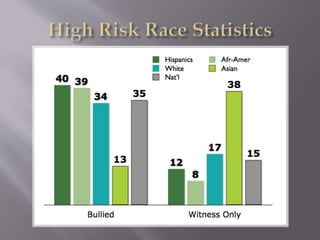
  • #14 Two groups in 2010 reported bullying at higher rates than the national average -- Hispanics and African-Americans. This suggests groups with legally protected status experience status-blind cruelty in addition to discrimination, or (2) there is some same-race bullying occurring, or both. In either case there is an element of harassment not addressed by current legal protections (Workplace bullying Institute, 2010).
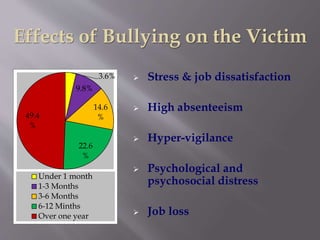
  • #15 In a national survey on workplace bullying over 49% of respondents in the U.S. have been involved in a workplace bully situation lasting more than one year, 3.6% for under one month, 9.8% for one to three months, 14.6% for three to six months, and 22.6% for 6 to 12 months, as shown in the chart above. In the U.S. over 49% of all workers say they have been involved in a workplace bullying situation. Among the effects of workplace bullying are: varying degrees of stress and job dissatisfaction with high absenteeism. Hyper-vigilance, which is, being constantly on the watch for the bully and those in collaboration with them if any, this is especially troublesome in small towns or when the victim lives near the bully. Intrusive thoughts, these are thoughts that are constantly coming to mind these thoughts are of the bully, despair, replaying situations in the mind, http://www.digitalopinion.co.uk/clientservices-bullying-workplace-natsurvey-results-length.html
  • #16 Surveys have indicated that more than a third of all workers, 37%, have been the victims of workplace bullies, another 12% reported that they have witnessed bullying. Debilitating Anxiety are experienced by more that 80% of bully victims. 39% of victims develop clinical depression for the first time or relapse into a previously controlled depression. 30% of targeted women & 21% of men develop post-traumatic stress disorder (PTSD) from deliberately inflicted bullying. A sense of shame or deserving a bad fate are the desired result of humiliating tactics by the bully. Many victims feel guilt for having "allowed" the bully to control them. An overwhelming sense of Injustice & inequity (the unfairness of targeting you who works so hard) is often felt by the victim; a result of the inadequacy of the employer's response to the victims complaint (Workplace Bullying Institute, 2011).
  • #17 Witnessing workplace bullying has a lasting impression on bystanders. A bystander articulated it as “far worse in the staffroom than the classroom; it’s far worse in the world of work than in the schoolroom, and it can sabotage everything else in your life.”
  • #18 Bystanders or witnesses in most cases do nothing to stop the bullying often for fear of becoming a target themselves and in some cases will join with the bully as a form of protection which results in mobbing. What is important for these people to know is that they are, as witnesses turned bully, subject to the same devastating symptoms as the victim.
  • #19 Distribution of cyber-bullying venues used by young people in the US, according to the Centers for Disease Control. Once in cyber space always in cyber space, when these tactics are used by a bully they can easily turn into harassment which is illegal. By using these forms of communication there is a permanent record of the incidents, not good for the bully.
  • #20 These are the benefits of a zero-tolerance policy and a positive psycho-social safety climate, which means a healthy and productive workplace. What employer would not want happy more productive employees? (Washington State Department of Labor & Industries, 2011).
  • #21 A workplace with low psycho-social safety culture (PSC) have 32% higher employee turnover, 11% more employees suffering chronic stress, 19% more employees looking for work somewhere else, 13% fewer employees that would recommend their place of employment as a good place to work, and 8% fewer employees that are satisfied with their job. This is according to the APA’s 2010 psychologically healthy workplace award (PHWA) winners.
  • #22 If employees will step up and take the initiative to stop bullying, which can be done, they will be protecting not only themselves but every one of their co-workers and their jobs.
  • #23 Without these steps being implemented the problem will persist. It will end when employers finally recognize the problem and what it cost them. If a few rules and enforcing those rule will add to a companies bottom line and they recognize it, that will be the beginning of the end.
  • #24 A lot of employers are into the idea of codes of conduct and ethics but don’t enforce them. An anti-bullying policy will work only if it is enforced. (Washington State Department of Labor & Industries, 2011).
  • #25 Education is a key component to stopping workplace bullying. I you don’t know about it you can’t do anything about it. (Washington State Department of Labor & Industries, 2011).
  • #26 To create a safe work environment employers need to provide help for anyone involved and take an active roll in their recovery. One major road to company success is a good Psycho-social Safety Culture (Bond, Dollard, & Tuckey, 2010).
  • #27 We can all become change agents, no matter how big or how little our involvement; the key is to “act”, to be engaged and active, be socially responsible in issues concerning the world
  • #28 This problem is not going away over night. Those who research workplace bullying believe it will take 5 to 10 years to make significant change, but change it must. Affecting nearly half the U.S. and world workforce and costing so many so much it must change.
  • #29 There are thousands who have been victimized by their co-workers and managers, many of these victims suffer debilitating symptoms like nightmares, flashbacks, intrusive thoughts, anxiety, depression, PTSD, shame, guilt, neurotransmitter disruption, hippocampus shrinkage, immune system impairment, high blood pressure, and a hundred other symptoms both psychological and physiological. Whether these symptoms are mild or severe the victim, the person, will never be the same. If you watched this happen you too are in danger of the same fate. The symptoms can start up to a year after the bullying has stopped, making you a victim too.
  • #30 You can’t change the world, but you can change how you respond to bullying, you can share what you have learned today, you can learn more, and you can take small steps that add to a big change. A journey of a thousand miles begins with one step.