
Dr Jasper Kenter & Prof Mark Reed
Shared and cultural values of ecosystems
What are
cultural
ecosystem
services?
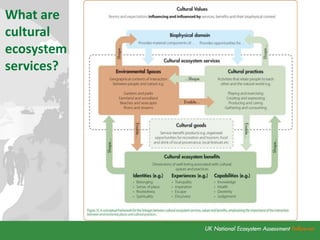
“The individual or shared benefits
to human well-being that arise
from interactions between
environmental spaces (e.g.
gardens, parks, beaches and
landscapes) and cultural practices
(e.g. gardening, walking, painting
and watching wildlife).”
What are
cultural
ecosystem
services?
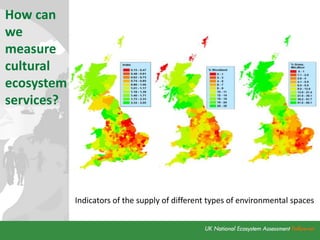
How can
we
measure
cultural
ecosystem
services?
Indicators of the supply of different types of environmental spaces
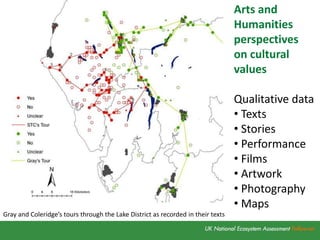
Arts and
Humanities
perspectives
on cultural
values
Qualitative data
• Texts
• Stories
• Performance
• Films
• Artwork
• Photography
• Maps
Gray and Coleridge’s tours through the Lake District as recorded in their texts
What are shared values?
• The values that bind us together as
communities, societies and cultures
(‘communal’, ‘societal’ and ‘cultural’ values)
• Our moral principles and overarching life
goals (‘transcendental’ values)
• Other-regarding values and values in relation
to society
• The values that arise from deliberation and
group-based decisions (‘deliberated’ and
‘group’ values)
Key findings
• Shared values resulting from
deliberative, group-based valuation
are different from individual values.
Case study evidence suggests that they
are more informed, considered,
confident and reflective of
participants’ deeper-held,
transcendental values
Key findings
• It is particularly important to consider
shared values when dealing with
uncertainty & complexity, where
values are likely to be subtle & implicit
(e.g. cultural services), and for issues
that are contested and/or have large
numbers of different stakeholders
Key findings
• A mixed method approach is required
to elicit the multiple dimensions of
shared values and to translate deeper-
held, transcendental values into
contextual values and preferences
Key findings
• Deliberative and social learning
processes help people to understand
the values held by others; they can
lead to increased sharing of values
and/or to greater acceptance of the
decisions emerging from such
processes
What is deliberation?
• Searching for & acquiring information,
gaining knowledge (by learning), and forming
reasoned opinions
• Expressing logical/reasoned opinions (not
exerting power/coercion) through dialogue
• Identifying & critically evaluating options
that might address a problem
• Integrating insights from deliberation to
determine a preferred option, which is well
informed and reasoned
Social learning
Social learning partly explains how
deliberation works
– A change in the relationship between a
person and the world (i.e. change in
understanding)
– This change in understanding occurs
through social interaction
– The learning occurs across more than one
person, at the scale of social units or
communities of practice
Extent to which deliberation & social
learning leads to greater sharing of values
depends on:
– Diversity of initial values in a group
– How effectively values are made explicit in the
deliberation (may be easier for some
participants to do than others)
– How deeply held those values are
– How effectively the process is designed and
facilitated (ensuring opportunities for
deliberation between participants and
managing power dynamics)
– Length of time over which deliberation occurs
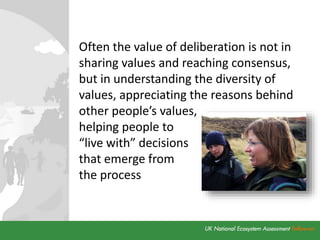
Often the value of deliberation is not in
sharing values and reaching consensus,
but in understanding the diversity of
values, appreciating the reasons behind
other people’s values,
helping people to
“live with” decisions
that emerge from
the process
Handbook for decision-makers
• Overview of key deliberative, psychometric
and interpretive methods for assessing shared
values
• Different stages of the policy cycle
• Indication of resources/timescales needed
• Examples at different scales and short case
studies to demon-
strate how methods
can be combined
www.lwec.org/sharedvalues
More information
• Video
• Handbook for decision-makers
• Full report
• Summary
www.lwec.org.uk/sharedvalues

Shared and cultural values of ecosystems

  • 1.
    Dr Jasper Kenter& Prof Mark Reed Shared and cultural values of ecosystems
  • 2.
    What are cultural ecosystem services? “The individualor shared benefits to human well-being that arise from interactions between environmental spaces (e.g. gardens, parks, beaches and landscapes) and cultural practices (e.g. gardening, walking, painting and watching wildlife).”
  • 3.
  • 4.
    How can we measure cultural ecosystem services? Indicators ofthe supply of different types of environmental spaces
  • 5.
    Arts and Humanities perspectives on cultural values Qualitativedata • Texts • Stories • Performance • Films • Artwork • Photography • Maps Gray and Coleridge’s tours through the Lake District as recorded in their texts
  • 7.
    What are sharedvalues? • The values that bind us together as communities, societies and cultures (‘communal’, ‘societal’ and ‘cultural’ values) • Our moral principles and overarching life goals (‘transcendental’ values) • Other-regarding values and values in relation to society • The values that arise from deliberation and group-based decisions (‘deliberated’ and ‘group’ values)
  • 8.
    Key findings • Sharedvalues resulting from deliberative, group-based valuation are different from individual values. Case study evidence suggests that they are more informed, considered, confident and reflective of participants’ deeper-held, transcendental values
  • 9.
    Key findings • Itis particularly important to consider shared values when dealing with uncertainty & complexity, where values are likely to be subtle & implicit (e.g. cultural services), and for issues that are contested and/or have large numbers of different stakeholders
  • 10.
    Key findings • Amixed method approach is required to elicit the multiple dimensions of shared values and to translate deeper- held, transcendental values into contextual values and preferences
  • 11.
    Key findings • Deliberativeand social learning processes help people to understand the values held by others; they can lead to increased sharing of values and/or to greater acceptance of the decisions emerging from such processes
  • 12.
    What is deliberation? •Searching for & acquiring information, gaining knowledge (by learning), and forming reasoned opinions • Expressing logical/reasoned opinions (not exerting power/coercion) through dialogue • Identifying & critically evaluating options that might address a problem • Integrating insights from deliberation to determine a preferred option, which is well informed and reasoned
  • 13.
    Social learning Social learningpartly explains how deliberation works – A change in the relationship between a person and the world (i.e. change in understanding) – This change in understanding occurs through social interaction – The learning occurs across more than one person, at the scale of social units or communities of practice
  • 14.
    Extent to whichdeliberation & social learning leads to greater sharing of values depends on: – Diversity of initial values in a group – How effectively values are made explicit in the deliberation (may be easier for some participants to do than others) – How deeply held those values are – How effectively the process is designed and facilitated (ensuring opportunities for deliberation between participants and managing power dynamics) – Length of time over which deliberation occurs
  • 15.
    Often the valueof deliberation is not in sharing values and reaching consensus, but in understanding the diversity of values, appreciating the reasons behind other people’s values, helping people to “live with” decisions that emerge from the process
  • 16.
    Handbook for decision-makers •Overview of key deliberative, psychometric and interpretive methods for assessing shared values • Different stages of the policy cycle • Indication of resources/timescales needed • Examples at different scales and short case studies to demon- strate how methods can be combined www.lwec.org/sharedvalues
  • 17.
    More information • Video •Handbook for decision-makers • Full report • Summary www.lwec.org.uk/sharedvalues