Individualist/CollectivistHigh- and Low-ContextCultural Comparisons1
A system of expressive practices fraught with feelings, a system of symbols, premises, rules, forms, and the domains and dimensions of mutual meanings associated with these.
A learned set of shared interpretations about beliefs, values, and norms, which affect the behaviors of a relatively large group of people.2What is Culture?From DonalCarbaugh
The framework, background, and surrounding circumstances in which communication or an event takes place.The background, the “field” of belief systems, world view, and perspectives people have been raised in.A set of “cultural lenses” though which one views the world and interprets communication—we can never “lose” completely the lenses we were raised with.3What is Cultural Context?From Edward T. Hall
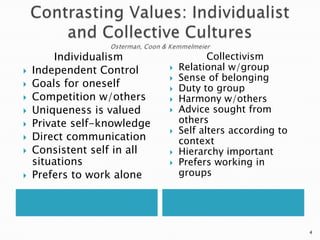
Contrasting Values: Individualist and Collective CulturesOsterman, Coon & KemmelmeierIndividualismIndependent ControlGoals for oneselfCompetition w/othersUniqueness is valuedPrivate self-knowledgeDirect communicationConsistent self in all situationsPrefers to work aloneCollectivismRelational w/groupSense of belongingDuty to groupHarmony w/othersAdvice sought from othersSelf alters according to contextHierarchy importantPrefers working in groups4
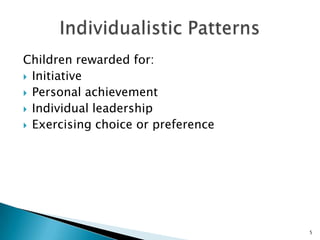
Children rewarded for:InitiativePersonal achievementIndividual leadershipExercising choice or preference5Individualistic Patterns
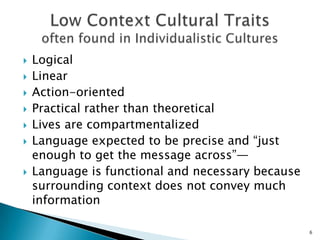
LogicalLinearAction-oriented Practical rather than theoreticalLives are compartmentalizedLanguage expected to be precise and “just enough to get the message across”—Language is functional and necessary because surrounding context does not convey much information6Low Context Cultural Traitsoften found in Individualistic Cultures
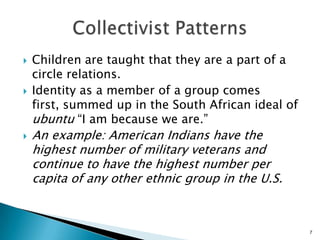
Children are taught that they are a part of a circle relations.Identity as a member of a group comes first, summed up in the South African ideal of ubuntu “I am because we are.”An example: American Indians have the highest number of military veterans and continue to have the highest number per capita of any other ethnic group in the U.S.7Collectivist Patterns
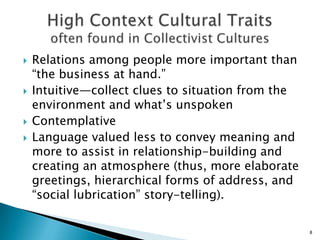
Relations among people more important than “the business at hand.”Intuitive—collect clues to situation from the environment and what’s unspokenContemplativeLanguage valued less to convey meaning and more to assist in relationship-building and creating an atmosphere (thus, more elaborate greetings, hierarchical forms of address, and “social lubrication” story-telling).8High Context Cultural Traitsoften found in Collectivist Cultures
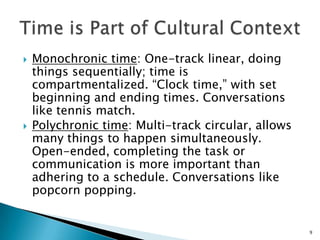
Monochronic time: One-track linear, doing things sequentially; time is compartmentalized. “Clock time,” with set beginning and ending times. Conversations like tennis match.Polychronic time: Multi-track circular, allows many things to happen simultaneously. Open-ended, completing the task or communication is more important than adhering to a schedule. Conversations like popcorn popping.9Time is Part of Cultural Context
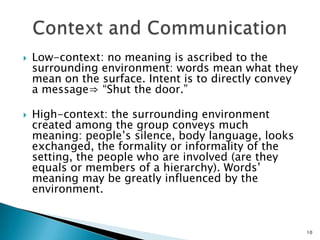
Low-context: no meaning is ascribed to the surrounding environment: words mean what they mean on the surface. Intent is to directly convey a message⇒ “Shut the door.”High-context: the surrounding environment created among the group conveys much meaning: people’s silence, body language, looks exchanged, the formality or informality of the setting, the people who are involved (are they equals or members of a hierarchy). Words’ meaning may be greatly influenced by the environment.10Context and Communication
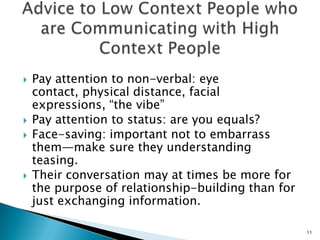
Pay attention to non-verbal: eye contact, physical distance, facial expressions, “the vibe”Pay attention to status: are you equals?Face-saving: important not to embarrass them—make sure they understanding teasing.Their conversation may at times be more for the purpose of relationship-building than for just exchanging information.11Advice to Low Context People who are Communicating with High Context People
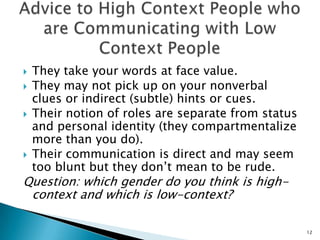
They take your words at face value.They may not pick up on your nonverbal clues or indirect (subtle) hints or cues.Their notion of roles are separate from status and personal identity (they compartmentalize more than you do).Their communication is direct and may seem too blunt but they don’t mean to be rude.Question: which gender do you think is high-context and which is low-context?12Advice to High Context People who are Communicating with Low Context People
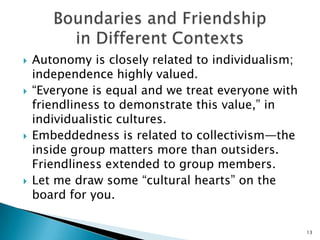
Autonomy is closely related to individualism; independence highly valued.“Everyone is equal and we treat everyone with friendliness to demonstrate this value,” in individualistic cultures.Embeddedness is related to collectivism—the inside group matters more than outsiders. Friendliness extended to group members.Let me draw some “cultural hearts” on the board for you.13Boundaries and Friendshipin Different Contexts

Individualism, Collectivism, High And Low Context

  • 1.
  • 2.
    A system ofexpressive practices fraught with feelings, a system of symbols, premises, rules, forms, and the domains and dimensions of mutual meanings associated with these.
  • 3.
    A learned setof shared interpretations about beliefs, values, and norms, which affect the behaviors of a relatively large group of people.2What is Culture?From DonalCarbaugh
  • 4.
    The framework, background,and surrounding circumstances in which communication or an event takes place.The background, the “field” of belief systems, world view, and perspectives people have been raised in.A set of “cultural lenses” though which one views the world and interprets communication—we can never “lose” completely the lenses we were raised with.3What is Cultural Context?From Edward T. Hall
  • 5.
    Contrasting Values: Individualistand Collective CulturesOsterman, Coon & KemmelmeierIndividualismIndependent ControlGoals for oneselfCompetition w/othersUniqueness is valuedPrivate self-knowledgeDirect communicationConsistent self in all situationsPrefers to work aloneCollectivismRelational w/groupSense of belongingDuty to groupHarmony w/othersAdvice sought from othersSelf alters according to contextHierarchy importantPrefers working in groups4
  • 6.
    Children rewarded for:InitiativePersonalachievementIndividual leadershipExercising choice or preference5Individualistic Patterns
  • 7.
    LogicalLinearAction-oriented Practical ratherthan theoreticalLives are compartmentalizedLanguage expected to be precise and “just enough to get the message across”—Language is functional and necessary because surrounding context does not convey much information6Low Context Cultural Traitsoften found in Individualistic Cultures
  • 8.
    Children are taughtthat they are a part of a circle relations.Identity as a member of a group comes first, summed up in the South African ideal of ubuntu “I am because we are.”An example: American Indians have the highest number of military veterans and continue to have the highest number per capita of any other ethnic group in the U.S.7Collectivist Patterns
  • 9.
    Relations among peoplemore important than “the business at hand.”Intuitive—collect clues to situation from the environment and what’s unspokenContemplativeLanguage valued less to convey meaning and more to assist in relationship-building and creating an atmosphere (thus, more elaborate greetings, hierarchical forms of address, and “social lubrication” story-telling).8High Context Cultural Traitsoften found in Collectivist Cultures
  • 10.
    Monochronic time: One-tracklinear, doing things sequentially; time is compartmentalized. “Clock time,” with set beginning and ending times. Conversations like tennis match.Polychronic time: Multi-track circular, allows many things to happen simultaneously. Open-ended, completing the task or communication is more important than adhering to a schedule. Conversations like popcorn popping.9Time is Part of Cultural Context
  • 11.
    Low-context: no meaningis ascribed to the surrounding environment: words mean what they mean on the surface. Intent is to directly convey a message⇒ “Shut the door.”High-context: the surrounding environment created among the group conveys much meaning: people’s silence, body language, looks exchanged, the formality or informality of the setting, the people who are involved (are they equals or members of a hierarchy). Words’ meaning may be greatly influenced by the environment.10Context and Communication
  • 12.
    Pay attention tonon-verbal: eye contact, physical distance, facial expressions, “the vibe”Pay attention to status: are you equals?Face-saving: important not to embarrass them—make sure they understanding teasing.Their conversation may at times be more for the purpose of relationship-building than for just exchanging information.11Advice to Low Context People who are Communicating with High Context People
  • 13.
    They take yourwords at face value.They may not pick up on your nonverbal clues or indirect (subtle) hints or cues.Their notion of roles are separate from status and personal identity (they compartmentalize more than you do).Their communication is direct and may seem too blunt but they don’t mean to be rude.Question: which gender do you think is high-context and which is low-context?12Advice to High Context People who are Communicating with Low Context People
  • 14.
    Autonomy is closelyrelated to individualism; independence highly valued.“Everyone is equal and we treat everyone with friendliness to demonstrate this value,” in individualistic cultures.Embeddedness is related to collectivism—the inside group matters more than outsiders. Friendliness extended to group members.Let me draw some “cultural hearts” on the board for you.13Boundaries and Friendshipin Different Contexts