
Unit 1 Mass Media and its
Importance
Prepared by-
Dr.Dhvani Joshi
Shared by-
Vaidehi Hariyani
Research Scholar
Department of English,
Maharaja Krishnakumarsinhji Bhavnagar University
Communication: The Term
• A human relationship involving two or more persons
who come together to share, to dialogue and to
commune.
• Thus, communication is not just an act or a process
but also a social and cultural togetherness.
According to Denis Mcquail, “Communication is a process which
increases commonality – but also requires elements of commonality
for it to occur at all.”
A common language for instance does bring people together but
language alone does not suffice for communication to take place.
There are other factors too at play such as a shared culture and a
common interest which bring about a sense of commonality and
more significantly, a sense of community.
The Sanskrit term, ‘Sadharanikaran’ comes closest tto the term of
‘common’ or ‘commonness’ usually associated with communication.
Need For Communication
• A human being’s need for communication is as strong as the need to eat, sleep and love.
• Communication is as much a natural need as it is a social requirement in order to engage
in the sharing of experiences, through symbol mediated interaction.
• It requires active interaction with our physical, biological and social environments.
• The basic human need for communication can perhaps be traced ti the process of
mankind’s evolution from lower species.
• Excommunication or lack of communication may lead to sensory deprivation, anxiety,
depraved judgement, strange visions.
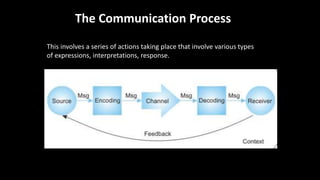
The Communication Process
This involves a series of actions taking place that involve various types
of expressions, interpretations, response.
1. The sender has an idea: The intent of this phase is to start the process at a time when
a sender intentionally decide to send a message to someone else. So, the sender has
an idea.
2. The Sender encodes the idea: When encoding one’s idea, one has to pick the code that
will fit the message and that will allow the receiver to understand. Humans use a
multitude of symbols to represent their ideas. Some symbols are linguistic (verbal or
written) code developed into complex languages. Languages are many: the Morse code,
the Braille language, the American Sign Language, and all the spoken and dead languages
of the world. Other symbols are also in use to communicate: mathematical formulas,
paintings, pictographs, hieroglyphs, traffic signals, zip codes, baseball gestures signalling
instructions from managers to players.
3. The sender transmits the message: In order for the sender to transmit the encoded
message, the sender has to choose a channel, a medium through which to send the
message. Senders can send information verbally or nonverbally. In nonverbal
communication, messages are sent through gestures, tone of voice, use of space, etc. In
verbal communication, messages are sent through speeches or through documents.
A good medium is one that (1) can convey a message using more than one type of clue
(visual and verbal and vocal), (2) can facilitate feedback, and (3) can establish personal
focus. The richest medium is a face-to-face conversation
4. The receiver gets the message:
5. The receiver decodes the message: The receiver always decodes the message using his
or her knowledge of the code used to encode the message.
6. The receiver send feedback to the sender
Using the same phases as the sender, the receiver send a message back to the sender
providing information on his or her level of comprehension of the message.
Noices or barriers to communication process:
Throughout the communication process, unintentional interferences occur, distorting or
interrupting the process. These interferences are called noises. Noises can be real noises,
auditory stimuli, like phones ringing, people talking. Noises distractions and distortions as
well: static over a phone, solar flares altering a television’s reception, or psychological
illnesses modifying how people perceive the world. Communication without noises has yet
to happen. Therefore, recognizing the sources of noise and attempting to minimize its
effect is essential to improving the efficiency of one’s communication.
Channel: A Channel is the link between the sender and the receiver and is an essential
tool for communication. The Channel should be chosen appropriately at the appropriate
time and for the appropriate audience in order for it to function effectively.
Feedback: It means response or reaction to the sender once the message is received.
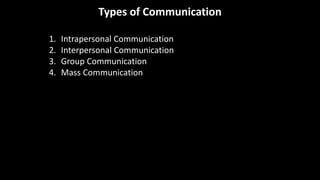
Types of Communication
1. Intrapersonal Communication
2. Interpersonal Communication
3. Group Communication
4. Mass Communication
5. Mass-line Communication
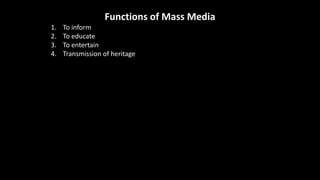
Functions of Mass Media
1. To inform
2. To educate
3. To entertain
4. Transmission of heritage
5. Commercial
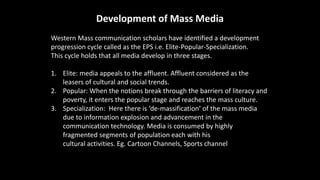
Development of Mass Media
Western Mass communication scholars have identified a development
progression cycle called as the EPS i.e. Elite-Popular-Specialization.
This cycle holds that all media develop in three stages.
1. Elite: media appeals to the affluent. Affluent considered as the
leasers of cultural and social trends.
2. Popular: When the notions break through the barriers of literacy and
poverty, it enters the popular stage and reaches the mass culture.
3. Specialization: Here there is ‘de-massification’ of the mass media
due to information explosion and advancement in the
communication technology. Media is consumed by highly
fragmented segments of population each with his own interest and
cultural activities. Eg. Cartoon Channels, Sports channel, News, Films
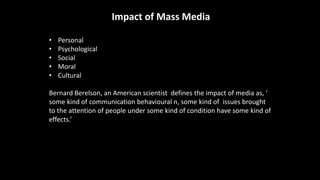
Impact of Mass Media
• Personal
• Psychological
• Social
• Moral
• Cultural
Bernard Berelson, an American scientist defines the impact of media as, ‘
some kind of communication behavioural n, some kind of issues brought
to the attention of people under some kind of condition have some kind of
effects.’
Western Communication Theories
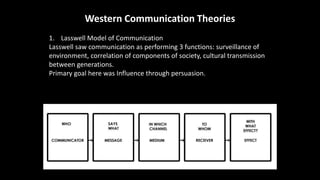
1. Lasswell Model of Communication
Lasswell saw communication as performing 3 functions: surveillance of
environment, correlation of components of society, cultural transmission
between generations.
Primary goal here was Influence through persuasion.
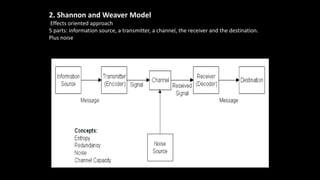
2. Shannon and Weaver Model
Effects oriented approach
5 parts: information source, a transmitter, a channel, the receiver and the destination.
Plus noise
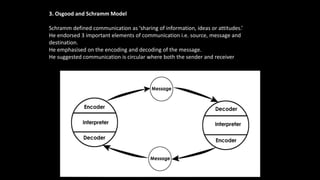
3. Osgood and Schramm Model
Schramm defined communication as ‘sharing of information, ideas or attitudes.’
He endorsed 3 important elements of communication i.e. source, message and
destination.
He emphasised on the encoding and decoding of the message.
He suggested communication is circular where both the sender and receiver are involved
in encoding and decoding and equal partners in exchange.
4. Ritual Model of Communication
James Carey an American anthropologist promoted this model.
‘Role of ritual in societies’.
All members of public not just the senders are actors contributing in some way to the
pattern of meaning of a nation or a region.
Objective of Communication/ transmission of messages is for the purpose of Social Control.
Communication is thus seen as a process of creation, representation and celebration of
shared belief.
5. Communication as Dialogue
Brazilian educationist, Paul Friere
Communication as a dialogic and ‘participatory’ relationship is at the heart of South
American perspective. They key elements here are ‘liberation’, ‘participation’ and
‘conscientization’.
This model challenges the Aristotelian model of communication which focusses on
‘transmission’ and ‘transportation’.
6. Communication as Power Relationship
This perspective has it’s basis in Marxist ideology which sees ‘conflict’ and class differences
rather than consensus as the function of communication.
In some situations, Communication is an exercise in power relations, the power of one
individual over another, of an individual over a group, and of mass media owners and
producers/professionals over audiences.
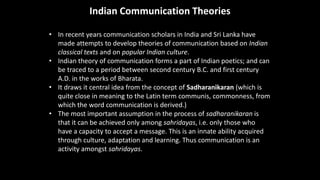
Indian Communication Theories
• In recent years communication scholars in India and Sri Lanka have
made attempts to develop theories of communication based on Indian
classical texts and on popular Indian culture.
• Indian theory of communication forms a part of Indian poetics; and can
be traced to a period between second century B.C. and first century
A.D. in the works of Bharata.
• It draws it central idea from the concept of Sadharanikaran (which is
quite close in meaning to the Latin term communis, commonness, from
which the word communication is derived.)
• The most important assumption in the process of sadharanikaran is
that it can be achieved only among sahridayas, i.e. only those who
have a capacity to accept a message. This is an innate ability acquired
through culture, adaptation and learning. Thus communication is an
activity amongst sahridayas.
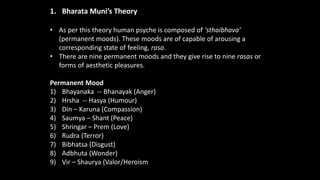
1. Bharata Muni’s Theory
• As per this theory human psyche is composed of ‘sthaibhava’
(permanent moods). These moods are of capable of arousing a
corresponding state of feeling, rasa.
• There are nine permanent moods and they give rise to nine rasas or
forms of aesthetic pleasures.
Permanent Mood
1) Bhayanaka -- Bhanayak (Anger)
2) Hrsha -- Hasya (Humour)
3) Din – Karuna (Compassion)
4) Saumya – Shant (Peace)
5) Shringar – Prem (Love)
6) Rudra (Terror)
7) Bibhatsa (Disgust)
8) Adbhuta (Wonder)
9) Vir – Shaurya (Valor/Heroism)
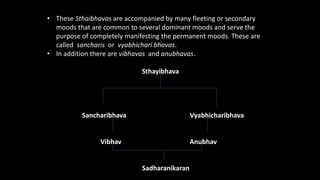
• These Sthaibhavas are accompanied by many fleeting or secondary
moods that are common to several dominant moods and serve the
purpose of completely manifesting the permanent moods. These are
called sancharis or vyabhichari bhavas.
• In addition there are vibhavas and anubhavas.
Sthayibhava
Sancharibhava Vyabhicharibhava
Vibhav Anubhav
Sadharanikaran
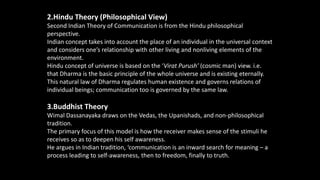
2.Hindu Theory (Philosophical View)
Second Indian Theory of Communication is from the Hindu philosophical
perspective.
Indian concept takes into account the place of an individual in the universal context
and considers one’s relationship with other living and nonliving elements of the
environment.
Hindu concept of universe is based on the ‘Virat Purush’ (cosmic man) view. i.e.
that Dharma is the basic principle of the whole universe and is existing eternally.
This natural law of Dharma regulates human existence and governs relations of
individual beings; communication too is governed by the same law.
3.Buddhist Theory
Wimal Dassanayaka draws on the Vedas, the Upanishads, and non-philosophical
tradition.
The primary focus of this model is how the receiver makes sense of the stimuli he
receives so as to deepen his self awareness.
He argues in Indian tradition, ‘communication is an inward search for meaning – a
process leading to self-awareness, then to freedom, finally to truth..
Mass Communication and Mass Culture
• Culture can be defined as the beliefs, values, or other frameworks of
reference by which we make sense of our experiences. It also concerns how
we communicate these values and ideas.
• The concept of Mass Culture refers to a whole range of popular activities and
artefacts to entertainments, spectacles, music, books, films – but has become
identified with the typical content of mass media and especially with the
fictional, dramatic and entertainment material which they provide.
• Mass media are centrally involved in the production of modern culture.
Reach of Mass Media is limited in India thus Mass Culture in our country is
still by and large the one that prevails in our villages where over 77% of the
our people live. Here folk media is still predominant.
• Most popular entertainment medium in India is Cinema. Nearly 800 films
produced per year.
• Indian Cinema has qualities of a mass culture product but it is doubtful if it is
the only factor that contributes to the ‘mass culture’
Features
1. Immense popularity amongst all classes, but particularly among the
working class in industrial societies.
2. Mass production and mass distribution
3. Unlike ‘elite’ or ‘high’ culture is aesthetic and literary standards are
low, and commercialised, as it is mass produced programmes aim at
the mass market.
The culture propagated by mass media is not necessarily the popular
culture of the masses of the majority community in the country.
The ‘mass culture’ is a complex cultural phenomenon which is a creation
of the mass media. It is therefore more precise to term it ‘mass media
culture’ to distinguish it from the majority culture or folk culture.
Mass media culture is an entirely urban phenomenon resulting from rapid
industrialization and alienation from the majority culture.

Unit 1 Mass media and its importance

  • 1.
    Unit 1 MassMedia and its Importance Prepared by- Dr.Dhvani Joshi Shared by- Vaidehi Hariyani Research Scholar Department of English, Maharaja Krishnakumarsinhji Bhavnagar University
  • 3.
    Communication: The Term •A human relationship involving two or more persons who come together to share, to dialogue and to commune. • Thus, communication is not just an act or a process but also a social and cultural togetherness.
  • 4.
    According to DenisMcquail, “Communication is a process which increases commonality – but also requires elements of commonality for it to occur at all.” A common language for instance does bring people together but language alone does not suffice for communication to take place. There are other factors too at play such as a shared culture and a common interest which bring about a sense of commonality and more significantly, a sense of community. The Sanskrit term, ‘Sadharanikaran’ comes closest tto the term of ‘common’ or ‘commonness’ usually associated with communication.
  • 5.
    Need For Communication •A human being’s need for communication is as strong as the need to eat, sleep and love. • Communication is as much a natural need as it is a social requirement in order to engage in the sharing of experiences, through symbol mediated interaction. • It requires active interaction with our physical, biological and social environments. • The basic human need for communication can perhaps be traced ti the process of mankind’s evolution from lower species. • Excommunication or lack of communication may lead to sensory deprivation, anxiety, depraved judgement, strange visions.
  • 6.
    The Communication Process Thisinvolves a series of actions taking place that involve various types of expressions, interpretations, response.
  • 7.
    1. The senderhas an idea: The intent of this phase is to start the process at a time when a sender intentionally decide to send a message to someone else. So, the sender has an idea. 2. The Sender encodes the idea: When encoding one’s idea, one has to pick the code that will fit the message and that will allow the receiver to understand. Humans use a multitude of symbols to represent their ideas. Some symbols are linguistic (verbal or written) code developed into complex languages. Languages are many: the Morse code, the Braille language, the American Sign Language, and all the spoken and dead languages of the world. Other symbols are also in use to communicate: mathematical formulas, paintings, pictographs, hieroglyphs, traffic signals, zip codes, baseball gestures signalling instructions from managers to players. 3. The sender transmits the message: In order for the sender to transmit the encoded message, the sender has to choose a channel, a medium through which to send the message. Senders can send information verbally or nonverbally. In nonverbal communication, messages are sent through gestures, tone of voice, use of space, etc. In verbal communication, messages are sent through speeches or through documents. A good medium is one that (1) can convey a message using more than one type of clue (visual and verbal and vocal), (2) can facilitate feedback, and (3) can establish personal focus. The richest medium is a face-to-face conversation
  • 8.
    4. The receivergets the message: 5. The receiver decodes the message: The receiver always decodes the message using his or her knowledge of the code used to encode the message. 6. The receiver send feedback to the sender Using the same phases as the sender, the receiver send a message back to the sender providing information on his or her level of comprehension of the message. Noices or barriers to communication process: Throughout the communication process, unintentional interferences occur, distorting or interrupting the process. These interferences are called noises. Noises can be real noises, auditory stimuli, like phones ringing, people talking. Noises distractions and distortions as well: static over a phone, solar flares altering a television’s reception, or psychological illnesses modifying how people perceive the world. Communication without noises has yet to happen. Therefore, recognizing the sources of noise and attempting to minimize its effect is essential to improving the efficiency of one’s communication. Channel: A Channel is the link between the sender and the receiver and is an essential tool for communication. The Channel should be chosen appropriately at the appropriate time and for the appropriate audience in order for it to function effectively. Feedback: It means response or reaction to the sender once the message is received.
  • 9.
    Types of Communication 1.Intrapersonal Communication 2. Interpersonal Communication 3. Group Communication 4. Mass Communication 5. Mass-line Communication
  • 10.
    Functions of MassMedia 1. To inform 2. To educate 3. To entertain 4. Transmission of heritage 5. Commercial
  • 11.
    Development of MassMedia Western Mass communication scholars have identified a development progression cycle called as the EPS i.e. Elite-Popular-Specialization. This cycle holds that all media develop in three stages. 1. Elite: media appeals to the affluent. Affluent considered as the leasers of cultural and social trends. 2. Popular: When the notions break through the barriers of literacy and poverty, it enters the popular stage and reaches the mass culture. 3. Specialization: Here there is ‘de-massification’ of the mass media due to information explosion and advancement in the communication technology. Media is consumed by highly fragmented segments of population each with his own interest and cultural activities. Eg. Cartoon Channels, Sports channel, News, Films
  • 12.
    Impact of MassMedia • Personal • Psychological • Social • Moral • Cultural Bernard Berelson, an American scientist defines the impact of media as, ‘ some kind of communication behavioural n, some kind of issues brought to the attention of people under some kind of condition have some kind of effects.’
  • 13.
    Western Communication Theories 1.Lasswell Model of Communication Lasswell saw communication as performing 3 functions: surveillance of environment, correlation of components of society, cultural transmission between generations. Primary goal here was Influence through persuasion.
  • 14.
    2. Shannon andWeaver Model Effects oriented approach 5 parts: information source, a transmitter, a channel, the receiver and the destination. Plus noise
  • 15.
    3. Osgood andSchramm Model Schramm defined communication as ‘sharing of information, ideas or attitudes.’ He endorsed 3 important elements of communication i.e. source, message and destination. He emphasised on the encoding and decoding of the message. He suggested communication is circular where both the sender and receiver are involved in encoding and decoding and equal partners in exchange.
  • 16.
    4. Ritual Modelof Communication James Carey an American anthropologist promoted this model. ‘Role of ritual in societies’. All members of public not just the senders are actors contributing in some way to the pattern of meaning of a nation or a region. Objective of Communication/ transmission of messages is for the purpose of Social Control. Communication is thus seen as a process of creation, representation and celebration of shared belief. 5. Communication as Dialogue Brazilian educationist, Paul Friere Communication as a dialogic and ‘participatory’ relationship is at the heart of South American perspective. They key elements here are ‘liberation’, ‘participation’ and ‘conscientization’. This model challenges the Aristotelian model of communication which focusses on ‘transmission’ and ‘transportation’. 6. Communication as Power Relationship This perspective has it’s basis in Marxist ideology which sees ‘conflict’ and class differences rather than consensus as the function of communication. In some situations, Communication is an exercise in power relations, the power of one individual over another, of an individual over a group, and of mass media owners and producers/professionals over audiences.
  • 17.
    Indian Communication Theories •In recent years communication scholars in India and Sri Lanka have made attempts to develop theories of communication based on Indian classical texts and on popular Indian culture. • Indian theory of communication forms a part of Indian poetics; and can be traced to a period between second century B.C. and first century A.D. in the works of Bharata. • It draws it central idea from the concept of Sadharanikaran (which is quite close in meaning to the Latin term communis, commonness, from which the word communication is derived.) • The most important assumption in the process of sadharanikaran is that it can be achieved only among sahridayas, i.e. only those who have a capacity to accept a message. This is an innate ability acquired through culture, adaptation and learning. Thus communication is an activity amongst sahridayas.
  • 18.
    1. Bharata Muni’sTheory • As per this theory human psyche is composed of ‘sthaibhava’ (permanent moods). These moods are of capable of arousing a corresponding state of feeling, rasa. • There are nine permanent moods and they give rise to nine rasas or forms of aesthetic pleasures. Permanent Mood 1) Bhayanaka -- Bhanayak (Anger) 2) Hrsha -- Hasya (Humour) 3) Din – Karuna (Compassion) 4) Saumya – Shant (Peace) 5) Shringar – Prem (Love) 6) Rudra (Terror) 7) Bibhatsa (Disgust) 8) Adbhuta (Wonder) 9) Vir – Shaurya (Valor/Heroism)
  • 19.
    • These Sthaibhavasare accompanied by many fleeting or secondary moods that are common to several dominant moods and serve the purpose of completely manifesting the permanent moods. These are called sancharis or vyabhichari bhavas. • In addition there are vibhavas and anubhavas. Sthayibhava Sancharibhava Vyabhicharibhava Vibhav Anubhav Sadharanikaran
  • 20.
    2.Hindu Theory (PhilosophicalView) Second Indian Theory of Communication is from the Hindu philosophical perspective. Indian concept takes into account the place of an individual in the universal context and considers one’s relationship with other living and nonliving elements of the environment. Hindu concept of universe is based on the ‘Virat Purush’ (cosmic man) view. i.e. that Dharma is the basic principle of the whole universe and is existing eternally. This natural law of Dharma regulates human existence and governs relations of individual beings; communication too is governed by the same law. 3.Buddhist Theory Wimal Dassanayaka draws on the Vedas, the Upanishads, and non-philosophical tradition. The primary focus of this model is how the receiver makes sense of the stimuli he receives so as to deepen his self awareness. He argues in Indian tradition, ‘communication is an inward search for meaning – a process leading to self-awareness, then to freedom, finally to truth..
  • 21.
    Mass Communication andMass Culture • Culture can be defined as the beliefs, values, or other frameworks of reference by which we make sense of our experiences. It also concerns how we communicate these values and ideas. • The concept of Mass Culture refers to a whole range of popular activities and artefacts to entertainments, spectacles, music, books, films – but has become identified with the typical content of mass media and especially with the fictional, dramatic and entertainment material which they provide. • Mass media are centrally involved in the production of modern culture. Reach of Mass Media is limited in India thus Mass Culture in our country is still by and large the one that prevails in our villages where over 77% of the our people live. Here folk media is still predominant. • Most popular entertainment medium in India is Cinema. Nearly 800 films produced per year. • Indian Cinema has qualities of a mass culture product but it is doubtful if it is the only factor that contributes to the ‘mass culture’
  • 22.
    Features 1. Immense popularityamongst all classes, but particularly among the working class in industrial societies. 2. Mass production and mass distribution 3. Unlike ‘elite’ or ‘high’ culture is aesthetic and literary standards are low, and commercialised, as it is mass produced programmes aim at the mass market. The culture propagated by mass media is not necessarily the popular culture of the masses of the majority community in the country. The ‘mass culture’ is a complex cultural phenomenon which is a creation of the mass media. It is therefore more precise to term it ‘mass media culture’ to distinguish it from the majority culture or folk culture. Mass media culture is an entirely urban phenomenon resulting from rapid industrialization and alienation from the majority culture.