What is
Communication?
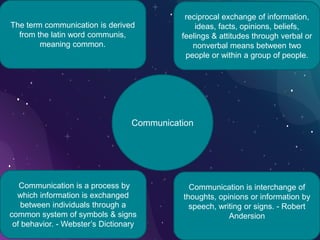
Communication
The term communication is derived
from the latin word communis,
meaning common.
reciprocal exchange of information,
ideas, facts, opinions, beliefs,
feelings & attitudes through verbal or
nonverbal means between two
people or within a group of people.
Communication is interchange of
thoughts, opinions or information by
speech, writing or signs. - Robert
Andersion
Communication is a process by
which information is exchanged
between individuals through a
common system of symbols & signs
of behavior. - Webster’s Dictionary
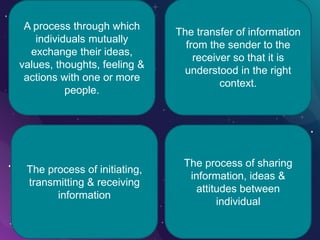
A process through which
individuals mutually
exchange their ideas,
values, thoughts, feeling &
actions with one or more
people.
The process of sharing
information, ideas &
attitudes between
individual
The transfer of information
from the sender to the
receiver so that it is
understood in the right
context.
The process of initiating,
transmitting & receiving
information
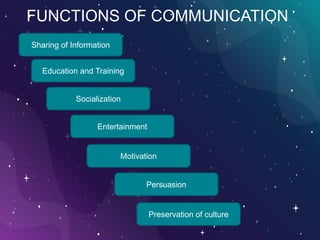
FUNCTIONS OF COMMUNICATION
Sharing of Information
Entertainment
Education and Training
Socialization
Motivation
Persuasion
Preservation of culture
Sharing of Information
Information is key to progress in any society.
Communication plays an important role in
information dissemination related to any form
of human activity, such as social, political,
economic, educational and developmental.
Regular exposure to information over a period
of time generates awareness on a given
issue, problem or matter of concern.
Education and Training
Communication results in sharing of
information, which in turn makes
people knowledgeable and thus
productive members of the society.
Right from our childhood we are
taught by our teachers in the school
and elders at home and we thus gain
various new concepts and skills as
we grow up.
Socialization
Communication fosters the feeling
of oneness in a society by
exposing the various social
groups to different views. It
develops the need to share and
understand the feelings, emotions,
hopes, aspirations and
expectations of varied groups in a
social system.
Entertainment
To break the monotony of human life, we
need to be exposed to art, literature, music,
films, dance, drama, sports and other
modes of entertainment. Communication
provides us with this necessary diversion.
Thus entertainment is an equally important
function of communication.
Motivation
A motivated individual plays a useful and active
role in a society. Communication motivates and
persuades individuals to meet the mutually
agreed upon goals. Sharing success stories of
those who have overcome the odds in life and
have been able to achieve their goals can do
this. This function of communication, although
relevant in all walks of life is more pronounced in
business and industry where communication is
being increasingly used as a tool for motivation.
Persuasion
This may be to influence us
towards a new idea, technique
or a product and also to
persuade us to buy these
products.
Preservation of culture
Communication helps to preserve the culture
and heritage of a nation and society. Through
communication, stories from the epics, such as
Ramayana, Mahabharata, Bible, Koran, etc. are
shared with the younger generation. The
transmission of values from one generation to
another has been taking place orally as well as
through written texts, over the ages.
Types of Communication
Intrapersonal
The word 'intra' denotes 'within'. When we
communicate within ourselves, it is
intrapersonal communication. This can take the
form of thinking, analyzing, dreaming or
introspecting. Day dreaming, self-talk and
memories are all facets of intrapersonal
communication.
Interpersonal
When two persons communicate with
each other, the communication is
interpersonal. Our everyday
exchanges, formal or informal, which
may take place anywhere come under
this type of communication.
Group communication
This is an extension of interpersonal
communication where more than two
individuals are involved in the process of
communication. The groups can be both
formal as well as informal depending on
the type and objectives of communication
but generally they have common interests
and goals.
Mass Communication
In mass communication, the communicator is
separated from the audience in terms of time and
place. Communication takes place
simultaneously with the help of an electronic
device, in which an institution is involved. These
electronic devices are known as mass media
such as print, radio, television, the Internet, etc.
Models of Communication
Like the nature and concept of communication, models
of communication have also been the subject of a vast
amount of research. No single theory or model has
found a general acceptance.
A model is a graphic representation designed to explain
the way a variable works. It is a pattern, plan,
representation, or description designed to show the
structure or workings of an object, system, or concept. A
model of communication offers a convenient way to think
about it by providing a graphical checklist of its various
elements.
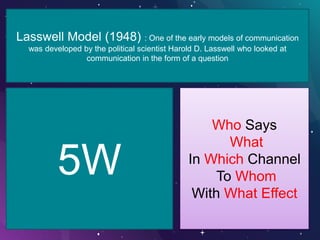
Lasswell Model (1948) : One of the early models of communication
was developed by the political scientist Harold D. Lasswell who looked at
communication in the form of a question
5W
Who Says
What
In Which Channel
To Whom
With What Effect
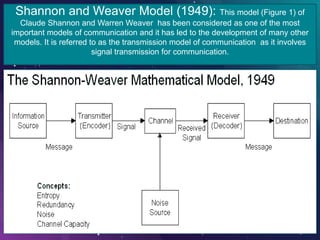
Shannon and Weaver Model (1949): This model (Figure 1) of
Claude Shannon and Warren Weaver has been considered as one of the most
important models of communication and it has led to the development of many other
models. It is referred to as the transmission model of communication as it involves
signal transmission for communication.
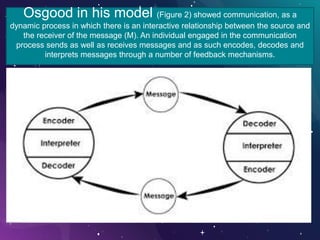
Osgood in his model (Figure 2) showed communication, as a
dynamic process in which there is an interactive relationship between the source and
the receiver of the message (M). An individual engaged in the communication
process sends as well as receives messages and as such encodes, decodes and
interprets messages through a number of feedback mechanisms.
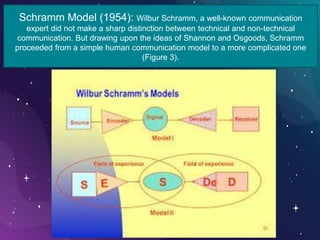
Schramm Model (1954): Wilbur Schramm, a well-known communication
expert did not make a sharp distinction between technical and non-technical
communication. But drawing upon the ideas of Shannon and Osgoods, Schramm
proceeded from a simple human communication model to a more complicated one
(Figure 3).

Oral communication

  • 1.
  • 2.
    Communication The term communicationis derived from the latin word communis, meaning common. reciprocal exchange of information, ideas, facts, opinions, beliefs, feelings & attitudes through verbal or nonverbal means between two people or within a group of people. Communication is interchange of thoughts, opinions or information by speech, writing or signs. - Robert Andersion Communication is a process by which information is exchanged between individuals through a common system of symbols & signs of behavior. - Webster’s Dictionary
  • 3.
    A process throughwhich individuals mutually exchange their ideas, values, thoughts, feeling & actions with one or more people. The process of sharing information, ideas & attitudes between individual The transfer of information from the sender to the receiver so that it is understood in the right context. The process of initiating, transmitting & receiving information
  • 4.
    FUNCTIONS OF COMMUNICATION Sharingof Information Entertainment Education and Training Socialization Motivation Persuasion Preservation of culture
  • 5.
    Sharing of Information Informationis key to progress in any society. Communication plays an important role in information dissemination related to any form of human activity, such as social, political, economic, educational and developmental. Regular exposure to information over a period of time generates awareness on a given issue, problem or matter of concern.
  • 6.
    Education and Training Communicationresults in sharing of information, which in turn makes people knowledgeable and thus productive members of the society. Right from our childhood we are taught by our teachers in the school and elders at home and we thus gain various new concepts and skills as we grow up.
  • 7.
    Socialization Communication fosters thefeeling of oneness in a society by exposing the various social groups to different views. It develops the need to share and understand the feelings, emotions, hopes, aspirations and expectations of varied groups in a social system.
  • 8.
    Entertainment To break themonotony of human life, we need to be exposed to art, literature, music, films, dance, drama, sports and other modes of entertainment. Communication provides us with this necessary diversion. Thus entertainment is an equally important function of communication.
  • 9.
    Motivation A motivated individualplays a useful and active role in a society. Communication motivates and persuades individuals to meet the mutually agreed upon goals. Sharing success stories of those who have overcome the odds in life and have been able to achieve their goals can do this. This function of communication, although relevant in all walks of life is more pronounced in business and industry where communication is being increasingly used as a tool for motivation.
  • 10.
    Persuasion This may beto influence us towards a new idea, technique or a product and also to persuade us to buy these products.
  • 11.
    Preservation of culture Communicationhelps to preserve the culture and heritage of a nation and society. Through communication, stories from the epics, such as Ramayana, Mahabharata, Bible, Koran, etc. are shared with the younger generation. The transmission of values from one generation to another has been taking place orally as well as through written texts, over the ages.
  • 12.
    Types of Communication Intrapersonal Theword 'intra' denotes 'within'. When we communicate within ourselves, it is intrapersonal communication. This can take the form of thinking, analyzing, dreaming or introspecting. Day dreaming, self-talk and memories are all facets of intrapersonal communication.
  • 13.
    Interpersonal When two personscommunicate with each other, the communication is interpersonal. Our everyday exchanges, formal or informal, which may take place anywhere come under this type of communication.
  • 14.
    Group communication This isan extension of interpersonal communication where more than two individuals are involved in the process of communication. The groups can be both formal as well as informal depending on the type and objectives of communication but generally they have common interests and goals.
  • 15.
    Mass Communication In masscommunication, the communicator is separated from the audience in terms of time and place. Communication takes place simultaneously with the help of an electronic device, in which an institution is involved. These electronic devices are known as mass media such as print, radio, television, the Internet, etc.
  • 16.
    Models of Communication Likethe nature and concept of communication, models of communication have also been the subject of a vast amount of research. No single theory or model has found a general acceptance. A model is a graphic representation designed to explain the way a variable works. It is a pattern, plan, representation, or description designed to show the structure or workings of an object, system, or concept. A model of communication offers a convenient way to think about it by providing a graphical checklist of its various elements.
  • 17.
    Lasswell Model (1948): One of the early models of communication was developed by the political scientist Harold D. Lasswell who looked at communication in the form of a question 5W Who Says What In Which Channel To Whom With What Effect
  • 18.
    Shannon and WeaverModel (1949): This model (Figure 1) of Claude Shannon and Warren Weaver has been considered as one of the most important models of communication and it has led to the development of many other models. It is referred to as the transmission model of communication as it involves signal transmission for communication.
  • 19.
    Osgood in hismodel (Figure 2) showed communication, as a dynamic process in which there is an interactive relationship between the source and the receiver of the message (M). An individual engaged in the communication process sends as well as receives messages and as such encodes, decodes and interprets messages through a number of feedback mechanisms.
  • 20.
    Schramm Model (1954):Wilbur Schramm, a well-known communication expert did not make a sharp distinction between technical and non-technical communication. But drawing upon the ideas of Shannon and Osgoods, Schramm proceeded from a simple human communication model to a more complicated one (Figure 3).