UNDER WATER
COMMUNICATION
INTRODUCTION
Technique of sending and receiving message below water.
Most commonly employed using hydrophones.
Difficult due to factors like multi-path propagation, time
variations of the channel, small available bandwidth and
strong signal attenuation.
Underwater communication uses acoustic waves instead
of electromagnetic waves.
DEFICIENCY IN
CURRENT
COMMUNICATION
Future ocean environment will be increasingly
complicated.
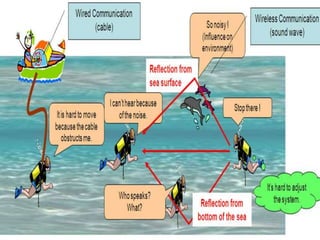
Radio waves propagate under water at extremely low
frequencies (30Hz-300Hz) & require large antennae and
high transmission power.
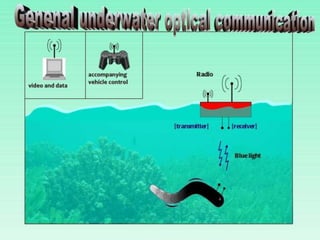
Optical waves do not suffer much attenuation but are
affected by scattering.
Acoustic waves are the single best solution for
communicating Under water.
ABOUT
Underwater Acoustics is the study of propagation of sound
in water & interaction of mechanical waves that constitute
with water & its boundaries.
Typical frequencies associated with Underwater Acoustics
are 10Hz to 1MHz
The propagation of sound in the ocean at frequencies lower
than 10 Hz is not possible.
Frequencies above 1 MHz are rarely used because they are
absorbed very quickly.
Underwater Acoustics is also known as
HYDROACOUSTICS.
PEOPLE WHO THOUGHT IT
IS POSSIBLE
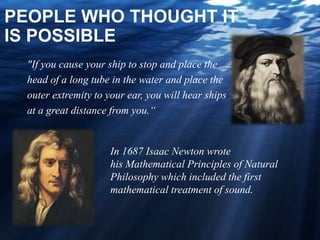
"If you cause your ship to stop and place the
head of a long tube in the water and place the
outer extremity to your ear, you will hear ships
at a great distance from you.“
In 1687 Isaac Newton wrote
his Mathematical Principles of Natural
Philosophy which included the first
mathematical treatment of sound.
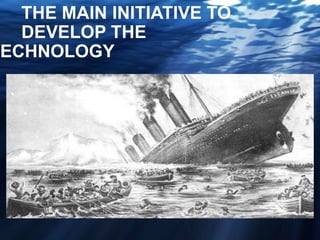
THE MAIN INITIATIVE TO
DEVELOP THE
TECHNOLOGY
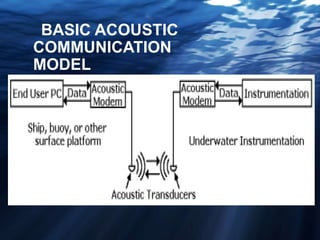
BASIC ACOUSTIC
COMMUNICATION
MODEL
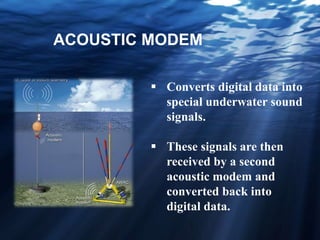
ACOUSTIC MODEM
 Converts digital data into
special underwater sound
signals.
 These signals are then
received by a second
acoustic modem and
converted back into
digital data.
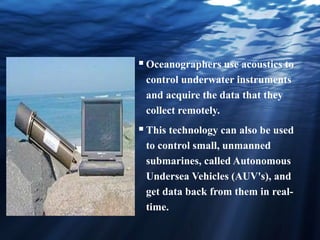
Oceanographers use acoustics to
control underwater instruments
and acquire the data that they
collect remotely.
This technology can also be used
to control small, unmanned
submarines, called Autonomous
Undersea Vehicles (AUV's), and
get data back from them in real-
time.
HYDROPHONE
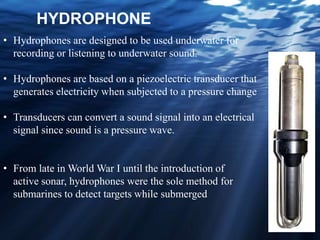
• Hydrophones are designed to be used underwater for
recording or listening to underwater sound.
• Hydrophones are based on a piezoelectric transducer that
generates electricity when subjected to a pressure change
• Transducers can convert a sound signal into an electrical
signal since sound is a pressure wave.
• From late in World War I until the introduction of
active sonar, hydrophones were the sole method for
submarines to detect targets while submerged
PIEZOELECTRIC
TRANSDUCER
• Piezoelectricity means electricity resulting from pressure.
• It is a device that transforms one type of energy to another by taking advantage
of the piezoelectric properties of certain crystals or other materials.
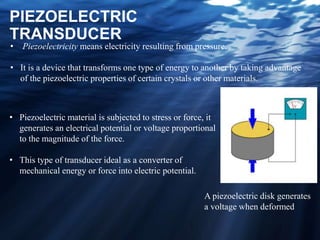
• Piezoelectric material is subjected to stress or force, it
generates an electrical potential or voltage proportional
to the magnitude of the force.
• This type of transducer ideal as a converter of
mechanical energy or force into electric potential.
A piezoelectric disk generates
a voltage when deformed
DIRECTIONAL
HYDROPHONESFocused Transducers
• Uses a single transducer element with a dish or conical-shaped
sound reflector to focus the signals
• Can be produced from a low-cost omnidirectional type
• Must be used while stationary, as the reflector impedes its
movement through water
Array of Hydrophones
• Multiple hydrophones can be arranged in an array
• It will add the signals from the desired direction while subtracting
signals from other directions.
• Hydrophones are arranged in a "line array“, but may be in two- or
three-dimensional arrangements
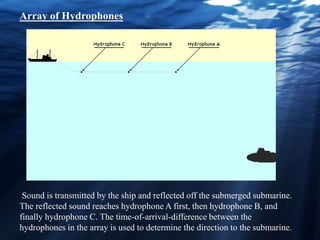
Array of Hydrophones
Sound is transmitted by the ship and reflected off the submerged submarine.
The reflected sound reaches hydrophone A first, then hydrophone B, and
finally hydrophone C. The time-of-arrival-difference between the
hydrophones in the array is used to determine the direction to the submarine.
SOSUS HYDROPHONES
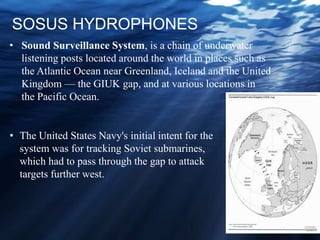
• The United States Navy's initial intent for the
system was for tracking Soviet submarines,
which had to pass through the gap to attack
targets further west.
• Sound Surveillance System, is a chain of underwater
listening posts located around the world in places such as
the Atlantic Ocean near Greenland, Iceland and the United
Kingdom — the GIUK gap, and at various locations in
the Pacific Ocean.
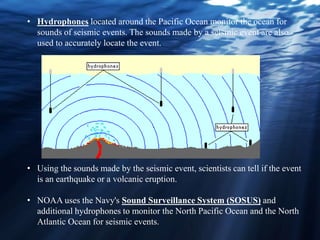
• Using the sounds made by the seismic event, scientists can tell if the event
is an earthquake or a volcanic eruption.
• NOAA uses the Navy's Sound Surveillance System (SOSUS) and
additional hydrophones to monitor the North Pacific Ocean and the North
Atlantic Ocean for seismic events.
• Hydrophones located around the Pacific Ocean monitor the ocean for
sounds of seismic events. The sounds made by a seismic event are also
used to accurately locate the event.
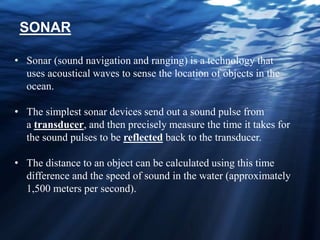
• Sonar (sound navigation and ranging) is a technology that
uses acoustical waves to sense the location of objects in the
ocean.
• The simplest sonar devices send out a sound pulse from
a transducer, and then precisely measure the time it takes for
the sound pulses to be reflected back to the transducer.
• The distance to an object can be calculated using this time
difference and the speed of sound in the water (approximately
1,500 meters per second).
SONAR
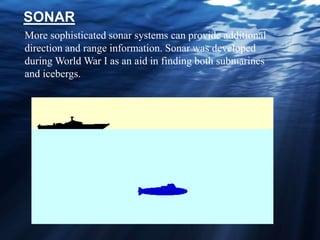
More sophisticated sonar systems can provide additional
direction and range information. Sonar was developed
during World War I as an aid in finding both submarines
and icebergs.
SONAR
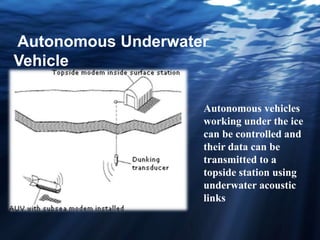
Autonomous vehicles
working under the ice
can be controlled and
their data can be
transmitted to a
topside station using
underwater acoustic
links
Autonomous Underwater
Vehicle
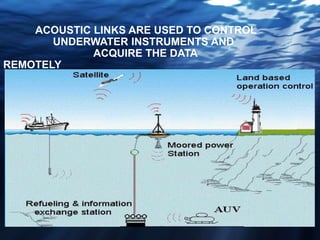
ACOUSTIC LINKS ARE USED TO CONTROL
UNDERWATER INSTRUMENTS AND
ACQUIRE THE DATA
REMOTELY
APPLICATIONS OF AUV’S &
OTHER DEVICES USING
ACOUSTIC SIGNALS
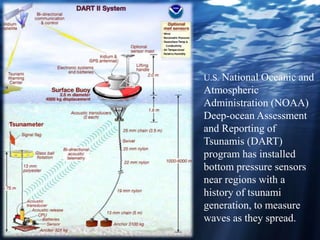
U.S. National Oceanic and
Atmospheric
Administration (NOAA)
Deep-ocean Assessment
and Reporting of
Tsunamis (DART)
program has installed
bottom pressure sensors
near regions with a
history of tsunami
generation, to measure
waves as they spread.
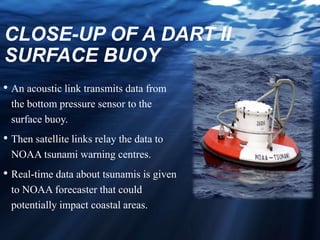
CLOSE-UP OF A DART II
SURFACE BUOY
• An acoustic link transmits data from
the bottom pressure sensor to the
surface buoy.
• Then satellite links relay the data to
NOAA tsunami warning centres.
• Real-time data about tsunamis is given
to NOAA forecaster that could
potentially impact coastal areas.
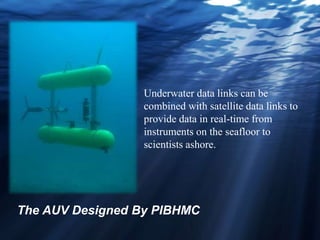
Underwater data links can be
combined with satellite data links to
provide data in real-time from
instruments on the seafloor to
scientists ashore.
The AUV Designed By PIBHMC
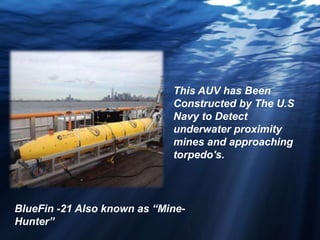
This AUV has Been
Constructed by The U.S
Navy to Detect
underwater proximity
mines and approaching
torpedo's.
BlueFin -21 Also known as “Mine-
Hunter”
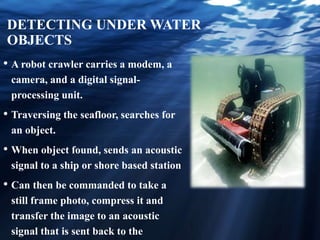
DETECTING UNDER WATER
OBJECTS
• A robot crawler carries a modem, a
camera, and a digital signal-
processing unit.
• Traversing the seafloor, searches for
an object.
• When object found, sends an acoustic
signal to a ship or shore based station
• Can then be commanded to take a
still frame photo, compress it and
transfer the image to an acoustic
signal that is sent back to the
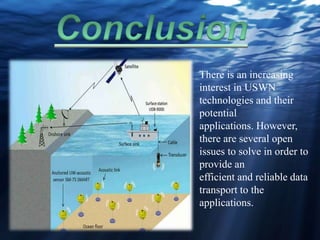
There is an increasing
interest in USWN
technologies and their
potential
applications. However,
there are several open
issues to solve in order to
provide an
efficient and reliable data
transport to the
applications.
Underwater communication

Underwater communication

  • 1.
  • 2.
    INTRODUCTION Technique of sendingand receiving message below water. Most commonly employed using hydrophones. Difficult due to factors like multi-path propagation, time variations of the channel, small available bandwidth and strong signal attenuation. Underwater communication uses acoustic waves instead of electromagnetic waves.
  • 4.
    DEFICIENCY IN CURRENT COMMUNICATION Future oceanenvironment will be increasingly complicated. Radio waves propagate under water at extremely low frequencies (30Hz-300Hz) & require large antennae and high transmission power. Optical waves do not suffer much attenuation but are affected by scattering. Acoustic waves are the single best solution for communicating Under water.
  • 6.
    ABOUT Underwater Acoustics isthe study of propagation of sound in water & interaction of mechanical waves that constitute with water & its boundaries. Typical frequencies associated with Underwater Acoustics are 10Hz to 1MHz The propagation of sound in the ocean at frequencies lower than 10 Hz is not possible. Frequencies above 1 MHz are rarely used because they are absorbed very quickly. Underwater Acoustics is also known as HYDROACOUSTICS.
  • 7.
    PEOPLE WHO THOUGHTIT IS POSSIBLE "If you cause your ship to stop and place the head of a long tube in the water and place the outer extremity to your ear, you will hear ships at a great distance from you.“ In 1687 Isaac Newton wrote his Mathematical Principles of Natural Philosophy which included the first mathematical treatment of sound.
  • 8.
    THE MAIN INITIATIVETO DEVELOP THE TECHNOLOGY
  • 9.
  • 10.
    ACOUSTIC MODEM  Convertsdigital data into special underwater sound signals.  These signals are then received by a second acoustic modem and converted back into digital data.
  • 11.
    Oceanographers use acousticsto control underwater instruments and acquire the data that they collect remotely. This technology can also be used to control small, unmanned submarines, called Autonomous Undersea Vehicles (AUV's), and get data back from them in real- time.
  • 12.
    HYDROPHONE • Hydrophones aredesigned to be used underwater for recording or listening to underwater sound. • Hydrophones are based on a piezoelectric transducer that generates electricity when subjected to a pressure change • Transducers can convert a sound signal into an electrical signal since sound is a pressure wave. • From late in World War I until the introduction of active sonar, hydrophones were the sole method for submarines to detect targets while submerged
  • 13.
    PIEZOELECTRIC TRANSDUCER • Piezoelectricity meanselectricity resulting from pressure. • It is a device that transforms one type of energy to another by taking advantage of the piezoelectric properties of certain crystals or other materials. • Piezoelectric material is subjected to stress or force, it generates an electrical potential or voltage proportional to the magnitude of the force. • This type of transducer ideal as a converter of mechanical energy or force into electric potential. A piezoelectric disk generates a voltage when deformed
  • 14.
    DIRECTIONAL HYDROPHONESFocused Transducers • Usesa single transducer element with a dish or conical-shaped sound reflector to focus the signals • Can be produced from a low-cost omnidirectional type • Must be used while stationary, as the reflector impedes its movement through water Array of Hydrophones • Multiple hydrophones can be arranged in an array • It will add the signals from the desired direction while subtracting signals from other directions. • Hydrophones are arranged in a "line array“, but may be in two- or three-dimensional arrangements
  • 15.
    Array of Hydrophones Soundis transmitted by the ship and reflected off the submerged submarine. The reflected sound reaches hydrophone A first, then hydrophone B, and finally hydrophone C. The time-of-arrival-difference between the hydrophones in the array is used to determine the direction to the submarine.
  • 16.
    SOSUS HYDROPHONES • TheUnited States Navy's initial intent for the system was for tracking Soviet submarines, which had to pass through the gap to attack targets further west. • Sound Surveillance System, is a chain of underwater listening posts located around the world in places such as the Atlantic Ocean near Greenland, Iceland and the United Kingdom — the GIUK gap, and at various locations in the Pacific Ocean.
  • 17.
    • Using thesounds made by the seismic event, scientists can tell if the event is an earthquake or a volcanic eruption. • NOAA uses the Navy's Sound Surveillance System (SOSUS) and additional hydrophones to monitor the North Pacific Ocean and the North Atlantic Ocean for seismic events. • Hydrophones located around the Pacific Ocean monitor the ocean for sounds of seismic events. The sounds made by a seismic event are also used to accurately locate the event.
  • 18.
    • Sonar (soundnavigation and ranging) is a technology that uses acoustical waves to sense the location of objects in the ocean. • The simplest sonar devices send out a sound pulse from a transducer, and then precisely measure the time it takes for the sound pulses to be reflected back to the transducer. • The distance to an object can be calculated using this time difference and the speed of sound in the water (approximately 1,500 meters per second). SONAR
  • 19.
    More sophisticated sonarsystems can provide additional direction and range information. Sonar was developed during World War I as an aid in finding both submarines and icebergs. SONAR
  • 20.
    Autonomous vehicles working underthe ice can be controlled and their data can be transmitted to a topside station using underwater acoustic links Autonomous Underwater Vehicle
  • 21.
    ACOUSTIC LINKS AREUSED TO CONTROL UNDERWATER INSTRUMENTS AND ACQUIRE THE DATA REMOTELY
  • 22.
    APPLICATIONS OF AUV’S& OTHER DEVICES USING ACOUSTIC SIGNALS
  • 23.
    U.S. National Oceanicand Atmospheric Administration (NOAA) Deep-ocean Assessment and Reporting of Tsunamis (DART) program has installed bottom pressure sensors near regions with a history of tsunami generation, to measure waves as they spread.
  • 24.
    CLOSE-UP OF ADART II SURFACE BUOY • An acoustic link transmits data from the bottom pressure sensor to the surface buoy. • Then satellite links relay the data to NOAA tsunami warning centres. • Real-time data about tsunamis is given to NOAA forecaster that could potentially impact coastal areas.
  • 25.
    Underwater data linkscan be combined with satellite data links to provide data in real-time from instruments on the seafloor to scientists ashore. The AUV Designed By PIBHMC
  • 26.
    This AUV hasBeen Constructed by The U.S Navy to Detect underwater proximity mines and approaching torpedo's. BlueFin -21 Also known as “Mine- Hunter”
  • 27.
    DETECTING UNDER WATER OBJECTS •A robot crawler carries a modem, a camera, and a digital signal- processing unit. • Traversing the seafloor, searches for an object. • When object found, sends an acoustic signal to a ship or shore based station • Can then be commanded to take a still frame photo, compress it and transfer the image to an acoustic signal that is sent back to the
  • 28.
    There is anincreasing interest in USWN technologies and their potential applications. However, there are several open issues to solve in order to provide an efficient and reliable data transport to the applications.