RICHA
TRIPATHI
CONTENTS
 Introduction
 History of sonar
 Types of Sonar
 Application
 Limitation
 New innovation of sonar
 How it works
 Conclusion
 Video
introduction
 Sonar,which in itself originally an acronym for sound navigation &
ranging.
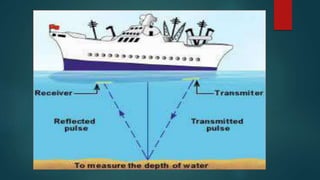
 Sonar is a device that is used to detect underwater objects
using sound waves.
 In this system a sound pulse is generated and sent
underwater through a transmitter.
 Sound waves are reflected by the underwater object which are
received at receiver.
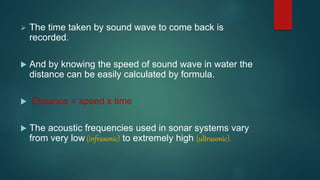
 The time taken by sound wave to come back is
recorded.
 And by knowing the speed of sound wave in water the
distance can be easily calculated by formula.
 Distance = speed x time
 The acoustic frequencies used in sonar systems vary
from very low (infrasonic) to extremely high (ultrasonic).
history
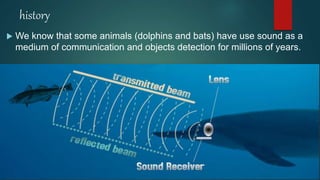
 We know that some animals (dolphins and bats) have use sound as a
medium of communication and objects detection for millions of years.
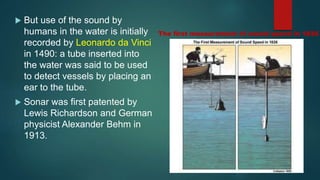
 But use of the sound by
humans in the water is initially
recorded by Leonardo da Vinci
in 1490: a tube inserted into
the water was said to be used
to detect vessels by placing an
ear to the tube.
 Sonar was first patented by
Lewis Richardson and German
physicist Alexander Behm in
1913.
The first measurement of sound speed in 1826
Type of sonar
 ACTIVE SONAR
 PASSIVE SONAR
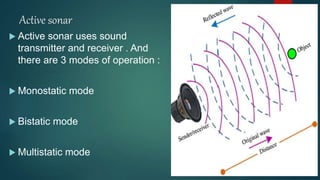
Active sonar
 Active sonar uses sound
transmitter and receiver . And
there are 3 modes of operation :
 Monostatic mode
 Bistatic mode
 Multistatic mode
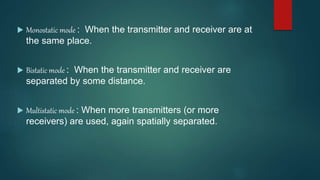
 Monostatic mode : When the transmitter and receiver are at
the same place.
 Bistatic mode : When the transmitter and receiver are
separated by some distance.
 Multistatic mode : When more transmitters (or more
receivers) are used, again spatially separated.
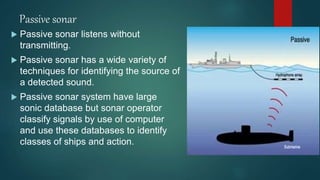
Passive sonar
 Passive sonar listens without
transmitting.
 Passive sonar has a wide variety of
techniques for identifying the source of
a detected sound.
 Passive sonar system have large
sonic database but sonar operator
classify signals by use of computer
and use these databases to identify
classes of ships and action.
Application
 It is used to find the actual depth of the sea.
 Sonar systems are used to find lost ships and
submarines.
 These are used in ocean surveillance systems.
 They are used by navy detect the locations of enemy
submarines.
 They are used for under water security.
Limitation
 It has an adverse effects on marine animals like
dolphins and whales ,that also use sound waves for
their navigation.
 It leads whales to painful and often fatal
decompression sickness.
 The sonar systems generate lot of noise.
 High intensity sonar sounds can create a small
temporary shift in the hearing threshold of some fish.
NEW INnovation OF SONAR
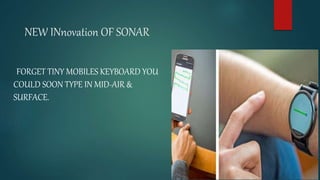
FORGET TINY MOBILES KEYBOARD YOU
COULD SOON TYPE IN MID-AIR &
SURFACE.
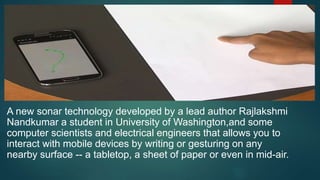
A new sonar technology developed by a lead author Rajlakshmi
Nandkumar a student in University of Washington,and some
computer scientists and electrical engineers that allows you to
interact with mobile devices by writing or gesturing on any
nearby surface -- a tabletop, a sheet of paper or even in mid-air.
Finger io
 A new sonar technology called Finger IO will make it easier to interact
with screens on smartwatches and smartphones by simply writing or
gesturing on any nearby surface. It’s is an active sonar system using the
device’s own microphones and speakers to track fine-grained finger
movements (to within 8mm).
 Two microphones are needed to track finger motion in two dimensions,
and three for three dimensions. So this system may work (when
available commercially) with some smartphones (it was tested with a
Samsung Galaxy S4).
 It also track subtle finger motion around the device,even when the phone
is inside a pocket.
HOW IT WORKS
b
tthttttt
34589hgcc
Nnnhgirw543ihbAAA
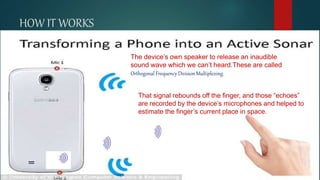
The device’s own speaker to release an inaudible
sound wave which we can’t heard.These are called
Orthogonal Frequency DivisionMultiplexing.
That signal rebounds off the finger, and those “echoes”
are recorded by the device’s microphones and helped to
estimate the finger’s current place in space.
WORKING
 The minimum difference between the drawings and
the FingerIO tracings was 0.8 centimetres for the
smartphone and 1.2 centimetres for the smartwatch.
 The scientists developed a FingerIO prototype app
for smartphone and a smartwatch equipped with two
microphones, which are required to track finger
motion in two dimensions
conclusion
 It’s very easy way of typing and after sometime we
use this technique.
 Finger IO makes it easier than ever to interact with
devices that have small screens.
 Finger IO does not require any special finger
instrumentation, sensors or hardware.
Sonar tech
video
Sonar technology ppt

Sonar technology ppt

  • 1.
  • 2.
    CONTENTS  Introduction  Historyof sonar  Types of Sonar  Application  Limitation  New innovation of sonar  How it works  Conclusion  Video
  • 3.
    introduction  Sonar,which initself originally an acronym for sound navigation & ranging.  Sonar is a device that is used to detect underwater objects using sound waves.  In this system a sound pulse is generated and sent underwater through a transmitter.  Sound waves are reflected by the underwater object which are received at receiver.
  • 4.
     The timetaken by sound wave to come back is recorded.  And by knowing the speed of sound wave in water the distance can be easily calculated by formula.  Distance = speed x time  The acoustic frequencies used in sonar systems vary from very low (infrasonic) to extremely high (ultrasonic).
  • 6.
    history  We knowthat some animals (dolphins and bats) have use sound as a medium of communication and objects detection for millions of years.
  • 7.
     But useof the sound by humans in the water is initially recorded by Leonardo da Vinci in 1490: a tube inserted into the water was said to be used to detect vessels by placing an ear to the tube.  Sonar was first patented by Lewis Richardson and German physicist Alexander Behm in 1913. The first measurement of sound speed in 1826
  • 8.
    Type of sonar ACTIVE SONAR  PASSIVE SONAR
  • 9.
    Active sonar  Activesonar uses sound transmitter and receiver . And there are 3 modes of operation :  Monostatic mode  Bistatic mode  Multistatic mode
  • 10.
     Monostatic mode: When the transmitter and receiver are at the same place.  Bistatic mode : When the transmitter and receiver are separated by some distance.  Multistatic mode : When more transmitters (or more receivers) are used, again spatially separated.
  • 11.
    Passive sonar  Passivesonar listens without transmitting.  Passive sonar has a wide variety of techniques for identifying the source of a detected sound.  Passive sonar system have large sonic database but sonar operator classify signals by use of computer and use these databases to identify classes of ships and action.
  • 12.
    Application  It isused to find the actual depth of the sea.  Sonar systems are used to find lost ships and submarines.  These are used in ocean surveillance systems.  They are used by navy detect the locations of enemy submarines.  They are used for under water security.
  • 13.
    Limitation  It hasan adverse effects on marine animals like dolphins and whales ,that also use sound waves for their navigation.  It leads whales to painful and often fatal decompression sickness.  The sonar systems generate lot of noise.  High intensity sonar sounds can create a small temporary shift in the hearing threshold of some fish.
  • 15.
    NEW INnovation OFSONAR FORGET TINY MOBILES KEYBOARD YOU COULD SOON TYPE IN MID-AIR & SURFACE.
  • 16.
    A new sonartechnology developed by a lead author Rajlakshmi Nandkumar a student in University of Washington,and some computer scientists and electrical engineers that allows you to interact with mobile devices by writing or gesturing on any nearby surface -- a tabletop, a sheet of paper or even in mid-air.
  • 17.
    Finger io  Anew sonar technology called Finger IO will make it easier to interact with screens on smartwatches and smartphones by simply writing or gesturing on any nearby surface. It’s is an active sonar system using the device’s own microphones and speakers to track fine-grained finger movements (to within 8mm).  Two microphones are needed to track finger motion in two dimensions, and three for three dimensions. So this system may work (when available commercially) with some smartphones (it was tested with a Samsung Galaxy S4).  It also track subtle finger motion around the device,even when the phone is inside a pocket.
  • 18.
    HOW IT WORKS b tthttttt 34589hgcc Nnnhgirw543ihbAAA Thedevice’s own speaker to release an inaudible sound wave which we can’t heard.These are called Orthogonal Frequency DivisionMultiplexing. That signal rebounds off the finger, and those “echoes” are recorded by the device’s microphones and helped to estimate the finger’s current place in space.
  • 19.
    WORKING  The minimumdifference between the drawings and the FingerIO tracings was 0.8 centimetres for the smartphone and 1.2 centimetres for the smartwatch.  The scientists developed a FingerIO prototype app for smartphone and a smartwatch equipped with two microphones, which are required to track finger motion in two dimensions
  • 20.
    conclusion  It’s veryeasy way of typing and after sometime we use this technique.  Finger IO makes it easier than ever to interact with devices that have small screens.  Finger IO does not require any special finger instrumentation, sensors or hardware.
  • 21.