A
SEMINAR PRESENTATION
ON
“tsunami

warning system”

2013-2014
SUBMITTED TO:

SUBMITTED BY:

Mr. Amit Kumar Prajapati
Mr. Rajveer Marwal
Seminar Coordinators (Sec B)

Vibhor Rathi
4th Year, 8th Sem.
EC/10/148

DEPARTMENT OF ELECTRONICS & COMMUNICATION ENGINEERING
POORNIMA COLLEGE OF ENGINEERING, JAIPUR
1
CONTENTS
 Tsunami
 Tsunami Warning System
 Detecting Tsunami
 Seismometers
 Tidal Gauge
 DART Buoys
 Digiquartz Broadband Depth Sensor
 Acoustic Transducer
 Acoustic Link
 DART I & II System
 Advantages & Disadvantages
 Future Scope

2
TSUNAMI
It is a series of wave with long wavelength and long wave
period.
Apart from seismic activity, there are many other factors
responsible for Tsunami.
These gigantic waves are probably one of the most
powerful and destructive forces of nature.

3
TSUNAMI WARNING SYSTEM
TWS is a system which detects tsunami and issue a
warning to prevent loss of life and property.
This system consist of two main parts:

TWS

Network of
sensors

Communication
Infrastructure
4
WORKING OF TWS
Network of seismic monitoring station at sea floor
detects presence of earthquake.
Seismic monitoring station determines location and
depth of earthquake having potential to cause tsunami.
Any resulting tsunami are verified by sea level
monitoring station such as DART buoys, tidal gauge.

5
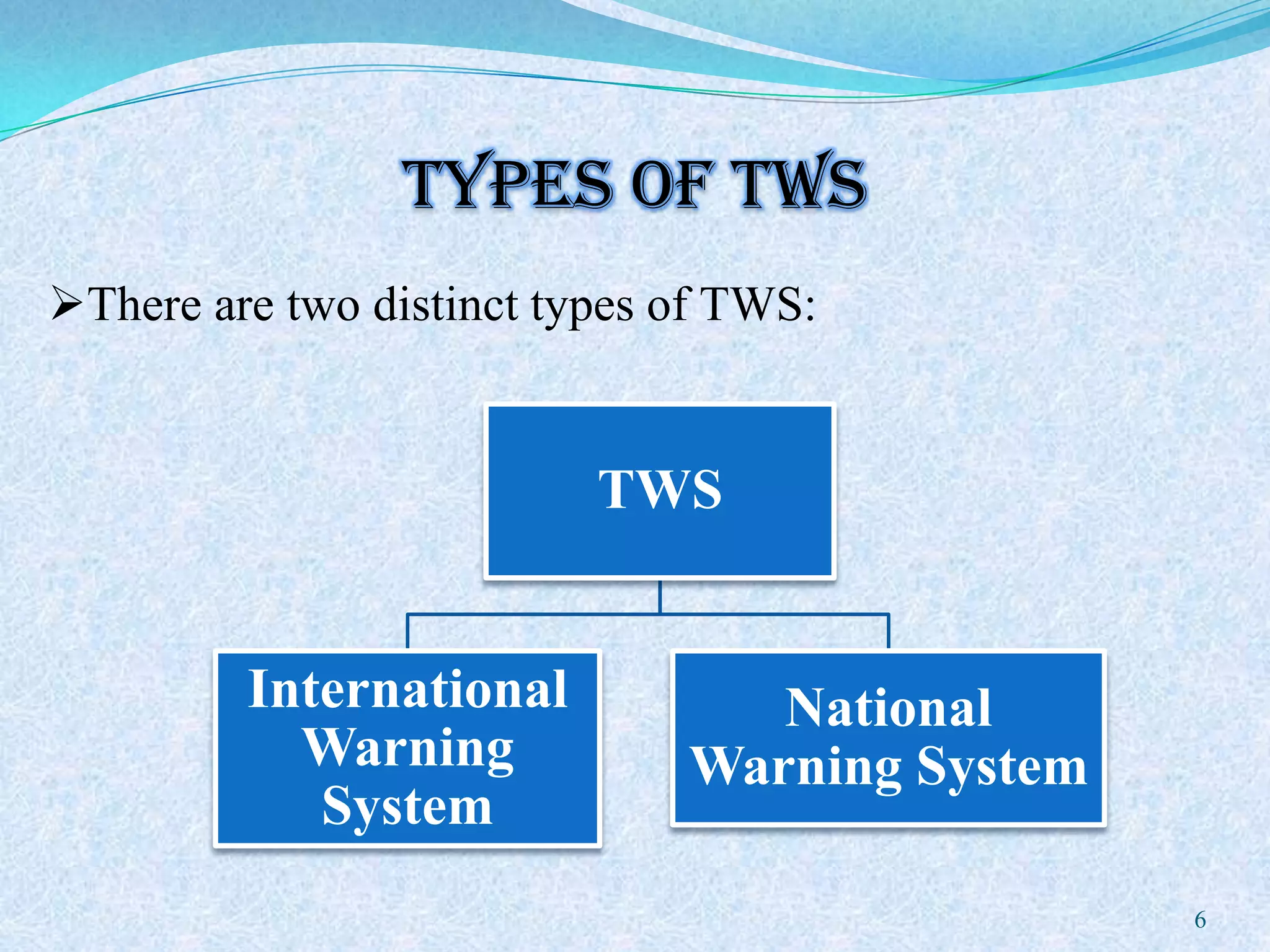
TYPES OF TWS
There are two distinct types of TWS:

TWS

International
Warning
System

National
Warning System
6
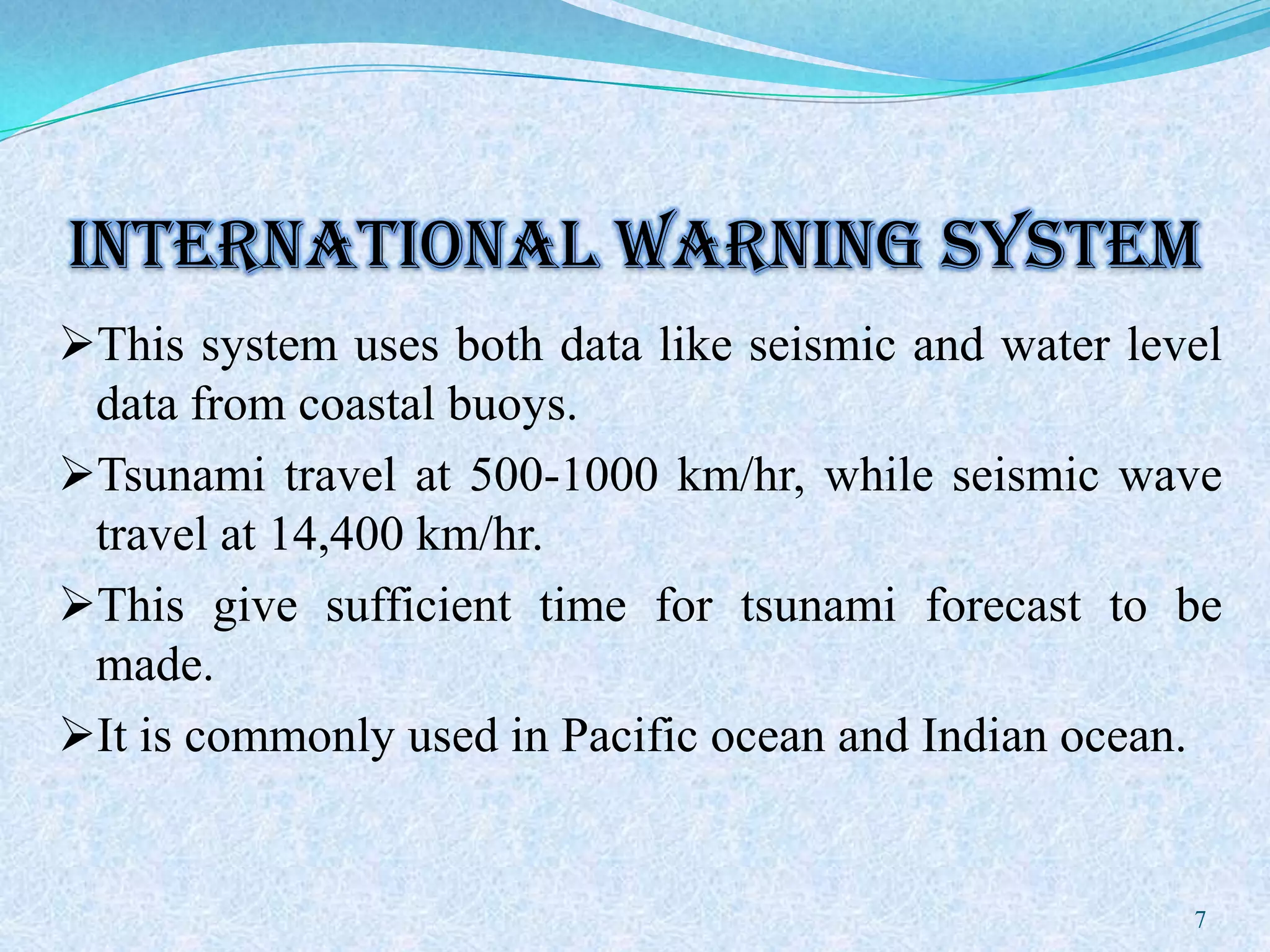
INTERNATIONAL WARNING SYSTEM
This system uses both data like seismic and water level
data from coastal buoys.
Tsunami travel at 500-1000 km/hr, while seismic wave
travel at 14,400 km/hr.
This give sufficient time for tsunami forecast to be
made.
It is commonly used in Pacific ocean and Indian ocean.

7
NATIONAL WARNING SYSTEM
This system use seismic data about nearby recent
earthquake.
This system is unable to predict which earthquake will
produce significant tsunami.

NWS
Tsunami
Watches

Tsunami
Warning
8
TSUNAMI WATCH
Watch is issued based on seismic information.
Watch is issued without confirmation that destructive
tsunami is underway.
Tsunami watch is issued to officials which may later
impact the watch area.

9
TSUNAMI WARNING
Tsunami warning is issued when potential tsunami is
expected.
It alert officials to take action for entire tsunami hazard
zone.
Warning is issued automatically if an earthquake
powerful enough to create tsunami occur nearby.

10
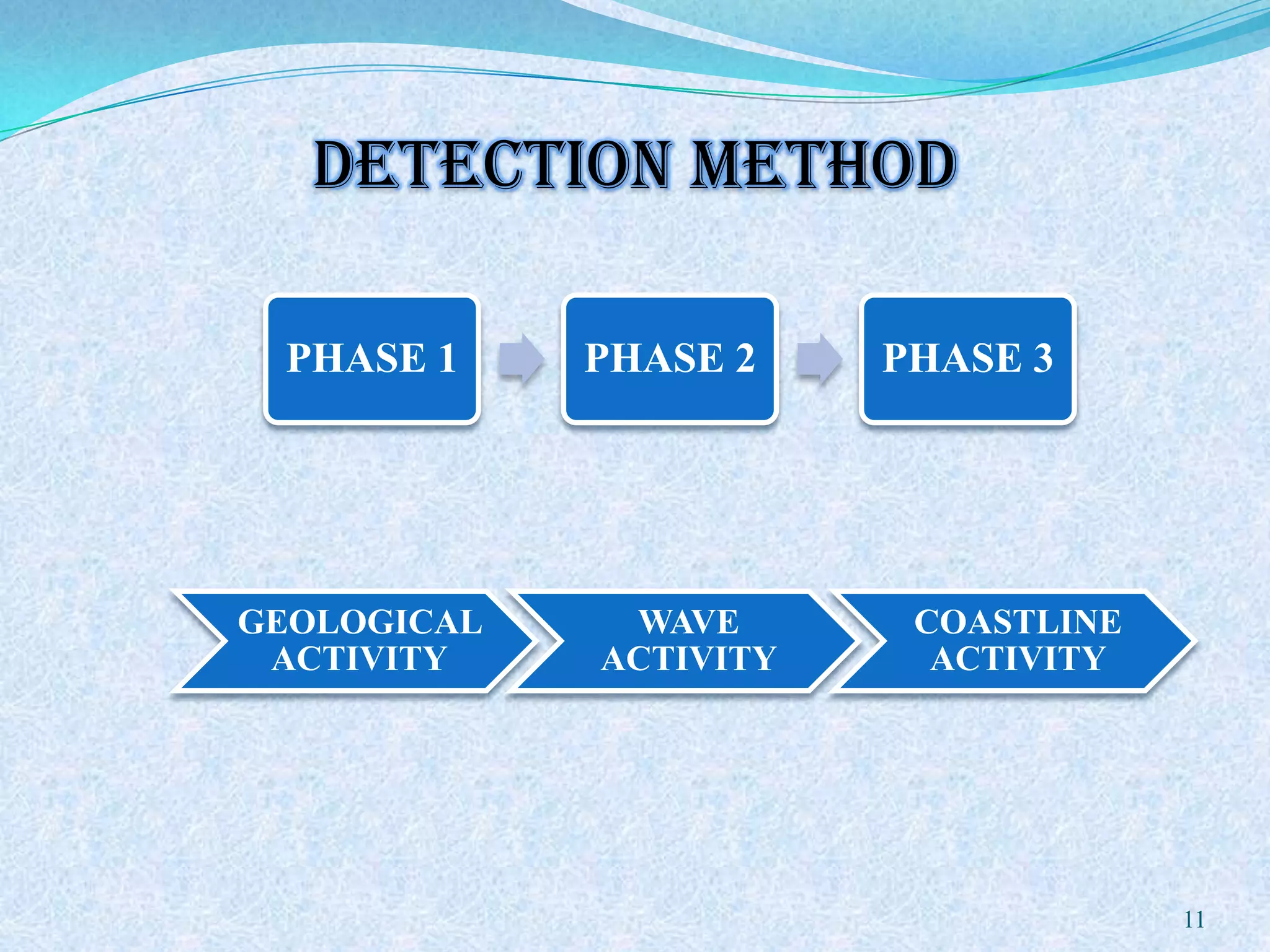
DETECTION METHOD
PHASE 1

GEOLOGICAL
ACTIVITY

PHASE 2

WAVE
ACTIVITY

PHASE 3

COASTLINE
ACTIVITY

11
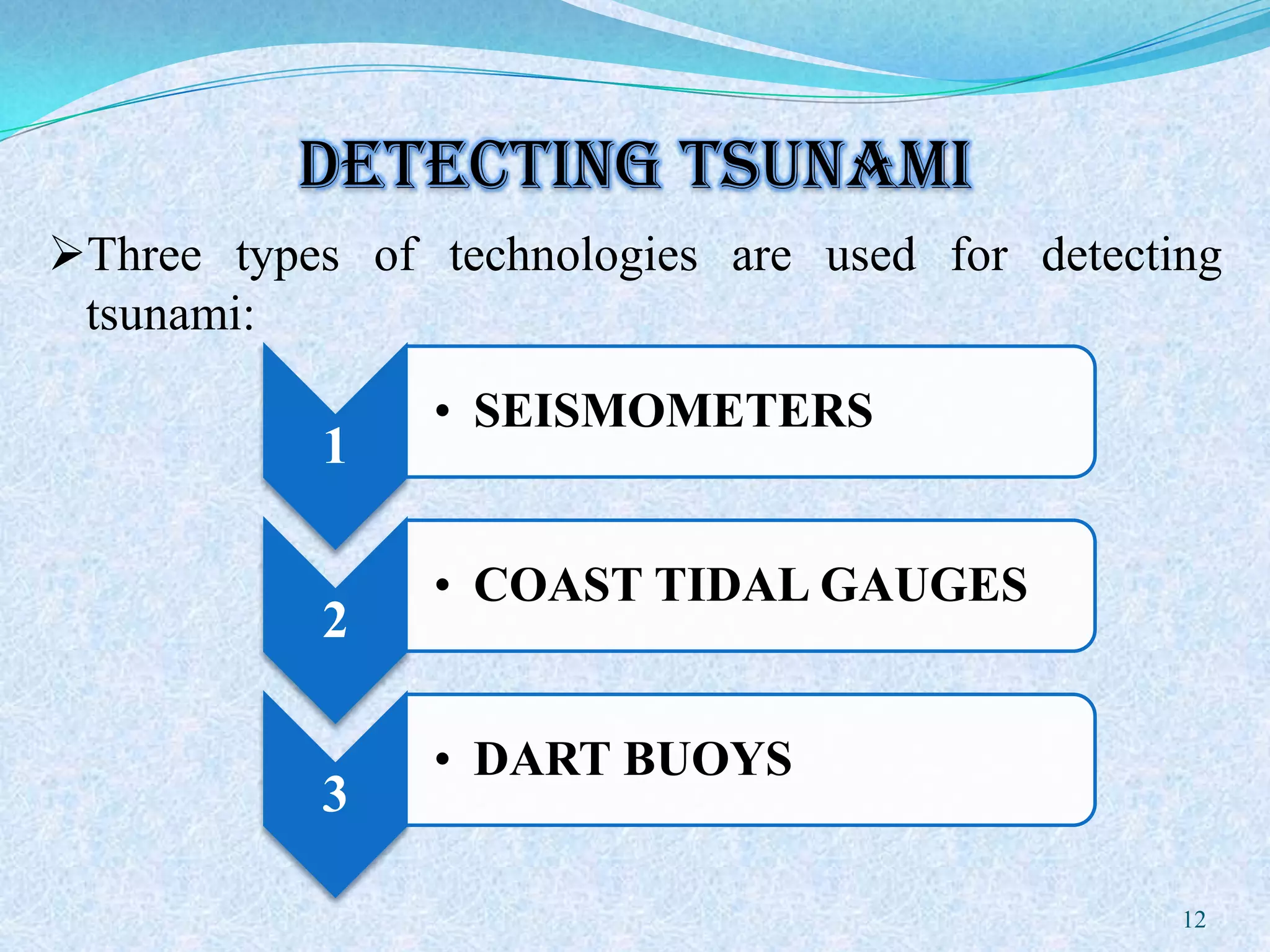
DETECTING TSUNAMI
Three types of technologies are used for detecting
tsunami:

1

2
3

• SEISMOMETERS
• COAST TIDAL GAUGES

• DART BUOYS

12
SEISMOMETERS
Information available about source of tsunami is based
on seismic information.
Earthquake are measured based on its magnitude
recorded by its seismograph.

13
DRAWBACK OF SEISMOMETERS
Data are indirect and interpretation is difficult.
It involve poor understanding of seismic coupling.

14
TIDAL GAUGE
Measure sea level near coastal area.
Continuously monitors and confirms tsunami waves
following an earthquake.
If tsunami occurred other than earthquake we depend
solely on data of tidal gauge.

15
DRAWBACK OF TIDAL GAUGE
May not survive impact of tsunami.
Cannot provide data that are especially important to
operational hazard assessment directly.

16
DART BUOYS
Report to tsunami warning centre, when tsunami occur.
Information are processed to produce a new and more
refined estimate of tsunami source.
Result is an accurate forecast of tsunami.

17
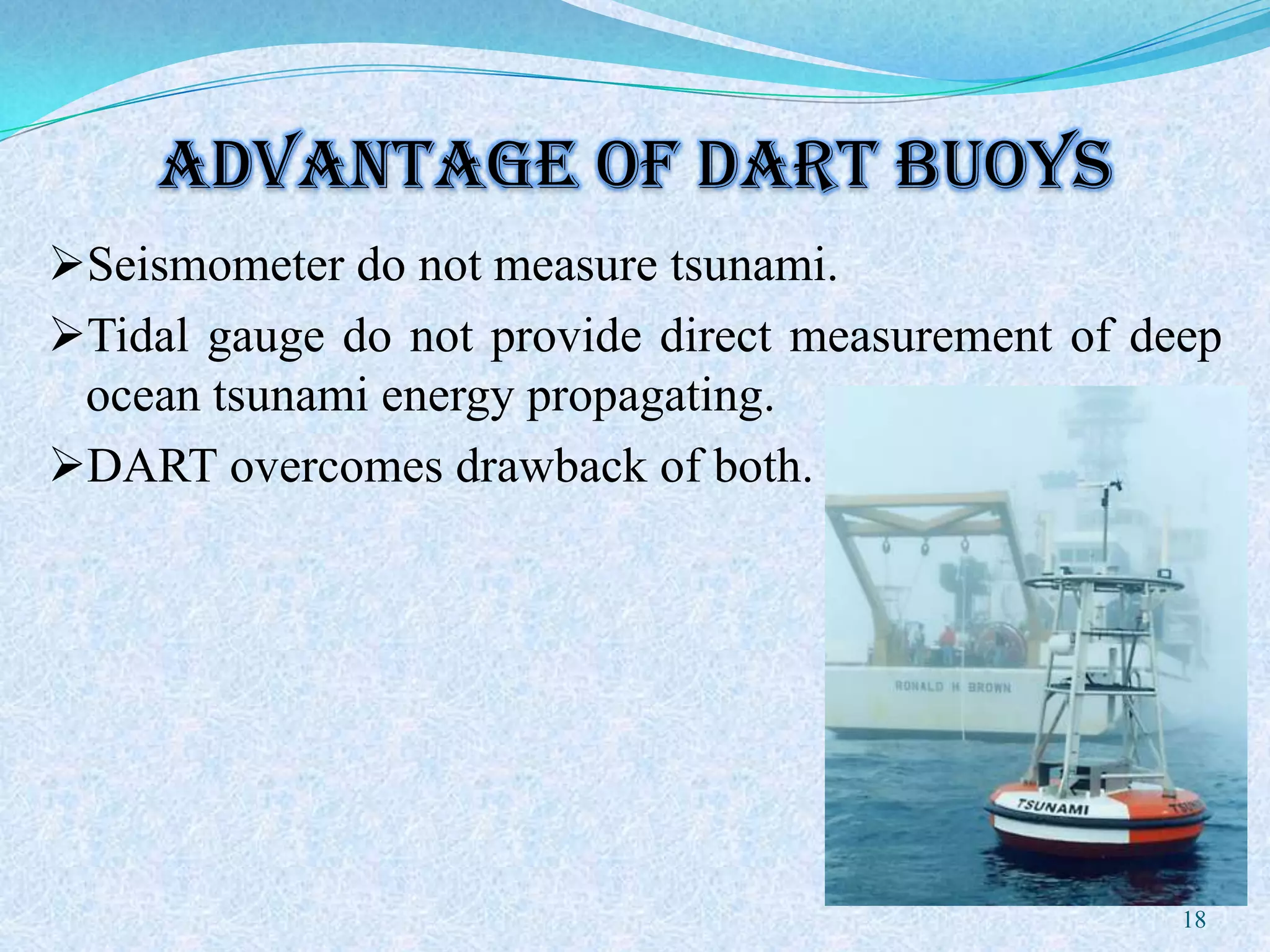
ADVANTAGE OF DART BUOYS
Seismometer do not measure tsunami.
Tidal gauge do not provide direct measurement of deep
ocean tsunami energy propagating.
DART overcomes drawback of both.

18
WORKING OF DART BUOYS
DART BUOY consist of two main component:
• Bottom Pressure Recorder (BPR)
• Surface Buoy
BPR consisting of a modem to transmit data to surface
buoy.
Surface buoy transmit data to warning centre via satellite
communication.

19
 BOTTOM PRESSURE RECORDER:
Digiquartz Broadband depth Sensor is the main sensing
element.
This sensor continuously monitors pressure and if
pressure exceeds threshold value, it automatically report
to warning centre.
 SURFACE BUOYS:
Surface buoys makes satellite communication to
warning centers that evaluate the threat and issue a
tsunami warning.
20
DIAGRAM OF DART BUOY

21
DIGIQUARTZ BROADBAND DEPTH
SENSOR
This depth sensor provide accurate & stable data.
Superior performance of digiquartz instruments is
achieved through use of quartz crystal.
Pressure transducer employs bellows tube as pressure to
load generators.
Change in frequency of quartz crystal oscillator is a
measure of the applied pressure.

22
ACOUSTIC TRANSDUCER
A electrical device that converts sound wave into
electrical energy.
Hydrophone is used in this case.
When electrical plates are exposed to sound vibration
electrical energy is produced.
Electrical energy is sent to amplifier and then to final
destination.

23
ACOUSTIC LINK
Acoustic communication is a technique of sending and
receiving signals under water.
It is done by help of acoustic modem.
Modem operates at frequency of 10Hz – 1MHz.
It provides an accurate and efficient method to send and
receive data underwater.

24
NOAA AND DART STATIONS
NOAA
(NATIONAL OCEANIC & ATMOSPHERIC ADMINISTRATION)

• Responsible for providing tsunami warning to the
nation.
DART
(DEEP OCEAN ASSESSMENT & REPORTING OF TSUNAMI)

• Station that detects tsunami.

25
MODES OF OPERATION
DART buoy has two modes of operation:

MODES

STANDARD
MODE

EVENT
MODE

26
 STANDARD MODE:
System generally operates in standard mode.
DART transmits data every six hours with recording
period of 15 minutes.
 EVENT MODE:
When tsunami wave occur standard mode trigger to
event mode.
Transmit data every15 minutes at an average of 1 minute
for three hours.

27
DIAGRAM SHOWING TSUNAMI WAVE GENERATION
28
SERIES OF DART SYSTEM
There are two series of DART buoy system:

DART I
BUOY

DART II
BUOY

SERIES

29
DART I SYSTEM
One way communication ability.
Relied solely on software’s ability to detect a tsunami
and trigger to event mode.
To avoid false alarm, a threshold value is set such that
tsunami with low amplitude could fail to trigger the
station.

30
DART II SYSTEM
It is a two way communication
Measure seal level change of less than a millimeter in
the deep ocean.
Two way communication allows for trouble shooting of
the system.
System can be switched to event mode by concerned
authority for research purpose.

31
ADVANTAGES
Deep water pressure produce low false reading.
Multiple sensor can detect wave propagation.
Good advance warning system.

32
DISADVANTAGES
Expensive equipments.
High maintenance cost.
Require multiple communication link:
•
•
•
•
•

SONAR.
Satellite Uplink.
Satellite Downlink.
Notification to authorities.
Authorities notifies coastal dwellers.

33
FUTURE SCOPE
Use of GPS to detect tsunami.
Developed by NASA.
GPS detects ground motion preceding tsunami.
It estimate tsunami destructive potential within minutes.
Estimates energy that undersea earthquake transfer to
ocean.
With help of these data, ocean floor displacement
caused by earthquake can be inferred.

34
REFERENCES
http://en.wikipedia.org/wiki/Tsunami_warning_system
http://seminarprojects.net/t-tsunami-warning-system
http://www.authorstream.com/Presentation/aSGuest1322
68-1389817-ppt-for-seminar-tsunami-alarm
http://www.tsunamiterror.info/future_proposed.html

35
QUERIES ? ? ?

36
THANK YOU

37

Tsunami warning system

  • 1.
    A SEMINAR PRESENTATION ON “tsunami warning system” 2013-2014 SUBMITTEDTO: SUBMITTED BY: Mr. Amit Kumar Prajapati Mr. Rajveer Marwal Seminar Coordinators (Sec B) Vibhor Rathi 4th Year, 8th Sem. EC/10/148 DEPARTMENT OF ELECTRONICS & COMMUNICATION ENGINEERING POORNIMA COLLEGE OF ENGINEERING, JAIPUR 1
  • 2.
    CONTENTS  Tsunami  TsunamiWarning System  Detecting Tsunami  Seismometers  Tidal Gauge  DART Buoys  Digiquartz Broadband Depth Sensor  Acoustic Transducer  Acoustic Link  DART I & II System  Advantages & Disadvantages  Future Scope 2
  • 3.
    TSUNAMI It is aseries of wave with long wavelength and long wave period. Apart from seismic activity, there are many other factors responsible for Tsunami. These gigantic waves are probably one of the most powerful and destructive forces of nature. 3
  • 4.
    TSUNAMI WARNING SYSTEM TWSis a system which detects tsunami and issue a warning to prevent loss of life and property. This system consist of two main parts: TWS Network of sensors Communication Infrastructure 4
  • 5.
    WORKING OF TWS Networkof seismic monitoring station at sea floor detects presence of earthquake. Seismic monitoring station determines location and depth of earthquake having potential to cause tsunami. Any resulting tsunami are verified by sea level monitoring station such as DART buoys, tidal gauge. 5
  • 6.
    TYPES OF TWS Thereare two distinct types of TWS: TWS International Warning System National Warning System 6
  • 7.
    INTERNATIONAL WARNING SYSTEM Thissystem uses both data like seismic and water level data from coastal buoys. Tsunami travel at 500-1000 km/hr, while seismic wave travel at 14,400 km/hr. This give sufficient time for tsunami forecast to be made. It is commonly used in Pacific ocean and Indian ocean. 7
  • 8.
    NATIONAL WARNING SYSTEM Thissystem use seismic data about nearby recent earthquake. This system is unable to predict which earthquake will produce significant tsunami. NWS Tsunami Watches Tsunami Warning 8
  • 9.
    TSUNAMI WATCH Watch isissued based on seismic information. Watch is issued without confirmation that destructive tsunami is underway. Tsunami watch is issued to officials which may later impact the watch area. 9
  • 10.
    TSUNAMI WARNING Tsunami warningis issued when potential tsunami is expected. It alert officials to take action for entire tsunami hazard zone. Warning is issued automatically if an earthquake powerful enough to create tsunami occur nearby. 10
  • 11.
    DETECTION METHOD PHASE 1 GEOLOGICAL ACTIVITY PHASE2 WAVE ACTIVITY PHASE 3 COASTLINE ACTIVITY 11
  • 12.
    DETECTING TSUNAMI Three typesof technologies are used for detecting tsunami: 1 2 3 • SEISMOMETERS • COAST TIDAL GAUGES • DART BUOYS 12
  • 13.
    SEISMOMETERS Information available aboutsource of tsunami is based on seismic information. Earthquake are measured based on its magnitude recorded by its seismograph. 13
  • 14.
    DRAWBACK OF SEISMOMETERS Dataare indirect and interpretation is difficult. It involve poor understanding of seismic coupling. 14
  • 15.
    TIDAL GAUGE Measure sealevel near coastal area. Continuously monitors and confirms tsunami waves following an earthquake. If tsunami occurred other than earthquake we depend solely on data of tidal gauge. 15
  • 16.
    DRAWBACK OF TIDALGAUGE May not survive impact of tsunami. Cannot provide data that are especially important to operational hazard assessment directly. 16
  • 17.
    DART BUOYS Report totsunami warning centre, when tsunami occur. Information are processed to produce a new and more refined estimate of tsunami source. Result is an accurate forecast of tsunami. 17
  • 18.
    ADVANTAGE OF DARTBUOYS Seismometer do not measure tsunami. Tidal gauge do not provide direct measurement of deep ocean tsunami energy propagating. DART overcomes drawback of both. 18
  • 19.
    WORKING OF DARTBUOYS DART BUOY consist of two main component: • Bottom Pressure Recorder (BPR) • Surface Buoy BPR consisting of a modem to transmit data to surface buoy. Surface buoy transmit data to warning centre via satellite communication. 19
  • 20.
     BOTTOM PRESSURERECORDER: Digiquartz Broadband depth Sensor is the main sensing element. This sensor continuously monitors pressure and if pressure exceeds threshold value, it automatically report to warning centre.  SURFACE BUOYS: Surface buoys makes satellite communication to warning centers that evaluate the threat and issue a tsunami warning. 20
  • 21.
  • 22.
    DIGIQUARTZ BROADBAND DEPTH SENSOR Thisdepth sensor provide accurate & stable data. Superior performance of digiquartz instruments is achieved through use of quartz crystal. Pressure transducer employs bellows tube as pressure to load generators. Change in frequency of quartz crystal oscillator is a measure of the applied pressure. 22
  • 23.
    ACOUSTIC TRANSDUCER A electricaldevice that converts sound wave into electrical energy. Hydrophone is used in this case. When electrical plates are exposed to sound vibration electrical energy is produced. Electrical energy is sent to amplifier and then to final destination. 23
  • 24.
    ACOUSTIC LINK Acoustic communicationis a technique of sending and receiving signals under water. It is done by help of acoustic modem. Modem operates at frequency of 10Hz – 1MHz. It provides an accurate and efficient method to send and receive data underwater. 24
  • 25.
    NOAA AND DARTSTATIONS NOAA (NATIONAL OCEANIC & ATMOSPHERIC ADMINISTRATION) • Responsible for providing tsunami warning to the nation. DART (DEEP OCEAN ASSESSMENT & REPORTING OF TSUNAMI) • Station that detects tsunami. 25
  • 26.
    MODES OF OPERATION DARTbuoy has two modes of operation: MODES STANDARD MODE EVENT MODE 26
  • 27.
     STANDARD MODE: Systemgenerally operates in standard mode. DART transmits data every six hours with recording period of 15 minutes.  EVENT MODE: When tsunami wave occur standard mode trigger to event mode. Transmit data every15 minutes at an average of 1 minute for three hours. 27
  • 28.
    DIAGRAM SHOWING TSUNAMIWAVE GENERATION 28
  • 29.
    SERIES OF DARTSYSTEM There are two series of DART buoy system: DART I BUOY DART II BUOY SERIES 29
  • 30.
    DART I SYSTEM Oneway communication ability. Relied solely on software’s ability to detect a tsunami and trigger to event mode. To avoid false alarm, a threshold value is set such that tsunami with low amplitude could fail to trigger the station. 30
  • 31.
    DART II SYSTEM Itis a two way communication Measure seal level change of less than a millimeter in the deep ocean. Two way communication allows for trouble shooting of the system. System can be switched to event mode by concerned authority for research purpose. 31
  • 32.
    ADVANTAGES Deep water pressureproduce low false reading. Multiple sensor can detect wave propagation. Good advance warning system. 32
  • 33.
    DISADVANTAGES Expensive equipments. High maintenancecost. Require multiple communication link: • • • • • SONAR. Satellite Uplink. Satellite Downlink. Notification to authorities. Authorities notifies coastal dwellers. 33
  • 34.
    FUTURE SCOPE Use ofGPS to detect tsunami. Developed by NASA. GPS detects ground motion preceding tsunami. It estimate tsunami destructive potential within minutes. Estimates energy that undersea earthquake transfer to ocean. With help of these data, ocean floor displacement caused by earthquake can be inferred. 34
  • 35.
  • 36.
  • 37.