The Unit Circle
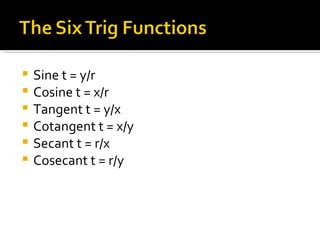
Sine t = y/r Cosine t = x/r Tangent t = y/x Cotangent t = x/y Secant t = r/x Cosecant t = r/y
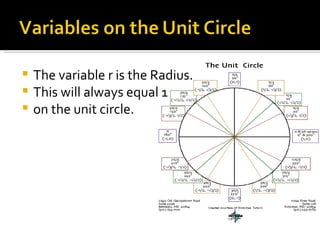
The variable r is the Radius.  This will always equal 1  on the unit circle.
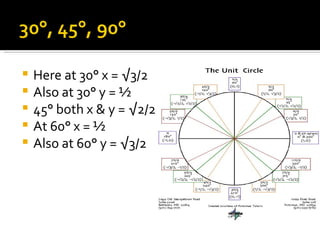
Here at 30° x = √3/2 Also at 30° y = ½ 45° both x & y = √2/2 At 60° x = ½ Also at 60° y = √3/2
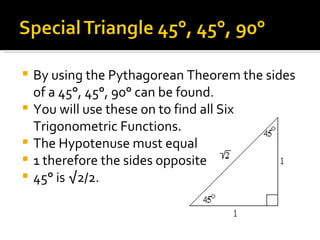
By using the Pythagorean Theorem the sides of a 45°, 45°, 90° can be found. You will use these on to find all Six Trigonometric Functions. The Hypotenuse must equal 1 therefore the sides opposite 45° is √2/2.
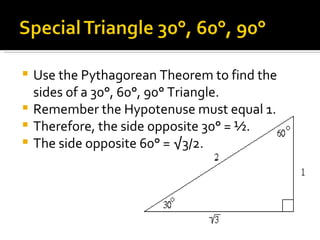
Use the Pythagorean Theorem to find the sides of a 30°, 60°, 90° Triangle. Remember the Hypotenuse must equal 1. Therefore, the side opposite 30° = ½. The side opposite 60° = √3/2.
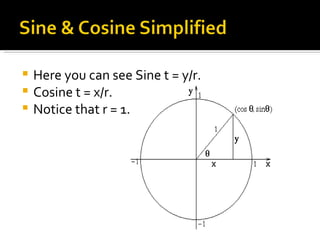
Here you can see Sine t = y/r. Cosine t = x/r. Notice that r = 1.
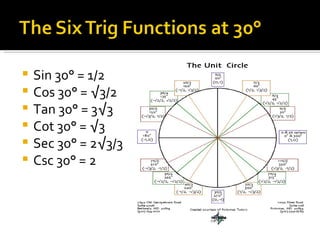
Sin 30° = 1/2  Cos 30° = √3/2 Tan 30°   = 3√3 Cot 30° = √3 Sec 30° = 2√3/3 Csc 30° = 2
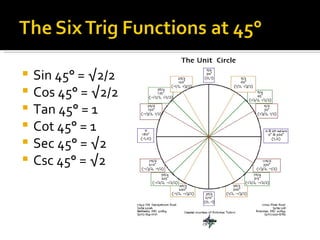
Sin 45° = √2/2 Cos 45° = √2/2 Tan 45° = 1 Cot 45° = 1 Sec 45° = √2 Csc 45° = √2
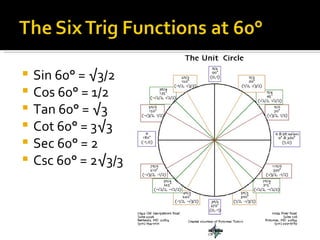
Sin 60° = √3/2 Cos 60° = 1/2 Tan 60° = √3 Cot 60° = 3√3 Sec 60° = 2 Csc 60° = 2√3/3
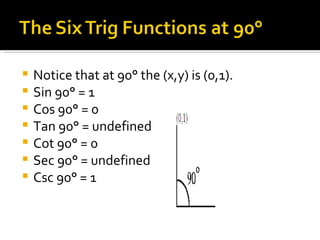
Notice that at 90° the (x,y) is (0,1). Sin 90° = 1 Cos 90° = 0 Tan 90° = undefined Cot 90° = 0 Sec 90° = undefined Csc 90° = 1
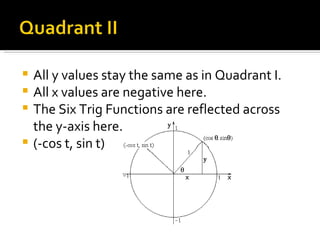
All y values stay the same as in Quadrant I. All x values are negative here.  The Six Trig Functions are reflected across the y-axis here. (-cos t, sin t)
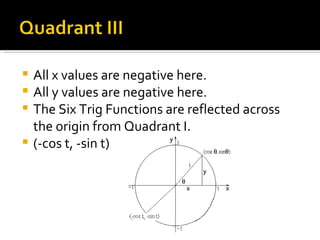
All x values are negative here. All y values are negative here.  The Six Trig Functions are reflected across the origin from Quadrant I. (-cos t, -sin t)
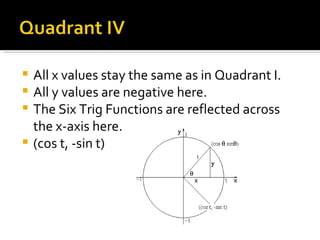
All x values stay the same as in Quadrant I. All y values are negative here.  The Six Trig Functions are reflected across the x-axis here. (cos t, -sin t)
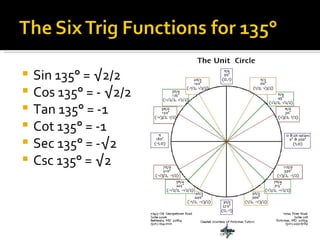
Sin 135° = √2/2 Cos 135° = - √2/2 Tan 135° = -1 Cot 135° = -1  Sec 135° = -√2 Csc 135° = √2
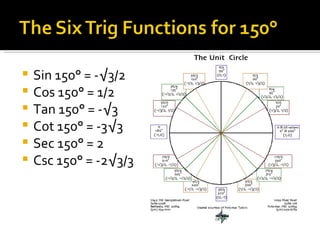
Sin 150° = -√3/2 Cos 150° = 1/2 Tan 150° = -√3 Cot 150° = -3√3 Sec 150° = 2 Csc 150° = -2√3/3
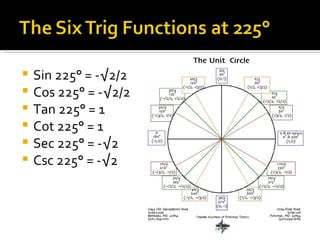
Sin 225° = -√2/2 Cos 225° = -√2/2 Tan 225° = 1 Cot 225° = 1 Sec 225° = -√2 Csc 225° = -√2
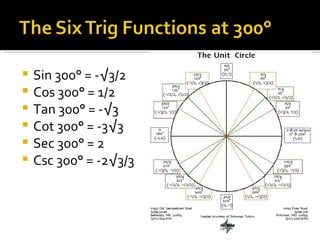
Sin 300° = -√3/2 Cos 300° = 1/2 Tan 300° = -√3 Cot 300° = -3√3 Sec 300° = 2 Csc 300° = -2√3/3
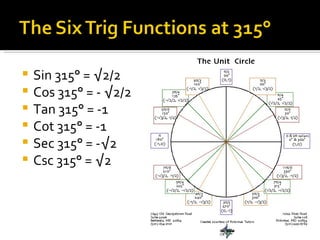
Sin 315° = √2/2  Cos 315° = - √2/2  Tan 315° = -1 Cot 315° = -1 Sec 315° = -√2 Csc 315° = √2
All the Trig Functions in the second Quadrant have the same values as Quad I except the x values are now negative. The same thing happens in Quad III both the x and y values are negative here. In Quad IV the x values are positive and the y values here are negative.

Trig overview

  • 1.
  • 2.
    Sine t =y/r Cosine t = x/r Tangent t = y/x Cotangent t = x/y Secant t = r/x Cosecant t = r/y
  • 3.
    The variable ris the Radius. This will always equal 1 on the unit circle.
  • 4.
    Here at 30°x = √3/2 Also at 30° y = ½ 45° both x & y = √2/2 At 60° x = ½ Also at 60° y = √3/2
  • 5.
    By using thePythagorean Theorem the sides of a 45°, 45°, 90° can be found. You will use these on to find all Six Trigonometric Functions. The Hypotenuse must equal 1 therefore the sides opposite 45° is √2/2.
  • 6.
    Use the PythagoreanTheorem to find the sides of a 30°, 60°, 90° Triangle. Remember the Hypotenuse must equal 1. Therefore, the side opposite 30° = ½. The side opposite 60° = √3/2.
  • 7.
    Here you cansee Sine t = y/r. Cosine t = x/r. Notice that r = 1.
  • 8.
    Sin 30° =1/2 Cos 30° = √3/2 Tan 30° = 3√3 Cot 30° = √3 Sec 30° = 2√3/3 Csc 30° = 2
  • 9.
    Sin 45° =√2/2 Cos 45° = √2/2 Tan 45° = 1 Cot 45° = 1 Sec 45° = √2 Csc 45° = √2
  • 10.
    Sin 60° =√3/2 Cos 60° = 1/2 Tan 60° = √3 Cot 60° = 3√3 Sec 60° = 2 Csc 60° = 2√3/3
  • 11.
    Notice that at90° the (x,y) is (0,1). Sin 90° = 1 Cos 90° = 0 Tan 90° = undefined Cot 90° = 0 Sec 90° = undefined Csc 90° = 1
  • 12.
    All y valuesstay the same as in Quadrant I. All x values are negative here. The Six Trig Functions are reflected across the y-axis here. (-cos t, sin t)
  • 13.
    All x valuesare negative here. All y values are negative here. The Six Trig Functions are reflected across the origin from Quadrant I. (-cos t, -sin t)
  • 14.
    All x valuesstay the same as in Quadrant I. All y values are negative here. The Six Trig Functions are reflected across the x-axis here. (cos t, -sin t)
  • 15.
    Sin 135° =√2/2 Cos 135° = - √2/2 Tan 135° = -1 Cot 135° = -1 Sec 135° = -√2 Csc 135° = √2
  • 16.
    Sin 150° =-√3/2 Cos 150° = 1/2 Tan 150° = -√3 Cot 150° = -3√3 Sec 150° = 2 Csc 150° = -2√3/3
  • 17.
    Sin 225° =-√2/2 Cos 225° = -√2/2 Tan 225° = 1 Cot 225° = 1 Sec 225° = -√2 Csc 225° = -√2
  • 18.
    Sin 300° =-√3/2 Cos 300° = 1/2 Tan 300° = -√3 Cot 300° = -3√3 Sec 300° = 2 Csc 300° = -2√3/3
  • 19.
    Sin 315° =√2/2 Cos 315° = - √2/2 Tan 315° = -1 Cot 315° = -1 Sec 315° = -√2 Csc 315° = √2
  • 20.
    All the TrigFunctions in the second Quadrant have the same values as Quad I except the x values are now negative. The same thing happens in Quad III both the x and y values are negative here. In Quad IV the x values are positive and the y values here are negative.